Objective:
To learn how to form and use the near future
tense in French.
1
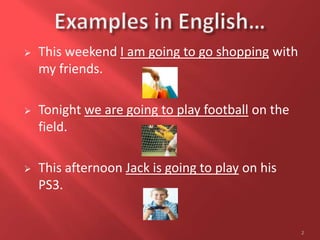
 This weekend I am going to go shopping with
my friends.
 Tonight we are going to play football on the
field.
 This afternoon Jack is going to play on his
PS3.
2
1. Take the present tense of ‘aller’ (to go).
Je vais – I am going
Tu vas – You (s.) are going
Il/elle va – He/she is going
Nous allons – We are going
Vous allez – You (pl.) are going
Ils/elles vont – They are going
3
2. Plus the infinitive, for example:
 danser – to dance
 chanter – to sing
 écouter - to listen
 jouer – to play
 vivre – to live
 manger – to eat
 faire – to do
4
Note that
they all end
in ER, IR or
RE! 
5
 If you look up a verb (doing word) in the dictionary it
will give you the infinitive.
 Basic form of the verb before it’s been conjugated.
 In French it will either end in ER, IR or RE.
 In English it is just a verb with ‘to’ in front of it, for
example:
to sing, to play, to run, to dance, to eat, to live
 Je vais danser – I am going to dance.
 Tu vas habiter – You (s.) are going to live.
 Il va manger – He is going to eat.
 Nous allons jouer – We are going to play.
 Vous allez faire – You (pl.) are going to do.
 Ils vont écouter – They are going to listen.
6
How do you say:
1. I am going to sing.
2. He is going to play.
3. Jennifer is going to listen. (*same as ‘she is going’)
4. We are going to eat.
5. You (s.) are going to dance.
6. They are going to live.
And some more difficult ones:
1. I am going to eat a hamburger.
2. You (pl.) are going to live in Spain.
3. She is going to listen to music.
7
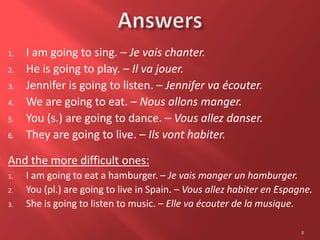
1. I am going to sing. – Je vais chanter.
2. He is going to play. – Il va jouer.
3. Jennifer is going to listen. – Jennifer va écouter.
4. We are going to eat. – Nous allons manger.
5. You (s.) are going to dance. – Vous allez danser.
6. They are going to live. – Ils vont habiter.
And the more difficult ones:
1. I am going to eat a hamburger. – Je vais manger un hamburger.
2. You (pl.) are going to live in Spain. – Vous allez habiter en Espagne.
3. She is going to listen to music. – Elle va écouter de la musique.
8

The Near Future Tense

  • 1.
    Objective: To learn howto form and use the near future tense in French. 1
  • 2.
     This weekendI am going to go shopping with my friends.  Tonight we are going to play football on the field.  This afternoon Jack is going to play on his PS3. 2
  • 3.
    1. Take thepresent tense of ‘aller’ (to go). Je vais – I am going Tu vas – You (s.) are going Il/elle va – He/she is going Nous allons – We are going Vous allez – You (pl.) are going Ils/elles vont – They are going 3
  • 4.
    2. Plus theinfinitive, for example:  danser – to dance  chanter – to sing  écouter - to listen  jouer – to play  vivre – to live  manger – to eat  faire – to do 4 Note that they all end in ER, IR or RE! 
  • 5.
    5  If youlook up a verb (doing word) in the dictionary it will give you the infinitive.  Basic form of the verb before it’s been conjugated.  In French it will either end in ER, IR or RE.  In English it is just a verb with ‘to’ in front of it, for example: to sing, to play, to run, to dance, to eat, to live
  • 6.
     Je vaisdanser – I am going to dance.  Tu vas habiter – You (s.) are going to live.  Il va manger – He is going to eat.  Nous allons jouer – We are going to play.  Vous allez faire – You (pl.) are going to do.  Ils vont écouter – They are going to listen. 6
  • 7.
    How do yousay: 1. I am going to sing. 2. He is going to play. 3. Jennifer is going to listen. (*same as ‘she is going’) 4. We are going to eat. 5. You (s.) are going to dance. 6. They are going to live. And some more difficult ones: 1. I am going to eat a hamburger. 2. You (pl.) are going to live in Spain. 3. She is going to listen to music. 7
  • 8.
    1. I amgoing to sing. – Je vais chanter. 2. He is going to play. – Il va jouer. 3. Jennifer is going to listen. – Jennifer va écouter. 4. We are going to eat. – Nous allons manger. 5. You (s.) are going to dance. – Vous allez danser. 6. They are going to live. – Ils vont habiter. And the more difficult ones: 1. I am going to eat a hamburger. – Je vais manger un hamburger. 2. You (pl.) are going to live in Spain. – Vous allez habiter en Espagne. 3. She is going to listen to music. – Elle va écouter de la musique. 8