Department of Languages
Tec hnical University of Košice


      Present Simple


  Mgr. Soňa Polakovičová
Present Simple


Present Simple
Important facts

-   The fundamental tense in English.
-   Commonly used.
-   Exists in every language.
-   Without it you can´t learn anything else in English.
Present Simple

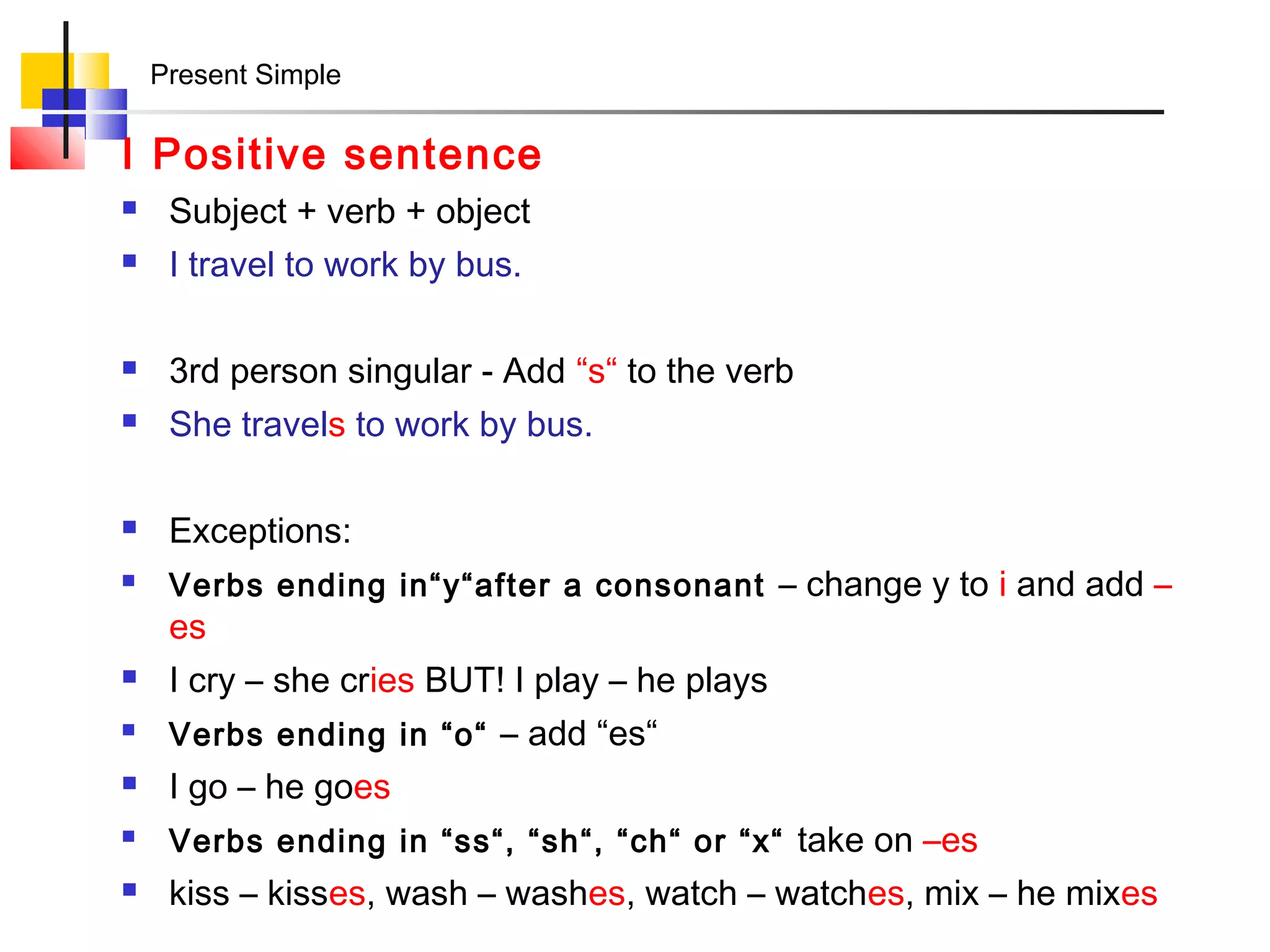
I Positive sentence
    Subject + verb + object
    I travel to work by bus.

    3rd person singular - Add “s“ to the verb
    She travels to work by bus.

    Exceptions:
    Verbs ending in“y“after a consonant – change y to i and add –
     es
    I cry – she cries BUT! I play – he plays
    Verbs ending in “o“ – add “es“
    I go – he goes
    Verbs ending in “ss“, “sh“, “ch“ or “x“ take on –es
    kiss – kisses, wash – washes, watch – watches, mix – he mixes
Present Simple


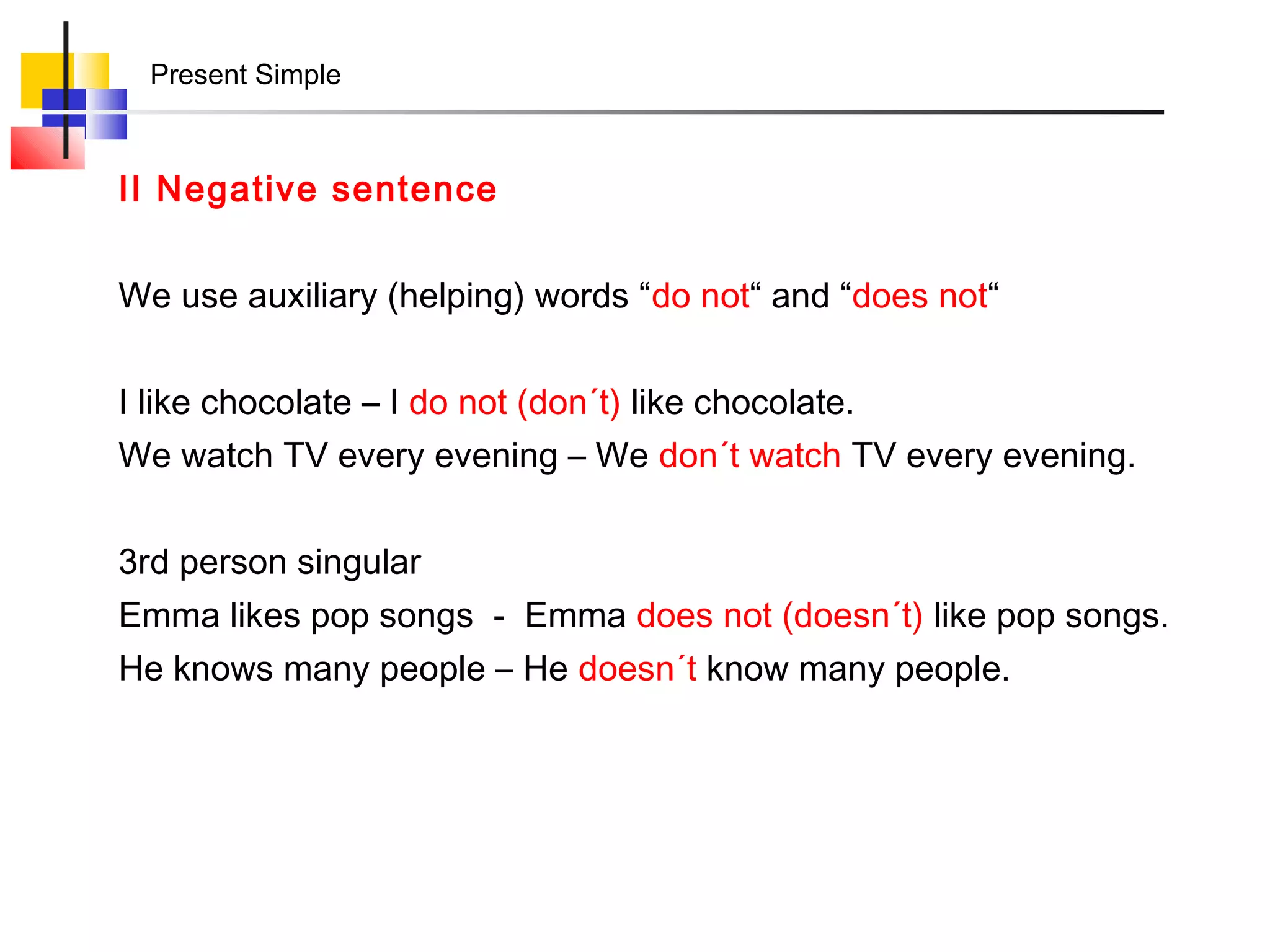
II Negative sentence


We use auxiliary (helping) words “do not“ and “does not“


I like chocolate – I do not (don´t) like chocolate.
We watch TV every evening – We don´t watch TV every evening.


3rd person singular
Emma likes pop songs - Emma does not (doesn´t) like pop songs.
He knows many people – He doesn´t know many people.
Simple Present


  III Question
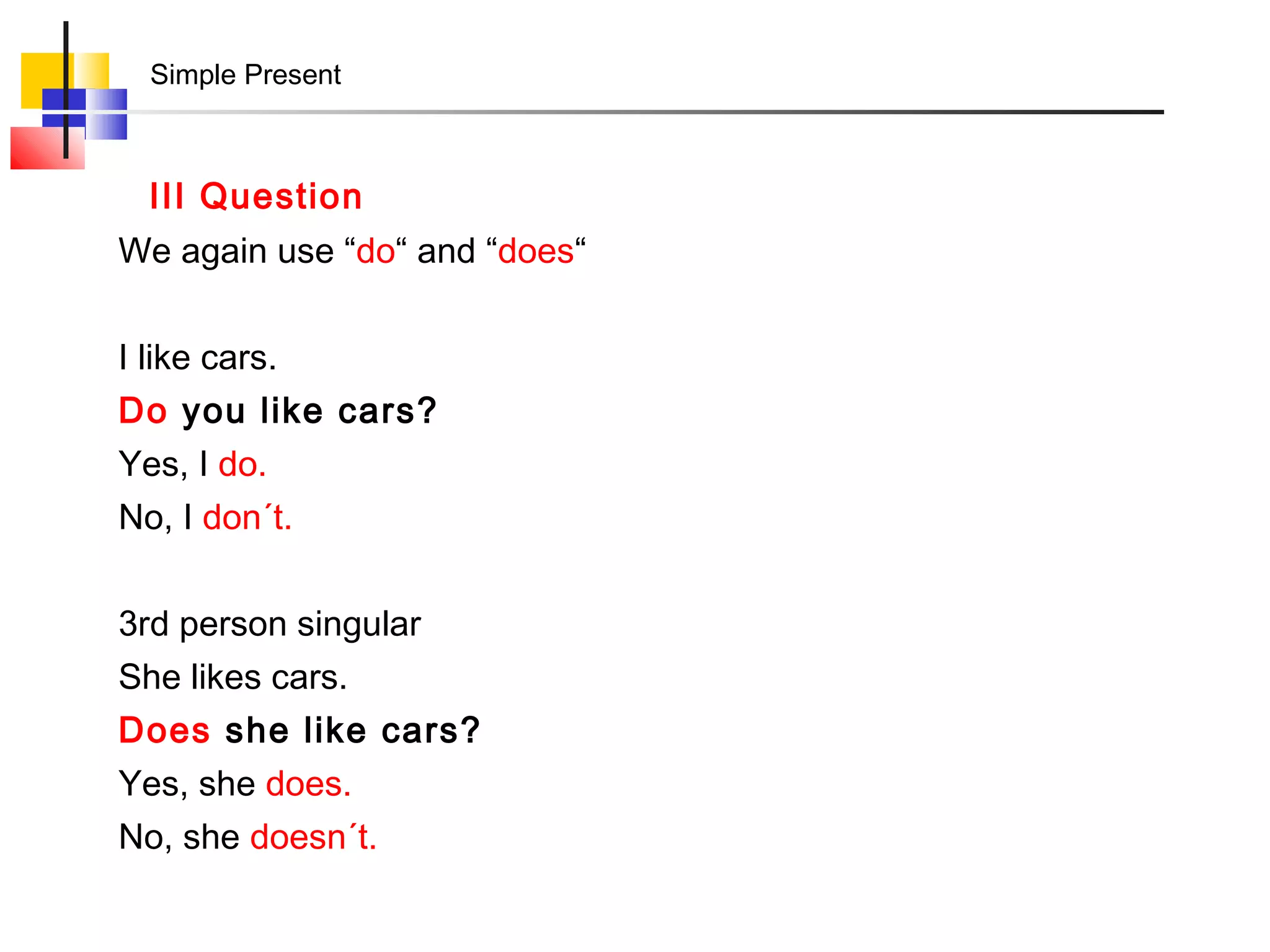
We again use “do“ and “does“


I like cars.
Do you like cars?
Yes, I do.
No, I don´t.


3rd person singular
She likes cars.
Does she like cars?
Yes, she does.
No, she doesn´t.
Simple Present


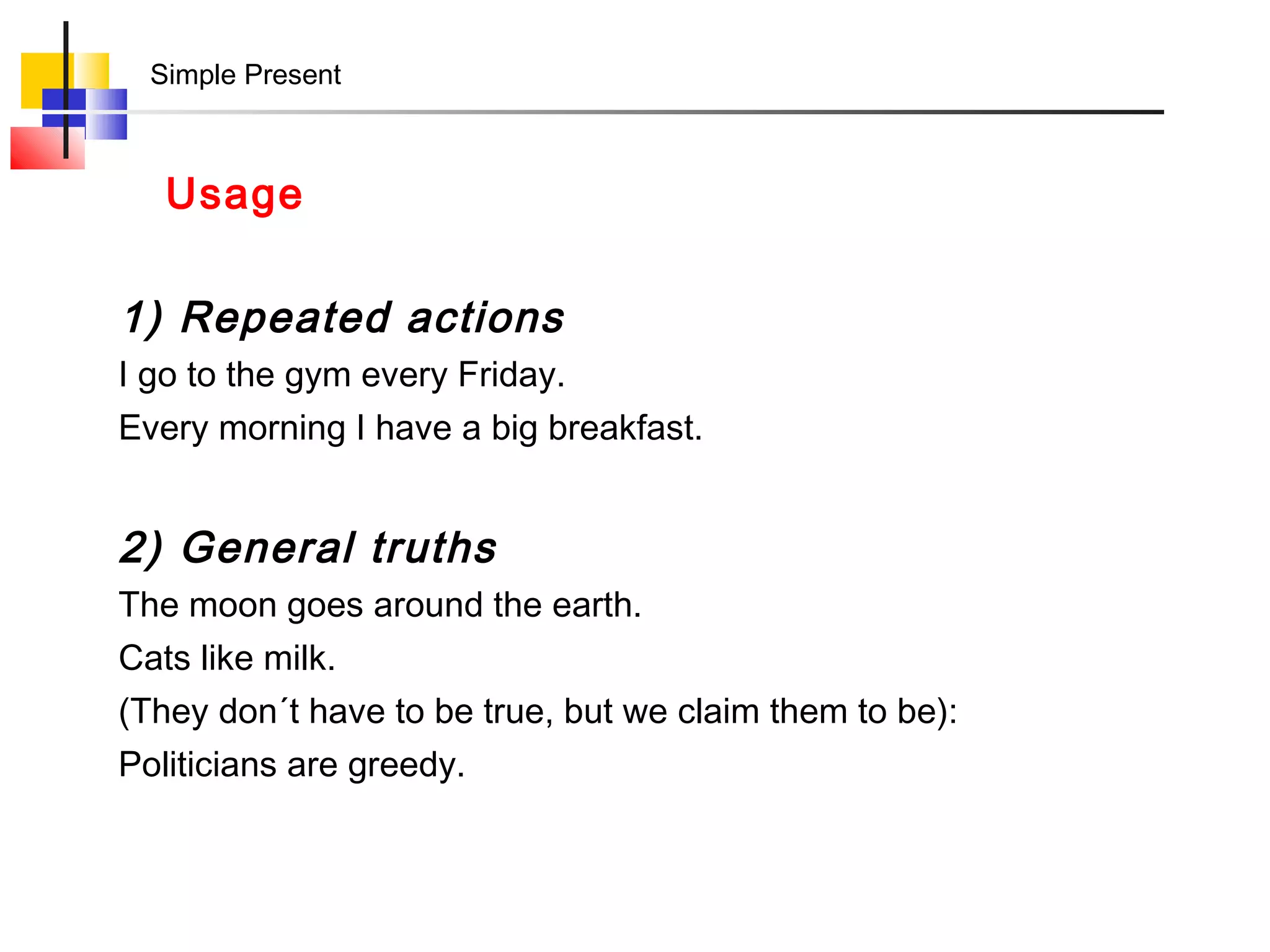
   Usage

1) Repeated actions
I go to the gym every Friday.
Every morning I have a big breakfast.


2) General truths
The moon goes around the earth.
Cats like milk.
(They don´t have to be true, but we claim them to be):
Politicians are greedy.
Present Simple


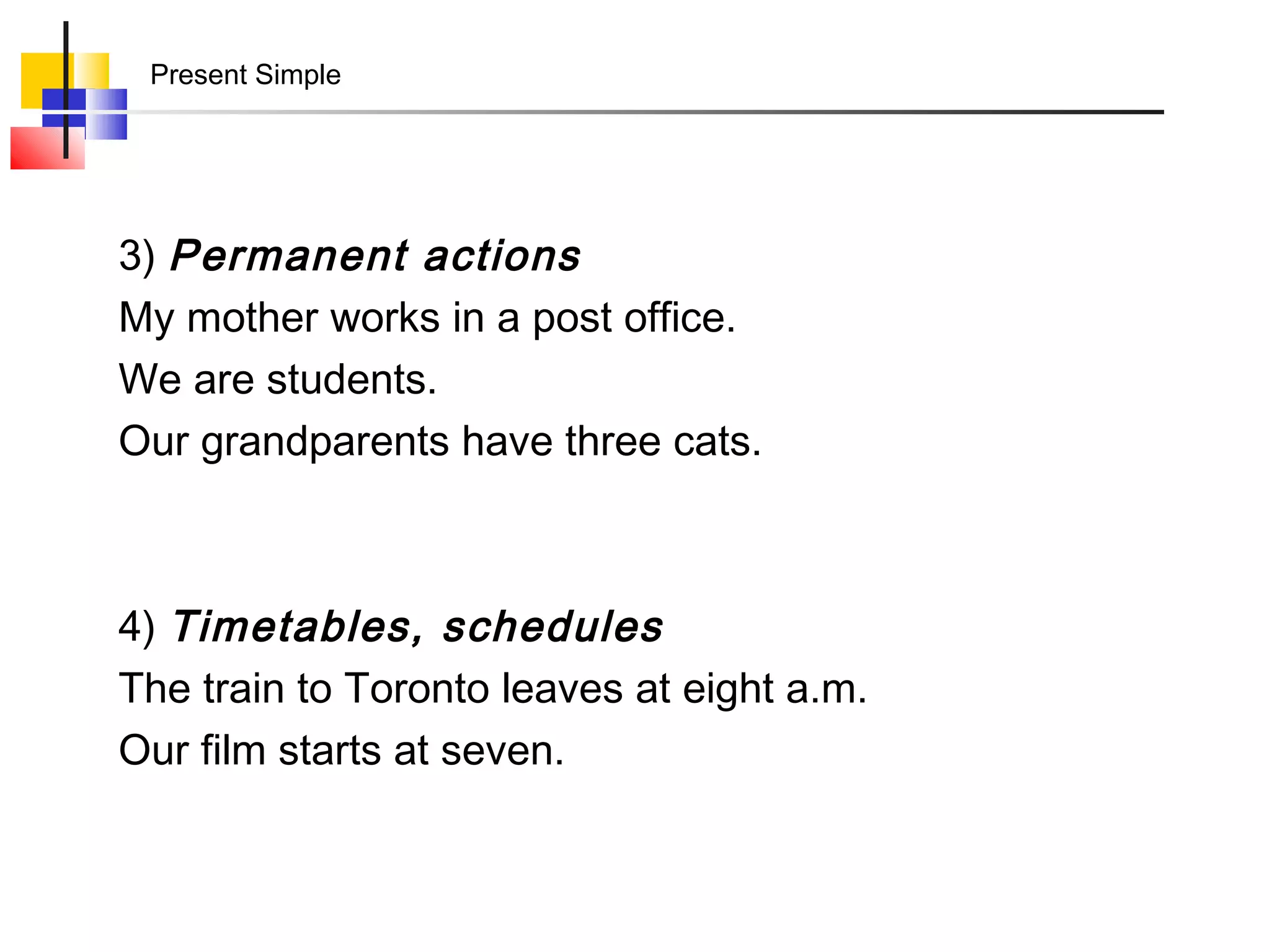
3) Permanent actions
My mother works in a post office.
We are students.
Our grandparents have three cats.


4) Timetables, schedules
The train to Toronto leaves at eight a.m.
Our film starts at seven.
Present Simple


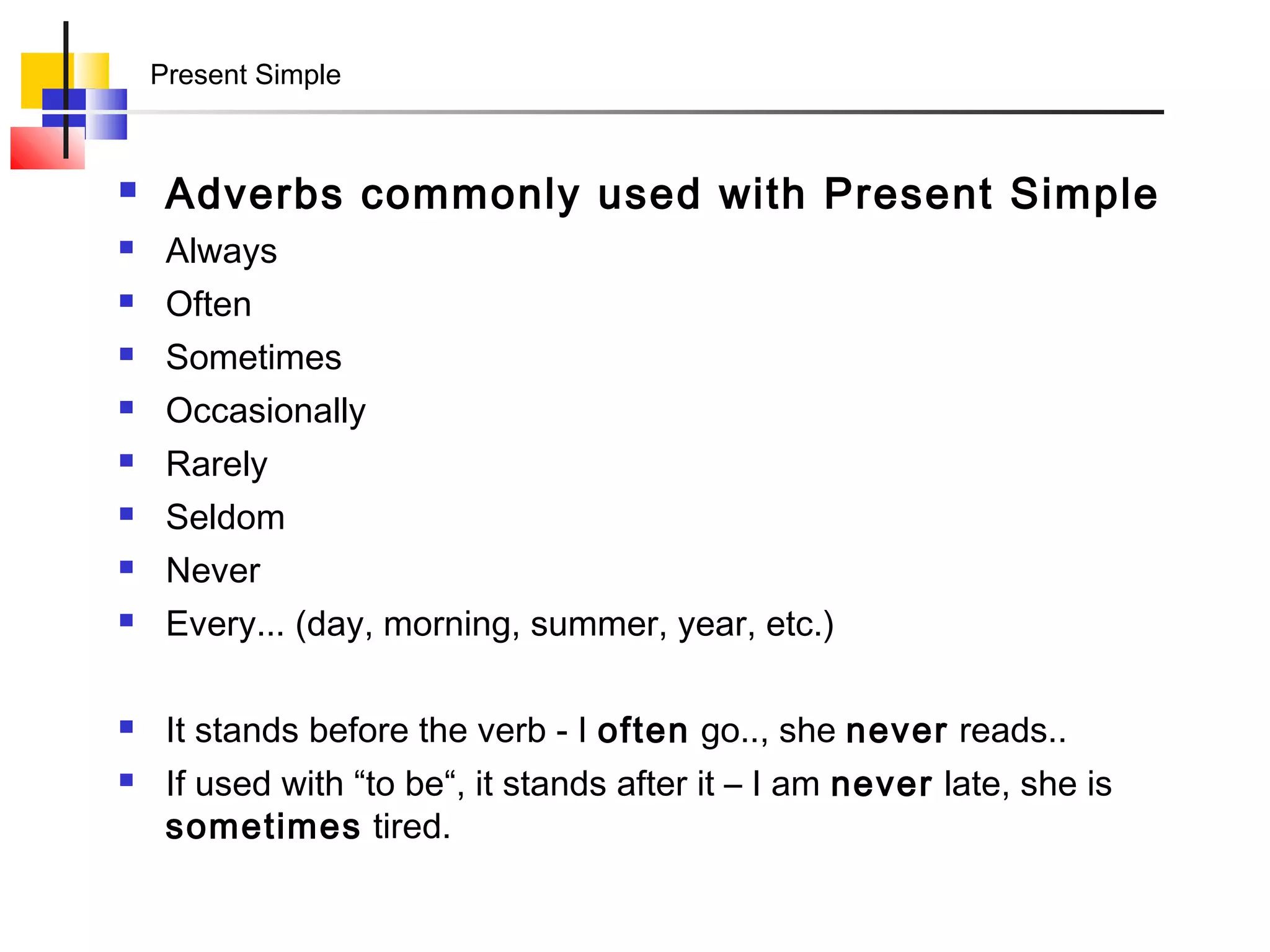
    Adverbs commonly used with Present Simple
    Always
    Often
    Sometimes
    Occasionally
    Rarely
    Seldom
    Never
    Every... (day, morning, summer, year, etc.)

    It stands before the verb - I often go.., she never reads..
    If used with “to be“, it stands after it – I am never late, she is
     sometimes tired.
Present Simple


Question words used with Present Simple
When..?
Why..?
Where..?
Who..?
What..?
Which..?
How..?

They stand at the beginning of the sentence.
Present Simple


    Revision
    Translate these sentences:

    Nepracujem v banke.
    Máš rád deti?
    Nehovorím po francúzsky.
    Pochádzame z Ázie.
    Moja sestra nikdy neraňajkuje.
    Čo robievaš cez víkendy?

    Talk about your daily routine.
    What do you do with your mobile phone?
Thank you for your attention

Present simple

  • 1.
    Department of Languages Technical University of Košice Present Simple Mgr. Soňa Polakovičová
  • 2.
    Present Simple Present Simple Importantfacts - The fundamental tense in English. - Commonly used. - Exists in every language. - Without it you can´t learn anything else in English.
  • 3.
    Present Simple I Positivesentence  Subject + verb + object  I travel to work by bus.  3rd person singular - Add “s“ to the verb  She travels to work by bus.  Exceptions:  Verbs ending in“y“after a consonant – change y to i and add – es  I cry – she cries BUT! I play – he plays  Verbs ending in “o“ – add “es“  I go – he goes  Verbs ending in “ss“, “sh“, “ch“ or “x“ take on –es  kiss – kisses, wash – washes, watch – watches, mix – he mixes
  • 4.
    Present Simple II Negativesentence We use auxiliary (helping) words “do not“ and “does not“ I like chocolate – I do not (don´t) like chocolate. We watch TV every evening – We don´t watch TV every evening. 3rd person singular Emma likes pop songs - Emma does not (doesn´t) like pop songs. He knows many people – He doesn´t know many people.
  • 5.
    Simple Present III Question We again use “do“ and “does“ I like cars. Do you like cars? Yes, I do. No, I don´t. 3rd person singular She likes cars. Does she like cars? Yes, she does. No, she doesn´t.
  • 6.
    Simple Present Usage 1) Repeated actions I go to the gym every Friday. Every morning I have a big breakfast. 2) General truths The moon goes around the earth. Cats like milk. (They don´t have to be true, but we claim them to be): Politicians are greedy.
  • 7.
    Present Simple 3) Permanentactions My mother works in a post office. We are students. Our grandparents have three cats. 4) Timetables, schedules The train to Toronto leaves at eight a.m. Our film starts at seven.
  • 8.
    Present Simple  Adverbs commonly used with Present Simple  Always  Often  Sometimes  Occasionally  Rarely  Seldom  Never  Every... (day, morning, summer, year, etc.)  It stands before the verb - I often go.., she never reads..  If used with “to be“, it stands after it – I am never late, she is sometimes tired.
  • 9.
    Present Simple Question wordsused with Present Simple When..? Why..? Where..? Who..? What..? Which..? How..? They stand at the beginning of the sentence.
  • 10.
    Present Simple  Revision  Translate these sentences:  Nepracujem v banke.  Máš rád deti?  Nehovorím po francúzsky.  Pochádzame z Ázie.  Moja sestra nikdy neraňajkuje.  Čo robievaš cez víkendy?  Talk about your daily routine.  What do you do with your mobile phone?
  • 11.
    Thank you foryour attention