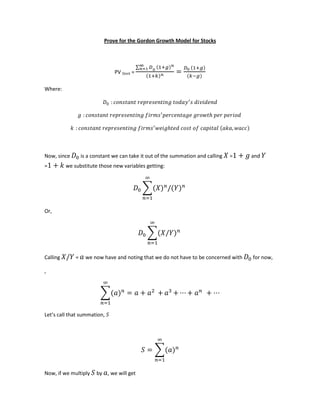
Prove for the Gordon Growth Model for Stocks
PV Stock =
Where:
Now, since is a constant we can take it out of the summation and calling = and
= we substitute those new variables getting:
Or,
Calling = we now have and noting that we do not have to be concerned with for now,
,
Let’s call that summation,
Now, if we multiply by , we will get
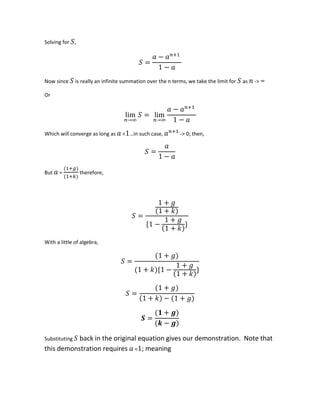
If we subtract
less
We can observed that only the first term of the first summation and the last
term of the second summation will not cancel each other; that is, we will
have:
Then, factoring S out in the term on the left
Solving for ,
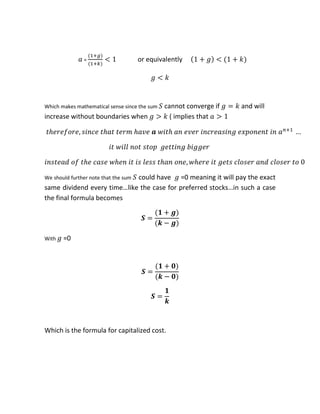
Now since is really an infinite summation over the n terms, we take the limit for as -> ∞
Or
Which will converge as long as < …in such case, -> 0; then,
But = therefore,
With a little of algebra,
Substituting back in the original equation gives our demonstration. Note that
this demonstration requires < ; meaning
= or equivalently
Which makes mathematical sense since the sum cannot converge if and will
increase without boundaries when ( implies that
We should further note that the sum could have =0 meaning it will pay the exact
same dividend every time…like the case for preferred stocks…in such a case
the final formula becomes
With =0
Which is the formula for capitalized cost.
Ismae
l
Digitally signed by
Ismael
DN: cn=Ismael, o, ou,
email=ismaeltorres20
02@yahoo.com, c=US
Date: 2013.06.08
12:25:00 -04'00'

Gordon growth model proof

  • 1.
    Prove for theGordon Growth Model for Stocks PV Stock = Where: Now, since is a constant we can take it out of the summation and calling = and = we substitute those new variables getting: Or, Calling = we now have and noting that we do not have to be concerned with for now, , Let’s call that summation, Now, if we multiply by , we will get
  • 2.
    If we subtract less Wecan observed that only the first term of the first summation and the last term of the second summation will not cancel each other; that is, we will have: Then, factoring S out in the term on the left
  • 3.
    Solving for , Nowsince is really an infinite summation over the n terms, we take the limit for as -> ∞ Or Which will converge as long as < …in such case, -> 0; then, But = therefore, With a little of algebra, Substituting back in the original equation gives our demonstration. Note that this demonstration requires < ; meaning
  • 4.
    = or equivalently Whichmakes mathematical sense since the sum cannot converge if and will increase without boundaries when ( implies that We should further note that the sum could have =0 meaning it will pay the exact same dividend every time…like the case for preferred stocks…in such a case the final formula becomes With =0 Which is the formula for capitalized cost. Ismae l Digitally signed by Ismael DN: cn=Ismael, o, ou, email=ismaeltorres20 02@yahoo.com, c=US Date: 2013.06.08 12:25:00 -04'00'