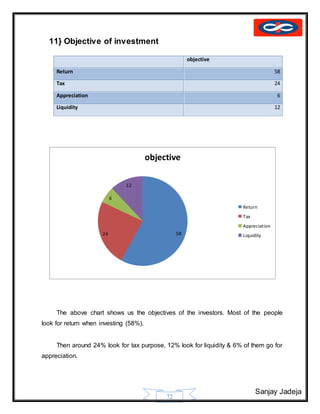
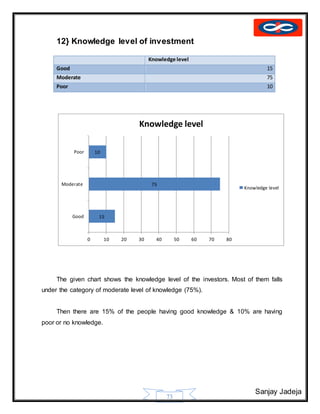
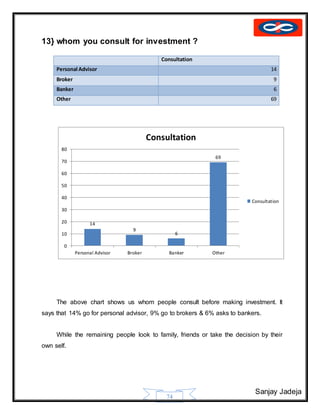
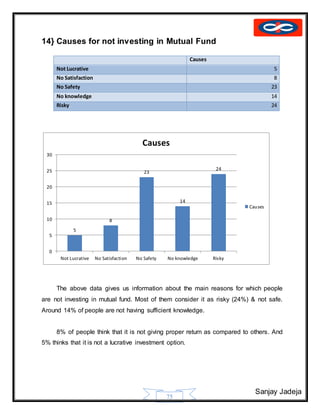
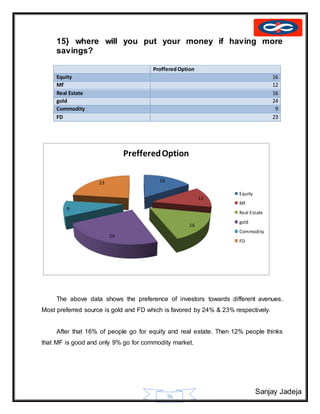
Sanjay Jadeja
1
HISTORY OF MUTUAL FUNDS IN INDIA
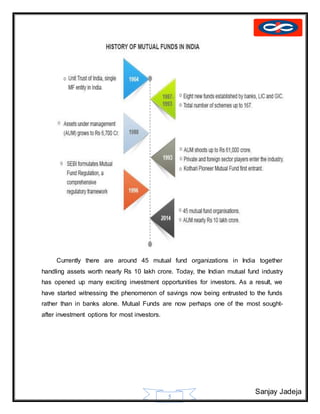
The mutual fund industry in India started in 1963 with the formation of Unit
Trust of India, at the initiative of the Govt. of India and Reserve Bank. The history of
mutual fund in India can be broadly divided into four distinct phases.
The Indian mutual fund industry has started opening up many exciting
investment opportunities to Indian investors. Despite the expected continuing growth in
the industry, mutual funds are still a new financial intermediary in India. Hence, it is
important that the investors, the mutual fund agents/distributors, the investment
advisors and even the fund employees acquire better knowledge of what mutual funds
are, what they can do for investors and what they cannot, and how they function
differently from other intermediaries such as the banks.
Phase 1. (1964-87 Unit Trust of India.)
In 1963, UTI was established by an Act of parliament and given a monopoly.
Operationally, UTI was set up by the RBI. But was later de linked from RBI the first,
and still one of the largest schemes launched by UTI was Unit Scheme 64. Over the
years, US 64 attracted and probably still have the largest number of investors in any
single investment scheme. It was also at least partially the first open –end scheme in
the country. Now moving towards becoming fully open-end.
Later in 1970s and 80s, UTI started innovating and offering different schemes to
suit the needs of different classes of different investors. Unit Linked Insurance Plan
(ULIP) was launched in 1971. Six new schemes were introduced between 1981 and
1984. During 1984-87, new schemes like children’s gift growth fund (1986) and Master
share (1987) were launched
.
Sanjay Jadeja
2
Phase 2 (1987-1993 Entry of public sector funds.)
1987 Marked the entry of non –UTI, public sector mutual funds, bringing in
competition. With the opening up of the economy, many public sector banks and
financial institutions were allowed to establish mutual funds. The SBI established the
first non-UTI Mutual funds in Nov, 1987. This was followed by Can Bank Mutual fund
in Dec, 1987. LIC Mutual fund (1989) and GIC MF and Indian Bank MF. The fund
industry expanded nearly 7 times in terms of Asset under Management.
Phase 3 (1993-1996 Emergence of Private funds)
A new era of Mutual Fund industry began with the permission granted for the
entry of private sector funds in 1993, giving the Indian investors a broader choice of
‘fund families’ and increasing competition for the existing public sector funds.
Initially, the mobilization of funds by the private mutual fund was slow. But, this
segment of fund industry now has been witnessing much greater investor confidence
in them. One influencing factor has been development of a SEBI driven regulatory
framework for mutual funds. Investors in India now clearly see the benefits of investing
through mutual funds and have started becoming selective.
Phase 4 (1996 SEBI regulation for mutual funds)
The entire mutual fund industry in India, despite initial hiccups, has since
scaled new heights in terms of mobilization of funds and number of players.
Deregulations and liberalization of the Indian economy has introduced competition and
impetus to the growth of the industry.
Sanjay Jadeja
3
More investor’s friendly regulatory measures have been taken both by SEBI to
protect the investors and by the government to enhance investors’ returns through tax
benefits. A comprehensive set of regulations for all mutual funds operating in India
was introduced with SEBI (mf) Regulations, 1996. These regulation set uniform
standards for all funds and will eventually be applied in full to UTI as well, even though
UTI is govern by its own UTI Act.
In fact, UTI has been voluntarily adopting SEBI guidelines for most of its
schemes. Similarly the 1999 Union Government Budget took a big step in exempting
all mutual fund dividends from income tax in the hands of investors. Both the 1996
regulation and the 1999 budget must be considered of historic importance, given their
far reaching impact on the fund industry and investors.
PHASE -5 2003 ONWARDS
This phase was marked by very rapid growth in the industry, and significant
increase in market shares of private sector players. In February 2003, following the
repeal of the unit Trust of India Act 1963 was bifurcated into two separate entities.
One is the specified undertakings of the Unit Trust of India with assets under
management of Rs.29,835 corers as at the end of January 2003, representation
broadly, the assets of unit scheme 1964, assured return and certain other schemes.
The specified undertakings of UTI, functioning under an administrator and under the
rules framed by the Government of India, and do not come under the purview of the
Mutual Fund Regulation.
Sanjay Jadeja
4
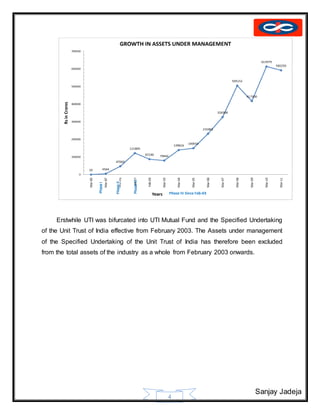
Erstwhile UTI was bifurcated into UTI Mutual Fund and the Specified Undertaking
of the Unit Trust of India effective from February 2003. The Assets under management
of the Specified Undertaking of the Unit Trust of India has therefore been excluded
from the total assets of the industry as a whole from February 2003 onwards.
Sanjay Jadeja
5
Currently there are around 45 mutual fund organizations in India together
handling assets worth nearly Rs 10 lakh crore. Today, the Indian mutual fund industry
has opened up many exciting investment opportunities for investors. As a result, we
have started witnessing the phenomenon of savings now being entrusted to the funds
rather than in banks alone. Mutual Funds are now perhaps one of the most sought-
after investment options for most investors.
Sanjay Jadeja
6
STRUCTURE OF MUTUAL FUND IN INDIA
For anybody to become well aware about mutual funds, it is imperative for him or her
to know the structure of a mutual fund. How does a mutual fund come into being? Who
are the important people in a mutual fund? What are their roles? etc. We will start our
understanding by looking at the mutual fund structure in brief.
Mutual Funds in India follow a 3-tier structure. There is a Sponsor (the First tier),
who thinks of starting a mutual fund. The Sponsor approaches the Securities &
Exchange Board of India (SEBI), which is the market regulator and also the regulator
for mutual funds.
Not everyone can start a mutual fund. SEBI checks whether the person is of integrity,
whether he has enough experience in the financial sector, his net worth etc. Once
SEBI is convinced, the sponsor creates a Public Trust (the Second tier) as per the
Indian Trusts Act, 1882. Trusts have no legal identity in India and cannot enter into
contracts, hence the Trustees are the people authorized to act on behalf of the Trust.
Contracts are entered into in the name of the Trustees. Once the Trust is created, it is
registered with SEBI after which this trust is known as the mutual fund.
It is important to understand the difference between the Sponsor and the Trust. They
are two separate entities. Sponsor is not the Trust; i.e. Sponsor is not the Mutual
Fund. It is the Trust which is the Mutual Fund.
The Trustees role is not to manage the money. Their job is only to see, whether the
money is being managed as per stated objectives. Trustees may be seen as the
internal regulators of a mutual fund.
Sanjay Jadeja
7
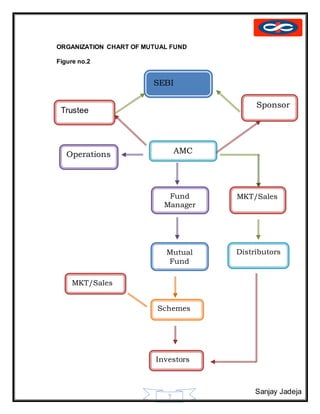
ORGANIZATION CHART OF MUTUAL FUND
Figure no.2
SEBI
Trustee
Sponsor
Operations AMC
Fund
Manager
MKT/Sales
Mutual
Fund
Distributors
MKT/Sales
Schemes
Investors
Sanjay Jadeja
8
 A vehicle for investing in stocks and bonds
A mutual fund is not an alternative investment option to stocks and bonds, rather it
pools the money of several investors and invests this in stocks, bonds, money market
instruments and other types of securities.
Buying a mutual fund is like buying a small slice of a big pizza. The owner of a
mutual fund unit gets a proportional share of the fund’s gains, losses, income and
expenses.
 Each mutual fund has a specific stated objective
The fund’s objective is laid out in the fund's prospectus, which is the legal
document that contains information about the fund, its history, its officers and its
performance.
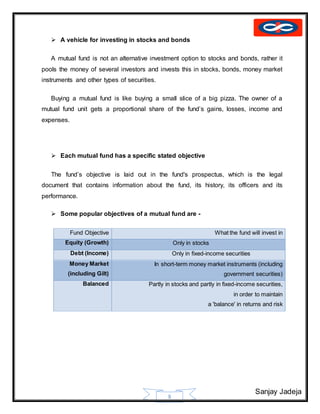
 Some popular objectives of a mutual fund are -
Fund Objective What the fund will invest in
Equity (Growth) Only in stocks
Debt (Income) Only in fixed-income securities
Money Market
(including Gilt)
In short-term money market instruments (including
government securities)
Balanced Partly in stocks and partly in fixed-income securities,
in order to maintain
a 'balance' in returns and risk
Sanjay Jadeja
9
 Managed by an Asset Management Company (AMC)
The company that puts together a mutual fund is called an AMC. An AMC may
have several mutual fund schemes with similar or varied investment objectives.
The AMC hires a professional money manager, who buys and sells securities in
line with the fund's stated objective.
 All AMCs Regulated by SEBI, Funds governed by Board of Directors
The Securities and Exchange Board of India (SEBI) mutual fund regulations require
that the fund’s objectives are clearly spelt out in the prospectus.
 Net Asset Value or NAV
NAV is the total asset value (net of expenses) per unit of the fund and is calculated
by the AMC at the end of every business day.
 How is NAV calculated?
The value of all the securities in the portfolio in calculated daily. From this, all
expenses are deducted and the resultant value divided by the number of units in the
fund is the fund’s NAV.
For e.g.
If the market value of securities of a mutual fund scheme is Rs. 200
lakhs and the mutual fund has issued 10 lakhs unit at Rs. 10 each to the investors,
then the NAV per unit of the fund is Rs.20
Net Asset Value Of Scheme
NAV =------------------------------------
No. Of Units Outstanding
Sanjay Jadeja
10
The major factor affecting the NAV of a fund are;
 Sale and purchase of securities
 Sale and repurchase of unit
 Valuation of assets
 Actual of income and exp
Expense Ratio
AMCs charge an annual fee, or expense ratio that covers administrative
expenses, salaries, advertising expenses, brokerage fee, etc. A 1.5% expense ratio
means the AMC charges Rs1.50 for every Rs100 in assets under management.
A fund's expense ratio is typically to the size of the funds under
management and not to the returns earned. Normally, the costs of running a fund grow
slower than the growth in the fund size - so, the more assets in the fund, the lower
should be its expense ratio.
Load
Some AMCs have sales charges, or loads, on their funds (entry load
and/or exit load) to compensate for distribution costs. Funds that can be purchased
without a sales charge are called no-load funds.
Sanjay Jadeja
11
Open- and Close-Ended Funds
1) Open-Ended Funds
At any time during the scheme period, investors can enter and exit the
fund scheme (by buying/ selling fund units) at its NAV (net of any load charge).
Increasingly, AMCs are issuing mostly open-ended funds.
2) Close-Ended Funds
Redemption can take place only after the period of the scheme is over.
However, close-ended funds are listed on the stock exchanges and investors can buy/
0sell units in the secondary market (there is no load).
STP-Systematic transfer plan
They allow the investors to transfer on a periodic basis a specifying amount
from one scheme to another within the same fund family meaning two schemes
belonging to the same mutual fund. A transfer will be treated as redemption of units
from the scheme from which the transfer is made. Such redemption or investment will
be at the applicable NAV. This service allows the investor to manage his investment
activity to achieve his objectives.
SWP- Systematic withdrawal plan
An opposed to the SIP, the SWP allows the investors the facility to withdraw
the pre determined interval. The investor’s units will be redeemed at the existing NAV
as on that day.
Sanjay Jadeja
12
SIP – Systematic Investment Planning
 It is a method of investing a fixed sum, at a regular interval, in a mutual fund.
 It is very similar to monthly saving schemes like a recurring monthly deposit /
post office deposit
Advantages of Systematic Investment Planning
 Encourages Regular Investments (just like recurring deposit schemes)
 A Convenient way to invest regularly
 Lower initial investment without cutting into regular expense
 Long term perspective
 Rupee Cost Averaging Benefit to counter volatility - it brings down the average
cost of your Investments
 No timing the market!!!
 Meet investment objective with investment needs
 Helps to match the risk / return profile
Types of risks associated with Mutual Fund Investment
Market risk: At times the prices or yields of all the securities in a particular market rise
or fall due to broad outside influences. This change in price is due to 'market risk'.
Inflation risk: Sometimes referred to as 'loss of purchasing power'. Whenever the rate
of inflation exceeds the earnings on your investment, you run the risk that you'll
actually be able to buy less, not more.
Credit risk: In short, how stable is the company or entity to which you lend your
money when you invest? How certain are you that it will be able to pay the interest you
are promised, or repay your principal when the investment matures?
Interest rate risk: Interest rate movements in the Indian debt markets can be volatile
leading to the possibility of large price movements up or down in debt and money
market securities and thereby to possibly large movements in the NAV.
Sanjay Jadeja
13
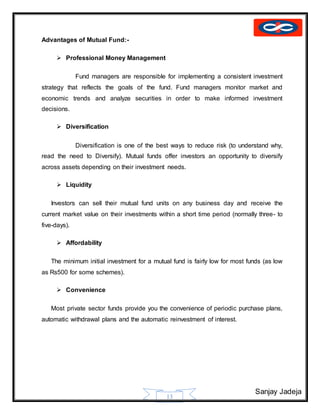
Advantages of Mutual Fund:-
 Professional Money Management
Fund managers are responsible for implementing a consistent investment
strategy that reflects the goals of the fund. Fund managers monitor market and
economic trends and analyze securities in order to make informed investment
decisions.
 Diversification
Diversification is one of the best ways to reduce risk (to understand why,
read the need to Diversify). Mutual funds offer investors an opportunity to diversify
across assets depending on their investment needs.
 Liquidity
Investors can sell their mutual fund units on any business day and receive the
current market value on their investments within a short time period (normally three- to
five-days).
 Affordability
The minimum initial investment for a mutual fund is fairly low for most funds (as low
as Rs500 for some schemes).
 Convenience
Most private sector funds provide you the convenience of periodic purchase plans,
automatic withdrawal plans and the automatic reinvestment of interest.
Sanjay Jadeja
14
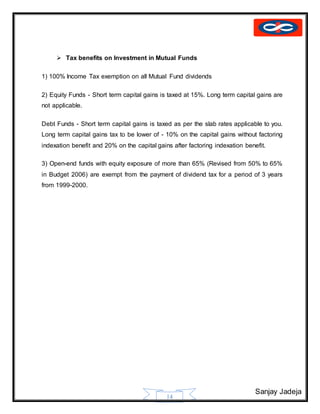
 Tax benefits on Investment in Mutual Funds
1) 100% Income Tax exemption on all Mutual Fund dividends
2) Equity Funds - Short term capital gains is taxed at 15%. Long term capital gains are
not applicable.
Debt Funds - Short term capital gains is taxed as per the slab rates applicable to you.
Long term capital gains tax to be lower of - 10% on the capital gains without factoring
indexation benefit and 20% on the capital gains after factoring indexation benefit.
3) Open-end funds with equity exposure of more than 65% (Revised from 50% to 65%
in Budget 2006) are exempt from the payment of dividend tax for a period of 3 years
from 1999-2000.
Sanjay Jadeja
15
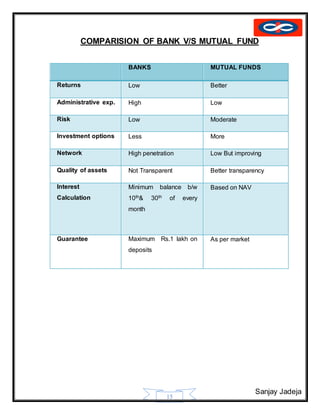
COMPARISION OF BANK V/S MUTUAL FUND
BANKS MUTUAL FUNDS
Returns Low Better
Administrative exp. High Low
Risk Low Moderate
Investment options Less More
Network High penetration Low But improving
Quality of assets Not Transparent Better transparency
Interest
Calculation
Minimum balance b/w
10th& 30th of every
month
Based on NAV
Guarantee Maximum Rs.1 lakh on
deposits
As per market
Sanjay Jadeja
16
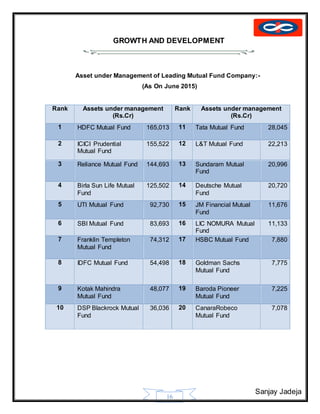
GROWTH AND DEVELOPMENT
Asset under Management of Leading Mutual Fund Company:-
(As On June 2015)
Rank Assets under management
(Rs.Cr)
Rank Assets under management
(Rs.Cr)
1 HDFC Mutual Fund 165,013 11 Tata Mutual Fund 28,045
2 ICICI Prudential
Mutual Fund
155,522 12 L&T Mutual Fund 22,213
3 Reliance Mutual Fund 144,693 13 Sundaram Mutual
Fund
20,996
4 Birla Sun Life Mutual
Fund
125,502 14 Deutsche Mutual
Fund
20,720
5 UTI Mutual Fund 92,730 15 JM Financial Mutual
Fund
11,676
6 SBI Mutual Fund 83,693 16 LIC NOMURA Mutual
Fund
11,133
7 Franklin Templeton
Mutual Fund
74,312 17 HSBC Mutual Fund 7,880
8 IDFC Mutual Fund 54,498 18 Goldman Sachs
Mutual Fund
7,775
9 Kotak Mahindra
Mutual Fund
48,077 19 Baroda Pioneer
Mutual Fund
7,225
10 DSP Blackrock Mutual
Fund
36,036 20 CanaraRobeco
Mutual Fund
7,078
Sanjay Jadeja
17
Growth in the AUM:-
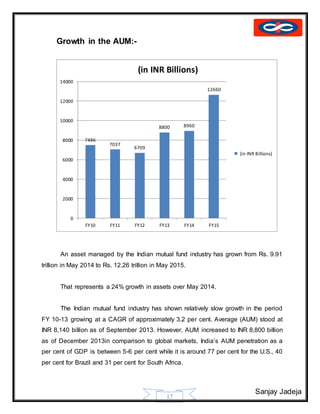
An asset managed by the Indian mutual fund industry has grown from Rs. 9.91
trillion in May 2014 to Rs. 12.26 trillion in May 2015.
That represents a 24% growth in assets over May 2014.
The Indian mutual fund industry has shown relatively slow growth in the period
FY 10-13 growing at a CAGR of approximately 3.2 per cent. Average (AUM) stood at
INR 8,140 billion as of September 2013. However, AUM increased to INR 8,800 billion
as of December 2013in comparison to global markets, India’s AUM penetration as a
per cent of GDP is between 5-6 per cent while it is around 77 per cent for the U.S., 40
per cent for Brazil and 31 per cent for South Africa.
7486
7037
6709
8800 8960
12660
0
2000
4000
6000
8000
10000
12000
14000
FY10 FY11 FY12 FY13 FY14 FY15
(in INR Billions)
(in INR Billions)
Sanjay Jadeja
18
Despite the relatively low penetration of mutual funds in India, the market is
highly concentrated. Though, there are 46 AMCs operating in the sector,
approximately 80 per cent of the AUM concentrated with 8 of the leading players in
the market .There have been recent instances of consolidation in the market and
market concentration is expected to remain in the near-term.
Sanjay Jadeja
19
Market share of Leading Mutual Funds:-
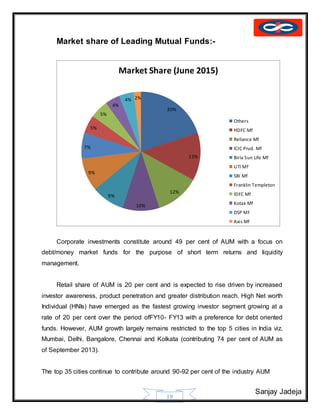
Corporate investments constitute around 49 per cent of AUM with a focus on
debt/money market funds for the purpose of short term returns and liquidity
management.
Retail share of AUM is 20 per cent and is expected to rise driven by increased
investor awareness, product penetration and greater distribution reach. High Net worth
Individual (HNIs) have emerged as the fastest growing investor segment growing at a
rate of 20 per cent over the period ofFY10- FY13 with a preference for debt oriented
funds. However, AUM growth largely remains restricted to the top 5 cities in India viz.
Mumbai, Delhi, Bangalore, Chennai and Kolkata (contributing 74 per cent of AUM as
of September 2013).
The top 35 cities continue to contribute around 90-92 per cent of the industry AUM
20%
13%
12%
10%
9%
9%
7%
5%
5%
4%
4% 2%
Market Share (June 2015)
Others
HDFC Mf
Reliance Mf
ICIC Prud. Mf
Birla Sun Life Mf
UTI Mf
SBI Mf
Franklin Templeton
IDFC Mf
Kotak Mf
DSP Mf
Axis Mf
Sanjay Jadeja
20
Performance and Other Key Statistical data
Category Average Returns % 1 year 2 year 3 year
Equity & Hybrid Equity
Large Cap Equity Fund 2.9 6 1.9
Diversified Equity Fund 2.1 6.1 1.7
Small & Mid Cap Equity 3.4 8.5 2.8
Equity Oreinted Hybrid Fund 3.6 5.3 2.8
International Commodities 8.6 5 1.4
Benchmark Indices
CNX Nifty 3.6 24.9 10.4
S&P Sensex 5.5 26.7 11.3
S&P Small cap -11.4 4 -26.7
S&P Midcap -8.4 15.4 -11.7
Debt & Hybrid Debt
Long term income funds 4.8 3.6 3.6
Short term income fund 7.8 5.2 4.9
Liquid funds 7.8 5.3 5
Ultra short funds 8.2 5.2 5.2
Guilt short term funds 4.4 3.2 2.9
guilt long term funds 3.4 3.4 3.5
Balanced 4.4 5.9 2.8
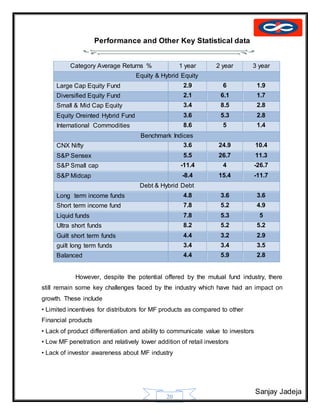
However, despite the potential offered by the mutual fund industry, there
still remain some key challenges faced by the industry which have had an impact on
growth. These include
• Limited incentives for distributors for MF products as compared to other
Financial products
• Lack of product differentiation and ability to communicate value to investors
• Low MF penetration and relatively lower addition of retail investors
• Lack of investor awareness about MF industry
Sanjay Jadeja
21
• Evolving nature of industry regulations the key to combating these challenges is to
ensure a wider distribution reachto widen the existing base of the industry.
Additionally, there needs to be an improvement in overall investor awareness through
strategic initiatives and investor education drives to drive growth. The next section
elaborates key trends that may have an impact on the future growth of the industry
Sanjay Jadeja
22
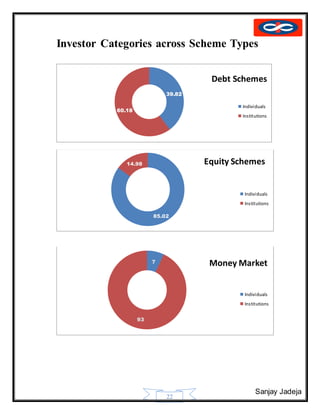
Investor Categories across Scheme Types
39.82
60.18
Debt Schemes
Individuals
Institutions
85.02
14.98 Equity Schemes
Individuals
Institutions
7
93
Money Market
Individuals
Institutions
Sanjay Jadeja
23
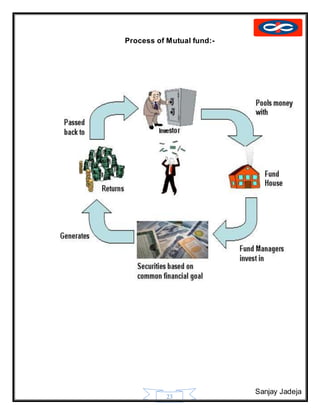
Process of Mutual fund:-
Sanjay Jadeja
24
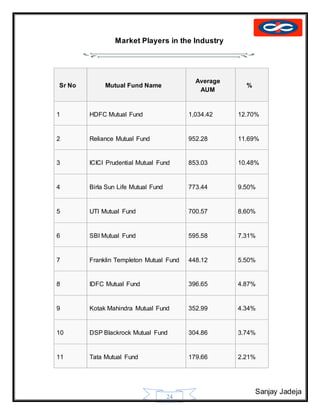
Market Players in the Industry
Sr No Mutual Fund Name
Average
AUM
%
1 HDFC Mutual Fund 1,034.42 12.70%
2 Reliance Mutual Fund 952.28 11.69%
3 ICICI Prudential Mutual Fund 853.03 10.48%
4 Birla Sun Life Mutual Fund 773.44 9.50%
5 UTI Mutual Fund 700.57 8.60%
6 SBI Mutual Fund 595.58 7.31%
7 Franklin Templeton Mutual Fund 448.12 5.50%
8 IDFC Mutual Fund 396.65 4.87%
9 Kotak Mahindra Mutual Fund 352.99 4.34%
10 DSP Blackrock Mutual Fund 304.86 3.74%
11 Tata Mutual Fund 179.66 2.21%
Sanjay Jadeja
25
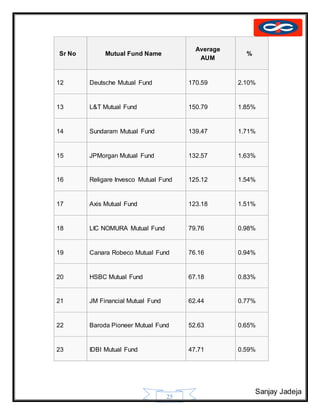
Sr No Mutual Fund Name
Average
AUM
%
12 Deutsche Mutual Fund 170.59 2.10%
13 L&T Mutual Fund 150.79 1.85%
14 Sundaram Mutual Fund 139.47 1.71%
15 JPMorgan Mutual Fund 132.57 1.63%
16 Religare Invesco Mutual Fund 125.12 1.54%
17 Axis Mutual Fund 123.18 1.51%
18 LIC NOMURA Mutual Fund 79.76 0.98%
19 Canara Robeco Mutual Fund 76.16 0.94%
20 HSBC Mutual Fund 67.18 0.83%
21 JM Financial Mutual Fund 62.44 0.77%
22 Baroda Pioneer Mutual Fund 52.63 0.65%
23 IDBI Mutual Fund 47.71 0.59%
Sanjay Jadeja
26
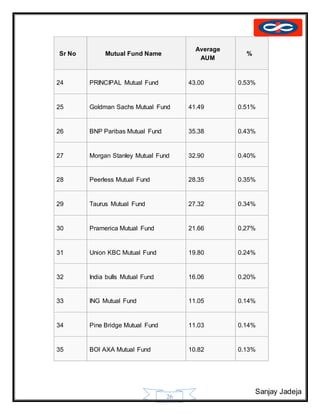
Sr No Mutual Fund Name
Average
AUM
%
24 PRINCIPAL Mutual Fund 43.00 0.53%
25 Goldman Sachs Mutual Fund 41.49 0.51%
26 BNP Paribas Mutual Fund 35.38 0.43%
27 Morgan Stanley Mutual Fund 32.90 0.40%
28 Peerless Mutual Fund 28.35 0.35%
29 Taurus Mutual Fund 27.32 0.34%
30 Pramerica Mutual Fund 21.66 0.27%
31 Union KBC Mutual Fund 19.80 0.24%
32 India bulls Mutual Fund 16.06 0.20%
33 ING Mutual Fund 11.05 0.14%
34 Pine Bridge Mutual Fund 11.03 0.14%
35 BOI AXA Mutual Fund 10.82 0.13%
Sanjay Jadeja
27
Sr No Mutual Fund Name
Average
AUM
%
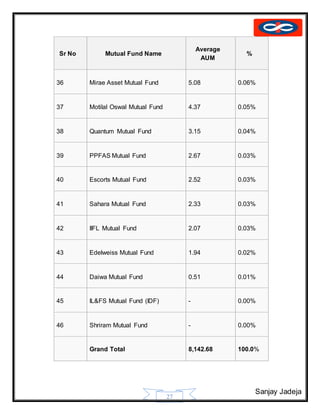
36 Mirae Asset Mutual Fund 5.08 0.06%
37 Motilal Oswal Mutual Fund 4.37 0.05%
38 Quantum Mutual Fund 3.15 0.04%
39 PPFAS Mutual Fund 2.67 0.03%
40 Escorts Mutual Fund 2.52 0.03%
41 Sahara Mutual Fund 2.33 0.03%
42 IIFL Mutual Fund 2.07 0.03%
43 Edelweiss Mutual Fund 1.94 0.02%
44 Daiwa Mutual Fund 0.51 0.01%
45 IL&FS Mutual Fund (IDF) - 0.00%
46 Shriram Mutual Fund - 0.00%
Grand Total 8,142.68 100.0%
Sanjay Jadeja
28
HISTORY
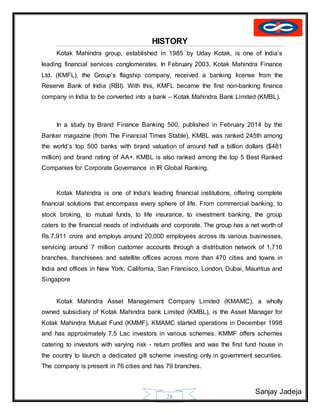
Kotak Mahindra group, established in 1985 by Uday Kotak, is one of India’s
leading financial services conglomerates. In February 2003, Kotak Mahindra Finance
Ltd. (KMFL), the Group’s flagship company, received a banking license from the
Reserve Bank of India (RBI). With this, KMFL became the first non-banking finance
company in India to be converted into a bank – Kotak Mahindra Bank Limited (KMBL).
In a study by Brand Finance Banking 500, published in February 2014 by the
Banker magazine (from The Financial Times Stable), KMBL was ranked 245th among
the world’s top 500 banks with brand valuation of around half a billion dollars ($481
million) and brand rating of AA+. KMBL is also ranked among the top 5 Best Ranked
Companies for Corporate Governance in IR Global Ranking.
Kotak Mahindra is one of India's leading financial institutions, offering complete
financial solutions that encompass every sphere of life. From commercial banking, to
stock broking, to mutual funds, to life insurance, to investment banking, the group
caters to the financial needs of individuals and corporate. The group has a net worth of
Rs.7,911 crore and employs around 20,000 employees across its various businesses,
servicing around 7 million customer accounts through a distribution network of 1,716
branches, franchisees and satellite offices across more than 470 cities and towns in
India and offices in New York, California, San Francisco, London, Dubai, Mauritius and
Singapore
Kotak Mahindra Asset Management Company Limited (KMAMC), a wholly
owned subsidiary of Kotak Mahindra bank Limited (KMBL), is the Asset Manager for
Kotak Mahindra Mutual Fund (KMMF). KMAMC started operations in December 1998
and has approximately 7.5 Lac investors in various schemes. KMMF offers schemes
catering to investors with varying risk - return profiles and was the first fund house in
the country to launch a dedicated gilt scheme investing only in government securities.
The company is present in 76 cities and has 79 branches.
Sanjay Jadeja
29
Our vision is to be a responsible player in the Indian mutual fund space, always
striving to offer best in class products across investor lifecycle. We strive hard to
deliver consistent performance over the benchmark across all our products, thereby
creating customer satisfaction. Our 12 years of existence offering a broad range of
investment products across asset classes with varying risk parameters that cater to
needs of various customer segments, have enabled us to garner trust of over 10 lac
investor
KOTAK GROUP: - ONE TEAM ONE ASSET
Kotak Mahindra Group is one of India’s leading banking and financial services
organizations, with offerings across personal financial services, commercial banking,
corporate and investment banking and markets, stock broking, asset management and
life insurance
HIGHLIGHTS:
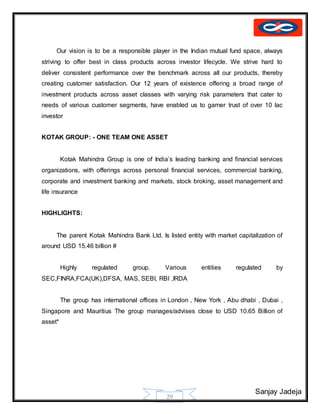
The parent Kotak Mahindra Bank Ltd. Is listed entity with market capitalization of
around USD 15.46 billion #
Highly regulated group. Various entities regulated by
SEC,FINRA,FCA(UK),DFSA, MAS, SEBI, RBI ,IRDA
The group has international offices in London , New York , Abu dhabi , Dubai ,
Singapore and Mauritius The group manages/advises close to USD 10.65 Billion of
asset*
Sanjay Jadeja
30
KOTAK GROUP OF SCALE BUSSINESS:-
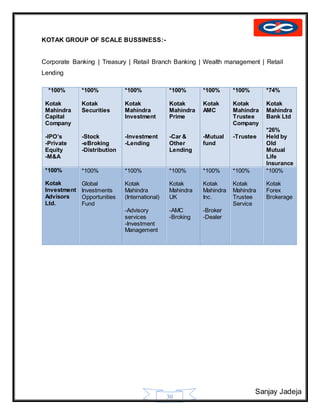
Corporate Banking | Treasury | Retail Branch Banking | Wealth management | Retail
Lending
*100%
Kotak
Mahindra
Capital
Company
-IPO’s
-Private
Equity
-M&A
*100%
Kotak
Securities
-Stock
-eBroking
-Distribution
*100%
Kotak
Mahindra
Investment
-Investment
-Lending
*100%
Kotak
Mahindra
Prime
-Car &
Other
Lending
*100%
Kotak
AMC
-Mutual
fund
*100%
Kotak
Mahindra
Trustee
Company
-Trustee
*74%
Kotak
Mahindra
Bank Ltd
*26%
Held by
Old
Mutual
Life
Insurance
*100%
Kotak
Investment
Advisors
Ltd.
*100%
Global
Investments
Opportunities
Fund
*100%
Kotak
Mahindra
(International)
-Advisory
services
-Investment
Management
*100%
Kotak
Mahindra
UK
-AMC
-Broking
*100%
Kotak
Mahindra
Inc.
-Broker
-Dealer
*100%
Kotak
Mahindra
Trustee
Service
*100%
Kotak
Forex
Brokerage
Sanjay Jadeja
31
Kotak Management
Directors:-TrusteeCompany
 Mr. Amit Krishnakant Desai
Mr. Amit Krishnakant Desai, is a Graduate in Commerce and Law from the Bombay
University. He is a senior advocate and has about 32 years of experience in criminal,
economic and revenue laws. He is associated with the Sponsor.
 Mr. Noshir Dastur
Mr. Noshir Dastur, is a B.Com, Fellow Chartered Accountant from the Institute of
Chartered Accounts of India. He is a Partner with Dubash & Patil, Chartered
Accountants from January 1992. He was also a Partner with Bhandari Dastur Gupta &
Associates, Chartered Accountants for period of ten years ending in March 2008.
 Mr. Chandrashekhar Sathe
Mr. Chandrashekhar Sathe, is a Graduate with B.Tech. (Chemical Engineering)

from IIT, Mumbai. He has over 36 years' experience in Banking and Finance. He has
been a part of the Senior Management team of the Kotak Mahindra Group since 1992
and was responsible for setting up the Fixed Income Securities capability of Kotak
Mahindra Capital Company. Prior to Kotak Mahindra, he was with the Bank of Nova
Scotia and Bank of Maharashtra and has wide ranging experience in Banking,
Finance, Administration, Credit, Foreign Exchange and Money Markets. Mr. Sathe was
Sanjay Jadeja
32
the Chief Executive Officer of the AMC for the period, 1st April, 1998 to 30th
November, 2001. He retired from Kotak Mahindra Bank as Head of Risk in the year
2009. He is also associated with the Sponsor.
 Mr. Balan Wasudeo
Mr. Balan Wasudeo, B.Sc. from the University of Madras and PGDBA from the
Indian Institute of Management, Ahmedabad, has over 37 years experience in the
areas of Treasury, Finance, Projects, Strategic Planning, Risk Management and
General Management. His significant achievements include financing large organic
and inorganic growth through various debt and capital market instruments in India and
abroad. Mr. Balan's career spans a unique combination of Multinational Companies,
Public Sector Company and Family Owned Companies. It also involves developing
sound relationships with International Multilateral agencies, International Commercial
banks and Financial Institutions and banks in India. Mr. Balan is presently a consulting
CFO. Mr. Balan Wasudeo was Chief Financial Officer of Great Eastern Shipping
Company Ltd. Mr. Balan Wasudeo has also received the Best Performing CFO Award
in Logistics Sector from CNBC TV18 in 2006
 Mr. Arun Palkar
Mr. Arun Palkar, B.Com.(Hons.), F.C.A. Mr. Arun Palkar has more than 30
years of extensive experience in corporate advisory, power & infrastructure sector
advisory, corporate restructuring, share valuations, audit & assurance, and taxation.
He has also provided consultancy services to large corporate in structuring
investments, carrying out financial feasibility and appraisals, privatization advice,
Compliance with Regulatory Provisions, Taxation and Law. He has advised a large
number of corporate on compliance with Clause 49 of the Stock Exchange Listing
Agreement for developing the Risk Management Frameworks and Internal Control
Frameworks for assisting CEO/CFO certification and advising on stressed assets. Mr.
Palkar is a Director on the Board of Transparent Energy Systems Private Limited. His
Sanjay Jadeja
33
current responsibilities include corporate strategy, fund raising and business
relationships management. He is also a Director on the Board of Transparent
Technologies Private Ltd and Decimin Control Systems Private Ltd. Before joining
Transparent Energy Systems Private Limited ,he was a Senior Partner with Deloitte
Haskins & Sells in India in their the Financial Advisory Services Group in Mumbai. And
headed Corporate Law and Advisory, Corporate Governance and Re-organization
practice Group.
Directors :- Asset Management Company
 Mr. Uday S. Kotak
Mr. Uday S. Kotak, is a graduate in Commerce and a post-graduate in Business
Administration from Jamnalal Bajaj Institute of Management Studies of Mumbai
University. Mr. Kotak is the Vice Chairman and Managing Director of the Sponsor,
Kotak Mahindra Bank Ltd., and the chairman of various other companies, and has
over 26 years of experience in the Financial Services industry. He is associated with
the sponsor.
 Mr. Sukant S. Kelkar
Mr. Sukant S. Kelkar, is a post-graduate in commerce. He has about 45 years of
experience in finance, capital markets, and related areas. Mr. Kelkar has over 12
years experience in the Bank of India, and has even been a foreign exchange dealer
in London for 3 years during this tenure. Following this, Mr. Kelkar worked with
Bombay Dyeing Manufacturing Company Limited for 31 years, finally retiring as
Executive Director in July 2001. He is on the Board of major Wadia Group Companies
as a Non- Executive Director.
Sanjay Jadeja
34
 Mr. Chengalath Jayaram
Mr. Chengalath Jayaram, holds a postgraduate diploma in Management from
IIMC, Calcutta, Mr. C. Jayaram, Joint Managing Director, Kotak Mahindra Bank Ltd.,
has been with the Kotak group since 1990. He has been a member of the Kotak
Mahindra Board since October 1999, and a whole-time director on the board of Kotak
Mahindra Bank since 2003. Mr. Jayaram heads the wealth management business and
international operations for Kotak Mahindra group. He also oversees the alternative
investments business which includes private equity funds and real estate funds. With
over 25 years experience in many areas of finance and business, Mr. Jayaram has
been instrumental in building numerous businesses for the Kotak Mahindra Group and
has headed Kotak Securities Ltd as CEO in the past. He also played a crucial role in
the setting up the car finance business. Prior to joining Kotak, Jayaram had worked
with ICICI, and the consultancy division of A.F. Ferguson. He is associated with the
sponsor.
 Mr. Bipin R. Shah
Mr. Bipin R. Shah, a member of the Institute of Chartered Accountants of India,
holds a Bachelor's Degree in Commerce from Bombay University. He has 52 years of
work experience. Mr. Shah began his career in 1956, with Hindustan Lever Limited,
where he held various Senior Commercial Assignments, including the post of
Commercial Manager at its largest soaps, detergents and foods factory in Bombay,
Chief Buyer, Raw Materials and Head of Foods Business. He became a Director of the
company in 1979, assuming responsibility for Foods, Animal Feeds, Agri Products and
Exports Business, and managed a commendable turnaround of the company's dairy
business. In 1981, Mr. Shah also became Chairman of another Unilever subsidiary,
Lipton India Limited, which was facing losses and financial crisis. Mr. Shah was
responsible for turning the company around, and for reviving employee and investor
confidence. Mr. Shah was also Chairman of Export Business of four Unilever
Companies in India viz. Hindustan Lever Ltd., Lipton India Ltd., Brooke Bond India Ltd.
Sanjay Jadeja
35
and Ponds India Ltd. On his retirement from the Lever Group of Companies in 1992,
Mr. Shah joined Indus Venture Management Ltd., where he he was the Vice Chairman
until May 2006. Mr. Shah is also a non Executive Director on the Board of several
companies.
 Mr. Gaurang Shah
Mr. Gaurang Shah, Member of The Institute of Chartered Accountants of India,
Member of The Institute of Cost and Work Accountants of India, Member of The
Institute of Company Secretaries of India. M. Com. from Gujarat University. Mr.
Gaurang Shah is the Group Head - Asset Management and Life Insurance at Kotak
Mahindra Group and is responsible for Domestic and International Asset Management
and Life Insurance businesses of the Group. In his immediate prior assignment, he
was the Managing Director of Kotak Mahindra Old Mutual Life Insurance Limited, (a
74:26 joint venture between Kotak Mahindra Bank Ltd., its affiliates and Old Mutual
plc) among India's leading Life Insurers. Mr. Shah has over 29 years of rich and varied
experience primarily in the Financial Services sector, several of which are in the Kotak
Mahindra Group. He is associated with the Sponsor
 Mr. Pranab Kumar Datta
Mr. Pranab Kumar Datta, is B.Com, ACA, FRICS, He is Vice Chairman &
Managing Director, Knight Frank (India) Pvt. Ltd. He has multi-functional experience of
over 40 years covering Finance, Sales & Marketing, Corporate Planning, Profit Centre
Management and General Management in diverse industries such as engineering,
electronics, consumer durables, consumer products, edible oil and food products, real
estate development and consulting. He has occupied senior management positions in
large conglomerates such as TATAs and Mahindras. He has been involved in several
organizational turnaround and transformation processes.
Sanjay Jadeja
36
 Mr. Nalin Shah
Mr. Nalin Shah, 68 years, B.Sc( Bus Admin)(USA), FCA(England & Wales) and
FCA (India). He Joined S. B. Billimoria & Co. in June 1974 and became a partner of
the firm in February 1977. S. B. Billimoria & Co. became an affiliate of Deloitte Haskins
& Sells in 2000 and also became a partner of Deloitte Haskins & Sells. He has been
an Audit Partner throughout his career. He has retired from Deloitte Haskins & Sells
1st April, 2012. He was member of the Governing Board of Deloitte India for several
years and was also the National Professional Practice Director of Deloitte India for 2
years and Chairman of the firm's Audit Technical Committee for over five years. He
was a member of the Accounting Standards Board of the Institute of Chartered
Accountants of India for 1 year and a member of the Institute's Expert Advisory
Committee (for 5 terms). Technical Reviewer for the Financial Reporting Board
(FRRB) of the Institute and a member of the Institute's Shield Panel for the best
published Accounts 2012 and 2014. Technical Reviewer for the FRRB and for the
Qualified Audit Report Committee of SEBI/ICAI. He was also a member of the
Corporate Laws Committee of the Bombay Chamber of Commerce & Industry for one
year. He is Director on the Board of Eimco-Elecon (India) Ltd., Artson Engineering Ltd.
(a subsidiary of Tata Projects Ltd.) DCB Bank Ltd., ABC Bearings Ltd.,
Cholamandalam Investment and Finance Co. Ltd., Omnigrid Micro power Co. Pvt.
Ltd., Tata Capital Ltd., Cholamandalam Distribution Services Ltd. and Cholamandalam
Securities Ltd.
Sanjay Jadeja
37
Key Employees: - Kotak Asset Management Company
 Mr. Niles Shah
Managing Director
Mr. Niles Shah is the Managing Director (MD) of Kotak Mahindra Asset
Management Co Ltd. He has over 25 years of experience in capital markets and
market related investments, having managed funds across equity, fixed income
securities and real estate for local and global investors. In his previous assignments,
Niles has held leadership roles with Axis Capital, ICICI Prudential Asset Management ,
Franklin Templeton and ICICI securities. Niles is the recipient of the inaugural
Business Standard Fund Manager of the year award - Debt in 2004. He was part of
the team that received the best fund house of the year award at Franklin Templeton as
well as at ICICI Prudential. Niles is a gold medalist chartered accountant and a merit
ranking cost accountant. His hobbies include reading and educating investors on
financial planning. He has co-authored book on Financial Planning called "A Direct
Take"
 Mr. Alroy Lobo
Chief Strategist and Global Head Equities Asset Management
Mr. Alroy Lobo, is in charge of equity strategy for the entire Kotak group.
Alroy has a total work experience of 20 years in the Indian equity market of which he
has spent about 14 years in the Institutional Equities business at Kotak Securities
advising Global Institutional Investors. Among his academic qualifications, Mr. Lobo is
an accomplished Chartered Financial Analyst from AIMR and ICFAI. He completed his
Masters in Management Studies (Finance) from Sydenham Institute of Management,
Mumbai and his Bachelor in Mechanical Engineering from Regional Engineering
Sanjay Jadeja
38
College, Srinagar. Mr. Lobo has achieved the following accolades at the above
mentioned institutes:- 1985: - Gold medalist Bachelor of Mechanical Engineering 1988:
- Ranked First in Masters in Management Studies 1995: - Gold medalist Chartered
Financial Analyst, ICFAI
 Mr. R. Krishnan
Chief Operations Officer
Mr. R. Krishnan, is a Chartered Accountant and Cost Accountant with over
19 years of experience in the fields of Operations, Systems, Finance, MIS, Accounting,
Audit and Taxation. Prior to joining the Kotak Group in August 1994, Mr. Krishnan was
a practicing Chartered Accountant for two years, handling Accounting, Audit and
Taxation matters for clients. Since joining the Kotak Group, Mr. Krishnan has handled
major assignments like the US GAAP implementation for the erstwhile Kotak Mahindra
Finance Limited (KMFL) and subsidiary/group companies, Systems Development and
Implementation, for the Retail Assets Group and KMFL's transition to Kotak Bank. Mr.
Krishnan's latest assignment was as Head – Operations/Finance, Retail Assets, at
Kotak Bank. Mr. Krishnan joined Kotak Mutual in August 2004 as Senior Vice
President, and Chief Operations Officer, and oversees the Operations, Accounting,
Admin and IT functions of the Fund.
 Mr. Sandeep Kamath
Compliance Officer
Mr. Sandeep Kamath, is a B. Com, B.G.L. He has joined Kotak Mahindra
AMC in July 2004. He has nearly 11 years experience in Compliance, Secretarial and
Legal areas. He has previously worked with Principal Pnb Asset Management
Company Pvt. Ltd
Sanjay Jadeja
39
Growth and Development of Kotak Group:-
Year Milestone
1985 Kotak Mahindra Finance Limited commences bill discounting business
1987 Kotak Mahindra Finance Limited enters leasing and hire purchase business
1990 Starts the auto finance division for financing passenger cars
1991 Launches investment banking business
1992 Enters the funds syndication business
1995 Commenced joint venture with Goldman Sachs Group Inc.
Investment Banking division incorporated into a separate company - Kotak
Mahindra Capital Company
1996 The auto finance business is hived off into a separate company - Kotak
Mahindra Prime Limited (formerly known as Kotak Mahindra Primus Limited).
Kotak Mahindra takes a significant stake in Ford Credit Kotak Mahindra
Limited, for financing Ford vehicles.
1998 Launches mutual fund through Kotak Mahindra Asset Management Company
(KMAMC).
2000 Kotak Securities launches online broking business
2001 Launches insurance business, partners Old Mutual from South Africa to form
Kotak Mahindra Old Mutual Life Insurance Ltd.
2003 Kotak Mahindra Finance Ltd. (KMFL), the group's flagship company, receives
banking license from the Reserve Bank of India (RBI). With this, KMFL
becomes the first non-banking finance company to be converted into a
commercial bank - Kotak Mahindra Bank Ltd.
2004 Enters alternate assets business with the launch of a private equity fund.
2005 Kotak Mahindra Group realigns joint venture in Ford Credit; takes 100%
ownership of Kotak Mahindra Prime (formerly known as Kotak Mahindra
Primus Limited) and sells its stake in Ford credit Mahindra to Ford.
2005 Launches a real estate fund
2006 Buys out Goldman Sachs' equity stake in Kotak Mahindra Capital Company
and Kotak Securities Ltd.
2008 Launched a Pension Fund under India's National Pension System (NPS)
2009 Kotak Mahindra Bank Ltd. opens a representative office in Dubai
Kotak Mahindra Bank Ltd. becomes anchor investor in Ahmedabad
Commodities Exchange (ACE)
2015 ING Vysya Bank has merged with Kotak Mahindra Bank with effect from April
1, 2015.[7]
Sanjay Jadeja
40
Mergerwith ING Vysya Bank
In 2014, Kotak Bank acquired ING Vysaya Bank for a deal valued at ₹15000 crore
(US$2.4 billion). With the merger, the total human resource count will jump to almost 40,000
heads and the branch was expected to rise over 1200.[8] Post the merger, ING Group which
controlled ING Vysya Bank will own 7% share in Kotak Mahindra Bank.[9]
Symbol :-
The symbol of the infinite Ka reflects our global Indian personality. The Ka is
uniquely Indian while its curve forms the infinity sign, which is universal. One of the basic
tenets of economists is that man's needs are unlimited. The infinite Kasymbolises that we have
infinite number of ways to meet those needs
Sanjay Jadeja
41
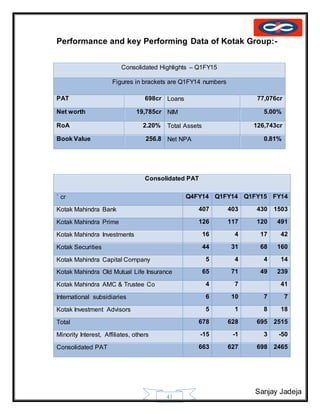
Performance and key Performing Data of Kotak Group:-
Consolidated Highlights – Q1FY15
Figures in brackets are Q1FY14 numbers
PAT 698cr Loans 77,076cr
Net worth 19,785cr NIM 5.00%
RoA 2.20% Total Assets 126,743cr
Book Value 256.8 Net NPA 0.81%
Consolidated PAT
` cr Q4FY14 Q1FY14 Q1FY15 FY14
Kotak Mahindra Bank 407 403 430 1503
Kotak Mahindra Prime 126 117 120 491
Kotak Mahindra Investments 16 4 17 42
Kotak Securities 44 31 68 160
Kotak Mahindra Capital Company 5 4 4 14
Kotak Mahindra Old Mutual Life Insurance 65 71 49 239
Kotak Mahindra AMC & Trustee Co 4 7 41
International subsidiaries 6 10 7 7
Kotak Investment Advisors 5 1 8 18
Total 678 628 695 2515
Minority Interest, Affiliates, others -15 -1 3 -50
Consolidated PAT 663 627 698 2465
Sanjay Jadeja
42
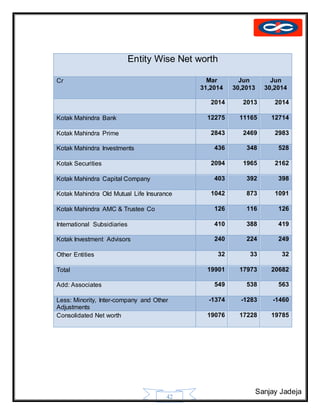
Entity Wise Net worth
Cr Mar
31,2014
Jun
30,2013
Jun
30,2014
2014 2013 2014
Kotak Mahindra Bank 12275 11165 12714
Kotak Mahindra Prime 2843 2469 2983
Kotak Mahindra Investments 436 348 528
Kotak Securities 2094 1965 2162
Kotak Mahindra Capital Company 403 392 398
Kotak Mahindra Old Mutual Life Insurance 1042 873 1091
Kotak Mahindra AMC & Trustee Co 126 116 126
International Subsidiaries 410 388 419
Kotak Investment Advisors 240 224 249
Other Entities 32 33 32
Total 19901 17973 20682
Add: Associates 549 538 563
Less: Minority, Inter-company and Other
Adjustments
-1374 -1283 -1460
Consolidated Net worth 19076 17228 19785
Sanjay Jadeja
43
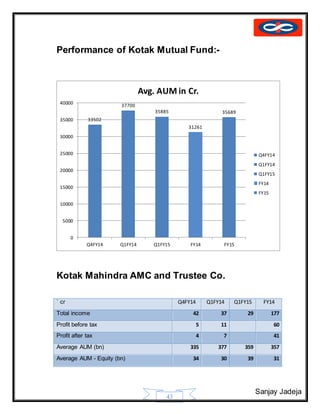
Performance of Kotak Mutual Fund:-
Kotak Mahindra AMC and Trustee Co.
` cr Q4FY14 Q1FY14 Q1FY15 FY14
Total income 42 37 29 177
Profit before tax 5 11 60
Profit after tax 4 7 41
Average AUM (bn) 335 377 359 357
Average AUM - Equity (bn) 34 30 39 31
33502
37700
35885
31261
35689
0
5000
10000
15000
20000
25000
30000
35000
40000
Q4FY14 Q1FY14 Q1FY15 FY14 FY15
Avg. AUM in Cr.
Q4FY14
Q1FY14
Q1FY15
FY14
FY15
Sanjay Jadeja
44
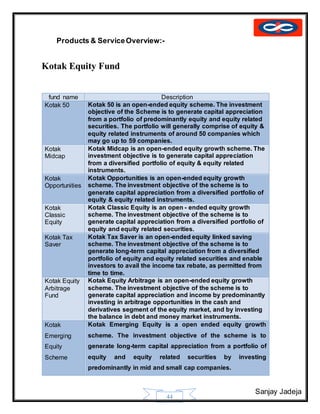
Products & ServiceOverview:-
Kotak Equity Fund
fund name Description
Kotak 50 Kotak 50 is an open-ended equity scheme. The investment
objective of the Scheme is to generate capital appreciation
from a portfolio of predominantly equity and equity related
securities. The portfolio will generally comprise of equity &
equity related instruments of around 50 companies which
may go up to 59 companies.
Kotak
Midcap
Kotak Midcap is an open-ended equity growth scheme. The
investment objective is to generate capital appreciation
from a diversified portfolio of equity & equity related
instruments.
Kotak
Opportunities
Kotak Opportunities is an open-ended equity growth
scheme. The investment objective of the scheme is to
generate capital appreciation from a diversified portfolio of
equity & equity related instruments.
Kotak
Classic
Equity
Kotak Classic Equity is an open - ended equity growth
scheme. The investment objective of the scheme is to
generate capital appreciation from a diversified portfolio of
equity and equity related securities.
Kotak Tax
Saver
Kotak Tax Saver is an open-ended equity linked saving
scheme. The investment objective of the scheme is to
generate long-term capital appreciation from a diversified
portfolio of equity and equity related securities and enable
investors to avail the income tax rebate, as permitted from
time to time.
Kotak Equity
Arbitrage
Fund
Kotak Equity Arbitrage is an open-ended equity growth
scheme. The investment objective of the scheme is to
generate capital appreciation and income by predominantly
investing in arbitrage opportunities in the cash and
derivatives segment of the equity market, and by investing
the balance in debt and money market instruments.
Kotak
Emerging
Equity
Scheme
Kotak Emerging Equity is a open ended equity growth
scheme. The investment objective of the scheme is to
generate long-term capital appreciation from a portfolio of
equity and equity related securities by investing
predominantly in mid and small cap companies.
Sanjay Jadeja
45
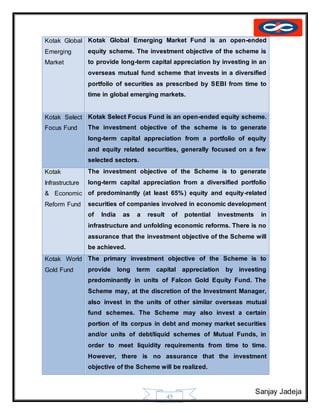
Kotak Global
Emerging
Market
Kotak Global Emerging Market Fund is an open-ended
equity scheme. The investment objective of the scheme is
to provide long-term capital appreciation by investing in an
overseas mutual fund scheme that invests in a diversified
portfolio of securities as prescribed by SEBI from time to
time in global emerging markets.
Kotak Select
Focus Fund
Kotak Select Focus Fund is an open-ended equity scheme.
The investment objective of the scheme is to generate
long-term capital appreciation from a portfolio of equity
and equity related securities, generally focused on a few
selected sectors.
Kotak
Infrastructure
& Economic
Reform Fund
The investment objective of the Scheme is to generate
long-term capital appreciation from a diversified portfolio
of predominantly (at least 65%) equity and equity-related
securities of companies involved in economic development
of India as a result of potential investments in
infrastructure and unfolding economic reforms. There is no
assurance that the investment objective of the Scheme will
be achieved.
Kotak World
Gold Fund
The primary investment objective of the Scheme is to
provide long term capital appreciation by investing
predominantly in units of Falcon Gold Equity Fund. The
Scheme may, at the discretion of the Investment Manager,
also invest in the units of other similar overseas mutual
fund schemes. The Scheme may also invest a certain
portion of its corpus in debt and money market securities
and/or units of debt/liquid schemes of Mutual Funds, in
order to meet liquidity requirements from time to time.
However, there is no assurance that the investment
objective of the Scheme will be realized.
Sanjay Jadeja
46
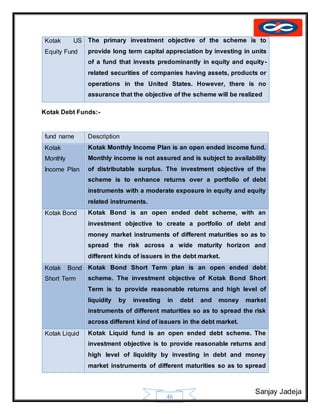
Kotak US
Equity Fund
The primary investment objective of the scheme is to
provide long term capital appreciation by investing in units
of a fund that invests predominantly in equity and equity-
related securities of companies having assets, products or
operations in the United States. However, there is no
assurance that the objective of the scheme will be realized
Kotak Debt Funds:-
fund name Description
Kotak
Monthly
Income Plan
Kotak Monthly Income Plan is an open ended income fund.
Monthly income is not assured and is subject to availability
of distributable surplus. The investment objective of the
scheme is to enhance returns over a portfolio of debt
instruments with a moderate exposure in equity and equity
related instruments.
Kotak Bond Kotak Bond is an open ended debt scheme, with an
investment objective to create a portfolio of debt and
money market instruments of different maturities so as to
spread the risk across a wide maturity horizon and
different kinds of issuers in the debt market.
Kotak Bond
Short Term
Kotak Bond Short Term plan is an open ended debt
scheme. The investment objective of Kotak Bond Short
Term is to provide reasonable returns and high level of
liquidity by investing in debt and money market
instruments of different maturities so as to spread the risk
across different kind of issuers in the debt market.
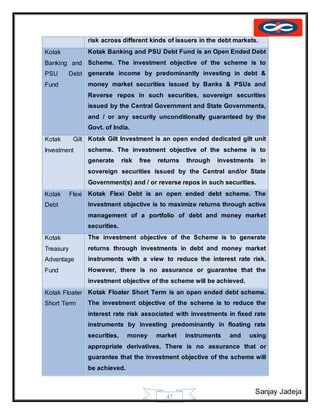
Kotak Liquid Kotak Liquid fund is an open ended debt scheme. The
investment objective is to provide reasonable returns and
high level of liquidity by investing in debt and money
market instruments of different maturities so as to spread
Sanjay Jadeja
47
risk across different kinds of issuers in the debt markets.
Kotak
Banking and
PSU Debt
Fund
Kotak Banking and PSU Debt Fund is an Open Ended Debt
Scheme. The investment objective of the scheme is to
generate income by predominantly investing in debt &
money market securities issued by Banks & PSUs and
Reverse repos in such securities, sovereign securities
issued by the Central Government and State Governments,
and / or any security unconditionally guaranteed by the
Govt. of India.
Kotak Gilt
Investment
Kotak Gilt Investment is an open ended dedicated gilt unit
scheme. The investment objective of the scheme is to
generate risk free returns through investments in
sovereign securities issued by the Central and/or State
Government(s) and / or reverse repos in such securities.
Kotak Flexi
Debt
Kotak Flexi Debt is an open ended debt scheme. The
investment objective is to maximize returns through active
management of a portfolio of debt and money market
securities.
Kotak
Treasury
Advantage
Fund
The investment objective of the Scheme is to generate
returns through investments in debt and money market
instruments with a view to reduce the interest rate risk.
However, there is no assurance or guarantee that the
investment objective of the scheme will be achieved.
Kotak Floater
Short Term
Kotak Floater Short Term is an open ended debt scheme.
The investment objective of the scheme is to reduce the
interest rate risk associated with investments in fixed rate
instruments by investing predominantly in floating rate
securities, money market instruments and using
appropriate derivatives. There is no assurance that or
guarantee that the investment objective of the scheme will
be achieved.
Sanjay Jadeja
48
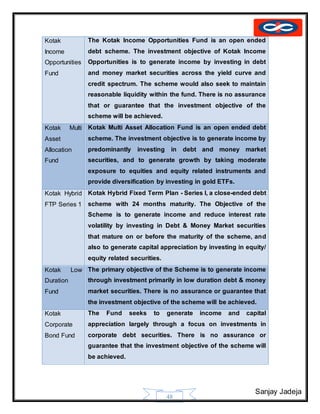
Kotak
Income
Opportunities
Fund
The Kotak Income Opportunities Fund is an open ended
debt scheme. The investment objective of Kotak Income
Opportunities is to generate income by investing in debt
and money market securities across the yield curve and
credit spectrum. The scheme would also seek to maintain
reasonable liquidity within the fund. There is no assurance
that or guarantee that the investment objective of the
scheme will be achieved.
Kotak Multi
Asset
Allocation
Fund
Kotak Multi Asset Allocation Fund is an open ended debt
scheme. The investment objective is to generate income by
predominantly investing in debt and money market
securities, and to generate growth by taking moderate
exposure to equities and equity related instruments and
provide diversification by investing in gold ETFs.
Kotak Hybrid
FTP Series 1
Kotak Hybrid Fixed Term Plan - Series I, a close-ended debt
scheme with 24 months maturity. The Objective of the
Scheme is to generate income and reduce interest rate
volatility by investing in Debt & Money Market securities
that mature on or before the maturity of the scheme, and
also to generate capital appreciation by investing in equity/
equity related securities.
Kotak Low
Duration
Fund
The primary objective of the Scheme is to generate income
through investment primarily in low duration debt & money
market securities. There is no assurance or guarantee that
the investment objective of the scheme will be achieved.
Kotak
Corporate
Bond Fund
The Fund seeks to generate income and capital
appreciation largely through a focus on investments in
corporate debt securities. There is no assurance or
guarantee that the investment objective of the scheme will
be achieved.
Sanjay Jadeja
49
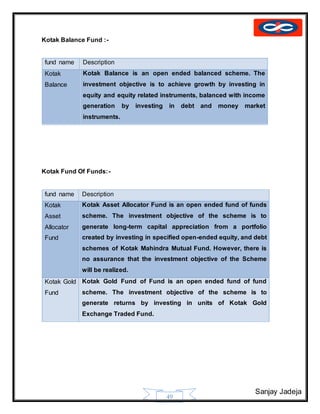
Kotak Balance Fund :-
fund name Description
Kotak
Balance
Kotak Balance is an open ended balanced scheme. The
investment objective is to achieve growth by investing in
equity and equity related instruments, balanced with income
generation by investing in debt and money market
instruments.
Kotak Fund Of Funds:-
fund name Description
Kotak
Asset
Allocator
Fund
Kotak Asset Allocator Fund is an open ended fund of funds
scheme. The investment objective of the scheme is to
generate long-term capital appreciation from a portfolio
created by investing in specified open-ended equity, and debt
schemes of Kotak Mahindra Mutual Fund. However, there is
no assurance that the investment objective of the Scheme
will be realized.
Kotak Gold
Fund
Kotak Gold Fund of Fund is an open ended fund of fund
scheme. The investment objective of the scheme is to
generate returns by investing in units of Kotak Gold
Exchange Traded Fund.
Sanjay Jadeja
50
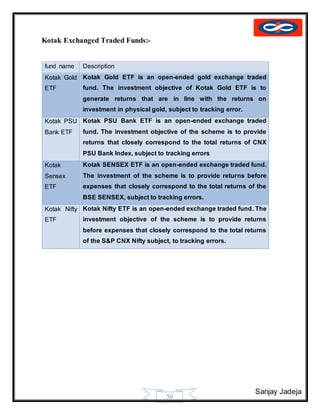
Kotak Exchanged Traded Funds:-
fund name Description
Kotak Gold
ETF
Kotak Gold ETF is an open-ended gold exchange traded
fund. The investment objective of Kotak Gold ETF is to
generate returns that are in line with the returns on
investment in physical gold, subject to tracking error.
Kotak PSU
Bank ETF
Kotak PSU Bank ETF is an open-ended exchange traded
fund. The investment objective of the scheme is to provide
returns that closely correspond to the total returns of CNX
PSU Bank Index, subject to tracking errors
Kotak
Sensex
ETF
Kotak SENSEX ETF is an open-ended exchange traded fund.
The investment of the scheme is to provide returns before
expenses that closely correspond to the total returns of the
BSE SENSEX, subject to tracking errors.
Kotak Nifty
ETF
Kotak Nifty ETF is an open-ended exchange traded fund. The
investment objective of the scheme is to provide returns
before expenses that closely correspond to the total returns
of the S&P CNX Nifty subject, to tracking errors.
Sanjay Jadeja
51
SWOT Analysis:-
Strengths:-
 Employees are highly empowered
 Strong communication network
 Vast area of service
 Innovative financial products of diverse categories
Weakness:-
 Lesser penetration as being late entrants
 Low publicity and marketing as compared to other premium Mf in the urban
area
Opportunity:-
Many of the mutual fund companies are presently functioning in the urban
area, but in country like India were the substation part of total population lives in
the rural area, also the mutual fund company needs to expand their business in
the unexplored rural area which will lead to the substantial increase in the total
amount which is invested in mutual fund.
 BUILD TRUST AMONG THE CUSTOMER
 PROVIDE SATISFACTION TO THE CUSTOMER
Threats:-
Increased Competitions: With intense competition by so many local players
causing headache to the current marketers. In addition to this though multinational
brands are not yet established but still they will soon hit the mark. Almost 60 to 70%
Sanjay Jadeja
52
of the revenue is spending on the management and services.
Hedge Funds: sometimes referred to as hot money, are also causing a threat for
mutual funds. They have gained worldwide notoriety for bringing the markets down.
Be it a crash in the currency, stock or bond market, usually a hedge fund
prominently figures somewhere in the picture.
Sanjay Jadeja
53
INTRODUCTION OF STUDY :-
The purpose of this study is to know the comparison of different type of
investment avenues mutual. To know the total market share of the mutual fund and
other avenues between different players. To know the industry of mutual fund.
This study helps to classify various schemes provided by Kotak Mutual Fund
Company.
Background of study
A Mutual Fund is a trust that pools the savings of a number of investors who
share a common financial goal. The money thus collected is invested by the fund
manager in different types of securities depending upon the objective of the
scheme. These could range from shares to debentures to money market
instruments. The income earned through these investments and the capital
appreciations realized by the scheme are shared by its unit holders in proportion to
the Number of units owned by them (pro - rata). Thus, a Mutual Fund is the most
suitable investment for the common man as it offers an opportunity to invest in a
diversified, professionally managed portfolio at a relatively low cost. Anybody with
an investible surplus of as little as a few thousand rupees can invest in Mutual
Funds.
Sanjay Jadeja
54
Literature Review
Gaurav Agarval And Dr. Mini Jain On The Topic Of “Investor’s Preference
Towards Mutual Fund In Comparison To Other Investment Avenues” From
“Journal Of Indian Research (Issn: 2321-4155) Vol.1, No.4, October-December,
2013”
In today’s competitive environment, different kinds of investment avenues are
available to the investors. All investment modes have advantages & disadvantages.
An investor tries to balance these benefits and shortcomings of different investment
modes before investing in them. Among various investment modes, Mutual Fund is
the most suitable investment mode for the common man, as it offers an opportunity
to invest in a diversified and professionally managed portfolio at a relatively low
cost. In this paper, an attempt is made to study mainly the investment avenue
preferred by the investors of Mathura, and we have tried to analyze the investor’s
preference towards investment in mutual funds when other investment avenues are
also available in the market.
Rashmi Sharma and N. K. Pandya on the topic of “Investing in Mutual Fund: An
Overview” from “Asian Research Journal of Business Management” Issue
1(Vol.1)2013
In this paper, structure of mutual fund, comparison between investments in mutual
Fund and other investment options and calculation of NAV etc. have been
considered. In this paper, the impacts of various demographic factors on investors’
attitude towards mutual fund have been studied. For measuring various
phenomena and analyzing the collected data effectively and efficiently for drawing
sound conclusions, drawing pie charts has been used and for analyzing the various
factors responsible for investment in mutual funds.
Sanjay Jadeja
55
Manoj Kumar, Sr. Assistant Professor on the topic of “A Study of Customers’
Preference towards Investment in Equity Shares and Mutual Funds” from
“International Journal of Education and Psychological Research (IJEPR)
ISSN: 2279-0179 Volume 2, Issue 2, pp: 95-100, April 2013”
Investment is the employment of funds on assets with the aim of earning income or
capital appreciation. In the past, investment avenues were limited to real estates,
schemes of the post office and banks. At present, a wide variety of investment
avenues are open to the investors to suit their needs and nature. The required level
of return and the risk tolerance level decide the choice of the investor. It is
necessary to know that investor prefer which particular investment instrument and
why? The main purpose of this research paper is to find Investors‟ preference for
various investment alternatives particularly shares and mutual funds.
Sandip Bansal On The Topic Of “Investor’s Perception Regarding Mutual
Funds And Other Investment Tools” From “Journal Of International
Academic Research For Multidisciplinary Impact Factor 1.393, Issn: 2320-
5083, Volume 2, Issue 5, June 2014”
In the context of growing importance of mutual funds in the developing countries
like India, majority of the investors prefer mutual funds as a good tool of
investment. Mutual funds pool the savings of small investors and made the
investment in blue chip companies. Due to these reasons the present study’s main
objective are to analyze investor’s perception regarding the mutual fund industry in
India and other investment tools. Large number of new other investment tools could
have led to competition with the mutual funds for their existence. The study made a
comparative analysis of the mutual fund and other investment tools. The study aims
to help understand the investor’s behavior towards mutual fund and various other
investment plans like PPF, FD life insurance, equity etc. The study required design
a questionnaire and to do a primary survey on investor perception towards mutual
Funds and other investment tools The target respondents of the primary survey
Sanjay Jadeja
56
were walk in investors in ICICI bank and various professional people. The data
gathered from the primary survey and secondary survey and to find various factors
that affect an investor decisions while choosing Mutual Fund plan other investment
plan and risk factors which involve in mutual fund. The findings of the study reveal
that mostly investors are not aware about all investment tools and mostly see the
transparency in investment tools during invest in particular tools
SEBI – NCAER Survey (2000) was carried out to estimate the number of households
and the population of individual investors, their economic and demographic profile,
portfolio size, and investment preference for equity as well as other savings
instruments. This is a unique and comprehensive study of Indian Investors, for which
data was collected from 3,0,00,000 geographically dispersed rural and urban
households. Some of the relevant findings of the study are : Households preference
for instruments match their risk perception; Bank Deposit has an appeal across all
income class; 43% of the non-investor households equivalent to around 60 million
households (estimated) apparently lack awareness about stock markets; and,
compared with low income groups, the higher income groups have higher share of
investments in Mutual Funds (MFs) signifying that MFs have still not become truly the
investment vehicle for small investors.
Bodla B. S., Bishnoi Sunita(2008) has concluded in their study that the mutual fund
investors in India at present have as many as 609 schemes with variety of features
such as dividend, growth, cumulative interest income, monthly income plans, sectoral
plans, equity linked schemes, money market schemes, etc. Though both open-end
and close-end schemes have registered excellent growth in fund mobilization, but
currently the former category of schemes is more popular among the investors.
Portfolio-wise analysis has brought that income schemes have an edge over growth
schemes in terms of assets under management. Moreover UTI’s share in total assets
under management has come down to 11.8 percent in 2006 from 82.5 percent in
1998.
Sanjay Jadeja
57
Statement of problem:
Research Problem:
The main reason behind this problem was to find out the preference of different
investors towards different type of investment avenues. Which avenue is preferred
most by them and for which reason.
 To find out the most preferred Investment Avenue.
 To find out the perceptions of investors behind investing in different avenues.
 To analyze the portfolio of different type of investors in the area.
 To study on different types of investment avenues and find their benefits.
Sanjay Jadeja
58
Objective of the study:
 To find out the most preferred Investment Avenue of the investors of Rajkot.
 To analyze the investor’s preference towards investment in mutual funds when
other investment avenues are also available in the market.
 To find the main bases of different investment avenues, an investor thinks
before investing.
 To find out the overall criterion of investors regarding investment.
 To analyse the different type of portfolios of different investors in Rajkot.
Sanjay Jadeja
59
Contribution and learning from the project:
In this project I came to know about the real scenario of the current market of the
market. The preference of investors in different set of invests avenues. How many of
them are preferring mutual fund compared to others.
I have personally called many of the investors for this matter and tried to get their
views on this. I have also tried to convince many of them for investing in mutual fund
under systemic investment plans (sip).
I have also personally met some of the investors for this matter talked to them
and tried to make them convinced for investing in sip.
Sanjay Jadeja
60
Research Methodology
Research design:
There are three different types of research designs that can be used, which are
descriptive, exponential and causal. For the purpose of my research I have used
descriptive research design. This design gives proper idea about the whole situation
and describes it thoroughly.
Sampling Method:
There are many type of methods that can be used for selecting samples for the
research. I have used convenient sampling method.
Sample size:
Sample size for the purpose of my research was 100. I had selected this samples
from different set of investors.
Sources of data:
There are mostly two sources for data collection for the study. These are primary
and secondary data sources.
For the primary data collection I have used questionnaire. I filled 100
questionnaires from different investors.
Sanjay Jadeja
61
For the secondary data sources I used fact sheets, pamphlets, company web
site, internet and other findings of different surveys done by others.
Data Collection Method:
Primary data are collected with help of questionnaire and secondary data was
collected with the help of Journals , Magazines , Fact sheet , Websites
Data Collection Instrument:
Questionnaire is used as instrument for collecting primary data
Data processing:
Data processing is done with the Help Ms. Excel, I have filtered the data then
interpretation of Data is done with help of various excel formulas.
Sanjay Jadeja
62
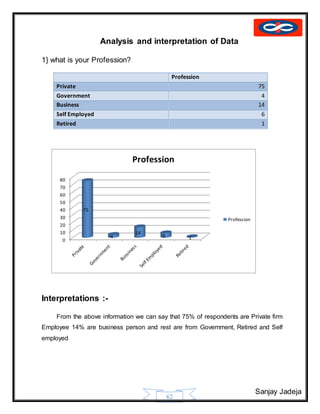
Analysis and interpretation of Data
1} what is your Profession?
Profession
Private 75
Government 4
Business 14
Self Employed 6
Retired 1
Interpretations :-
From the above information we can say that 75% of respondents are Private firm
Employee 14% are business person and rest are from Government, Retired and Self
employed
0
10
20
30
40
50
60
70
80
75
4
14
6 1
Profession
Profession
Sanjay Jadeja
63
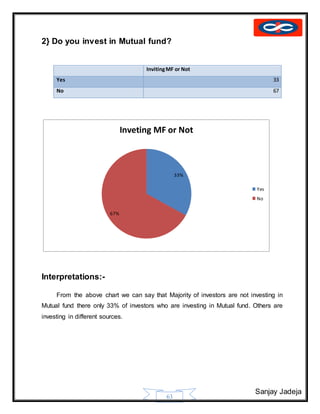
2} Do you invest in Mutual fund?
InvitingMF or Not
Yes 33
No 67
Interpretations:-
From the above chart we can say that Majority of investors are not investing in
Mutual fund there only 33% of investors who are investing in Mutual fund. Others are
investing in different sources.
33%
67%
Inveting MF or Not
Yes
No
Sanjay Jadeja
64
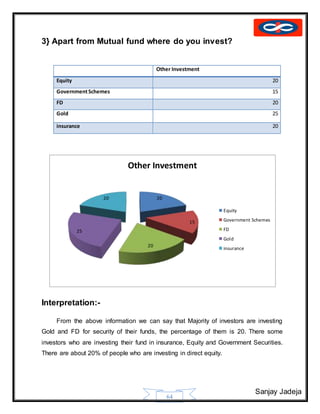
3} Apart from Mutual fund where do you invest?
Other Investment
Equity 20
GovernmentSchemes 15
FD 20
Gold 25
insurance 20
Interpretation:-
From the above information we can say that Majority of investors are investing
Gold and FD for security of their funds, the percentage of them is 20. There some
investors who are investing their fund in insurance, Equity and Government Securities.
There are about 20% of people who are investing in direct equity.
20
15
20
25
20
Other Investment
Equity
Government Schemes
FD
Gold
insurance
Sanjay Jadeja
65
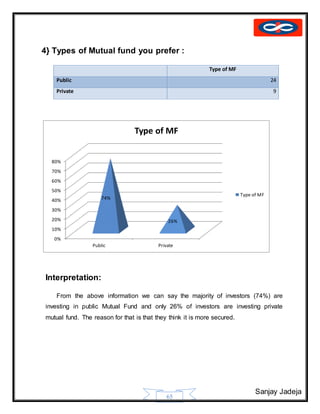
4} Types of Mutual fund you prefer :
Type of MF
Public 24
Private 9
Interpretation:
From the above information we can say the majority of investors (74%) are
investing in public Mutual Fund and only 26% of investors are investing private
mutual fund. The reason for that is that they think it is more secured.
0%
10%
20%
30%
40%
50%
60%
70%
80%
Public Private
74%
26%
Type of MF
Type of MF
Sanjay Jadeja
66
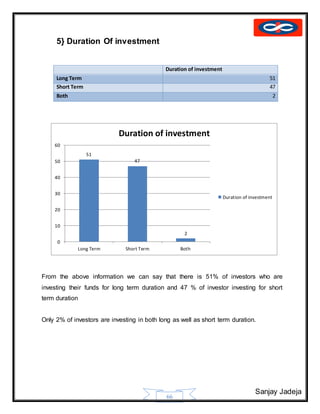
5} Duration Of investment
Duration of investment
Long Term 51
Short Term 47
Both 2
From the above information we can say that there is 51% of investors who are
investing their funds for long term duration and 47 % of investor investing for short
term duration
Only 2% of investors are investing in both long as well as short term duration.
51
47
2
0
10
20
30
40
50
60
Long Term Short Term Both
Duration of investment
Sanjay Jadeja
67
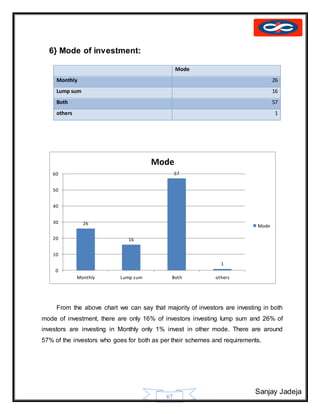
6} Mode of investment:
Mode
Monthly 26
Lump sum 16
Both 57
others 1
From the above chart we can say that majority of investors are investing in both
mode of investment, there are only 16% of investors investing lump sum and 26% of
investors are investing in Monthly only 1% invest in other mode. There are around
57% of the investors who goes for both as per their schemes and requirements.
26
16
57
1
0
10
20
30
40
50
60
Monthly Lump sum Both others
Mode
Mode
Sanjay Jadeja
68
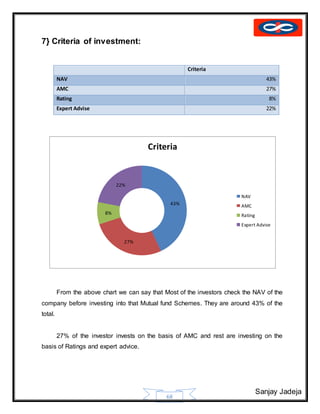
7} Criteria of investment:
Criteria
NAV 43%
AMC 27%
Rating 8%
Expert Advise 22%
From the above chart we can say that Most of the investors check the NAV of the
company before investing into that Mutual fund Schemes. They are around 43% of the
total.
27% of the investor invests on the basis of AMC and rest are investing on the
basis of Ratings and expert advice.
43%
27%
8%
22%
Criteria
NAV
AMC
Rating
Expert Advise
Sanjay Jadeja
69
8} Types of Schemes:
Types ofschemes
Equity 21
both 68
Hybrid 5
Debt 6
In this case most of the investors are investing in both schemes debt as well as
equity. But there are some investors who are only investing in equity, they are about
21%. And there are few investors who are investing only in debt, which are only about
6%. There are very few investors who are investing in hybrid fund.
21
68
5
6
Types of schemes
Equity
both
Hybrid
Debt
Sanjay Jadeja
70
9} Risk portion involved in your investment
Risk profile
High risk 14
Moderate 67
Low risk 6
No Risk 13
From the above graph we can say that, most of the investors are in the moderate
risk portion, means they are not willing to take too much risk (67%). Then there are
also some investors who are risk takers (14%).
There are also some investors who are not willing to take any amount of risk
which are 13%
0
10
20
30
40
50
60
70
High risk Moderate Low risk No Risk
14
67
6
13
Risk profile
Risk profile
Sanjay Jadeja
71
10 } Features you look for investment
Features
Safety 33
Liquidity 14
NAV 23
FundManager 5
Riskfactor 10
Returns 15
From the above chart we can see that around 33% of the investors are looking at
safety while investing their money. Then the nav of the scheme is given the
preference.
There are around 14% of the investors who look for liquidity when investing &
15% for returns.
33
14
23
5
10
15
0
5
10
15
20
25
30
35
Safety Liquidity NAV Fund Manager Risk factor Returns
Features
Sanjay Jadeja
72
11} Objective of investment
objective
Return 58
Tax 24
Appreciation 6
Liquidity 12
The above chart shows us the objectives of the investors. Most of the people
look for return when investing (58%).
Then around 24% look for tax purpose, 12% look for liquidity & 6% of them go for
appreciation.
5824
6
12
objective
Return
Tax
Appreciation
Liquidity
Sanjay Jadeja
73
12} Knowledge level of investment
Knowledge level
Good 15
Moderate 75
Poor 10
The given chart shows the knowledge level of the investors. Most of them falls
under the category of moderate level of knowledge (75%).
Then there are 15% of the people having good knowledge & 10% are having
poor or no knowledge.
15
75
10
0 10 20 30 40 50 60 70 80
Good
Moderate
Poor
Knowledge level
Knowledge level
Sanjay Jadeja
74
13} whom you consult for investment ?
Consultation
Personal Advisor 14
Broker 9
Banker 6
Other 69
The above chart shows us whom people consult before making investment. It
says that 14% go for personal advisor, 9% go to brokers & 6% asks to bankers.
While the remaining people look to family, friends or take the decision by their
own self.
14
9
6
69
0
10
20
30
40
50
60
70
80
Personal Advisor Broker Banker Other
Consultation
Consultation
Sanjay Jadeja
75
14} Causes for not investing in Mutual Fund
Causes
Not Lucrative 5
No Satisfaction 8
No Safety 23
No knowledge 14
Risky 24
The above data gives us information about the main reasons for which people
are not investing in mutual fund. Most of them consider it as risky (24%) & not safe.
Around 14% of people are not having sufficient knowledge.
8% of people think that it is not giving proper return as compared to others. And
5% thinks that it is not a lucrative investment option.
5
8
23
14
24
0
5
10
15
20
25
30
Not Lucrative No Satisfaction No Safety No knowledge Risky
Causes
Causes
Sanjay Jadeja
76
15} where will you put your money if having more
savings?
ProfferedOption
Equity 16
Mf 12
Real Estate 16
gold 24
Commodity 9
FD 23
The above data shows the preference of investors towards different avenues.
Most preferred source is gold and FD which is favored by 24% & 23% respectively.
After that 16% of people go for equity and real estate. Then 12% people thinks
that MF is good and only 9% go for commodity market.
16
12
16
24
9
23
PrefferedOption
Equity
Mf
Real Estate
gold
Commodity
FD
Sanjay Jadeja
77
Results and Findings
From the above data & charts we can say that from total investors there are only
33% of the people are investing in mutual fund. The most preferred avenue by the
investors is gold. More than 25% of them are investing in gold.
The main objective of people behind the investment is return which is considered
by 58% of people. There are 33% of the people who gives most priority to safety.
There are only 14% of the people who are willing to take high risk & 68% go for
moderate risk.
Most of the investors look for NAV( net asset value) while investing in particular
scheme, which are around 48%. The investors go for both the long and short term
investment. Most of the MF investors go for equity schemes and that also of public
firms.
The main reason behind people not investing in MF is that they (24%) think that it
is risky as it is related to the share market. Around 14% are not having knowledge of
how to invest & 8% thinks that it is not giving proper return as compared to others.
Sanjay Jadeja
78
Sanjay Jadeja
79
Suggestions and conclusion
After analyzing & interpreting the data received from the respondents, it may be
concluded that maximum investors are aware about Banks FD & insurance as
investment avenues only. More than 80% investors are aware about Mutual Funds,
Real Estate, and NSC investment avenues.
Following are the main bases of different investment modes, an investor thinks
before investing:
Mode Preference Mode Preference
Banks for Safety
Real estate for Return
LIC for Safety
Comm. Mkt. for Return & liquidity
PPF for Safety
Gold for Safety
Stock Mkt. for Return & liquidity
Mutual fund for Return & Tax Planning
Bonds for Safety & Tax Planning
Post office for Safety & Tax
Looking from different perspective, it is also evident that the overall and main
criterion of the investors regarding their investments is Return. Therefore, on the basis
of Safety, Bank FD & insurance are the most preferred avenues of investments it
provides maximum safety. On the basis of Return, Real Estate & Mutual Funds are the
most preferred avenues of investment as it provides maximum return.
Similarly, on the basis of Tax Planning, Post Office Schemes & Mutual Funds
are the most preferred avenues of investment. Therefore, the preference is given to
Sanjay Jadeja
80
investment in Mutual Funds amidst availability of other traditional investment avenues
in the market.
Lastly, if the investors have been provided more funds, then they would like to
invest in Real Estate because of its rapid growth. Therefore, on the whole, it may be
concluded that the Real Estate is the most preferred investment avenue of the
investors of Mathura. The Mutual fund has yet to percolate down as the preferred
mode of investment in the aria of Rajkot.
For the suggestion part I would suggest that the MF firm should try & make
people aware that mutual fund is very good option for them for investment as it gives
very good return, is most liquid transparent mode of investment.
Sanjay Jadeja
81
Limitations of the study
As far as this research is concerned, the biggest limitation of the study was that it
was only limited to the Rajkot area.
The samples selected under the research were only limited to 100. So the finding
of this cannot be implemented to other areas & other people. The method of data
collection here was both primary and secondary, so the sources cannot be fully trusted
as it is related to the personal thinking & beliefs.
Sanjay Jadeja
82
Scope for Further Research
There is a huge scope for the further research on this topic and the subject as
this study was only limited to one specific area and for small amount of sample.
There can be a big research done on this subject by including more cities or
states and the research can be done at India level by including more samples.
The result of the study can be more concrete and trustable by using more
specific and accurate method of sampling & data collection.
Sanjay Jadeja
83
Bibliography
Journals:
 Agraval, G., & Jain, D. Investor’s Preference Towards Mutual Fund In
Comparison To Other Investment Avenues, 1(4), 115-131. doi:
October to December 2013
 Kumar, M. A Study of Customers’ Preference towards Investment in
Equity Shares and Mutual Funds, 2(2), 95-100. doi: April 2013
 Bansal, Sandeep, Investor’s Perception Regarding Mutual Funds And
Other Investment Tools, 2(5), Doi: June 2014
Books:
 Kothari, C.R. (2006). Research Methodology, 2nd edition, New Delhi:
New Age International Pvt. Ltd., pp 11, 130.
Websites:
 www.kotak.com
 www.assetmanagementcompany.com
 www.amfiindia.com
 www.valueresearch.com
Sanjay Jadeja
84
Annexure
1) Name:___________________________________________________________
2) No : __________________________________
3) Email :__________________________________
4) Age :________________
5) Gender :-
 Male
 Female
6) What Is Your Profession?
 Government Employee Self Employed
 Business Person Professional
 Pvt. Ltd Employee Other
7) Do You Make Savings? What Is The Percentage?
 __________________________________________
8) Do You Invest In Mutual Fund?
 Yes
 No
9) Apart Of Mutual Fund, Where Do You Invest?
 Equity Market Insurance
 Gov. Scheme Gold/ Silver
Fixed Deposit
10) Type Of Mutual Fund You Prefer.
 Public Private
11) Duration Of Investment.
 Long Term
 Short Term
12) Mode Of Investment.
 Monthly ( SIP / STP )
 Lump Sum
 Other
Sanjay Jadeja
85
13) Criteria For Investment.
 Past Performance Rating
 AMC Expert Advise
14) You Have Invest In Which Mutual Fund Company?
 Name Few Companies That You Have Invested
_____________________________________________
15) Which Mutual Funds Schemes Do You Invest?
 Equity Funds
 Debt Funds
 Hybrid Funds
16) Name Equity Funds.
 Diversified Equity Mid Cap
 Index Fund Tax Saving Fund
 Sector Specific Fund Other ________________
17) Name Debt Funds.
 Gilt Funds Income Funds
 MIPS STP Liquid Funds
18) Risk Portion Involved In Your Investment.
 Aggressive ( High Risk ) Conservative (No Risk)
 Somewhat Aggressive (Moderate Risk ) Somewhat Conservative
19) Features You Look For In Investment?
 Safety Return Earning
 Liquidity NAV
 Risk Factor Profile Of Fund Manager
20) What Is Your Objective Of Your Investment?
 Return Appreciation
 Tax Liquidity
21) Your Knowledge Level Of Investment.
 Good Moderate
 Poor
Sanjay Jadeja
86
22) Whom You Consult For Investment.
 Personal Adviser Banker
 Broker Other _______________
23) Causes For Not Investing In Mutual Fund?
 It’s Not Lucrative Investment Instrument No Knowledge Of How To Invest
 No Satisfactory Return Compare To Other. Risky Investment.
 No Safety Of Fund Invests.
24) Where Will You Put Your Money If Having More Savings?
 Equity Market Gold / Silver
 Mutual Fund Commodity
 Real Estate
25) Suggestion
____________________________________________________________

mutual fund project

  • 1.
    Sanjay Jadeja 1 HISTORY OFMUTUAL FUNDS IN INDIA The mutual fund industry in India started in 1963 with the formation of Unit Trust of India, at the initiative of the Govt. of India and Reserve Bank. The history of mutual fund in India can be broadly divided into four distinct phases. The Indian mutual fund industry has started opening up many exciting investment opportunities to Indian investors. Despite the expected continuing growth in the industry, mutual funds are still a new financial intermediary in India. Hence, it is important that the investors, the mutual fund agents/distributors, the investment advisors and even the fund employees acquire better knowledge of what mutual funds are, what they can do for investors and what they cannot, and how they function differently from other intermediaries such as the banks. Phase 1. (1964-87 Unit Trust of India.) In 1963, UTI was established by an Act of parliament and given a monopoly. Operationally, UTI was set up by the RBI. But was later de linked from RBI the first, and still one of the largest schemes launched by UTI was Unit Scheme 64. Over the years, US 64 attracted and probably still have the largest number of investors in any single investment scheme. It was also at least partially the first open –end scheme in the country. Now moving towards becoming fully open-end. Later in 1970s and 80s, UTI started innovating and offering different schemes to suit the needs of different classes of different investors. Unit Linked Insurance Plan (ULIP) was launched in 1971. Six new schemes were introduced between 1981 and 1984. During 1984-87, new schemes like children’s gift growth fund (1986) and Master share (1987) were launched .
  • 2.
    Sanjay Jadeja 2 Phase 2(1987-1993 Entry of public sector funds.) 1987 Marked the entry of non –UTI, public sector mutual funds, bringing in competition. With the opening up of the economy, many public sector banks and financial institutions were allowed to establish mutual funds. The SBI established the first non-UTI Mutual funds in Nov, 1987. This was followed by Can Bank Mutual fund in Dec, 1987. LIC Mutual fund (1989) and GIC MF and Indian Bank MF. The fund industry expanded nearly 7 times in terms of Asset under Management. Phase 3 (1993-1996 Emergence of Private funds) A new era of Mutual Fund industry began with the permission granted for the entry of private sector funds in 1993, giving the Indian investors a broader choice of ‘fund families’ and increasing competition for the existing public sector funds. Initially, the mobilization of funds by the private mutual fund was slow. But, this segment of fund industry now has been witnessing much greater investor confidence in them. One influencing factor has been development of a SEBI driven regulatory framework for mutual funds. Investors in India now clearly see the benefits of investing through mutual funds and have started becoming selective. Phase 4 (1996 SEBI regulation for mutual funds) The entire mutual fund industry in India, despite initial hiccups, has since scaled new heights in terms of mobilization of funds and number of players. Deregulations and liberalization of the Indian economy has introduced competition and impetus to the growth of the industry.
  • 3.
    Sanjay Jadeja 3 More investor’sfriendly regulatory measures have been taken both by SEBI to protect the investors and by the government to enhance investors’ returns through tax benefits. A comprehensive set of regulations for all mutual funds operating in India was introduced with SEBI (mf) Regulations, 1996. These regulation set uniform standards for all funds and will eventually be applied in full to UTI as well, even though UTI is govern by its own UTI Act. In fact, UTI has been voluntarily adopting SEBI guidelines for most of its schemes. Similarly the 1999 Union Government Budget took a big step in exempting all mutual fund dividends from income tax in the hands of investors. Both the 1996 regulation and the 1999 budget must be considered of historic importance, given their far reaching impact on the fund industry and investors. PHASE -5 2003 ONWARDS This phase was marked by very rapid growth in the industry, and significant increase in market shares of private sector players. In February 2003, following the repeal of the unit Trust of India Act 1963 was bifurcated into two separate entities. One is the specified undertakings of the Unit Trust of India with assets under management of Rs.29,835 corers as at the end of January 2003, representation broadly, the assets of unit scheme 1964, assured return and certain other schemes. The specified undertakings of UTI, functioning under an administrator and under the rules framed by the Government of India, and do not come under the purview of the Mutual Fund Regulation.
  • 4.
    Sanjay Jadeja 4 Erstwhile UTIwas bifurcated into UTI Mutual Fund and the Specified Undertaking of the Unit Trust of India effective from February 2003. The Assets under management of the Specified Undertaking of the Unit Trust of India has therefore been excluded from the total assets of the industry as a whole from February 2003 onwards.
  • 5.
    Sanjay Jadeja 5 Currently thereare around 45 mutual fund organizations in India together handling assets worth nearly Rs 10 lakh crore. Today, the Indian mutual fund industry has opened up many exciting investment opportunities for investors. As a result, we have started witnessing the phenomenon of savings now being entrusted to the funds rather than in banks alone. Mutual Funds are now perhaps one of the most sought- after investment options for most investors.
  • 6.
    Sanjay Jadeja 6 STRUCTURE OFMUTUAL FUND IN INDIA For anybody to become well aware about mutual funds, it is imperative for him or her to know the structure of a mutual fund. How does a mutual fund come into being? Who are the important people in a mutual fund? What are their roles? etc. We will start our understanding by looking at the mutual fund structure in brief. Mutual Funds in India follow a 3-tier structure. There is a Sponsor (the First tier), who thinks of starting a mutual fund. The Sponsor approaches the Securities & Exchange Board of India (SEBI), which is the market regulator and also the regulator for mutual funds. Not everyone can start a mutual fund. SEBI checks whether the person is of integrity, whether he has enough experience in the financial sector, his net worth etc. Once SEBI is convinced, the sponsor creates a Public Trust (the Second tier) as per the Indian Trusts Act, 1882. Trusts have no legal identity in India and cannot enter into contracts, hence the Trustees are the people authorized to act on behalf of the Trust. Contracts are entered into in the name of the Trustees. Once the Trust is created, it is registered with SEBI after which this trust is known as the mutual fund. It is important to understand the difference between the Sponsor and the Trust. They are two separate entities. Sponsor is not the Trust; i.e. Sponsor is not the Mutual Fund. It is the Trust which is the Mutual Fund. The Trustees role is not to manage the money. Their job is only to see, whether the money is being managed as per stated objectives. Trustees may be seen as the internal regulators of a mutual fund.
  • 7.
    Sanjay Jadeja 7 ORGANIZATION CHARTOF MUTUAL FUND Figure no.2 SEBI Trustee Sponsor Operations AMC Fund Manager MKT/Sales Mutual Fund Distributors MKT/Sales Schemes Investors
  • 8.
    Sanjay Jadeja 8  Avehicle for investing in stocks and bonds A mutual fund is not an alternative investment option to stocks and bonds, rather it pools the money of several investors and invests this in stocks, bonds, money market instruments and other types of securities. Buying a mutual fund is like buying a small slice of a big pizza. The owner of a mutual fund unit gets a proportional share of the fund’s gains, losses, income and expenses.  Each mutual fund has a specific stated objective The fund’s objective is laid out in the fund's prospectus, which is the legal document that contains information about the fund, its history, its officers and its performance.  Some popular objectives of a mutual fund are - Fund Objective What the fund will invest in Equity (Growth) Only in stocks Debt (Income) Only in fixed-income securities Money Market (including Gilt) In short-term money market instruments (including government securities) Balanced Partly in stocks and partly in fixed-income securities, in order to maintain a 'balance' in returns and risk
  • 9.
    Sanjay Jadeja 9  Managedby an Asset Management Company (AMC) The company that puts together a mutual fund is called an AMC. An AMC may have several mutual fund schemes with similar or varied investment objectives. The AMC hires a professional money manager, who buys and sells securities in line with the fund's stated objective.  All AMCs Regulated by SEBI, Funds governed by Board of Directors The Securities and Exchange Board of India (SEBI) mutual fund regulations require that the fund’s objectives are clearly spelt out in the prospectus.  Net Asset Value or NAV NAV is the total asset value (net of expenses) per unit of the fund and is calculated by the AMC at the end of every business day.  How is NAV calculated? The value of all the securities in the portfolio in calculated daily. From this, all expenses are deducted and the resultant value divided by the number of units in the fund is the fund’s NAV. For e.g. If the market value of securities of a mutual fund scheme is Rs. 200 lakhs and the mutual fund has issued 10 lakhs unit at Rs. 10 each to the investors, then the NAV per unit of the fund is Rs.20 Net Asset Value Of Scheme NAV =------------------------------------ No. Of Units Outstanding
  • 10.
    Sanjay Jadeja 10 The majorfactor affecting the NAV of a fund are;  Sale and purchase of securities  Sale and repurchase of unit  Valuation of assets  Actual of income and exp Expense Ratio AMCs charge an annual fee, or expense ratio that covers administrative expenses, salaries, advertising expenses, brokerage fee, etc. A 1.5% expense ratio means the AMC charges Rs1.50 for every Rs100 in assets under management. A fund's expense ratio is typically to the size of the funds under management and not to the returns earned. Normally, the costs of running a fund grow slower than the growth in the fund size - so, the more assets in the fund, the lower should be its expense ratio. Load Some AMCs have sales charges, or loads, on their funds (entry load and/or exit load) to compensate for distribution costs. Funds that can be purchased without a sales charge are called no-load funds.
  • 11.
    Sanjay Jadeja 11 Open- andClose-Ended Funds 1) Open-Ended Funds At any time during the scheme period, investors can enter and exit the fund scheme (by buying/ selling fund units) at its NAV (net of any load charge). Increasingly, AMCs are issuing mostly open-ended funds. 2) Close-Ended Funds Redemption can take place only after the period of the scheme is over. However, close-ended funds are listed on the stock exchanges and investors can buy/ 0sell units in the secondary market (there is no load). STP-Systematic transfer plan They allow the investors to transfer on a periodic basis a specifying amount from one scheme to another within the same fund family meaning two schemes belonging to the same mutual fund. A transfer will be treated as redemption of units from the scheme from which the transfer is made. Such redemption or investment will be at the applicable NAV. This service allows the investor to manage his investment activity to achieve his objectives. SWP- Systematic withdrawal plan An opposed to the SIP, the SWP allows the investors the facility to withdraw the pre determined interval. The investor’s units will be redeemed at the existing NAV as on that day.
  • 12.
    Sanjay Jadeja 12 SIP –Systematic Investment Planning  It is a method of investing a fixed sum, at a regular interval, in a mutual fund.  It is very similar to monthly saving schemes like a recurring monthly deposit / post office deposit Advantages of Systematic Investment Planning  Encourages Regular Investments (just like recurring deposit schemes)  A Convenient way to invest regularly  Lower initial investment without cutting into regular expense  Long term perspective  Rupee Cost Averaging Benefit to counter volatility - it brings down the average cost of your Investments  No timing the market!!!  Meet investment objective with investment needs  Helps to match the risk / return profile Types of risks associated with Mutual Fund Investment Market risk: At times the prices or yields of all the securities in a particular market rise or fall due to broad outside influences. This change in price is due to 'market risk'. Inflation risk: Sometimes referred to as 'loss of purchasing power'. Whenever the rate of inflation exceeds the earnings on your investment, you run the risk that you'll actually be able to buy less, not more. Credit risk: In short, how stable is the company or entity to which you lend your money when you invest? How certain are you that it will be able to pay the interest you are promised, or repay your principal when the investment matures? Interest rate risk: Interest rate movements in the Indian debt markets can be volatile leading to the possibility of large price movements up or down in debt and money market securities and thereby to possibly large movements in the NAV.
  • 13.
    Sanjay Jadeja 13 Advantages ofMutual Fund:-  Professional Money Management Fund managers are responsible for implementing a consistent investment strategy that reflects the goals of the fund. Fund managers monitor market and economic trends and analyze securities in order to make informed investment decisions.  Diversification Diversification is one of the best ways to reduce risk (to understand why, read the need to Diversify). Mutual funds offer investors an opportunity to diversify across assets depending on their investment needs.  Liquidity Investors can sell their mutual fund units on any business day and receive the current market value on their investments within a short time period (normally three- to five-days).  Affordability The minimum initial investment for a mutual fund is fairly low for most funds (as low as Rs500 for some schemes).  Convenience Most private sector funds provide you the convenience of periodic purchase plans, automatic withdrawal plans and the automatic reinvestment of interest.
  • 14.
    Sanjay Jadeja 14  Taxbenefits on Investment in Mutual Funds 1) 100% Income Tax exemption on all Mutual Fund dividends 2) Equity Funds - Short term capital gains is taxed at 15%. Long term capital gains are not applicable. Debt Funds - Short term capital gains is taxed as per the slab rates applicable to you. Long term capital gains tax to be lower of - 10% on the capital gains without factoring indexation benefit and 20% on the capital gains after factoring indexation benefit. 3) Open-end funds with equity exposure of more than 65% (Revised from 50% to 65% in Budget 2006) are exempt from the payment of dividend tax for a period of 3 years from 1999-2000.
  • 15.
    Sanjay Jadeja 15 COMPARISION OFBANK V/S MUTUAL FUND BANKS MUTUAL FUNDS Returns Low Better Administrative exp. High Low Risk Low Moderate Investment options Less More Network High penetration Low But improving Quality of assets Not Transparent Better transparency Interest Calculation Minimum balance b/w 10th& 30th of every month Based on NAV Guarantee Maximum Rs.1 lakh on deposits As per market
  • 16.
    Sanjay Jadeja 16 GROWTH ANDDEVELOPMENT Asset under Management of Leading Mutual Fund Company:- (As On June 2015) Rank Assets under management (Rs.Cr) Rank Assets under management (Rs.Cr) 1 HDFC Mutual Fund 165,013 11 Tata Mutual Fund 28,045 2 ICICI Prudential Mutual Fund 155,522 12 L&T Mutual Fund 22,213 3 Reliance Mutual Fund 144,693 13 Sundaram Mutual Fund 20,996 4 Birla Sun Life Mutual Fund 125,502 14 Deutsche Mutual Fund 20,720 5 UTI Mutual Fund 92,730 15 JM Financial Mutual Fund 11,676 6 SBI Mutual Fund 83,693 16 LIC NOMURA Mutual Fund 11,133 7 Franklin Templeton Mutual Fund 74,312 17 HSBC Mutual Fund 7,880 8 IDFC Mutual Fund 54,498 18 Goldman Sachs Mutual Fund 7,775 9 Kotak Mahindra Mutual Fund 48,077 19 Baroda Pioneer Mutual Fund 7,225 10 DSP Blackrock Mutual Fund 36,036 20 CanaraRobeco Mutual Fund 7,078
  • 17.
    Sanjay Jadeja 17 Growth inthe AUM:- An asset managed by the Indian mutual fund industry has grown from Rs. 9.91 trillion in May 2014 to Rs. 12.26 trillion in May 2015. That represents a 24% growth in assets over May 2014. The Indian mutual fund industry has shown relatively slow growth in the period FY 10-13 growing at a CAGR of approximately 3.2 per cent. Average (AUM) stood at INR 8,140 billion as of September 2013. However, AUM increased to INR 8,800 billion as of December 2013in comparison to global markets, India’s AUM penetration as a per cent of GDP is between 5-6 per cent while it is around 77 per cent for the U.S., 40 per cent for Brazil and 31 per cent for South Africa. 7486 7037 6709 8800 8960 12660 0 2000 4000 6000 8000 10000 12000 14000 FY10 FY11 FY12 FY13 FY14 FY15 (in INR Billions) (in INR Billions)
  • 18.
    Sanjay Jadeja 18 Despite therelatively low penetration of mutual funds in India, the market is highly concentrated. Though, there are 46 AMCs operating in the sector, approximately 80 per cent of the AUM concentrated with 8 of the leading players in the market .There have been recent instances of consolidation in the market and market concentration is expected to remain in the near-term.
  • 19.
    Sanjay Jadeja 19 Market shareof Leading Mutual Funds:- Corporate investments constitute around 49 per cent of AUM with a focus on debt/money market funds for the purpose of short term returns and liquidity management. Retail share of AUM is 20 per cent and is expected to rise driven by increased investor awareness, product penetration and greater distribution reach. High Net worth Individual (HNIs) have emerged as the fastest growing investor segment growing at a rate of 20 per cent over the period ofFY10- FY13 with a preference for debt oriented funds. However, AUM growth largely remains restricted to the top 5 cities in India viz. Mumbai, Delhi, Bangalore, Chennai and Kolkata (contributing 74 per cent of AUM as of September 2013). The top 35 cities continue to contribute around 90-92 per cent of the industry AUM 20% 13% 12% 10% 9% 9% 7% 5% 5% 4% 4% 2% Market Share (June 2015) Others HDFC Mf Reliance Mf ICIC Prud. Mf Birla Sun Life Mf UTI Mf SBI Mf Franklin Templeton IDFC Mf Kotak Mf DSP Mf Axis Mf
  • 20.
    Sanjay Jadeja 20 Performance andOther Key Statistical data Category Average Returns % 1 year 2 year 3 year Equity & Hybrid Equity Large Cap Equity Fund 2.9 6 1.9 Diversified Equity Fund 2.1 6.1 1.7 Small & Mid Cap Equity 3.4 8.5 2.8 Equity Oreinted Hybrid Fund 3.6 5.3 2.8 International Commodities 8.6 5 1.4 Benchmark Indices CNX Nifty 3.6 24.9 10.4 S&P Sensex 5.5 26.7 11.3 S&P Small cap -11.4 4 -26.7 S&P Midcap -8.4 15.4 -11.7 Debt & Hybrid Debt Long term income funds 4.8 3.6 3.6 Short term income fund 7.8 5.2 4.9 Liquid funds 7.8 5.3 5 Ultra short funds 8.2 5.2 5.2 Guilt short term funds 4.4 3.2 2.9 guilt long term funds 3.4 3.4 3.5 Balanced 4.4 5.9 2.8 However, despite the potential offered by the mutual fund industry, there still remain some key challenges faced by the industry which have had an impact on growth. These include • Limited incentives for distributors for MF products as compared to other Financial products • Lack of product differentiation and ability to communicate value to investors • Low MF penetration and relatively lower addition of retail investors • Lack of investor awareness about MF industry
  • 21.
    Sanjay Jadeja 21 • Evolvingnature of industry regulations the key to combating these challenges is to ensure a wider distribution reachto widen the existing base of the industry. Additionally, there needs to be an improvement in overall investor awareness through strategic initiatives and investor education drives to drive growth. The next section elaborates key trends that may have an impact on the future growth of the industry
  • 22.
    Sanjay Jadeja 22 Investor Categoriesacross Scheme Types 39.82 60.18 Debt Schemes Individuals Institutions 85.02 14.98 Equity Schemes Individuals Institutions 7 93 Money Market Individuals Institutions
  • 23.
  • 24.
    Sanjay Jadeja 24 Market Playersin the Industry Sr No Mutual Fund Name Average AUM % 1 HDFC Mutual Fund 1,034.42 12.70% 2 Reliance Mutual Fund 952.28 11.69% 3 ICICI Prudential Mutual Fund 853.03 10.48% 4 Birla Sun Life Mutual Fund 773.44 9.50% 5 UTI Mutual Fund 700.57 8.60% 6 SBI Mutual Fund 595.58 7.31% 7 Franklin Templeton Mutual Fund 448.12 5.50% 8 IDFC Mutual Fund 396.65 4.87% 9 Kotak Mahindra Mutual Fund 352.99 4.34% 10 DSP Blackrock Mutual Fund 304.86 3.74% 11 Tata Mutual Fund 179.66 2.21%
  • 25.
    Sanjay Jadeja 25 Sr NoMutual Fund Name Average AUM % 12 Deutsche Mutual Fund 170.59 2.10% 13 L&T Mutual Fund 150.79 1.85% 14 Sundaram Mutual Fund 139.47 1.71% 15 JPMorgan Mutual Fund 132.57 1.63% 16 Religare Invesco Mutual Fund 125.12 1.54% 17 Axis Mutual Fund 123.18 1.51% 18 LIC NOMURA Mutual Fund 79.76 0.98% 19 Canara Robeco Mutual Fund 76.16 0.94% 20 HSBC Mutual Fund 67.18 0.83% 21 JM Financial Mutual Fund 62.44 0.77% 22 Baroda Pioneer Mutual Fund 52.63 0.65% 23 IDBI Mutual Fund 47.71 0.59%
  • 26.
    Sanjay Jadeja 26 Sr NoMutual Fund Name Average AUM % 24 PRINCIPAL Mutual Fund 43.00 0.53% 25 Goldman Sachs Mutual Fund 41.49 0.51% 26 BNP Paribas Mutual Fund 35.38 0.43% 27 Morgan Stanley Mutual Fund 32.90 0.40% 28 Peerless Mutual Fund 28.35 0.35% 29 Taurus Mutual Fund 27.32 0.34% 30 Pramerica Mutual Fund 21.66 0.27% 31 Union KBC Mutual Fund 19.80 0.24% 32 India bulls Mutual Fund 16.06 0.20% 33 ING Mutual Fund 11.05 0.14% 34 Pine Bridge Mutual Fund 11.03 0.14% 35 BOI AXA Mutual Fund 10.82 0.13%
  • 27.
    Sanjay Jadeja 27 Sr NoMutual Fund Name Average AUM % 36 Mirae Asset Mutual Fund 5.08 0.06% 37 Motilal Oswal Mutual Fund 4.37 0.05% 38 Quantum Mutual Fund 3.15 0.04% 39 PPFAS Mutual Fund 2.67 0.03% 40 Escorts Mutual Fund 2.52 0.03% 41 Sahara Mutual Fund 2.33 0.03% 42 IIFL Mutual Fund 2.07 0.03% 43 Edelweiss Mutual Fund 1.94 0.02% 44 Daiwa Mutual Fund 0.51 0.01% 45 IL&FS Mutual Fund (IDF) - 0.00% 46 Shriram Mutual Fund - 0.00% Grand Total 8,142.68 100.0%
  • 28.
    Sanjay Jadeja 28 HISTORY Kotak Mahindragroup, established in 1985 by Uday Kotak, is one of India’s leading financial services conglomerates. In February 2003, Kotak Mahindra Finance Ltd. (KMFL), the Group’s flagship company, received a banking license from the Reserve Bank of India (RBI). With this, KMFL became the first non-banking finance company in India to be converted into a bank – Kotak Mahindra Bank Limited (KMBL). In a study by Brand Finance Banking 500, published in February 2014 by the Banker magazine (from The Financial Times Stable), KMBL was ranked 245th among the world’s top 500 banks with brand valuation of around half a billion dollars ($481 million) and brand rating of AA+. KMBL is also ranked among the top 5 Best Ranked Companies for Corporate Governance in IR Global Ranking. Kotak Mahindra is one of India's leading financial institutions, offering complete financial solutions that encompass every sphere of life. From commercial banking, to stock broking, to mutual funds, to life insurance, to investment banking, the group caters to the financial needs of individuals and corporate. The group has a net worth of Rs.7,911 crore and employs around 20,000 employees across its various businesses, servicing around 7 million customer accounts through a distribution network of 1,716 branches, franchisees and satellite offices across more than 470 cities and towns in India and offices in New York, California, San Francisco, London, Dubai, Mauritius and Singapore Kotak Mahindra Asset Management Company Limited (KMAMC), a wholly owned subsidiary of Kotak Mahindra bank Limited (KMBL), is the Asset Manager for Kotak Mahindra Mutual Fund (KMMF). KMAMC started operations in December 1998 and has approximately 7.5 Lac investors in various schemes. KMMF offers schemes catering to investors with varying risk - return profiles and was the first fund house in the country to launch a dedicated gilt scheme investing only in government securities. The company is present in 76 cities and has 79 branches.
  • 29.
    Sanjay Jadeja 29 Our visionis to be a responsible player in the Indian mutual fund space, always striving to offer best in class products across investor lifecycle. We strive hard to deliver consistent performance over the benchmark across all our products, thereby creating customer satisfaction. Our 12 years of existence offering a broad range of investment products across asset classes with varying risk parameters that cater to needs of various customer segments, have enabled us to garner trust of over 10 lac investor KOTAK GROUP: - ONE TEAM ONE ASSET Kotak Mahindra Group is one of India’s leading banking and financial services organizations, with offerings across personal financial services, commercial banking, corporate and investment banking and markets, stock broking, asset management and life insurance HIGHLIGHTS: The parent Kotak Mahindra Bank Ltd. Is listed entity with market capitalization of around USD 15.46 billion # Highly regulated group. Various entities regulated by SEC,FINRA,FCA(UK),DFSA, MAS, SEBI, RBI ,IRDA The group has international offices in London , New York , Abu dhabi , Dubai , Singapore and Mauritius The group manages/advises close to USD 10.65 Billion of asset*
  • 30.
    Sanjay Jadeja 30 KOTAK GROUPOF SCALE BUSSINESS:- Corporate Banking | Treasury | Retail Branch Banking | Wealth management | Retail Lending *100% Kotak Mahindra Capital Company -IPO’s -Private Equity -M&A *100% Kotak Securities -Stock -eBroking -Distribution *100% Kotak Mahindra Investment -Investment -Lending *100% Kotak Mahindra Prime -Car & Other Lending *100% Kotak AMC -Mutual fund *100% Kotak Mahindra Trustee Company -Trustee *74% Kotak Mahindra Bank Ltd *26% Held by Old Mutual Life Insurance *100% Kotak Investment Advisors Ltd. *100% Global Investments Opportunities Fund *100% Kotak Mahindra (International) -Advisory services -Investment Management *100% Kotak Mahindra UK -AMC -Broking *100% Kotak Mahindra Inc. -Broker -Dealer *100% Kotak Mahindra Trustee Service *100% Kotak Forex Brokerage
  • 31.
    Sanjay Jadeja 31 Kotak Management Directors:-TrusteeCompany Mr. Amit Krishnakant Desai Mr. Amit Krishnakant Desai, is a Graduate in Commerce and Law from the Bombay University. He is a senior advocate and has about 32 years of experience in criminal, economic and revenue laws. He is associated with the Sponsor.  Mr. Noshir Dastur Mr. Noshir Dastur, is a B.Com, Fellow Chartered Accountant from the Institute of Chartered Accounts of India. He is a Partner with Dubash & Patil, Chartered Accountants from January 1992. He was also a Partner with Bhandari Dastur Gupta & Associates, Chartered Accountants for period of ten years ending in March 2008.  Mr. Chandrashekhar Sathe Mr. Chandrashekhar Sathe, is a Graduate with B.Tech. (Chemical Engineering) from IIT, Mumbai. He has over 36 years' experience in Banking and Finance. He has been a part of the Senior Management team of the Kotak Mahindra Group since 1992 and was responsible for setting up the Fixed Income Securities capability of Kotak Mahindra Capital Company. Prior to Kotak Mahindra, he was with the Bank of Nova Scotia and Bank of Maharashtra and has wide ranging experience in Banking, Finance, Administration, Credit, Foreign Exchange and Money Markets. Mr. Sathe was
  • 32.
    Sanjay Jadeja 32 the ChiefExecutive Officer of the AMC for the period, 1st April, 1998 to 30th November, 2001. He retired from Kotak Mahindra Bank as Head of Risk in the year 2009. He is also associated with the Sponsor.  Mr. Balan Wasudeo Mr. Balan Wasudeo, B.Sc. from the University of Madras and PGDBA from the Indian Institute of Management, Ahmedabad, has over 37 years experience in the areas of Treasury, Finance, Projects, Strategic Planning, Risk Management and General Management. His significant achievements include financing large organic and inorganic growth through various debt and capital market instruments in India and abroad. Mr. Balan's career spans a unique combination of Multinational Companies, Public Sector Company and Family Owned Companies. It also involves developing sound relationships with International Multilateral agencies, International Commercial banks and Financial Institutions and banks in India. Mr. Balan is presently a consulting CFO. Mr. Balan Wasudeo was Chief Financial Officer of Great Eastern Shipping Company Ltd. Mr. Balan Wasudeo has also received the Best Performing CFO Award in Logistics Sector from CNBC TV18 in 2006  Mr. Arun Palkar Mr. Arun Palkar, B.Com.(Hons.), F.C.A. Mr. Arun Palkar has more than 30 years of extensive experience in corporate advisory, power & infrastructure sector advisory, corporate restructuring, share valuations, audit & assurance, and taxation. He has also provided consultancy services to large corporate in structuring investments, carrying out financial feasibility and appraisals, privatization advice, Compliance with Regulatory Provisions, Taxation and Law. He has advised a large number of corporate on compliance with Clause 49 of the Stock Exchange Listing Agreement for developing the Risk Management Frameworks and Internal Control Frameworks for assisting CEO/CFO certification and advising on stressed assets. Mr. Palkar is a Director on the Board of Transparent Energy Systems Private Limited. His
  • 33.
    Sanjay Jadeja 33 current responsibilitiesinclude corporate strategy, fund raising and business relationships management. He is also a Director on the Board of Transparent Technologies Private Ltd and Decimin Control Systems Private Ltd. Before joining Transparent Energy Systems Private Limited ,he was a Senior Partner with Deloitte Haskins & Sells in India in their the Financial Advisory Services Group in Mumbai. And headed Corporate Law and Advisory, Corporate Governance and Re-organization practice Group. Directors :- Asset Management Company  Mr. Uday S. Kotak Mr. Uday S. Kotak, is a graduate in Commerce and a post-graduate in Business Administration from Jamnalal Bajaj Institute of Management Studies of Mumbai University. Mr. Kotak is the Vice Chairman and Managing Director of the Sponsor, Kotak Mahindra Bank Ltd., and the chairman of various other companies, and has over 26 years of experience in the Financial Services industry. He is associated with the sponsor.  Mr. Sukant S. Kelkar Mr. Sukant S. Kelkar, is a post-graduate in commerce. He has about 45 years of experience in finance, capital markets, and related areas. Mr. Kelkar has over 12 years experience in the Bank of India, and has even been a foreign exchange dealer in London for 3 years during this tenure. Following this, Mr. Kelkar worked with Bombay Dyeing Manufacturing Company Limited for 31 years, finally retiring as Executive Director in July 2001. He is on the Board of major Wadia Group Companies as a Non- Executive Director.
  • 34.
    Sanjay Jadeja 34  Mr.Chengalath Jayaram Mr. Chengalath Jayaram, holds a postgraduate diploma in Management from IIMC, Calcutta, Mr. C. Jayaram, Joint Managing Director, Kotak Mahindra Bank Ltd., has been with the Kotak group since 1990. He has been a member of the Kotak Mahindra Board since October 1999, and a whole-time director on the board of Kotak Mahindra Bank since 2003. Mr. Jayaram heads the wealth management business and international operations for Kotak Mahindra group. He also oversees the alternative investments business which includes private equity funds and real estate funds. With over 25 years experience in many areas of finance and business, Mr. Jayaram has been instrumental in building numerous businesses for the Kotak Mahindra Group and has headed Kotak Securities Ltd as CEO in the past. He also played a crucial role in the setting up the car finance business. Prior to joining Kotak, Jayaram had worked with ICICI, and the consultancy division of A.F. Ferguson. He is associated with the sponsor.  Mr. Bipin R. Shah Mr. Bipin R. Shah, a member of the Institute of Chartered Accountants of India, holds a Bachelor's Degree in Commerce from Bombay University. He has 52 years of work experience. Mr. Shah began his career in 1956, with Hindustan Lever Limited, where he held various Senior Commercial Assignments, including the post of Commercial Manager at its largest soaps, detergents and foods factory in Bombay, Chief Buyer, Raw Materials and Head of Foods Business. He became a Director of the company in 1979, assuming responsibility for Foods, Animal Feeds, Agri Products and Exports Business, and managed a commendable turnaround of the company's dairy business. In 1981, Mr. Shah also became Chairman of another Unilever subsidiary, Lipton India Limited, which was facing losses and financial crisis. Mr. Shah was responsible for turning the company around, and for reviving employee and investor confidence. Mr. Shah was also Chairman of Export Business of four Unilever Companies in India viz. Hindustan Lever Ltd., Lipton India Ltd., Brooke Bond India Ltd.
  • 35.
    Sanjay Jadeja 35 and PondsIndia Ltd. On his retirement from the Lever Group of Companies in 1992, Mr. Shah joined Indus Venture Management Ltd., where he he was the Vice Chairman until May 2006. Mr. Shah is also a non Executive Director on the Board of several companies.  Mr. Gaurang Shah Mr. Gaurang Shah, Member of The Institute of Chartered Accountants of India, Member of The Institute of Cost and Work Accountants of India, Member of The Institute of Company Secretaries of India. M. Com. from Gujarat University. Mr. Gaurang Shah is the Group Head - Asset Management and Life Insurance at Kotak Mahindra Group and is responsible for Domestic and International Asset Management and Life Insurance businesses of the Group. In his immediate prior assignment, he was the Managing Director of Kotak Mahindra Old Mutual Life Insurance Limited, (a 74:26 joint venture between Kotak Mahindra Bank Ltd., its affiliates and Old Mutual plc) among India's leading Life Insurers. Mr. Shah has over 29 years of rich and varied experience primarily in the Financial Services sector, several of which are in the Kotak Mahindra Group. He is associated with the Sponsor  Mr. Pranab Kumar Datta Mr. Pranab Kumar Datta, is B.Com, ACA, FRICS, He is Vice Chairman & Managing Director, Knight Frank (India) Pvt. Ltd. He has multi-functional experience of over 40 years covering Finance, Sales & Marketing, Corporate Planning, Profit Centre Management and General Management in diverse industries such as engineering, electronics, consumer durables, consumer products, edible oil and food products, real estate development and consulting. He has occupied senior management positions in large conglomerates such as TATAs and Mahindras. He has been involved in several organizational turnaround and transformation processes.
  • 36.
    Sanjay Jadeja 36  Mr.Nalin Shah Mr. Nalin Shah, 68 years, B.Sc( Bus Admin)(USA), FCA(England & Wales) and FCA (India). He Joined S. B. Billimoria & Co. in June 1974 and became a partner of the firm in February 1977. S. B. Billimoria & Co. became an affiliate of Deloitte Haskins & Sells in 2000 and also became a partner of Deloitte Haskins & Sells. He has been an Audit Partner throughout his career. He has retired from Deloitte Haskins & Sells 1st April, 2012. He was member of the Governing Board of Deloitte India for several years and was also the National Professional Practice Director of Deloitte India for 2 years and Chairman of the firm's Audit Technical Committee for over five years. He was a member of the Accounting Standards Board of the Institute of Chartered Accountants of India for 1 year and a member of the Institute's Expert Advisory Committee (for 5 terms). Technical Reviewer for the Financial Reporting Board (FRRB) of the Institute and a member of the Institute's Shield Panel for the best published Accounts 2012 and 2014. Technical Reviewer for the FRRB and for the Qualified Audit Report Committee of SEBI/ICAI. He was also a member of the Corporate Laws Committee of the Bombay Chamber of Commerce & Industry for one year. He is Director on the Board of Eimco-Elecon (India) Ltd., Artson Engineering Ltd. (a subsidiary of Tata Projects Ltd.) DCB Bank Ltd., ABC Bearings Ltd., Cholamandalam Investment and Finance Co. Ltd., Omnigrid Micro power Co. Pvt. Ltd., Tata Capital Ltd., Cholamandalam Distribution Services Ltd. and Cholamandalam Securities Ltd.
  • 37.
    Sanjay Jadeja 37 Key Employees:- Kotak Asset Management Company  Mr. Niles Shah Managing Director Mr. Niles Shah is the Managing Director (MD) of Kotak Mahindra Asset Management Co Ltd. He has over 25 years of experience in capital markets and market related investments, having managed funds across equity, fixed income securities and real estate for local and global investors. In his previous assignments, Niles has held leadership roles with Axis Capital, ICICI Prudential Asset Management , Franklin Templeton and ICICI securities. Niles is the recipient of the inaugural Business Standard Fund Manager of the year award - Debt in 2004. He was part of the team that received the best fund house of the year award at Franklin Templeton as well as at ICICI Prudential. Niles is a gold medalist chartered accountant and a merit ranking cost accountant. His hobbies include reading and educating investors on financial planning. He has co-authored book on Financial Planning called "A Direct Take"  Mr. Alroy Lobo Chief Strategist and Global Head Equities Asset Management Mr. Alroy Lobo, is in charge of equity strategy for the entire Kotak group. Alroy has a total work experience of 20 years in the Indian equity market of which he has spent about 14 years in the Institutional Equities business at Kotak Securities advising Global Institutional Investors. Among his academic qualifications, Mr. Lobo is an accomplished Chartered Financial Analyst from AIMR and ICFAI. He completed his Masters in Management Studies (Finance) from Sydenham Institute of Management, Mumbai and his Bachelor in Mechanical Engineering from Regional Engineering
  • 38.
    Sanjay Jadeja 38 College, Srinagar.Mr. Lobo has achieved the following accolades at the above mentioned institutes:- 1985: - Gold medalist Bachelor of Mechanical Engineering 1988: - Ranked First in Masters in Management Studies 1995: - Gold medalist Chartered Financial Analyst, ICFAI  Mr. R. Krishnan Chief Operations Officer Mr. R. Krishnan, is a Chartered Accountant and Cost Accountant with over 19 years of experience in the fields of Operations, Systems, Finance, MIS, Accounting, Audit and Taxation. Prior to joining the Kotak Group in August 1994, Mr. Krishnan was a practicing Chartered Accountant for two years, handling Accounting, Audit and Taxation matters for clients. Since joining the Kotak Group, Mr. Krishnan has handled major assignments like the US GAAP implementation for the erstwhile Kotak Mahindra Finance Limited (KMFL) and subsidiary/group companies, Systems Development and Implementation, for the Retail Assets Group and KMFL's transition to Kotak Bank. Mr. Krishnan's latest assignment was as Head – Operations/Finance, Retail Assets, at Kotak Bank. Mr. Krishnan joined Kotak Mutual in August 2004 as Senior Vice President, and Chief Operations Officer, and oversees the Operations, Accounting, Admin and IT functions of the Fund.  Mr. Sandeep Kamath Compliance Officer Mr. Sandeep Kamath, is a B. Com, B.G.L. He has joined Kotak Mahindra AMC in July 2004. He has nearly 11 years experience in Compliance, Secretarial and Legal areas. He has previously worked with Principal Pnb Asset Management Company Pvt. Ltd
  • 39.
    Sanjay Jadeja 39 Growth andDevelopment of Kotak Group:- Year Milestone 1985 Kotak Mahindra Finance Limited commences bill discounting business 1987 Kotak Mahindra Finance Limited enters leasing and hire purchase business 1990 Starts the auto finance division for financing passenger cars 1991 Launches investment banking business 1992 Enters the funds syndication business 1995 Commenced joint venture with Goldman Sachs Group Inc. Investment Banking division incorporated into a separate company - Kotak Mahindra Capital Company 1996 The auto finance business is hived off into a separate company - Kotak Mahindra Prime Limited (formerly known as Kotak Mahindra Primus Limited). Kotak Mahindra takes a significant stake in Ford Credit Kotak Mahindra Limited, for financing Ford vehicles. 1998 Launches mutual fund through Kotak Mahindra Asset Management Company (KMAMC). 2000 Kotak Securities launches online broking business 2001 Launches insurance business, partners Old Mutual from South Africa to form Kotak Mahindra Old Mutual Life Insurance Ltd. 2003 Kotak Mahindra Finance Ltd. (KMFL), the group's flagship company, receives banking license from the Reserve Bank of India (RBI). With this, KMFL becomes the first non-banking finance company to be converted into a commercial bank - Kotak Mahindra Bank Ltd. 2004 Enters alternate assets business with the launch of a private equity fund. 2005 Kotak Mahindra Group realigns joint venture in Ford Credit; takes 100% ownership of Kotak Mahindra Prime (formerly known as Kotak Mahindra Primus Limited) and sells its stake in Ford credit Mahindra to Ford. 2005 Launches a real estate fund 2006 Buys out Goldman Sachs' equity stake in Kotak Mahindra Capital Company and Kotak Securities Ltd. 2008 Launched a Pension Fund under India's National Pension System (NPS) 2009 Kotak Mahindra Bank Ltd. opens a representative office in Dubai Kotak Mahindra Bank Ltd. becomes anchor investor in Ahmedabad Commodities Exchange (ACE) 2015 ING Vysya Bank has merged with Kotak Mahindra Bank with effect from April 1, 2015.[7]
  • 40.
    Sanjay Jadeja 40 Mergerwith INGVysya Bank In 2014, Kotak Bank acquired ING Vysaya Bank for a deal valued at ₹15000 crore (US$2.4 billion). With the merger, the total human resource count will jump to almost 40,000 heads and the branch was expected to rise over 1200.[8] Post the merger, ING Group which controlled ING Vysya Bank will own 7% share in Kotak Mahindra Bank.[9] Symbol :- The symbol of the infinite Ka reflects our global Indian personality. The Ka is uniquely Indian while its curve forms the infinity sign, which is universal. One of the basic tenets of economists is that man's needs are unlimited. The infinite Kasymbolises that we have infinite number of ways to meet those needs
  • 41.
    Sanjay Jadeja 41 Performance andkey Performing Data of Kotak Group:- Consolidated Highlights – Q1FY15 Figures in brackets are Q1FY14 numbers PAT 698cr Loans 77,076cr Net worth 19,785cr NIM 5.00% RoA 2.20% Total Assets 126,743cr Book Value 256.8 Net NPA 0.81% Consolidated PAT ` cr Q4FY14 Q1FY14 Q1FY15 FY14 Kotak Mahindra Bank 407 403 430 1503 Kotak Mahindra Prime 126 117 120 491 Kotak Mahindra Investments 16 4 17 42 Kotak Securities 44 31 68 160 Kotak Mahindra Capital Company 5 4 4 14 Kotak Mahindra Old Mutual Life Insurance 65 71 49 239 Kotak Mahindra AMC & Trustee Co 4 7 41 International subsidiaries 6 10 7 7 Kotak Investment Advisors 5 1 8 18 Total 678 628 695 2515 Minority Interest, Affiliates, others -15 -1 3 -50 Consolidated PAT 663 627 698 2465
  • 42.
    Sanjay Jadeja 42 Entity WiseNet worth Cr Mar 31,2014 Jun 30,2013 Jun 30,2014 2014 2013 2014 Kotak Mahindra Bank 12275 11165 12714 Kotak Mahindra Prime 2843 2469 2983 Kotak Mahindra Investments 436 348 528 Kotak Securities 2094 1965 2162 Kotak Mahindra Capital Company 403 392 398 Kotak Mahindra Old Mutual Life Insurance 1042 873 1091 Kotak Mahindra AMC & Trustee Co 126 116 126 International Subsidiaries 410 388 419 Kotak Investment Advisors 240 224 249 Other Entities 32 33 32 Total 19901 17973 20682 Add: Associates 549 538 563 Less: Minority, Inter-company and Other Adjustments -1374 -1283 -1460 Consolidated Net worth 19076 17228 19785
  • 43.
    Sanjay Jadeja 43 Performance ofKotak Mutual Fund:- Kotak Mahindra AMC and Trustee Co. ` cr Q4FY14 Q1FY14 Q1FY15 FY14 Total income 42 37 29 177 Profit before tax 5 11 60 Profit after tax 4 7 41 Average AUM (bn) 335 377 359 357 Average AUM - Equity (bn) 34 30 39 31 33502 37700 35885 31261 35689 0 5000 10000 15000 20000 25000 30000 35000 40000 Q4FY14 Q1FY14 Q1FY15 FY14 FY15 Avg. AUM in Cr. Q4FY14 Q1FY14 Q1FY15 FY14 FY15
  • 44.
    Sanjay Jadeja 44 Products &ServiceOverview:- Kotak Equity Fund fund name Description Kotak 50 Kotak 50 is an open-ended equity scheme. The investment objective of the Scheme is to generate capital appreciation from a portfolio of predominantly equity and equity related securities. The portfolio will generally comprise of equity & equity related instruments of around 50 companies which may go up to 59 companies. Kotak Midcap Kotak Midcap is an open-ended equity growth scheme. The investment objective is to generate capital appreciation from a diversified portfolio of equity & equity related instruments. Kotak Opportunities Kotak Opportunities is an open-ended equity growth scheme. The investment objective of the scheme is to generate capital appreciation from a diversified portfolio of equity & equity related instruments. Kotak Classic Equity Kotak Classic Equity is an open - ended equity growth scheme. The investment objective of the scheme is to generate capital appreciation from a diversified portfolio of equity and equity related securities. Kotak Tax Saver Kotak Tax Saver is an open-ended equity linked saving scheme. The investment objective of the scheme is to generate long-term capital appreciation from a diversified portfolio of equity and equity related securities and enable investors to avail the income tax rebate, as permitted from time to time. Kotak Equity Arbitrage Fund Kotak Equity Arbitrage is an open-ended equity growth scheme. The investment objective of the scheme is to generate capital appreciation and income by predominantly investing in arbitrage opportunities in the cash and derivatives segment of the equity market, and by investing the balance in debt and money market instruments. Kotak Emerging Equity Scheme Kotak Emerging Equity is a open ended equity growth scheme. The investment objective of the scheme is to generate long-term capital appreciation from a portfolio of equity and equity related securities by investing predominantly in mid and small cap companies.
  • 45.
    Sanjay Jadeja 45 Kotak Global Emerging Market KotakGlobal Emerging Market Fund is an open-ended equity scheme. The investment objective of the scheme is to provide long-term capital appreciation by investing in an overseas mutual fund scheme that invests in a diversified portfolio of securities as prescribed by SEBI from time to time in global emerging markets. Kotak Select Focus Fund Kotak Select Focus Fund is an open-ended equity scheme. The investment objective of the scheme is to generate long-term capital appreciation from a portfolio of equity and equity related securities, generally focused on a few selected sectors. Kotak Infrastructure & Economic Reform Fund The investment objective of the Scheme is to generate long-term capital appreciation from a diversified portfolio of predominantly (at least 65%) equity and equity-related securities of companies involved in economic development of India as a result of potential investments in infrastructure and unfolding economic reforms. There is no assurance that the investment objective of the Scheme will be achieved. Kotak World Gold Fund The primary investment objective of the Scheme is to provide long term capital appreciation by investing predominantly in units of Falcon Gold Equity Fund. The Scheme may, at the discretion of the Investment Manager, also invest in the units of other similar overseas mutual fund schemes. The Scheme may also invest a certain portion of its corpus in debt and money market securities and/or units of debt/liquid schemes of Mutual Funds, in order to meet liquidity requirements from time to time. However, there is no assurance that the investment objective of the Scheme will be realized.
  • 46.
    Sanjay Jadeja 46 Kotak US EquityFund The primary investment objective of the scheme is to provide long term capital appreciation by investing in units of a fund that invests predominantly in equity and equity- related securities of companies having assets, products or operations in the United States. However, there is no assurance that the objective of the scheme will be realized Kotak Debt Funds:- fund name Description Kotak Monthly Income Plan Kotak Monthly Income Plan is an open ended income fund. Monthly income is not assured and is subject to availability of distributable surplus. The investment objective of the scheme is to enhance returns over a portfolio of debt instruments with a moderate exposure in equity and equity related instruments. Kotak Bond Kotak Bond is an open ended debt scheme, with an investment objective to create a portfolio of debt and money market instruments of different maturities so as to spread the risk across a wide maturity horizon and different kinds of issuers in the debt market. Kotak Bond Short Term Kotak Bond Short Term plan is an open ended debt scheme. The investment objective of Kotak Bond Short Term is to provide reasonable returns and high level of liquidity by investing in debt and money market instruments of different maturities so as to spread the risk across different kind of issuers in the debt market. Kotak Liquid Kotak Liquid fund is an open ended debt scheme. The investment objective is to provide reasonable returns and high level of liquidity by investing in debt and money market instruments of different maturities so as to spread
  • 47.
    Sanjay Jadeja 47 risk acrossdifferent kinds of issuers in the debt markets. Kotak Banking and PSU Debt Fund Kotak Banking and PSU Debt Fund is an Open Ended Debt Scheme. The investment objective of the scheme is to generate income by predominantly investing in debt & money market securities issued by Banks & PSUs and Reverse repos in such securities, sovereign securities issued by the Central Government and State Governments, and / or any security unconditionally guaranteed by the Govt. of India. Kotak Gilt Investment Kotak Gilt Investment is an open ended dedicated gilt unit scheme. The investment objective of the scheme is to generate risk free returns through investments in sovereign securities issued by the Central and/or State Government(s) and / or reverse repos in such securities. Kotak Flexi Debt Kotak Flexi Debt is an open ended debt scheme. The investment objective is to maximize returns through active management of a portfolio of debt and money market securities. Kotak Treasury Advantage Fund The investment objective of the Scheme is to generate returns through investments in debt and money market instruments with a view to reduce the interest rate risk. However, there is no assurance or guarantee that the investment objective of the scheme will be achieved. Kotak Floater Short Term Kotak Floater Short Term is an open ended debt scheme. The investment objective of the scheme is to reduce the interest rate risk associated with investments in fixed rate instruments by investing predominantly in floating rate securities, money market instruments and using appropriate derivatives. There is no assurance that or guarantee that the investment objective of the scheme will be achieved.
  • 48.
    Sanjay Jadeja 48 Kotak Income Opportunities Fund The KotakIncome Opportunities Fund is an open ended debt scheme. The investment objective of Kotak Income Opportunities is to generate income by investing in debt and money market securities across the yield curve and credit spectrum. The scheme would also seek to maintain reasonable liquidity within the fund. There is no assurance that or guarantee that the investment objective of the scheme will be achieved. Kotak Multi Asset Allocation Fund Kotak Multi Asset Allocation Fund is an open ended debt scheme. The investment objective is to generate income by predominantly investing in debt and money market securities, and to generate growth by taking moderate exposure to equities and equity related instruments and provide diversification by investing in gold ETFs. Kotak Hybrid FTP Series 1 Kotak Hybrid Fixed Term Plan - Series I, a close-ended debt scheme with 24 months maturity. The Objective of the Scheme is to generate income and reduce interest rate volatility by investing in Debt & Money Market securities that mature on or before the maturity of the scheme, and also to generate capital appreciation by investing in equity/ equity related securities. Kotak Low Duration Fund The primary objective of the Scheme is to generate income through investment primarily in low duration debt & money market securities. There is no assurance or guarantee that the investment objective of the scheme will be achieved. Kotak Corporate Bond Fund The Fund seeks to generate income and capital appreciation largely through a focus on investments in corporate debt securities. There is no assurance or guarantee that the investment objective of the scheme will be achieved.
  • 49.
    Sanjay Jadeja 49 Kotak BalanceFund :- fund name Description Kotak Balance Kotak Balance is an open ended balanced scheme. The investment objective is to achieve growth by investing in equity and equity related instruments, balanced with income generation by investing in debt and money market instruments. Kotak Fund Of Funds:- fund name Description Kotak Asset Allocator Fund Kotak Asset Allocator Fund is an open ended fund of funds scheme. The investment objective of the scheme is to generate long-term capital appreciation from a portfolio created by investing in specified open-ended equity, and debt schemes of Kotak Mahindra Mutual Fund. However, there is no assurance that the investment objective of the Scheme will be realized. Kotak Gold Fund Kotak Gold Fund of Fund is an open ended fund of fund scheme. The investment objective of the scheme is to generate returns by investing in units of Kotak Gold Exchange Traded Fund.
  • 50.
    Sanjay Jadeja 50 Kotak ExchangedTraded Funds:- fund name Description Kotak Gold ETF Kotak Gold ETF is an open-ended gold exchange traded fund. The investment objective of Kotak Gold ETF is to generate returns that are in line with the returns on investment in physical gold, subject to tracking error. Kotak PSU Bank ETF Kotak PSU Bank ETF is an open-ended exchange traded fund. The investment objective of the scheme is to provide returns that closely correspond to the total returns of CNX PSU Bank Index, subject to tracking errors Kotak Sensex ETF Kotak SENSEX ETF is an open-ended exchange traded fund. The investment of the scheme is to provide returns before expenses that closely correspond to the total returns of the BSE SENSEX, subject to tracking errors. Kotak Nifty ETF Kotak Nifty ETF is an open-ended exchange traded fund. The investment objective of the scheme is to provide returns before expenses that closely correspond to the total returns of the S&P CNX Nifty subject, to tracking errors.
  • 51.
    Sanjay Jadeja 51 SWOT Analysis:- Strengths:- Employees are highly empowered  Strong communication network  Vast area of service  Innovative financial products of diverse categories Weakness:-  Lesser penetration as being late entrants  Low publicity and marketing as compared to other premium Mf in the urban area Opportunity:- Many of the mutual fund companies are presently functioning in the urban area, but in country like India were the substation part of total population lives in the rural area, also the mutual fund company needs to expand their business in the unexplored rural area which will lead to the substantial increase in the total amount which is invested in mutual fund.  BUILD TRUST AMONG THE CUSTOMER  PROVIDE SATISFACTION TO THE CUSTOMER Threats:- Increased Competitions: With intense competition by so many local players causing headache to the current marketers. In addition to this though multinational brands are not yet established but still they will soon hit the mark. Almost 60 to 70%
  • 52.
    Sanjay Jadeja 52 of therevenue is spending on the management and services. Hedge Funds: sometimes referred to as hot money, are also causing a threat for mutual funds. They have gained worldwide notoriety for bringing the markets down. Be it a crash in the currency, stock or bond market, usually a hedge fund prominently figures somewhere in the picture.
  • 53.
    Sanjay Jadeja 53 INTRODUCTION OFSTUDY :- The purpose of this study is to know the comparison of different type of investment avenues mutual. To know the total market share of the mutual fund and other avenues between different players. To know the industry of mutual fund. This study helps to classify various schemes provided by Kotak Mutual Fund Company. Background of study A Mutual Fund is a trust that pools the savings of a number of investors who share a common financial goal. The money thus collected is invested by the fund manager in different types of securities depending upon the objective of the scheme. These could range from shares to debentures to money market instruments. The income earned through these investments and the capital appreciations realized by the scheme are shared by its unit holders in proportion to the Number of units owned by them (pro - rata). Thus, a Mutual Fund is the most suitable investment for the common man as it offers an opportunity to invest in a diversified, professionally managed portfolio at a relatively low cost. Anybody with an investible surplus of as little as a few thousand rupees can invest in Mutual Funds.
  • 54.
    Sanjay Jadeja 54 Literature Review GauravAgarval And Dr. Mini Jain On The Topic Of “Investor’s Preference Towards Mutual Fund In Comparison To Other Investment Avenues” From “Journal Of Indian Research (Issn: 2321-4155) Vol.1, No.4, October-December, 2013” In today’s competitive environment, different kinds of investment avenues are available to the investors. All investment modes have advantages & disadvantages. An investor tries to balance these benefits and shortcomings of different investment modes before investing in them. Among various investment modes, Mutual Fund is the most suitable investment mode for the common man, as it offers an opportunity to invest in a diversified and professionally managed portfolio at a relatively low cost. In this paper, an attempt is made to study mainly the investment avenue preferred by the investors of Mathura, and we have tried to analyze the investor’s preference towards investment in mutual funds when other investment avenues are also available in the market. Rashmi Sharma and N. K. Pandya on the topic of “Investing in Mutual Fund: An Overview” from “Asian Research Journal of Business Management” Issue 1(Vol.1)2013 In this paper, structure of mutual fund, comparison between investments in mutual Fund and other investment options and calculation of NAV etc. have been considered. In this paper, the impacts of various demographic factors on investors’ attitude towards mutual fund have been studied. For measuring various phenomena and analyzing the collected data effectively and efficiently for drawing sound conclusions, drawing pie charts has been used and for analyzing the various factors responsible for investment in mutual funds.
  • 55.
    Sanjay Jadeja 55 Manoj Kumar,Sr. Assistant Professor on the topic of “A Study of Customers’ Preference towards Investment in Equity Shares and Mutual Funds” from “International Journal of Education and Psychological Research (IJEPR) ISSN: 2279-0179 Volume 2, Issue 2, pp: 95-100, April 2013” Investment is the employment of funds on assets with the aim of earning income or capital appreciation. In the past, investment avenues were limited to real estates, schemes of the post office and banks. At present, a wide variety of investment avenues are open to the investors to suit their needs and nature. The required level of return and the risk tolerance level decide the choice of the investor. It is necessary to know that investor prefer which particular investment instrument and why? The main purpose of this research paper is to find Investors‟ preference for various investment alternatives particularly shares and mutual funds. Sandip Bansal On The Topic Of “Investor’s Perception Regarding Mutual Funds And Other Investment Tools” From “Journal Of International Academic Research For Multidisciplinary Impact Factor 1.393, Issn: 2320- 5083, Volume 2, Issue 5, June 2014” In the context of growing importance of mutual funds in the developing countries like India, majority of the investors prefer mutual funds as a good tool of investment. Mutual funds pool the savings of small investors and made the investment in blue chip companies. Due to these reasons the present study’s main objective are to analyze investor’s perception regarding the mutual fund industry in India and other investment tools. Large number of new other investment tools could have led to competition with the mutual funds for their existence. The study made a comparative analysis of the mutual fund and other investment tools. The study aims to help understand the investor’s behavior towards mutual fund and various other investment plans like PPF, FD life insurance, equity etc. The study required design a questionnaire and to do a primary survey on investor perception towards mutual Funds and other investment tools The target respondents of the primary survey
  • 56.
    Sanjay Jadeja 56 were walkin investors in ICICI bank and various professional people. The data gathered from the primary survey and secondary survey and to find various factors that affect an investor decisions while choosing Mutual Fund plan other investment plan and risk factors which involve in mutual fund. The findings of the study reveal that mostly investors are not aware about all investment tools and mostly see the transparency in investment tools during invest in particular tools SEBI – NCAER Survey (2000) was carried out to estimate the number of households and the population of individual investors, their economic and demographic profile, portfolio size, and investment preference for equity as well as other savings instruments. This is a unique and comprehensive study of Indian Investors, for which data was collected from 3,0,00,000 geographically dispersed rural and urban households. Some of the relevant findings of the study are : Households preference for instruments match their risk perception; Bank Deposit has an appeal across all income class; 43% of the non-investor households equivalent to around 60 million households (estimated) apparently lack awareness about stock markets; and, compared with low income groups, the higher income groups have higher share of investments in Mutual Funds (MFs) signifying that MFs have still not become truly the investment vehicle for small investors. Bodla B. S., Bishnoi Sunita(2008) has concluded in their study that the mutual fund investors in India at present have as many as 609 schemes with variety of features such as dividend, growth, cumulative interest income, monthly income plans, sectoral plans, equity linked schemes, money market schemes, etc. Though both open-end and close-end schemes have registered excellent growth in fund mobilization, but currently the former category of schemes is more popular among the investors. Portfolio-wise analysis has brought that income schemes have an edge over growth schemes in terms of assets under management. Moreover UTI’s share in total assets under management has come down to 11.8 percent in 2006 from 82.5 percent in 1998.
  • 57.
    Sanjay Jadeja 57 Statement ofproblem: Research Problem: The main reason behind this problem was to find out the preference of different investors towards different type of investment avenues. Which avenue is preferred most by them and for which reason.  To find out the most preferred Investment Avenue.  To find out the perceptions of investors behind investing in different avenues.  To analyze the portfolio of different type of investors in the area.  To study on different types of investment avenues and find their benefits.
  • 58.
    Sanjay Jadeja 58 Objective ofthe study:  To find out the most preferred Investment Avenue of the investors of Rajkot.  To analyze the investor’s preference towards investment in mutual funds when other investment avenues are also available in the market.  To find the main bases of different investment avenues, an investor thinks before investing.  To find out the overall criterion of investors regarding investment.  To analyse the different type of portfolios of different investors in Rajkot.
  • 59.
    Sanjay Jadeja 59 Contribution andlearning from the project: In this project I came to know about the real scenario of the current market of the market. The preference of investors in different set of invests avenues. How many of them are preferring mutual fund compared to others. I have personally called many of the investors for this matter and tried to get their views on this. I have also tried to convince many of them for investing in mutual fund under systemic investment plans (sip). I have also personally met some of the investors for this matter talked to them and tried to make them convinced for investing in sip.
  • 60.
    Sanjay Jadeja 60 Research Methodology Researchdesign: There are three different types of research designs that can be used, which are descriptive, exponential and causal. For the purpose of my research I have used descriptive research design. This design gives proper idea about the whole situation and describes it thoroughly. Sampling Method: There are many type of methods that can be used for selecting samples for the research. I have used convenient sampling method. Sample size: Sample size for the purpose of my research was 100. I had selected this samples from different set of investors. Sources of data: There are mostly two sources for data collection for the study. These are primary and secondary data sources. For the primary data collection I have used questionnaire. I filled 100 questionnaires from different investors.
  • 61.
    Sanjay Jadeja 61 For thesecondary data sources I used fact sheets, pamphlets, company web site, internet and other findings of different surveys done by others. Data Collection Method: Primary data are collected with help of questionnaire and secondary data was collected with the help of Journals , Magazines , Fact sheet , Websites Data Collection Instrument: Questionnaire is used as instrument for collecting primary data Data processing: Data processing is done with the Help Ms. Excel, I have filtered the data then interpretation of Data is done with help of various excel formulas.
  • 62.
    Sanjay Jadeja 62 Analysis andinterpretation of Data 1} what is your Profession? Profession Private 75 Government 4 Business 14 Self Employed 6 Retired 1 Interpretations :- From the above information we can say that 75% of respondents are Private firm Employee 14% are business person and rest are from Government, Retired and Self employed 0 10 20 30 40 50 60 70 80 75 4 14 6 1 Profession Profession
  • 63.
    Sanjay Jadeja 63 2} Doyou invest in Mutual fund? InvitingMF or Not Yes 33 No 67 Interpretations:- From the above chart we can say that Majority of investors are not investing in Mutual fund there only 33% of investors who are investing in Mutual fund. Others are investing in different sources. 33% 67% Inveting MF or Not Yes No
  • 64.
    Sanjay Jadeja 64 3} Apartfrom Mutual fund where do you invest? Other Investment Equity 20 GovernmentSchemes 15 FD 20 Gold 25 insurance 20 Interpretation:- From the above information we can say that Majority of investors are investing Gold and FD for security of their funds, the percentage of them is 20. There some investors who are investing their fund in insurance, Equity and Government Securities. There are about 20% of people who are investing in direct equity. 20 15 20 25 20 Other Investment Equity Government Schemes FD Gold insurance
  • 65.
    Sanjay Jadeja 65 4} Typesof Mutual fund you prefer : Type of MF Public 24 Private 9 Interpretation: From the above information we can say the majority of investors (74%) are investing in public Mutual Fund and only 26% of investors are investing private mutual fund. The reason for that is that they think it is more secured. 0% 10% 20% 30% 40% 50% 60% 70% 80% Public Private 74% 26% Type of MF Type of MF
  • 66.
    Sanjay Jadeja 66 5} DurationOf investment Duration of investment Long Term 51 Short Term 47 Both 2 From the above information we can say that there is 51% of investors who are investing their funds for long term duration and 47 % of investor investing for short term duration Only 2% of investors are investing in both long as well as short term duration. 51 47 2 0 10 20 30 40 50 60 Long Term Short Term Both Duration of investment Duration of investment
  • 67.
    Sanjay Jadeja 67 6} Modeof investment: Mode Monthly 26 Lump sum 16 Both 57 others 1 From the above chart we can say that majority of investors are investing in both mode of investment, there are only 16% of investors investing lump sum and 26% of investors are investing in Monthly only 1% invest in other mode. There are around 57% of the investors who goes for both as per their schemes and requirements. 26 16 57 1 0 10 20 30 40 50 60 Monthly Lump sum Both others Mode Mode
  • 68.
    Sanjay Jadeja 68 7} Criteriaof investment: Criteria NAV 43% AMC 27% Rating 8% Expert Advise 22% From the above chart we can say that Most of the investors check the NAV of the company before investing into that Mutual fund Schemes. They are around 43% of the total. 27% of the investor invests on the basis of AMC and rest are investing on the basis of Ratings and expert advice. 43% 27% 8% 22% Criteria NAV AMC Rating Expert Advise
  • 69.
    Sanjay Jadeja 69 8} Typesof Schemes: Types ofschemes Equity 21 both 68 Hybrid 5 Debt 6 In this case most of the investors are investing in both schemes debt as well as equity. But there are some investors who are only investing in equity, they are about 21%. And there are few investors who are investing only in debt, which are only about 6%. There are very few investors who are investing in hybrid fund. 21 68 5 6 Types of schemes Equity both Hybrid Debt
  • 70.
    Sanjay Jadeja 70 9} Riskportion involved in your investment Risk profile High risk 14 Moderate 67 Low risk 6 No Risk 13 From the above graph we can say that, most of the investors are in the moderate risk portion, means they are not willing to take too much risk (67%). Then there are also some investors who are risk takers (14%). There are also some investors who are not willing to take any amount of risk which are 13% 0 10 20 30 40 50 60 70 High risk Moderate Low risk No Risk 14 67 6 13 Risk profile Risk profile
  • 71.
    Sanjay Jadeja 71 10 }Features you look for investment Features Safety 33 Liquidity 14 NAV 23 FundManager 5 Riskfactor 10 Returns 15 From the above chart we can see that around 33% of the investors are looking at safety while investing their money. Then the nav of the scheme is given the preference. There are around 14% of the investors who look for liquidity when investing & 15% for returns. 33 14 23 5 10 15 0 5 10 15 20 25 30 35 Safety Liquidity NAV Fund Manager Risk factor Returns Features
  • 72.
    Sanjay Jadeja 72 11} Objectiveof investment objective Return 58 Tax 24 Appreciation 6 Liquidity 12 The above chart shows us the objectives of the investors. Most of the people look for return when investing (58%). Then around 24% look for tax purpose, 12% look for liquidity & 6% of them go for appreciation. 5824 6 12 objective Return Tax Appreciation Liquidity
  • 73.
    Sanjay Jadeja 73 12} Knowledgelevel of investment Knowledge level Good 15 Moderate 75 Poor 10 The given chart shows the knowledge level of the investors. Most of them falls under the category of moderate level of knowledge (75%). Then there are 15% of the people having good knowledge & 10% are having poor or no knowledge. 15 75 10 0 10 20 30 40 50 60 70 80 Good Moderate Poor Knowledge level Knowledge level
  • 74.
    Sanjay Jadeja 74 13} whomyou consult for investment ? Consultation Personal Advisor 14 Broker 9 Banker 6 Other 69 The above chart shows us whom people consult before making investment. It says that 14% go for personal advisor, 9% go to brokers & 6% asks to bankers. While the remaining people look to family, friends or take the decision by their own self. 14 9 6 69 0 10 20 30 40 50 60 70 80 Personal Advisor Broker Banker Other Consultation Consultation
  • 75.
    Sanjay Jadeja 75 14} Causesfor not investing in Mutual Fund Causes Not Lucrative 5 No Satisfaction 8 No Safety 23 No knowledge 14 Risky 24 The above data gives us information about the main reasons for which people are not investing in mutual fund. Most of them consider it as risky (24%) & not safe. Around 14% of people are not having sufficient knowledge. 8% of people think that it is not giving proper return as compared to others. And 5% thinks that it is not a lucrative investment option. 5 8 23 14 24 0 5 10 15 20 25 30 Not Lucrative No Satisfaction No Safety No knowledge Risky Causes Causes
  • 76.
    Sanjay Jadeja 76 15} wherewill you put your money if having more savings? ProfferedOption Equity 16 Mf 12 Real Estate 16 gold 24 Commodity 9 FD 23 The above data shows the preference of investors towards different avenues. Most preferred source is gold and FD which is favored by 24% & 23% respectively. After that 16% of people go for equity and real estate. Then 12% people thinks that MF is good and only 9% go for commodity market. 16 12 16 24 9 23 PrefferedOption Equity Mf Real Estate gold Commodity FD
  • 77.
    Sanjay Jadeja 77 Results andFindings From the above data & charts we can say that from total investors there are only 33% of the people are investing in mutual fund. The most preferred avenue by the investors is gold. More than 25% of them are investing in gold. The main objective of people behind the investment is return which is considered by 58% of people. There are 33% of the people who gives most priority to safety. There are only 14% of the people who are willing to take high risk & 68% go for moderate risk. Most of the investors look for NAV( net asset value) while investing in particular scheme, which are around 48%. The investors go for both the long and short term investment. Most of the MF investors go for equity schemes and that also of public firms. The main reason behind people not investing in MF is that they (24%) think that it is risky as it is related to the share market. Around 14% are not having knowledge of how to invest & 8% thinks that it is not giving proper return as compared to others.
  • 78.
  • 79.
    Sanjay Jadeja 79 Suggestions andconclusion After analyzing & interpreting the data received from the respondents, it may be concluded that maximum investors are aware about Banks FD & insurance as investment avenues only. More than 80% investors are aware about Mutual Funds, Real Estate, and NSC investment avenues. Following are the main bases of different investment modes, an investor thinks before investing: Mode Preference Mode Preference Banks for Safety Real estate for Return LIC for Safety Comm. Mkt. for Return & liquidity PPF for Safety Gold for Safety Stock Mkt. for Return & liquidity Mutual fund for Return & Tax Planning Bonds for Safety & Tax Planning Post office for Safety & Tax Looking from different perspective, it is also evident that the overall and main criterion of the investors regarding their investments is Return. Therefore, on the basis of Safety, Bank FD & insurance are the most preferred avenues of investments it provides maximum safety. On the basis of Return, Real Estate & Mutual Funds are the most preferred avenues of investment as it provides maximum return. Similarly, on the basis of Tax Planning, Post Office Schemes & Mutual Funds are the most preferred avenues of investment. Therefore, the preference is given to
  • 80.
    Sanjay Jadeja 80 investment inMutual Funds amidst availability of other traditional investment avenues in the market. Lastly, if the investors have been provided more funds, then they would like to invest in Real Estate because of its rapid growth. Therefore, on the whole, it may be concluded that the Real Estate is the most preferred investment avenue of the investors of Mathura. The Mutual fund has yet to percolate down as the preferred mode of investment in the aria of Rajkot. For the suggestion part I would suggest that the MF firm should try & make people aware that mutual fund is very good option for them for investment as it gives very good return, is most liquid transparent mode of investment.
  • 81.
    Sanjay Jadeja 81 Limitations ofthe study As far as this research is concerned, the biggest limitation of the study was that it was only limited to the Rajkot area. The samples selected under the research were only limited to 100. So the finding of this cannot be implemented to other areas & other people. The method of data collection here was both primary and secondary, so the sources cannot be fully trusted as it is related to the personal thinking & beliefs.
  • 82.
    Sanjay Jadeja 82 Scope forFurther Research There is a huge scope for the further research on this topic and the subject as this study was only limited to one specific area and for small amount of sample. There can be a big research done on this subject by including more cities or states and the research can be done at India level by including more samples. The result of the study can be more concrete and trustable by using more specific and accurate method of sampling & data collection.
  • 83.
    Sanjay Jadeja 83 Bibliography Journals:  Agraval,G., & Jain, D. Investor’s Preference Towards Mutual Fund In Comparison To Other Investment Avenues, 1(4), 115-131. doi: October to December 2013  Kumar, M. A Study of Customers’ Preference towards Investment in Equity Shares and Mutual Funds, 2(2), 95-100. doi: April 2013  Bansal, Sandeep, Investor’s Perception Regarding Mutual Funds And Other Investment Tools, 2(5), Doi: June 2014 Books:  Kothari, C.R. (2006). Research Methodology, 2nd edition, New Delhi: New Age International Pvt. Ltd., pp 11, 130. Websites:  www.kotak.com  www.assetmanagementcompany.com  www.amfiindia.com  www.valueresearch.com
  • 84.
    Sanjay Jadeja 84 Annexure 1) Name:___________________________________________________________ 2)No : __________________________________ 3) Email :__________________________________ 4) Age :________________ 5) Gender :-  Male  Female 6) What Is Your Profession?  Government Employee Self Employed  Business Person Professional  Pvt. Ltd Employee Other 7) Do You Make Savings? What Is The Percentage?  __________________________________________ 8) Do You Invest In Mutual Fund?  Yes  No 9) Apart Of Mutual Fund, Where Do You Invest?  Equity Market Insurance  Gov. Scheme Gold/ Silver Fixed Deposit 10) Type Of Mutual Fund You Prefer.  Public Private 11) Duration Of Investment.  Long Term  Short Term 12) Mode Of Investment.  Monthly ( SIP / STP )  Lump Sum  Other
  • 85.
    Sanjay Jadeja 85 13) CriteriaFor Investment.  Past Performance Rating  AMC Expert Advise 14) You Have Invest In Which Mutual Fund Company?  Name Few Companies That You Have Invested _____________________________________________ 15) Which Mutual Funds Schemes Do You Invest?  Equity Funds  Debt Funds  Hybrid Funds 16) Name Equity Funds.  Diversified Equity Mid Cap  Index Fund Tax Saving Fund  Sector Specific Fund Other ________________ 17) Name Debt Funds.  Gilt Funds Income Funds  MIPS STP Liquid Funds 18) Risk Portion Involved In Your Investment.  Aggressive ( High Risk ) Conservative (No Risk)  Somewhat Aggressive (Moderate Risk ) Somewhat Conservative 19) Features You Look For In Investment?  Safety Return Earning  Liquidity NAV  Risk Factor Profile Of Fund Manager 20) What Is Your Objective Of Your Investment?  Return Appreciation  Tax Liquidity 21) Your Knowledge Level Of Investment.  Good Moderate  Poor
  • 86.
    Sanjay Jadeja 86 22) WhomYou Consult For Investment.  Personal Adviser Banker  Broker Other _______________ 23) Causes For Not Investing In Mutual Fund?  It’s Not Lucrative Investment Instrument No Knowledge Of How To Invest  No Satisfactory Return Compare To Other. Risky Investment.  No Safety Of Fund Invests. 24) Where Will You Put Your Money If Having More Savings?  Equity Market Gold / Silver  Mutual Fund Commodity  Real Estate 25) Suggestion ____________________________________________________________