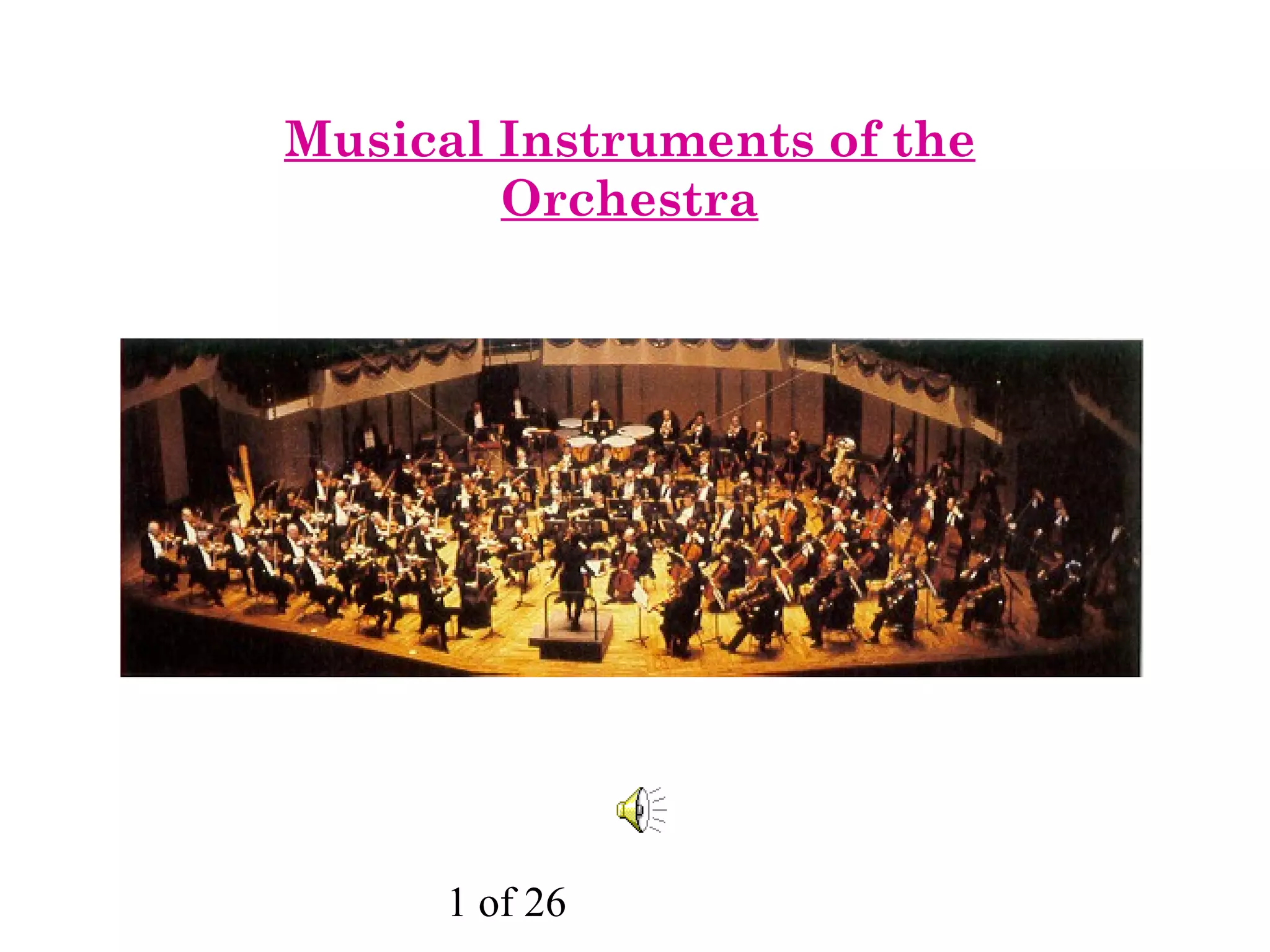
Musical Instruments of the Orchestra
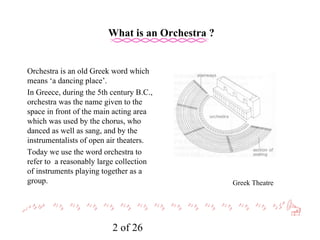
What is an Orchestra ? Orchestra is an old Greek word which means ‘a dancing place’.
In Greece, during the 5th century B.C., orchestra was the name given to the space in front of the main acting area which was used by the chorus, who danced as well as sang, and by the instrumentalists of open air theaters.
Today we use the word orchestra to refer to  a reasonably large collection of instruments playing together as a group. Greek Theatre
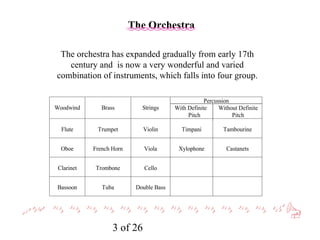
The orchestra has expanded gradually from early 17th century and  is now a very wonderful and varied combination of instruments, which falls into four group. The Orchestra
Woodwind Instruments As the name ‘woodwind’ suggests, the instruments of this section of the orchestra are mostly made of wood, though flutes are now often made of metal instead.
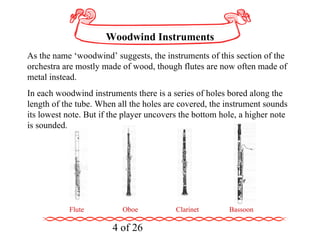
In each woodwind instruments there is a series of holes bored along the length of the tube. When all the holes are covered, the instrument sounds its lowest note. But if the player uncovers the bottom hole, a higher note is sounded. Flute Oboe Clarinet Bassoon
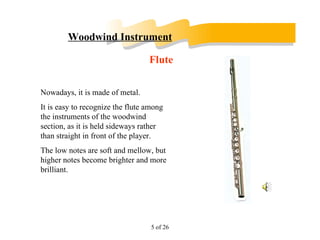
Woodwind Instrument Nowadays, it is made of metal.
It is easy to recognize the flute among the instruments of the woodwind section, as it is held sideways rather than straight in front of the player.
The low notes are soft and mellow, but higher notes become brighter and more brilliant. Flute
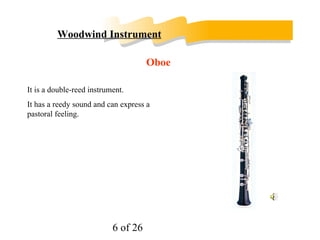
Woodwind Instrument It is a double-reed instrument.
It has a reedy sound and can express a pastoral feeling. Oboe
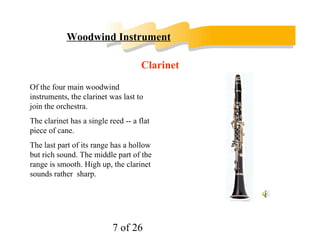
Woodwind Instrument Of the four main woodwind instruments, the clarinet was last to join the orchestra.
The clarinet has a single reed -- a flat piece of cane.
The last part of its range has a hollow but rich sound. The middle part of the range is smooth. High up, the clarinet sounds rather  sharp. Clarinet
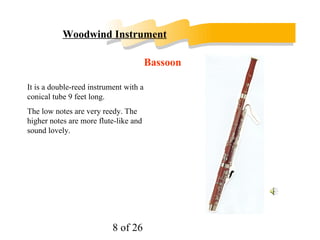
Woodwind Instrument It is a double-reed instrument with a conical tube 9 feet long.
The low notes are very reedy. The higher notes are more flute-like and sound lovely. Bassoon
Brass Instruments The sounds of the brass section, like those of the woodwind, are made by blowing.
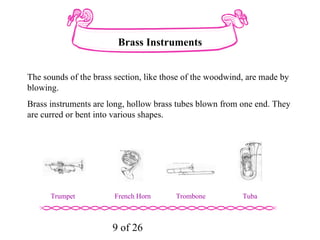
Brass instruments are long, hollow brass tubes blown from one end. They are curred or bent into various shapes. Trumpet French Horn Trombone Tuba
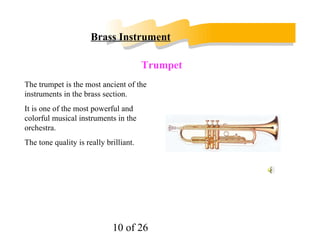
Brass Instrument The trumpet is the most ancient of the instruments in the brass section.
It is one of the most powerful and colorful musical instruments in the orchestra.
The tone quality is really brilliant. Trumpet
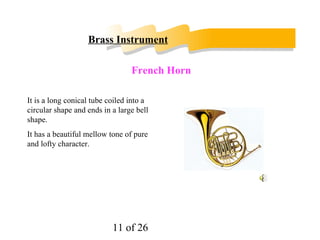
Brass Instrument It is a long conical tube coiled into a circular shape and ends in a large bell shape.
It has a beautiful mellow tone of pure and lofty character. French Horn
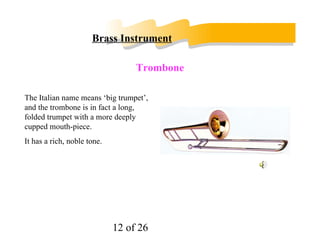
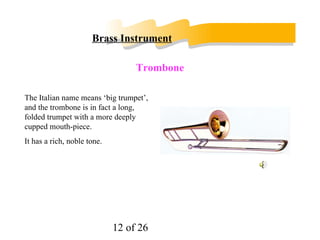
Brass Instrument The Italian name means ‘big trumpet’, and the trombone is in fact a long, folded trumpet with a more deeply cupped mouth-piece.
It has a rich, noble tone. Trombone

Musical Instruments

  • 1.
  • 2.
    What is anOrchestra ? Orchestra is an old Greek word which means ‘a dancing place’.
  • 3.
    In Greece, duringthe 5th century B.C., orchestra was the name given to the space in front of the main acting area which was used by the chorus, who danced as well as sang, and by the instrumentalists of open air theaters.
  • 4.
    Today we usethe word orchestra to refer to a reasonably large collection of instruments playing together as a group. Greek Theatre
  • 5.
    The orchestra hasexpanded gradually from early 17th century and is now a very wonderful and varied combination of instruments, which falls into four group. The Orchestra
  • 6.
    Woodwind Instruments Asthe name ‘woodwind’ suggests, the instruments of this section of the orchestra are mostly made of wood, though flutes are now often made of metal instead.
  • 7.
    In each woodwindinstruments there is a series of holes bored along the length of the tube. When all the holes are covered, the instrument sounds its lowest note. But if the player uncovers the bottom hole, a higher note is sounded. Flute Oboe Clarinet Bassoon
  • 8.
    Woodwind Instrument Nowadays,it is made of metal.
  • 9.
    It is easyto recognize the flute among the instruments of the woodwind section, as it is held sideways rather than straight in front of the player.
  • 10.
    The low notesare soft and mellow, but higher notes become brighter and more brilliant. Flute
  • 11.
    Woodwind Instrument Itis a double-reed instrument.
  • 12.
    It has areedy sound and can express a pastoral feeling. Oboe
  • 13.
    Woodwind Instrument Ofthe four main woodwind instruments, the clarinet was last to join the orchestra.
  • 14.
    The clarinet hasa single reed -- a flat piece of cane.
  • 15.
    The last partof its range has a hollow but rich sound. The middle part of the range is smooth. High up, the clarinet sounds rather sharp. Clarinet
  • 16.
    Woodwind Instrument Itis a double-reed instrument with a conical tube 9 feet long.
  • 17.
    The low notesare very reedy. The higher notes are more flute-like and sound lovely. Bassoon
  • 18.
    Brass Instruments Thesounds of the brass section, like those of the woodwind, are made by blowing.
  • 19.
    Brass instruments arelong, hollow brass tubes blown from one end. They are curred or bent into various shapes. Trumpet French Horn Trombone Tuba
  • 20.
    Brass Instrument Thetrumpet is the most ancient of the instruments in the brass section.
  • 21.
    It is oneof the most powerful and colorful musical instruments in the orchestra.
  • 22.
    The tone qualityis really brilliant. Trumpet
  • 23.
    Brass Instrument Itis a long conical tube coiled into a circular shape and ends in a large bell shape.
  • 24.
    It has abeautiful mellow tone of pure and lofty character. French Horn
  • 25.
    Brass Instrument TheItalian name means ‘big trumpet’, and the trombone is in fact a long, folded trumpet with a more deeply cupped mouth-piece.
  • 26.
    It has arich, noble tone. Trombone
  • 27.
    Brass Instrument TheItalian name means ‘big trumpet’, and the trombone is in fact a long, folded trumpet with a more deeply cupped mouth-piece.
  • 28.
    It has arich, noble tone. Trombone
  • 29.
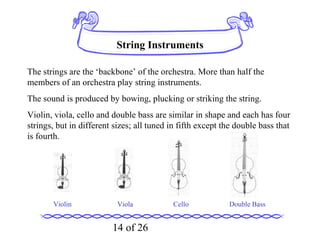
    String Instruments Thestrings are the ‘backbone’ of the orchestra. More than half the members of an orchestra play string instruments.
  • 30.
    The sound isproduced by bowing, plucking or striking the string.
  • 31.
    Violin, viola, celloand double bass are similar in shape and each has four strings, but in different sizes; all tuned in fifth except the double bass that is fourth. Violin Viola Cello Double Bass
  • 32.
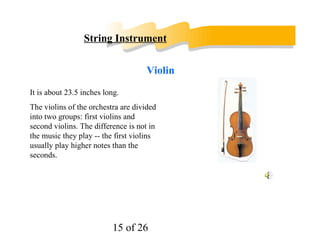
    String Instrument Itis about 23.5 inches long.
  • 33.
    The violins ofthe orchestra are divided into two groups: first violins and second violins. The difference is not in the music they play -- the first violins usually play higher notes than the seconds. Violin
  • 34.
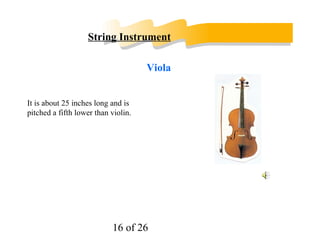
    String Instrument Itis about 25 inches long and is pitched a fifth lower than violin. Viola
  • 35.
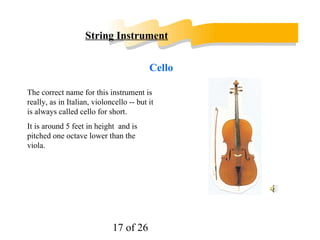
    String Instrument Thecorrect name for this instrument is really, as in Italian, violoncello -- but it is always called cello for short.
  • 36.
    It is around5 feet in height and is pitched one octave lower than the viola. Cello
  • 37.
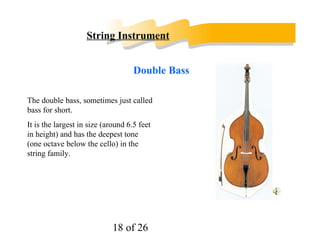
    String Instrument Thedouble bass, sometimes just called bass for short.
  • 38.
    It is thelargest in size (around 6.5 feet in height) and has the deepest tone (one octave below the cello) in the string family. Double Bass
  • 39.
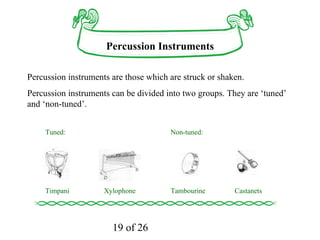
    Percussion Instruments Percussioninstruments are those which are struck or shaken.
  • 40.
    Percussion instruments canbe divided into two groups. They are ‘tuned’ and ‘non-tuned’. Tuned: Non-tuned: Timpani Xylophone Tambourine Castanets
  • 41.
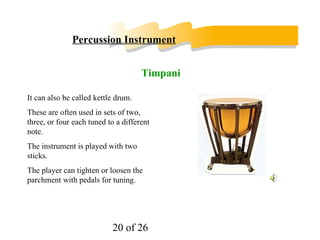
    Percussion Instrument Itcan also be called kettle drum.
  • 42.
    These are oftenused in sets of two, three, or four each tuned to a different note.
  • 43.
    The instrument isplayed with two sticks.
  • 44.
    The player cantighten or loosen the parchment with pedals for tuning. Timpani
  • 45.
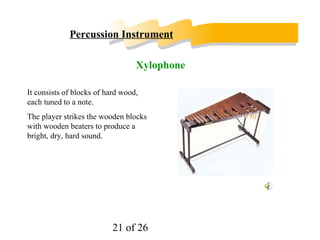
    Percussion Instrument Itconsists of blocks of hard wood, each tuned to a note.
  • 46.
    The player strikesthe wooden blocks with wooden beaters to produce a bright, dry, hard sound. Xylophone
  • 47.
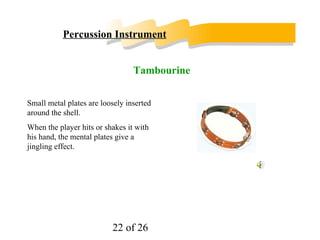
    Percussion Instrument Smallmetal plates are loosely inserted around the shell.
  • 48.
    When the playerhits or shakes it with his hand, the mental plates give a jingling effect. Tambourine
  • 49.
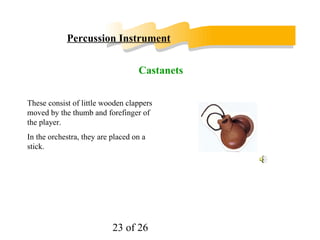
    Percussion Instrument Theseconsist of little wooden clappers moved by the thumb and forefinger of the player.
  • 50.
    In the orchestra,they are placed on a stick. Castanets
  • 51.
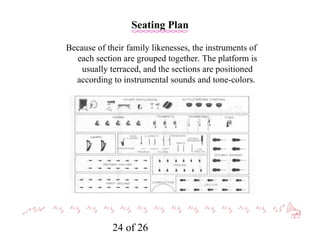
    Seating Plan Becauseof their family likenesses, the instruments of each section are grouped together. The platform is usually terraced, and the sections are positioned according to instrumental sounds and tone-colors.
  • 52.
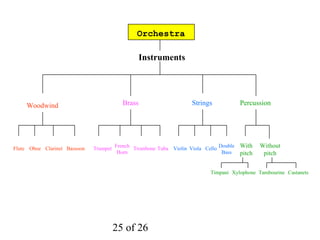
    Woodwind Flute OboeClarinet Bassoon Brass Trumpet French Horn Trombone Tuba Strings Violin Viola Cello Double Bass Percussion With pitch Without pitch Timpani Xylophone Tambourine Castanets Instruments Orchestra
  • 53.