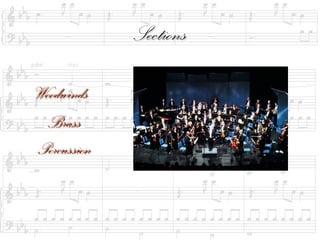
SectionsSections
WoodwindsWoodwinds
BrassBrass
PercussionPercussion
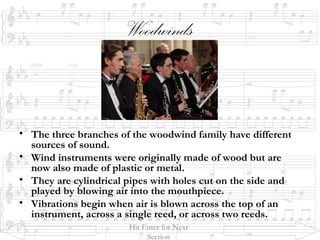
Woodwinds
• The three branches of the woodwind family have different
sources of sound.
• Wind instruments were originally made of wood but are
now also made of plastic or metal.
• They are cylindrical pipes with holes cut on the side and
played by blowing air into the mouthpiece.
• Vibrations begin when air is blown across the top of an
instrument, across a single reed, or across two reeds.
Hit Enter for Next
Section
FluteFlute
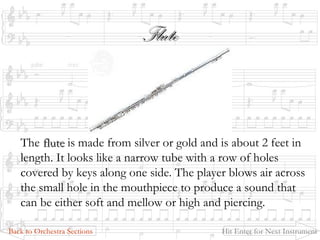
The fluteflute is made from silver or gold and is about 2 feet in
length. It looks like a narrow tube with a row of holes
covered by keys along one side. The player blows air across
the small hole in the mouthpiece to produce a sound that
can be either soft and mellow or high and piercing.
Back to Orchestra Sections Hit Enter for Next Instrument
Oboe
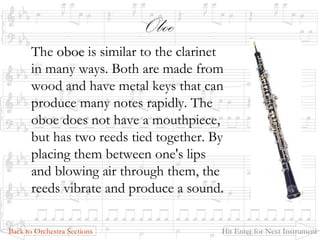
The oboeoboe is similar to the clarinet
in many ways. Both are made from
wood and have metal keys that can
produce many notes rapidly. The
oboe does not have a mouthpiece,
but has two reeds tied together. By
placing them between one's lips
and blowing air through them, the
reeds vibrate and produce a sound.
Back to Orchestra Sections Hit Enter for Next Instrument
Clarinet
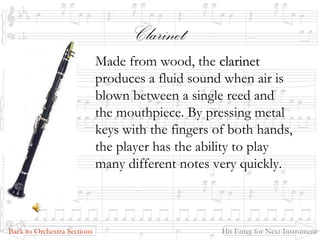
Made from wood, the clarinetclarinet
produces a fluid sound when air is
blown between a single reed and
the mouthpiece. By pressing metal
keys with the fingers of both hands,
the player has the ability to play
many different notes very quickly.
Back to Orchestra Sections Hit Enter for Next Instrument
BassoonBassoon
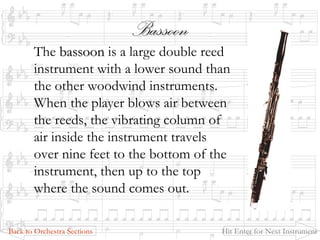
The bassoonbassoon is a large double reed
instrument with a lower sound than
the other woodwind instruments.
When the player blows air between
the reeds, the vibrating column of
air inside the instrument travels
over nine feet to the bottom of the
instrument, then up to the top
where the sound comes out.
Back to Orchestra Sections Hit Enter for Next Instrument
Brass
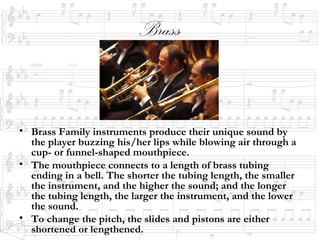
• Brass Family instruments produce their unique sound by
the player buzzing his/her lips while blowing air through a
cup- or funnel-shaped mouthpiece.
• The mouthpiece connects to a length of brass tubing
ending in a bell. The shorter the tubing length, the smaller
the instrument, and the higher the sound; and the longer
the tubing length, the larger the instrument, and the lower
the sound.
• To change the pitch, the slides and pistons are either
shortened or lengthened.
TrumpetTrumpet
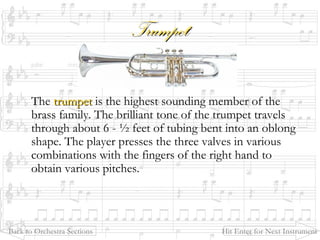
The trumpettrumpet is the highest sounding member of the
brass family. The brilliant tone of the trumpet travels
through about 6 - ½ feet of tubing bent into an oblong
shape. The player presses the three valves in various
combinations with the fingers of the right hand to
obtain various pitches.
Back to Orchestra Sections Hit Enter for Next Instrument
TromboneTrombone
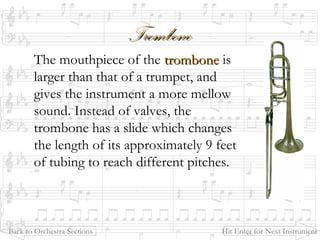
The mouthpiece of the trombonetrombone is
larger than that of a trumpet, and
gives the instrument a more mellow
sound. Instead of valves, the
trombone has a slide which changes
the length of its approximately 9 feet
of tubing to reach different pitches.
Back to Orchestra Sections Hit Enter for Next Instrument
TubaTuba
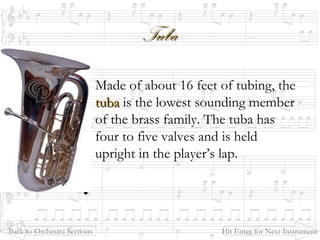
Made of about 16 feet of tubing, the
tubatuba is the lowest sounding member
of the brass family. The tuba has
four to five valves and is held
upright in the player’s lap.
•
Back to Orchestra Sections Hit Enter for Next Instrument
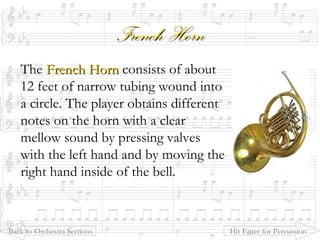
French HornFrench Horn
The French HornFrench Horn consists of about
12 feet of narrow tubing wound into
a circle. The player obtains different
notes on the horn with a clear
mellow sound by pressing valves
with the left hand and by moving the
right hand inside of the bell.
Back to Orchestra Sections Hit Enter for Percussion
Percussion
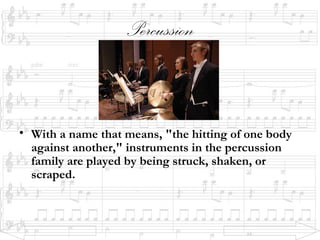
• With a name that means, "the hitting of one body
against another," instruments in the percussion
family are played by being struck, shaken, or
scraped.
Snare Drum
The snare drumsnare drum has two calfskin or plastic drumheads
stretched tightly over a hollow metal frame. The top
head is struck with wooden drumsticks, and is called the
batter-head. The bottom head, or snare-head has catgut
or metal wires called snares stretched tightly across it.
When this drum is struck on the top head, the snares
produce a characteristic sharp rattling sound as they
vibrate against the bottom head.
Back to Orchestra Sections Hit Enter for Next Instrument
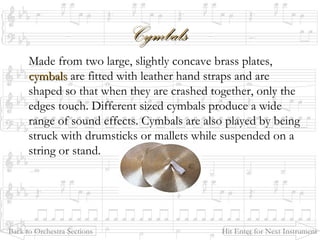
CymbalsCymbals
Made from two large, slightly concave brass plates,
cymbalscymbals are fitted with leather hand straps and are
shaped so that when they are crashed together, only the
edges touch. Different sized cymbals produce a wide
range of sound effects. Cymbals are also played by being
struck with drumsticks or mallets while suspended on a
string or stand.
Back to Orchestra Sections Hit Enter for Next Instrument
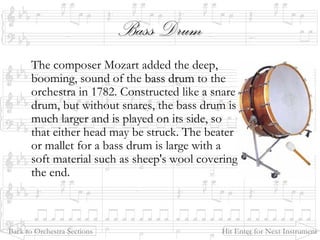
Bass DrumBass Drum
The composer Mozart added the deep,
booming, sound of the bass drumbass drum to the
orchestra in 1782. Constructed like a snare
drum, but without snares, the bass drum is
much larger and is played on its side, so
that either head may be struck. The beater
or mallet for a bass drum is large with a
soft material such as sheep's wool covering
the end.
Back to Orchestra Sections Hit Enter for Next Instrument
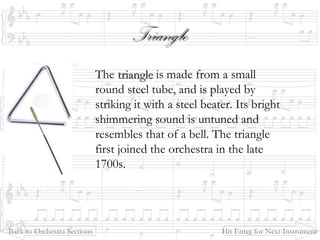
TriangleTriangle
The triangletriangle is made from a small
round steel tube, and is played by
striking it with a steel beater. Its bright
shimmering sound is untuned and
resembles that of a bell. The triangle
first joined the orchestra in the late
1700s.
Back to Orchestra Sections Hit Enter for Next Instrument
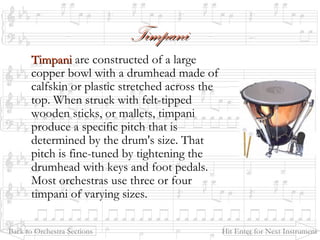
TimpaniTimpani
TimpaniTimpani are constructed of a large
copper bowl with a drumhead made of
calfskin or plastic stretched across the
top. When struck with felt-tipped
wooden sticks, or mallets, timpani
produce a specific pitch that is
determined by the drum's size. That
pitch is fine-tuned by tightening the
drumhead with keys and foot pedals.
Most orchestras use three or four
timpani of varying sizes.
Back to Orchestra Sections Hit Enter for Next Instrument
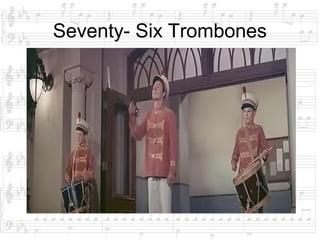
Seventy- Six Trombones
The End

musical instruments in a band

  • 2.
  • 3.
    Woodwinds • The threebranches of the woodwind family have different sources of sound. • Wind instruments were originally made of wood but are now also made of plastic or metal. • They are cylindrical pipes with holes cut on the side and played by blowing air into the mouthpiece. • Vibrations begin when air is blown across the top of an instrument, across a single reed, or across two reeds. Hit Enter for Next Section
  • 4.
    FluteFlute The fluteflute ismade from silver or gold and is about 2 feet in length. It looks like a narrow tube with a row of holes covered by keys along one side. The player blows air across the small hole in the mouthpiece to produce a sound that can be either soft and mellow or high and piercing. Back to Orchestra Sections Hit Enter for Next Instrument
  • 5.
    Oboe The oboeoboe issimilar to the clarinet in many ways. Both are made from wood and have metal keys that can produce many notes rapidly. The oboe does not have a mouthpiece, but has two reeds tied together. By placing them between one's lips and blowing air through them, the reeds vibrate and produce a sound. Back to Orchestra Sections Hit Enter for Next Instrument
  • 6.
    Clarinet Made from wood,the clarinetclarinet produces a fluid sound when air is blown between a single reed and the mouthpiece. By pressing metal keys with the fingers of both hands, the player has the ability to play many different notes very quickly. Back to Orchestra Sections Hit Enter for Next Instrument
  • 7.
    BassoonBassoon The bassoonbassoon isa large double reed instrument with a lower sound than the other woodwind instruments. When the player blows air between the reeds, the vibrating column of air inside the instrument travels over nine feet to the bottom of the instrument, then up to the top where the sound comes out. Back to Orchestra Sections Hit Enter for Next Instrument
  • 8.
    Brass • Brass Familyinstruments produce their unique sound by the player buzzing his/her lips while blowing air through a cup- or funnel-shaped mouthpiece. • The mouthpiece connects to a length of brass tubing ending in a bell. The shorter the tubing length, the smaller the instrument, and the higher the sound; and the longer the tubing length, the larger the instrument, and the lower the sound. • To change the pitch, the slides and pistons are either shortened or lengthened.
  • 9.
    TrumpetTrumpet The trumpettrumpet isthe highest sounding member of the brass family. The brilliant tone of the trumpet travels through about 6 - ½ feet of tubing bent into an oblong shape. The player presses the three valves in various combinations with the fingers of the right hand to obtain various pitches. Back to Orchestra Sections Hit Enter for Next Instrument
  • 10.
    TromboneTrombone The mouthpiece ofthe trombonetrombone is larger than that of a trumpet, and gives the instrument a more mellow sound. Instead of valves, the trombone has a slide which changes the length of its approximately 9 feet of tubing to reach different pitches. Back to Orchestra Sections Hit Enter for Next Instrument
  • 11.
    TubaTuba Made of about16 feet of tubing, the tubatuba is the lowest sounding member of the brass family. The tuba has four to five valves and is held upright in the player’s lap. • Back to Orchestra Sections Hit Enter for Next Instrument
  • 12.
    French HornFrench Horn TheFrench HornFrench Horn consists of about 12 feet of narrow tubing wound into a circle. The player obtains different notes on the horn with a clear mellow sound by pressing valves with the left hand and by moving the right hand inside of the bell. Back to Orchestra Sections Hit Enter for Percussion
  • 13.
    Percussion • With aname that means, "the hitting of one body against another," instruments in the percussion family are played by being struck, shaken, or scraped.
  • 14.
    Snare Drum The snaredrumsnare drum has two calfskin or plastic drumheads stretched tightly over a hollow metal frame. The top head is struck with wooden drumsticks, and is called the batter-head. The bottom head, or snare-head has catgut or metal wires called snares stretched tightly across it. When this drum is struck on the top head, the snares produce a characteristic sharp rattling sound as they vibrate against the bottom head. Back to Orchestra Sections Hit Enter for Next Instrument
  • 15.
    CymbalsCymbals Made from twolarge, slightly concave brass plates, cymbalscymbals are fitted with leather hand straps and are shaped so that when they are crashed together, only the edges touch. Different sized cymbals produce a wide range of sound effects. Cymbals are also played by being struck with drumsticks or mallets while suspended on a string or stand. Back to Orchestra Sections Hit Enter for Next Instrument
  • 16.
    Bass DrumBass Drum Thecomposer Mozart added the deep, booming, sound of the bass drumbass drum to the orchestra in 1782. Constructed like a snare drum, but without snares, the bass drum is much larger and is played on its side, so that either head may be struck. The beater or mallet for a bass drum is large with a soft material such as sheep's wool covering the end. Back to Orchestra Sections Hit Enter for Next Instrument
  • 17.
    TriangleTriangle The triangletriangle ismade from a small round steel tube, and is played by striking it with a steel beater. Its bright shimmering sound is untuned and resembles that of a bell. The triangle first joined the orchestra in the late 1700s. Back to Orchestra Sections Hit Enter for Next Instrument
  • 18.
    TimpaniTimpani TimpaniTimpani are constructedof a large copper bowl with a drumhead made of calfskin or plastic stretched across the top. When struck with felt-tipped wooden sticks, or mallets, timpani produce a specific pitch that is determined by the drum's size. That pitch is fine-tuned by tightening the drumhead with keys and foot pedals. Most orchestras use three or four timpani of varying sizes. Back to Orchestra Sections Hit Enter for Next Instrument
  • 19.
  • 20.