PERCUSSION INSTRUMENT
A percussion instrument is a musical
instrument that is sounded by being struck
or scraped by a beater (including attached or
enclosed beaters or rattles); struck, scraped
or rubbed by hand; or struck against
another similar instrument. The percussion
family is believed to include the oldest
musical instruments, following the human
voice.
Function
Percussion instruments may play
not only rhythm, but
also melody and harmony. Percussion
is commonly referred to as "the
backbone" or "the heartbeat" of a
musical ensemble, often working in
close collaboration with bass
instruments, when present.
RHYTHMIC
PERCUSSIONS
DRUM SET
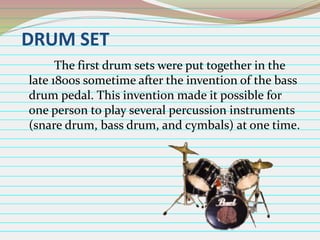
The first drum sets were put together in the
late 1800s sometime after the invention of the bass
drum pedal. This invention made it possible for
one person to play several percussion instruments
(snare drum, bass drum, and cymbals) at one time.
BASS DRUM
This drum is the largest member of the set and
is played by using a foot pedal attached to a beater
which then strikes the drum head. This drum
produces a low deep sound.
SNARE DRUM
This shallow, cylindrical drum produces a
sound that is very distinctive to the drum (higher
in pitch than the bass drum). The snares, which
are bands of metal wires, are pulled across the
bottom head of the drum.
CYMBALS
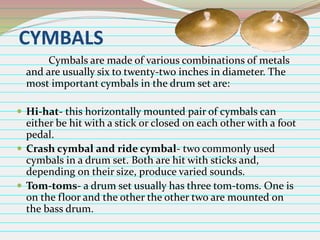
Cymbals are made of various combinations of metals
and are usually six to twenty-two inches in diameter. The
most important cymbals in the drum set are:
 Hi-hat- this horizontally mounted pair of cymbals can

either be hit with a stick or closed on each other with a foot
pedal.
 Crash cymbal and ride cymbal- two commonly used
cymbals in a drum set. Both are hit with sticks and,
depending on their size, produce varied sounds.
 Tom-toms- a drum set usually has three tom-toms. One is
on the floor and the other the other two are mounted on
the bass drum.
TIMPANI
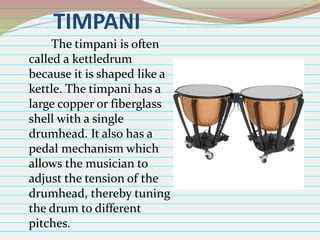
The timpani is often
called a kettledrum
because it is shaped like a
kettle. The timpani has a
large copper or fiberglass
shell with a single
drumhead. It also has a
pedal mechanism which
allows the musician to
adjust the tension of the
drumhead, thereby tuning
the drum to different
pitches.
OTHER PERCUSSION INSTRUMENTS
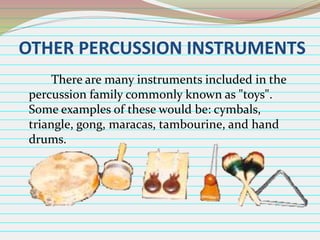
There are many instruments included in the
percussion family commonly known as "toys".
Some examples of these would be: cymbals,
triangle, gong, maracas, tambourine, and hand
drums.
CYMBAL
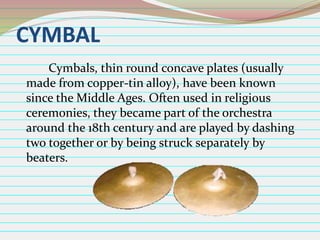
Cymbals, thin round concave plates (usually
made from copper-tin alloy), have been known
since the Middle Ages. Often used in religious
ceremonies, they became part of the orchestra
around the 18th century and are played by dashing
two together or by being struck separately by
beaters.
TRIANGLE
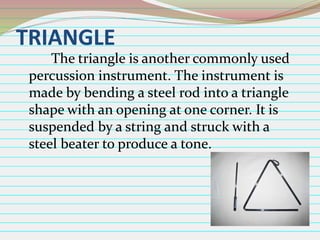
The triangle is another commonly used
percussion instrument. The instrument is
made by bending a steel rod into a triangle
shape with an opening at one corner. It is
suspended by a string and struck with a
steel beater to produce a tone.
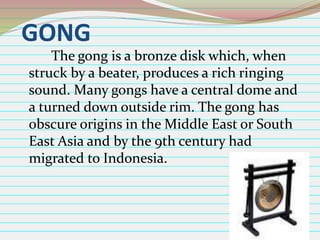
GONG
The gong is a bronze disk which, when
struck by a beater, produces a rich ringing
sound. Many gongs have a central dome and
a turned down outside rim. The gong has
obscure origins in the Middle East or South
East Asia and by the 9th century had
migrated to Indonesia.
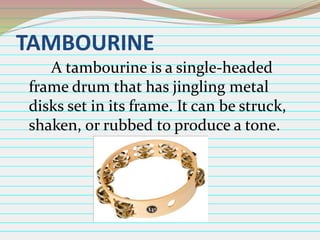
TAMBOURINE
A tambourine is a single-headed
frame drum that has jingling metal
disks set in its frame. It can be struck,
shaken, or rubbed to produce a tone.
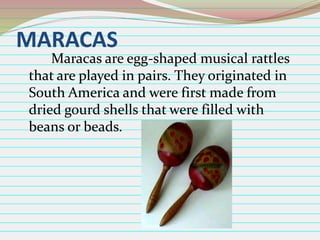
MARACAS

Maracas are egg-shaped musical rattles
that are played in pairs. They originated in
South America and were first made from
dried gourd shells that were filled with
beans or beads.
MELODIC
PERCUSSIONS
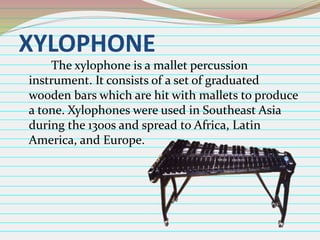
XYLOPHONE
The xylophone is a mallet percussion
instrument. It consists of a set of graduated
wooden bars which are hit with mallets to produce
a tone. Xylophones were used in Southeast Asia
during the 1300s and spread to Africa, Latin
America, and Europe.
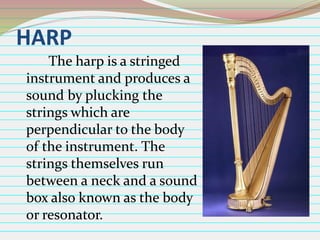
HARP
The harp is a stringed
instrument and produces a
sound by plucking the
strings which are
perpendicular to the body
of the instrument. The
strings themselves run
between a neck and a sound
box also known as the body
or resonator.
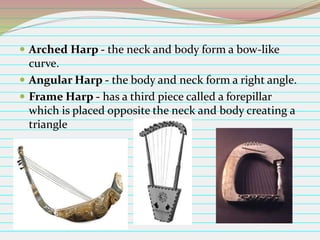
 Arched Harp - the neck and body form a bow-like

curve.
 Angular Harp - the body and neck form a right angle.
 Frame Harp - has a third piece called a forepillar
which is placed opposite the neck and body creating a
triangle
STRING INSRUMENTS
String instruments may be played with
or without a bow. These instruments
produce sound when strummed, plucked,
struck or slapped. Under the SachsHornbostel system, these instruments are
classified as chordophones.
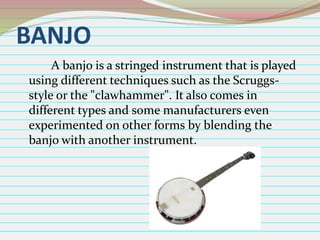
BANJO
A banjo is a stringed instrument that is played
using different techniques such as the Scruggsstyle or the "clawhammer". It also comes in
different types and some manufacturers even
experimented on other forms by blending the
banjo with another instrument.
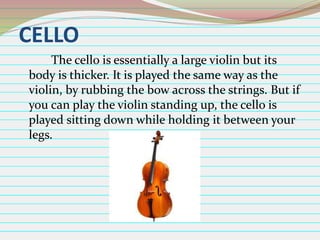
CELLO
The cello is essentially a large violin but its
body is thicker. It is played the same way as the
violin, by rubbing the bow across the strings. But if
you can play the violin standing up, the cello is
played sitting down while holding it between your
legs.
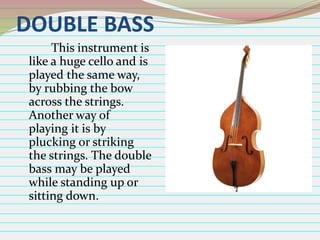
DOUBLE BASS
This instrument is
like a huge cello and is
played the same way,
by rubbing the bow
across the strings.
Another way of
playing it is by
plucking or striking
the strings. The double
bass may be played
while standing up or
sitting down.
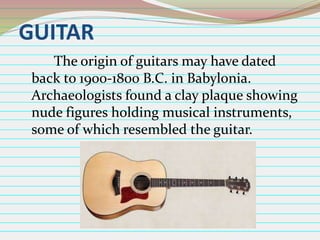
GUITAR
The origin of guitars may have dated
back to 1900-1800 B.C. in Babylonia.
Archaeologists found a clay plaque showing
nude figures holding musical instruments,
some of which resembled the guitar.
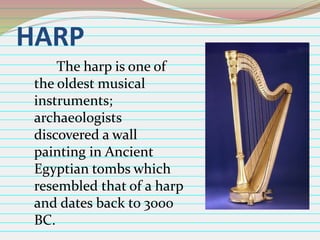
HARP
The harp is one of
the oldest musical
instruments;
archaeologists
discovered a wall
painting in Ancient
Egyptian tombs which
resembled that of a harp
and dates back to 3000
BC.
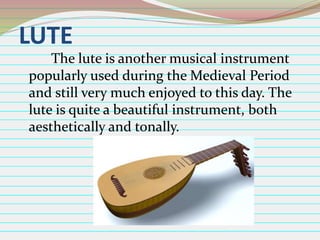
LUTE
The lute is another musical instrument
popularly used during the Medieval Period
and still very much enjoyed to this day. The
lute is quite a beautiful instrument, both
aesthetically and tonally.
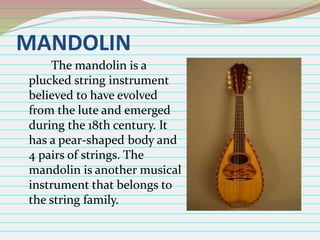
MANDOLIN
The mandolin is a
plucked string instrument
believed to have evolved
from the lute and emerged
during the 18th century. It
has a pear-shaped body and
4 pairs of strings. The
mandolin is another musical
instrument that belongs to
the string family.
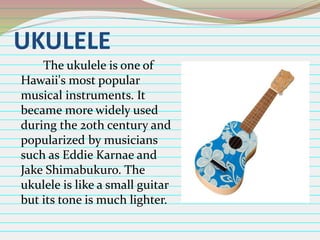
UKULELE
The ukulele is one of
Hawaii's most popular
musical instruments. It
became more widely used
during the 20th century and
popularized by musicians
such as Eddie Karnae and
Jake Shimabukuro. The
ukulele is like a small guitar
but its tone is much lighter.
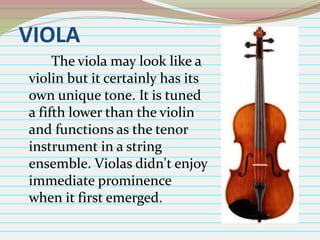
VIOLA
The viola may look like a
violin but it certainly has its
own unique tone. It is tuned
a fifth lower than the violin
and functions as the tenor
instrument in a string
ensemble. Violas didn't enjoy
immediate prominence
when it first emerged.
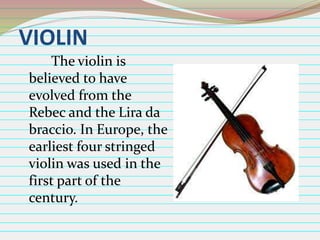
VIOLIN
The violin is
believed to have
evolved from the
Rebec and the Lira da
braccio. In Europe, the
earliest four stringed
violin was used in the
first part of the
century.
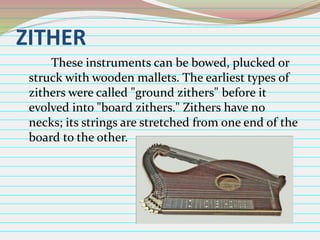
ZITHER
These instruments can be bowed, plucked or
struck with wooden mallets. The earliest types of
zithers were called "ground zithers" before it
evolved into "board zithers." Zithers have no
necks; its strings are stretched from one end of the
board to the other.
END


Stringed and Percussion Instruments

  • 2.
    PERCUSSION INSTRUMENT A percussioninstrument is a musical instrument that is sounded by being struck or scraped by a beater (including attached or enclosed beaters or rattles); struck, scraped or rubbed by hand; or struck against another similar instrument. The percussion family is believed to include the oldest musical instruments, following the human voice.
  • 3.
    Function Percussion instruments mayplay not only rhythm, but also melody and harmony. Percussion is commonly referred to as "the backbone" or "the heartbeat" of a musical ensemble, often working in close collaboration with bass instruments, when present.
  • 4.
  • 5.
    DRUM SET The firstdrum sets were put together in the late 1800s sometime after the invention of the bass drum pedal. This invention made it possible for one person to play several percussion instruments (snare drum, bass drum, and cymbals) at one time.
  • 6.
    BASS DRUM This drumis the largest member of the set and is played by using a foot pedal attached to a beater which then strikes the drum head. This drum produces a low deep sound. SNARE DRUM This shallow, cylindrical drum produces a sound that is very distinctive to the drum (higher in pitch than the bass drum). The snares, which are bands of metal wires, are pulled across the bottom head of the drum.
  • 7.
    CYMBALS Cymbals are madeof various combinations of metals and are usually six to twenty-two inches in diameter. The most important cymbals in the drum set are:  Hi-hat- this horizontally mounted pair of cymbals can either be hit with a stick or closed on each other with a foot pedal.  Crash cymbal and ride cymbal- two commonly used cymbals in a drum set. Both are hit with sticks and, depending on their size, produce varied sounds.  Tom-toms- a drum set usually has three tom-toms. One is on the floor and the other the other two are mounted on the bass drum.
  • 8.
    TIMPANI The timpani isoften called a kettledrum because it is shaped like a kettle. The timpani has a large copper or fiberglass shell with a single drumhead. It also has a pedal mechanism which allows the musician to adjust the tension of the drumhead, thereby tuning the drum to different pitches.
  • 9.
    OTHER PERCUSSION INSTRUMENTS Thereare many instruments included in the percussion family commonly known as "toys". Some examples of these would be: cymbals, triangle, gong, maracas, tambourine, and hand drums.
  • 10.
    CYMBAL Cymbals, thin roundconcave plates (usually made from copper-tin alloy), have been known since the Middle Ages. Often used in religious ceremonies, they became part of the orchestra around the 18th century and are played by dashing two together or by being struck separately by beaters.
  • 11.
    TRIANGLE The triangle isanother commonly used percussion instrument. The instrument is made by bending a steel rod into a triangle shape with an opening at one corner. It is suspended by a string and struck with a steel beater to produce a tone.
  • 12.
    GONG The gong isa bronze disk which, when struck by a beater, produces a rich ringing sound. Many gongs have a central dome and a turned down outside rim. The gong has obscure origins in the Middle East or South East Asia and by the 9th century had migrated to Indonesia.
  • 13.
    TAMBOURINE A tambourine isa single-headed frame drum that has jingling metal disks set in its frame. It can be struck, shaken, or rubbed to produce a tone.
  • 14.
    MARACAS Maracas are egg-shapedmusical rattles that are played in pairs. They originated in South America and were first made from dried gourd shells that were filled with beans or beads.
  • 15.
  • 16.
    XYLOPHONE The xylophone isa mallet percussion instrument. It consists of a set of graduated wooden bars which are hit with mallets to produce a tone. Xylophones were used in Southeast Asia during the 1300s and spread to Africa, Latin America, and Europe.
  • 17.
    HARP The harp isa stringed instrument and produces a sound by plucking the strings which are perpendicular to the body of the instrument. The strings themselves run between a neck and a sound box also known as the body or resonator.
  • 18.
     Arched Harp- the neck and body form a bow-like curve.  Angular Harp - the body and neck form a right angle.  Frame Harp - has a third piece called a forepillar which is placed opposite the neck and body creating a triangle
  • 19.
    STRING INSRUMENTS String instrumentsmay be played with or without a bow. These instruments produce sound when strummed, plucked, struck or slapped. Under the SachsHornbostel system, these instruments are classified as chordophones.
  • 20.
    BANJO A banjo isa stringed instrument that is played using different techniques such as the Scruggsstyle or the "clawhammer". It also comes in different types and some manufacturers even experimented on other forms by blending the banjo with another instrument.
  • 21.
    CELLO The cello isessentially a large violin but its body is thicker. It is played the same way as the violin, by rubbing the bow across the strings. But if you can play the violin standing up, the cello is played sitting down while holding it between your legs.
  • 22.
    DOUBLE BASS This instrumentis like a huge cello and is played the same way, by rubbing the bow across the strings. Another way of playing it is by plucking or striking the strings. The double bass may be played while standing up or sitting down.
  • 23.
    GUITAR The origin ofguitars may have dated back to 1900-1800 B.C. in Babylonia. Archaeologists found a clay plaque showing nude figures holding musical instruments, some of which resembled the guitar.
  • 24.
    HARP The harp isone of the oldest musical instruments; archaeologists discovered a wall painting in Ancient Egyptian tombs which resembled that of a harp and dates back to 3000 BC.
  • 25.
    LUTE The lute isanother musical instrument popularly used during the Medieval Period and still very much enjoyed to this day. The lute is quite a beautiful instrument, both aesthetically and tonally.
  • 26.
    MANDOLIN The mandolin isa plucked string instrument believed to have evolved from the lute and emerged during the 18th century. It has a pear-shaped body and 4 pairs of strings. The mandolin is another musical instrument that belongs to the string family.
  • 27.
    UKULELE The ukulele isone of Hawaii's most popular musical instruments. It became more widely used during the 20th century and popularized by musicians such as Eddie Karnae and Jake Shimabukuro. The ukulele is like a small guitar but its tone is much lighter.
  • 28.
    VIOLA The viola maylook like a violin but it certainly has its own unique tone. It is tuned a fifth lower than the violin and functions as the tenor instrument in a string ensemble. Violas didn't enjoy immediate prominence when it first emerged.
  • 29.
    VIOLIN The violin is believedto have evolved from the Rebec and the Lira da braccio. In Europe, the earliest four stringed violin was used in the first part of the century.
  • 30.
    ZITHER These instruments canbe bowed, plucked or struck with wooden mallets. The earliest types of zithers were called "ground zithers" before it evolved into "board zithers." Zithers have no necks; its strings are stretched from one end of the board to the other.
  • 31.