Music TherapyMusic Therapy
Professional OverviewProfessional Overview
What is Music Therapy?What is Music Therapy?
Music Therapy is an established healthcareMusic Therapy is an established healthcare
profession that uses music to address physical,profession that uses music to address physical,
emotional, cognitive, and social needs ofemotional, cognitive, and social needs of
individuals of all ages. Music Therapist useindividuals of all ages. Music Therapist use
music to work on non-music goals…music to work on non-music goals…
Non-Music Goals…Non-Music Goals…
• promote wellnesspromote wellness
• manage stressmanage stress
• alleviate painalleviate pain
• express feelingsexpress feelings
• enhance memoryenhance memory
• improve communicationimprove communication
• promote physical rehabilitation.promote physical rehabilitation.
Music Therapy: A Brief HistoryMusic Therapy: A Brief History
The earliest known writings of the use of music as a healingThe earliest known writings of the use of music as a healing
influence were written during the times of Aristotle and Platoinfluence were written during the times of Aristotle and Plato
The 20th century discipline began after World War I and WorldThe 20th century discipline began after World War I and World
War II when musicians of all types, went to Veterans hospitalsWar II when musicians of all types, went to Veterans hospitals
around the country to play for the thousands of veteransaround the country to play for the thousands of veterans
suffering both physical and emotional trauma from the wars. Thesuffering both physical and emotional trauma from the wars. The
patients' notable physical and emotional responses to music ledpatients' notable physical and emotional responses to music led
the doctors and nurses to request the hiring of musicians by thethe doctors and nurses to request the hiring of musicians by the
hospitals. It was soon evident that the hospital musicians neededhospitals. It was soon evident that the hospital musicians needed
some prior training before entering the facility and so thesome prior training before entering the facility and so the
demand grew for a college curriculum. The first music therapydemand grew for a college curriculum. The first music therapy
degree program in the world, founded at Michigandegree program in the world, founded at Michigan
History cont…History cont…
State University in 1944, celebrated its 50th anniversary in 1994. The AmericanState University in 1944, celebrated its 50th anniversary in 1994. The American
Music Therapy Association was founded in 1998 as a union of the NationalMusic Therapy Association was founded in 1998 as a union of the National
Association for Music Therapy and the American Association for MusicAssociation for Music Therapy and the American Association for Music
therapy.therapy.
There are now many research journals dedicated to the studies of music and itsThere are now many research journals dedicated to the studies of music and its
therapeutic value's as well as organizations dedicated to the continued growththerapeutic value's as well as organizations dedicated to the continued growth
of music therapy as a profession.of music therapy as a profession.
Research Journals:Research Journals:
Journal of Music TherapyJournal of Music Therapy
Music Therapy PerspectivesMusic Therapy Perspectives
Music therapy improves the quality of life for personsMusic therapy improves the quality of life for persons
who are well and for those who are not well. Musicwho are well and for those who are not well. Music
Therapists work with all populations.Therapists work with all populations.
Music Therapy is often usedMusic Therapy is often used
in conjunction with otherin conjunction with other
therapies such as:therapies such as:
SpeechSpeech
OccupationalOccupational
Dance/MovementDance/Movement
PhysicalPhysical
ArtArt
Who can benefit from music therapy?Who can benefit from music therapy?
• ChildrenChildren
• AdolescentsAdolescents
• elderly with mentalelderly with mental
health needs,health needs,
developmental anddevelopmental and
learning disabilities,learning disabilities,
Alzheimer's disease andAlzheimer's disease and
other aging relatedother aging related
conditionsconditions
People with…People with…
• substance abusesubstance abuse
problems, brain injuries,problems, brain injuries,
physical disabilities, andphysical disabilities, and
acute and chronic pain,acute and chronic pain,
• mothers in labormothers in labor
Where do Music Therapists work?Where do Music Therapists work?
• psychiatric hospitals,psychiatric hospitals,
• rehabilitative facilities,rehabilitative facilities,
• medical hospitals,medical hospitals,
• outpatient clinics,outpatient clinics,
• day care treatment centersday care treatment centers
• agencies servingagencies serving
developmentally disableddevelopmentally disabled
personspersons
• community mental healthcommunity mental health
centerscenters
• drug and alcohol programs,drug and alcohol programs,
senior centerssenior centers
• nursing homesnursing homes
• hospice programshospice programs
• correctional facilitiescorrectional facilities
• halfway houseshalfway houses
• schoolsschools
• private practiceprivate practice
Qualifications of a Music Therapist:Qualifications of a Music Therapist:
Education Requirements:Education Requirements:
 Bachelor’s of Music in Music TherapyBachelor’s of Music in Music Therapy
-Music classes include Music Theory, Sightsinging, Music History, World Music-Music classes include Music Theory, Sightsinging, Music History, World Music
Cultures, Applied Music Lessons, Ensembles, Intro to String, Wind,Cultures, Applied Music Lessons, Ensembles, Intro to String, Wind,
and Percussions Instruments, Class Pianoand Percussions Instruments, Class Piano
-Music Therapy classes include: Introduction to Music Therapy, Non-Verbal-Music Therapy classes include: Introduction to Music Therapy, Non-Verbal
Communication, Choral Conducting, Psychology of Music, Music Therapy, Guitar,Communication, Choral Conducting, Psychology of Music, Music Therapy, Guitar,
Music Recreational TechniquesMusic Recreational Techniques
-Psychology Courses- Intro to Brain and Behavior, General Psychology, Psychology of-Psychology Courses- Intro to Brain and Behavior, General Psychology, Psychology of
Women, etc (psychology electives-enough to complete a minor in psychology)Women, etc (psychology electives-enough to complete a minor in psychology)
 Three to six month internshipThree to six month internship
 Board Certification:Board Certification: successfully complete the independently administeredsuccessfully complete the independently administered
examination hold the music therapist-board certified credential (MT-BC).examination hold the music therapist-board certified credential (MT-BC).
Where’s the Music?Where’s the Music?
For music to be truly effectiveFor music to be truly effective
in the healing process it isin the healing process it is
best if it is performed live.best if it is performed live.
Therefore music therapist’sTherefore music therapist’s
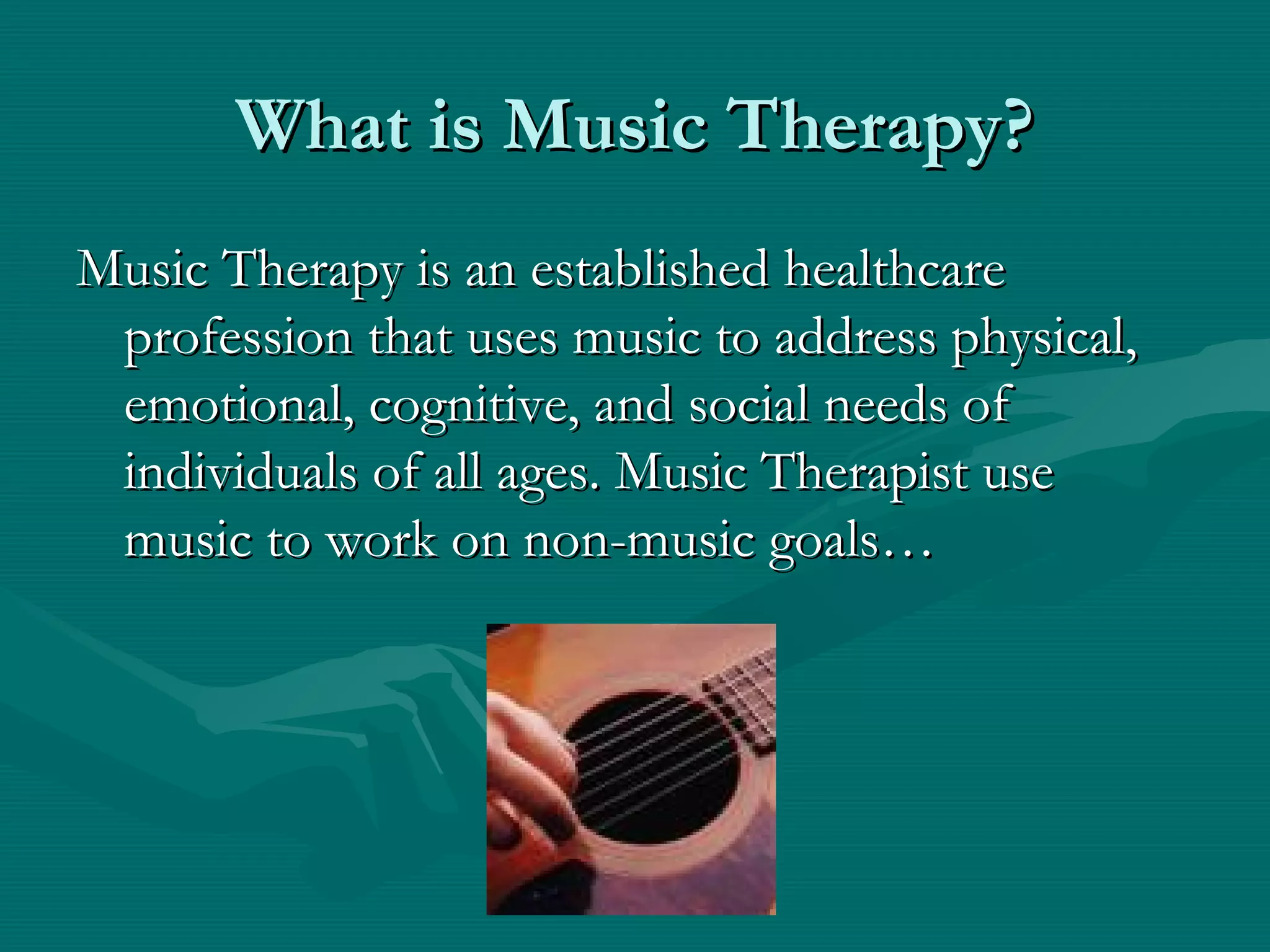
study guitar as a secondarystudy guitar as a secondary
instrument.instrument.
Guitars are portable, easy toGuitars are portable, easy to
carry into any environmentcarry into any environment
(hospitals, schools etc.), and(hospitals, schools etc.), and
provide great liveprovide great live
accompaniment for any pieceaccompaniment for any piece
of music.of music.
Where’s the Music Cont.Where’s the Music Cont.
Music Therapists use patientMusic Therapists use patient
preferred music.preferred music.
For example, if I was working on breathingFor example, if I was working on breathing
techniques with a geriatric patient thattechniques with a geriatric patient that
recently underwent surgery I would notrecently underwent surgery I would not
want to “jam out” with Metallica’swant to “jam out” with Metallica’s
Enter Sandman. An early Elvis PresleyEnter Sandman. An early Elvis Presley
might be a better choice.might be a better choice.
In conclusion, musicIn conclusion, music
therapists are continuallytherapists are continually
building their musicbuilding their music
repertoire to fit specificrepertoire to fit specific
clientele.clientele. For example:For example: II
currently have Patsy Cline, The Mama’scurrently have Patsy Cline, The Mama’s
and the Papa’s, Hendrix, Theand the Papa’s, Hendrix, The
Carpenters, Brittany Spears in myCarpenters, Brittany Spears in my
selectionselection
Music Therapy at FSUMusic Therapy at FSU
• PhilosophyPhilosophy
Selection and preparation in Music Therapy at Florida StateSelection and preparation in Music Therapy at Florida State
University is based upon an important yet extremely simpleUniversity is based upon an important yet extremely simple
premise -- it is, that every client receiving music therapy servicespremise -- it is, that every client receiving music therapy services
should have the best clinical assistance possible.should have the best clinical assistance possible.
• This implies that every therapist should be committed to theThis implies that every therapist should be committed to the
subject of music and its therapeutic use with people. Thesubject of music and its therapeutic use with people. The
strength of this commitment is evidenced by the academic andstrength of this commitment is evidenced by the academic and
social behaviors of the prospective therapist in life, both in andsocial behaviors of the prospective therapist in life, both in and
out of the university environment.out of the university environment.
• The FSU Music Therapy student is characterized by diligence inThe FSU Music Therapy student is characterized by diligence in
the pursuit of musical and academic excellence and activethe pursuit of musical and academic excellence and active
dedication to the improvement of the quality of life of theirdedication to the improvement of the quality of life of their
fellow human beings.fellow human beings.
Thank you for viewing my presentation…Thank you for viewing my presentation…
For more information about music therapy pleaseFor more information about music therapy please
visit:visit:
The College of Music websiteThe College of Music website www.music.fsu.eduwww.music.fsu.edu
American Music Therapy AssociationAmerican Music Therapy Association
www.musictherapy.orgwww.musictherapy.org
THE END…..THE END…..
Please visit Sarah Quinney’s webpage and view herPlease visit Sarah Quinney’s webpage and view her
powerpoint about sign languagepowerpoint about sign language
garnet.acns.fsu.edu/~shq03/musictechgarnet.acns.fsu.edu/~shq03/musictech
Music Therapist use non-verbal communicationMusic Therapist use non-verbal communication
(such as sign language) to communicate with(such as sign language) to communicate with
special populations.special populations.

Music therapy

  • 1.
    Music TherapyMusic Therapy ProfessionalOverviewProfessional Overview
  • 2.
    What is MusicTherapy?What is Music Therapy? Music Therapy is an established healthcareMusic Therapy is an established healthcare profession that uses music to address physical,profession that uses music to address physical, emotional, cognitive, and social needs ofemotional, cognitive, and social needs of individuals of all ages. Music Therapist useindividuals of all ages. Music Therapist use music to work on non-music goals…music to work on non-music goals…
  • 3.
    Non-Music Goals…Non-Music Goals… •promote wellnesspromote wellness • manage stressmanage stress • alleviate painalleviate pain • express feelingsexpress feelings • enhance memoryenhance memory • improve communicationimprove communication • promote physical rehabilitation.promote physical rehabilitation.
  • 4.
    Music Therapy: ABrief HistoryMusic Therapy: A Brief History The earliest known writings of the use of music as a healingThe earliest known writings of the use of music as a healing influence were written during the times of Aristotle and Platoinfluence were written during the times of Aristotle and Plato The 20th century discipline began after World War I and WorldThe 20th century discipline began after World War I and World War II when musicians of all types, went to Veterans hospitalsWar II when musicians of all types, went to Veterans hospitals around the country to play for the thousands of veteransaround the country to play for the thousands of veterans suffering both physical and emotional trauma from the wars. Thesuffering both physical and emotional trauma from the wars. The patients' notable physical and emotional responses to music ledpatients' notable physical and emotional responses to music led the doctors and nurses to request the hiring of musicians by thethe doctors and nurses to request the hiring of musicians by the hospitals. It was soon evident that the hospital musicians neededhospitals. It was soon evident that the hospital musicians needed some prior training before entering the facility and so thesome prior training before entering the facility and so the demand grew for a college curriculum. The first music therapydemand grew for a college curriculum. The first music therapy degree program in the world, founded at Michigandegree program in the world, founded at Michigan
  • 5.
    History cont…History cont… StateUniversity in 1944, celebrated its 50th anniversary in 1994. The AmericanState University in 1944, celebrated its 50th anniversary in 1994. The American Music Therapy Association was founded in 1998 as a union of the NationalMusic Therapy Association was founded in 1998 as a union of the National Association for Music Therapy and the American Association for MusicAssociation for Music Therapy and the American Association for Music therapy.therapy. There are now many research journals dedicated to the studies of music and itsThere are now many research journals dedicated to the studies of music and its therapeutic value's as well as organizations dedicated to the continued growththerapeutic value's as well as organizations dedicated to the continued growth of music therapy as a profession.of music therapy as a profession. Research Journals:Research Journals: Journal of Music TherapyJournal of Music Therapy Music Therapy PerspectivesMusic Therapy Perspectives
  • 6.
    Music therapy improvesthe quality of life for personsMusic therapy improves the quality of life for persons who are well and for those who are not well. Musicwho are well and for those who are not well. Music Therapists work with all populations.Therapists work with all populations.
  • 7.
    Music Therapy isoften usedMusic Therapy is often used in conjunction with otherin conjunction with other therapies such as:therapies such as: SpeechSpeech OccupationalOccupational Dance/MovementDance/Movement PhysicalPhysical ArtArt
  • 8.
    Who can benefitfrom music therapy?Who can benefit from music therapy? • ChildrenChildren • AdolescentsAdolescents • elderly with mentalelderly with mental health needs,health needs, developmental anddevelopmental and learning disabilities,learning disabilities, Alzheimer's disease andAlzheimer's disease and other aging relatedother aging related conditionsconditions People with…People with… • substance abusesubstance abuse problems, brain injuries,problems, brain injuries, physical disabilities, andphysical disabilities, and acute and chronic pain,acute and chronic pain, • mothers in labormothers in labor
  • 9.
    Where do MusicTherapists work?Where do Music Therapists work? • psychiatric hospitals,psychiatric hospitals, • rehabilitative facilities,rehabilitative facilities, • medical hospitals,medical hospitals, • outpatient clinics,outpatient clinics, • day care treatment centersday care treatment centers • agencies servingagencies serving developmentally disableddevelopmentally disabled personspersons • community mental healthcommunity mental health centerscenters • drug and alcohol programs,drug and alcohol programs, senior centerssenior centers • nursing homesnursing homes • nursing homesnursing homes • hospice programshospice programs • correctional facilitiescorrectional facilities • halfway houseshalfway houses • schoolsschools • private practiceprivate practice
  • 10.
    Qualifications of aMusic Therapist:Qualifications of a Music Therapist: Education Requirements:Education Requirements:  Bachelor’s of Music in Music TherapyBachelor’s of Music in Music Therapy -Music classes include Music Theory, Sightsinging, Music History, World Music-Music classes include Music Theory, Sightsinging, Music History, World Music Cultures, Applied Music Lessons, Ensembles, Intro to String, Wind,Cultures, Applied Music Lessons, Ensembles, Intro to String, Wind, and Percussions Instruments, Class Pianoand Percussions Instruments, Class Piano -Music Therapy classes include: Introduction to Music Therapy, Non-Verbal-Music Therapy classes include: Introduction to Music Therapy, Non-Verbal Communication, Choral Conducting, Psychology of Music, Music Therapy, Guitar,Communication, Choral Conducting, Psychology of Music, Music Therapy, Guitar, Music Recreational TechniquesMusic Recreational Techniques -Psychology Courses- Intro to Brain and Behavior, General Psychology, Psychology of-Psychology Courses- Intro to Brain and Behavior, General Psychology, Psychology of Women, etc (psychology electives-enough to complete a minor in psychology)Women, etc (psychology electives-enough to complete a minor in psychology)  Three to six month internshipThree to six month internship  Board Certification:Board Certification: successfully complete the independently administeredsuccessfully complete the independently administered examination hold the music therapist-board certified credential (MT-BC).examination hold the music therapist-board certified credential (MT-BC).
  • 11.
    Where’s the Music?Where’sthe Music? For music to be truly effectiveFor music to be truly effective in the healing process it isin the healing process it is best if it is performed live.best if it is performed live. Therefore music therapist’sTherefore music therapist’s study guitar as a secondarystudy guitar as a secondary instrument.instrument. Guitars are portable, easy toGuitars are portable, easy to carry into any environmentcarry into any environment (hospitals, schools etc.), and(hospitals, schools etc.), and provide great liveprovide great live accompaniment for any pieceaccompaniment for any piece of music.of music.
  • 12.
    Where’s the MusicCont.Where’s the Music Cont. Music Therapists use patientMusic Therapists use patient preferred music.preferred music. For example, if I was working on breathingFor example, if I was working on breathing techniques with a geriatric patient thattechniques with a geriatric patient that recently underwent surgery I would notrecently underwent surgery I would not want to “jam out” with Metallica’swant to “jam out” with Metallica’s Enter Sandman. An early Elvis PresleyEnter Sandman. An early Elvis Presley might be a better choice.might be a better choice. In conclusion, musicIn conclusion, music therapists are continuallytherapists are continually building their musicbuilding their music repertoire to fit specificrepertoire to fit specific clientele.clientele. For example:For example: II currently have Patsy Cline, The Mama’scurrently have Patsy Cline, The Mama’s and the Papa’s, Hendrix, Theand the Papa’s, Hendrix, The Carpenters, Brittany Spears in myCarpenters, Brittany Spears in my selectionselection
  • 13.
    Music Therapy atFSUMusic Therapy at FSU • PhilosophyPhilosophy Selection and preparation in Music Therapy at Florida StateSelection and preparation in Music Therapy at Florida State University is based upon an important yet extremely simpleUniversity is based upon an important yet extremely simple premise -- it is, that every client receiving music therapy servicespremise -- it is, that every client receiving music therapy services should have the best clinical assistance possible.should have the best clinical assistance possible. • This implies that every therapist should be committed to theThis implies that every therapist should be committed to the subject of music and its therapeutic use with people. Thesubject of music and its therapeutic use with people. The strength of this commitment is evidenced by the academic andstrength of this commitment is evidenced by the academic and social behaviors of the prospective therapist in life, both in andsocial behaviors of the prospective therapist in life, both in and out of the university environment.out of the university environment. • The FSU Music Therapy student is characterized by diligence inThe FSU Music Therapy student is characterized by diligence in the pursuit of musical and academic excellence and activethe pursuit of musical and academic excellence and active dedication to the improvement of the quality of life of theirdedication to the improvement of the quality of life of their fellow human beings.fellow human beings.
  • 14.
    Thank you forviewing my presentation…Thank you for viewing my presentation… For more information about music therapy pleaseFor more information about music therapy please visit:visit: The College of Music websiteThe College of Music website www.music.fsu.eduwww.music.fsu.edu American Music Therapy AssociationAmerican Music Therapy Association www.musictherapy.orgwww.musictherapy.org
  • 15.
    THE END…..THE END….. Pleasevisit Sarah Quinney’s webpage and view herPlease visit Sarah Quinney’s webpage and view her powerpoint about sign languagepowerpoint about sign language garnet.acns.fsu.edu/~shq03/musictechgarnet.acns.fsu.edu/~shq03/musictech Music Therapist use non-verbal communicationMusic Therapist use non-verbal communication (such as sign language) to communicate with(such as sign language) to communicate with special populations.special populations.