Indore Call Girls ❤️🍑7718850664❤️🍑 Call Girl service in Indore ☎️ Indore Call...
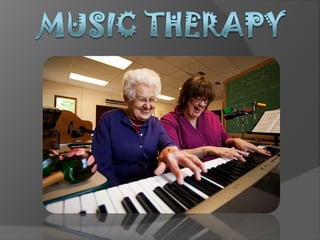
Music therapy
1.
2. Music Therapy
OUTLINE
Mediation with Music
Introduction
History of Music Therapy
What IS Music Therapy?
The Brain and Music Therapy
NMT: Neurologic Music Therapy
Children, Adolescents and Music Therapy
Autism and Music Therapy
Depression and Music Therapy
Palliative Care and Music Therapy
3. History
Music Therapy
Ancient history
1849 Report of the Commissioners, Beauport
Asylum, Quebec (music and dance)
World War II (1945)
Musicians went to Veterans hospitals
Patients‟ physical and emotional responses
Columbia University offered the first music therapy
course
1941 a National Foundation for Music Therapy was
established in the USA
4. History
Music Therapy
New training courses at Michigan State Uni. in
1944
Kansas University in 1946
National Association of Music Therapy (US)
Related activities in UK
E.G. Sydney Mitchell‟s orchestra of patients
Role of recorded music on patients
Live music in research on alcoholic and neurotic patients
1950s the society for Music Therapy and Remedial
Music, later replaced by the British Association for Music
Therapy in 2011
5. History
Music Therapy
Difficult for MT to become recognized as an effective
treatment
More than using as a recreational activity
The National Association for Music Therapy (NAMT)
was founded in 1950
Programs (1950s)
Winter Veterans Administration Hospital in Kansas
Other programs for children with disabilities; mental illness
Different organizations merged in 1998 and the result
was American Music Therapy Association (AMTA)
6. History
Music Therapy
In England: British Society of Music Therapy, founded in
1958 as the Society for Music Therapy and Remedial
Music, collaborated with the GSM to develop a one-year
post-graduate program
In Canada Alfred Rosé: first pilot projects (1952-61) at
Westminster Hospital in London, Ont
1950s three prominent music therapists established
programs
Norma Sharpe (St Thomas Psychiatric Hospital)
Fran Herman (Bloorview Hospital)
Thérèse Pageau (Hôpital Louis-Hippolyte Lafontaine)
7. History
Music Therapy
1974 Conference at St Thomas Psychiatric Hospital
Canadian Music Therapy Association
1974 Sharpe and Burnett published Canadian Music
Therapy Bulletin
the CAMT Newsletter: the first official publication
1979 the first 17 music therapists accredited by CAMT
1991 the number of Music Therapists Accredited
(MTA) by the CAMT was 78
8. History
Music Therapy
Until the mid 70s most accredited music therapists
were training in England or USA.
1976 - 1st MT training program in Canada founded at
Capilano College, North Vancouver
Nancy McMaster & Carolyn Kenny
two-year diploma program
1990 - Changed in to a 3 year undergraduate
Graduates undergo supervised clinical internship of
1000 hours
MTA
10. Music Therapy
Music therapy training in Canada
Wilfrid Laurier University - Ontario
University of Windsor - Ontario
Acadia University - Nova Scotia
Capilano University - British Columbia
Canadian Mennonite University - Manitoba
Concordia University – Québec
11. Music Therapy
What Is Music Therapy
“music therapy is a systematic process of
intervention wherein the therapist helps the
client to achieve health, using musical
experiences and the relationships that
develop through them as dynamic forces of
change” (Bruscia 1995).
12. Music Therapy
What Is Music Therapy
Not about teaching/developing musical
skills
Concept of change
Social and Humanistic psychological roots
Areas of change:
-communication, cognition, physical, social,
emotional, and neurological functioning
All ages, groups, individual
13. Music Therapy
What is Music Therapy
Diverse
settings:
specialized hospitals/treatment centers, preschools, schools, hospitals, residential homes,
centers for visual/hearing impairments,
hospices, probations/prison services, private
practice
14. What is Music Therapy
Music Therapy
WFMT (World federation of music therapy)
definition
Use of music and musical elements by a qualified music
therapist with a client or group, in a process designed to
facilitate and promote communication, expression etc.
and other therapeutic objectives in order to meet physical,
emotional, mental, social and cognitive needs.
MT aims to develop potentials or restore functions
Two applications of music therapy
music for its inherent healing qualities
mean for self expression, interaction within a therapeutic
relationship.
15. What is Music Therapy
Music Therapy
Use of music for its inherent healing qualities
Focus on the physical properties of music as healing.
Client-therapist relationship is secondary
E.G. Vibroacoustic therapy or Music Bath
Use of recorded music as therapy supplementary to the
cure of physical illness
○ Surgery rooms
○ Clients on kidney dialysis
○ Cancer
○ premature or sick infants
16. What is Music Therapy
Using
Music Therapy
music as a means for self expression,
interaction within a therapeutic relationship
Community music therapy
Guided imagery and Music (GIM)
Improvisational Music Therapy
17. What is Music Therapy
Another definition
Music Therapy
“Music therapy is the use of sound and
music within an evolving relationship
between client and therapist to support and
encourage physical, mental and emotional
well-being”
18. Music Therapy
Role of the Therapist
Changes depending on the type of music
therapy used and needs of client
Therapist is using music to bring about
change in client‟s behaviour or emotional
state
Therapist must be open, and willing to listen
Encourage client
20. Music Therapy
Goals of Music Therapy
Music as a means to an end
Maintain and develop physical skills,
cognitive potential, motivation, speech,
language, non-verbal expression, social
skills
Bring about individual changes in mood,
releasing tension, expression of feelings,
social interaction, development of selfesteem
22. The power of music
Music Therapy
Is
there a biological basis for the experiences
that people talk about?
heart rate increases, breathing deepens their muscle
tension increases
Human body fall into synchronism with a rhythmic
phenomenon
What about hormones
○ adrenaline, cortisol, and ACTH
○ Study: surgery, cortisol level and music‟s impact
23. The power of music
Music Therapy
Sex,
drugs and rock and roll right there in the
brain?
Listening to music releases neurochemicals such
as
Prolactin
Oxytocin
Dopamine
But
why are music and sex and drug act so
similar?
Study by Robert Zattore
24. The power of music
Music Therapy
Specific
parts of the brain are involved in
perceiving different musical elements.
Pitch, harmony, melody, loudness, rhythm
E.G. specific neurons in the auditory cortex are tuned
to perceive specific pitches
Some of the areas involved: auditory cortex, motor
cortex prefrontal cortex, sensory cortex, the visual
cortex, nucleus accumbens and amygdala,
hippocampus and so on.
25. Music Therapy
Hearing
music
auditory cortex
○ Core: pitch and volume
○ Surrounding: timbre, melody and rhythm
Imagining
music
Auditory cortex to a lesser magnitude
Inferior frontal gyrus (retrieving memories)
Dorsolateral frontal cortex (working memory)
26. Music Therapy
Playing
music
auditory cortex (feedback system)
visual cortex (reading a score)
parietal lobe ( e.g. computation of finger position)
motor cortex
sensory cortex
frontal lobe
cerebellum
27. Music Therapy
Emotional
reaction to music
Reward structures such as ventral tegmental area (when
you get chills!)
Same areas that get activated while:
○ Eating
○ Sex
○ Using drugs
Pleasing song Inhibition of amygdala
29. Music Therapy
Neurologic Music Therapy
Center for Biomedical Research in Music at
Colorado State University
Brain imaging, brain wave analysis, kinematic
motion analysis, technological shift early 90s
Finding: central nervous system involved in
creating, perceiving, understanding, producing
Improvement in 3 areas: sensorimotor
functioning, speech and language functioning,
cognitive functioning
30. Music Therapy
Rhythmic Auditory Stimulation (RAS)
for sensorimotor functioning
Who uses RAS?
Stroke patients, Parkinson‟s patients showed
improvements
Spinal cord injured patients, traumatic brain
injured patients
31. Music Therapy
Rhythmic Auditory Stimulation (RAS)
for sensorimotor functioning
Applies auditory sounds to movement
(walking, stepping) 2/2, 2/4
Therapist gradually increases to form a
pattern
Rhythmic entrainment, priming of auditorymotor pathway, cueing of movement
Rhythm has physiological function to
stimulate movement
32. Music Therapy
(RAS)
Auditory system detects patterns
No large effort required
Stimuli activates motor neurons via
reticulospinal pathways – “priming of the
auditory-motor pathway”
Rhythm offers cues for movement: when to
place foot down, creating a pattern
Limit cycle: optimal movement frequency
33. Music Therapy
Vocal Intonation Therapy (VIT) or
Melodic Intonation Therapy (MIT)
Structured singing and voice exercises:
pitch, timber, breath control, volume,
phonation, resonance, intonation
Technique: relaxing head, neck, upper body,
warming up the diaphragm breath using
scales and singing
Therapist may resemble a voice coach, yet
they customize the therapy to patients‟
needs: Speech therapist or Music Therapists
36. Music Therapy
MT Neurological disorders
Melodic
Intonation Therapy
Aphasia
“Rhythm
in disguise: why singing may
not hold the key to recovery from
aphasia”
37. Music Therapy
Musical Neglect Training (MNT)
or Patterned Sensory Enhancement
(PSE)
Patients play musical instruments in spatial
configuration (left-right, right-left)
Temporal, spatial cues
focus attention on area of brain that is
damaged, visual neglect due to injury, stroke
(hemispheric lesions)
How: music can activate neurons!
38. Music Therapy
Goals of NMT
CASE STUDY: “Mrs. S”
MT helps the individual as a “whole”
Being in MT helps: verbal/non-verbal
communication, social-interaction, motor
functioning, cognitive functioning, helps
psychological and emotional adjustment to
disability
Environment becomes more relaxed; music has
emotional and physiological effects
39. Music Therapy
…Goals
COMMUNICATION!
Patients may not have language – MT can
help to asses and help provide info
MT a medium for interaction
Music abilities may be preserved when
language is not (TBI)
MT can asses: (non verbal) imitation,
development, turn-taking, eye contact, nonverbal gestures
40. Music Therapy
…Goals
Help patients foster a rewarding and
enjoyable environment
COGNITION!
Playing instruments and singing – initiation,
attention, concentration, short/long-term
memory, motor planning, sequencing,
switching between tasks, behavioural
control motivation, fluency in thinking
41. Music Therapy
…Goals
MT a vehicle for brain responses – pulse,
rhythm, tempo, melody, phrasing, melodic
contour, harmonic direction
Therapists can use music and customize
activities to what patients‟ cognitive
disabilities are
42. Music Therapy
…Goals
PHYSICAL FUNCTIONING!
Being part of MT requires patients to be
physically active – playing an instrument
Uni/bilateral hand grasps, arm extension,
trunk alignment, leg stretching
Wind instrument: breath control and
coordination, face muscles, voice production
Improves walking gait
relaxation
43. Music Therapy
…Goals
EMOTIONAL FUNCTIONING!
TBI patients dealing with trauma, loss of
independence, fatigue, relationship change, anxiety
MT allows an outlet for emotions to be expressed
when verbal expression is unavailable
Shared musical interactions allow can help self
esteem, well being, confidence
Challenge their abilities through creative means
From grief to joy
Reduce anxiety
44. Music Therapy
…Goals
SOCIAL FUNCTIONING!
Music for social gathering, celebrations
Patients with TBI may benefit from
interaction with others
Enhance relationships, relate to each other,
express together,
Decreasing anger, agression
46. Music Therapy
Children & Music therapy
Bonding and attachment in traumatized kids
Building a secure relationship; Music therapists have
resources for supporting this
Early trauma affects right-hemisphere brain
development
Parent-Infant MT: using musical and music-like
interactions for developing a relationship with a
caregiver/dyad
E.G. vocal improvisation and lullabies to help mutual co-
regulation
practised in groups
47. Music Therapy
Music Therapy for children (0-3)
The musical parent
Infant has the capacity to recognize the emotional
intention of vocal timbres
“infant-directed communication”
○ Not present in depressed mothers
Finding the pulse
Exposure to crisis children display distress
Repeated negative experience builds mistrust; Music
therapy as an environment to explore positive and
creative connections
Words may be experienced as threatening by some
adopted children
48. Music Therapy
Music Therapy for children (0-3)
The role of music therapy in supporting parent–
child bonding
Parent–infant communication is intrinsically musical
MT may „permit regression to early, infantile modes of
feeling, thinking and meaning‟
Relearn how to engage in social exchanges
49. Music Therapy
Music Therapy for children (0-3)
The challenge of separation: Sam and May
Sam adopted by Richard and May, appeared wellbonded to adopted parents
After 6 months, became very clingy with May
Also stopped crying
Attended MT for security and self-confidence
In his first MT session Sam remained physically
attached to May
Gradually began to explore some of the instruments
50. Music Therapy
Music Therapy for children (0-3)
The challenge of separation: Sam and May (Cont‟d)
fascinated by drum; first significant separation
Little by little he waited longer before jumping
Lack of toleration for May‟s absence
Music indicated that something still „existed‟ rather
than Sam being left with the void created by silence
Appearance of smile as her mom reappeared
reappearance from behind a drum
51. Music Therapy
Music Therapy for children (0-3)
The challenge of separation: Sam and May (Cont‟d)
Session 7 introduced the idea of mother being
absent from the music therapy room
His little smile on being „found‟ began to
reassure the presence
Sam became able to stay in the room for whole
sessions without May present; May always
joined us for the „Goodbye‟ song
May described Sam as „chatty‟
53. Music Therapy
Music Therapy and Children
“Emotional, motivational and interpersonal
responsiveness of children with autism”
54. MT and Emotional Behavioural
Disorders (EBD) children
Music Therapy
WHO? Physical, sexual verbal assault victims,
accident victims, death of family, loss of limbs,
spinal cord injuries, paralysis, trauma
Children are limited in ways they can express
themselves and emotions; behaviour is affected,
pressure from parents, teachers peers
Stress and anxiety can lead to withdrawal from
peers, low academic performance, enjoyment
levels decrease, risky behaviours, irritability,
depression, suicide
“talk-therapy” can intimidate with figures of
authority; forced into by parents
55. Music Therapy
MT and EBD
Breakdown in MT assessment
Interviews with family about musical history
Assessment tools: Natural response choice,
Musical Preference, Musical responsiveness,
Verbal Associations, Non-verbal reactions and
Client/Therapist Interaction
Music used as tool to build trusting relationship
between therapist and child/adolescent
Case Studies…
57. Music Therapy
Music Therapy and Emotion
Depression
“The effectiveness of music listening in
reducing depressive symptoms”
“Effects of music therapy on depression
compared with psychotherapy”
59. Music Therapy
MT and Palliative Care
Palliative care has grown so has MT in
palliative centres
Therapists may use song writing, musical
improvisation
Oncology, HIV/Aids, multiple sclerosis, cystic
fibrosis, other degenerative diseases
In home MT or institutions
All members of hospital staff may refer patients
to MT
Adult family members may refer child
60. Music Therapy
..MT and Palliative Care
Patients may also self-refer themselves, includes
adults, adolescents and children
Depending on the diagnosis, the music therapist
creates and implements programs for longer term or
acute care
MT Palliative GOALS and OUTCOMES:
helps with coping, pain management, reduction of
anxiety, enhance relationships, provide selfexpression, feelings of support and validation,
improves self-worth and dignity, allows for
interaction in “non-patient” way, feelings of choice
and control, hospital environment becomes more
pleasurable, assist with grieving
61. Music Therapy
...MT and Palliative Care
Study done with Health professionals:
Art therapist, Chaplain, Clinical Nurse, Day-Care
Nurse, Medical Director, Occupational Therapist,
Physiotherapist, Social Workers
1) General Attitudes towards Music Therapy?
- Nurses: too intrusive? affect the wrong “spots?”
2) Perceived Scope of Music Therapy?
- emotional, physical, social, environmental,
spiritual
62. Music Therapy
…Study MT in Palliative Care
3) Holism and Music therapy
4) Integration of Music therapy and palliative
care
63. Music Therapy
Music therapy and dementia
Study: Music therapy-induced changes in behavioral
evaluations, and saliva chromogranin A and
immunoglobulin A concentrations in elderly patients
with senile dementia
Aim: to clarify music therapy-induced changes in
behavioral evaluations, and saliva chromogranin A
and immunoglobulin A concentrations in elderly
patients with dementia.
64. Music Therapy
Music therapy and dementia
Methods:
8 patients with dementia
25 1h sessions of MT twice weekly for 3 months
Scales: Gottfries–Brane–Steen Scale (GBS) and
Behavioral Pathology in Alzheimer‟s Disease
Rating Scale
Saliva chromogranin A and immunoglobulin A
measured
65. Music Therapy
Music therapy and dementia
Evaluation
Mini-Mental State (MMSE)
Gottfries–Brane–Steen Scale (GBS)
Behavior Pathology in Alzheimer’s Disease Rating Scale
(BEHAVE-AD)
Salivary chromogranin A
Secretory immunoglobulin A
Results:
Improvement on MMSE after 1 month showed significant
improvement (MT group)
66. Music Therapy
Music therapy and dementia
Results (Cond’d):
In the MT group, significant improvement on a GBS
subscale (symptoms common in dementia); disappeared
after 1 month
On the “paranoid/delusional ideation” subscale the MT
group significantly improved; more significant after 1
month
“motor-function” = “inability to control bladder and
bowel” MT demonstrated significant improvement
level of salivary CgA was significantly decreased after the
last therapy session; impact disappeared after 1 month
67. Music Therapy
Music therapy approaches
Analytically oriented music therapy (AOM)
Mary Priestly
roots in psychoanalysis
Example a person might be frustrated by her intruding
mother
Title for improvisation in order to access the unconscious
Real case example: rape victim
68. Music Therapy
Music therapy approaches
Nordoff-Robbins Music Therapy
Philosophy: every human being has an innate
responsiveness to music
Power of music enables self expression and
communication
Requires a skilled musician as the therapist, trained to
improvise music
making is the primary focus of the sessions
The therapist provides a musical frame
Nordoff and Robbins‟s account of the therapy session
Also to work with adults in areas of neurology, psychiatry
and terminal illness