Music and Machine Learning
Using Machine Learning for the Classification of
   Indian Music: Experiments and Prospects
                       Paritosh K. Pandya


           School of Technology and Computer Science
             Tata Institute of Fundamental Research


                    email: pandya@tifr.res.in
                http://www.tcs.tifr.res.in/∼pandya


                                                       SNDT 2006 – p.
Outline
Motivation (Example)
Introduction to Machine Learning
Intelligent Music Processing Examples
Indian Music: Some questions
Automatic Raag Recognition System


                                        SNDT 2006 – p.
Computers and Information Processing
 Evolution of computers
    Scientific calculations: e.g. planetary orbits
    Data processing: e.g. inventory
     Multimedia Rich Text, Graphics, Pictures, Animations,
    Video, Sound and Music.
    Computers can store, edit, process and display all of
    these!!
    Internet and World-wide Web:


                                                         SNDT 2006 – p.
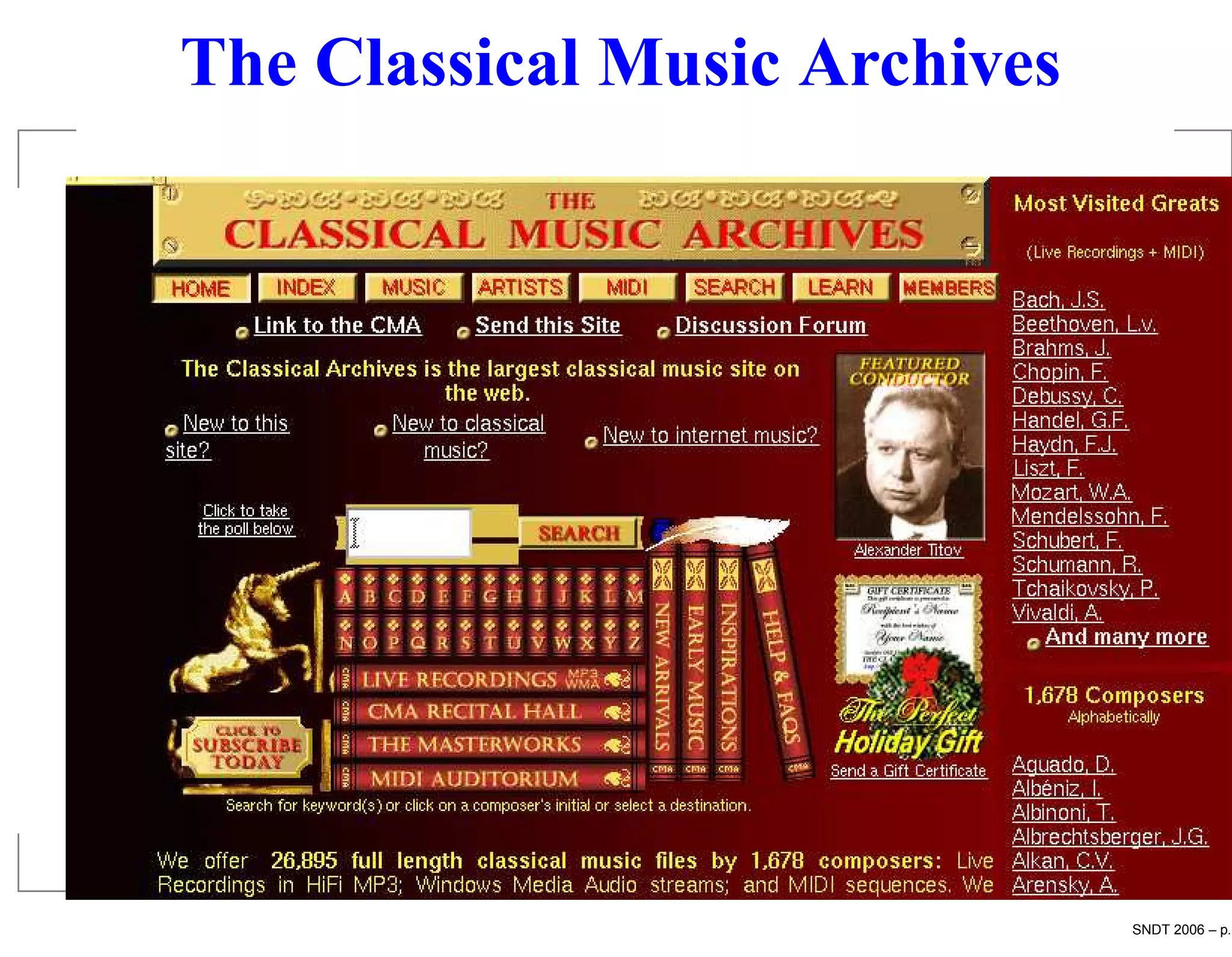
The Classical Music Archives


                               SNDT 2006 – p.
Computers and Arts
Computers and networks are increasingly used for
storing, processing (editing, cataloguing, searching),
and disseminating artistic content.
Web Portals with artistic, educational and
research-oriented content are becoming available e.g.
complete works of Shakespeare
Computers can be used to analyse artistic content in
new and sophisticated manners.
Computer as a tool for research in humanities and arts:
Example Discovery channel news (2003): Computers to
reveal Shakespeare


                                                         SNDT 2006 – p.
Learning Machines
   Traditionally, computers are calculating devices. How to
   calculate must be fully pre-programmed.
   People observe patterns in nature, they discover rules
   and they learn.
   Can Computers learn? A question addressed by
   artificial intelligence.

Learning System A system capable of the autonomous
acquisition and integration of knowledge.


                                                         SNDT 2006 – p.
How do systems learn?
Supervised Learning: Learn from examples.
     Training Example Set (annotated)
     Feature Selection (Input)
     Target function representation
Statistical learning and classification

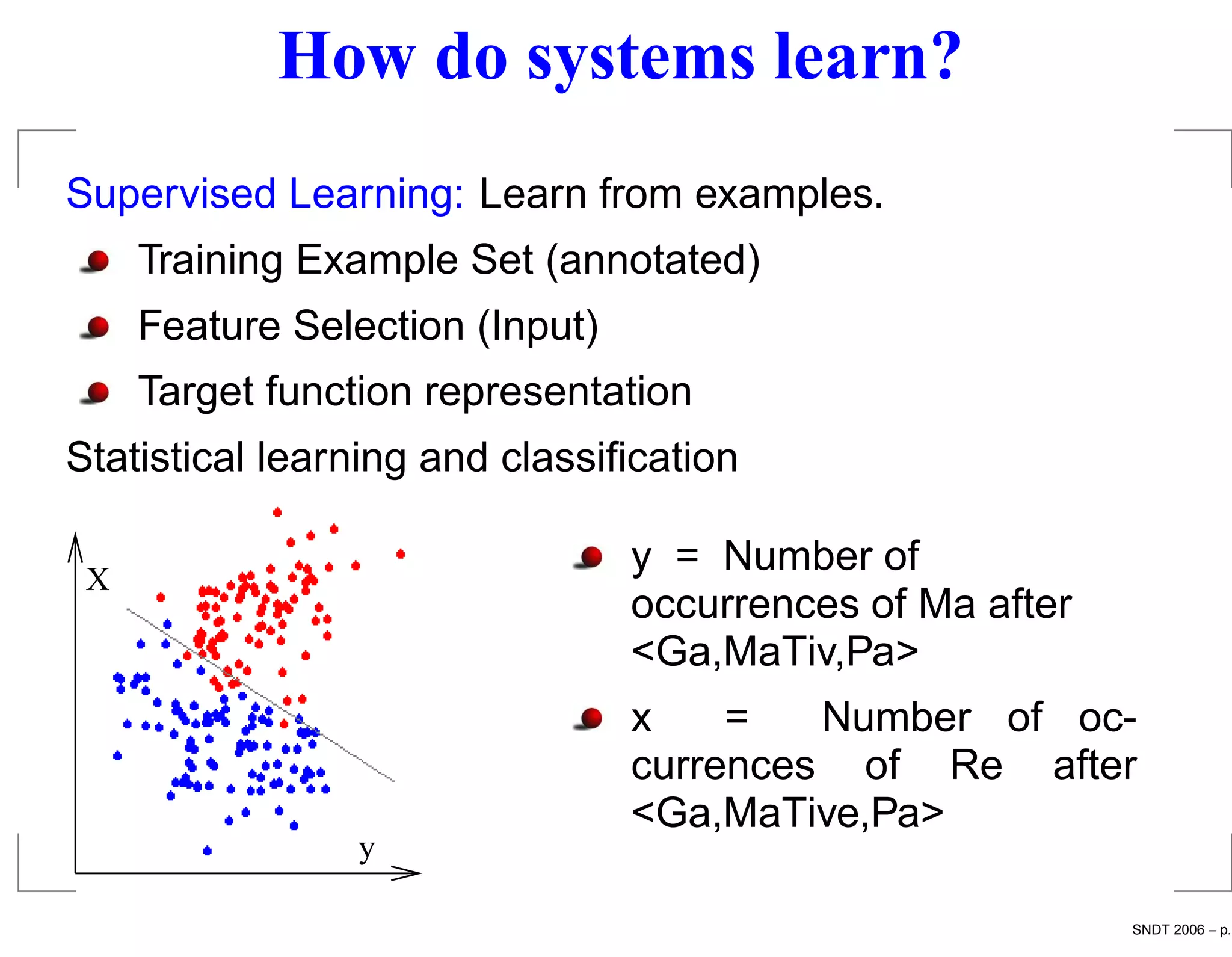
 X
                                 y = Number of
                                 occurrences of Ma after
                                 <Ga,MaTiv,Pa>
                                 x    =   Number of oc-
                                 currences of Re after
                                 <Ga,MaTive,Pa>
                y

                                                           SNDT 2006 – p.
Neural Nets
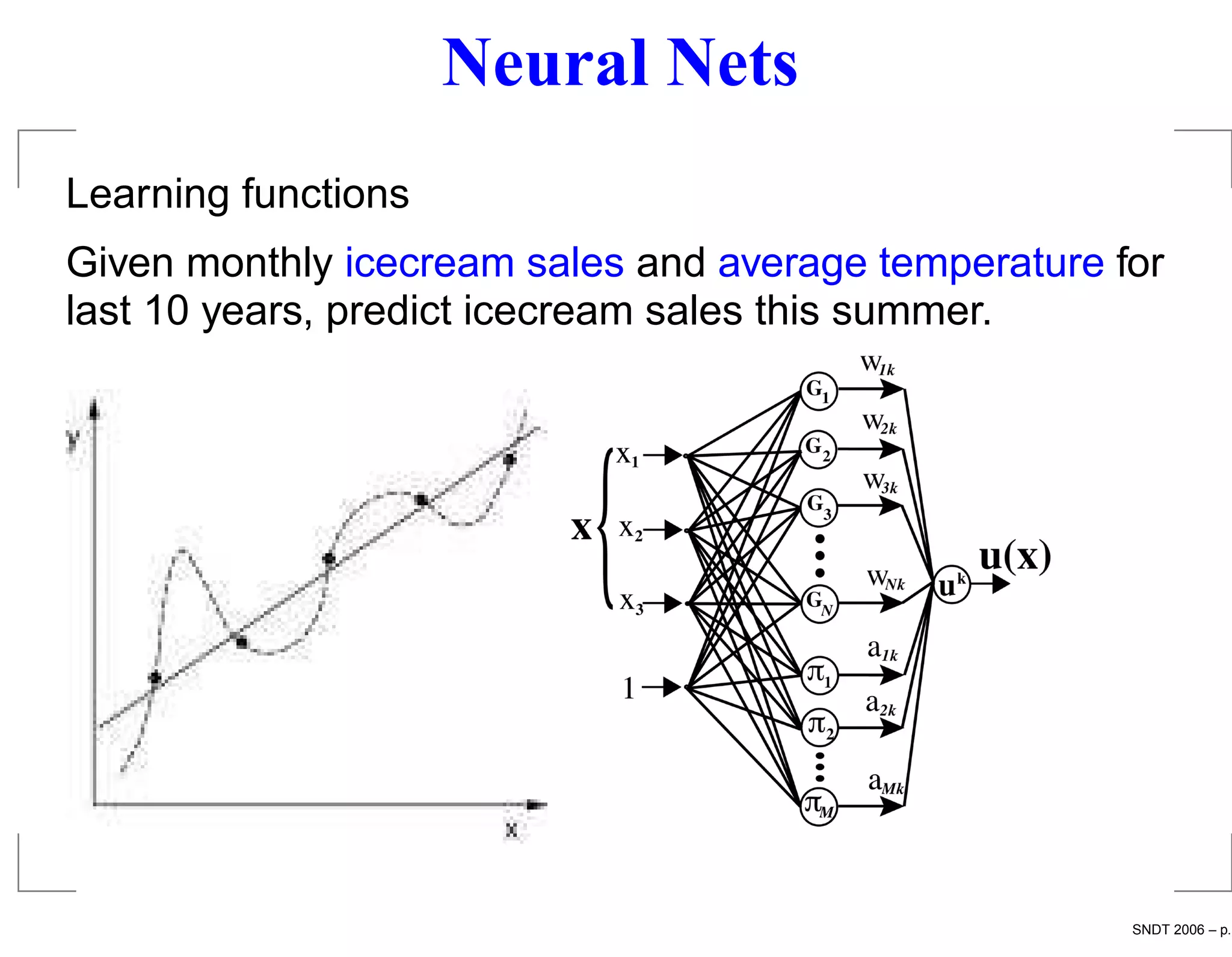
Learning functions
Given monthly icecream sales and average temperature for
last 10 years, predict icecream sales this summer.


                                                      SNDT 2006 – p.
Why use learning system?
   The relationship between data elements is not
   formalized. Only examples are available.
   Relationship between data items is buried within large
   amount of data.

Data mining: using historical data to discover relationships
and using this to improve future performance.


                                                           SNDT 2006 – p.
Applications of Machine Learning
Speech recognition
Image recognition (Face recognition)
Identifying Genes
Predicting Drug Activity
Cataloguing Faint Objects in Astronomical Data
Detecting Credit Card Frauds
Predicting Medical Outcomes from Historic Data
Detecting Hacking and Intrusion from Network Load
Computational Linguistics


                                                    SNDT 2006 – p. 1
Music Performance Visualisation
Performance worm [Widmer, Vienna]
   Different players have different ways of building tension
   or expression in the music
   Measure subtle changes in beat level tempo versus
   loudness for each note played.
   Represent this visually in tempo-loudness space as a
   trajectory called "performance worm".


                                                          SNDT 2006 – p. 1
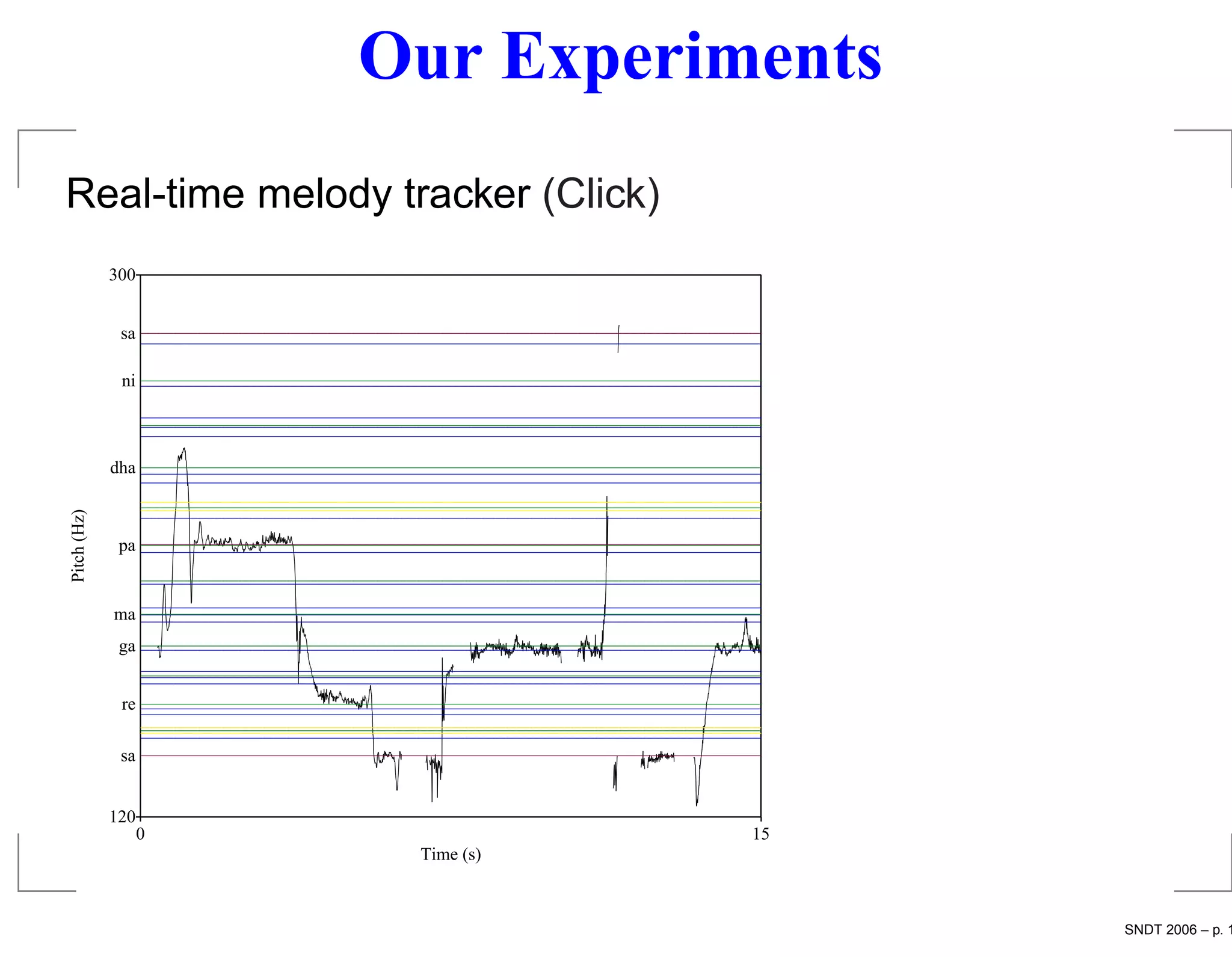
Our Experiments
Real-time melody tracker (Click)
             300


              sa

              ni


             dha
Pitch (Hz)


              pa


             ma
              ga


              re

              sa


             120
                   0               15
                        Time (s)


                                         SNDT 2006 – p. 1
Recognition of Concert Pianists
Characterisation of Personal Expression Features
Classification
   Classification between 22 piano players
   Classification based on performance worm like data
   Achieved accuracy comparable with human listeners.
[Saunders et al (2005)]


                                                        SNDT 2006 – p. 1
Islands of Music
Intelligent structuring and exploration of digital music
collections [Pampalk et al (2004)]
    Grouping of Music by
    Similarity
    Genre and Style
    Performer
    Timbral and rythmic con-
    tent

Automatic classification of music by Genre: Classical,
Country, Disco, HipHop, Jazz and Rock [Pye 2000]
About 90% success on 176 songs

                                                           SNDT 2006 – p. 1
Music Structure Analysis
Structure in Music Composition
   repetition, transposition, call and response, rythmic
   patterns and harmoic sequences
   shape of a song e.g. AABA
   Automatic structure analysis attempts to discover such
   structure [Danenberg,CMU]

Beat tracking and Tempo Detection
   Identifying time signatures and tempo
   Marking beat positions within music [Simon Dixon]


                                                           SNDT 2006 – p. 1
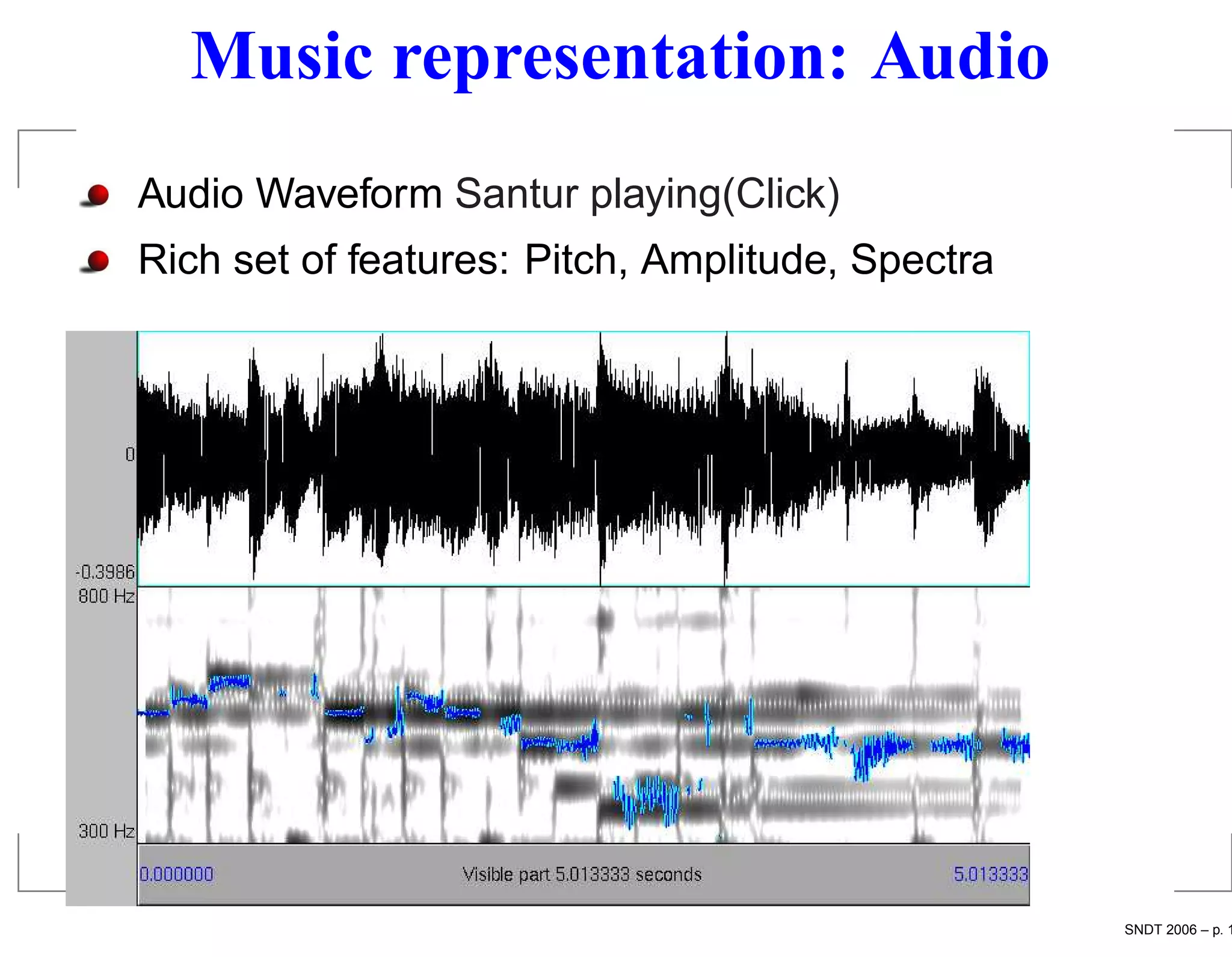
Music representation: Audio
Audio Waveform Santur playing(Click)
Rich set of features: Pitch, Amplitude, Spectra


                                                  SNDT 2006 – p. 1
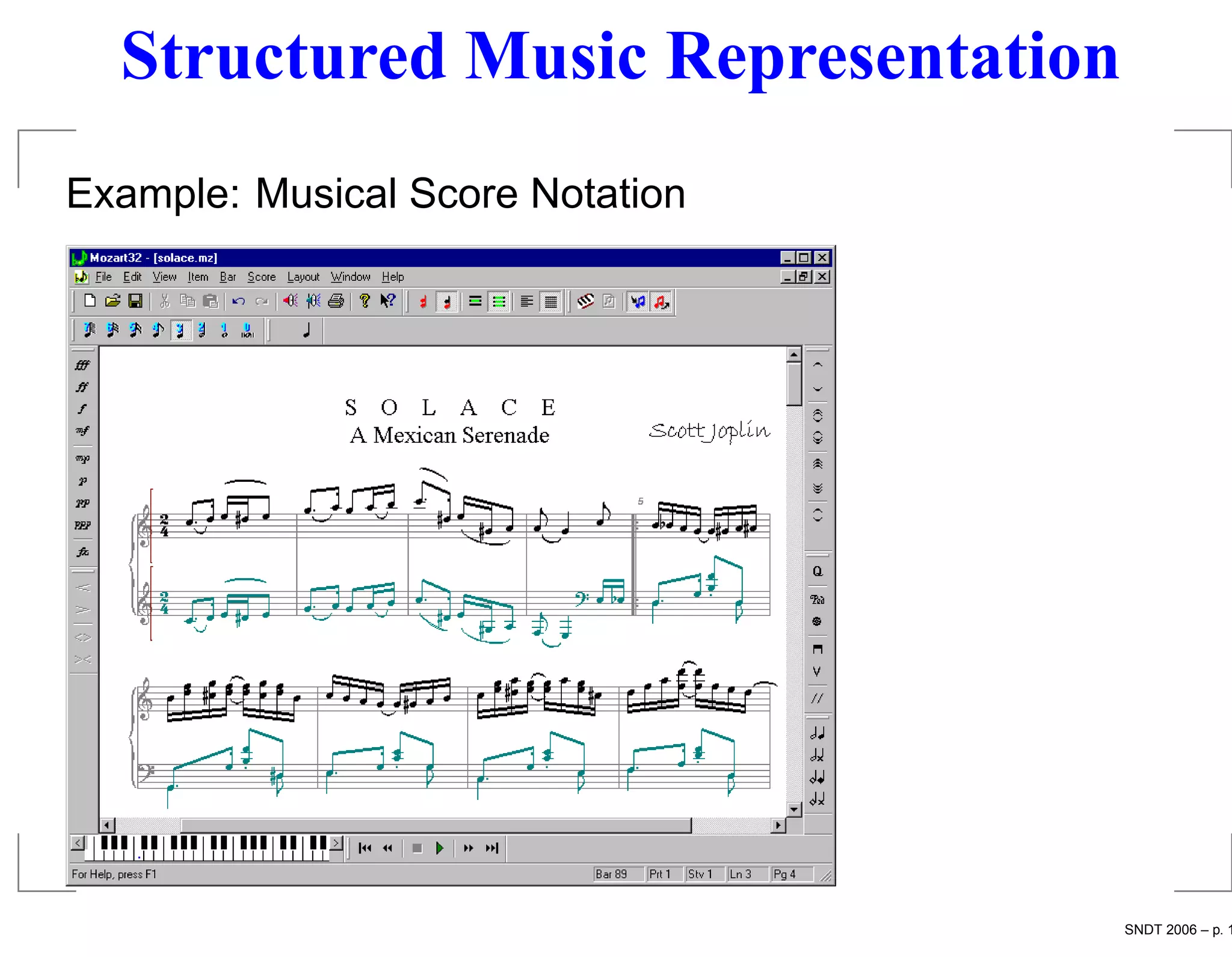
Structured Music Representation
Example: Musical Score Notation


                                    SNDT 2006 – p. 1
Computers and Music Notation
   MIDI files: computer representation of musical score.
   Can be recorded from keyboards etc.
   Synthesizers: MIDI → Sound

Issue Expressive Music Representation
(a hot topic for research!)

Music Notation for Indian Music
   Bhatkhande or Paluskar systems
   Not used by professional musicians
   Lacks structures


                                                          SNDT 2006 – p. 1
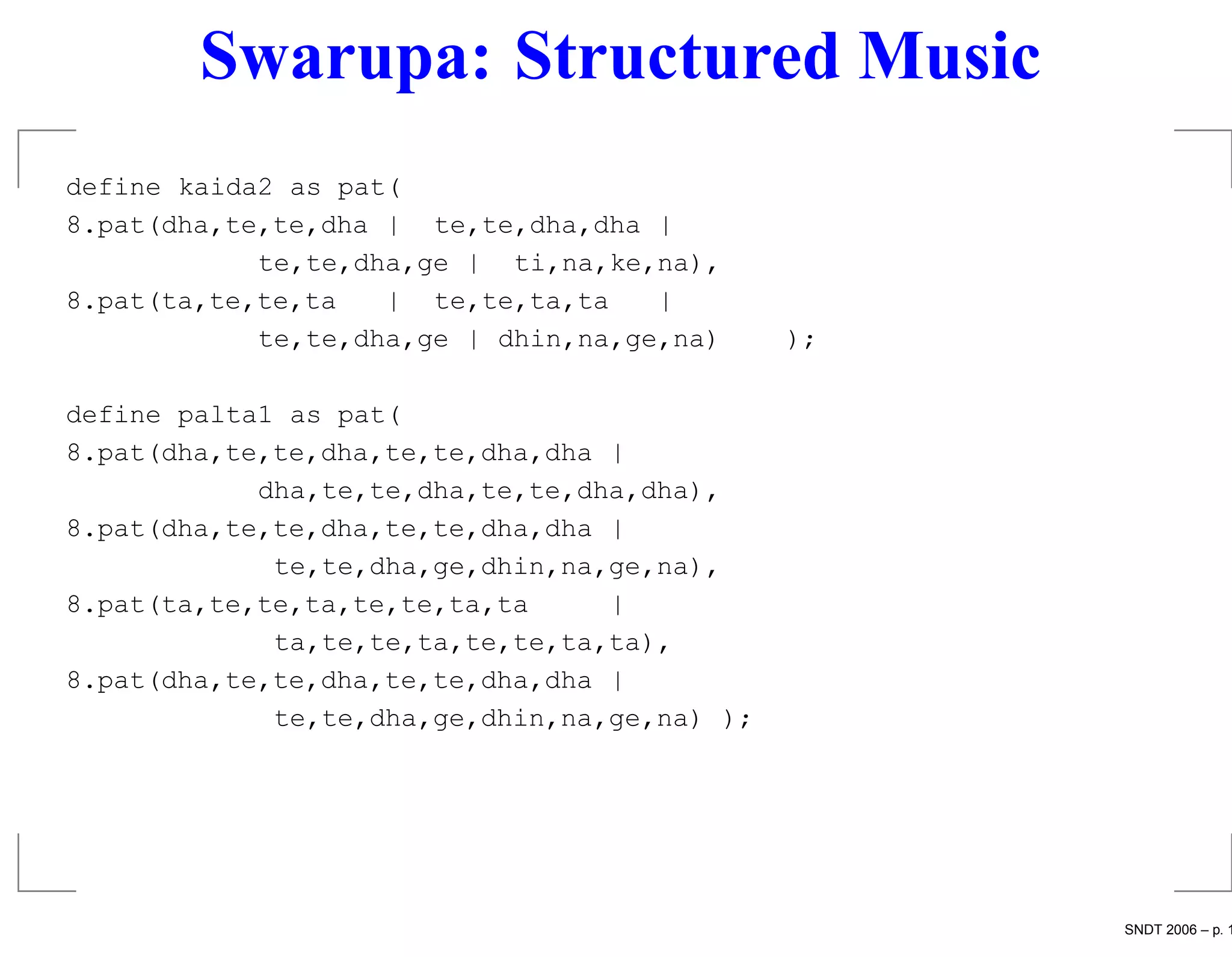
Swarupa: Structured Music
define kaida2 as pat(
8.pat(dha,te,te,dha | te,te,dha,dha |
            te,te,dha,ge | ti,na,ke,na),
8.pat(ta,te,te,ta   | te,te,ta,ta    |
            te,te,dha,ge | dhin,na,ge,na)     );

define palta1 as pat(
8.pat(dha,te,te,dha,te,te,dha,dha |
            dha,te,te,dha,te,te,dha,dha),
8.pat(dha,te,te,dha,te,te,dha,dha |
             te,te,dha,ge,dhin,na,ge,na),
8.pat(ta,te,te,ta,te,te,ta,ta     |
             ta,te,te,ta,te,te,ta,ta),
8.pat(dha,te,te,dha,te,te,dha,dha |
             te,te,dha,ge,dhin,na,ge,na) );


                                                   SNDT 2006 – p. 1
Swarupa: Structured Music
define kaida2n as
[
 A::[ 2:dhatita::[dha,te,te], dhadha::[dha,dha]
        tite::[te, te], dha,ge | tin,na,ke,na ];
 B::[ A.1{khali} | C::[A.2 | A.3{bhari}] ]
];

define palta1 as
[ 3:[A.1 |] C;      3:[B.1 |] C; ];

define palta2 as
[ A.1 | D::4:5%[te,te] ;           B ;
   B.1 | D ;                       B    ];
Synthesis Swarupa → Audio (See MuM Webpage)
Music transcription: Audio → Score
                                              SNDT 2006 – p. 2
Indian Music Research using AI
Some topics
   Classification of Music
      Raag Recognition
      Classification of Music in Thaats and Jatis
      Classification of Raags into Time Cycle, Seasonal
      Cycles,
      Classification of music by gharanas
      Performer recognition
      Identification of Raag Lakshans
      Association of Bhaav with musical performance
   [B.Chaitanya Deva, 1981]
   Beat tracking and taal recognition
   Identification of musical structure
                                                         SNDT 2006 – p. 2
Associated Applications
   Music Visualisation
   Musical query processing from large annotated musical
   databases.
   Automatic music composition
   Automatic accompaniment

Pursuit: Distance Education of Indian Music


                                                     SNDT 2006 – p. 2
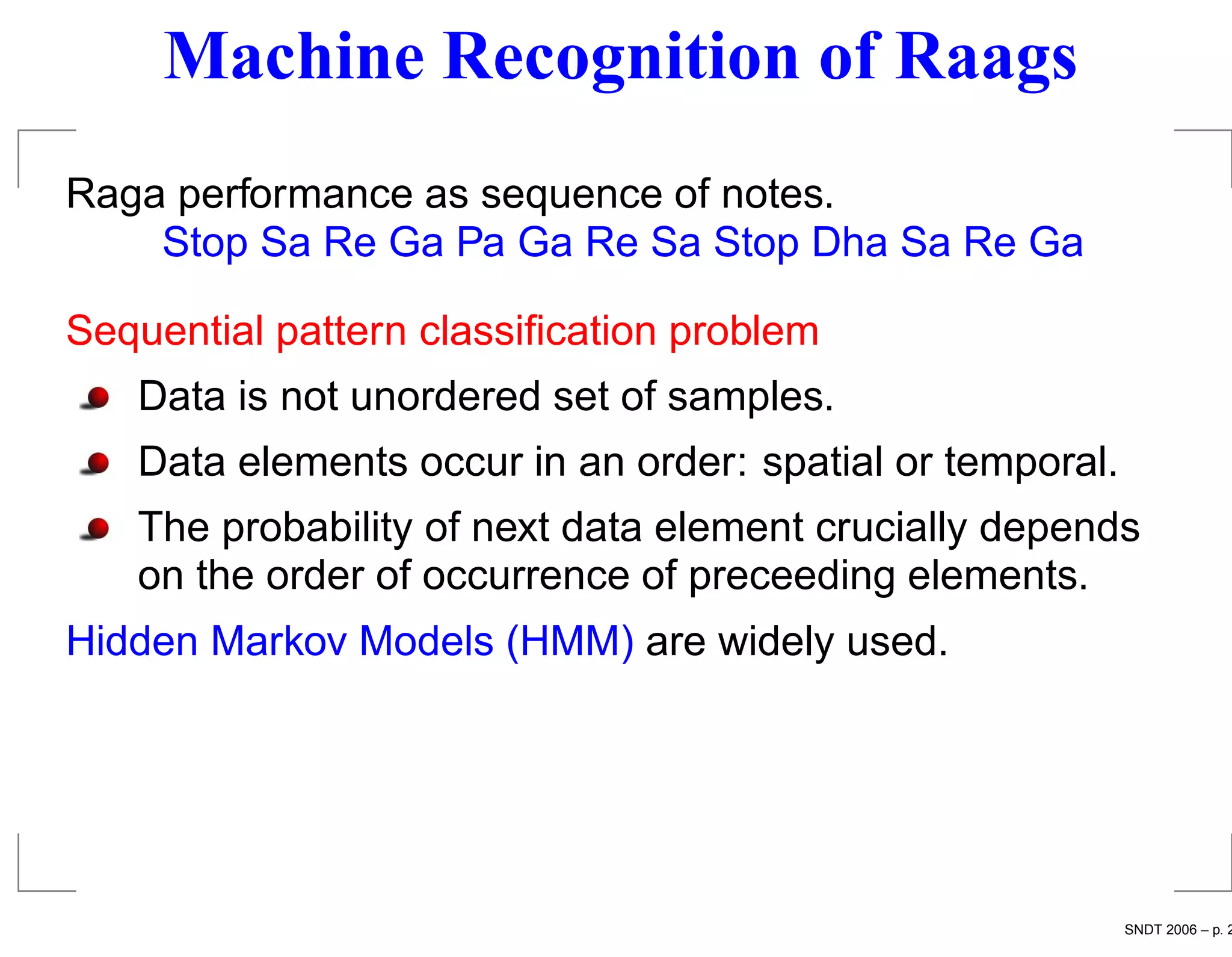
Machine Recognition of Raags
Raga performance as sequence of notes.
    Stop Sa Re Ga Pa Ga Re Sa Stop Dha Sa Re Ga

Sequential pattern classification problem
   Data is not unordered set of samples.
   Data elements occur in an order: spatial or temporal.
   The probability of next data element crucially depends
   on the order of occurrence of preceeding elements.
Hidden Markov Models (HMM) are widely used.


                                                           SNDT 2006 – p. 2
Finite state automaton for Raag
                        7
                       Stop      System can be in one of
                                 finite number of states
  2
  Ga                             Current state depends on
                                 the past and current input
            3                    seen
            Re
                                 Current state and next in-
            5                    put determines the possible
            Sa
                                 next states
             6
            Dha               Experiments:   Manual con-
                              struction of raag automata
       4                      based on Bhatkhande Books
       Pa
            Bhoopali
                               [Sahasrabuddhe]

                                                              SNDT 2006 – p. 2
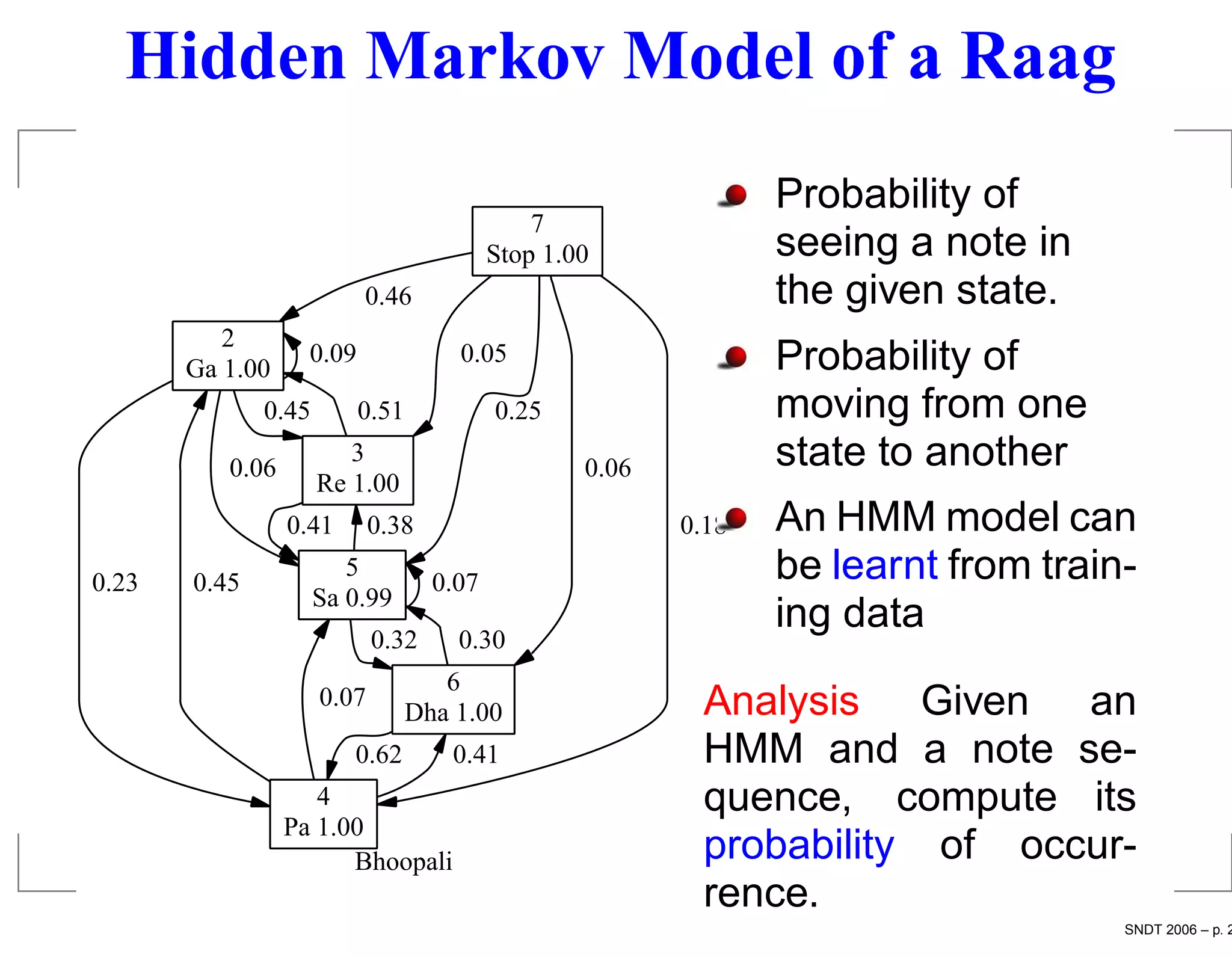
Hidden Markov Model of a Raag
                                                                Probability of
                                              7
                                          Stop 1.00             seeing a note in
                          0.46                                  the given state.
          2
       Ga 1.00
                   0.09              0.05                       Probability of
              0.45        0.51            0.25                  moving from one
          0.06
                        3
                                                  0.06          state to another
                     Re 1.00
                 0.41       0.38                         0.18   An HMM model can
0.23   0.45
                        5
                                   0.07                         be learnt from train-
                     Sa 0.99
                                                                ing data
                            0.32     0.30
                                    6
                     0.07
                                 Dha 1.00                 Analysis Given an
                        0.62        0.41                  HMM and a note se-
                    4                                     quence, compute its
                 Pa 1.00
                       Bhoopali                           probability of occur-
                                                          rence.
                                                                                    SNDT 2006 – p. 2
Raag Recognition using HMM
Hidden Markov Model for a raag
   Finite state automata
   Probability of “seeing a note” in each state.
   Probability of transition between states.
   HMM model can be learnt from a set of training data
Given a note seqeuence we can compute its probability
within given Raag HMM model.


                                                         SNDT 2006 – p. 2
Kansen: A raga recognition system
An Experiment at TIFR using a Toolkit HTK:
   Learns HMM for each raag from training data
   (Baum-Welch Algorithm)
   Training data: (Bhatkhande, IITK) collection of midi files
   of raags played on keyboard. We use 29 raag database.
   Test data: sequence of notes
   Output: probability of the sequence being in each raag.
Preliminary Results
   About 86 percent success on 29 raag recognition
   Confusion between close raags
   Insufficiency of dat a significant reason
(Joint work with Bhaumik Choksi and K. Samudravijaya)
                                                         SNDT 2006 – p. 2
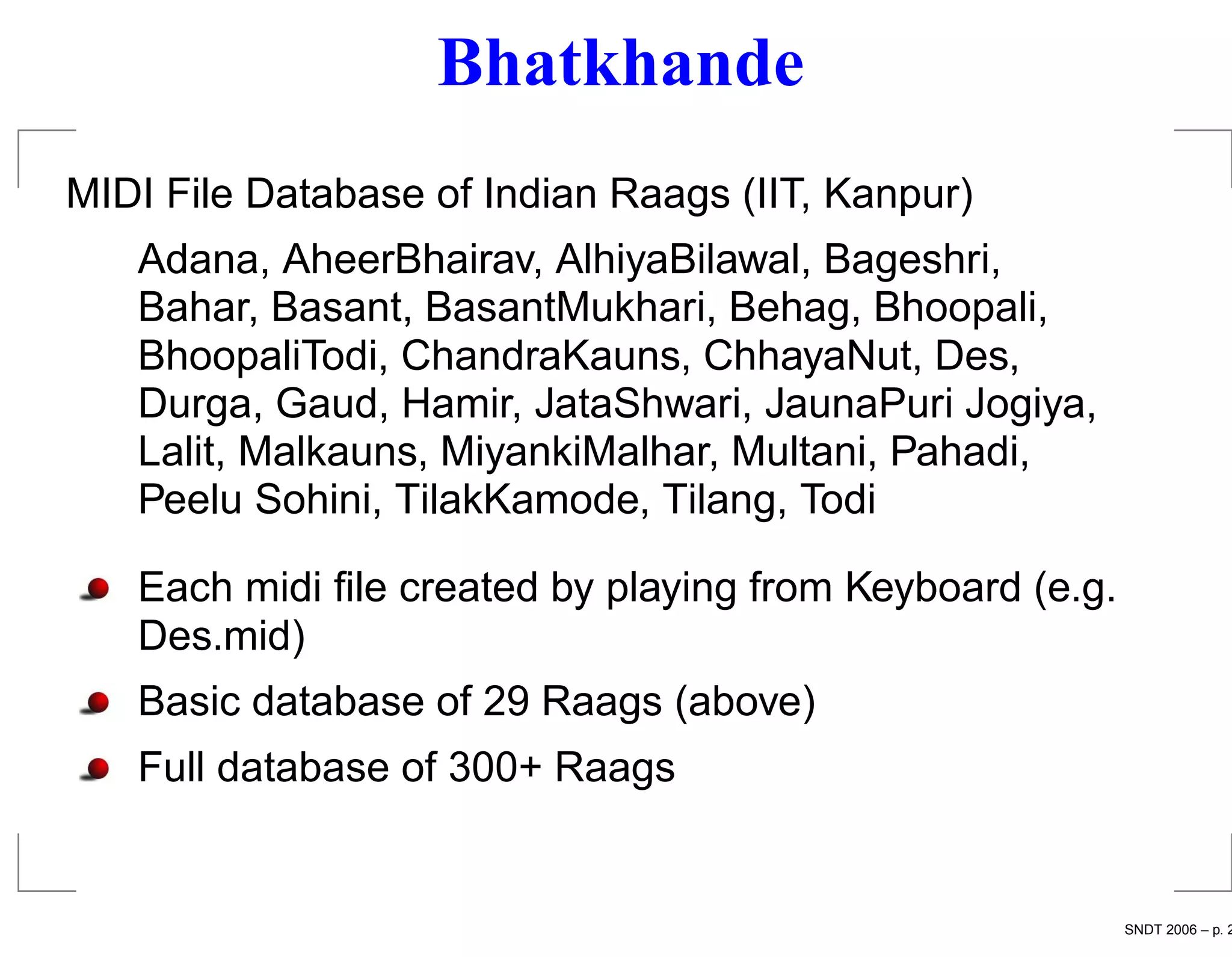
Bhatkhande
MIDI File Database of Indian Raags (IIT, Kanpur)
   Adana, AheerBhairav, AlhiyaBilawal, Bageshri,
   Bahar, Basant, BasantMukhari, Behag, Bhoopali,
   BhoopaliTodi, ChandraKauns, ChhayaNut, Des,
   Durga, Gaud, Hamir, JataShwari, JaunaPuri Jogiya,
   Lalit, Malkauns, MiyankiMalhar, Multani, Pahadi,
   Peelu Sohini, TilakKamode, Tilang, Todi

   Each midi file created by playing from Keyboard (e.g.
   Des.mid)
   Basic database of 29 Raags (above)
   Full database of 300+ Raags


                                                          SNDT 2006 – p. 2
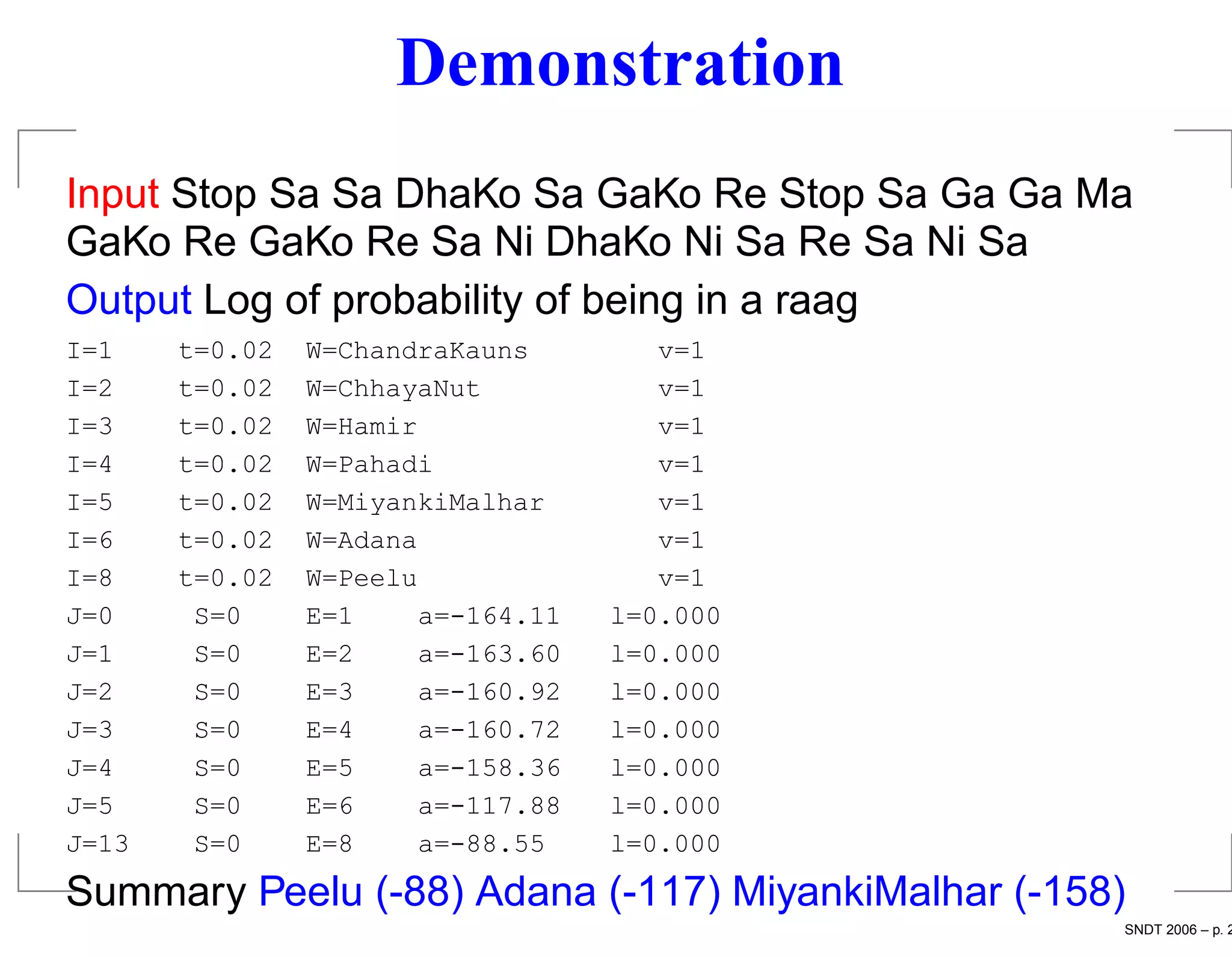
Demonstration
Input Stop Sa Sa DhaKo Sa GaKo Re Stop Sa Ga Ga Ma
GaKo Re GaKo Re Sa Ni DhaKo Ni Sa Re Sa Ni Sa
Output Log of probability of being in a raag
I=1    t=0.02   W=ChandraKauns         v=1
I=2    t=0.02   W=ChhayaNut            v=1
I=3    t=0.02   W=Hamir                v=1
I=4    t=0.02   W=Pahadi               v=1
I=5    t=0.02   W=MiyankiMalhar        v=1
I=6    t=0.02   W=Adana                v=1
I=8    t=0.02   W=Peelu                v=1
J=0     S=0     E=1     a=-164.11   l=0.000
J=1     S=0     E=2     a=-163.60   l=0.000
J=2     S=0     E=3     a=-160.92   l=0.000
J=3     S=0     E=4     a=-160.72   l=0.000
J=4     S=0     E=5     a=-158.36   l=0.000
J=5     S=0     E=6     a=-117.88   l=0.000
J=13    S=0     E=8     a=-88.55    l=0.000

Summary Peelu (-88) Adana (-117) MiyankiMalhar (-158)
                                                    SNDT 2006 – p. 2
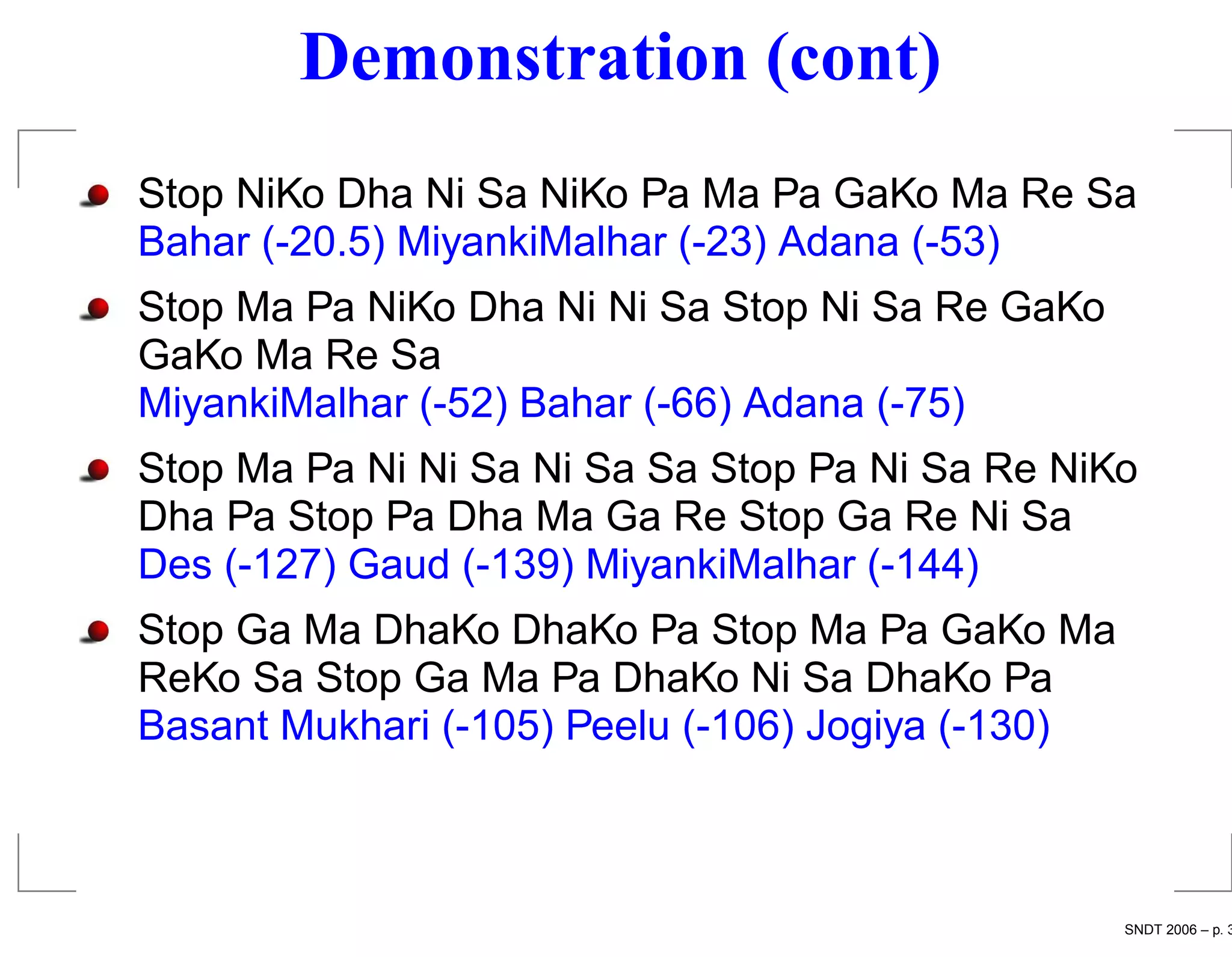
Demonstration (cont)
Stop NiKo Dha Ni Sa NiKo Pa Ma Pa GaKo Ma Re Sa
Bahar (-20.5) MiyankiMalhar (-23) Adana (-53)
Stop Ma Pa NiKo Dha Ni Ni Sa Stop Ni Sa Re GaKo
GaKo Ma Re Sa
MiyankiMalhar (-52) Bahar (-66) Adana (-75)
Stop Ma Pa Ni Ni Sa Ni Sa Sa Stop Pa Ni Sa Re NiKo
Dha Pa Stop Pa Dha Ma Ga Re Stop Ga Re Ni Sa
Des (-127) Gaud (-139) MiyankiMalhar (-144)
Stop Ga Ma DhaKo DhaKo Pa Stop Ma Pa GaKo Ma
ReKo Sa Stop Ga Ma Pa DhaKo Ni Sa DhaKo Pa
Basant Mukhari (-105) Peelu (-106) Jogiya (-130)


                                                   SNDT 2006 – p. 3
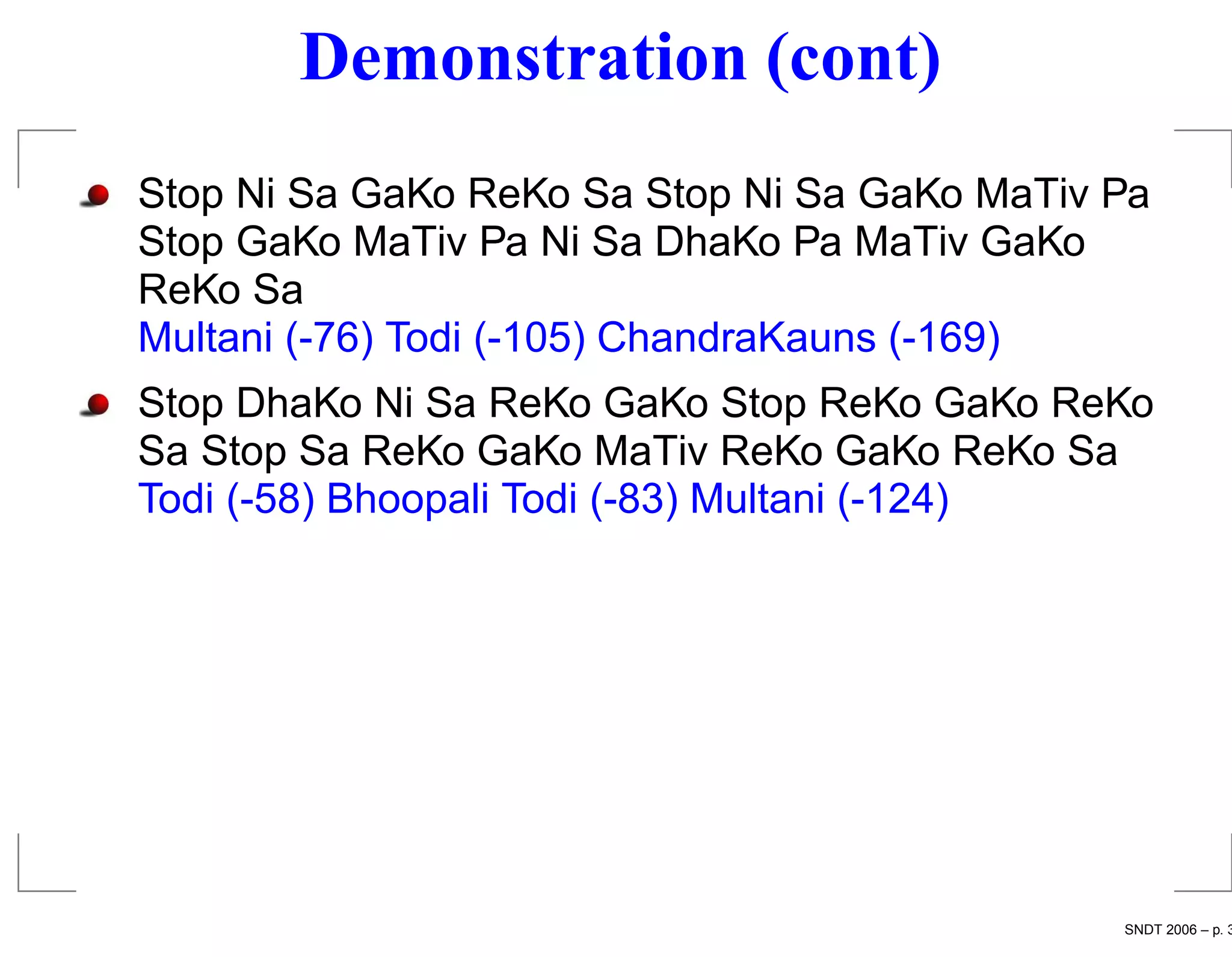
Demonstration (cont)
Stop Ni Sa GaKo ReKo Sa Stop Ni Sa GaKo MaTiv Pa
Stop GaKo MaTiv Pa Ni Sa DhaKo Pa MaTiv GaKo
ReKo Sa
Multani (-76) Todi (-105) ChandraKauns (-169)
Stop DhaKo Ni Sa ReKo GaKo Stop ReKo GaKo ReKo
Sa Stop Sa ReKo GaKo MaTiv ReKo GaKo ReKo Sa
Todi (-58) Bhoopali Todi (-83) Multani (-124)


                                              SNDT 2006 – p. 3
Conclusions
Computer analysis and machine learning provides
interesting new method of analysing music. It allows
many intuitive and qualitative observations to be made
objective, precise and quantitative.
Research with computational techniques lead to direct
applications in music technology.
Intelligent music analysis is almost untried for Indian
Music.
Work requires collaboration between musicologists,
computer scientists and electrical engineers.
Music researchers must help by building corpuses and
annotated datasets for future machine analysis.


                                                          SNDT 2006 – p. 3

Music and Machine Learning

  • 1.
    Music and MachineLearning Using Machine Learning for the Classification of Indian Music: Experiments and Prospects Paritosh K. Pandya School of Technology and Computer Science Tata Institute of Fundamental Research email: pandya@tifr.res.in http://www.tcs.tifr.res.in/∼pandya SNDT 2006 – p.
  • 2.
    Outline Motivation (Example) Introduction toMachine Learning Intelligent Music Processing Examples Indian Music: Some questions Automatic Raag Recognition System SNDT 2006 – p.
  • 3.
    Computers and InformationProcessing Evolution of computers Scientific calculations: e.g. planetary orbits Data processing: e.g. inventory Multimedia Rich Text, Graphics, Pictures, Animations, Video, Sound and Music. Computers can store, edit, process and display all of these!! Internet and World-wide Web: SNDT 2006 – p.
  • 4.
    The Classical MusicArchives SNDT 2006 – p.
  • 5.
    Computers and Arts Computersand networks are increasingly used for storing, processing (editing, cataloguing, searching), and disseminating artistic content. Web Portals with artistic, educational and research-oriented content are becoming available e.g. complete works of Shakespeare Computers can be used to analyse artistic content in new and sophisticated manners. Computer as a tool for research in humanities and arts: Example Discovery channel news (2003): Computers to reveal Shakespeare SNDT 2006 – p.
  • 6.
    Learning Machines Traditionally, computers are calculating devices. How to calculate must be fully pre-programmed. People observe patterns in nature, they discover rules and they learn. Can Computers learn? A question addressed by artificial intelligence. Learning System A system capable of the autonomous acquisition and integration of knowledge. SNDT 2006 – p.
  • 7.
    How do systemslearn? Supervised Learning: Learn from examples. Training Example Set (annotated) Feature Selection (Input) Target function representation Statistical learning and classification X y = Number of occurrences of Ma after <Ga,MaTiv,Pa> x = Number of oc- currences of Re after <Ga,MaTive,Pa> y SNDT 2006 – p.
  • 8.
    Neural Nets Learning functions Givenmonthly icecream sales and average temperature for last 10 years, predict icecream sales this summer. SNDT 2006 – p.
  • 9.
    Why use learningsystem? The relationship between data elements is not formalized. Only examples are available. Relationship between data items is buried within large amount of data. Data mining: using historical data to discover relationships and using this to improve future performance. SNDT 2006 – p.
  • 10.
    Applications of MachineLearning Speech recognition Image recognition (Face recognition) Identifying Genes Predicting Drug Activity Cataloguing Faint Objects in Astronomical Data Detecting Credit Card Frauds Predicting Medical Outcomes from Historic Data Detecting Hacking and Intrusion from Network Load Computational Linguistics SNDT 2006 – p. 1
  • 11.
    Music Performance Visualisation Performanceworm [Widmer, Vienna] Different players have different ways of building tension or expression in the music Measure subtle changes in beat level tempo versus loudness for each note played. Represent this visually in tempo-loudness space as a trajectory called "performance worm". SNDT 2006 – p. 1
  • 12.
    Our Experiments Real-time melodytracker (Click) 300 sa ni dha Pitch (Hz) pa ma ga re sa 120 0 15 Time (s) SNDT 2006 – p. 1
  • 13.
    Recognition of ConcertPianists Characterisation of Personal Expression Features Classification Classification between 22 piano players Classification based on performance worm like data Achieved accuracy comparable with human listeners. [Saunders et al (2005)] SNDT 2006 – p. 1
  • 14.
    Islands of Music Intelligentstructuring and exploration of digital music collections [Pampalk et al (2004)] Grouping of Music by Similarity Genre and Style Performer Timbral and rythmic con- tent Automatic classification of music by Genre: Classical, Country, Disco, HipHop, Jazz and Rock [Pye 2000] About 90% success on 176 songs SNDT 2006 – p. 1
  • 15.
    Music Structure Analysis Structurein Music Composition repetition, transposition, call and response, rythmic patterns and harmoic sequences shape of a song e.g. AABA Automatic structure analysis attempts to discover such structure [Danenberg,CMU] Beat tracking and Tempo Detection Identifying time signatures and tempo Marking beat positions within music [Simon Dixon] SNDT 2006 – p. 1
  • 16.
    Music representation: Audio AudioWaveform Santur playing(Click) Rich set of features: Pitch, Amplitude, Spectra SNDT 2006 – p. 1
  • 17.
    Structured Music Representation Example:Musical Score Notation SNDT 2006 – p. 1
  • 18.
    Computers and MusicNotation MIDI files: computer representation of musical score. Can be recorded from keyboards etc. Synthesizers: MIDI → Sound Issue Expressive Music Representation (a hot topic for research!) Music Notation for Indian Music Bhatkhande or Paluskar systems Not used by professional musicians Lacks structures SNDT 2006 – p. 1
  • 19.
    Swarupa: Structured Music definekaida2 as pat( 8.pat(dha,te,te,dha | te,te,dha,dha | te,te,dha,ge | ti,na,ke,na), 8.pat(ta,te,te,ta | te,te,ta,ta | te,te,dha,ge | dhin,na,ge,na) ); define palta1 as pat( 8.pat(dha,te,te,dha,te,te,dha,dha | dha,te,te,dha,te,te,dha,dha), 8.pat(dha,te,te,dha,te,te,dha,dha | te,te,dha,ge,dhin,na,ge,na), 8.pat(ta,te,te,ta,te,te,ta,ta | ta,te,te,ta,te,te,ta,ta), 8.pat(dha,te,te,dha,te,te,dha,dha | te,te,dha,ge,dhin,na,ge,na) ); SNDT 2006 – p. 1
  • 20.
    Swarupa: Structured Music definekaida2n as [ A::[ 2:dhatita::[dha,te,te], dhadha::[dha,dha] tite::[te, te], dha,ge | tin,na,ke,na ]; B::[ A.1{khali} | C::[A.2 | A.3{bhari}] ] ]; define palta1 as [ 3:[A.1 |] C; 3:[B.1 |] C; ]; define palta2 as [ A.1 | D::4:5%[te,te] ; B ; B.1 | D ; B ]; Synthesis Swarupa → Audio (See MuM Webpage) Music transcription: Audio → Score SNDT 2006 – p. 2
  • 21.
    Indian Music Researchusing AI Some topics Classification of Music Raag Recognition Classification of Music in Thaats and Jatis Classification of Raags into Time Cycle, Seasonal Cycles, Classification of music by gharanas Performer recognition Identification of Raag Lakshans Association of Bhaav with musical performance [B.Chaitanya Deva, 1981] Beat tracking and taal recognition Identification of musical structure SNDT 2006 – p. 2
  • 22.
    Associated Applications Music Visualisation Musical query processing from large annotated musical databases. Automatic music composition Automatic accompaniment Pursuit: Distance Education of Indian Music SNDT 2006 – p. 2
  • 23.
    Machine Recognition ofRaags Raga performance as sequence of notes. Stop Sa Re Ga Pa Ga Re Sa Stop Dha Sa Re Ga Sequential pattern classification problem Data is not unordered set of samples. Data elements occur in an order: spatial or temporal. The probability of next data element crucially depends on the order of occurrence of preceeding elements. Hidden Markov Models (HMM) are widely used. SNDT 2006 – p. 2
  • 24.
    Finite state automatonfor Raag 7 Stop System can be in one of finite number of states 2 Ga Current state depends on the past and current input 3 seen Re Current state and next in- 5 put determines the possible Sa next states 6 Dha Experiments: Manual con- struction of raag automata 4 based on Bhatkhande Books Pa Bhoopali [Sahasrabuddhe] SNDT 2006 – p. 2
  • 25.
    Hidden Markov Modelof a Raag Probability of 7 Stop 1.00 seeing a note in 0.46 the given state. 2 Ga 1.00 0.09 0.05 Probability of 0.45 0.51 0.25 moving from one 0.06 3 0.06 state to another Re 1.00 0.41 0.38 0.18 An HMM model can 0.23 0.45 5 0.07 be learnt from train- Sa 0.99 ing data 0.32 0.30 6 0.07 Dha 1.00 Analysis Given an 0.62 0.41 HMM and a note se- 4 quence, compute its Pa 1.00 Bhoopali probability of occur- rence. SNDT 2006 – p. 2
  • 26.
    Raag Recognition usingHMM Hidden Markov Model for a raag Finite state automata Probability of “seeing a note” in each state. Probability of transition between states. HMM model can be learnt from a set of training data Given a note seqeuence we can compute its probability within given Raag HMM model. SNDT 2006 – p. 2
  • 27.
    Kansen: A ragarecognition system An Experiment at TIFR using a Toolkit HTK: Learns HMM for each raag from training data (Baum-Welch Algorithm) Training data: (Bhatkhande, IITK) collection of midi files of raags played on keyboard. We use 29 raag database. Test data: sequence of notes Output: probability of the sequence being in each raag. Preliminary Results About 86 percent success on 29 raag recognition Confusion between close raags Insufficiency of dat a significant reason (Joint work with Bhaumik Choksi and K. Samudravijaya) SNDT 2006 – p. 2
  • 28.
    Bhatkhande MIDI File Databaseof Indian Raags (IIT, Kanpur) Adana, AheerBhairav, AlhiyaBilawal, Bageshri, Bahar, Basant, BasantMukhari, Behag, Bhoopali, BhoopaliTodi, ChandraKauns, ChhayaNut, Des, Durga, Gaud, Hamir, JataShwari, JaunaPuri Jogiya, Lalit, Malkauns, MiyankiMalhar, Multani, Pahadi, Peelu Sohini, TilakKamode, Tilang, Todi Each midi file created by playing from Keyboard (e.g. Des.mid) Basic database of 29 Raags (above) Full database of 300+ Raags SNDT 2006 – p. 2
  • 29.
    Demonstration Input Stop SaSa DhaKo Sa GaKo Re Stop Sa Ga Ga Ma GaKo Re GaKo Re Sa Ni DhaKo Ni Sa Re Sa Ni Sa Output Log of probability of being in a raag I=1 t=0.02 W=ChandraKauns v=1 I=2 t=0.02 W=ChhayaNut v=1 I=3 t=0.02 W=Hamir v=1 I=4 t=0.02 W=Pahadi v=1 I=5 t=0.02 W=MiyankiMalhar v=1 I=6 t=0.02 W=Adana v=1 I=8 t=0.02 W=Peelu v=1 J=0 S=0 E=1 a=-164.11 l=0.000 J=1 S=0 E=2 a=-163.60 l=0.000 J=2 S=0 E=3 a=-160.92 l=0.000 J=3 S=0 E=4 a=-160.72 l=0.000 J=4 S=0 E=5 a=-158.36 l=0.000 J=5 S=0 E=6 a=-117.88 l=0.000 J=13 S=0 E=8 a=-88.55 l=0.000 Summary Peelu (-88) Adana (-117) MiyankiMalhar (-158) SNDT 2006 – p. 2
  • 30.
    Demonstration (cont) Stop NiKoDha Ni Sa NiKo Pa Ma Pa GaKo Ma Re Sa Bahar (-20.5) MiyankiMalhar (-23) Adana (-53) Stop Ma Pa NiKo Dha Ni Ni Sa Stop Ni Sa Re GaKo GaKo Ma Re Sa MiyankiMalhar (-52) Bahar (-66) Adana (-75) Stop Ma Pa Ni Ni Sa Ni Sa Sa Stop Pa Ni Sa Re NiKo Dha Pa Stop Pa Dha Ma Ga Re Stop Ga Re Ni Sa Des (-127) Gaud (-139) MiyankiMalhar (-144) Stop Ga Ma DhaKo DhaKo Pa Stop Ma Pa GaKo Ma ReKo Sa Stop Ga Ma Pa DhaKo Ni Sa DhaKo Pa Basant Mukhari (-105) Peelu (-106) Jogiya (-130) SNDT 2006 – p. 3
  • 31.
    Demonstration (cont) Stop NiSa GaKo ReKo Sa Stop Ni Sa GaKo MaTiv Pa Stop GaKo MaTiv Pa Ni Sa DhaKo Pa MaTiv GaKo ReKo Sa Multani (-76) Todi (-105) ChandraKauns (-169) Stop DhaKo Ni Sa ReKo GaKo Stop ReKo GaKo ReKo Sa Stop Sa ReKo GaKo MaTiv ReKo GaKo ReKo Sa Todi (-58) Bhoopali Todi (-83) Multani (-124) SNDT 2006 – p. 3
  • 32.
    Conclusions Computer analysis andmachine learning provides interesting new method of analysing music. It allows many intuitive and qualitative observations to be made objective, precise and quantitative. Research with computational techniques lead to direct applications in music technology. Intelligent music analysis is almost untried for Indian Music. Work requires collaboration between musicologists, computer scientists and electrical engineers. Music researchers must help by building corpuses and annotated datasets for future machine analysis. SNDT 2006 – p. 3