This document discusses the use of deep learning techniques for music genre classification, highlighting the integration of audio feature extraction methods and neural networks to improve song recommendations on streaming platforms like Spotify. It presents various data augmentation techniques and advanced algorithms such as Mel Frequency Cepstral Coefficients (MFCC) and convolutional neural networks (CNN) that enhance the classification process. The study emphasizes the necessity of content-based music classification to address the limitations of existing recommendation systems and improve user experience while supporting musicians.
![Indonesian Journal of Electrical Engineering and Computer Science
Vol. 25, No. 2, February 2022, pp. 1186~1198
ISSN: 2502-4752, DOI: 10.11591/ijeecs.v25.i2.pp1186-1198 1186
Journal homepage: http://ijeecs.iaescore.com
Music genres classification by deep learning
Yifeng Hu, Gabriela Mogos
Department of Computing, School of Advanced Technology, Xi’an Jiaotong-Liverpool University, Suzhou, China
Article Info ABSTRACT
Article history:
Received Jun 30, 2021
Revised Nov 24, 2021
Accepted Dec 1, 2021
Since musical genre is one of the most common ways used by people for
managing digital music databases, music-genre-classification is a crucial
task. There are many scenarios for its use, and the main one explored here is
eventually being placed on Spotify, or Netease music, as an external
component to recommend songs to users. This paper provides various deep
neural networks developed based on python, together with the effect of these
models on music genres classification. In addition, the paper illustrates the
technologies for audio feature extraction in industrial environment by mel
frequency cepstral coefficients (MFCC), audio data augmentation in order to
analyze the music species based on local data feature comparison.
Keywords:
Deep learning
Feature extraction
Music-genre-classification
Machine learning
Neural networks This is an open access article under the CC BY-SA license.
Corresponding Author:
Gabriela Mogos
Department of Computing, School of Advanced Technology, Xi’an Jiaotong-Liverpool University
111 Ren'ai Road, SIP, Suzhou, China
Email: Gabriela.Mogos@xjtlu.edu.cn
1. INTRODUCTION
In 2019, the total revenue of the music market has come to $20.2 billion, but according to the report
showcased, more than 75% of music artists in China still earn less than 1,000 renminbi (rmb) per month. This
means that all the online resources (streaming) are occupied by head users. The existing music
recommendation function on major music platforms basically determine the users' preferences from historical
usage data [1]. This makes the current phenomenon of streaming polarization even more serious, as songs
with high streaming are more likely to be heard and easier to collect data from user [2]. On the other hand,
songs with high quality but without high streaming are more difficult to be recommended by the system
comparing with the Pop music because usage data are less often to be captured [1].
In another respect, the communication of music is influenced by un-quantifiable factors such as
geography, politics, the sentiment conveyed, or the artist himself, making the issue of music recommendation
harder. For example, gosh music, a Chinese rap group, is better known and distributed in Chongqing than in
other regions due to geography. Such an environment is obviously unreasonable from the perspective of
cultural communication, and the imbalance of resource allocation caused by excessive concentration of
streaming. As a carrier of music playing, the platform should find to the essence of music, rather than under
the control of marketing [3]. By analyzing the content of music will be a core idea of this project.
From the level of data, despite of the tremendous scale of data to collect during the categorizing by
labeling, the problematic fact is that the songs may not necessarily be mutually exclusive [4] where the
manual classification will be meaningless and inefficient. To narrow down the precise research direction, the
application scene is focused on the recommendation system of music platform. Propuses a novel activation
function, "Swish", was discovered [5]. The function combines the traditional sigmoid function with
hyperparameter where specially designed for the rectified linear unit (ReLU) model. The swish replaces the](https://image.slidesharecdn.com/26822-52218-1-pb-240917071805-fa76afb5/85/Music-genres-classification-by-deep-learning-1-320.jpg)
![Indonesian Journal of Electrical Engineering and Computer Science
Vol. 25, No. 2, February 2022, pp. 1186~1198
ISSN: 2502-4752, DOI: 10.11591/ijeecs.v25.i2.pp1186-1198 1186
Journal homepage: http://ijeecs.iaescore.com
Music genres classification by deep learning
Yifeng Hu, Gabriela Mogos
Department of Computing, School of Advanced Technology, Xi’an Jiaotong-Liverpool University, Suzhou, China
Article Info ABSTRACT
Article history:
Received Jun 30, 2021
Revised Nov 24, 2021
Accepted Dec 1, 2021
Since musical genre is one of the most common ways used by people for
managing digital music databases, music-genre-classification is a crucial
task. There are many scenarios for its use, and the main one explored here is
eventually being placed on Spotify, or Netease music, as an external
component to recommend songs to users. This paper provides various deep
neural networks developed based on python, together with the effect of these
models on music genres classification. In addition, the paper illustrates the
technologies for audio feature extraction in industrial environment by mel
frequency cepstral coefficients (MFCC), audio data augmentation in order to
analyze the music species based on local data feature comparison.
Keywords:
Deep learning
Feature extraction
Music-genre-classification
Machine learning
Neural networks This is an open access article under the CC BY-SA license.
Corresponding Author:
Gabriela Mogos
Department of Computing, School of Advanced Technology, Xi’an Jiaotong-Liverpool University
111 Ren'ai Road, SIP, Suzhou, China
Email: Gabriela.Mogos@xjtlu.edu.cn
1. INTRODUCTION
In 2019, the total revenue of the music market has come to $20.2 billion, but according to the report
showcased, more than 75% of music artists in China still earn less than 1,000 renminbi (rmb) per month. This
means that all the online resources (streaming) are occupied by head users. The existing music
recommendation function on major music platforms basically determine the users' preferences from historical
usage data [1]. This makes the current phenomenon of streaming polarization even more serious, as songs
with high streaming are more likely to be heard and easier to collect data from user [2]. On the other hand,
songs with high quality but without high streaming are more difficult to be recommended by the system
comparing with the Pop music because usage data are less often to be captured [1].
In another respect, the communication of music is influenced by un-quantifiable factors such as
geography, politics, the sentiment conveyed, or the artist himself, making the issue of music recommendation
harder. For example, gosh music, a Chinese rap group, is better known and distributed in Chongqing than in
other regions due to geography. Such an environment is obviously unreasonable from the perspective of
cultural communication, and the imbalance of resource allocation caused by excessive concentration of
streaming. As a carrier of music playing, the platform should find to the essence of music, rather than under
the control of marketing [3]. By analyzing the content of music will be a core idea of this project.
From the level of data, despite of the tremendous scale of data to collect during the categorizing by
labeling, the problematic fact is that the songs may not necessarily be mutually exclusive [4] where the
manual classification will be meaningless and inefficient. To narrow down the precise research direction, the
application scene is focused on the recommendation system of music platform. Propuses a novel activation
function, "Swish", was discovered [5]. The function combines the traditional sigmoid function with
hyperparameter where specially designed for the rectified linear unit (ReLU) model. The swish replaces the](https://image.slidesharecdn.com/26822-52218-1-pb-240917071805-fa76afb5/75/Music-genres-classification-by-deep-learning-1-2048.jpg)
![Indonesian J Elec Eng & Comp Sci ISSN: 2502-4752
Music genres classification by deep learning (Yifeng Hu)
1187
rectified linear unit (ReLU) activation function and outperform ReLU and other activation function. The
simplicity of Swish and its similarity to ReLU allows the replacement of ReLU in Swish. Schmidhuber [6]
presents a hybrid model blending from pixel-based multilayer perceptron MLP and context-based
convolutional neural networks (CNN) and is proven to outperform both two models for very fine spatial
resolution (VFSR) image classification in isolation.
Yu et al. [7], demonstrate the effect of adjusting different parameters in the output function
(relation) of k x (m – n + 1)/p. The result of test illustrates high accuracy requires the quantity of output unit
below 600 and have no direct relation with the number of filters. In addition, with the optimal architecture,
the simulation time increase for a higher number of filters. Hence, the selection of appropriate parameters for
different data sets and different needs is also optimized for project performance. In attention mechanism is
illustrated and implemented in neural networks [8]. The attention mechanism explains the fact of human tend
to selectively concentrate only a part of information and ignore the rest of it. Inspired by this, the attention
has been applied in respect of simulation of human visual processing or reading processing. By combining
parallelized attention and serial attention with bidirectional recurrent neural networks (BRNN), the accuracy
and performance are improved. And the CNN model built based on the parallelized attention also outperform
the basic model. The deep CNN were implemented to predict latent factor, which cannot be obtained from
user's historical usage data, from music audio [9]. Research concludes that predicting latent factors from
music audio is a viable method for recommending new and unpopular music. Moreover, compared with
traditional bag-of-words representation, deep learning translates very well to the music recommendation
setting in music information retrieval (MIR). Also, Eklund [10] the optimization of the neural network by
dropout is demonstrated. The dropout feature has a large impact on training in the early stage that the number
of epochs is relatively small. As the number of training increases, the gradient of error with dropout gradually
flattens out but maintain the trend of declining. Moreover, compared to the standard neural networks, this
result decreases by nearly 1% in the same test environment. Hu et al. [11] provides a conclusion that
combination of audio and visual feature as a multimodal space which has a better performance after training
than audio or visual feature in isolation. In addition, more information is used to construct a more multi-
dimensional space for the process, such as audio, text, and images. By means of downscale reduction such as
t-distributed stochastic neighborhood embedding TSNE, better classification is capable to achieve. Britz [12]
shows that the first collaborative filtering is freshmen friendly in Spotify. The cold start needs to be done by
user ratings which takes time. Second, when the user has an unusual taste, the ratings are few and user does
not have many logical "neighbors", so recommendations will be poor. Then, as the user keeps on rating, the
user's data will not be representative for the new user. As an advantage of collaborative filtering,
recommendations are made by neighbors' preferences, avoiding low precision. To sum up, the main
disadvantage of the Spotify recommendation system is that it takes time for the system to perceive the users.
Therefore, developing of a content-based-music-classification plug-in, or model, has high commercial value
to break the existing barriers and reallocate market resources. Moreover, it is necessary to build a better
environment of the platform.
Analyzed from the user's point of view, the environment of a good platform in conducive to enhance
the user's experience. From the perspective of music artists, it is helpful to perceive user orientation and help
musicians to create. Hence, the result of this design is expected to achieve the following functions:
- To be able to recognize audio signals, extracting features.
- To be able to rain the system and update the packages of features according to the database.
- To classify and organize the rules compared to the data set.
2. METHOD
2.1. Data set
- GTZAN: George tzanetakis GTZAN is a database of 1,000 music clips, specially designed for audio and
music use. It contains 10 music genres, consisting of blues, classical, country, disco, hip-hop, jazz, metal,
pop, reggae, and rock. These music clips are only 30 seconds long to prevent copyright disputes. The
audio, however, is stored in the database in 220-50Hz, mono, 16-bit format.
- Music home-made: Due to our ability of using digital audio workstation DAW, the result of neural
networks testing would be interesting with the music home-made working as the test data set.
- Augmented audio file: The wave form of an audio from the GTZAN would be transformed after audio
pre-processing. These processed files kept the same quality and other characteristics with the audio file in
the GTZAN. Taking these processed files as the data set prevents the overfitting during the training.
2.1.1. Audio pre-processing phase
The audio files as shown in Figure 1 in the database can be used directly, but after a series of
transforming, diversity of data can be increased to expand the data set. There are some steps in data pre-](https://image.slidesharecdn.com/26822-52218-1-pb-240917071805-fa76afb5/85/Music-genres-classification-by-deep-learning-2-320.jpg)
![ ISSN: 2502-4752
Indonesian J Elec Eng & Comp Sci, Vol. 25, No. 2, February 2022: 1186-1198
1188
processing: import the libraries, import the dataset, check out the missing values, see the categorical values,
splitting the data-set into training and test set, and feature scaling. Simultaneously, the pre-processed audio is
used as the training set to prevent the network from overfitting during the training process.
Figure 1. Original wave form
- Data augmentation: The principle of data augmentation is to create a new sample by adjusting the factor
in the original sample [13]. This increases the size of the data set during the investigation and avoids the
homogenization of the data, which is helpful to avoid phenomena of overfitting in the training. While
the conventional data augmentation is acting on several characteristics of sound waves, pitch, loudness,
and sound quality. However, these concepts are abstract and based on human perception, not objective
features. Therefore, adjusting the corresponding parameters will cause the transformation of a wave form.
- Pitch shifting: For pitch, the corresponding processing is pitch shifting, in the field of music, an octave
is divided into 12 semi-tones, which, to put it more plainly, tweaking the parameter of semi-tones
determined it sounds higher or lower on the perceptual level. In python, pitch shifting was implemented
by calling the function librosa.effect.pitch_shift(signal, sr,n_steps). By adjusting the parameter, n_steps,
control the pitch as shown in Figure 2.
Figure 2. Pitch shifting wave form
- Time stretching: The process of changing the speed/duration of sound without affecting the pitch of the
sound as shown in Figure 3. Similarly, in python, the function librosa effects time_stretch (wav, factor) is
called to stretch duration of audio file. By tweaking the parameter factor to adjust the specific time
duration.
- Noise addition: This process involves addition of noise, i.e., white noise to the sample. White noises are
random samples distributed at regular intervals with mean of 0 and standard deviation of 1. The
introduction of noise has a great contribution to the robustness of image classification [14]. The function
keras.layers.GuassianNoise(stfdev)(input) was called to add random Gaussian noise to the input. In place
of execution of data augmentation during the pre-processing, this function is called while building the
model as shown in Figure 4.](https://image.slidesharecdn.com/26822-52218-1-pb-240917071805-fa76afb5/85/Music-genres-classification-by-deep-learning-3-320.jpg)
![Indonesian J Elec Eng & Comp Sci ISSN: 2502-4752
Music genres classification by deep learning (Yifeng Hu)
1189
Figure 3. Time stretching wave form
Figure 4. Noise addition wave form
2.1.2. Feature extraction phase
a) Regularization (L1 & L2)
Regularization, a technique commonly used in machine learning to control the complexity of model.
The kernel of this algorithm is achieving the confrontation with overfitting by adding penalty in the loss
function during machine learning or the optimization in inverse problem. From the DNN level, this algorithm
demonstrated excellent performance especially on the data set without label [3], [11]. Common regularization
is composed generally by L1 and L2. L2 regularization has the effect of deflating each element of the original
optimal solution by a different proportion. L1 regularization produces sparsity by shifting the elements of the
original optimal solution by different amounts and making some elements zero.
b) Fast fourier transformation (FFT)
FFT is a classical algorithm for digital signal processing. It is the fast computation of the DFT of a
sequence or its inverse transformation, converting the signal from the original domain (time or space) to the
frequency domain or vice versa. This algorithm was first proposed in 1965 by J.W. Cooley and T.W. Tukey
[15]. The FFT is often utilized in speech recognition, sound simulation, image preservation, filtering,
enhancement, and recovery. It is known that sound waves can be decomposed into several combinations of
sine waves with different frequency [15]. Therefore, by applying the fast Fourier transform FFT to music
fragments, it is possible to analyze the weight of the components at different frequencies, which is an ideal
method for content-based music classification.
c) Short time fourier transformation (STFT)
FFT is the conversion of the audio signal from the time domain, as well as loudness, to the
frequency domain and Amplitude, so the information of time is sacrificed in this transforming. But sound and
music are time-based object. A frequency domain signal that lacks a time sequence can only be used to
analyze the value at a certain instant. For this purpose, the two-dimensional results [frequency, amplitude] of
the FFT algorithm are converted to three-dimensional results [time, frequency, amplitude] in Short-Time-
Fourier’s-Transformation STFT. It works by sampling instant values of frequency and amplitude at different
moment and save current time as value of result in first dimension.
The X axis represent time and Y axis represent the frequency. The amplitude in FFT will be
represented by Grey Level instead. Domain of Grey Level is between 0 to 256 with 0 representing black and
256 representing white. The louder (amplitude) the audio, the more grey level converge to 0.
Correspondingly, the more grey level converge to 256, the less loudness. The Figure 5 plotted by such a](https://image.slidesharecdn.com/26822-52218-1-pb-240917071805-fa76afb5/85/Music-genres-classification-by-deep-learning-4-320.jpg)
![ ISSN: 2502-4752
Indonesian J Elec Eng & Comp Sci, Vol. 25, No. 2, February 2022: 1186-1198
1190
process is known as a sound spectrum. The result is usually frequent symmetric. For the purpose to simplify
the subsequent operation, only half of the frequency will be used.
Figure 5. The graphical representation of STFT
d) Mel frequency cepstral coefficients (MFCC)
In speech recognition and speaker recognition, the most used speech feature is mel frequency
cepstral coefficients function.
𝑀𝑒𝑙(𝑓) = 2595 𝑥 𝑙𝑔(1 +
𝑓
700
)
According to the research on the hearing mechanism of human ear, it is found that human children have
different hearing sensitivity to different frequency sound waves. When two sounds of unequal loudness are
applied to the human ear, the higher frequency component will affect the perception of the lower frequency
component, making it less detectable, a phenomenon known as masking.
We can learn that the lower frequency is more likely to mask the signal of the higher frequency.
Therefore, the frequency band perceived by the human ear is not linearly distributed. Since this nonlinear
characteristic does not depend on the nature of the signal, no need for assumptions or restrictions are made on
the input signal, and the results of the auditory model are used.
Therefore, MFCC has a remarkable robustness and fits well with the auditory characteristics of the
human ear and has an outstanding recognition performance when the signal-to-noise ratio is reduced. The
method librosa.feature.mfcc( ) was called in python during the feature extraction stage. To get different
precision of audio feature, tweak the parameters in the brackets to determine the length of observation chunk.
In this study, the dynamic feature was represented by differential spectrum of static feature. Hence the MFCC
feature were stored in local as the result of audio pre-processing.
2.1.3. Training phase
Human interaction-based classification is expensive and difficult [16]. Since late 90’s, neuronal
network started playing a significant role in image classification in field of remote sensing [17]. On the next,
we will focus on MLP, CNN, LSTM-RNN techniques and the results obtained with them.
a) Multilayer perceptron (MLP)
A multi-layer perceptron (MLP) is a network that maps inputs into outputs by forward feed and
backward propagation [14]. The MLP structure is typically composed of interconnected neurons in multiple
layers (input, hidden and output layers), with each layer fully connected to the preceding layer and the
succeeding layer [15]. Following a nonlinear activation function, the output in format of weighted unit can be
distinguished the data are not linear separable [16].
b) Convolutional neural networks (CNN)
A convolutional neural networks (CNN) is a variant of multilayer forward feeding neural networks
which specifically designed for large scale image processing or sensory data extracting by considering local
and global stationary features [17]. CNN had been implemented to achieve classification which explored
complex spatial pattern behind the VFSR image [6]. Mechanism of CNN is like MLP which contains a
number of layers where the output of previous layer connected to the subsequent layer by a set of learnable](https://image.slidesharecdn.com/26822-52218-1-pb-240917071805-fa76afb5/85/Music-genres-classification-by-deep-learning-5-320.jpg)
![Indonesian J Elec Eng & Comp Sci ISSN: 2502-4752
Music genres classification by deep learning (Yifeng Hu)
1191
weights and biases. The kernel idea in a CNN contains three major operations: convolution, nonlinearity, and
pooling/subsampling [18].
The convolutional layers and pooling layers are alternating in CNN framework, until the high-level
features obtained followed by a fully connected classification is performed [17]. Unlike MLP, the full-
connected architecture is not adopted in CNN which allows the spatial information to be concerned during
the convolutional training [7]. Moreover, the weights of convolutional nodes in same map are shared and
each convolutional layer contains several feature maps [6]. This feature of CNN allows networks to learn
different features with the parameters traceable. CNN is characterized by its pooling/subsampling layer,
which generalizes the convolved features by down-sampling and then decrease the complexity of
computation during the training. Assuming a pooling layer, the output can be derived from the previous
layer.
c) Long short-term memory-recurrent neural network (LSTM-RNN)
Whether it's audio or music, they are both cross the timeline in nature. Models like MLP and CNN
both shift the observation window by the same hop length. After extracting the data features in the form of
MFCC, the features of the audio signal are transformed into a three-dimensional array consisting of time,
frequency, and amplitude. The MLP and CNN feature extraction is more of a summary of the pattern, not a
model with a specific sensitivity to time. Therefore, the recurrent neural networks RNN model introduced
here is a sequential model, which is usually applied [19] to machine translation, speech recognition, and
generating image description.
The advantage of RNN is obvious. A model that looks back to previous data to learn and predict
subsequent data is well suited for analysis and categorization with audio. Likewise, its disadvantage is lethal,
because the network is built based on the concept of cell, the longer the input data, the deeper the cell will
generate the network which cause a situation of excessive computation. In addition, recurrent neural
networks RNN does not have long-term memory that it can only work on short interval data which limit the
training cannot adapt data with long interval or the data with long duration [5], [12]. To conquer the long-
term problem in recurrent neural networks RNN, there is a variation of RNN named long short-term memory
(LSTM) [20]. This model realizes the capability of learning long-term dependencies by implementing and
optimizing the model of RNN.
3. RESULTS
The implementation of the models of MLP, CNN, and LSTM-RNN are developed in the python
environment. To further explore the models suitable for content-based music recommendation, comparison
experiments were conducted with the following five dimensions. The dimensions are segments number, layer
number, neuron number, activation function, and epoch number, and the accuracy of the results is compared
between the same model and across models by means of control variables. In this research, test size
accounted for 25% of the total data set and validation target set 20% of the train set.
3.1. Segments number
3.1.1. Variation interval: [10, 20, 30]
Segment number represents the control of the observation points and the accuracy of the observation
window movement at the very beginning of the audio pre-processing and signal feature extraction stage. The
higher the segment number, the closer the observation points are to each other, the denser the sampling
frequency is, the denser the final data will be. In real life, rapid progress of high-resolution information
collection, but the information is cheap unless it is either processed or retrievable [4]. In this experiment, 100
epochs are used, and the internal parameters of the model (e.g., number of layers, and activation function) are
not adjusted, but only the segment number is adjusted. And dropout had been adapted in realization to
decrease the complexity from O(2n
) [7]. The Table 1 shown the average of the results after 3 training
sessions.
Table 1. The result of MLP, CNN, LSTM-RNN training on different segments numbers
Accuracy Validation Accuracy Error Validation Error
MLP - 10 Segments 0.6964 0.5745 1.1177 1.8091
MLP - 20 Segments 0.8231 0.6762 0.7547 1.3065
MLP - 30 Segments 0.8328 0.7116 0.7185 1.1494
CNN - 10 Segments 0.9187 0.7533 0.2494 0.8416
CNN - 20 Segments 0.8351 0.7727 0.4702 0.7022
CNN - 30 Segments 0.8043 0.7602 0.5641 0.7003
LSTM-RNN - 10 Segments 0.8622 0.6707 0.4375 1.2585
LSTM-RNN - 20 Segments 0.8952 0.7050 0.3289 1.1319
LSTM-RNN - 30 Segments 0.8983 0.7282 0.3149 1.0527](https://image.slidesharecdn.com/26822-52218-1-pb-240917071805-fa76afb5/85/Music-genres-classification-by-deep-learning-6-320.jpg)
![Indonesian J Elec Eng & Comp Sci ISSN: 2502-4752
Music genres classification by deep learning (Yifeng Hu)
1193
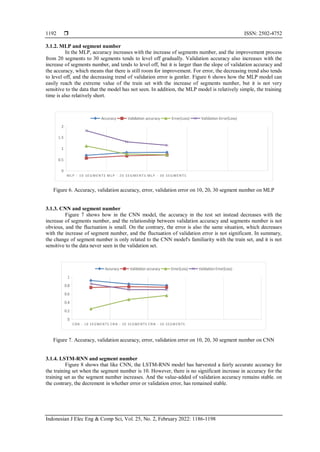
Figure 8. Accuracy, validation accuracy, error, validation error on 10, 20, 30 segment number on LSTM-RN
3.1.5. Cross-sectional comparison with segment number
As can be seen in the Figure 9, the CNN is the best fit for the training set when the segment number
is 10, but the highest familiarity with the validation set is when the CNN is at segment number 20. The
lowest value occurs in the case of MLP model with segment number 10. By observing the gradient analysis,
the MLP model exhibits a higher gradient as the segment number increases, followed by the recurrent neural
networks RNN, and only the CNN model decreases as the segment number increases. As for the training
time, RNN occupies the longest training time, with the increase of database, the deep network generation is
extremely burdensome for computing. the MLP model has a shorter training time because of its relative
simplicity [21], while CNN is in the middle of both.
Figure 9. The relationships between Models and segment number
3.2. Activation function
3.2.1. Variation interval: [Sigmoid, tanh, ReLU, Leaky ReLU, ELU]
To find the activation functions most suitable for the model, this part of the experiment focuses on
observing the effects of the different activation functions used above the same model on the results. Here are
some parameters of the models. Due to the difference between the models, the experiment did not compare
between the models when verifying the relationship between the activation function and the models. Leaky
ReLU here with the α equals to 0.05.
3.2.2. MLP evaluation
MLP: learning rate: 0.0001,hidden layers: [512,256,128] ,epochs: 50,dropout: 0.3, segment
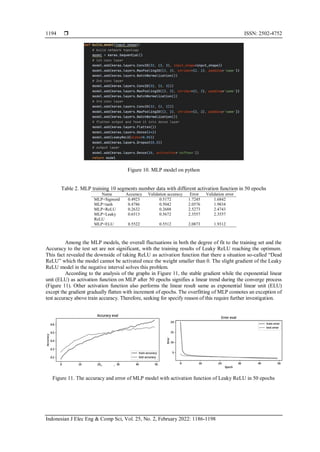
number: 10. In this experiment, we used MLP model in python as shown in Figure 10 and training 10
segments number data with different activation function. The Table 2 shows in the results, that the accuracy
of MLP drops from about 50% to 26.8% when using the ReLU function.](https://image.slidesharecdn.com/26822-52218-1-pb-240917071805-fa76afb5/85/Music-genres-classification-by-deep-learning-8-320.jpg)
![Indonesian J Elec Eng & Comp Sci ISSN: 2502-4752
Music genres classification by deep learning (Yifeng Hu)
1195
3.2.3. CNNs evaluation
Convolutional neural networks (CNN), learning rate: 0.0001, convolutional layer: [32, 32, 32], full-
connected layer [64], epochs: 50, dropout: 0.3, segment number: 10. Due to the advantages of CNN itself in
recognizing feature extraction on high-precision images, Table 3 has shown relatively outstanding accuracy on
different algorithms [22]. Among them, the activation functions used for the convergence of the training set all
played well, and all simulated an accuracy of roughly 82%. For the validation set, i.e., those data not seen by the
model, Leaky ReLU shows the best performance [23], with 74% accuracy. Through the evaluation of the image
of the training results of the CNN models, CNN demonstrates a stable and efficient performance in the
recognition of very fine spatial resolution VFSR image [6] as said by [5]. To implement the CNN model, we
used python as shown in Figure 12. Comparing with simple model, MLP, convergence process of CNN presents
a non-linear in the Figure 13. This indicates the efficiency of CNN in the early stage with epochs around 10.
The problem between the CNN model and the activation function is also obtained by a simple analysis
of the overfitting problem as shown in Figure 14. The activation function usually affects the training process,
resulting in higher train accuracy [5], [24]. Among results, tanh has the most severe overfitting in the CNN
model.
Table 3. CNN training 10 segments number data with different activation function in 50 epochs
Name Accuracy Validation Accuracy Error Validation Error
CNN+Sigmoid 0.8406 0.6647 0.4576 1.0268
CNN+tanh 0.8535 0.6120 0.4710 1.2152
CNN+ReLU 0.8244 0.7207 0.4992 0.8509
CNN+Leaky ReLU 0.8569 0.7427 0.4184 0.7589
CNN+ELU 0.8411 0.7167 0.4674 0.8454
Figure 12. CNN model on python
Figure 13. The accuracy and error of CNN model with activation function of tanh in 50 epochs](https://image.slidesharecdn.com/26822-52218-1-pb-240917071805-fa76afb5/85/Music-genres-classification-by-deep-learning-10-320.jpg)
![ ISSN: 2502-4752
Indonesian J Elec Eng & Comp Sci, Vol. 25, No. 2, February 2022: 1186-1198
1196
Figure 14. LSTM-RNN model on python
3.2.4. RNNs evaluation
Recurrent neural networks (RNN) learning rate: 0.0001, LSTM layer: [64], epochs: 50, dropout: 0.3,
segment number: 10. Table 4 shows that he RNN is relatively simple in structure, with only one LSTM layer
and flatten layer, so it is not difficult to derive from the data in the table that the results are more fluctuated
by the activation function. Among them [25], the best performers are the Leaky ReLU and ELU functions,
which show a better fit to the training set. However, in contrast, the lowest LSTM-RNN with Sigmoid has a
validation accuracy of 60.5%, while the highest LSTM-RNN with Leaky ReLU has only 66.8%, and the
difference between the two in accuracy is about 15%. This indicates that to conquer the phenomenon of
overfitting, more debugging in either ReLU or a variant function of ReLU are needed. Furthermore, training
of LSTM-RNN is relatively too expensive for small scale research. LSTM-RNN average running time of 50
epochs on CPU is 10-15 minutes but CNN takes around 5-10 minute as shown in Figure 15.
Table 4. RNN training 10 segments number data with different activation function in 50 epochs
Name Accuracy Validation accuracy Error Validation error
RNN + Sigmoid 0.6647 0.6053 0.9856 1.1540
RNN + tanh 0.7839 0.6427 0.6562 1.1148
RNN + ReLU 0.7513 0.6353 0.7868 1.0749
RNN + Leaky ReLU 0.7712 0.6680 0.7400 1.0524
RNN + ELU 0.8020 0.6567 0.6119 1.0962
Figure 15. The Accuracy and Error of LSTM-RNN model with activation function of Leaky ReLU
in 50 epochs
4. CONCLUSIONS
The goal of this study is to break down the pyramid structure of now day’s streaming which helping
bottom musician to reap higher revenue. At the very beginning, the expectation is to develop a plugin for
stream platform, and such as Spotify. But due to the technical ability limitation, research direction in this
project was changed to the analysis and evaluation after basic model developing. The data, GTZAN, used for](https://image.slidesharecdn.com/26822-52218-1-pb-240917071805-fa76afb5/85/Music-genres-classification-by-deep-learning-11-320.jpg)
![Indonesian J Elec Eng & Comp Sci ISSN: 2502-4752
Music genres classification by deep learning (Yifeng Hu)
1197
training also been used in field of audio recognition, and signal feature extracting. As the project was
investigated and advanced, “deep learning in audio classification” are redirected to “deep learning in
classification of VFSR images” by the powerful function STFT and MFCC in the package librosa. It easily
transforms un-analyzable audio signal from time domain and amplitude domain into frequency domain which
a new perspective is found for analysis for this purpose. After that, three deep learning models are developed
by python and used for image recognition a classification. The paper, besides the implementation of basic
function of models, presents the investigation of relation between prediction capability of deep neural
network models and factors had roughly done. The experiments are focused on the observation of the
relationship between the model and the Segment Number, and between the model and the activation function.
First, the relationship between segment number on different models was explored. It is finally
concluded that the higher the precision except for CNN, all demonstrate higher accuracy. Also, the training
time needed by the RNN model is increase in due to the effect of its own generated depth by the recurrent
structure. Therefore, to make the RNN model harvest efficiency rate during training, from the data accuracy
level, the higher the segment number, the higher the accuracy of prediction is accordingly. The same RNN
model training time is relatively long and consequently the training cost is expensive, for small-scale surveys
and experiments, it is not recommended to use RNN models, especially CPU training. Regarding the
activation functions, both Sigmoid and tanh in the saturated activation function have ordinary performance,
and only achieve relatively low accuracy and relatively slow convergence on each model. However, due to
their relatively stable gradients, better training results may be obtained after increasing the number of epochs.
As for the non-saturated activation functions, ReLU, Leaky ReLU, ELU, all make the training effect
of each model particularly obvious in the early stage of the backpropagation process due to the small value of
the negative interval of the function and the linear increment in positive interval. However, as the epochs
increase, the problem of overfitting also arises. Moreover, the dead ReLU case of the unsaturated activation
function ReLU needs to be controlled during the initialization of the weights, otherwise the weight will
always be equal to 0 during the backpropagation process, and the neural nodes will not be able to pass any
weight. Due to the satisfactory performance of CNN model in this experiment, and strong complementarity
between representation of feature by MLP and CNN, and the relatively stable gradient of Sigmoid, as well as
the high efficiency of Leaky ReLU function, and the the subsequent work will be based on CNN model,
fusion activation function for Sigmoid and Leaky ReLU, and debugging a deep learning model and algorithm
more suitable for audio analysis and classification. In addition, the attention model (AM) will be
implemented for future work to optimize the model because of its outstanding performance by biological
simulating of the activation neurons in human brain.
REFERENCES
[1] N. Srivastava, G. Hinton, A. Krizhevsky, I. Sutskever, and R. Salakhutdinov, "Dropout: A Simple Way to Prevent Neural
Networks from Overfitting,” Journal of Machine Learning Research, vol. 15, pp. 1929-1958, 2016.
[2] M. Nielsen, “Neural Networks and Deep Learning,” (2013). Accessed: 4, Apr. 2021 [Online]. Available:
http://neuralnetworksanddeeplearning.com
[3] K. T. Al-Sarayreh, K. Meridji, M. Alenezi, M. Zarour, and M. D. Al-Majali, “A sustainable procedural method of software design
process improvements,” Indonesian Journal of Electrical Engineering and Computer Science, vol. 21, no 1, 2021, doi:
10.11591/ijeecs.v21.i1.pp440-449.
[4] A. Oord, S. Dieleman, and B. Schrauwen, "Deep content-based music recommendation,” Advances in Neural Information
Processing Systems, vol. 26, pp. 2643-2651, 2013.
[5] C. Zhang, H. Li, A. Gardiner, I. Sargent, J. Hare, and P. M. Atkinson, "A Hybrid MLP-CNN Classifier for Very Fine Resolution
Remotely Sensed Image Classification,” ISPRS Journal of Photogrammetry and Remote Sensing, vol. 140, pp. 133-144, 2018,
doi: 10.1016/j.isprsjprs.2017.07.014.
[6] J. Schmidhuber, “Deep learning in neural networks: An overview,” Neural Networks, vol. 61, pp. 85-117, 2014, doi:
10.1016/j.neunet.2014.09.003.
[7] Y. Yu, S. Luo, S. Liu, H. Qiao, Y. Liu, and L. Feng, "Deep Attention Based on Music Genre Classification,” Neurocomputing,
vol. 372, pp. 84-91, 2020, doi: 10.1016/j.neucom.2019.09.054.
[8] S. Oramas, F. Barbieri, O. Nieto, and X. Serra, “Multimodal deep learning for music genre classification,” Transactions of the
International Society for Music Information Retrieval, pp. 4-21, 2020.
[9] F. Del Frate, F. Pacifici, G. Schiavon, and C. Solimini, "Use of Neural Networks for Automatic Classification from High-
Resolution Images," in IEEE Transactions on Geoscience and Remote Sensing, vol. 45, no. 4, pp. 800-809, April 2007,
doi: 10.1109/TGRS.2007.892009.
[10] V. V. Eklund, “Data Augmentation Techniques for Robust Audio Analysis,” (2019). Accessed: 4, Apr. 2021. [Online]. Available:
https://trepo.tuni.fi/bitstream/handle/10024/117251/EklundVille-Veikko.pdf?sequence=2
[11] Y. Hu, Y. Koren, and C. Volinsky, "Collaborative Filtering for Implicit Feedback Datasets," 2008 Eighth IEEE International
Conference on Data Mining, 2008, pp. 263-272, doi: 10.1109/ICDM.2008.22.
[12] D. Britz, “Recurrent Neural Networks Tutorial, Part 1–Introduction to RNNs,” (2015). Accessed: 4, Apr. 2021. [Online].
Available: http://www.wildml.com/2015/09/recun-ent-neural-networks-tutorial-part-l-introduction-to-rrms/
[13] A. Romero, C. Gatta, and G. Camps-Valls, "Unsupervised Deep Feature Extraction for Remote Sensing Image Classification," in
IEEE Transactions on Geoscience and Remote Sensing, vol. 54, no. 3, pp. 1349-1362, March 2016, doi:
10.1109/TGRS.2015.2478379.](https://image.slidesharecdn.com/26822-52218-1-pb-240917071805-fa76afb5/85/Music-genres-classification-by-deep-learning-12-320.jpg)
![ ISSN: 2502-4752
Indonesian J Elec Eng & Comp Sci, Vol. 25, No. 2, February 2022: 1186-1198
1198
[14] C. Olah, “Understanding LSTM Networks,” (2015). Accessed: 3, Mar. 2021. [Online]. Available: http://colah.github.io/posts/2015-
08-Understanding-LSTMs/
[15] D. Tuia, F. Ratle, F. Pacifici, M. F. Kanevski, and W. J. Emery, "Active Learning Methods for Remote Sensing Image
Classification," in IEEE Transactions on Geoscience and Remote Sensing, vol. 47, no. 7, pp. 2218-2232, July 2009, doi:
10.1109/TGRS.2008.2010404.
[16] D. Strigl, K. Kofler, and S. Podlipnig, "Performance and Scalability of GPU-Based Convolutional Neural Networks," 2010 18th
Euromicro Conference on Parallel, Distributed and Network-based Processing, 2010, pp. 317-324, doi: 10.1109/PDP.2010.43.
[17] I. Arel, D. C. Rose, and T. P. Karnowski, "Deep Machine Learning - A New Frontier in Artificial Intelligence Research [Research
Frontier]," in IEEE Computational Intelligence Magazine, vol. 5, no. 4, pp. 13-18, Nov. 2010, doi: 10.1109/MCI.2010.938364.
[18] W. Zhao and S. Du, "Learning multiscale and deep representations for classifying remotely sensed imagery,” Remote Sensing,
no. 113, pp. 155-165, 2016, doi: 10.1016/j.isprsjprs.2016.01.004.
[19] M. Langkvist, A. Kiselev, M. Alirezaie, and A. Loutfi, "Classification and Segmentation of Satellite Orthoimagery Using
Convolutional Neural Networks,” Remote Sensing, vol. 8, no. 4, 2019, doi: 10.3390/rs8040329.
[20] M. Kamyab, G. Liu, and M. Adjeisah, “Attention-Based CNN and Bi-LSTM Model Based on TF-IDF and GloVe Word
Embedding for Sentiment Analysis,” Applied Sciences, vol. 11, no. 23, pp. 11255, 2021, doi: 10.3390/app112311255.
[21] P. H. Talaee, “Multilayer perceptron with different training algorithms for streamflow forecastin,” Neural Computing and
Applications, vol. 24, no. 3-4, pp. 695-703, 2014, doi: 10.1007/s00521-012-1287-5.
[22] K. Yu, W. Xu, and Y. Gong, “Deep learning with kernel regularization for visual recognition,” Advances in Neural Information
Processing Systems, vol. 21, pp. 1889-1896, 2009.
[23] J. W. Cooley and J. W. Tukey, “An Algorithm for The Machine Calculation of Complex Fourier Series,” Comput., vol. 19, no. 2,
pp. 297-301, 1965.
[24] X. Li, Z. Deng, Z. Chen, and Q. Fei, "Analysis and Simplification of Three-Dimensional Space Vector PWM for Three-Phase
Four-Leg Inverters," in IEEE Transactions on Industrial Electronics, vol. 58, no. 2, pp. 450-464, Feb. 2011, doi:
10.1109/TIE.2010.2046610.
[25] M. C. Girish Baabu and M. C. Padma, “Semantic feature extraction method for hyperspectral crop classification,” Indonesian Journal
of Electrical Engineering and Computer Science, vol. 23, no. 1, pp. 387-395, 2021, doi: 10.11591/ijeecs.v23.i1.pp387-395.
BIOGRAPHIES OF AUTHORS
Yifeng Hu received his bachelor’s degrees in Information and Computer Science.
from the University of Liverpool (UK) and Xi’an Jiaotong-Liverpool University (China) in July
2021. His research interests include Music, Machine Learning, Deep Learning and some of the
interdisciplinary fields joint together with techniques of computer science. He is also chief
musical supervisor, producer, mixing engineer, cofunder of LessThan3 Studio. He can be
contacted at email: Hu.Yifeng@hotmail.com
Gabriela Mogos is Associate Professor in the Department of Computing, School of
Advanced Technology, at the Xi'an Jiaotong-Liverpool University (XJTLU), Suzhou, China. She
received her PhD in Computer Science from the Alexandru Ioan Cuza University of Iasi,
Romania, and followed this with a postdoctoral research position at the University of Oradea,
Romania. Her interests and research activities include Cybersecurity, Machine Learning,
Quantum computing with an emphasis on design of new quantum algorithms and quantum
cryptographic protocols. She has more than 100 academic publications, books, book chapters,
and has acted as principal investigator and co-investigator in international and national research
projects. She can be contacted at email: gabi.mogos@gmail.com, Gabriela.Mogos@xjtlu.edu.cn](https://image.slidesharecdn.com/26822-52218-1-pb-240917071805-fa76afb5/85/Music-genres-classification-by-deep-learning-13-320.jpg)


![[Deck] What's New in Spark-Iceberg Integration via DSV2.pptx](https://cdn.slidesharecdn.com/ss_thumbnails/deckwhatsnewinspark-icebergintegrationviadsv2-260210005337-25955b12-thumbnail.jpg?width=640&height=640&fit=bounds)


