INTRODUCTION
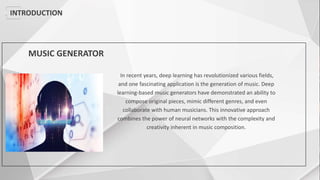
MUSIC GENERATOR
In recent years, deep learning has revolutionized various fields,
and one fascinating application is the generation of music. Deep
learning-based music generators have demonstrated an ability to
compose original pieces, mimic different genres, and even
collaborate with human musicians. This innovative approach
combines the power of neural networks with the complexity and
creativity inherent in music composition.
LIBRARY USED
Pretty_midi:
A useful library that contains functions and classes for easy handling, parsing and modifying MIDI data.
Tensorfiow (RNN-LSTM):
The recurrent neural network are helpful in learning and modelling sequential data, and can remember important
information from the input, as they have an internal memory. RNN is best suitable for music generation task.
GPT2:
The GPT2 model provides excellent performance along with stability in text generation. This model can also be used for
music generation.
Fluidsynth:
It is a software synthesizer for generating customized music using MIDI. It uses soundfont instruments (.sf2) to play MIDI
notes.
MUSIC REPRESENTATION
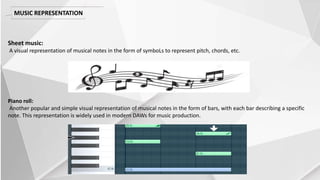
Sheet music:
A visual representation of musical notes in the form of symboLs to represent pitch, chords, etc.
Piano roll:
Another popular and simple visual representation of musical notes in the form of bars, with each bar describing a specific
note. This representation is widely used in modern DAWs for music production.
MUSIC REPRESENTATION
MiDI:
(Musical instrument Digital interface) is a digital standard to store the information about a
music in the form of notes, durations, timings, pitch, etc, which can be provided to digital
music synthesizer to create music.
WAV or MP3:
These are modern file formats for storing audio recorded in the form of bitstream
Recurrent Neural Networks
Recurrent Neural Networks (RNNs) are a type of artificial neural network designed for
sequential data processing. Unlike traditional feedforward neural networks, RNNs have
connections that form directed cycles, allowing them to maintain a hidden state
representing information about previous inputs. This recurrent nature makes RNNs well-
suited for tasks involving sequential or time-dependent data, such as natural language
processing, speech recognition, and time series analysis.
METHODOLOGY
1. Data Collection:
Gather a diverse dataset of musical pieces in a suitable format (MIDI, audio files, etc.). This dataset serves as
the training ground for the neural network.
2. Data Preprocessing:
Clean and preprocess the musical data. This may involve tasks such as normalizing tempo, transposing to a
consistent key, and converting the data into a format suitable for deep learning, such as MIDI representation.
3. Choosing a Model Architecture:
Select a deep learning architecture suitable for music generation. Recurrent Neural Networks (RNNs), especially
variants like Long Short-Term Memory (LSTM) or Gated Recurrent Unit (GRU), are commonly used due to their
ability to capture sequential dependencies.
METHODOLOGY
4. Input Representation:
Represent the musical data in a way that the model can understand. This could involve encoding musical notes,
durations, and other relevant features into a numerical format.
5. Model Training:
Train the chosen deep learning model on the preprocessed dataset. During training, the model learns the
patterns and structures present in the input musical data.
7. Generating Music:
Once the model is trained, use it to generate new music. Provide an initial seed or context to guide the
generation process, and let the model create a sequence of musical events.
8. Evaluation and Iteration:
Evaluate the generated music based on criteria such as coherence, creativity, and adherence to a particular
style. Iterate on the model and training process to improve the quality of generated music.
REFERENCES
REFERENCES
[1] Khawir Mahmood, Tausfer Rana and Abdur Rehman Raza, "Singular adaptive multi role intelligent personal assistant (SAM-
IPA) for human computer interaction", International conference on open source system and technologies, 2018.
[2] Veton Kepuska and Gamal Bohota, "Next generation of virtual assistant (Microsoft Cortana Apple Siri Amazon Alexa and
Google Home)", IEEE conference, 2018.
[3] Piyush Vashishta, Juginder Pal Singh, Pranav Jain and Jitendra Kumar, "Raspberry PI based voice-operated personal
assistant", International Conference on Electronics And Communication and Aerospace Technology ICECA, 2019.
THANKS

MUSZIC GENERATION USING DEEP LEARNING PPT.pptx

  • 1.
    INTRODUCTION MUSIC GENERATOR In recentyears, deep learning has revolutionized various fields, and one fascinating application is the generation of music. Deep learning-based music generators have demonstrated an ability to compose original pieces, mimic different genres, and even collaborate with human musicians. This innovative approach combines the power of neural networks with the complexity and creativity inherent in music composition.
  • 2.
    LIBRARY USED Pretty_midi: A usefullibrary that contains functions and classes for easy handling, parsing and modifying MIDI data. Tensorfiow (RNN-LSTM): The recurrent neural network are helpful in learning and modelling sequential data, and can remember important information from the input, as they have an internal memory. RNN is best suitable for music generation task. GPT2: The GPT2 model provides excellent performance along with stability in text generation. This model can also be used for music generation. Fluidsynth: It is a software synthesizer for generating customized music using MIDI. It uses soundfont instruments (.sf2) to play MIDI notes.
  • 3.
    MUSIC REPRESENTATION Sheet music: Avisual representation of musical notes in the form of symboLs to represent pitch, chords, etc. Piano roll: Another popular and simple visual representation of musical notes in the form of bars, with each bar describing a specific note. This representation is widely used in modern DAWs for music production.
  • 4.
    MUSIC REPRESENTATION MiDI: (Musical instrumentDigital interface) is a digital standard to store the information about a music in the form of notes, durations, timings, pitch, etc, which can be provided to digital music synthesizer to create music. WAV or MP3: These are modern file formats for storing audio recorded in the form of bitstream
  • 5.
    Recurrent Neural Networks RecurrentNeural Networks (RNNs) are a type of artificial neural network designed for sequential data processing. Unlike traditional feedforward neural networks, RNNs have connections that form directed cycles, allowing them to maintain a hidden state representing information about previous inputs. This recurrent nature makes RNNs well- suited for tasks involving sequential or time-dependent data, such as natural language processing, speech recognition, and time series analysis.
  • 6.
    METHODOLOGY 1. Data Collection: Gathera diverse dataset of musical pieces in a suitable format (MIDI, audio files, etc.). This dataset serves as the training ground for the neural network. 2. Data Preprocessing: Clean and preprocess the musical data. This may involve tasks such as normalizing tempo, transposing to a consistent key, and converting the data into a format suitable for deep learning, such as MIDI representation. 3. Choosing a Model Architecture: Select a deep learning architecture suitable for music generation. Recurrent Neural Networks (RNNs), especially variants like Long Short-Term Memory (LSTM) or Gated Recurrent Unit (GRU), are commonly used due to their ability to capture sequential dependencies.
  • 7.
    METHODOLOGY 4. Input Representation: Representthe musical data in a way that the model can understand. This could involve encoding musical notes, durations, and other relevant features into a numerical format. 5. Model Training: Train the chosen deep learning model on the preprocessed dataset. During training, the model learns the patterns and structures present in the input musical data. 7. Generating Music: Once the model is trained, use it to generate new music. Provide an initial seed or context to guide the generation process, and let the model create a sequence of musical events. 8. Evaluation and Iteration: Evaluate the generated music based on criteria such as coherence, creativity, and adherence to a particular style. Iterate on the model and training process to improve the quality of generated music.
  • 8.
    REFERENCES REFERENCES [1] Khawir Mahmood,Tausfer Rana and Abdur Rehman Raza, "Singular adaptive multi role intelligent personal assistant (SAM- IPA) for human computer interaction", International conference on open source system and technologies, 2018. [2] Veton Kepuska and Gamal Bohota, "Next generation of virtual assistant (Microsoft Cortana Apple Siri Amazon Alexa and Google Home)", IEEE conference, 2018. [3] Piyush Vashishta, Juginder Pal Singh, Pranav Jain and Jitendra Kumar, "Raspberry PI based voice-operated personal assistant", International Conference on Electronics And Communication and Aerospace Technology ICECA, 2019.
  • 9.