Muscle Mechanics
Dr. Aparna Shetty (P.T)
1
Contents
• Types of Muscles
• Types of muscle work/ contraction
• Muscle Action - Agonist, antagonist, fixators, synergist
• Active and passive insufficency
• Range of muscle work, Angle of pull
2
Types of muscles
• Muscles are classified by three different methods, based
on different factors:
I. Depending upon the presence or absence of striation
II.Depending upon the control
III.Depending upon the situation
3
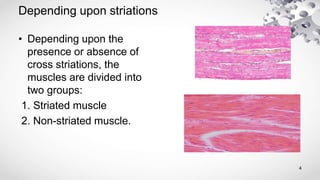
Depending upon striations
• Depending upon the
presence or absence of
cross striations, the
muscles are divided into
two groups:
1. Striated muscle
2. Non-striated muscle.
4
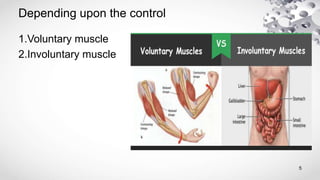
Depending upon the control
1.Voluntary muscle
2.Involuntary muscle
5
Depending upon the situation
• There are three types of
muscles:
1- Cardiac (in the heart).
2- Skeletal (around the
skeleton).
3- Smooth (in the viscera).
6
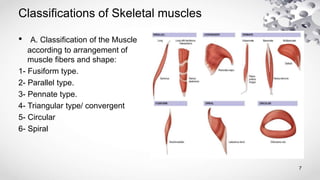
Classifications of Skeletal muscles
• A. Classification of the Muscle
according to arrangement of
muscle fibers and shape:
1- Fusiform type.
2- Parallel type.
3- Pennate type.
4- Triangular type/ convergent
5- Circular
6- Spiral
7
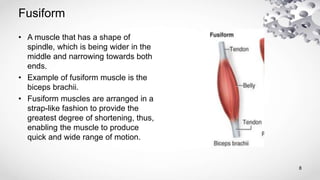
Fusiform
• A muscle that has a shape of
spindle, which is being wider in the
middle and narrowing towards both
ends.
• Example of fusiform muscle is the
biceps brachii.
• Fusiform muscles are arranged in a
strap-like fashion to provide the
greatest degree of shortening, thus,
enabling the muscle to produce
quick and wide range of motion.
8
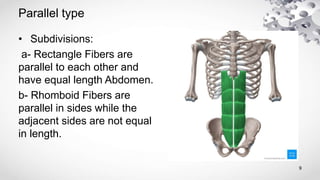
Parallel type
• Subdivisions:
a- Rectangle Fibers are
parallel to each other and
have equal length Abdomen.
b- Rhomboid Fibers are
parallel in sides while the
adjacent sides are not equal
in length.
9
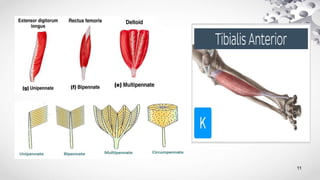
Penniform or pennate type
• Subdivisions:
1- Unipennate: The muscle fibers are attached to one side
of the tendon like = Half of a feather.
2- Bipennate: The muscle fibers are attached to both sides
of the tendon like = A complete feather.
3- Multipennate: It consists of many bipennate structures
set together on the muscle.
4- Circumpennate: The muscle fibers are attached to all
sides of the tendon
10
11
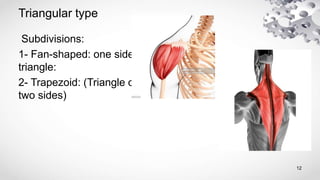
Triangular type
Subdivisions:
1- Fan-shaped: one side
triangle:
2- Trapezoid: (Triangle on
two sides)
12
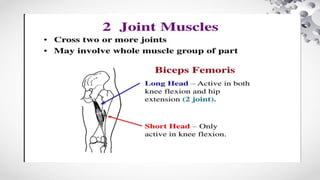
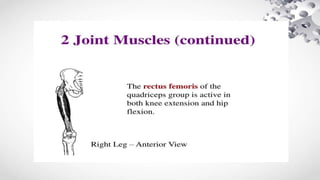
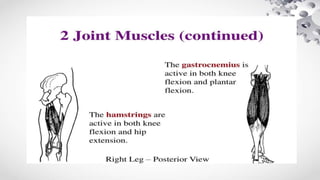
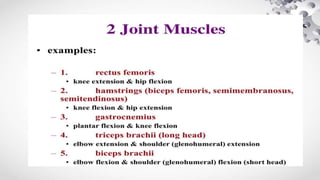
• B. Classification of muscle according to the number joints
over which the muscle passes:
1- One joint muscle
2- Two joint muscle
3- Multi-joint muscle
13
C. Classification of muscles according to the type of muscle
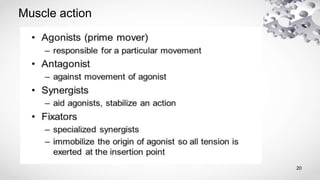
action or function (Group action of muscles)
1-AGONISTS:
2- ANTAGONISTS
3- SYNERGISTS: (Syn = together + ergon = work)
4- Fixators
14
D. Classification of muscles according to
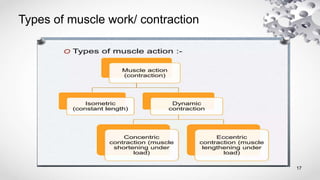
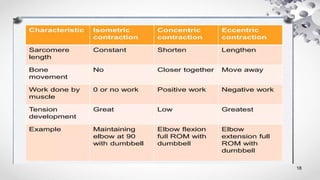
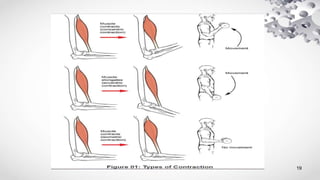
type muscle contraction:
1- Isometric contraction: (Iso = equal + metric = length)
2- Isotonic contraction: (Iso = equal + tonic = tone or tension) a-
Concentric contraction. b- Eccentric contraction.
3 - Isokinetic contraction: (Iso = equal + kinetics = motion).
15
F. Classification according to Orientation of
line of pull in relation to the joint
• Flexors: If the line of pull passes anterior to the joint axis; the
muscle is called Flexor.
• Extensors: If the line of pull passes posterior to the joint axis; the
muscle is called Extensor.
• Abductors: If the line or pull passes lateral to the joint axis, the
muscle is called Abductor.
• Adductors: If the line of pull passes medial to the joint axis; the
muscle is called Adductor.
16
Types of muscle work/ contraction
17
18
19
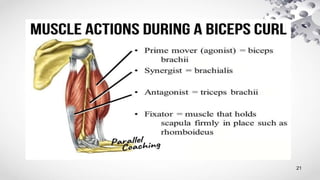
Muscle action
20
21
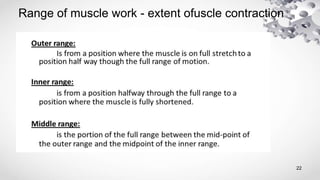
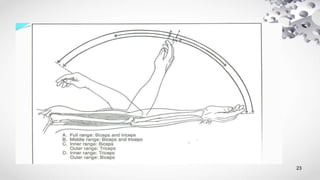
Range of muscle work - extent ofuscle contraction
22
23
Active and passive insufficiency
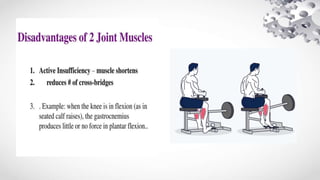
• Insufficiency is the term used for describing the inability of a
muscle to generate adequate force bring out a desired action /
movement.
• In absence of disease process, muscle insufficiency is seen when
the length tension relation is altered.
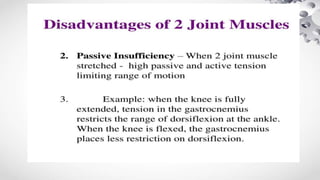
• Muscle lengthened = Passive insufficiency
• Muscle shortened = Active insufficiency
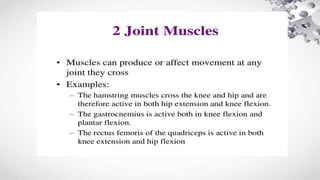
• Active and Passive insufficiency is seen only in two joint or multi-
joint muscles.
24
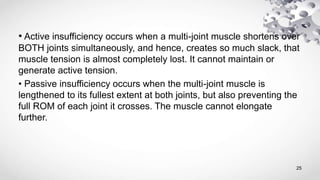
• Active insufficiency occurs when a multi-joint muscle shortens over
BOTH joints simultaneously, and hence, creates so much slack, that
muscle tension is almost completely lost. It cannot maintain or
generate active tension.
• Passive insufficiency occurs when the multi-joint muscle is
lengthened to its fullest extent at both joints, but also preventing the
full ROM of each joint it crosses. The muscle cannot elongate
further.
25
• The above recommendations are not hard and fast rules, but
understanding these two terms can help trainers better evaluate
their clients’ hindrances and progress with regard to efficient
movement. If a client seems to consistently struggle with
particular movements you can determine if active or passive
insufficiency is playing a role and adjust accordingly. Questioning
and re-evaluating your approach to programming can only
improve client goal achievement and outcomes.
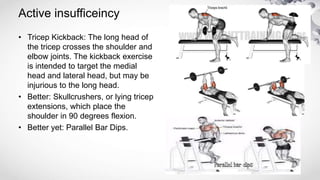
Active insufficeincy
• Tricep Kickback: The long head of
the tricep crosses the shoulder and
elbow joints. The kickback exercise
is intended to target the medial
head and lateral head, but may be
injurious to the long head.
• Better: Skullcrushers, or lying tricep
extensions, which place the
shoulder in 90 degrees flexion.
• Better yet: Parallel Bar Dips.
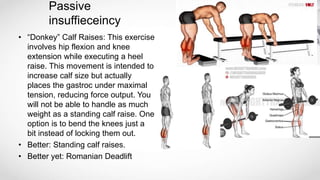
Passive
insuffieceincy
• “Donkey” Calf Raises: This exercise
involves hip flexion and knee
extension while executing a heel
raise. This movement is intended to
increase calf size but actually
places the gastroc under maximal
tension, reducing force output. You
will not be able to handle as much
weight as a standing calf raise. One
option is to bend the knees just a
bit instead of locking them out.
• Better: Standing calf raises.
• Better yet: Romanian Deadlift
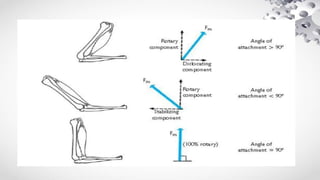
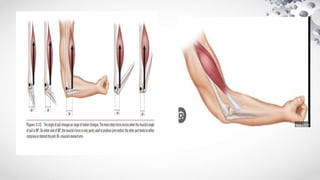
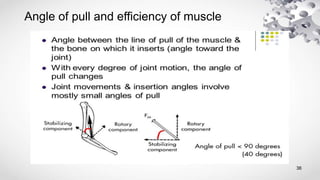
Angle of pull and efficiency of muscle
36
Angle is toward the joint or on the outer side.
Line of pull describe the direction of muscular force and
must always directed from the insertion point to the origin
point
Efficiency
• The effect of the resistance is maximal when it is applied
at right angle to the moving joint.
40

Muscle Mechanics.pptx

  • 1.
  • 2.
    Contents • Types ofMuscles • Types of muscle work/ contraction • Muscle Action - Agonist, antagonist, fixators, synergist • Active and passive insufficency • Range of muscle work, Angle of pull 2
  • 3.
    Types of muscles •Muscles are classified by three different methods, based on different factors: I. Depending upon the presence or absence of striation II.Depending upon the control III.Depending upon the situation 3
  • 4.
    Depending upon striations •Depending upon the presence or absence of cross striations, the muscles are divided into two groups: 1. Striated muscle 2. Non-striated muscle. 4
  • 5.
    Depending upon thecontrol 1.Voluntary muscle 2.Involuntary muscle 5
  • 6.
    Depending upon thesituation • There are three types of muscles: 1- Cardiac (in the heart). 2- Skeletal (around the skeleton). 3- Smooth (in the viscera). 6
  • 7.
    Classifications of Skeletalmuscles • A. Classification of the Muscle according to arrangement of muscle fibers and shape: 1- Fusiform type. 2- Parallel type. 3- Pennate type. 4- Triangular type/ convergent 5- Circular 6- Spiral 7
  • 8.
    Fusiform • A musclethat has a shape of spindle, which is being wider in the middle and narrowing towards both ends. • Example of fusiform muscle is the biceps brachii. • Fusiform muscles are arranged in a strap-like fashion to provide the greatest degree of shortening, thus, enabling the muscle to produce quick and wide range of motion. 8
  • 9.
    Parallel type • Subdivisions: a-Rectangle Fibers are parallel to each other and have equal length Abdomen. b- Rhomboid Fibers are parallel in sides while the adjacent sides are not equal in length. 9
  • 10.
    Penniform or pennatetype • Subdivisions: 1- Unipennate: The muscle fibers are attached to one side of the tendon like = Half of a feather. 2- Bipennate: The muscle fibers are attached to both sides of the tendon like = A complete feather. 3- Multipennate: It consists of many bipennate structures set together on the muscle. 4- Circumpennate: The muscle fibers are attached to all sides of the tendon 10
  • 11.
  • 12.
    Triangular type Subdivisions: 1- Fan-shaped:one side triangle: 2- Trapezoid: (Triangle on two sides) 12
  • 13.
    • B. Classificationof muscle according to the number joints over which the muscle passes: 1- One joint muscle 2- Two joint muscle 3- Multi-joint muscle 13
  • 14.
    C. Classification ofmuscles according to the type of muscle action or function (Group action of muscles) 1-AGONISTS: 2- ANTAGONISTS 3- SYNERGISTS: (Syn = together + ergon = work) 4- Fixators 14
  • 15.
    D. Classification ofmuscles according to type muscle contraction: 1- Isometric contraction: (Iso = equal + metric = length) 2- Isotonic contraction: (Iso = equal + tonic = tone or tension) a- Concentric contraction. b- Eccentric contraction. 3 - Isokinetic contraction: (Iso = equal + kinetics = motion). 15
  • 16.
    F. Classification accordingto Orientation of line of pull in relation to the joint • Flexors: If the line of pull passes anterior to the joint axis; the muscle is called Flexor. • Extensors: If the line of pull passes posterior to the joint axis; the muscle is called Extensor. • Abductors: If the line or pull passes lateral to the joint axis, the muscle is called Abductor. • Adductors: If the line of pull passes medial to the joint axis; the muscle is called Adductor. 16
  • 17.
    Types of musclework/ contraction 17
  • 18.
  • 19.
  • 20.
  • 21.
  • 22.
    Range of musclework - extent ofuscle contraction 22
  • 23.
  • 24.
    Active and passiveinsufficiency • Insufficiency is the term used for describing the inability of a muscle to generate adequate force bring out a desired action / movement. • In absence of disease process, muscle insufficiency is seen when the length tension relation is altered. • Muscle lengthened = Passive insufficiency • Muscle shortened = Active insufficiency • Active and Passive insufficiency is seen only in two joint or multi- joint muscles. 24
  • 25.
    • Active insufficiencyoccurs when a multi-joint muscle shortens over BOTH joints simultaneously, and hence, creates so much slack, that muscle tension is almost completely lost. It cannot maintain or generate active tension. • Passive insufficiency occurs when the multi-joint muscle is lengthened to its fullest extent at both joints, but also preventing the full ROM of each joint it crosses. The muscle cannot elongate further. 25
  • 33.
    • The aboverecommendations are not hard and fast rules, but understanding these two terms can help trainers better evaluate their clients’ hindrances and progress with regard to efficient movement. If a client seems to consistently struggle with particular movements you can determine if active or passive insufficiency is playing a role and adjust accordingly. Questioning and re-evaluating your approach to programming can only improve client goal achievement and outcomes.
  • 34.
    Active insufficeincy • TricepKickback: The long head of the tricep crosses the shoulder and elbow joints. The kickback exercise is intended to target the medial head and lateral head, but may be injurious to the long head. • Better: Skullcrushers, or lying tricep extensions, which place the shoulder in 90 degrees flexion. • Better yet: Parallel Bar Dips.
  • 35.
    Passive insuffieceincy • “Donkey” CalfRaises: This exercise involves hip flexion and knee extension while executing a heel raise. This movement is intended to increase calf size but actually places the gastroc under maximal tension, reducing force output. You will not be able to handle as much weight as a standing calf raise. One option is to bend the knees just a bit instead of locking them out. • Better: Standing calf raises. • Better yet: Romanian Deadlift
  • 36.
    Angle of pulland efficiency of muscle 36
  • 38.
    Angle is towardthe joint or on the outer side. Line of pull describe the direction of muscular force and must always directed from the insertion point to the origin point
  • 40.
    Efficiency • The effectof the resistance is maximal when it is applied at right angle to the moving joint. 40