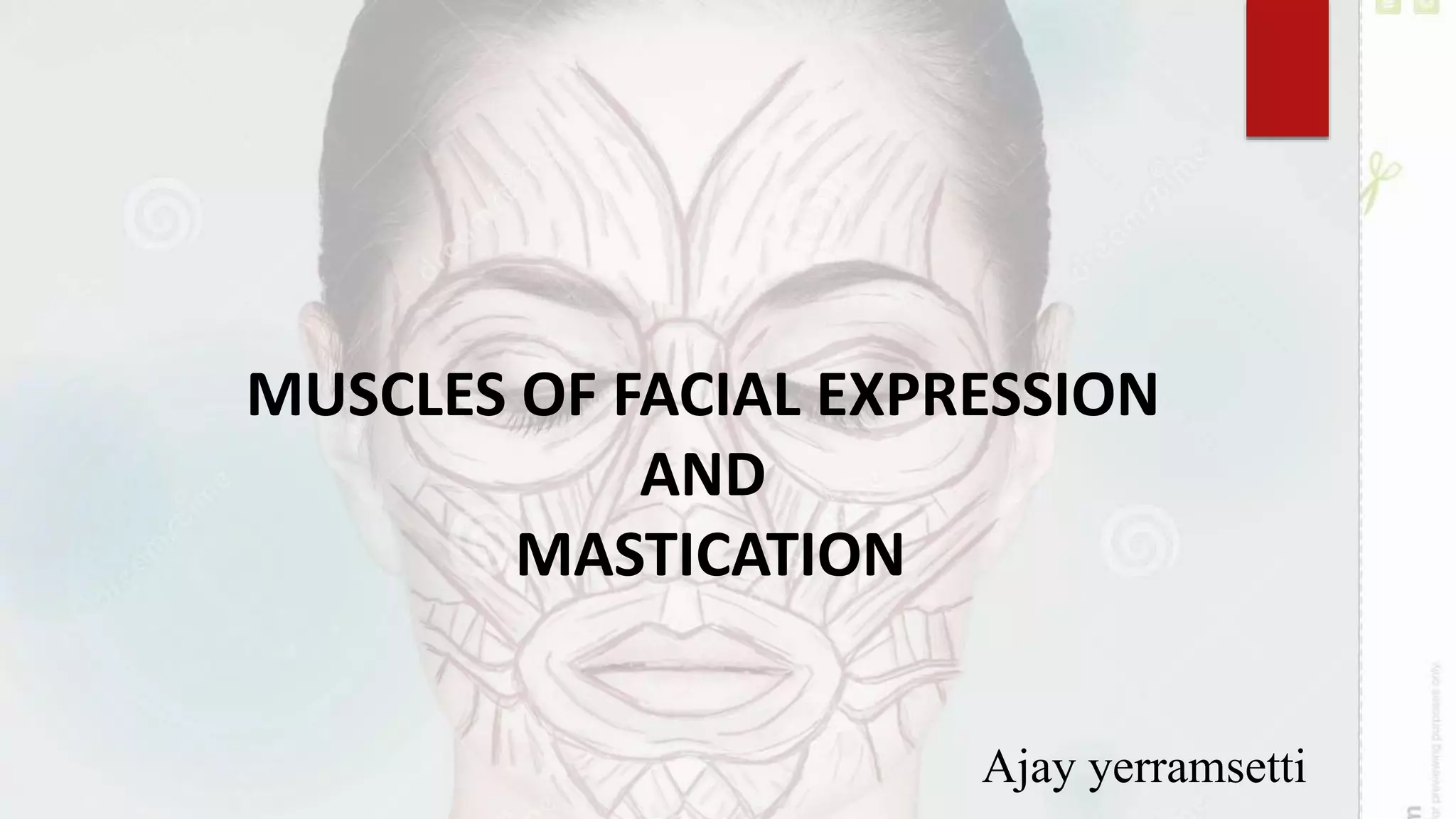
MUSCLES OF FACIAL EXPRESSION
AND
MASTICATION
Ajay yerramsetti
CONTENTS
 Introduction
 Muscles of the facial expression
 Origin and insertion
 Functions
 Applied anatomy
 Muscles of mastication
 Origin and insertion
 Functions
 Prosthodontic Considerations
 Clinical relevance
 References
 Face is the most prominent part of the body.
 Facial muscles help in showing a wide range of emotions.
 The face, therefore is an index of the mind.
INTRODUCTION
DEVELOPMENT OF FACIAL MUSCLES
EMBRYOLOGICALLY : They develop from the mesoderm of the second
branchial arch.
MORPHOLOGICALLY: They represent the best remnants of Panniculus
Carnosus, which is a continuous subcutaneous muscle sheet seen in some
animals.
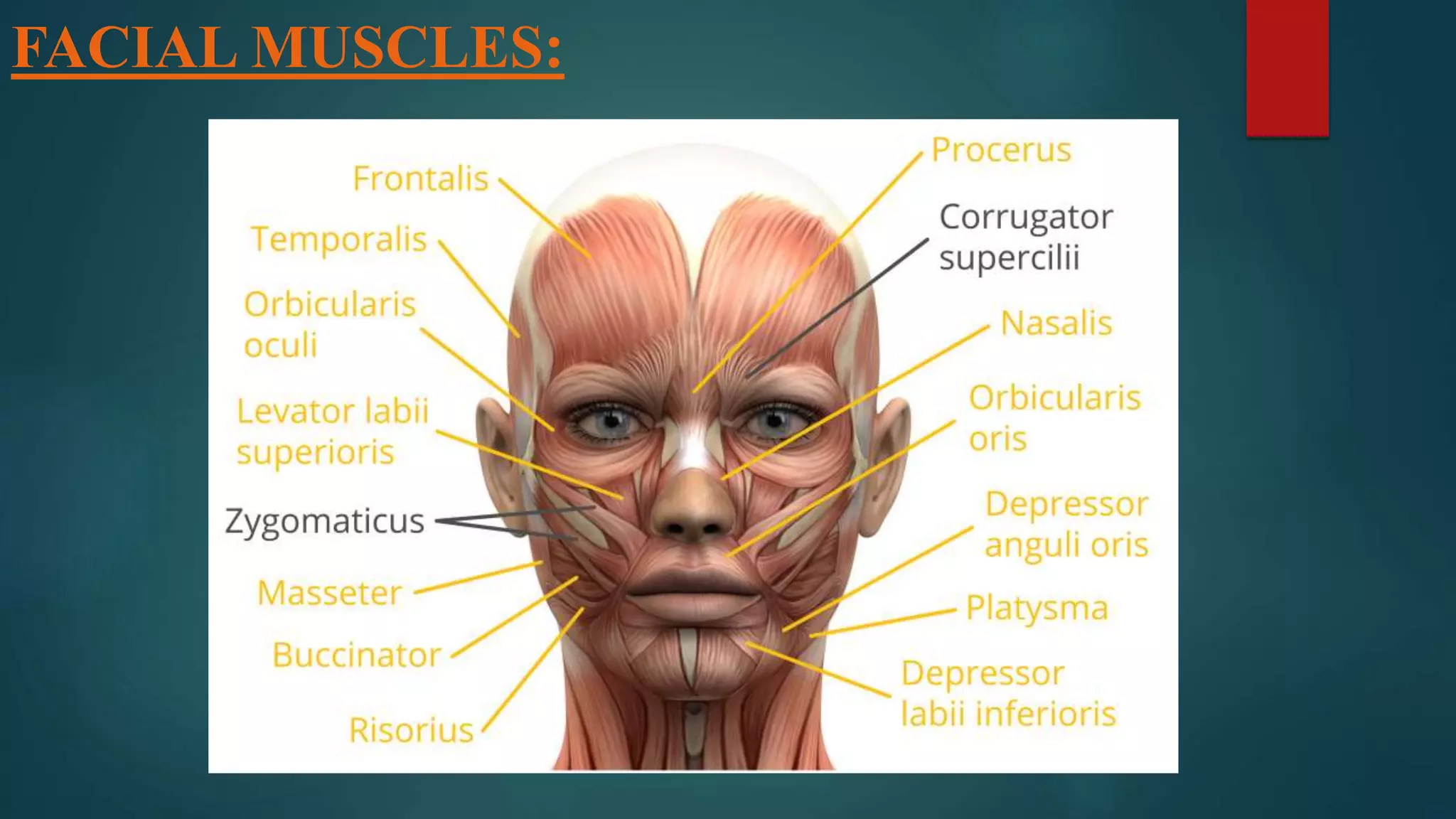
FACIAL MUSCLES:
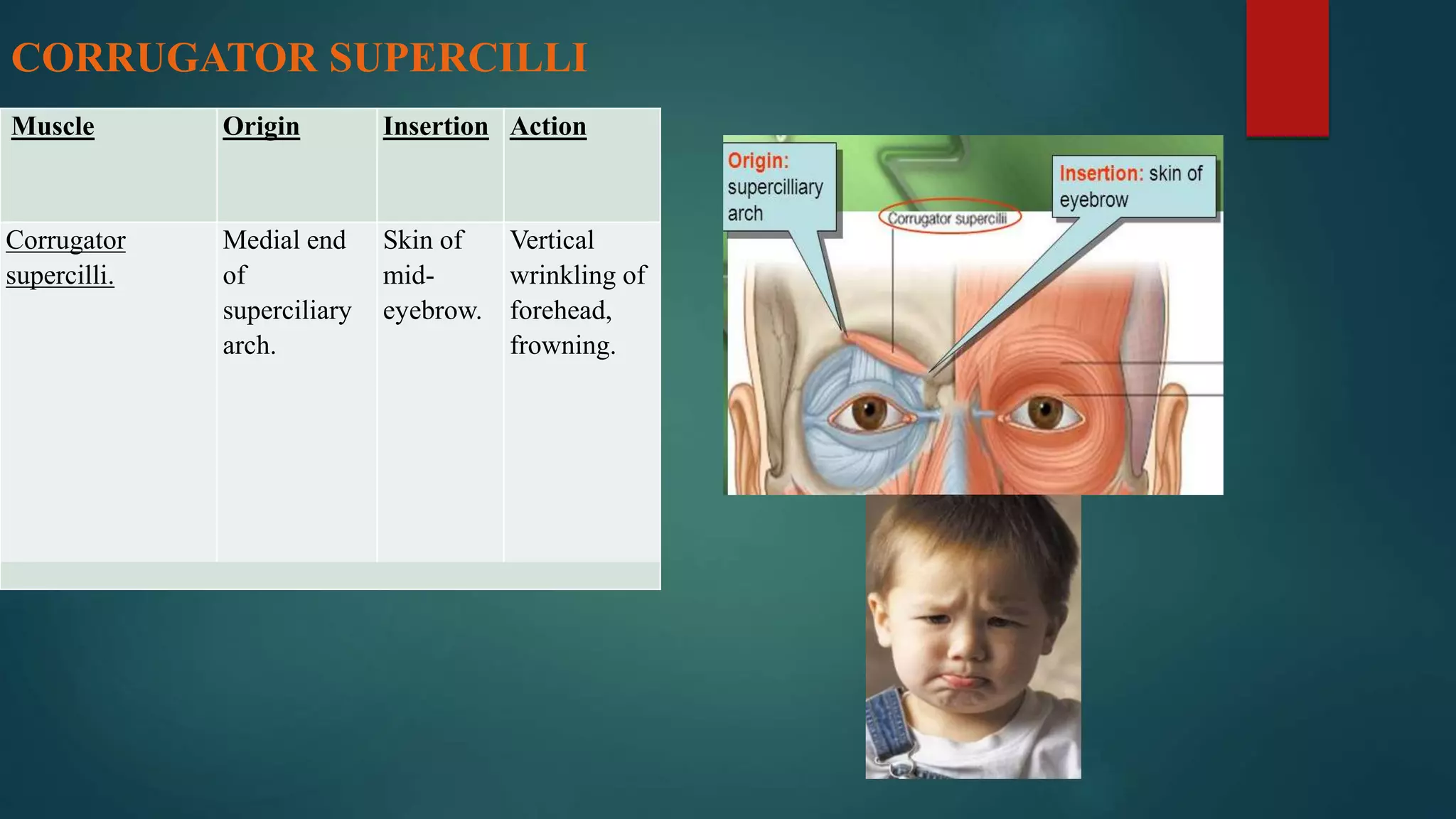
CORRUGATOR SUPERCILLI
Muscle Origin Insertion Action
Corrugator
supercilli.
Medial end
of
superciliary
arch.
Skin of
mid-
eyebrow.
Vertical
wrinkling of
forehead,
frowning.
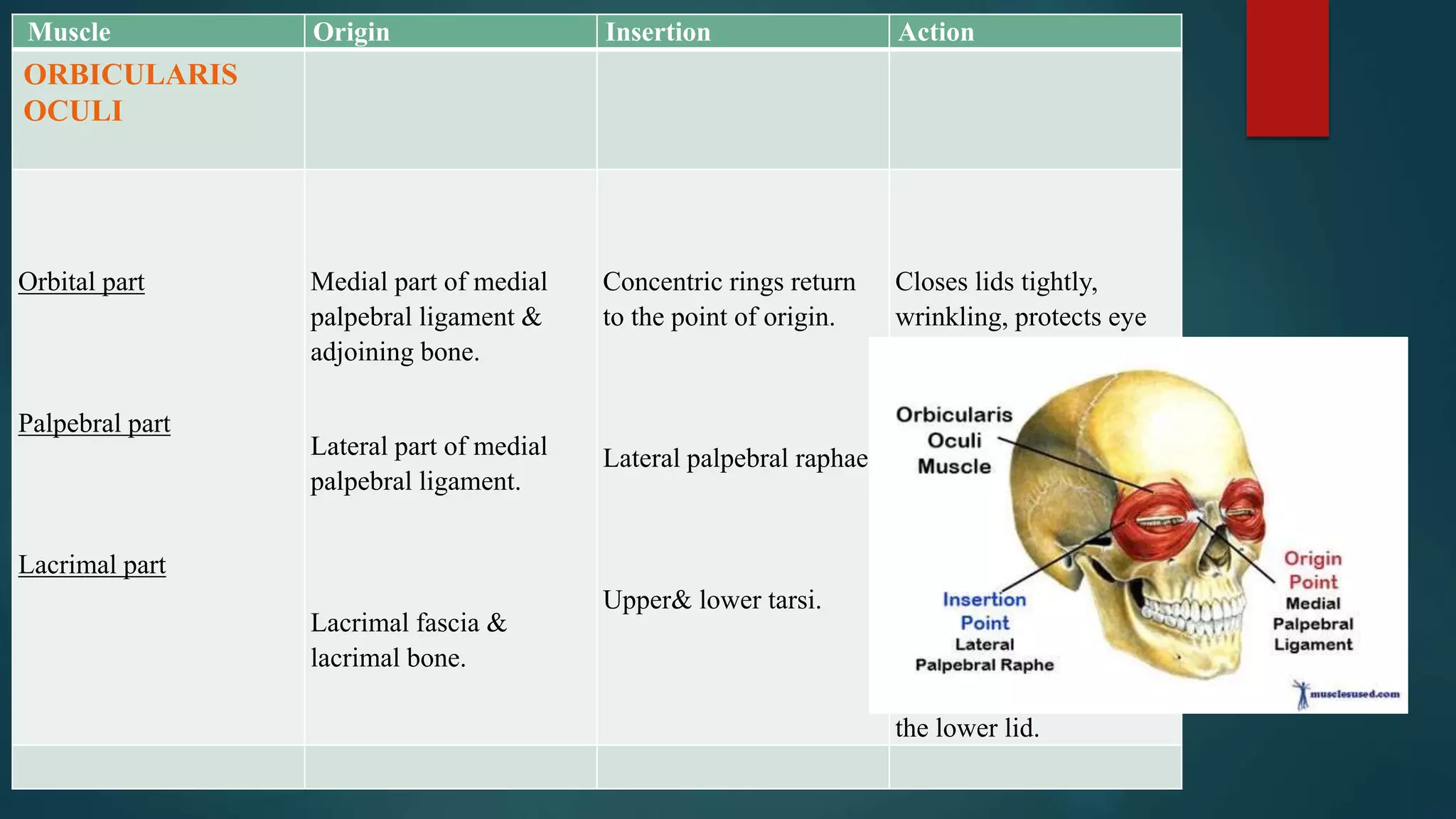
Muscle Origin Insertion Action
ORBICULARIS
OCULI
Orbital part
Palpebral part
Lacrimal part
Medial part of medial
palpebral ligament &
adjoining bone.
Lateral part of medial
palpebral ligament.
Lacrimal fascia &
lacrimal bone.
Concentric rings return
to the point of origin.
Lateral palpebral raphae.
Upper& lower tarsi.
Closes lids tightly,
wrinkling, protects eye
from bright light.
Closes lids gently,
blinking.
Dilates lacrimal sac,
directs lac. Puncta into
lacus lacrimalis, supports
the lower lid.
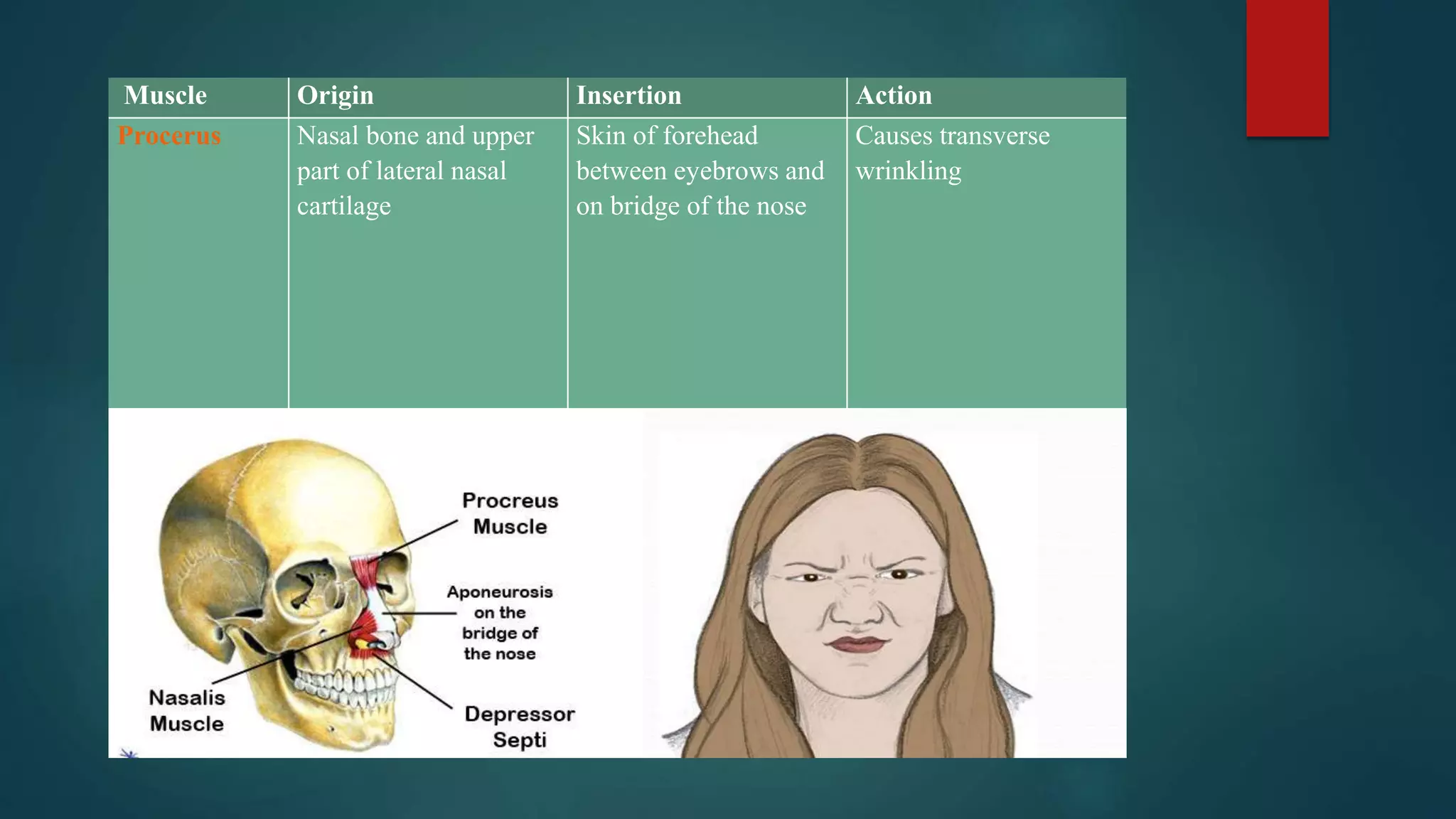
Muscle Origin Insertion Action
Procerus Nasal bone and upper
part of lateral nasal
cartilage
Skin of forehead
between eyebrows and
on bridge of the nose
Causes transverse
wrinkling
Muscle Origin Insertion Action
Compressor naris Maxilla just lateral to
nose
Aponeurosis across
dorsum of nose
Nasal aperture
compressed
Dilator naris Maxilla over the
lateral incisor
Alar cartilage of
nose
Nasal aperture
dilated
Depressor septi Maxilla over the
central incisor
Lower mobile part of
nasal septum
Nose pulled
inferiorly
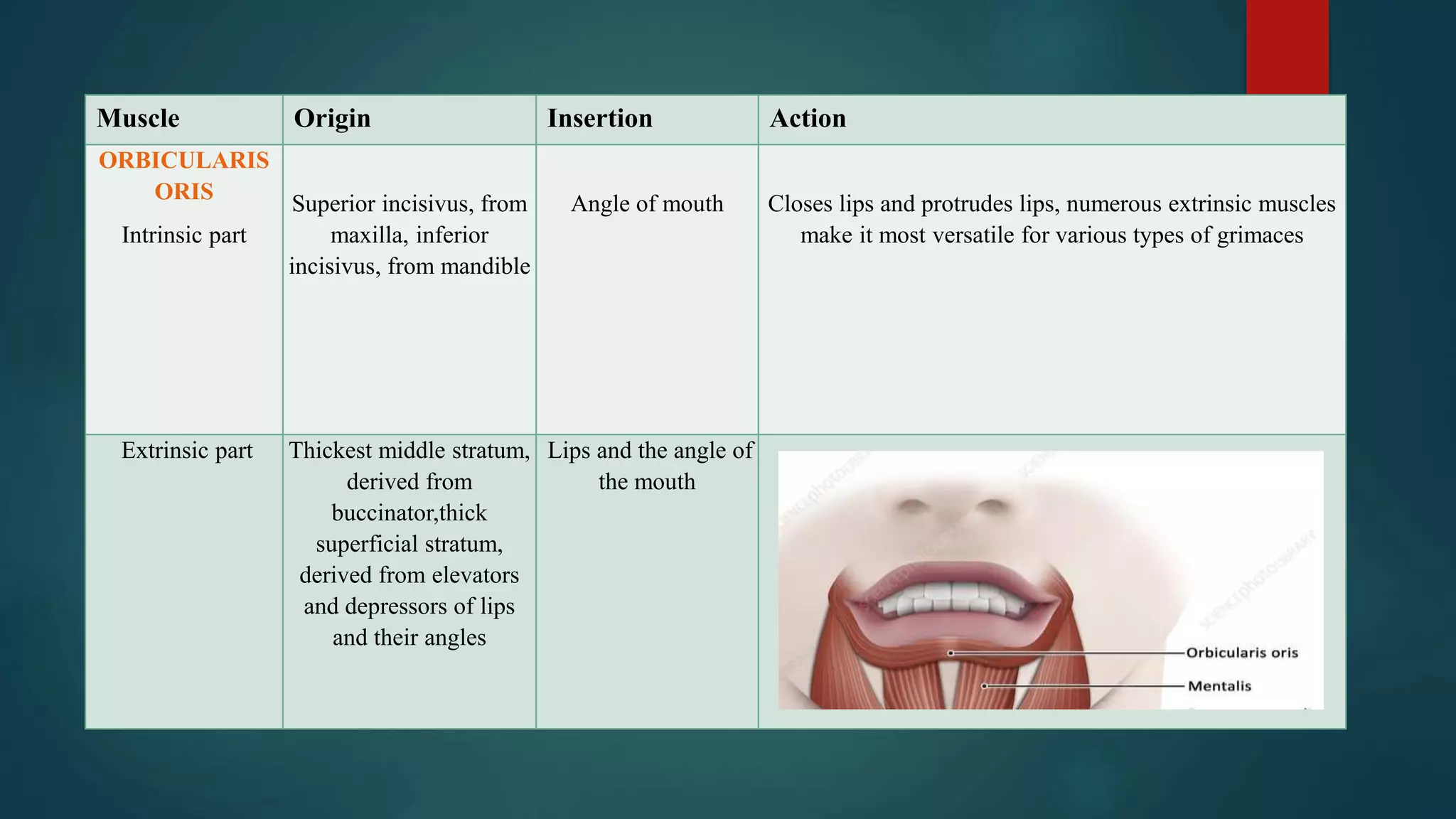
Muscle Origin Insertion Action
ORBICULARIS
ORIS
Intrinsic part
Superior incisivus, from
maxilla, inferior
incisivus, from mandible
Angle of mouth Closes lips and protrudes lips, numerous extrinsic muscles
make it most versatile for various types of grimaces
Extrinsic part Thickest middle stratum,
derived from
buccinator,thick
superficial stratum,
derived from elevators
and depressors of lips
and their angles
Lips and the angle of
the mouth
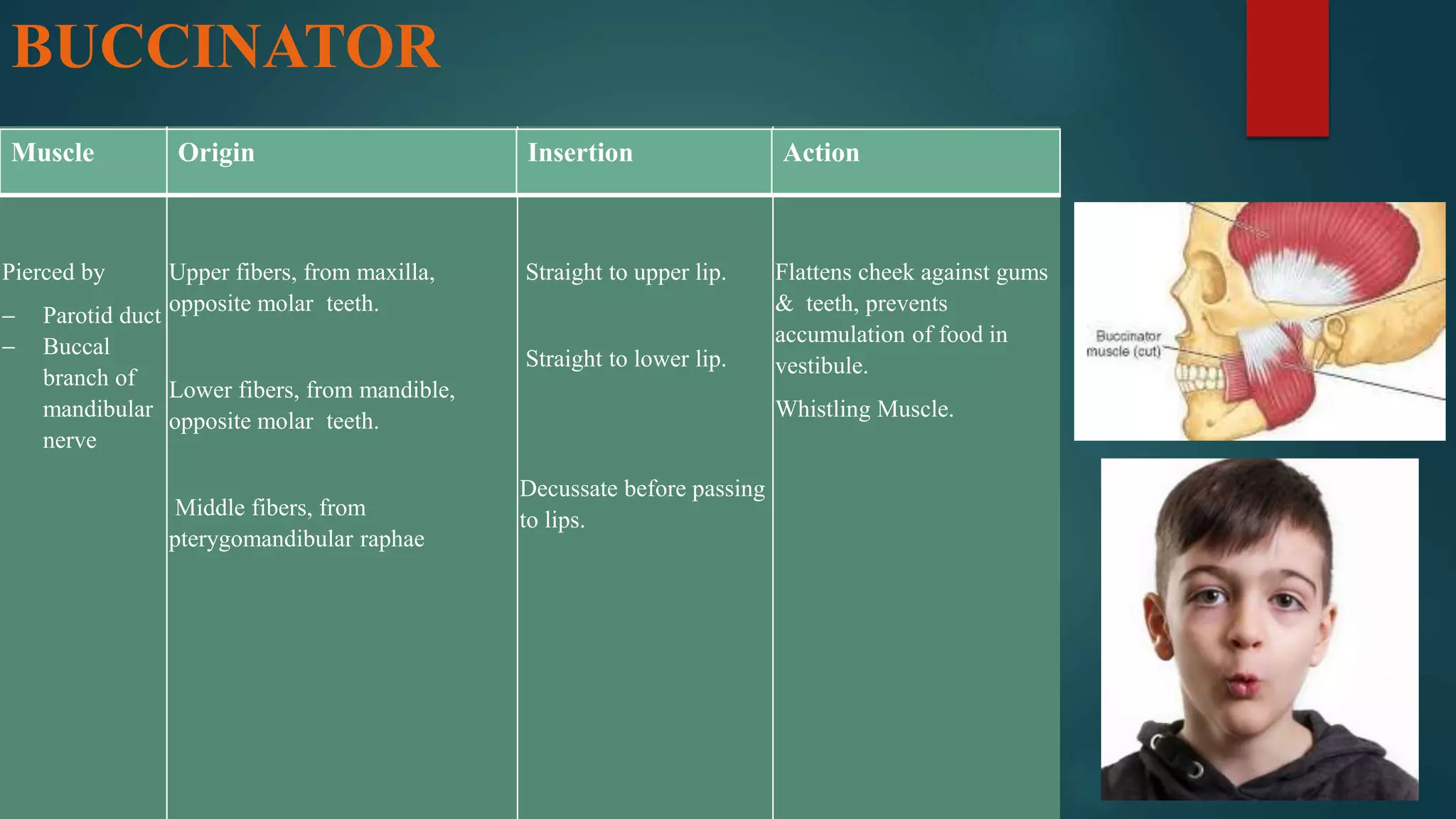
BUCCINATOR
Pierced by
 Parotid duct
 Buccal
branch of
mandibular
nerve
Upper fibers, from maxilla,
opposite molar teeth.
Lower fibers, from mandible,
opposite molar teeth.
Middle fibers, from
pterygomandibular raphae
Straight to upper lip.
Straight to lower lip.
Decussate before passing
to lips.
Flattens cheek against gums
& teeth, prevents
accumulation of food in
vestibule.
Whistling Muscle.
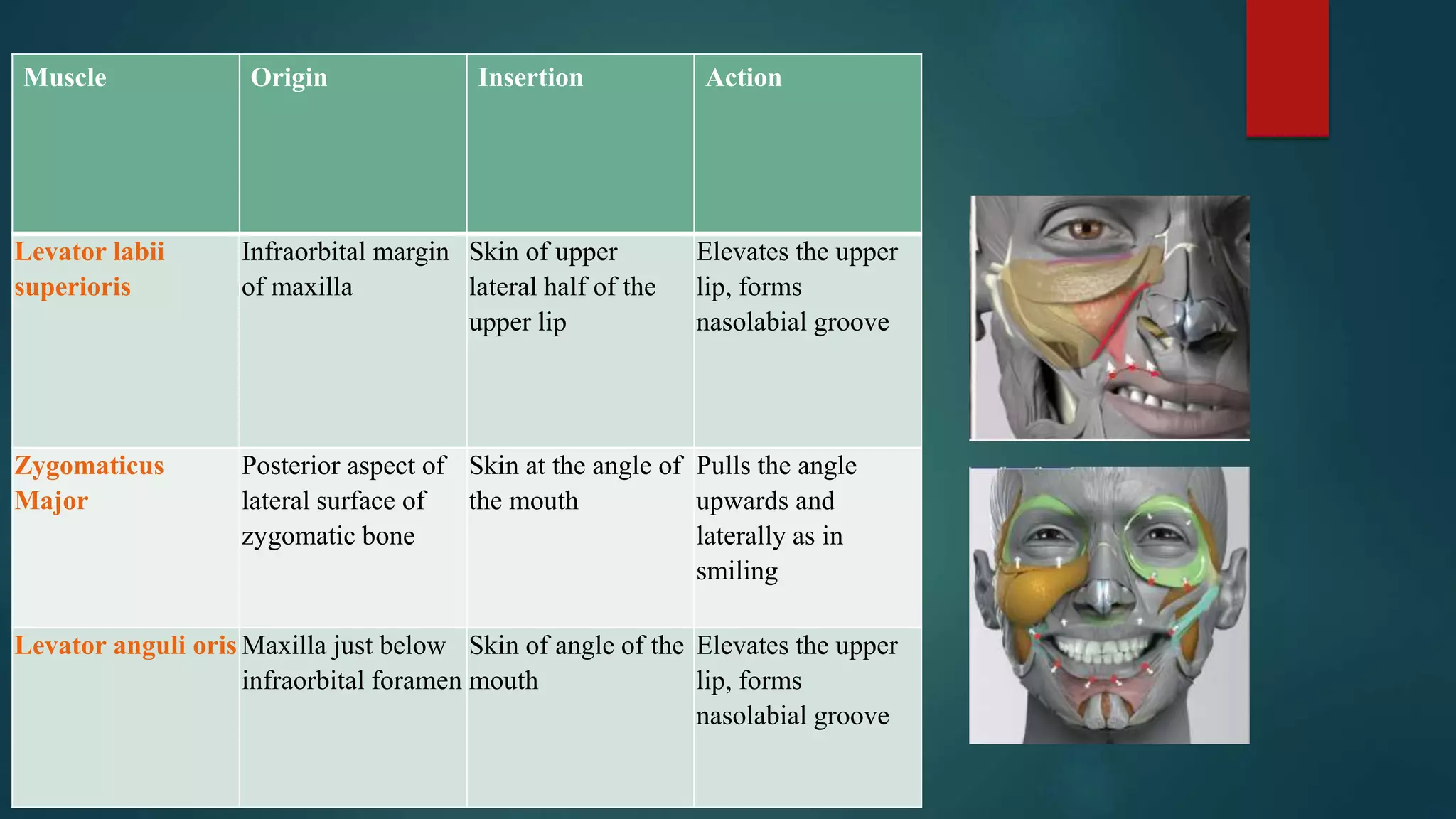
Muscle Origin Insertion Action
Levator labii
superioris
Infraorbital margin
of maxilla
Skin of upper
lateral half of the
upper lip
Elevates the upper
lip, forms
nasolabial groove
Zygomaticus
Major
Posterior aspect of
lateral surface of
zygomatic bone
Skin at the angle of
the mouth
Pulls the angle
upwards and
laterally as in
smiling
Levator anguli oris Maxilla just below
infraorbital foramen
Skin of angle of the
mouth
Elevates the upper
lip, forms
nasolabial groove
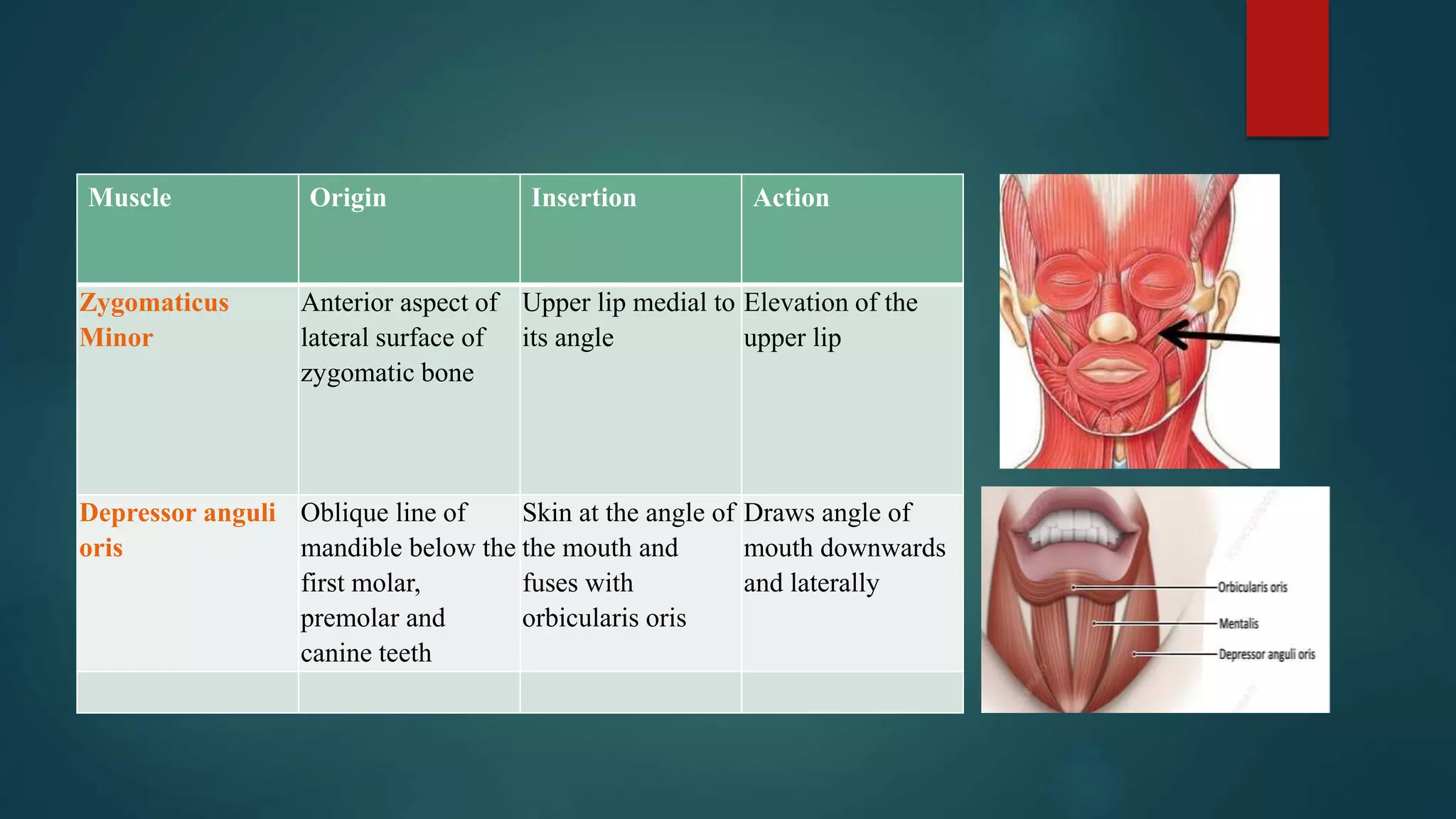
Muscle Origin Insertion Action
Zygomaticus
Minor
Anterior aspect of
lateral surface of
zygomatic bone
Upper lip medial to
its angle
Elevation of the
upper lip
Depressor anguli
oris
Oblique line of
mandible below the
first molar,
premolar and
canine teeth
Skin at the angle of
the mouth and
fuses with
orbicularis oris
Draws angle of
mouth downwards
and laterally
Muscle Origin Insertion Action
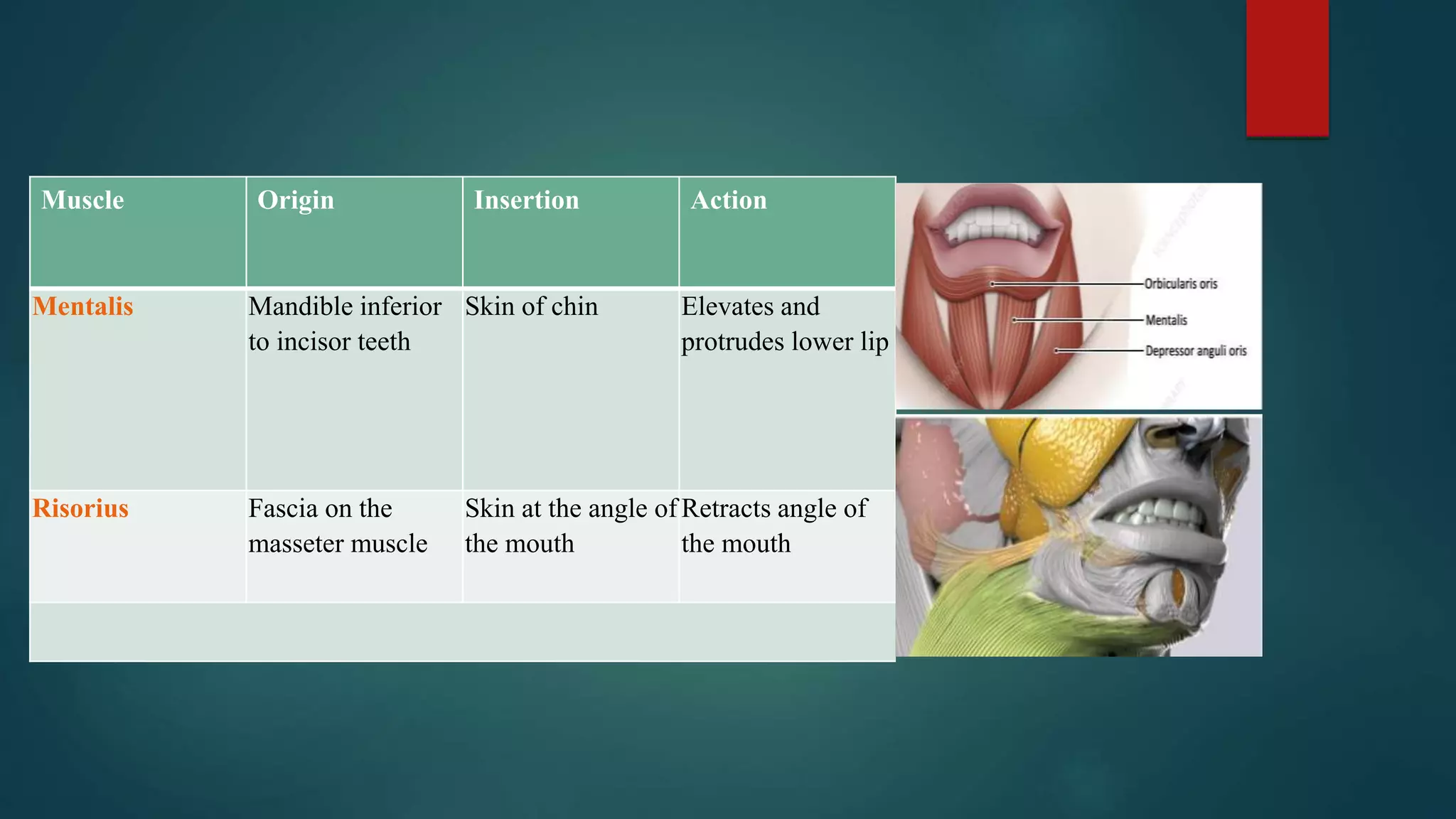
Mentalis Mandible inferior
to incisor teeth
Skin of chin Elevates and
protrudes lower lip
Risorius Fascia on the
masseter muscle
Skin at the angle of
the mouth
Retracts angle of
the mouth
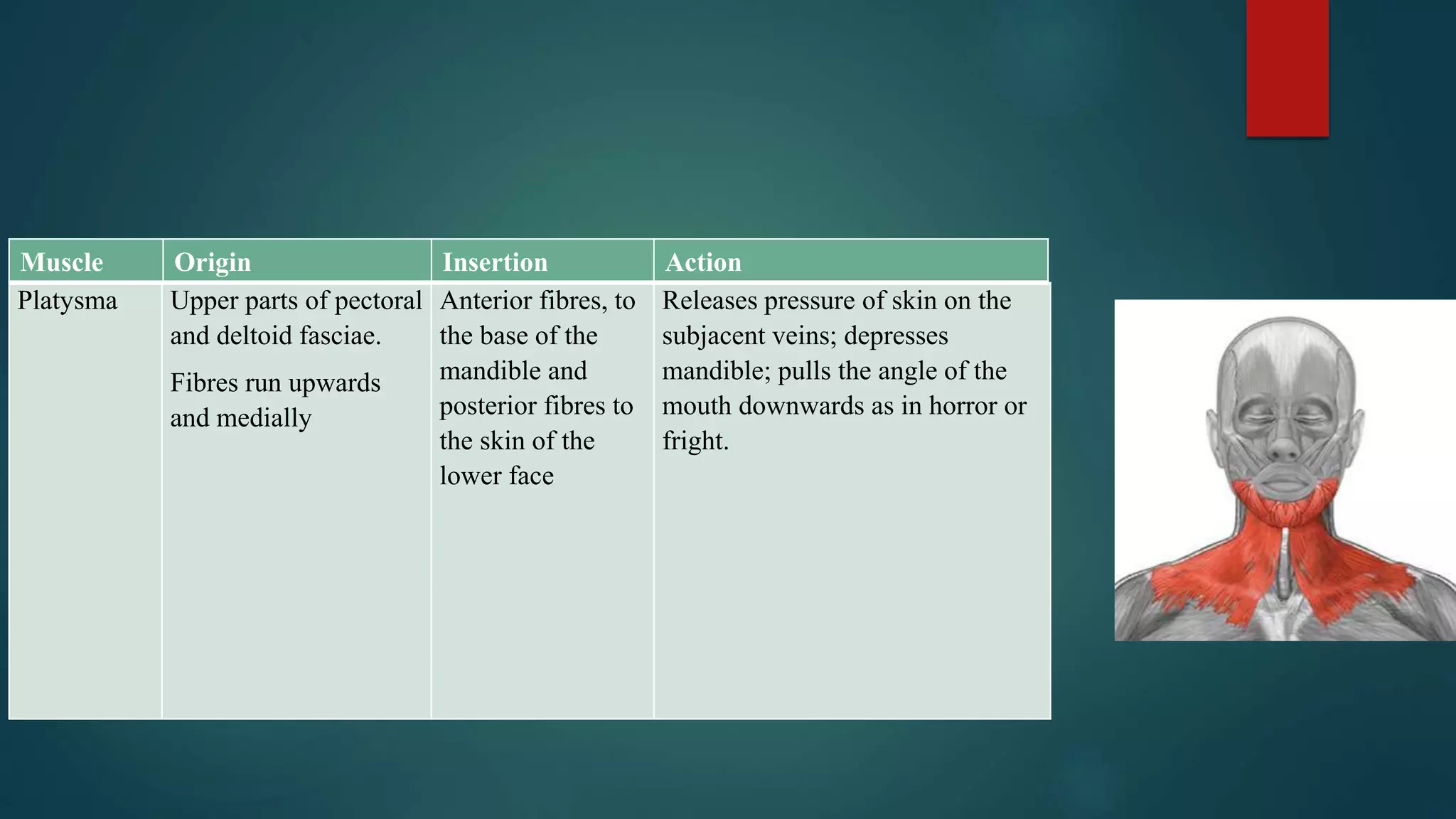
Platysma Upper parts of pectoral
and deltoid fasciae.
Fibres run upwards
and medially
Anterior fibres, to
the base of the
mandible and
posterior fibres to
the skin of the
lower face
Releases pressure of skin on the
subjacent veins; depresses
mandible; pulls the angle of the
mouth downwards as in horror or
fright.
Muscle Origin Insertion Action
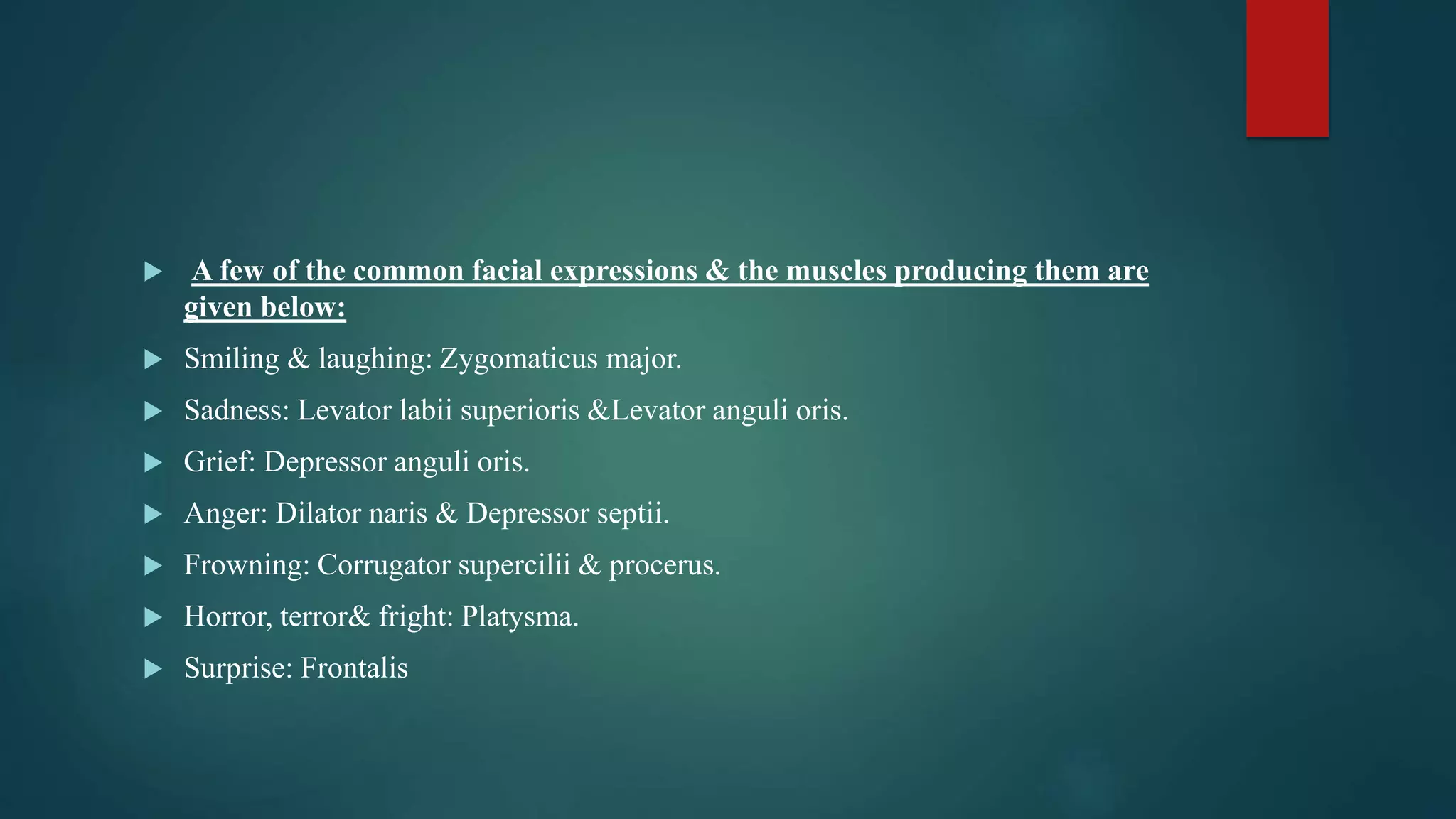
 A few of the common facial expressions & the muscles producing them are
given below:
 Smiling & laughing: Zygomaticus major.
 Sadness: Levator labii superioris &Levator anguli oris.
 Grief: Depressor anguli oris.
 Anger: Dilator naris & Depressor septii.
 Frowning: Corrugator supercilii & procerus.
 Horror, terror& fright: Platysma.
 Surprise: Frontalis
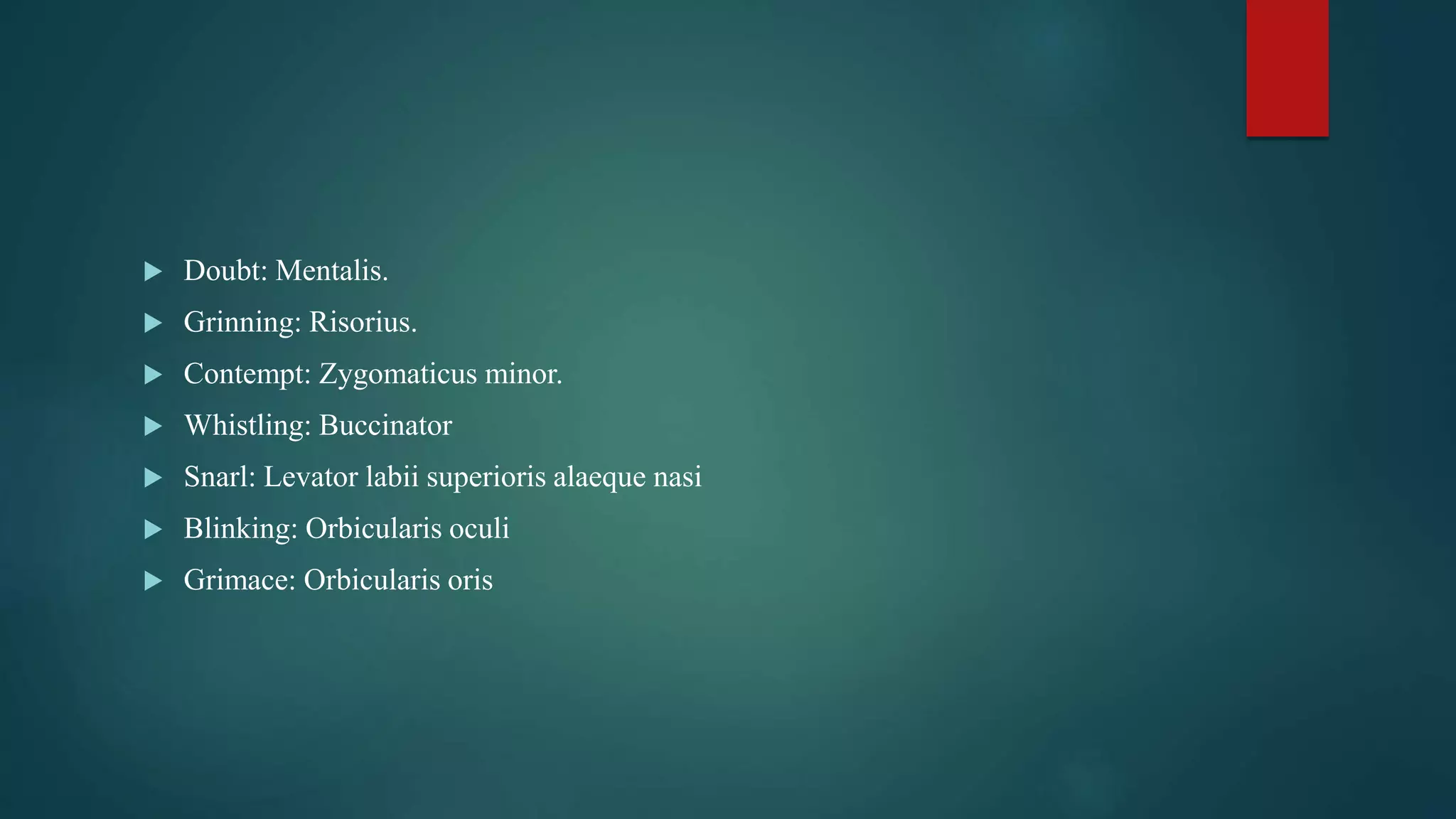
 Doubt: Mentalis.
 Grinning: Risorius.
 Contempt: Zygomaticus minor.
 Whistling: Buccinator
 Snarl: Levator labii superioris alaeque nasi
 Blinking: Orbicularis oculi
 Grimace: Orbicularis oris
NERVE SUPPLY
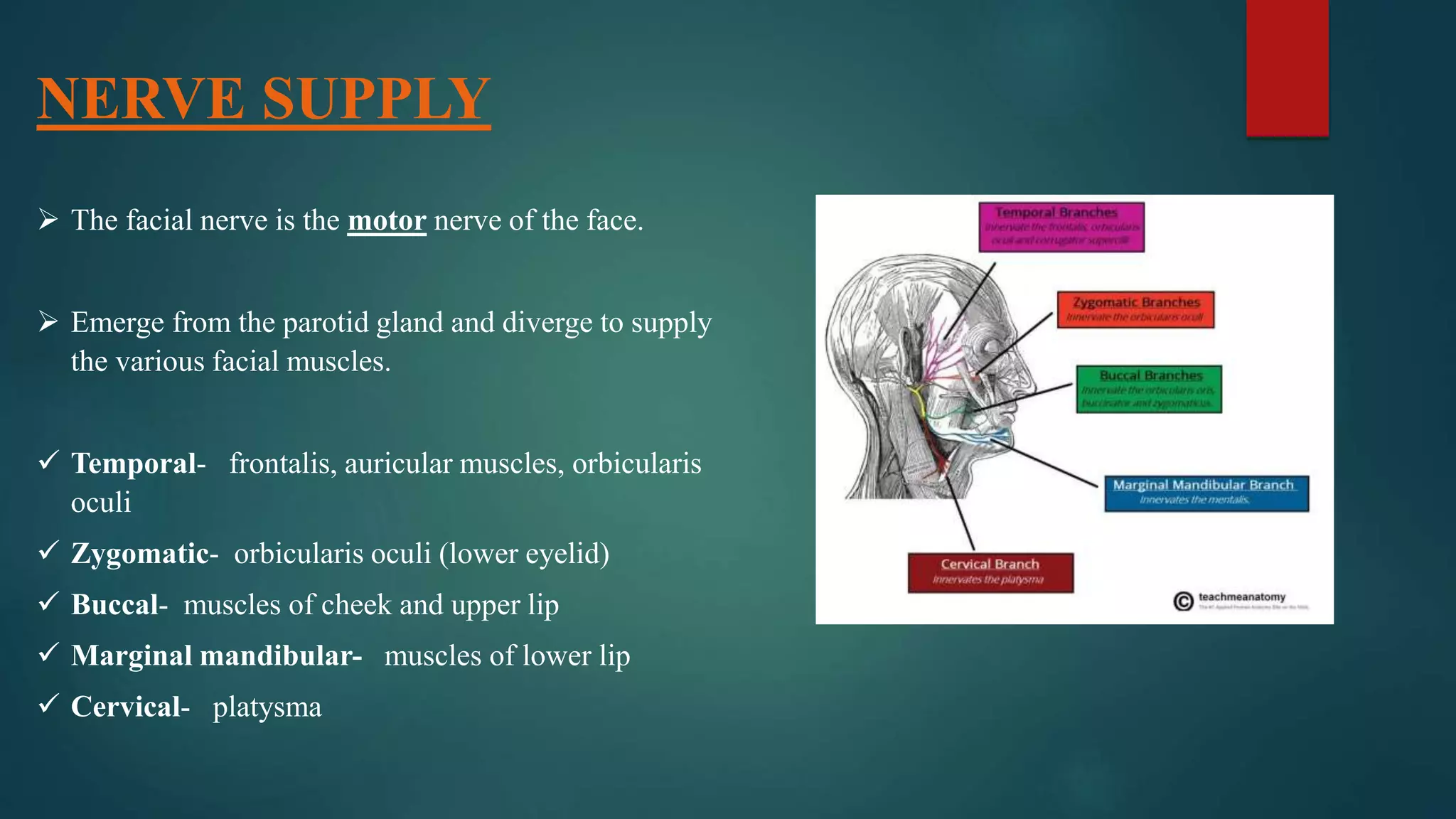
 The facial nerve is the motor nerve of the face.
 Emerge from the parotid gland and diverge to supply
the various facial muscles.
 Temporal- frontalis, auricular muscles, orbicularis
oculi
 Zygomatic- orbicularis oculi (lower eyelid)
 Buccal- muscles of cheek and upper lip
 Marginal mandibular- muscles of lower lip
 Cervical- platysma
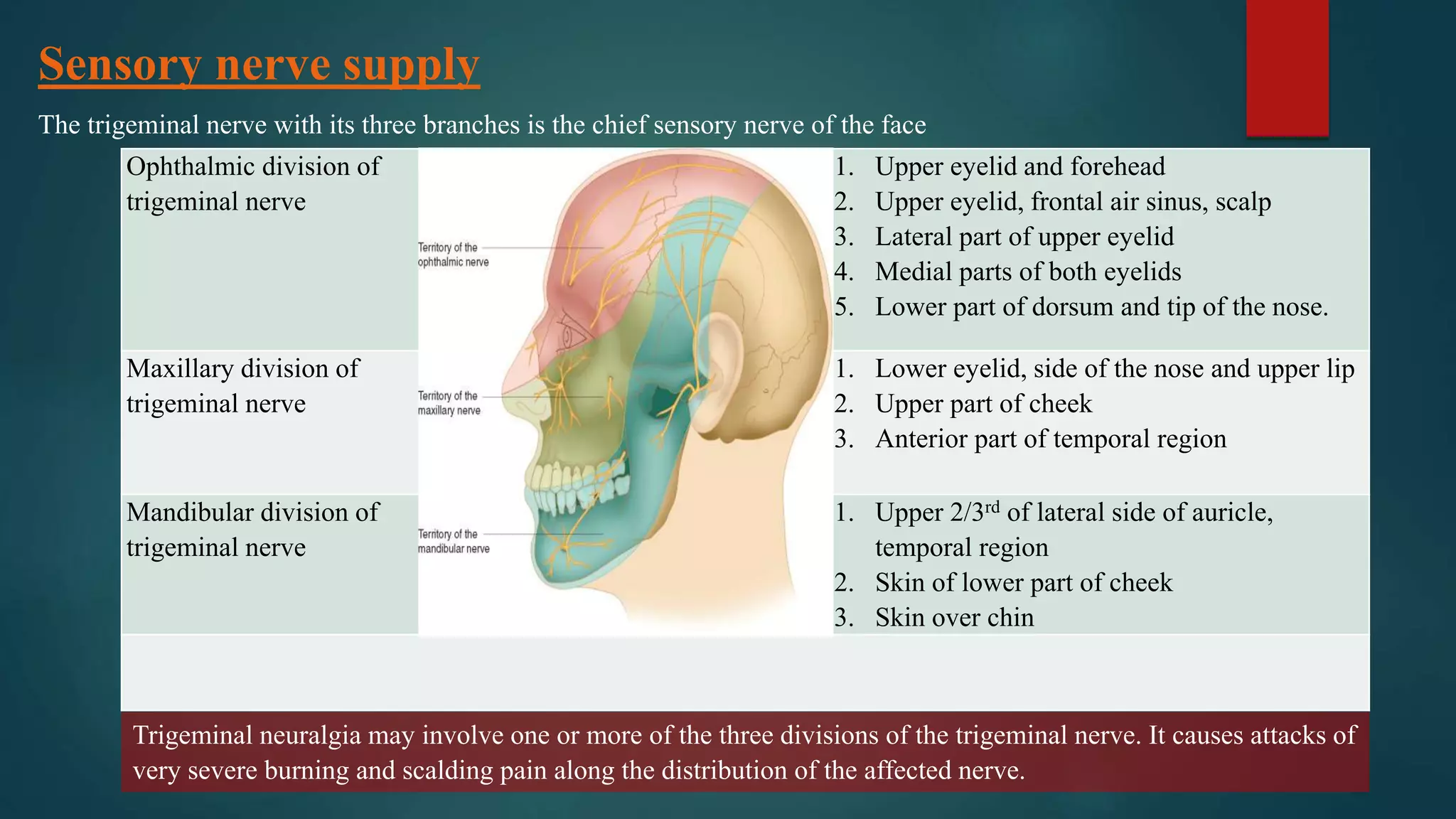
Ophthalmic division of
trigeminal nerve
1. Supratrochlear nerve
2. Supraorbital nerve
3. Lacrimal nerve
4. Infratrochlear nerve
5. External nasal nerve
1. Upper eyelid and forehead
2. Upper eyelid, frontal air sinus, scalp
3. Lateral part of upper eyelid
4. Medial parts of both eyelids
5. Lower part of dorsum and tip of the nose.
Maxillary division of
trigeminal nerve
1. Infraorbital nerve
2. Zygomaticofacial nerve
3. Zygomaticotemporal nerve
1. Lower eyelid, side of the nose and upper lip
2. Upper part of cheek
3. Anterior part of temporal region
Mandibular division of
trigeminal nerve
1. Auriculotemporal nerve
2. Buccal nerve
3. Mental nerve
1. Upper 2/3rd of lateral side of auricle,
temporal region
2. Skin of lower part of cheek
3. Skin over chin
Sensory nerve supply
The trigeminal nerve with its three branches is the chief sensory nerve of the face
Trigeminal neuralgia may involve one or more of the three divisions of the trigeminal nerve. It causes attacks of
very severe burning and scalding pain along the distribution of the affected nerve.
Applied anatomy:
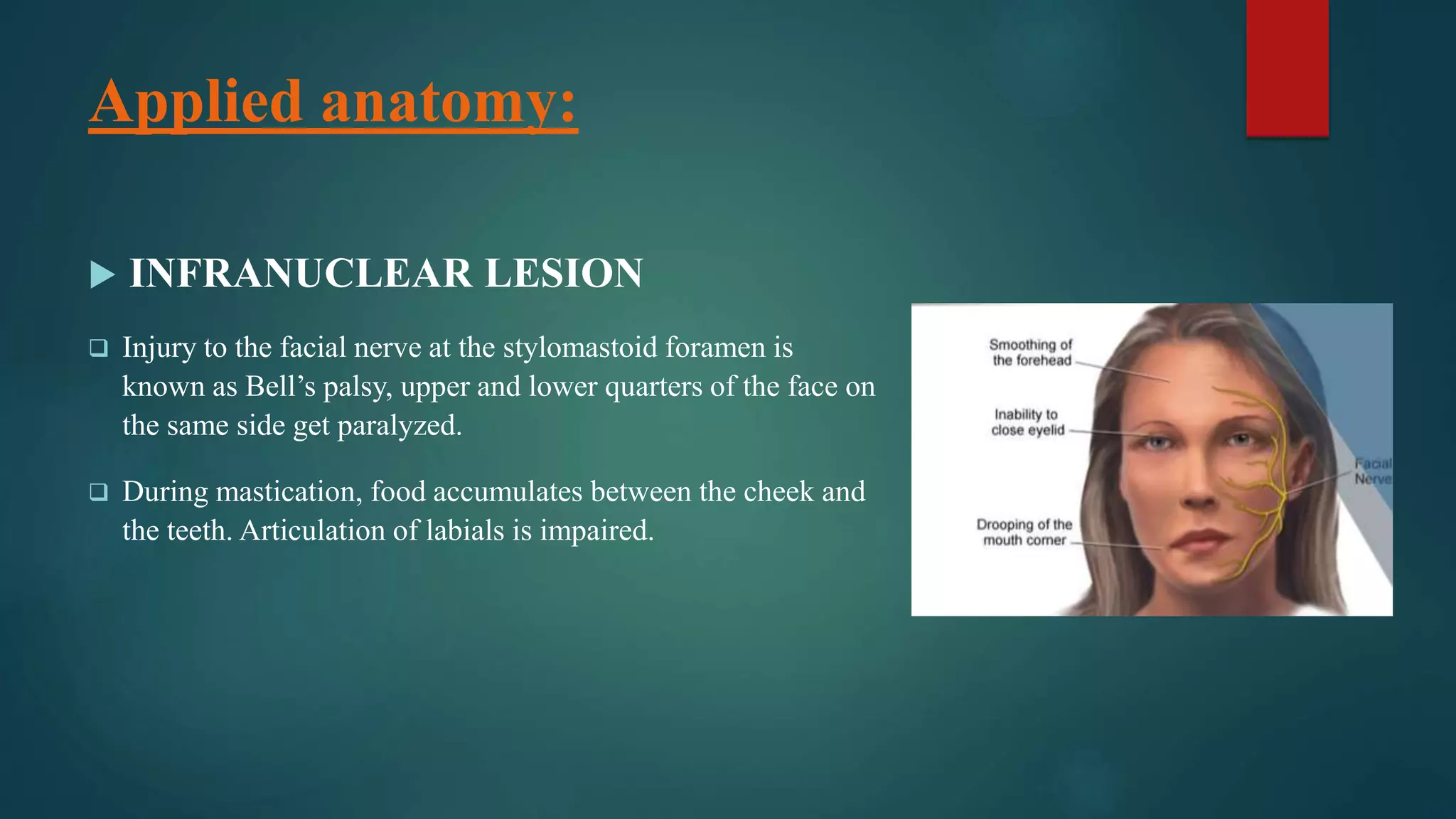
 INFRANUCLEAR LESION
 Injury to the facial nerve at the stylomastoid foramen is
known as Bell’s palsy, upper and lower quarters of the face on
the same side get paralyzed.
 During mastication, food accumulates between the cheek and
the teeth. Articulation of labials is impaired.
 Lagophthalmos
 It is the inability to close the eyelid.
 It may be the result of the residual effect of 7th cranial nerve damage secondary to
Bell’s palsy, tumour, cancer removal.
 Failure to provide protection to the eye may lead to exposure keratitis, corneal
abrasion, or blindness.
 The treat includes ointments, eye drops, taping, tarsorraphy, or an eyelid implant.
 SUPRANUCLEAR LESION:
• usually a part of hemiplegia with injury of corticonuclear fibres,
• Only the lower quarter of the opposite side of the face is paralyzed.
• The upper quarter with the frontalis and orbicularis oculi escapes due to its bilateral representation in the
cerebral cortex.
• Only voluntary movements are affected and the emotional expressions remain normal as there are
separate pathways for voluntary and emotional movements.
Prosthodontic Considerations
 Aging
• Wrinkles start appearing when layers of fat are lost. Age reduces the concavity and “pout” of the upper lip, and it
flattens the philtrum.
• The nasolabial grooves deepen, which produces a sagging look to the middle third of the face, whereas atrophy
of the subcutaneous and buccal pads of fat dissapears, and the upper lip droops( chelioptosis) over the maxillary
teeth.
• These canges are accentuated even more dramatically when teeth are lost or there is loss of occlusal vertical
dimension.
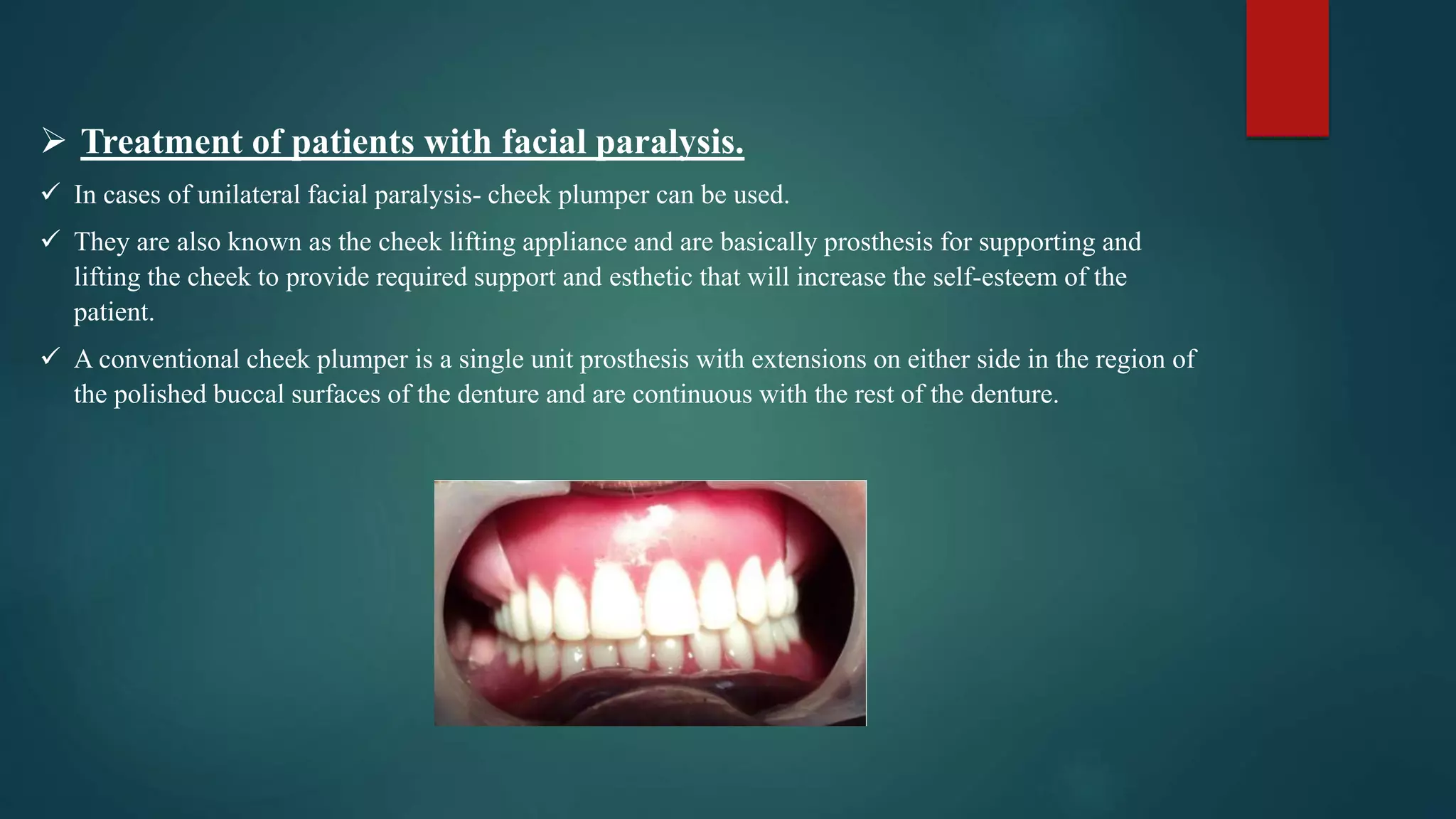
 Treatment of patients with facial paralysis.
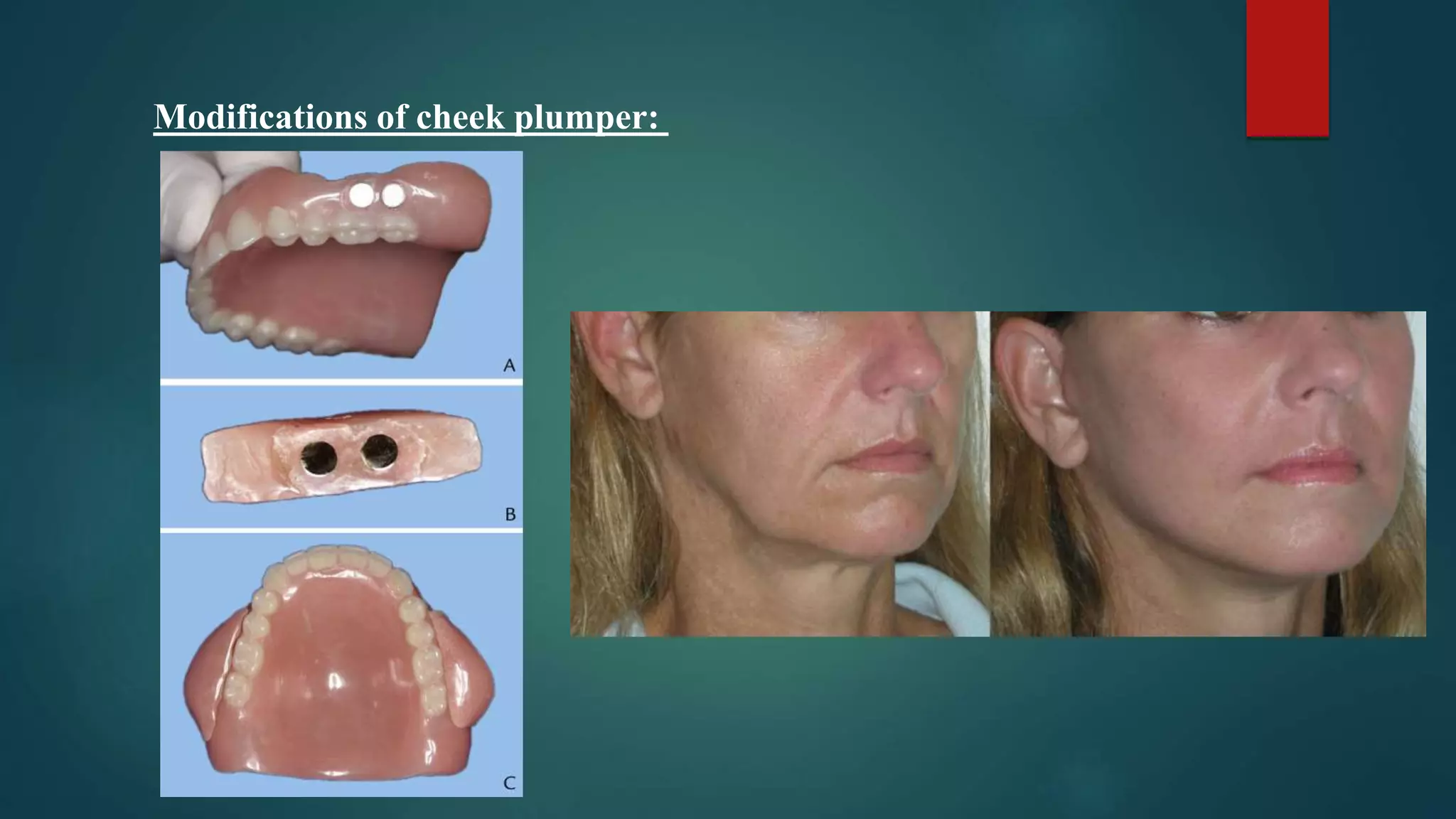
 In cases of unilateral facial paralysis- cheek plumper can be used.
 They are also known as the cheek lifting appliance and are basically prosthesis for supporting and
lifting the cheek to provide required support and esthetic that will increase the self-esteem of the
patient.
 A conventional cheek plumper is a single unit prosthesis with extensions on either side in the region of
the polished buccal surfaces of the denture and are continuous with the rest of the denture.
 Demerits of such a design are:
● Excessive weight which could hamper retention of the maxillary complete denture
● Can result in muscle fatigue.
● Can destabilize the maxillary denture
● Could interfere with masseter muscle and coronoid process of the mandible
● Difficult to insert the denture due to excessive weight.
● Can’t be used in patients with limited mouth opening.
 This problem can be solved with the fabrication of denture with detachable cheek plumper
creating dentures that are in harmony and dignity with the aging individual, which will not
eradicate but compliment the stigma of aging in them.
Modifications of cheek plumper:
MUSCLES
OF
MASTICATION
DEVELOPMENT
 The muscular system develops from intra embryonic mesoderm
 Muscles of mastication are derived from first or mandibular arch.
 Therefore all muscles are supplied by the mandibular nerve.
FUNCTIONS:
 Control all movements of the mandible.
 There is a wide area of origin of some of the muscles compared with the area of
insertion, making it possible to have a wide range of movement.
 The muscles of mastication occur bilaterally in pairs. Each muscle runs in a
different direction and at a different level. This also helps in the range of
movement.
Activities- divided into 2 types-
 FUNCTIONAL- chewing, speaking, swallowing
 PARAFUNCTIONAL - grinding, clenching, and bruxing
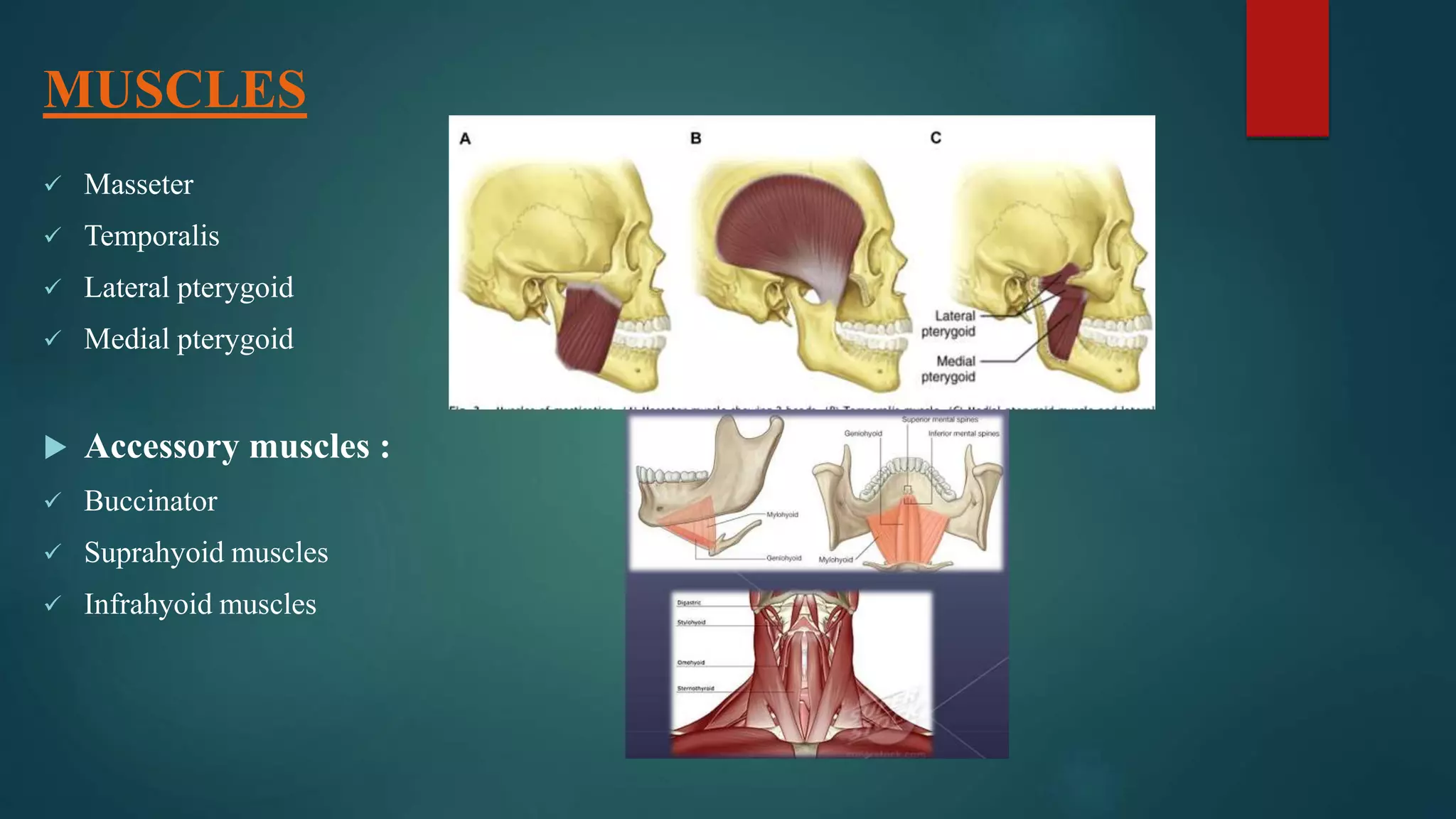
MUSCLES
 Masseter
 Temporalis
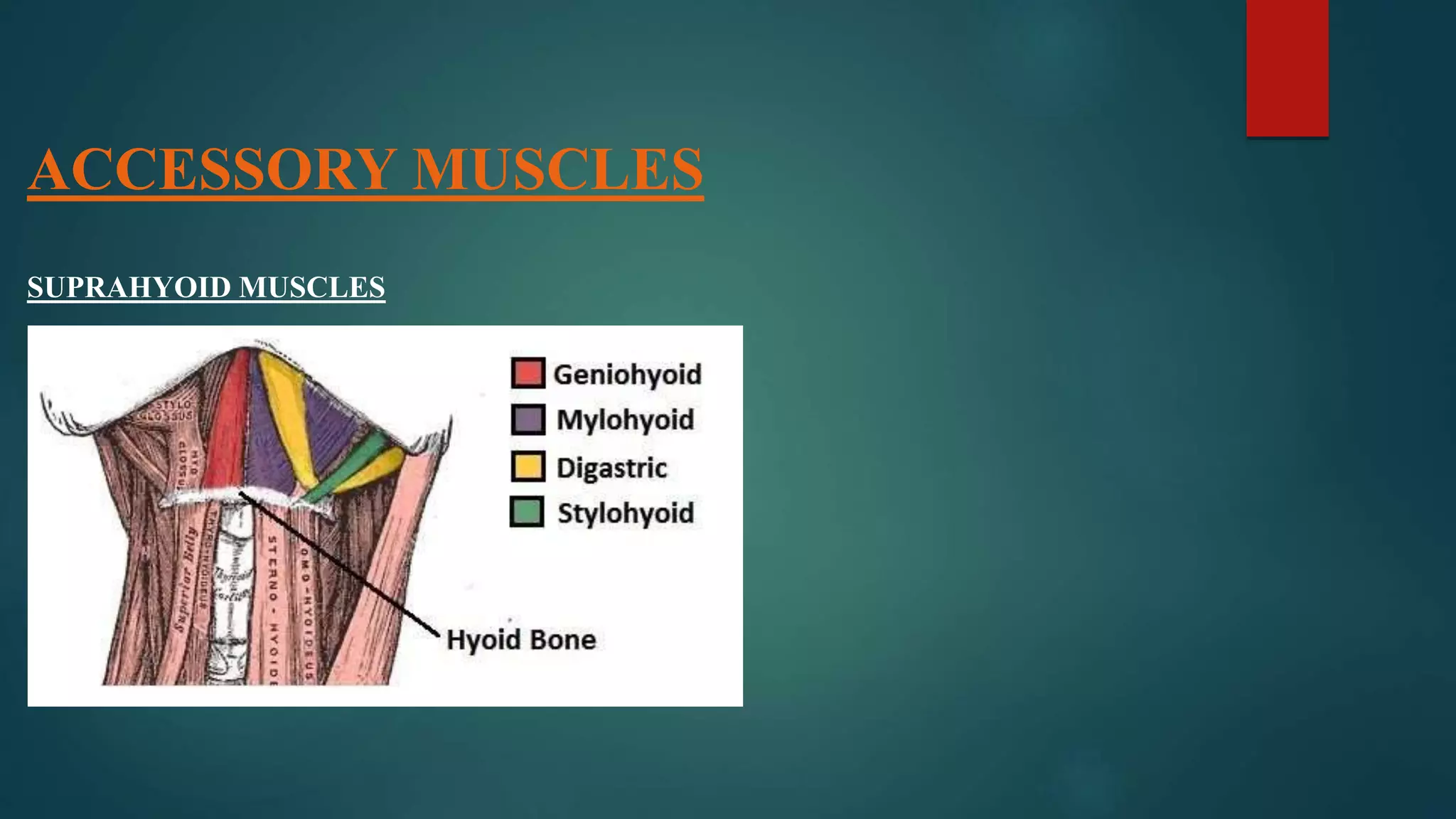
 Lateral pterygoid
 Medial pterygoid
 Accessory muscles :
 Buccinator
 Suprahyoid muscles
 Infrahyoid muscles
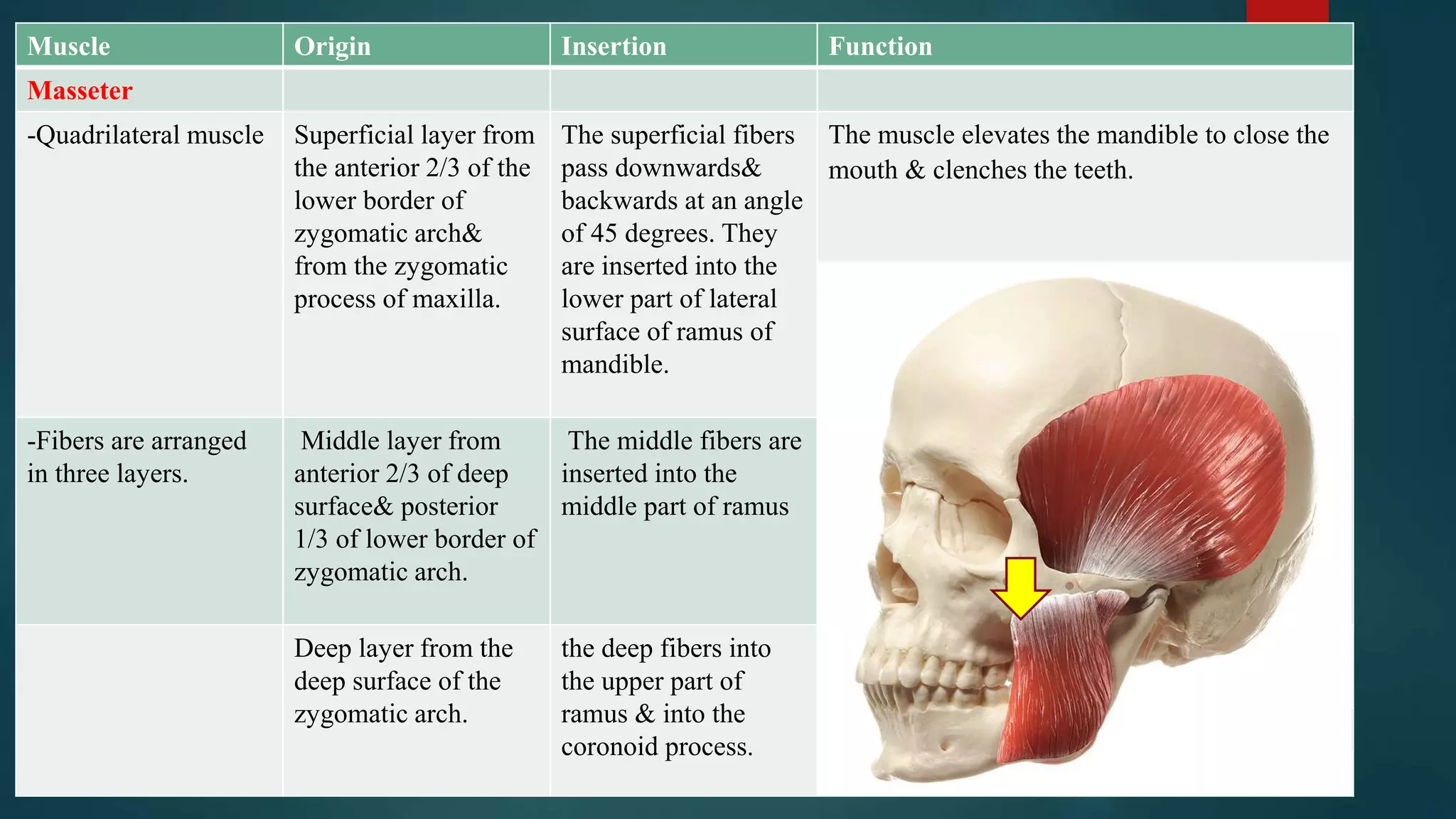
Muscle Origin Insertion Function
Masseter
-Quadrilateral muscle Superficial layer from
the anterior 2/3 of the
lower border of
zygomatic arch&
from the zygomatic
process of maxilla.
The superficial fibers
pass downwards&
backwards at an angle
of 45 degrees. They
are inserted into the
lower part of lateral
surface of ramus of
mandible.
The muscle elevates the mandible to close the
mouth & clenches the teeth.
-Fibers are arranged
in three layers.
Middle layer from
anterior 2/3 of deep
surface& posterior
1/3 of lower border of
zygomatic arch.
The middle fibers are
inserted into the
middle part of ramus
Deep layer from the
deep surface of the
zygomatic arch.
the deep fibers into
the upper part of
ramus & into the
coronoid process.
Muscle Origin Insertion Function
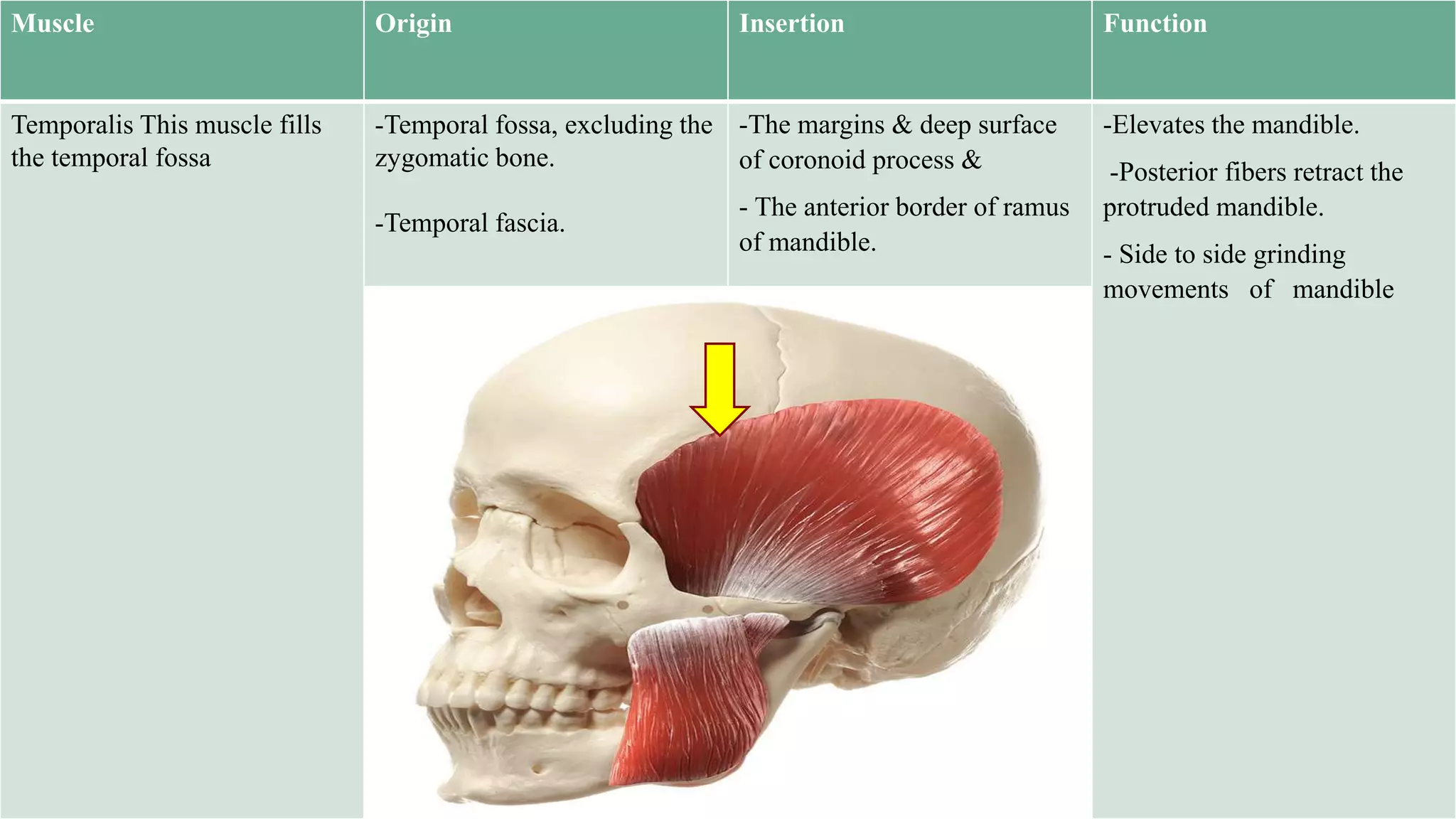
Temporalis This muscle fills
the temporal fossa
-Temporal fossa, excluding the
zygomatic bone.
-Temporal fascia.
-The margins & deep surface
of coronoid process &
- The anterior border of ramus
of mandible.
-Elevates the mandible.
-Posterior fibers retract the
protruded mandible.
- Side to side grinding
movements of mandible
Muscle Origin Insertion Function
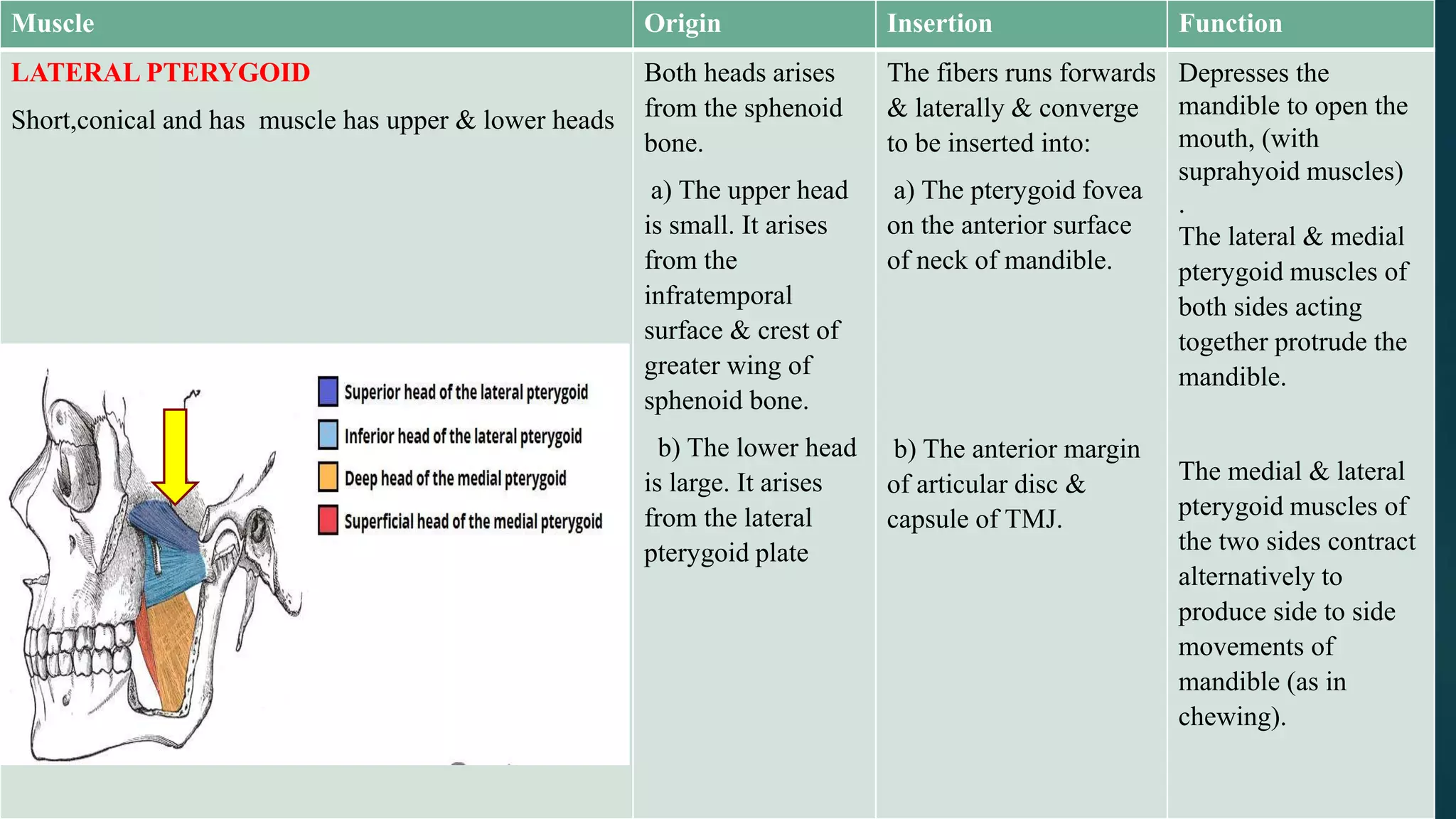
LATERAL PTERYGOID
Short,conical and has muscle has upper & lower heads
Both heads arises
from the sphenoid
bone.
a) The upper head
is small. It arises
from the
infratemporal
surface & crest of
greater wing of
sphenoid bone.
b) The lower head
is large. It arises
from the lateral
pterygoid plate
The fibers runs forwards
& laterally & converge
to be inserted into:
a) The pterygoid fovea
on the anterior surface
of neck of mandible.
b) The anterior margin
of articular disc &
capsule of TMJ.
Depresses the
mandible to open the
mouth, (with
suprahyoid muscles)
.
The lateral & medial
pterygoid muscles of
both sides acting
together protrude the
mandible.
The medial & lateral
pterygoid muscles of
the two sides contract
alternatively to
produce side to side
movements of
mandible (as in
chewing).
Muscle Origin Insertion Function
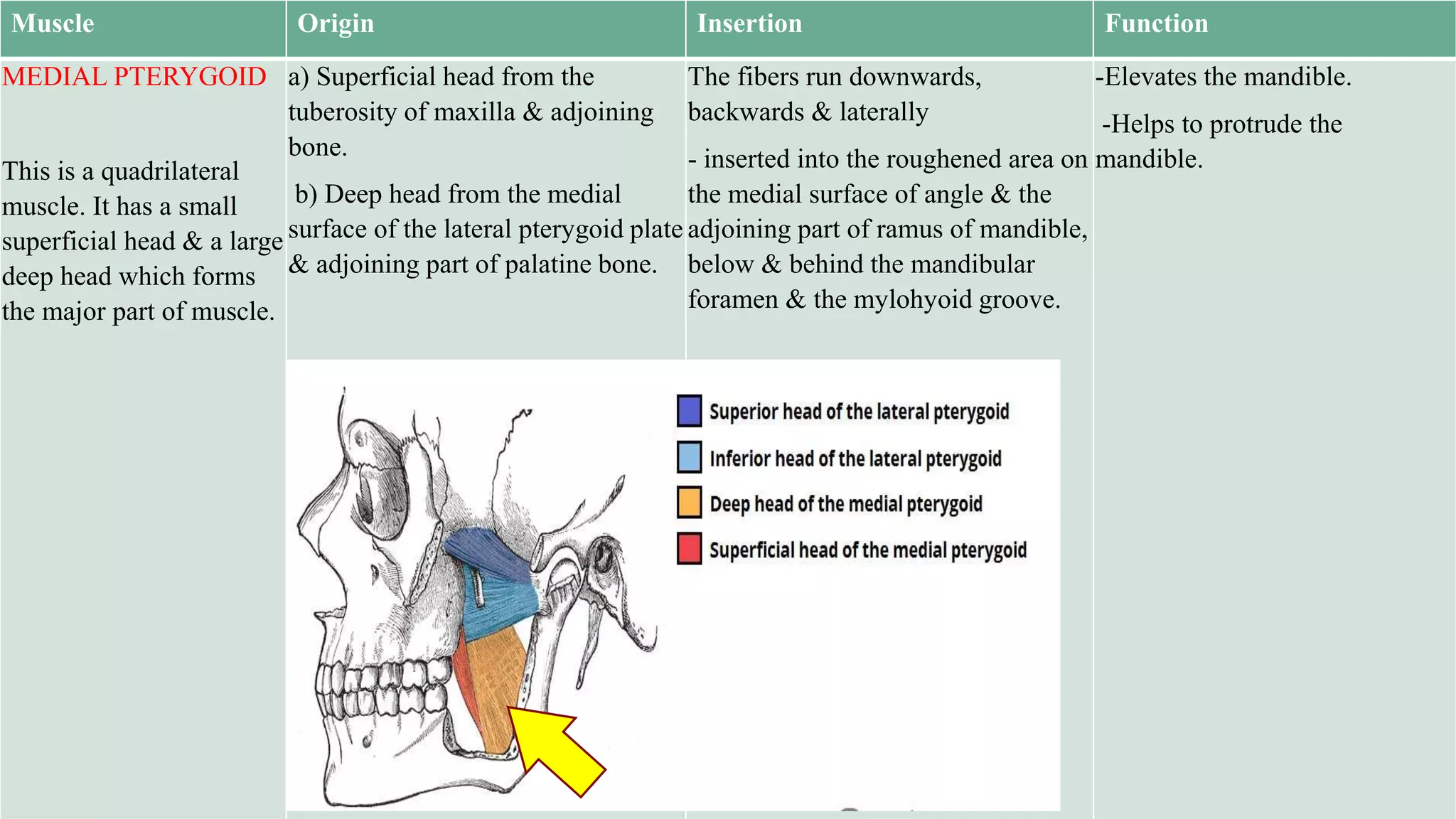
MEDIAL PTERYGOID
This is a quadrilateral
muscle. It has a small
superficial head & a large
deep head which forms
the major part of muscle.
a) Superficial head from the
tuberosity of maxilla & adjoining
bone.
b) Deep head from the medial
surface of the lateral pterygoid plate
& adjoining part of palatine bone.
The fibers run downwards,
backwards & laterally
- inserted into the roughened area on
the medial surface of angle & the
adjoining part of ramus of mandible,
below & behind the mandibular
foramen & the mylohyoid groove.
-Elevates the mandible.
-Helps to protrude the
mandible.
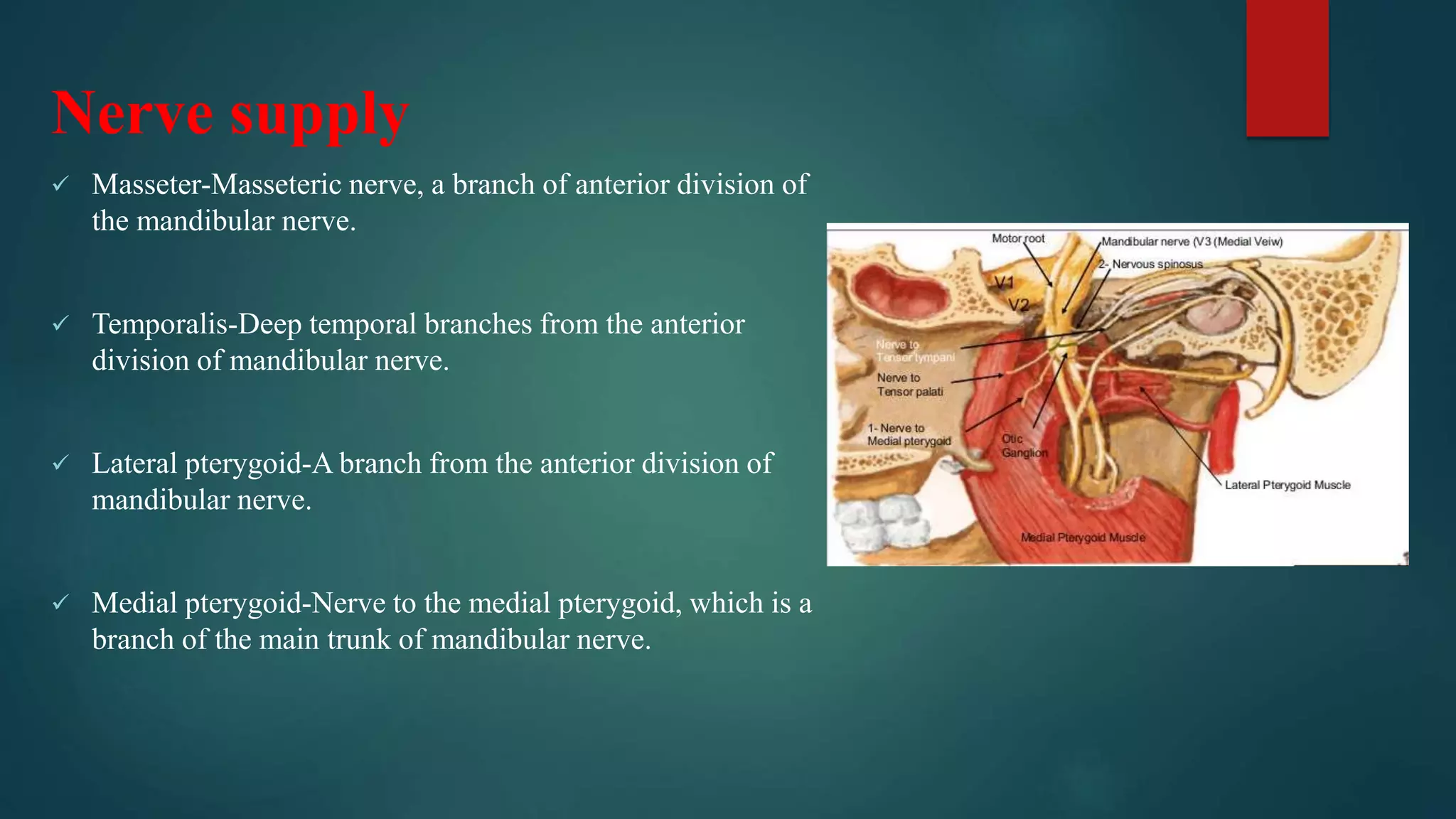
Nerve supply
 Masseter-Masseteric nerve, a branch of anterior division of
the mandibular nerve.
 Temporalis-Deep temporal branches from the anterior
division of mandibular nerve.
 Lateral pterygoid-A branch from the anterior division of
mandibular nerve.
 Medial pterygoid-Nerve to the medial pterygoid, which is a
branch of the main trunk of mandibular nerve.
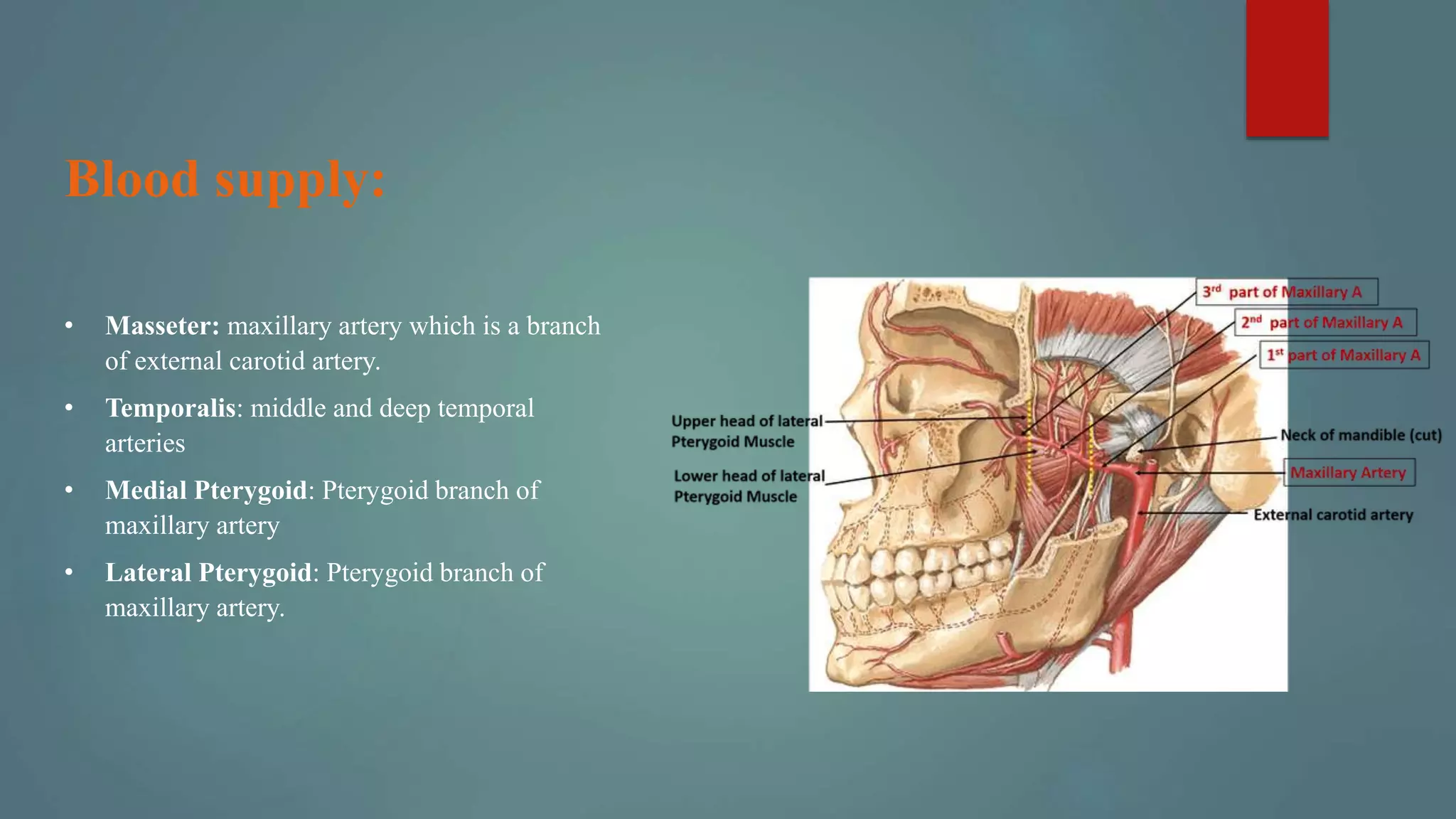
Blood supply:
• Masseter: maxillary artery which is a branch
of external carotid artery.
• Temporalis: middle and deep temporal
arteries
• Medial Pterygoid: Pterygoid branch of
maxillary artery
• Lateral Pterygoid: Pterygoid branch of
maxillary artery.
ACCESSORY MUSCLES
SUPRAHYOID MUSCLES
-
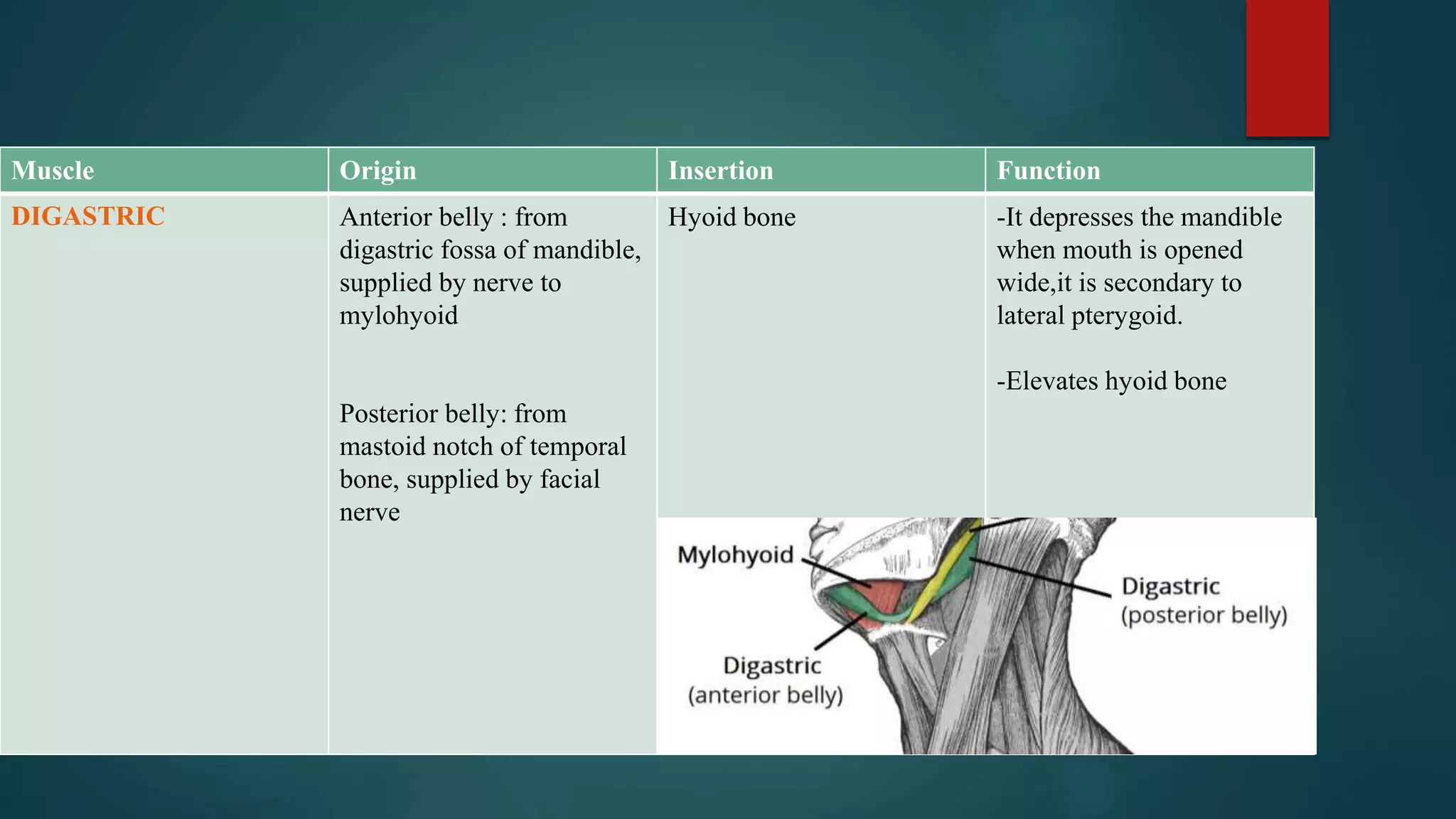
Muscle Origin Insertion Function
DIGASTRIC Anterior belly : from
digastric fossa of mandible,
supplied by nerve to
mylohyoid
Posterior belly: from
mastoid notch of temporal
bone, supplied by facial
nerve
Hyoid bone -It depresses the mandible
when mouth is opened
wide,it is secondary to
lateral pterygoid.
-Elevates hyoid bone
Muscle Origin Insertion Nerve supply Function
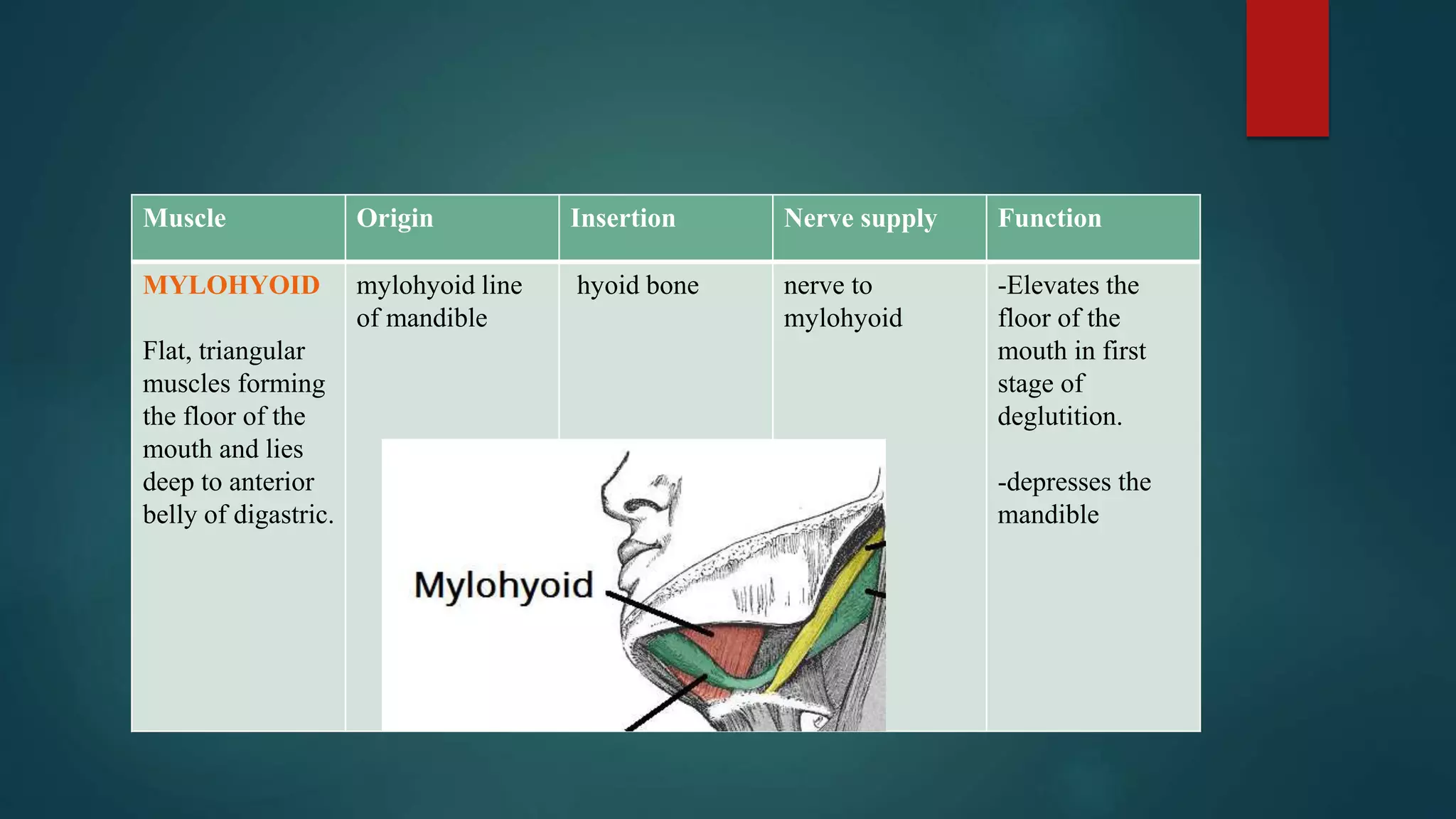
MYLOHYOID
Flat, triangular
muscles forming
the floor of the
mouth and lies
deep to anterior
belly of digastric.
mylohyoid line
of mandible
hyoid bone nerve to
mylohyoid
-Elevates the
floor of the
mouth in first
stage of
deglutition.
-depresses the
mandible
Muscle Origin Insertion Nerve supply Function
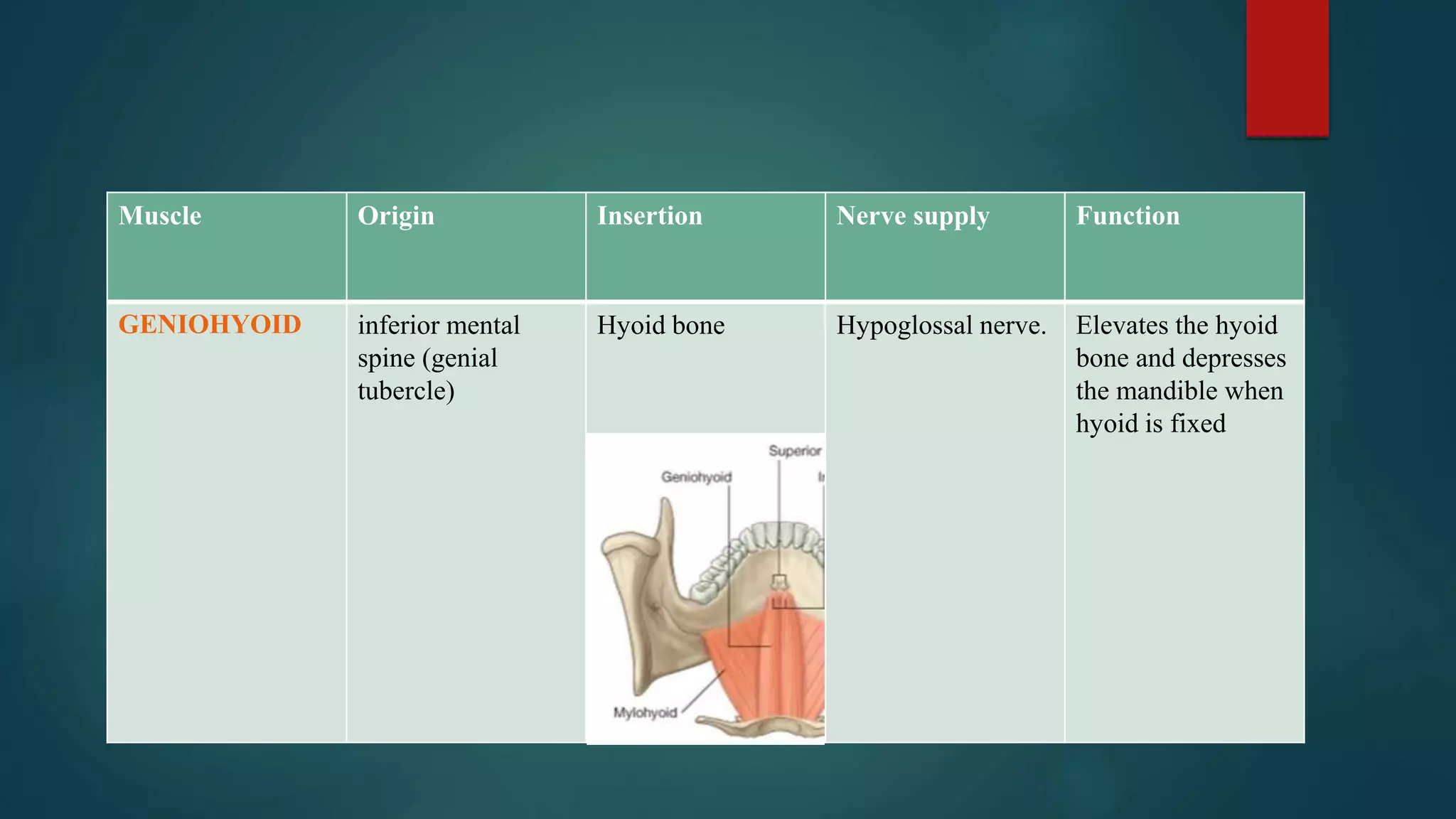
GENIOHYOID inferior mental
spine (genial
tubercle)
Hyoid bone Hypoglossal nerve. Elevates the hyoid
bone and depresses
the mandible when
hyoid is fixed
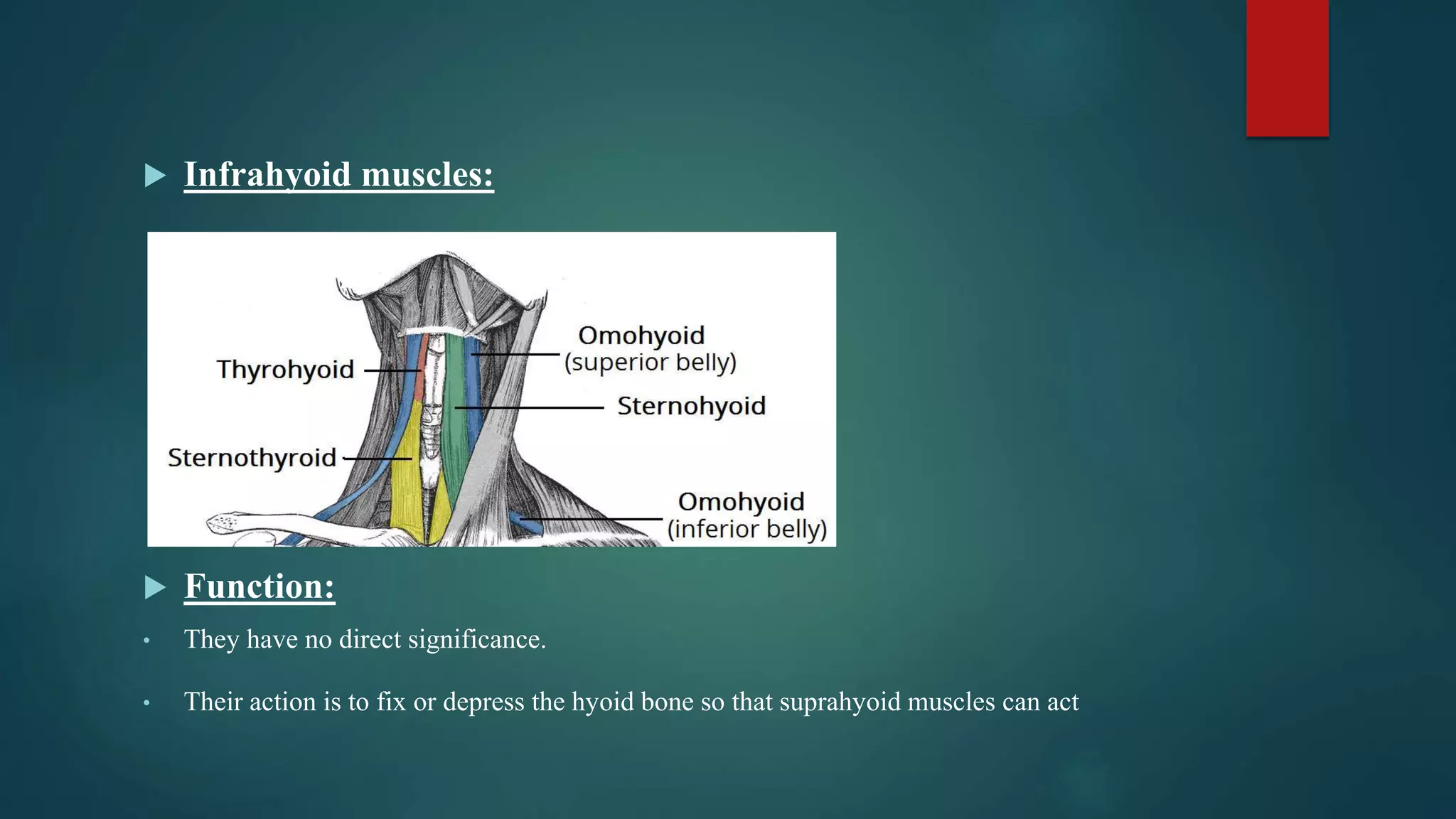
 Infrahyoid muscles:
 Function:
• They have no direct significance.
• Their action is to fix or depress the hyoid bone so that suprahyoid muscles can act
Relevance in prosthodontics:
 MASSETER:
 It will responsible for formation of masseteric notch (distobuccal to the pad i.e. outline of distobuccal border) it
forms due to the action of masseter over buccinator.
 This area of denture must be carefully recorded because overextension causes soreness.
 Under extension, may result in a loss of support and resistance, to distal displacement.
 ACTIVATION - Hold the tray with index finger and thumb at lower border of mandible. Instruct the patient to
close his mouth against the pressure exerted by the finger of operator. This will result masticatory muscle contract
against buccinator muscle.
 Buccinator
 Superior fibres of buccinator- seat the denture.
 Inferior fibres of buccinator- control denture stability and relaxes to form a pouch to store
food.
 A clinical study involving electromyography analysis of the function of the buccinator
muscle by Lundquist’showed that the nature of buccinator muscle contraction was not
able to adapt to changes in the contours of the denture base. Because learning and
adaptation appear to be limited, the denture contours should be designed to harmonize
with existing buccinators muscle function
 Mylohyoid
 It is very important to achieve stability of lower denture by acquiring adequate peripheral seal in
that area.
 It can be determined by:-
 Skillful border moulding and impression procedures.
 BOUCHER says that the denture flange must be parallel to the mylohyoid muscle when it is
contracted.
 ACTIVATION: - During borer moulding or impression making procedure, ask the patient to
swallow or move the tongue RT and Lt Side.
In maxilla:
 Buccal frenum :
o Levator anguli oris- attaches beneath the frenum
o Orbicularis oris- pulls frenum in forward direction
o Buccinator – pulls frenum in backward direction
 Inadequate provision for the buccal frenum of excess thickness of the flange distal to the buccal
notch can cause dislodgement of the denture when the cheeks are moved posteriorly as in a broad
smile.
 Recording: the cheek is elevated and then pulled outward, downward and inward and moved
backward and forward.
 Buccal vestibule:
o Varies with the contraction of the buccinators
o Contraction of the masseter muscle under heavy closing forces reduces the space
available for the distal end of buccal flange.
 Recording: the cheek is elevated and then pulled outward, downward and inward.
 IN THE MANDIBLE
 Buccal frenum: overlies the depressor anguli oris and buccinator is attached to it.
 Denture should be extended less in this region and the impression should be functionally
trimmed to have the maximum seal.
 Buccal vestibule :
 This space is influenced by the masseter. When the masseter contracts, it pushes inward against the
buccinator, producing a bulge in the mouth, which is reproduced as a notch in the denture flange.
Neutral zone
• The neutral zone has been defined as the area in the mouth where during function, the forces of the
tongue pressing outwards are neutralised by the forces of the cheeks and lips pressing inwards.
• The aim of the neutral zone is to construct a denture in muscle balance. That is a denture which is in
harmony with its surroundings to provide optimum stability, retention and comfort.
• A denture shaped by the neutral zone technique will ensure that the muscular forces are working more
effectively.
So the area is reduced in bulk, but concavity should not be made too pronounced because it can lead to food
accumulation and the buccinators is unable to clean out this hollow
 When the posterior fibres of temporal muscle contract they tend to move the mandible posteriorly in
CR or to hold it in its most post position during terminal hinge movement.
 Thus when a patient is instructed to “ Pull your lower jaw back and close on your back teeth” to make
a CR record or to locate the post terminal hinge axis the temporal muscles and the inframandibular
muscles retrude the mandible and maintain it in this most posterior position.
 The lateral pterygoid muscle are also responsible for the lateral and protrusive movements of the
mandible that are necessary to make eccentric interocclusal records or pantographic tracings used
when one is adjusting the horizontal condylar guidances and the lateral condylar guidances of the
articulator.
Muscle involvement in horizontal jaw relation
 The temporal, masseter and Medial pterygoid muscles elevate the mandible to a particular vertical
relation with the maxillae. The lateral pterygoid muscle show little activity when mandible is in centric
relation.
 Muscle involvement in vertical jaw relation
The elevator muscle, temporalis, masseter and the medial pterygoid are involved in stablishing vertical jaw
relations. The depressor muscles are the inframandibular and suprahyoid muscles including the mylohyoid,
geniohyoid, digastric and platysma muscles. These muscles plus gravity help to control the tonic balance that
maintains physiologic rest position.
Clinical Considerations
Trismus:
Limited jaw mobility can result from trauma, surgery, radiation treatment, or even TMJ problems. The
limitation in opening may be a result of muscle damage, joint damage, rapid growth of connective tissue
(i.e. scarring) or a combination of these factors.
Treatment:
1) Externally activated appliances: Inflatable bite opener, Dynamic bite opener, threaded tapered screw,
Shell-shaped mouth opener, Screw type mouth gag, Tongue blades, Fingers, Therabite jaw motion
Rehabilitation system.
2) Internally activated appliances: tongue blades, plastic tapered cylinders.
Bruxism
• Bruxism is excessive teeth grinding and jaw clenching. It is an oral parafunctional activity.
• Muscles involved: masseter,temporalis,pterygoids,digastric and stylohyoid
SYMPTOMS and SIGNS:
• Indentations of the teeth in the tongue (crenated tongue)
• Hypertrophy of the muscles of mastication, particularly the masseter muscle.
• Tenderness, pain or fatigue of the muscles of mastication, which may get worse during chewing or other
jaw movement.
• Excessive tooth wear, particularly attrition and abfraction, tooth fractures, and repeated failure of dental
restorations
• Treatment : mouth gaurds
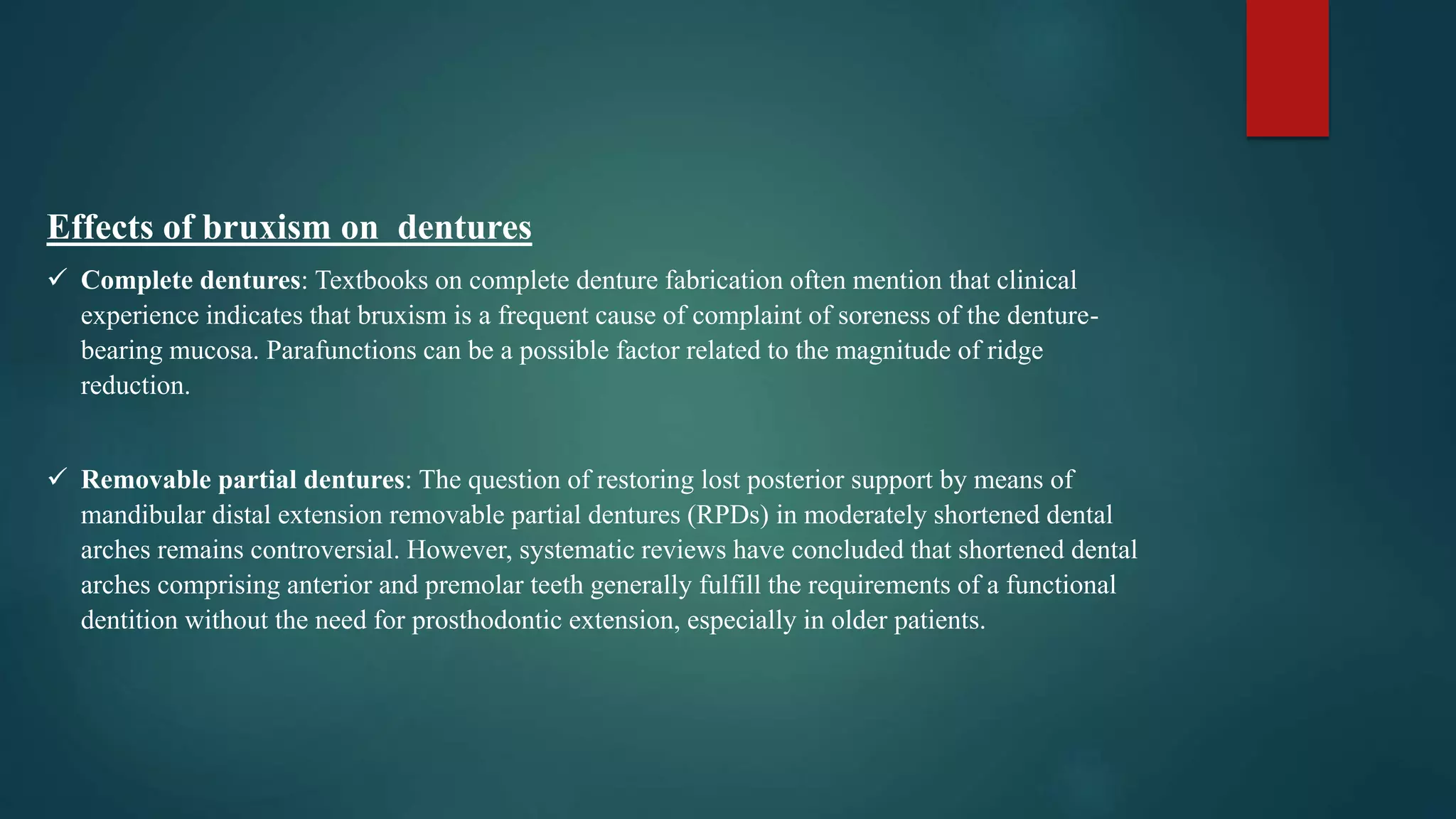
Effects of bruxism on dentures
 Complete dentures: Textbooks on complete denture fabrication often mention that clinical
experience indicates that bruxism is a frequent cause of complaint of soreness of the denture-
bearing mucosa. Parafunctions can be a possible factor related to the magnitude of ridge
reduction.
 Removable partial dentures: The question of restoring lost posterior support by means of
mandibular distal extension removable partial dentures (RPDs) in moderately shortened dental
arches remains controversial. However, systematic reviews have concluded that shortened dental
arches comprising anterior and premolar teeth generally fulfill the requirements of a functional
dentition without the need for prosthodontic extension, especially in older patients.
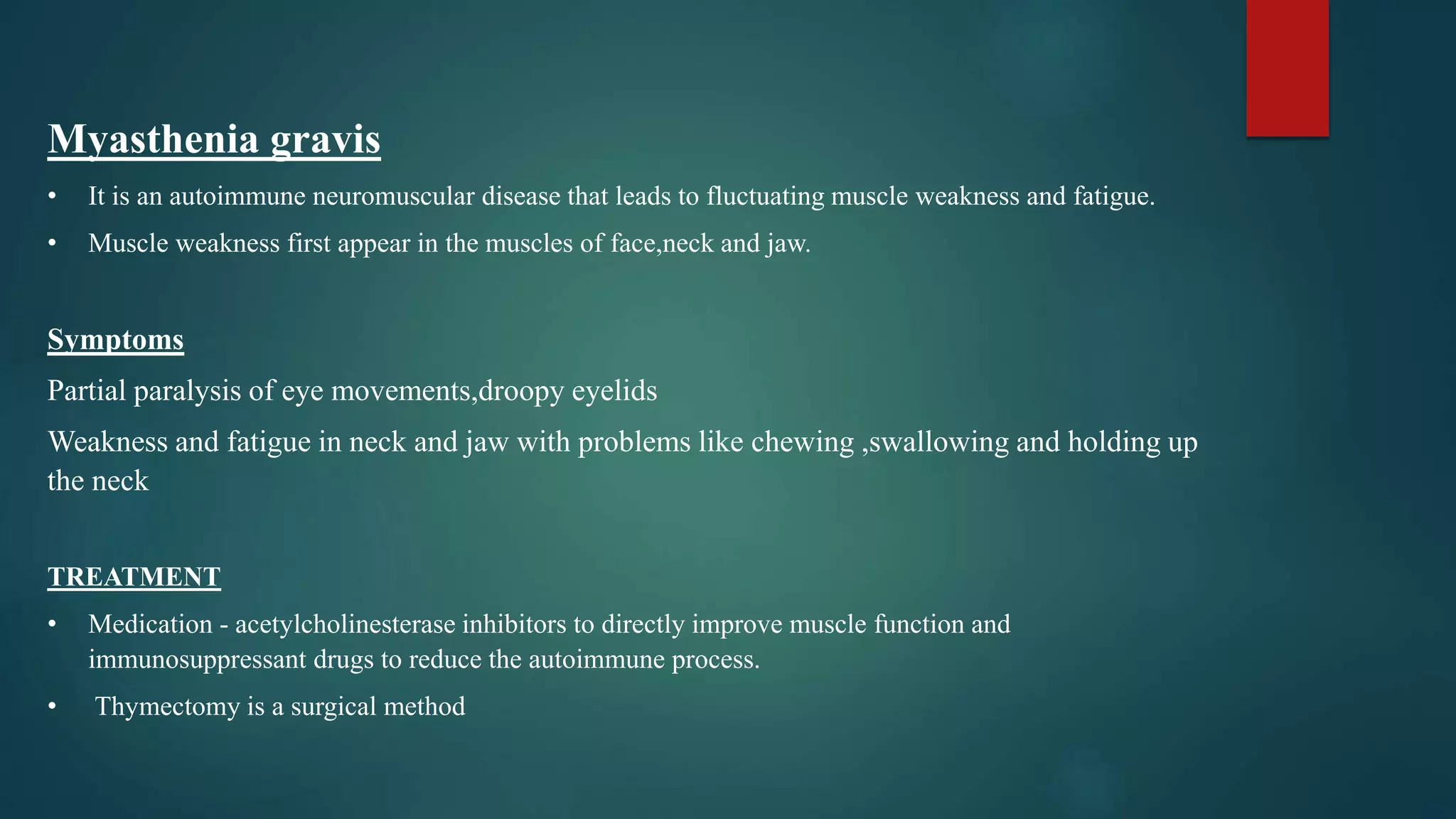
Myasthenia gravis
• It is an autoimmune neuromuscular disease that leads to fluctuating muscle weakness and fatigue.
• Muscle weakness first appear in the muscles of face,neck and jaw.
Symptoms
Partial paralysis of eye movements,droopy eyelids
Weakness and fatigue in neck and jaw with problems like chewing ,swallowing and holding up
the neck
TREATMENT
• Medication - acetylcholinesterase inhibitors to directly improve muscle function and
immunosuppressant drugs to reduce the autoimmune process.
• Thymectomy is a surgical method
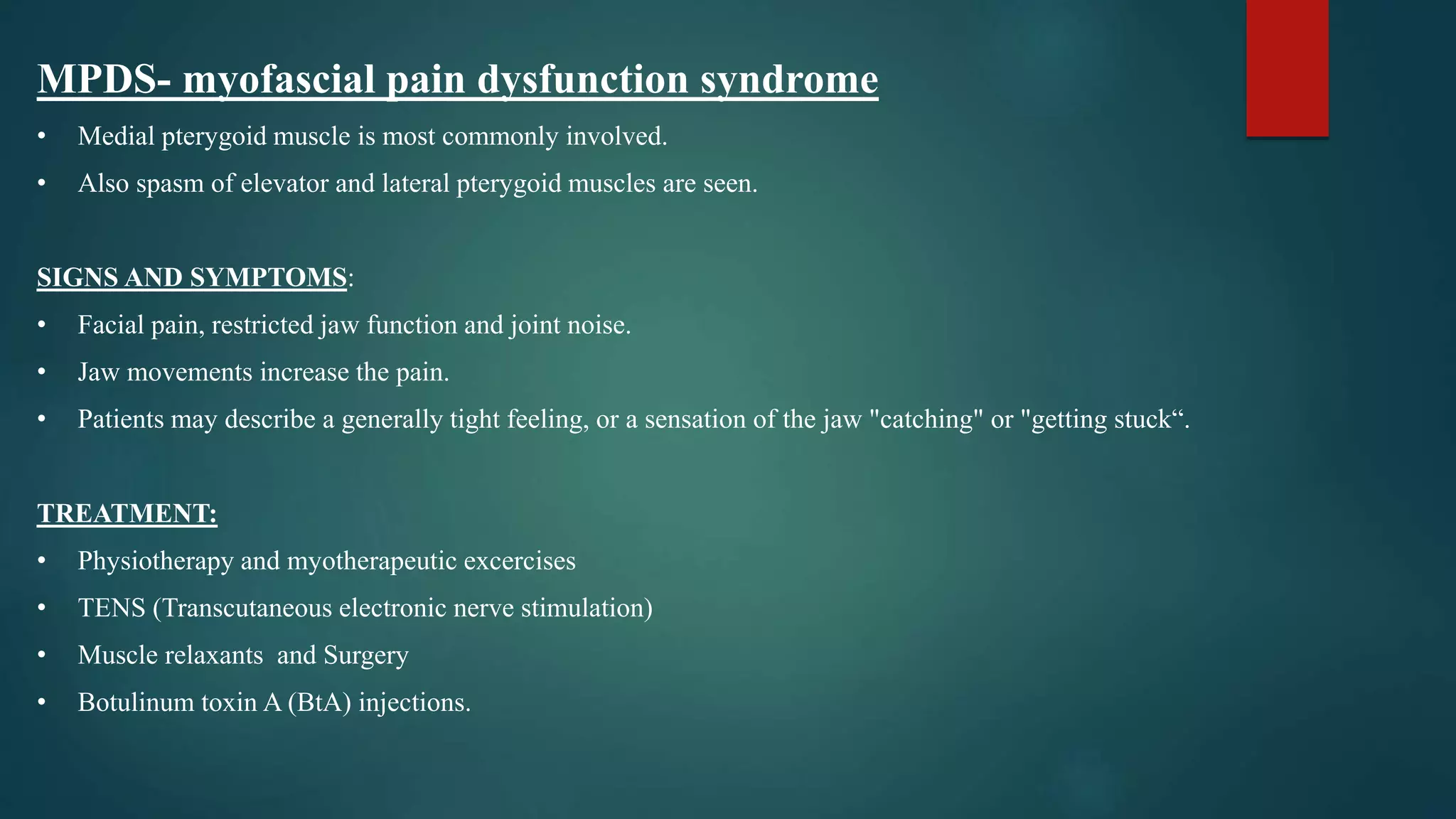
MPDS- myofascial pain dysfunction syndrome
• Medial pterygoid muscle is most commonly involved.
• Also spasm of elevator and lateral pterygoid muscles are seen.
SIGNS AND SYMPTOMS:
• Facial pain, restricted jaw function and joint noise.
• Jaw movements increase the pain.
• Patients may describe a generally tight feeling, or a sensation of the jaw "catching" or "getting stuck“.
TREATMENT:
• Physiotherapy and myotherapeutic excercises
• TENS (Transcutaneous electronic nerve stimulation)
• Muscle relaxants and Surgery
• Botulinum toxin A (BtA) injections.
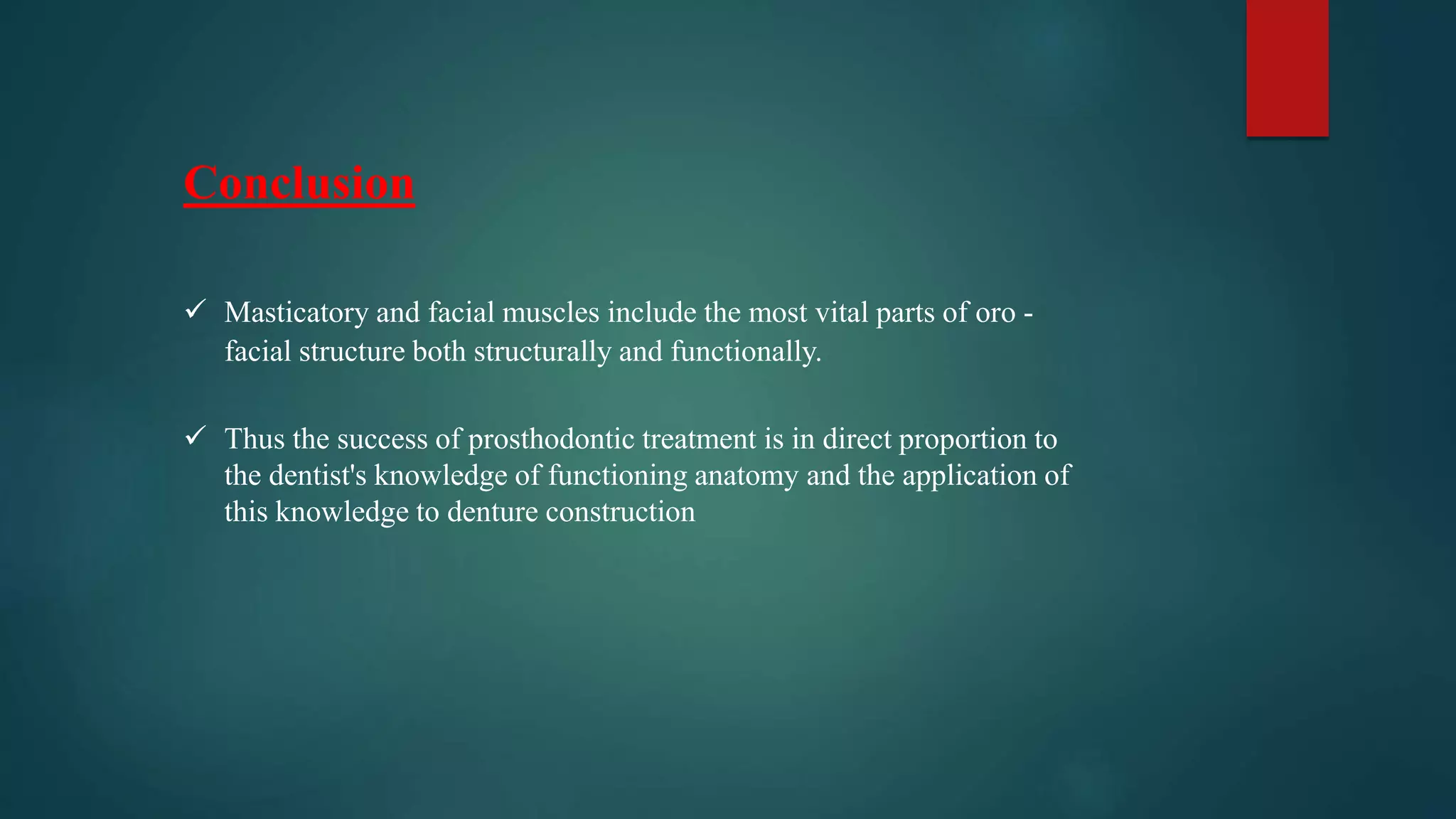
Conclusion
 Masticatory and facial muscles include the most vital parts of oro -
facial structure both structurally and functionally.
 Thus the success of prosthodontic treatment is in direct proportion to
the dentist's knowledge of functioning anatomy and the application of
this knowledge to denture construction
References:
1.B D Chaurasia’s Human Anatomy. Vol 3 Head, Neck and Brain. 11th edition.
2.Boucher. Prosthodontic treatment for edentulous patients. 9th edition Mosby 1985.
3.McCracken. Removable Partial Prosthodontics. 11th edition. 2005
4.Extended buccal flange technique to manage bells palsy patient with complete
denture. International Journal of Dental Clinics; Vol 4, No 3 (2012)
5.Larsen SJ, Carter JF, Abrahamian HA. Prosthetic support for unilateral facial
paralysis. The Journal of Prosthetic Dentistry. 1976; 35(2):192-201.
6.Lazzari JB. Intraoral splint for support of the lip in Bell’s palsy. The Journal of Prosthetic
Dentistry. 1955; 5(4):579-81.
7.Takashi Satomi1a , Toshiaki Tanaka1,2a , Takehito Kobayashi3 , Mituyoshi Iino Developing a New
Appliance to Dissipate Mechanical Load on Teeth and Improve Limitation of Vertical Mouth
Opening. J. C. Turp, F. Komine, A. Hugger. Efficacy of stabilization splints for the management of
patients with masticatory muscle pain: a qualitative systematic review. Clin Oral Invest (2004)
8:179–195.
8.Anders Johansson, Ridwaan Omar, Gunnar E. Carlsson. Bruxism and prosthetic treatment: A
critical review. Journal of Prosthodontic Research 55 (2011) 127–136.
9.Baba K, Aridome K, Pallegama RW. Management of bruxism-induced complications in removable
partial denture wearers using specially designed dentures: a clinical report. Cranio 2008; 26:71–6.
10.Philip S. Baker, Robert L. Brandt, Gregory Boyajian. Impression procedure for patients with
severely limited mouth opening .J Prosthet Dent 2000; 84:241-4.
Muscles of facial expression and mastication

Muscles of facial expression and mastication

  • 1.
    MUSCLES OF FACIALEXPRESSION AND MASTICATION Ajay yerramsetti
  • 2.
    CONTENTS  Introduction  Musclesof the facial expression  Origin and insertion  Functions  Applied anatomy  Muscles of mastication  Origin and insertion  Functions  Prosthodontic Considerations  Clinical relevance  References
  • 3.
     Face isthe most prominent part of the body.  Facial muscles help in showing a wide range of emotions.  The face, therefore is an index of the mind. INTRODUCTION
  • 4.
    DEVELOPMENT OF FACIALMUSCLES EMBRYOLOGICALLY : They develop from the mesoderm of the second branchial arch. MORPHOLOGICALLY: They represent the best remnants of Panniculus Carnosus, which is a continuous subcutaneous muscle sheet seen in some animals.
  • 5.
  • 6.
    CORRUGATOR SUPERCILLI Muscle OriginInsertion Action Corrugator supercilli. Medial end of superciliary arch. Skin of mid- eyebrow. Vertical wrinkling of forehead, frowning.
  • 7.
    Muscle Origin InsertionAction ORBICULARIS OCULI Orbital part Palpebral part Lacrimal part Medial part of medial palpebral ligament & adjoining bone. Lateral part of medial palpebral ligament. Lacrimal fascia & lacrimal bone. Concentric rings return to the point of origin. Lateral palpebral raphae. Upper& lower tarsi. Closes lids tightly, wrinkling, protects eye from bright light. Closes lids gently, blinking. Dilates lacrimal sac, directs lac. Puncta into lacus lacrimalis, supports the lower lid.
  • 8.
    Muscle Origin InsertionAction Procerus Nasal bone and upper part of lateral nasal cartilage Skin of forehead between eyebrows and on bridge of the nose Causes transverse wrinkling
  • 9.
    Muscle Origin InsertionAction Compressor naris Maxilla just lateral to nose Aponeurosis across dorsum of nose Nasal aperture compressed Dilator naris Maxilla over the lateral incisor Alar cartilage of nose Nasal aperture dilated Depressor septi Maxilla over the central incisor Lower mobile part of nasal septum Nose pulled inferiorly
  • 10.
    Muscle Origin InsertionAction ORBICULARIS ORIS Intrinsic part Superior incisivus, from maxilla, inferior incisivus, from mandible Angle of mouth Closes lips and protrudes lips, numerous extrinsic muscles make it most versatile for various types of grimaces Extrinsic part Thickest middle stratum, derived from buccinator,thick superficial stratum, derived from elevators and depressors of lips and their angles Lips and the angle of the mouth
  • 11.
    BUCCINATOR Pierced by  Parotidduct  Buccal branch of mandibular nerve Upper fibers, from maxilla, opposite molar teeth. Lower fibers, from mandible, opposite molar teeth. Middle fibers, from pterygomandibular raphae Straight to upper lip. Straight to lower lip. Decussate before passing to lips. Flattens cheek against gums & teeth, prevents accumulation of food in vestibule. Whistling Muscle. Muscle Origin Insertion Action
  • 12.
    Muscle Origin InsertionAction Levator labii superioris Infraorbital margin of maxilla Skin of upper lateral half of the upper lip Elevates the upper lip, forms nasolabial groove Zygomaticus Major Posterior aspect of lateral surface of zygomatic bone Skin at the angle of the mouth Pulls the angle upwards and laterally as in smiling Levator anguli oris Maxilla just below infraorbital foramen Skin of angle of the mouth Elevates the upper lip, forms nasolabial groove
  • 13.
    Muscle Origin InsertionAction Zygomaticus Minor Anterior aspect of lateral surface of zygomatic bone Upper lip medial to its angle Elevation of the upper lip Depressor anguli oris Oblique line of mandible below the first molar, premolar and canine teeth Skin at the angle of the mouth and fuses with orbicularis oris Draws angle of mouth downwards and laterally
  • 14.
    Muscle Origin InsertionAction Mentalis Mandible inferior to incisor teeth Skin of chin Elevates and protrudes lower lip Risorius Fascia on the masseter muscle Skin at the angle of the mouth Retracts angle of the mouth
  • 15.
    Platysma Upper partsof pectoral and deltoid fasciae. Fibres run upwards and medially Anterior fibres, to the base of the mandible and posterior fibres to the skin of the lower face Releases pressure of skin on the subjacent veins; depresses mandible; pulls the angle of the mouth downwards as in horror or fright. Muscle Origin Insertion Action
  • 16.
     A fewof the common facial expressions & the muscles producing them are given below:  Smiling & laughing: Zygomaticus major.  Sadness: Levator labii superioris &Levator anguli oris.  Grief: Depressor anguli oris.  Anger: Dilator naris & Depressor septii.  Frowning: Corrugator supercilii & procerus.  Horror, terror& fright: Platysma.  Surprise: Frontalis
  • 17.
     Doubt: Mentalis. Grinning: Risorius.  Contempt: Zygomaticus minor.  Whistling: Buccinator  Snarl: Levator labii superioris alaeque nasi  Blinking: Orbicularis oculi  Grimace: Orbicularis oris
  • 18.
    NERVE SUPPLY  Thefacial nerve is the motor nerve of the face.  Emerge from the parotid gland and diverge to supply the various facial muscles.  Temporal- frontalis, auricular muscles, orbicularis oculi  Zygomatic- orbicularis oculi (lower eyelid)  Buccal- muscles of cheek and upper lip  Marginal mandibular- muscles of lower lip  Cervical- platysma
  • 19.
    Ophthalmic division of trigeminalnerve 1. Supratrochlear nerve 2. Supraorbital nerve 3. Lacrimal nerve 4. Infratrochlear nerve 5. External nasal nerve 1. Upper eyelid and forehead 2. Upper eyelid, frontal air sinus, scalp 3. Lateral part of upper eyelid 4. Medial parts of both eyelids 5. Lower part of dorsum and tip of the nose. Maxillary division of trigeminal nerve 1. Infraorbital nerve 2. Zygomaticofacial nerve 3. Zygomaticotemporal nerve 1. Lower eyelid, side of the nose and upper lip 2. Upper part of cheek 3. Anterior part of temporal region Mandibular division of trigeminal nerve 1. Auriculotemporal nerve 2. Buccal nerve 3. Mental nerve 1. Upper 2/3rd of lateral side of auricle, temporal region 2. Skin of lower part of cheek 3. Skin over chin Sensory nerve supply The trigeminal nerve with its three branches is the chief sensory nerve of the face Trigeminal neuralgia may involve one or more of the three divisions of the trigeminal nerve. It causes attacks of very severe burning and scalding pain along the distribution of the affected nerve.
  • 20.
    Applied anatomy:  INFRANUCLEARLESION  Injury to the facial nerve at the stylomastoid foramen is known as Bell’s palsy, upper and lower quarters of the face on the same side get paralyzed.  During mastication, food accumulates between the cheek and the teeth. Articulation of labials is impaired.
  • 21.
     Lagophthalmos  Itis the inability to close the eyelid.  It may be the result of the residual effect of 7th cranial nerve damage secondary to Bell’s palsy, tumour, cancer removal.  Failure to provide protection to the eye may lead to exposure keratitis, corneal abrasion, or blindness.  The treat includes ointments, eye drops, taping, tarsorraphy, or an eyelid implant.
  • 22.
     SUPRANUCLEAR LESION: •usually a part of hemiplegia with injury of corticonuclear fibres, • Only the lower quarter of the opposite side of the face is paralyzed. • The upper quarter with the frontalis and orbicularis oculi escapes due to its bilateral representation in the cerebral cortex. • Only voluntary movements are affected and the emotional expressions remain normal as there are separate pathways for voluntary and emotional movements.
  • 23.
    Prosthodontic Considerations  Aging •Wrinkles start appearing when layers of fat are lost. Age reduces the concavity and “pout” of the upper lip, and it flattens the philtrum. • The nasolabial grooves deepen, which produces a sagging look to the middle third of the face, whereas atrophy of the subcutaneous and buccal pads of fat dissapears, and the upper lip droops( chelioptosis) over the maxillary teeth. • These canges are accentuated even more dramatically when teeth are lost or there is loss of occlusal vertical dimension.
  • 24.
     Treatment ofpatients with facial paralysis.  In cases of unilateral facial paralysis- cheek plumper can be used.  They are also known as the cheek lifting appliance and are basically prosthesis for supporting and lifting the cheek to provide required support and esthetic that will increase the self-esteem of the patient.  A conventional cheek plumper is a single unit prosthesis with extensions on either side in the region of the polished buccal surfaces of the denture and are continuous with the rest of the denture.
  • 25.
     Demerits ofsuch a design are: ● Excessive weight which could hamper retention of the maxillary complete denture ● Can result in muscle fatigue. ● Can destabilize the maxillary denture ● Could interfere with masseter muscle and coronoid process of the mandible ● Difficult to insert the denture due to excessive weight. ● Can’t be used in patients with limited mouth opening.  This problem can be solved with the fabrication of denture with detachable cheek plumper creating dentures that are in harmony and dignity with the aging individual, which will not eradicate but compliment the stigma of aging in them.
  • 26.
  • 27.
  • 28.
    DEVELOPMENT  The muscularsystem develops from intra embryonic mesoderm  Muscles of mastication are derived from first or mandibular arch.  Therefore all muscles are supplied by the mandibular nerve.
  • 29.
    FUNCTIONS:  Control allmovements of the mandible.  There is a wide area of origin of some of the muscles compared with the area of insertion, making it possible to have a wide range of movement.  The muscles of mastication occur bilaterally in pairs. Each muscle runs in a different direction and at a different level. This also helps in the range of movement.
  • 30.
    Activities- divided into2 types-  FUNCTIONAL- chewing, speaking, swallowing  PARAFUNCTIONAL - grinding, clenching, and bruxing
  • 31.
    MUSCLES  Masseter  Temporalis Lateral pterygoid  Medial pterygoid  Accessory muscles :  Buccinator  Suprahyoid muscles  Infrahyoid muscles
  • 32.
    Muscle Origin InsertionFunction Masseter -Quadrilateral muscle Superficial layer from the anterior 2/3 of the lower border of zygomatic arch& from the zygomatic process of maxilla. The superficial fibers pass downwards& backwards at an angle of 45 degrees. They are inserted into the lower part of lateral surface of ramus of mandible. The muscle elevates the mandible to close the mouth & clenches the teeth. -Fibers are arranged in three layers. Middle layer from anterior 2/3 of deep surface& posterior 1/3 of lower border of zygomatic arch. The middle fibers are inserted into the middle part of ramus Deep layer from the deep surface of the zygomatic arch. the deep fibers into the upper part of ramus & into the coronoid process.
  • 33.
    Muscle Origin InsertionFunction Temporalis This muscle fills the temporal fossa -Temporal fossa, excluding the zygomatic bone. -Temporal fascia. -The margins & deep surface of coronoid process & - The anterior border of ramus of mandible. -Elevates the mandible. -Posterior fibers retract the protruded mandible. - Side to side grinding movements of mandible
  • 34.
    Muscle Origin InsertionFunction LATERAL PTERYGOID Short,conical and has muscle has upper & lower heads Both heads arises from the sphenoid bone. a) The upper head is small. It arises from the infratemporal surface & crest of greater wing of sphenoid bone. b) The lower head is large. It arises from the lateral pterygoid plate The fibers runs forwards & laterally & converge to be inserted into: a) The pterygoid fovea on the anterior surface of neck of mandible. b) The anterior margin of articular disc & capsule of TMJ. Depresses the mandible to open the mouth, (with suprahyoid muscles) . The lateral & medial pterygoid muscles of both sides acting together protrude the mandible. The medial & lateral pterygoid muscles of the two sides contract alternatively to produce side to side movements of mandible (as in chewing).
  • 35.
    Muscle Origin InsertionFunction MEDIAL PTERYGOID This is a quadrilateral muscle. It has a small superficial head & a large deep head which forms the major part of muscle. a) Superficial head from the tuberosity of maxilla & adjoining bone. b) Deep head from the medial surface of the lateral pterygoid plate & adjoining part of palatine bone. The fibers run downwards, backwards & laterally - inserted into the roughened area on the medial surface of angle & the adjoining part of ramus of mandible, below & behind the mandibular foramen & the mylohyoid groove. -Elevates the mandible. -Helps to protrude the mandible.
  • 36.
    Nerve supply  Masseter-Massetericnerve, a branch of anterior division of the mandibular nerve.  Temporalis-Deep temporal branches from the anterior division of mandibular nerve.  Lateral pterygoid-A branch from the anterior division of mandibular nerve.  Medial pterygoid-Nerve to the medial pterygoid, which is a branch of the main trunk of mandibular nerve.
  • 37.
    Blood supply: • Masseter:maxillary artery which is a branch of external carotid artery. • Temporalis: middle and deep temporal arteries • Medial Pterygoid: Pterygoid branch of maxillary artery • Lateral Pterygoid: Pterygoid branch of maxillary artery.
  • 38.
  • 39.
    Muscle Origin InsertionFunction DIGASTRIC Anterior belly : from digastric fossa of mandible, supplied by nerve to mylohyoid Posterior belly: from mastoid notch of temporal bone, supplied by facial nerve Hyoid bone -It depresses the mandible when mouth is opened wide,it is secondary to lateral pterygoid. -Elevates hyoid bone
  • 40.
    Muscle Origin InsertionNerve supply Function MYLOHYOID Flat, triangular muscles forming the floor of the mouth and lies deep to anterior belly of digastric. mylohyoid line of mandible hyoid bone nerve to mylohyoid -Elevates the floor of the mouth in first stage of deglutition. -depresses the mandible
  • 41.
    Muscle Origin InsertionNerve supply Function GENIOHYOID inferior mental spine (genial tubercle) Hyoid bone Hypoglossal nerve. Elevates the hyoid bone and depresses the mandible when hyoid is fixed
  • 42.
     Infrahyoid muscles: Function: • They have no direct significance. • Their action is to fix or depress the hyoid bone so that suprahyoid muscles can act
  • 43.
    Relevance in prosthodontics: MASSETER:  It will responsible for formation of masseteric notch (distobuccal to the pad i.e. outline of distobuccal border) it forms due to the action of masseter over buccinator.  This area of denture must be carefully recorded because overextension causes soreness.  Under extension, may result in a loss of support and resistance, to distal displacement.  ACTIVATION - Hold the tray with index finger and thumb at lower border of mandible. Instruct the patient to close his mouth against the pressure exerted by the finger of operator. This will result masticatory muscle contract against buccinator muscle.
  • 44.
     Buccinator  Superiorfibres of buccinator- seat the denture.  Inferior fibres of buccinator- control denture stability and relaxes to form a pouch to store food.  A clinical study involving electromyography analysis of the function of the buccinator muscle by Lundquist’showed that the nature of buccinator muscle contraction was not able to adapt to changes in the contours of the denture base. Because learning and adaptation appear to be limited, the denture contours should be designed to harmonize with existing buccinators muscle function
  • 45.
     Mylohyoid  Itis very important to achieve stability of lower denture by acquiring adequate peripheral seal in that area.  It can be determined by:-  Skillful border moulding and impression procedures.  BOUCHER says that the denture flange must be parallel to the mylohyoid muscle when it is contracted.  ACTIVATION: - During borer moulding or impression making procedure, ask the patient to swallow or move the tongue RT and Lt Side.
  • 46.
    In maxilla:  Buccalfrenum : o Levator anguli oris- attaches beneath the frenum o Orbicularis oris- pulls frenum in forward direction o Buccinator – pulls frenum in backward direction  Inadequate provision for the buccal frenum of excess thickness of the flange distal to the buccal notch can cause dislodgement of the denture when the cheeks are moved posteriorly as in a broad smile.  Recording: the cheek is elevated and then pulled outward, downward and inward and moved backward and forward.
  • 47.
     Buccal vestibule: oVaries with the contraction of the buccinators o Contraction of the masseter muscle under heavy closing forces reduces the space available for the distal end of buccal flange.  Recording: the cheek is elevated and then pulled outward, downward and inward.
  • 48.
     IN THEMANDIBLE  Buccal frenum: overlies the depressor anguli oris and buccinator is attached to it.  Denture should be extended less in this region and the impression should be functionally trimmed to have the maximum seal.  Buccal vestibule :  This space is influenced by the masseter. When the masseter contracts, it pushes inward against the buccinator, producing a bulge in the mouth, which is reproduced as a notch in the denture flange.
  • 49.
    Neutral zone • Theneutral zone has been defined as the area in the mouth where during function, the forces of the tongue pressing outwards are neutralised by the forces of the cheeks and lips pressing inwards. • The aim of the neutral zone is to construct a denture in muscle balance. That is a denture which is in harmony with its surroundings to provide optimum stability, retention and comfort. • A denture shaped by the neutral zone technique will ensure that the muscular forces are working more effectively. So the area is reduced in bulk, but concavity should not be made too pronounced because it can lead to food accumulation and the buccinators is unable to clean out this hollow
  • 50.
     When theposterior fibres of temporal muscle contract they tend to move the mandible posteriorly in CR or to hold it in its most post position during terminal hinge movement.  Thus when a patient is instructed to “ Pull your lower jaw back and close on your back teeth” to make a CR record or to locate the post terminal hinge axis the temporal muscles and the inframandibular muscles retrude the mandible and maintain it in this most posterior position.  The lateral pterygoid muscle are also responsible for the lateral and protrusive movements of the mandible that are necessary to make eccentric interocclusal records or pantographic tracings used when one is adjusting the horizontal condylar guidances and the lateral condylar guidances of the articulator.
  • 51.
    Muscle involvement inhorizontal jaw relation  The temporal, masseter and Medial pterygoid muscles elevate the mandible to a particular vertical relation with the maxillae. The lateral pterygoid muscle show little activity when mandible is in centric relation.  Muscle involvement in vertical jaw relation The elevator muscle, temporalis, masseter and the medial pterygoid are involved in stablishing vertical jaw relations. The depressor muscles are the inframandibular and suprahyoid muscles including the mylohyoid, geniohyoid, digastric and platysma muscles. These muscles plus gravity help to control the tonic balance that maintains physiologic rest position.
  • 52.
    Clinical Considerations Trismus: Limited jawmobility can result from trauma, surgery, radiation treatment, or even TMJ problems. The limitation in opening may be a result of muscle damage, joint damage, rapid growth of connective tissue (i.e. scarring) or a combination of these factors. Treatment: 1) Externally activated appliances: Inflatable bite opener, Dynamic bite opener, threaded tapered screw, Shell-shaped mouth opener, Screw type mouth gag, Tongue blades, Fingers, Therabite jaw motion Rehabilitation system. 2) Internally activated appliances: tongue blades, plastic tapered cylinders.
  • 53.
    Bruxism • Bruxism isexcessive teeth grinding and jaw clenching. It is an oral parafunctional activity. • Muscles involved: masseter,temporalis,pterygoids,digastric and stylohyoid SYMPTOMS and SIGNS: • Indentations of the teeth in the tongue (crenated tongue) • Hypertrophy of the muscles of mastication, particularly the masseter muscle. • Tenderness, pain or fatigue of the muscles of mastication, which may get worse during chewing or other jaw movement. • Excessive tooth wear, particularly attrition and abfraction, tooth fractures, and repeated failure of dental restorations • Treatment : mouth gaurds
  • 54.
    Effects of bruxismon dentures  Complete dentures: Textbooks on complete denture fabrication often mention that clinical experience indicates that bruxism is a frequent cause of complaint of soreness of the denture- bearing mucosa. Parafunctions can be a possible factor related to the magnitude of ridge reduction.  Removable partial dentures: The question of restoring lost posterior support by means of mandibular distal extension removable partial dentures (RPDs) in moderately shortened dental arches remains controversial. However, systematic reviews have concluded that shortened dental arches comprising anterior and premolar teeth generally fulfill the requirements of a functional dentition without the need for prosthodontic extension, especially in older patients.
  • 55.
    Myasthenia gravis • Itis an autoimmune neuromuscular disease that leads to fluctuating muscle weakness and fatigue. • Muscle weakness first appear in the muscles of face,neck and jaw. Symptoms Partial paralysis of eye movements,droopy eyelids Weakness and fatigue in neck and jaw with problems like chewing ,swallowing and holding up the neck TREATMENT • Medication - acetylcholinesterase inhibitors to directly improve muscle function and immunosuppressant drugs to reduce the autoimmune process. • Thymectomy is a surgical method
  • 56.
    MPDS- myofascial paindysfunction syndrome • Medial pterygoid muscle is most commonly involved. • Also spasm of elevator and lateral pterygoid muscles are seen. SIGNS AND SYMPTOMS: • Facial pain, restricted jaw function and joint noise. • Jaw movements increase the pain. • Patients may describe a generally tight feeling, or a sensation of the jaw "catching" or "getting stuck“. TREATMENT: • Physiotherapy and myotherapeutic excercises • TENS (Transcutaneous electronic nerve stimulation) • Muscle relaxants and Surgery • Botulinum toxin A (BtA) injections.
  • 57.
    Conclusion  Masticatory andfacial muscles include the most vital parts of oro - facial structure both structurally and functionally.  Thus the success of prosthodontic treatment is in direct proportion to the dentist's knowledge of functioning anatomy and the application of this knowledge to denture construction
  • 58.
    References: 1.B D Chaurasia’sHuman Anatomy. Vol 3 Head, Neck and Brain. 11th edition. 2.Boucher. Prosthodontic treatment for edentulous patients. 9th edition Mosby 1985. 3.McCracken. Removable Partial Prosthodontics. 11th edition. 2005 4.Extended buccal flange technique to manage bells palsy patient with complete denture. International Journal of Dental Clinics; Vol 4, No 3 (2012) 5.Larsen SJ, Carter JF, Abrahamian HA. Prosthetic support for unilateral facial paralysis. The Journal of Prosthetic Dentistry. 1976; 35(2):192-201.
  • 59.
    6.Lazzari JB. Intraoralsplint for support of the lip in Bell’s palsy. The Journal of Prosthetic Dentistry. 1955; 5(4):579-81. 7.Takashi Satomi1a , Toshiaki Tanaka1,2a , Takehito Kobayashi3 , Mituyoshi Iino Developing a New Appliance to Dissipate Mechanical Load on Teeth and Improve Limitation of Vertical Mouth Opening. J. C. Turp, F. Komine, A. Hugger. Efficacy of stabilization splints for the management of patients with masticatory muscle pain: a qualitative systematic review. Clin Oral Invest (2004) 8:179–195. 8.Anders Johansson, Ridwaan Omar, Gunnar E. Carlsson. Bruxism and prosthetic treatment: A critical review. Journal of Prosthodontic Research 55 (2011) 127–136. 9.Baba K, Aridome K, Pallegama RW. Management of bruxism-induced complications in removable partial denture wearers using specially designed dentures: a clinical report. Cranio 2008; 26:71–6. 10.Philip S. Baker, Robert L. Brandt, Gregory Boyajian. Impression procedure for patients with severely limited mouth opening .J Prosthet Dent 2000; 84:241-4.

Editor's Notes

  • #32 Acc-supra-digastric,mylohyoid,geniohyoid infra-sternohyoid,sternothyroid,omohyoid