ORIGINAL ARTICLE
Muscle force distribution for adaptive control of a humanoid
robot arm with redundant bi-articular and mono-articular muscle
mechanism
Haiwei Dong • Nikolaos Mavridis
Received: 7 January 2013 / Accepted: 14 May 2013 / Published online: 30 May 2013
Ó ISAROB 2013
Abstract Robot arms driven by bi-articular and mono-
articular muscles have numerous advantages. If one muscle
is broken, the functionality of the arm is not influenced. In
addition, each joint torque is distributed to numerous
muscles, and thus the load of each muscle can be relatively
small. This paper addresses the problem of muscle control
for this kind of robot arm. A relatively mature control
method (i.e. sliding mode control) was chosen to get joint
torque first and then the joint torque was distributed to
muscle forces. The muscle force was computed based on a
Jacobian matrix between joint torque space and muscle
force space. In addition, internal forces were used to
optimize the computed muscle forces in the following
manner: not only to make sure that each muscle force is in
its force boundary, but also to make the muscles work in
the middle of their working range, which is considered best
in terms of fatigue. Besides, all the dynamic parameters
were updated in real-time. Compared with previous work, a
novel method was proposed to use prediction error to
accelerate the convergence speed of parameter. We
empirically evaluated our method for the case of bending-
stretching movements. The results clearly illustrate the
effectiveness of our method towards achieving the desired
kinetic as well as load distribution characteristics.
Keywords Muscle cooperation Á Redundancy Á
Internal force Á Parameter adaptation
1 Introduction
1.1 Background
Traditional robot arms are driven by motors. Each motor
drives a specific joint, corresponding to an independent
degree of freedom (DOF). There are two main problems in
this approach. First, if one motor is broken, the DOF cor-
responding to this motor will be lost. Second, the motor
near the base link always needs more power, leading to a
requirement for very heavy motors near the base. But let us
compare this to the human motor system: as there are many
muscles driving one joint, the total joint torque is distrib-
uted to every muscle. Thus, each muscle only carries a
relatively small load. Furthermore, if one muscle is broken,
the function of rotation for the corresponding joint does not
change. Thus, recently such driving systems for robots
inspired by muscles have started to be explored, creating a
new research direction. For example, there are a number of
papers focusing on bionic arms [1–4]. In our work, we
propose a muscle control method for humanoid robot arm
driven by bi-articular muscles. Here, the control method is
designed to be adaptive, i.e. robust to perturbations and
disturbances from environment. In addition, the muscle
forces have to satisfy the boundary force limit. Last, but
quite importantly, the method has to be efficient enough for
practical application.
To get insight into this muscle control problem, we can
consider it through viewpoints arising from two research
fields: human motor control and robotics. In human motor
control, the human body is usually considered as a multi-
link rigid body with numerous joints. By adding muscles
and tensors, the human body moves according to control
signals arising from the neural system. Such a kind of
system is usually termed a neural-skeleton muscle system
H. Dong (&) Á N. Mavridis
New York University AD, P.O. Box 129188, Abu Dhabi, UAE
e-mail: haiwei.dong@nyu.edu
N. Mavridis
e-mail: nikolaos.mavridis@nyu.edu
123
Artif Life Robotics (2013) 18:41–51
DOI 10.1007/s10015-013-0097-x
[5, 6] and the muscle control is described as human motor
control [7]. On the other hand, in robotics, there is also a
related research field focusing on controlling multi-link
rigid bodies [8–10].
In our research, we face two problems: redundancy and
adaptivity. For redundancy, there exist two types of
redundancies here. Type I Redundancy is between end
effector position and joints. Taking the robot arm as an
example, the number of degrees of freedom (DOF) of the
end effector position is 3, i.e., the end effector can move in
3D space. Nevertheless, the number of joints in the arm can
be more than 3, indicating the fact that for the same end
effector position, there exist many limb joint configura-
tions. The other type of redundancy, Type II Redundancy,
is between joint torque and muscle force. In the human
motor system, there are many more muscles as compared
to the minimum number required to generate the full range
of required movement [11, 12]. Towards generating a
certain desired joint torque, there is a lot of flexibility in
distributing load among the cooperating muscles. For
example, if we ask a subject to keep a certain gesture, when
the subject is under nervous status, the muscles are tense.
Both agonist muscles and antagonist muscles output large
force. At this time, the body’s impedance status is in a self-
protection mode, and the damping and viscosity coeffi-
cients are correspondingly large [13, 14]. Conversely,
when the subject is under relaxation status, the muscle
force, damping and viscosity coefficients are small. The
above two extreme statuses correspond to the same zero
joint torque with different muscle force distributions.
Ability for adaptation is also a very important issue,
especially for humanoid robots. As humanoid robots are
usually tailored towards significant human–robot interac-
tion, often their working environment is mainly a human
environment, which is very complex and always accom-
panied with various kinds of uncertainties. Furthermore,
even if we do not consider the environmental uncertainty,
and we focus on the robot itself, we still often have robot
model errors. Thus, in order to be able to create humanoids
that perform adequately under such conditions, it is nec-
essary to propose methods that have the ability to perform
real-time adaptation, for counteracting such uncertainties.
1.2 Related work
Let us start by discussing relevant work in human–robot
control, and then moving over to relevant work in robotics.
In human motor control, two of the main research direc-
tions are those focusing towards redundancy solutions and
ability for adaptation. Let us start with the first: redundancy
solution. The basic method utilized is nonlinear optimiza-
tion [15–18]. There have been many successful applica-
tions. Hogan proposed a voluntary movement principle
using dynamic optimization which minimizes the rate of
acceleration change of the limb [19]. Anderson et al. [15]
used dynamic optimization of minimum metabolic energy
expenditure to solve the motion control of walking. Manal
et al. [11] designed a nonlinear optimal controller to
develop a real-time EMG-driven virtual arm. Neptune [16]
evaluated different multivariate optimization methods in
pedaling.
The optimization method in human motor control
includes two different kinds of methods. One is forward
dynamics method which uses muscle excitations as the
inputs to calculating the corresponding body motions [12,
20]. It is a novel research in forward dynamics that
Anderson et al. [21] uses a parallel computer to calculate
the derivatives of the cost function and the constraints with
each control variable. The other is inverse dynamics
method [18]. Noninvasive measurement of body motions
(position, velocity, and acceleration of each segment) and
external forces are used as inputs to calculate muscle for-
ces. Two commercial software packages are famous based
on these two methods: AnyBody Modeling System as
inverse dynamics method [22] and OpenSim as forward
dynamics method [23].
As mentioned above, a second main research direction
focuses on adaptation ability. Although adaptation ability
based on bio-feedback has not been fully understood in
human motor control, right now the basic comprehension is
a combination control scheme of feed-forward control and
feedback control [24]. The feed-forward control corre-
sponds to the inverse dynamics [25–27]. Specifically, the
inverse dynamics are learnt (i.e., estimated) by nervous
system. Then, the feedback control uses this inverse
dynamics to provide a basic control efficiently. The feed-
back control deals with environment disturbance, load
change, and learning error of inverse dynamics, etc. It is
usually considered as a Visual Servo Feedback System
[28].
Now let us move from human motor control to
robotics. In robotics, modeling and control of multi-link
rigid body (especially manipulator control) have been
studied for years [10, 29–31]. Here, the redundancy
problem is usually considered from the viewpoint of
dynamic control [1, 32]. For Type I Redundancy problem,
considering different optimization criterion or restricted
conditions, many methods have been proposed. Yoshika-
wa [29] proposed a manipulability measure, by mini-
mizing which the arm is kept away from singularities.
Maciejewski et al. [30] used null-space vector to aid
obstacle avoidance. For Type II Redundancy problem,
there have been researches on building bionic robots to
mimic human’s movement system. Klug et al. [2]
developed a 3 DOF bionic robot arm which is controlled
by a PD controller with feed-forward compensation. The
42 Artif Life Robotics (2013) 18:41–51
123
trajectory of the arm is optimized and adjusted for a time
and energy-optimal motion [33]. Potkonjak et al. [3] built
a humanoid robot with antagonistic drives whose con-
troller is designed by H1 loop shaping. Tahara [4] pro-
posed a simple sensor-motor control scheme as internal
force and simulated the overall stability.
The initial research on adaptation ability in robotics
comes from online system identification. The objective is
to estimate system structure and parameters in real-time.
Here, the system is considered as a black box or gray box.
By stimulating the system and creating relation between
the inputs and outputs, the parameters of the system can be
adjusted online [34]. Based on this identification idea,
many adaptive methods came out, such as robust control
[35], adaptive feedback control [36], neurofuzzy adaptive
control [37], etc. However, the adaptation ability problem
has not been considered in arm control by bi-articular
muscles.
1.3 Our solution
In this paper, we took into account the previous research in
human motor control and robotics. One of our initial
observations was that the optimization-series methods are
difficult to use in practical applications because of their
relative inefficiency and difficulty in dealing with. It is also
difficult to directly propose a muscle control method for the
robot arm as it is hard to decouple the two redundancies.
Therefore, we use a relatively mature control method (i.e.
sliding mode control) to get joint torque first and then
distribute the joint torque to muscle forces. The muscle
force was computed based on a Jacobian matrix between
joint torque space and muscle force space. In addition,
internal forces were used to optimize the computed muscle
forces in the following manner: not only to make sure that
each muscle force is in its force boundary, but also to make
the muscles work in the middle of their working range,
which is considered best in terms of fatigue. Besides, all
the dynamic parameters were updated in real-time. A novel
method was proposed to use prediction error to accelerate
the convergence speed of parameter. We empirically
evaluated our method for the case of bending-stretching
movements. The results clearly illustrate the effectiveness
of our method towards achieving the desired kinetic as well
as load distribution characteristics.
2 Modeling arm with muscles
2.1 Arm model
We built a 2-dimensional model of the arm in the hori-
zontal plane based on the upper limb structure of a digital
human. The model includes six muscles (shown as 1–6)
and two degrees of freedom (shoulder flexion–extension
and elbow flexion–extension). The range of shoulder angle
is from -20 to 100°, and the range of the elbow is from 0
to 170°. Four of the muscles are mono-articular, and two
are bi-articular where 1 and 2 cross the shoulder joint; 3
and 4 cross the elbow joint; 5 and 6 cross both joints
(Fig. 1).
Considering the arm (including upper arm and lower
arm) as a planar, two-link, articulated rigid object, the
position of hand can be derived by a 2-vector q of two
angles. The input is a 6-vector Fm of muscle forces.
The dynamics of the rigid object is strongly nonlinear.
Using the Lagrangian equations in classical dynamics,
we get the dynamic equations of the ideal upper limb
model
H11 tð Þ H12 tð Þ
H21 tð Þ H22 tð Þ
!
€q1
€q2
!
þ
C11 tð Þ C12 tð Þ
C21 tð Þ C22 tð Þ
!
_q1
_q2
!
þ
G1 tð Þ
G2 tð Þ
!
¼
s1 tð Þ
s2 tð Þ
!
ð1Þ
or abbreviated as
H tð Þ€q þ C tð Þ _q þ G tð Þ ¼ s ð2Þ
with q ¼ q1 q2½ ŠT
¼ h1 h2½ ŠT
being the two joint
angles. s ¼ s1 s2½ ŠT
¼ f Fmð Þ is a function of muscle
force Fm
Fm ¼ Fm;1 Fm;2 Fm;3 Fm;4 Fm;5 Fm;6½ ŠT
ð3Þ
H q; tð Þ is inertia matrix containing information with
regard to the instantaneous mass distribution. C q; _q; tð Þ is
centripetal and coriolis torques representing the moments
Fig. 1 Humanoid robot arm model. The arm has two degrees of
freedom and it can rotate around the shoulder angle and elbow angle
in the anterior plane
Artif Life Robotics (2013) 18:41–51 43
123
of centrifugal forces. G q; tð Þ is gravitational torques
changing with the posture configuration of the arm.
H11 ¼ J1 þ J2 þ m2d2
1 þ 2m2d1c2 cos q2ð Þ
H12 ¼ H21 ¼ J2 þ m2d1c2 cos q2ð Þ
H22 ¼ J2
C11 ¼ À2m2d1c2 sin q2ð Þ _q2
C12 ¼ Àm2d1c2 sin q2ð Þ _q2
C21 ¼ m2d1c2 sin q2ð Þ _q1
C22 ¼ 0
G1 ¼ g m1c1 þ m2d1ð Þ cos q1ð Þ þ gm2c2 cos q1 þ q2ð Þ
G2 ¼ gm2c2 cos q1 þ q2ð Þ; ð4Þ
where g is the acceleration of gravity. ci is the distance
from the center of a joint i to the center of the gravity point
of link i: di is the length of link i. Ji ¼ mid2
i þ Ii where Ii is
the moment of inertia about axis through the center of mass
of link i.
2.2 Model with estimated parameters
In our research, we consider the arm model in Eq. (1) is
influenced by disturbances and perturbations from the
environment. Hence, we used an estimated arm model to
control, which is written as
^H11 tð Þ ^H12 tð Þ
^H21 tð Þ ^H22 tð Þ
" #
€q1
€q2
!
þ
^C11 tð Þ ^C12 tð Þ
^C21 tð Þ ^C22 tð Þ
" #
_q1
_q2
!
þ
^G1 tð Þ
^G2 tð Þ
" #
¼
^s1 tð Þ
^s2 tð Þ
!
ð5Þ
or abbreviated as
^H tð Þ€q þ ^C tð Þ _q þ ^G tð Þ ¼ ^s; ð6Þ
where ^Á means estimated value of Áð Þ. The connection part
between ideal model (Eq. 1) and estimated model (Eq. 5)
is that we choose s ¼ ^s. Below, we use estimated model (5)
to generate torque for real system for control. In addition,
the parameter adaptation updates the estimated parameters
^H, ^C and ^G in real time.
2.3 Dynamic parameters definition
For the convenience of following derivation, we define the
actual and estimated arm parameter vector
P ¼ PT
H PT
C PT
G
 ÃT
; ^P ¼ ^PT
H
^PT
C
^PT
G
 ÃT
; ð7Þ
where
PH ¼
H11
H12
H21
H22
2
6
6
6
4
3
7
7
7
5
; PC ¼
C11
C12
C21
C22
2
6
6
6
4
3
7
7
7
5
; PG ¼
G1
G2
!
;
^PH ¼
^H11
^H12
^H21
^H22
2
6
6
6
4
3
7
7
7
5
; ^PC ¼
^C11
^C12
^C21
^C22
2
6
6
6
4
3
7
7
7
5
; ^PG ¼
^G1
^G2
" #
ð8Þ
then the estimation error vector can be defined as
~P ¼ ^P À P ¼ ~PT
H
~PT
C
~PT
G
 ÃT
: ð9Þ
3 Joint torque computation
3.1 Torque control method
Sliding mode control is used to control the posture of the
arm [36]. A 2-vector qd is the desired states. Define a
sliding mode term s as
s ¼ _~q þ K~q ¼ ð _q À _qdÞ þ Kðq À qdÞ ð10Þ
where K is a positive diagonal matrix. Defining the
reference velocity _qr and reference acceleration €qr as
_qr ¼ _q À s
€qr ¼ €q À _s
ð11Þ
then we choose the control method as
s ¼ ^HðqÞ€qr þ ^Cðq; _qÞ _qr þ ^G À KsgnðsÞ; ð12Þ
where K is convergence parameter which is a diagonal
matrix. The proof of sliding mode control is in [38].
3.2 Parameter adaptation method
To accelerate the parameter update speed, we use two error
sources to update estimated parameters. The first source is
tracking error. We chose the parameter adaptation method
based on tracking error as
_^Ptra ¼ ÀCÀ1
s1 €qT
r s2 €qT
r s1 _qT
r s2 _qT
r s1 s2
 ÃT
; ð13Þ
where C is adaptation parameter which is a diagonal
matrix. The derivation of this parameter adaptation method
is based on the sliding mode control method, which is
proved in [39].
On the other side, the dynamic equation (Eq. 1) can be
written in the form
s tð Þ ¼
€q1 0 €q1 0 _q1 0 _q1 0 1 0
0 €q2 0 €q2 0 _q2 0 _q2 0 1
! PH
PC
PG
2
4
3
5:
ð14Þ
44 Artif Life Robotics (2013) 18:41–51
123
To avoid the acceleration terms in Eq. (14), we
use filtering technique. Specifically, by multiplying
both sides of Eq. (14) with eÀk tÀrð Þ
and integrating it, we
can get
Zt
0
eÀk tÀrð Þ
s rð Þdr ¼
Zt
0
eÀk tÀrð Þ
Â
€q1 0 €q1 0 _q1 0 _q1 0 1 0
0 €q2 0 €q2 0 _q2 0 _q2 0 1
!
dr
PH
PC
PG
2
6
4
3
7
5;
ð15Þ
where k and r are positive numbers. Using partial
integration, the acceleration terms on the right side can
be written as
Zt
0
eÀk tÀrð Þ €q1 0
0 €q2
!
dr ¼ eÀk tÀrð Þ €q1 0
0 €q2
!


t
0
À
Zt
0
d
dr
eÀk tÀrð Þ _q1 0
0 _q2
! 
dr: ð16Þ
Therefore, Eq. (14) can be written in the form
s tð Þ ¼ S t; _q; qð ÞP ð17Þ
From this equation, s is the ‘‘output’’ of the system. S is
a signal matrix. P is a vector of real parameters. We can
predict the value of the output s based on the parameter
estimation, i.e.
^s ¼ S ^P ð18Þ
Then, the prediction error e can be defined as
e ¼ ^s À s ¼ S ^P À SP ¼ S ~P: ð19Þ
According to it, we can get the parameter adaptation
method based on prediction error, i.e.
_^Ppre ¼ ÀN
o eT
eð Þ
o ^P
¼ ÀN
o S ^P À SP
À ÁT
S ^P À SP
À Á 
o ^P
¼ À2NST
S ^P À SP
À Á
¼ À2NST
e ¼ À2NST
^s À sð Þ;
ð20Þ
where N is a diagonal coefficient matrix. If we consider the
parameters change much slower with respect to the
parameter identification, from Eq. (20), we can get
_~P ¼ _^P À _P ¼ À2NST
S ~P ð21Þ
Here, we choose a Lyapunov function candidate
V tð Þ ¼
1
4
~PT ~P ð22Þ
then the derivative of V tð Þ is
_V tð Þ ¼
1
2
~PT _~P ¼
1
2
~PT
À2NST
S ~P
À Á
¼ ÀN S ~P
À ÁT
S ~P
À Á
0
ð23Þ
which means the parameter estimation converges to real
values. Therefore, according to Eqs. (13) and (20), the
overall adaptation law is
_^P ¼ _^Ptra þ _^Ppre
¼ ÀCÀ1
s1 €qT
r s2 €qT
r s1 _qT
r s2 _qT
r s1 s2
 ÃT
À 2NST
^s À sð Þ: ð24Þ
4 Muscle force distribution
4.1 Jacobian matrix between joint and muscle space
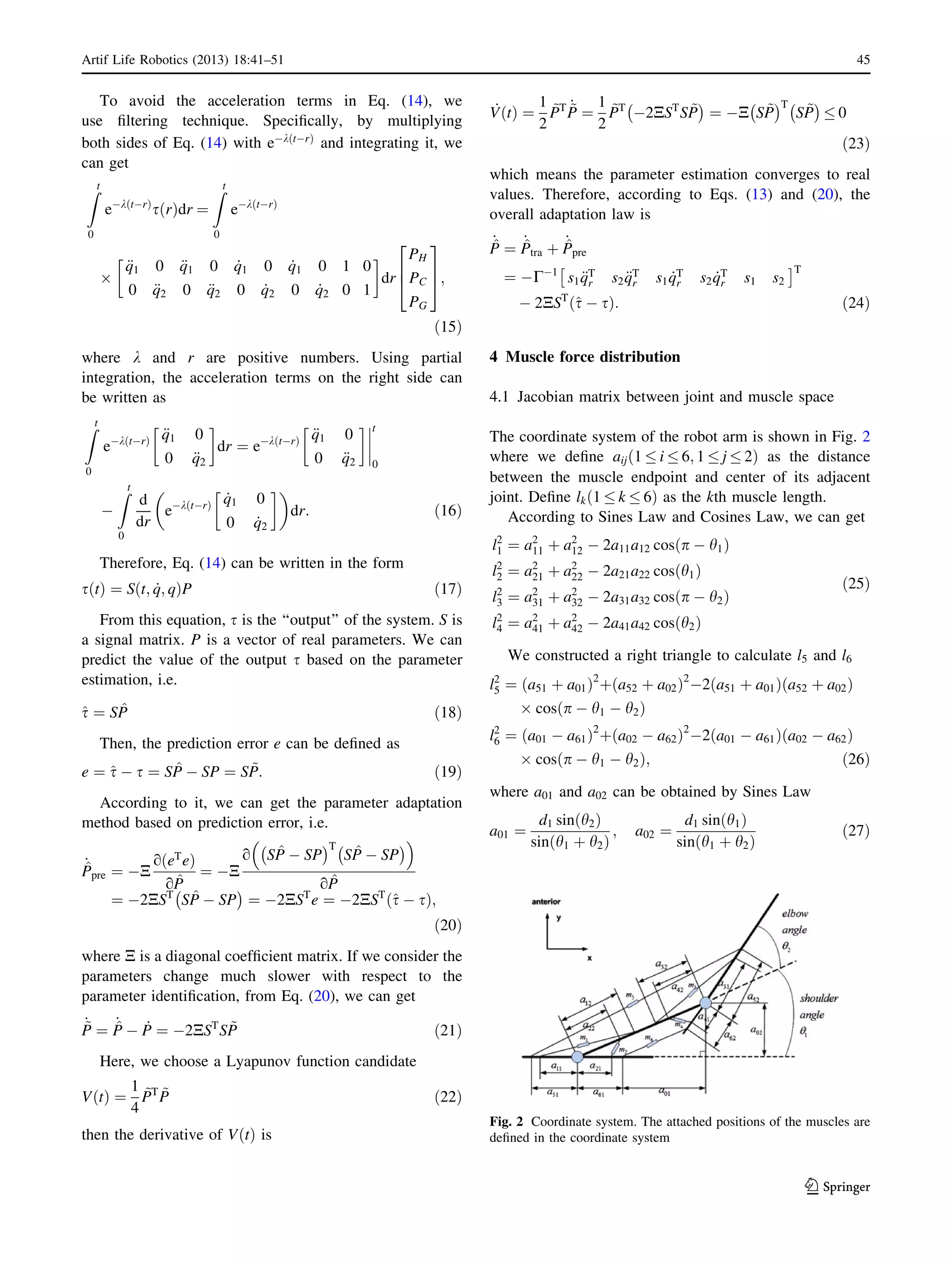
The coordinate system of the robot arm is shown in Fig. 2
where we define aij 1 i 6; 1 j 2ð Þ as the distance
between the muscle endpoint and center of its adjacent
joint. Define lk 1 k 6ð Þ as the kth muscle length.
According to Sines Law and Cosines Law, we can get
l2
1 ¼ a2
11 þ a2
12 À 2a11a12 cos p À h1ð Þ
l2
2 ¼ a2
21 þ a2
22 À 2a21a22 cos h1ð Þ
l2
3 ¼ a2
31 þ a2
32 À 2a31a32 cos p À h2ð Þ
l2
4 ¼ a2
41 þ a2
42 À 2a41a42 cos h2ð Þ
ð25Þ
We constructed a right triangle to calculate l5 and l6
l2
5 ¼ a51 þ a01ð Þ2
þ a52 þ a02ð Þ2
À2 a51 þ a01ð Þ a52 þ a02ð Þ
 cos p À h1 À h2ð Þ
l2
6 ¼ a01 À a61ð Þ2
þ a02 À a62ð Þ2
À2 a01 À a61ð Þ a02 À a62ð Þ
 cos p À h1 À h2ð Þ; ð26Þ
where a01 and a02 can be obtained by Sines Law
a01 ¼
d1 sin h2ð Þ
sin h1 þ h2ð Þ
; a02 ¼
d1 sin h1ð Þ
sin h1 þ h2ð Þ
ð27Þ
Fig. 2 Coordinate system. The attached positions of the muscles are
defined in the coordinate system
Artif Life Robotics (2013) 18:41–51 45
123
After simplification, we finally get
l1 ¼ a2
11 þ a2
12 þ 2a11a12 cos h1ð Þ
À Á1=2
l2 ¼ a2
21 þ a2
22 À 2a21a22 cos h1ð Þ
À Á1=2
l3 ¼ a2
31 þ a2
32 þ 2a31a32 cos h2ð Þ
À Á1=2
l4 ¼ a2
41 þ a2
42 À 2a41a42 cos h2ð Þ
À Á1=2
l5 ¼ a51 þ a01ð Þ2
þ a52 þ a02ð Þ2
þ2 a51 þ a01ð Þ a52 þ a02ð Þ

 cos h1 þ h2ð ÞÞ1=2
l6 ¼ a01 À a61ð Þ2
þ a02 À a62ð Þ2
þ2 a01 À a61ð Þ a02 À a62ð Þ

 cos h1 þ h2ð ÞÞ1=2
ð28Þ
Assuming the kinematics between the length of muscle
and the angle of joint is given as follows
L ¼ Q Hð Þ ð29Þ
where
L ¼ l1 l2 l3 l4 l5 l6½ ŠT
H ¼ h1 h2½ ŠT ð30Þ
then the derivative of Eq. (29) is
_L ¼ Jm
_H ð31Þ
where Jm is a Jacobian matrix between the joint space and
the muscle space. It has a format as
Jm ¼
Jm;1;1 Jm;1;2
Jm;2;1 Jm;2;2
Jm;3;1 Jm;3;2
Jm;4;1 Jm;4;2
Jm;5;1 Jm;5;2
Jm;6;1 Jm;6;2
2
6
6
6
6
6
6
4
3
7
7
7
7
7
7
5
; ð32Þ
where
Jm;1;1 ¼
Àa11a12 sin h1ð Þ
ffiffiffiffiffiffiffiffiffiffiffiffiffiffiffiffiffiffiffiffiffiffiffiffiffiffiffiffiffiffiffiffiffiffiffiffiffiffiffiffiffiffiffiffiffiffiffiffiffiffiffiffiffiffi
a2
11 þ 2 cos h1ð Þa11a12 þ a2
12
p
Jm;2;1 ¼
Àa21a22 sin h1ð Þ
ffiffiffiffiffiffiffiffiffiffiffiffiffiffiffiffiffiffiffiffiffiffiffiffiffiffiffiffiffiffiffiffiffiffiffiffiffiffiffiffiffiffiffiffiffiffiffiffiffiffiffiffiffiffi
a2
21 þ 2 cos h1ð Þa21a22 þ a2
22
p
Jm;3;2 ¼
Àa31a32 sin h2ð Þ
ffiffiffiffiffiffiffiffiffiffiffiffiffiffiffiffiffiffiffiffiffiffiffiffiffiffiffiffiffiffiffiffiffiffiffiffiffiffiffiffiffiffiffiffiffiffiffiffiffiffiffiffiffiffi
a2
31 þ 2 cos h2ð Þa31a32 þ a2
32
p
Jm;4;2 ¼
a41a42 sin h2ð Þ
ffiffiffiffiffiffiffiffiffiffiffiffiffiffiffiffiffiffiffiffiffiffiffiffiffiffiffiffiffiffiffiffiffiffiffiffiffiffiffiffiffiffiffiffiffiffiffiffiffiffiffiffiffiffi
a2
41 þ 2 cos h2ð Þa41a42 þ a2
42
p
Jm;1;2 ¼ Jm;2;2 ¼ Jm;3;1 ¼ Jm;4;1 ¼ 0
ð33Þ
Jm;5;1, Jm;5;2, Jm;6;1 and Jm;6;2 are long equations and we
do not provide them here. The derivation of the above
Jacobian matrix can be done by Matlab Symbolic Toolbox.
4.2 Muscle force distribution
The relationship between muscle forces and joint torques
can be derived by the principle of virtual work as
s ¼ f Fmð Þ ¼ JT
mFm: ð34Þ
Hence, the inverse relation between the joint torques and
the muscle forces can be expressed as
sinv ¼ fÀ1
sð Þ ¼ JT
m
À Áþ
s ð35Þ
where
JT
m
À Áþ
¼ Jm JT
mJm
À ÁÀ1
ð36Þ
is pseudo-inverse matrix of JT
m. The above muscle force
distribution solution satisfies
min Fmk k
s:t: JT
mFm ¼ s
ð37Þ
which means the pseudoinverse is an optimization solution
to obtain minimums muscle distribution force. However,
the above solution does not consider physical constraints,
such as the maximum output force of muscle is limited,
muscles can only contract, etc. To involve these
constraints, we define Fin as a voluntary vector having
the same dimension with Fm which expresses the internal
forces generated by redundant muscles. Then, we can
define the internal force in Fm space, i.e.
g Finð Þ ¼ I À JT
m
À Áþ
JT
m
 
Fin ð38Þ
where I is an identity matrix having the same dimension
with muscle space. According to Moore–Penrose pseudo-
inverse, g Finð Þ is orthogonal with the pseudo-inverse
solution. Thus, we can choose any vector as Fin. Below, we
give a gradient direction for Fin to make Fm satisfy
boundary constraints.
Here, we assume that each muscle force is limited in the
interval from Fm;i;min to Fm;i;max for 1 i 6. Our objective
is to choose a gradient direction to make each element of
Fm;i 1 i 6ð Þ equal or greater than Fm;i;min, and equal or
Table 1 Anthropological parameter values
Segment Upper arm Lower arm
Length (m) 0.282 0.269
Mass (kg) 1.980 1.180
MCS Pos (m) 0.163 0.123
I11 (kg m2
) 0.013 0.007
I22 (kg m2
) 0.004 0.001
I33 (kg m2
) 0.011 0.006
The parameter setting of the arm is based on a real human data [40]
MCS Pos position of the mass center
46 Artif Life Robotics (2013) 18:41–51
123
less than Fm;i;max. Considering the muscle fatigue, one
reasonable way is to make each output force of the muscles
to be around at the middle magnitude between Fm;i;min and
Fm;i;max. The physical meaning of this method is to dis-
tribute load to all the muscles in their proper load interval,
so that they can continue working for a longer time. Based
on these considerations, we choose a function h as
h Fmð Þ ¼
X6
j¼1
sinv;i À Fm;i;mid
Fm;i;mid À Fm;i;max
 2
ð39Þ
where
0 Fm;i;min sinv;i Fm;i;max
Fm;i;mid ¼
Fm;i;min þ Fm;i;max
2
i ¼ 1; 2; . . .6 ð40Þ
then we chose Fin as the gradient of the function h, i.e.
Fin ¼ Kin
oh sinvð Þ
osinv
¼ Kinrh ¼ Kin
2 Á
sinv;1ÀFm;1;mid
Fm;1;midÀFm;1;max
2 Á
sinv;2ÀFm;2;mid
Fm;2;midÀFm;2;max
2 Á
sinv;3ÀFm;3;mid
Fm;3;midÀFm;3;max
2 Á
sinv;4ÀFm;4;mid
Fm;4;midÀFm;4;max
2 Á
sinv;5ÀFm;5;mid
Fm;5;midÀFm;5;max
2 Á
sinv;6ÀFm;6;mid
Fm;6;midÀFm;6;max
2
6
6
6
6
6
6
6
6
6
6
4
3
7
7
7
7
7
7
7
7
7
7
5
ð41Þ
where Kin is a scalar matrix. It is very easy to prove that the
direction of Fin points to Fm;i;mid. According to the
computation in Eqs. (35) and (41), the muscle force is
calculated as
Fm ¼ sinv þ g Finð Þ ð42Þ
The procedures to compute muscle force are concluded
as the following algorithm.
5 Bending-streching movement simulation
The performance of the proposed muscle force computa-
tion method was tested by simulation. The desired
movement is bending the upper arm and lower arm from
0 rad to p=2 rad and then stretching them back to 0 rad.
The total simulation time was 10 s.
5.1 Arm model parameter setting
The parameters of the robot arm are based on the real data
of a human upper limb. The setting of length, mass, mass
center position and inertia coefficients is shown in Table 1.
The anthropological data come from [40]. Without loss of
generality, the muscle configuration coefficients (in Eq. 28)
are set as aij ¼ 0:1m 1 i 6; 1 j 2ð Þ.
5.2 Computational coefficient setting
There are three groups of parameters need to set, including
the parameters for sliding mode control, the parameters for
parameter adaptation, and the parameters for muscle force
computation. These parameters are set as follows.
In this research, the control parameters are set (Eq. 12)
as
K ¼ 20 Á Diag 1 1½ Šð Þ ð43Þ
the adaptation parameters (Eq. 24) are set as
CÀ1
¼ 0:0015 Á Diag 1 1 1 1 1 1 1 1 1 1½ Šð Þ
2N ¼ 0:001 Á Diag 1 1 1 1 1 1 1 1 1 1½ Šð Þ
ð44Þ
and the muscle force computation parameters (Eq. 41) are
set as
Kin ¼ 200 Á Diag 1 3 1 1 1 2½ Šð Þ ð45Þ
Fm;i;min ¼ 0; Fm;i;max ¼ 1000 1 i 6ð Þ; ð46Þ
where Diag Áð Þ is a diagonal matrix with diagonal elements
being as Áð Þ.
5.3 Control performance
According to the bending-stretching movement, two
sinusoidal waves are set as reference signals for q1 and
Algorithm 1 Muscle force distribution
Step 1 Computing Jacobian matrix (Eq. (32)) according to Eq. (33).
Step 2 Computing pseudoinverse matrix according to Eq. (36).
Step 3 Computing according to Eq. (35).
Step 4 Computing internal force according to Eq. (41). Here, comes
from the result in Step 3.
Step 5 Computing according to Eq. (38).
Step 6 Computing muscle force by Eq. (42) where comes from Step 3 and
comes from Step 5.
Jm
Fin
Fin
τinv
τinv
τinv,i
g
Jm( (
( (
Fing( (
(1 ≤ i ≤ 6)
T +
Artif Life Robotics (2013) 18:41–51 47
123
q2. The frequency of the two waves is set as 2p. Initial
states of q1 and q2 are set as zero. Based on the joint
torque coming from sliding mode control, we compute
the muscle force according to Algorithm 1. The
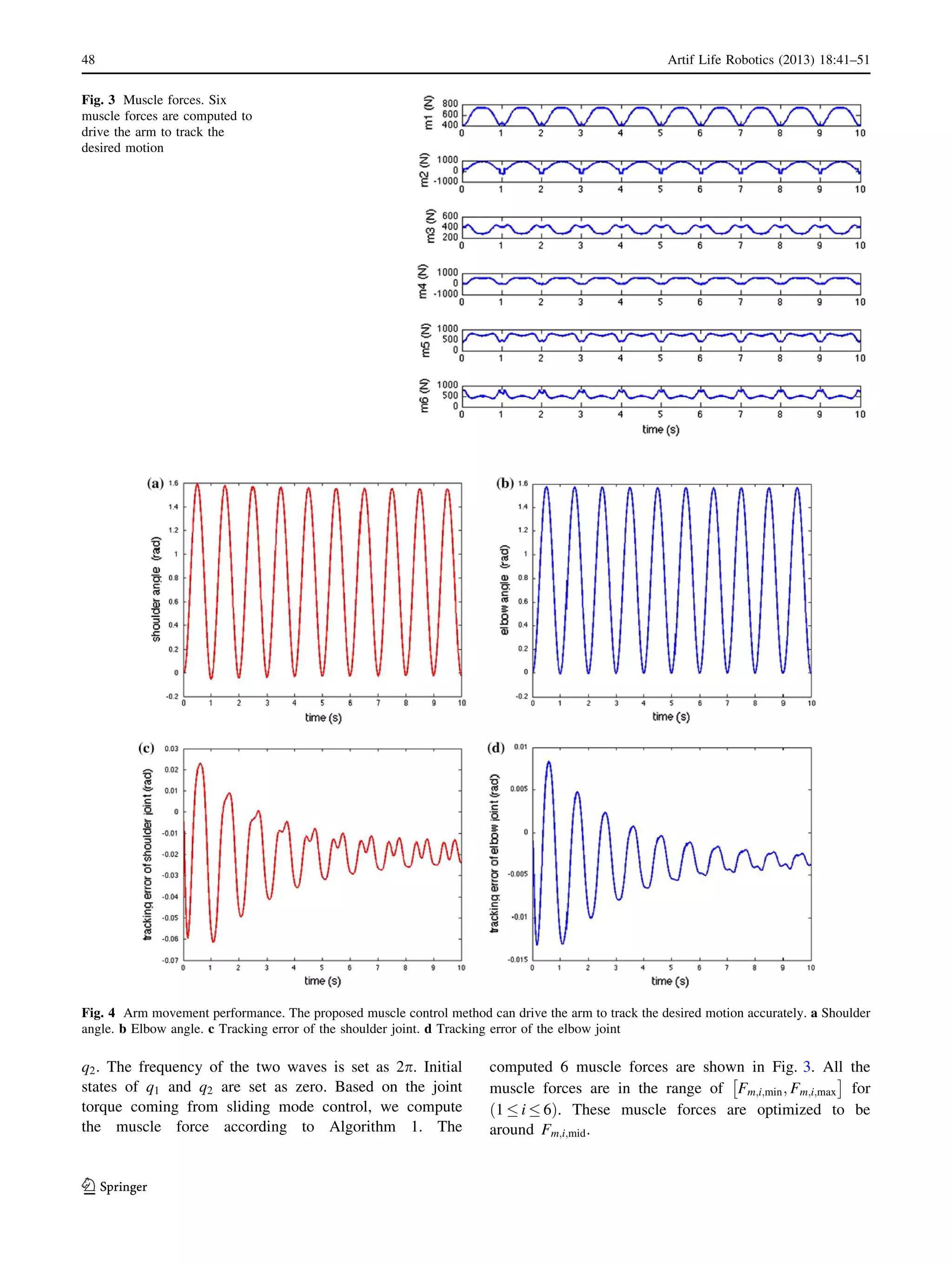
computed 6 muscle forces are shown in Fig. 3. All the
muscle forces are in the range of Fm;i;min; Fm;i;max
 Ã
for
1 i 6ð Þ. These muscle forces are optimized to be
around Fm;i;mid.
Fig. 3 Muscle forces. Six
muscle forces are computed to
drive the arm to track the
desired motion
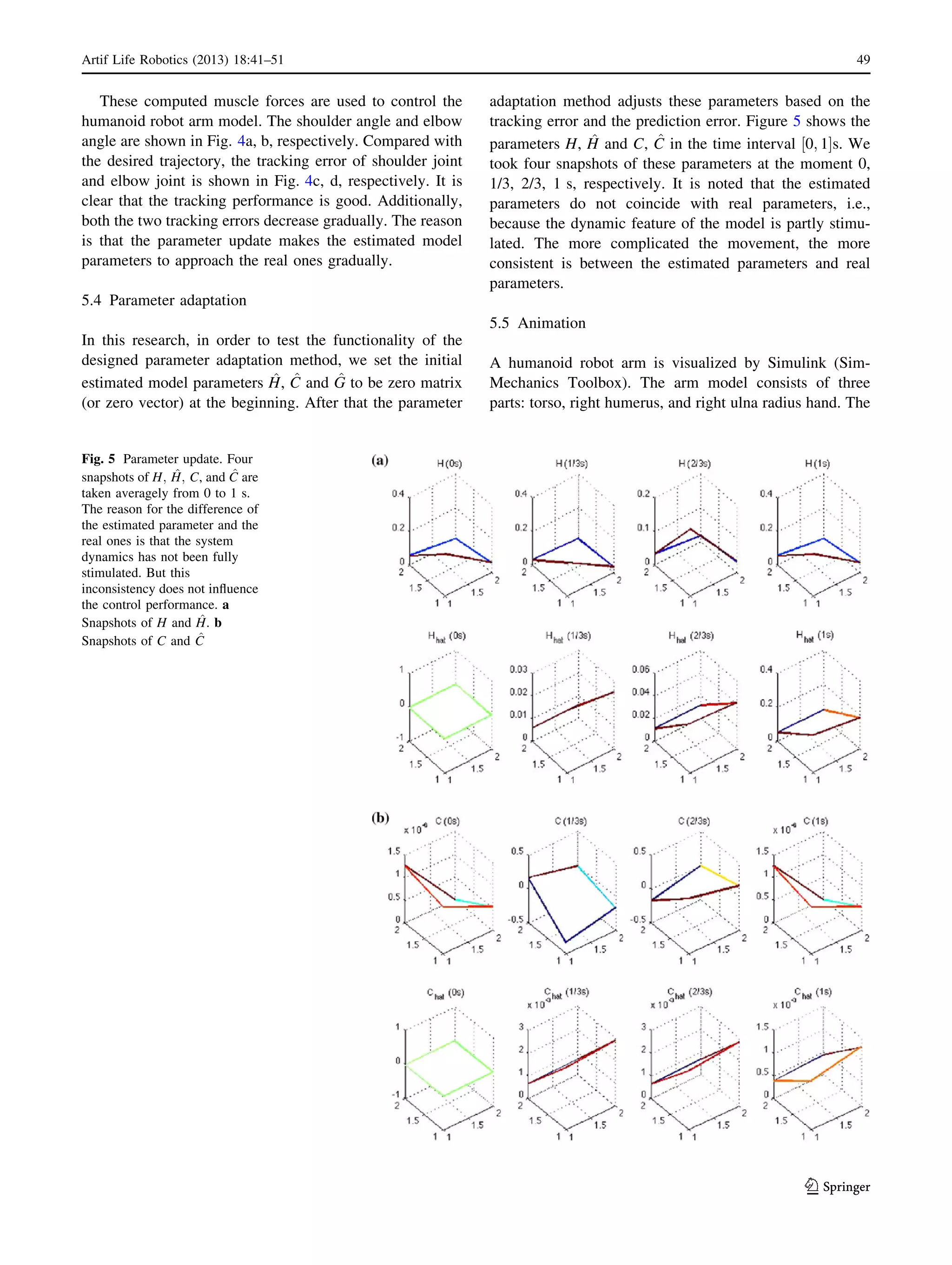
Fig. 4 Arm movement performance. The proposed muscle control method can drive the arm to track the desired motion accurately. a Shoulder
angle. b Elbow angle. c Tracking error of the shoulder joint. d Tracking error of the elbow joint
48 Artif Life Robotics (2013) 18:41–51
123
These computed muscle forces are used to control the
humanoid robot arm model. The shoulder angle and elbow
angle are shown in Fig. 4a, b, respectively. Compared with
the desired trajectory, the tracking error of shoulder joint
and elbow joint is shown in Fig. 4c, d, respectively. It is
clear that the tracking performance is good. Additionally,
both the two tracking errors decrease gradually. The reason
is that the parameter update makes the estimated model
parameters to approach the real ones gradually.
5.4 Parameter adaptation
In this research, in order to test the functionality of the
designed parameter adaptation method, we set the initial
estimated model parameters ^H, ^C and ^G to be zero matrix
(or zero vector) at the beginning. After that the parameter
adaptation method adjusts these parameters based on the
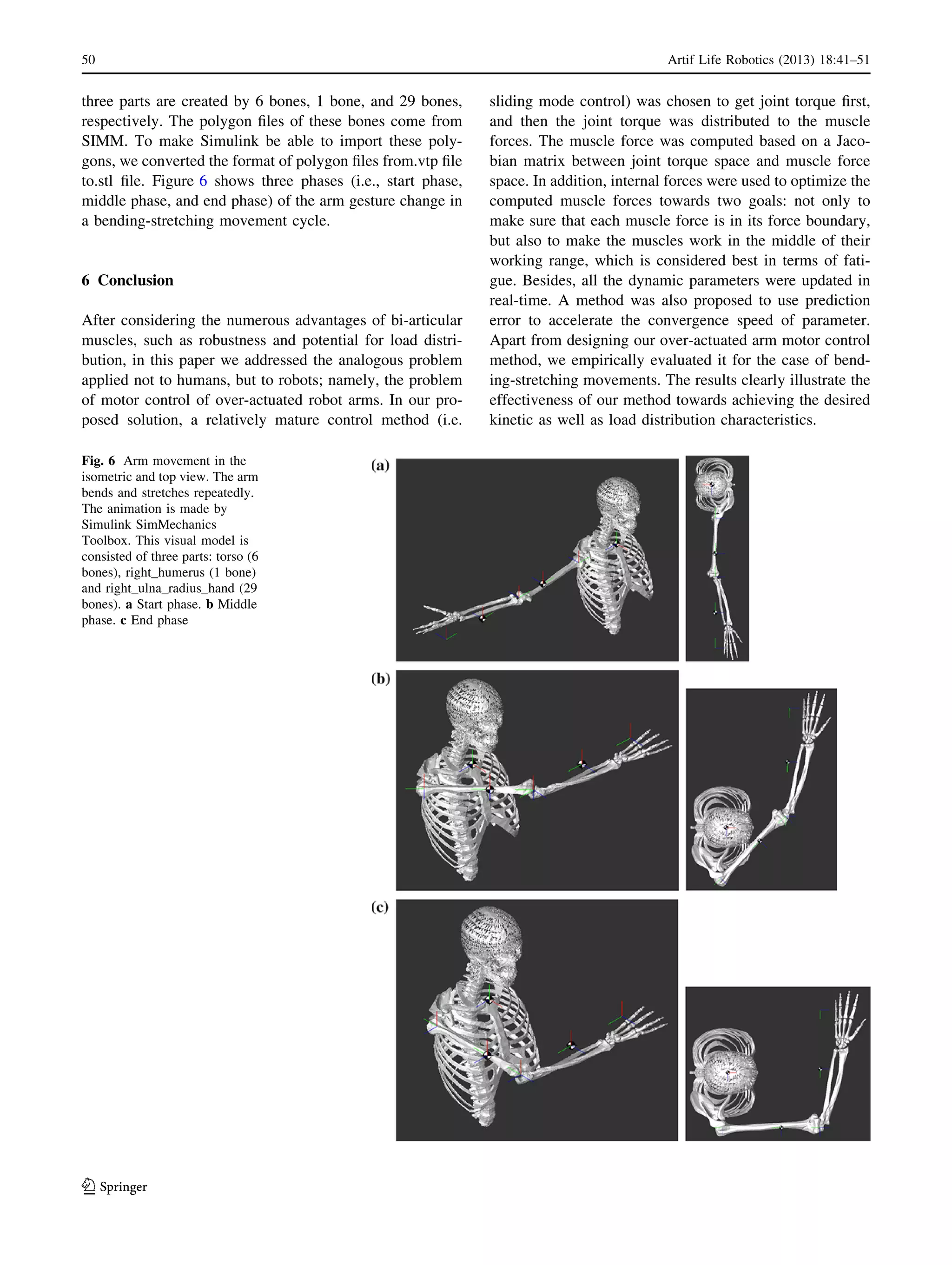
tracking error and the prediction error. Figure 5 shows the
parameters H, ^H and C, ^C in the time interval 0; 1½ Šs. We
took four snapshots of these parameters at the moment 0,
1/3, 2/3, 1 s, respectively. It is noted that the estimated
parameters do not coincide with real parameters, i.e.,
because the dynamic feature of the model is partly stimu-
lated. The more complicated the movement, the more
consistent is between the estimated parameters and real
parameters.
5.5 Animation
A humanoid robot arm is visualized by Simulink (Sim-
Mechanics Toolbox). The arm model consists of three
parts: torso, right humerus, and right ulna radius hand. The
Fig. 5 Parameter update. Four
snapshots of H; ^H; C, and ^C are
taken averagely from 0 to 1 s.
The reason for the difference of
the estimated parameter and the
real ones is that the system
dynamics has not been fully
stimulated. But this
inconsistency does not influence
the control performance. a
Snapshots of H and ^H. b
Snapshots of C and ^C
Artif Life Robotics (2013) 18:41–51 49
123
three parts are created by 6 bones, 1 bone, and 29 bones,
respectively. The polygon files of these bones come from
SIMM. To make Simulink be able to import these poly-
gons, we converted the format of polygon files from.vtp file
to.stl file. Figure 6 shows three phases (i.e., start phase,
middle phase, and end phase) of the arm gesture change in
a bending-stretching movement cycle.
6 Conclusion
After considering the numerous advantages of bi-articular
muscles, such as robustness and potential for load distri-
bution, in this paper we addressed the analogous problem
applied not to humans, but to robots; namely, the problem
of motor control of over-actuated robot arms. In our pro-
posed solution, a relatively mature control method (i.e.
sliding mode control) was chosen to get joint torque first,
and then the joint torque was distributed to the muscle
forces. The muscle force was computed based on a Jaco-
bian matrix between joint torque space and muscle force
space. In addition, internal forces were used to optimize the
computed muscle forces towards two goals: not only to
make sure that each muscle force is in its force boundary,
but also to make the muscles work in the middle of their
working range, which is considered best in terms of fati-
gue. Besides, all the dynamic parameters were updated in
real-time. A method was also proposed to use prediction
error to accelerate the convergence speed of parameter.
Apart from designing our over-actuated arm motor control
method, we empirically evaluated it for the case of bend-
ing-stretching movements. The results clearly illustrate the
effectiveness of our method towards achieving the desired
kinetic as well as load distribution characteristics.
Fig. 6 Arm movement in the
isometric and top view. The arm
bends and stretches repeatedly.
The animation is made by
Simulink SimMechanics
Toolbox. This visual model is
consisted of three parts: torso (6
bones), right_humerus (1 bone)
and right_ulna_radius_hand (29
bones). a Start phase. b Middle
phase. c End phase
50 Artif Life Robotics (2013) 18:41–51
123
References
1. Oh S, Hori Y (2009) Development of two-degree-of-freedom
control for robot manipulator with biarticular muscle torque. In:
American Control Conference 2009, pp 325–330
2. Klug S, Mohl B, Stryk OV, Barth O (2005) Design and appli-
cation of a 3 DOF bionic robot arm. In: 3rd International sym-
posium on adaptive motion in animals and machines 2005,
pp 1–6
3. Potkonjak V, Jovanovic KM, Milosavljevic P, Bascarevic N,
Holland O (2011) The puller-follower control concept in the
multi-jointed robot body with antagonistically coupled compliant
drives. In: IASTED international conference on robotics 2011,
pp 375–381
4. Tahara K, Luo Z, Arimoto S, Kino H (2005) Sensor-motor con-
trol mechanism for reaching movements of a redundant musculo-
skeletal arm. J Robot Syst 22:639–651
5. Ivancevic VG, Ivancevic TT (2005) Natural biodynamics. World
Scientific, Singapore
6. Crago PE (2000) Creating neuromusculoskeletal models. Bio-
mechanics and neural control of posture and movement. Springer,
Berlin, pp 119–133
7. Winter DA (1990) Biomechanics and motor control of human
movement. Wiley, New York
8. Tzafestas S, Raibert M, Tzafestas C (1996) Robust sliding-mode
control applied to a 5-link biped robot
9. Kumamoto M (2006) Revolution in humanoid robotics: evolution
of motion control. Tokyo Denki University Publisher, Tokyo
10. Liegeois A (1977) Automatic supervisory control of the config-
uration and behavior of multibody mechanisms. IEEE Trans Syst
Man Cybern 7:868–871
11. Manal K, Gonzalez RV, Lloyd DG, Buchanan TS (2002) A real-
time EMG-driven virtual arm. Comput Biol Med 32:25–36
12. Pandy MG (2001) Computer modeling and simulation of human
movement. Annu Rev Biomed Eng 3:245–273
13. Tee KP, Burdet E, Chew CM, Milner TE (2004) A model of force
and impedance in human arm movements. Biol Cybern 90:368–375
14. Hogan N (1984) Adaptive control of mechanical impedance by
coactivation of antagonist muscles. IEEE Trans Autom Control
29:681–690
15. Anderson FC, Pandy MG (2001) Dynamic optimization of human
walking. J Biomech Eng 125:381–390
16. Neptune RR (1999) Optimization algorithm performance in
determining optimal controls in human movement analyses.
J Biomech Eng 121:249–252
17. Crowninshield RD, Brand RA (1981) A physiologically based
criterion of muscle force prediction in locomotion. J Biomech
14:793–801
18. Glitsch U, Baumann W (1997) The three-dimensional determi-
nation of internal loads in the lower extremity. J Biomech
30:1123–1131
19. Hogan N (1984) An organizing principle for a class of voluntary
movements. J Neurosci 4:2745–2754
20. Patriarco AG, Mann RW, Simon SR, Mansour JM (1981) An
evaluation of the approaches of optimization models in the
prediction of muscle forces during human gait. J Biomech
14:513–525
21. Anderson FC, Pandy MG (1999) A dynamic optimization solu-
tion for vertical jumping in three dimensions. Comput Methods
Biomech Biomed Eng 2:201–231
22. Damsgaard M, Rasmussen J, Christensen ST, Surma E, Zee MD
(2006) Analysis of musculoskeletal systems in the Anybody
modeling system. Simul Model Pract Theory 14:1100–1111
23. Delp SL, Anderson FC, Arnold AS, Loan P, Habib A, John CT
et al (2007) Opensim: open-source software to create and analyze
dynamic simulations of movement. IEEE Trans Biomed Eng
54:1940–1950
24. Kawato M (1999) Internal models for motor control and trajec-
tory planning. Curr Opin Neurobiol 9:718–727
25. Gottlieb GL (1993) A computational model of the simplest motor
program. J Mot Behav 25:153–161
26. Karniel A, Inbar GF (1996) A model for learning human reach-
ing-movements. Biol Cybern 77:173–183
27. Katayama M, Kawato M (1993) Virtual trajectory and stiffness
ellipse during multijoint arm movement predicted by neural
inverse models. Biol Cybern 69:353–362
28. Chaumette F, Hutchinson S (2006) Visual servo control—part I:
basic approaches. IEEE Robot Autom Mag 13:82–90
29. Yoshikawa T (1984) Analysis and control of robot manipulators
with redundancy. In: Robotics research: the first international
symposium. MIT Press, Cambridge, pp 735–748
30. Maciejewski AA, Klein CA (1985) Obstacle avoidance for
kinematically redundant manipulators in dynamically varying
environments. Int J Robot Res 4:109–117
31. Hollerbach JM, Suh KC (1987) Redundancy resolution of
manipulators through torque optimization. IEEE J Robot Autom
3:308–316
32. Khosla PK, Kanade T (1988) Experimental evaluation of non-
linear feedback and feedforward control schemes for manipula-
tors. Int J Robot Res 7:18–28
33. Heim A, Stryk OV (2000) Trajectory optimization of industrial
robots with application to computer-aided robotics and robot
controllers. Optimization 47:407–420
34. Graupe D (1972) Identification of systems. Litton Educational
Publishing, New York
35. Zhou K, Doyle JC (1997) Essentials of robust control. Prentice
Hall, New Jersey
36. Slotine JE, Li W (1991) Applied nonlinar control. Prentice Hall,
New Jersey
37. Brown M, Harris C (1994) Neurofuzzy adaptive modelling and
control. Prentice Hall, New Jersey
38. Slotine JE, Li W (1988) Adaptive manipulator control: a case
study. IEEE Trans Autom Control 33:995–1003
39. Dong H, Luo Z, Nagano A (2010) Adaptive attitude control for
redundant time-varying complex model of human body in the
nursing activity. J Robot Mechatron 22:418–429
40. Nagano A, Yoshioka S, Komura T, Himeno R, Fukashiro S
(2005) A three-dimensional linked segment model of the whole
human body. Int J Sport Health Sci 3:311–325
Artif Life Robotics (2013) 18:41–51 51
123

Muscle force distribution for adaptive control of a humanoid robot arm with redundant bi-articular and mono-articular muscle mechanism

  • 1.
    ORIGINAL ARTICLE Muscle forcedistribution for adaptive control of a humanoid robot arm with redundant bi-articular and mono-articular muscle mechanism Haiwei Dong • Nikolaos Mavridis Received: 7 January 2013 / Accepted: 14 May 2013 / Published online: 30 May 2013 Ó ISAROB 2013 Abstract Robot arms driven by bi-articular and mono- articular muscles have numerous advantages. If one muscle is broken, the functionality of the arm is not influenced. In addition, each joint torque is distributed to numerous muscles, and thus the load of each muscle can be relatively small. This paper addresses the problem of muscle control for this kind of robot arm. A relatively mature control method (i.e. sliding mode control) was chosen to get joint torque first and then the joint torque was distributed to muscle forces. The muscle force was computed based on a Jacobian matrix between joint torque space and muscle force space. In addition, internal forces were used to optimize the computed muscle forces in the following manner: not only to make sure that each muscle force is in its force boundary, but also to make the muscles work in the middle of their working range, which is considered best in terms of fatigue. Besides, all the dynamic parameters were updated in real-time. Compared with previous work, a novel method was proposed to use prediction error to accelerate the convergence speed of parameter. We empirically evaluated our method for the case of bending- stretching movements. The results clearly illustrate the effectiveness of our method towards achieving the desired kinetic as well as load distribution characteristics. Keywords Muscle cooperation Á Redundancy Á Internal force Á Parameter adaptation 1 Introduction 1.1 Background Traditional robot arms are driven by motors. Each motor drives a specific joint, corresponding to an independent degree of freedom (DOF). There are two main problems in this approach. First, if one motor is broken, the DOF cor- responding to this motor will be lost. Second, the motor near the base link always needs more power, leading to a requirement for very heavy motors near the base. But let us compare this to the human motor system: as there are many muscles driving one joint, the total joint torque is distrib- uted to every muscle. Thus, each muscle only carries a relatively small load. Furthermore, if one muscle is broken, the function of rotation for the corresponding joint does not change. Thus, recently such driving systems for robots inspired by muscles have started to be explored, creating a new research direction. For example, there are a number of papers focusing on bionic arms [1–4]. In our work, we propose a muscle control method for humanoid robot arm driven by bi-articular muscles. Here, the control method is designed to be adaptive, i.e. robust to perturbations and disturbances from environment. In addition, the muscle forces have to satisfy the boundary force limit. Last, but quite importantly, the method has to be efficient enough for practical application. To get insight into this muscle control problem, we can consider it through viewpoints arising from two research fields: human motor control and robotics. In human motor control, the human body is usually considered as a multi- link rigid body with numerous joints. By adding muscles and tensors, the human body moves according to control signals arising from the neural system. Such a kind of system is usually termed a neural-skeleton muscle system H. Dong (&) Á N. Mavridis New York University AD, P.O. Box 129188, Abu Dhabi, UAE e-mail: haiwei.dong@nyu.edu N. Mavridis e-mail: nikolaos.mavridis@nyu.edu 123 Artif Life Robotics (2013) 18:41–51 DOI 10.1007/s10015-013-0097-x
  • 2.
    [5, 6] andthe muscle control is described as human motor control [7]. On the other hand, in robotics, there is also a related research field focusing on controlling multi-link rigid bodies [8–10]. In our research, we face two problems: redundancy and adaptivity. For redundancy, there exist two types of redundancies here. Type I Redundancy is between end effector position and joints. Taking the robot arm as an example, the number of degrees of freedom (DOF) of the end effector position is 3, i.e., the end effector can move in 3D space. Nevertheless, the number of joints in the arm can be more than 3, indicating the fact that for the same end effector position, there exist many limb joint configura- tions. The other type of redundancy, Type II Redundancy, is between joint torque and muscle force. In the human motor system, there are many more muscles as compared to the minimum number required to generate the full range of required movement [11, 12]. Towards generating a certain desired joint torque, there is a lot of flexibility in distributing load among the cooperating muscles. For example, if we ask a subject to keep a certain gesture, when the subject is under nervous status, the muscles are tense. Both agonist muscles and antagonist muscles output large force. At this time, the body’s impedance status is in a self- protection mode, and the damping and viscosity coeffi- cients are correspondingly large [13, 14]. Conversely, when the subject is under relaxation status, the muscle force, damping and viscosity coefficients are small. The above two extreme statuses correspond to the same zero joint torque with different muscle force distributions. Ability for adaptation is also a very important issue, especially for humanoid robots. As humanoid robots are usually tailored towards significant human–robot interac- tion, often their working environment is mainly a human environment, which is very complex and always accom- panied with various kinds of uncertainties. Furthermore, even if we do not consider the environmental uncertainty, and we focus on the robot itself, we still often have robot model errors. Thus, in order to be able to create humanoids that perform adequately under such conditions, it is nec- essary to propose methods that have the ability to perform real-time adaptation, for counteracting such uncertainties. 1.2 Related work Let us start by discussing relevant work in human–robot control, and then moving over to relevant work in robotics. In human motor control, two of the main research direc- tions are those focusing towards redundancy solutions and ability for adaptation. Let us start with the first: redundancy solution. The basic method utilized is nonlinear optimiza- tion [15–18]. There have been many successful applica- tions. Hogan proposed a voluntary movement principle using dynamic optimization which minimizes the rate of acceleration change of the limb [19]. Anderson et al. [15] used dynamic optimization of minimum metabolic energy expenditure to solve the motion control of walking. Manal et al. [11] designed a nonlinear optimal controller to develop a real-time EMG-driven virtual arm. Neptune [16] evaluated different multivariate optimization methods in pedaling. The optimization method in human motor control includes two different kinds of methods. One is forward dynamics method which uses muscle excitations as the inputs to calculating the corresponding body motions [12, 20]. It is a novel research in forward dynamics that Anderson et al. [21] uses a parallel computer to calculate the derivatives of the cost function and the constraints with each control variable. The other is inverse dynamics method [18]. Noninvasive measurement of body motions (position, velocity, and acceleration of each segment) and external forces are used as inputs to calculate muscle for- ces. Two commercial software packages are famous based on these two methods: AnyBody Modeling System as inverse dynamics method [22] and OpenSim as forward dynamics method [23]. As mentioned above, a second main research direction focuses on adaptation ability. Although adaptation ability based on bio-feedback has not been fully understood in human motor control, right now the basic comprehension is a combination control scheme of feed-forward control and feedback control [24]. The feed-forward control corre- sponds to the inverse dynamics [25–27]. Specifically, the inverse dynamics are learnt (i.e., estimated) by nervous system. Then, the feedback control uses this inverse dynamics to provide a basic control efficiently. The feed- back control deals with environment disturbance, load change, and learning error of inverse dynamics, etc. It is usually considered as a Visual Servo Feedback System [28]. Now let us move from human motor control to robotics. In robotics, modeling and control of multi-link rigid body (especially manipulator control) have been studied for years [10, 29–31]. Here, the redundancy problem is usually considered from the viewpoint of dynamic control [1, 32]. For Type I Redundancy problem, considering different optimization criterion or restricted conditions, many methods have been proposed. Yoshika- wa [29] proposed a manipulability measure, by mini- mizing which the arm is kept away from singularities. Maciejewski et al. [30] used null-space vector to aid obstacle avoidance. For Type II Redundancy problem, there have been researches on building bionic robots to mimic human’s movement system. Klug et al. [2] developed a 3 DOF bionic robot arm which is controlled by a PD controller with feed-forward compensation. The 42 Artif Life Robotics (2013) 18:41–51 123
  • 3.
    trajectory of thearm is optimized and adjusted for a time and energy-optimal motion [33]. Potkonjak et al. [3] built a humanoid robot with antagonistic drives whose con- troller is designed by H1 loop shaping. Tahara [4] pro- posed a simple sensor-motor control scheme as internal force and simulated the overall stability. The initial research on adaptation ability in robotics comes from online system identification. The objective is to estimate system structure and parameters in real-time. Here, the system is considered as a black box or gray box. By stimulating the system and creating relation between the inputs and outputs, the parameters of the system can be adjusted online [34]. Based on this identification idea, many adaptive methods came out, such as robust control [35], adaptive feedback control [36], neurofuzzy adaptive control [37], etc. However, the adaptation ability problem has not been considered in arm control by bi-articular muscles. 1.3 Our solution In this paper, we took into account the previous research in human motor control and robotics. One of our initial observations was that the optimization-series methods are difficult to use in practical applications because of their relative inefficiency and difficulty in dealing with. It is also difficult to directly propose a muscle control method for the robot arm as it is hard to decouple the two redundancies. Therefore, we use a relatively mature control method (i.e. sliding mode control) to get joint torque first and then distribute the joint torque to muscle forces. The muscle force was computed based on a Jacobian matrix between joint torque space and muscle force space. In addition, internal forces were used to optimize the computed muscle forces in the following manner: not only to make sure that each muscle force is in its force boundary, but also to make the muscles work in the middle of their working range, which is considered best in terms of fatigue. Besides, all the dynamic parameters were updated in real-time. A novel method was proposed to use prediction error to accelerate the convergence speed of parameter. We empirically evaluated our method for the case of bending-stretching movements. The results clearly illustrate the effectiveness of our method towards achieving the desired kinetic as well as load distribution characteristics. 2 Modeling arm with muscles 2.1 Arm model We built a 2-dimensional model of the arm in the hori- zontal plane based on the upper limb structure of a digital human. The model includes six muscles (shown as 1–6) and two degrees of freedom (shoulder flexion–extension and elbow flexion–extension). The range of shoulder angle is from -20 to 100°, and the range of the elbow is from 0 to 170°. Four of the muscles are mono-articular, and two are bi-articular where 1 and 2 cross the shoulder joint; 3 and 4 cross the elbow joint; 5 and 6 cross both joints (Fig. 1). Considering the arm (including upper arm and lower arm) as a planar, two-link, articulated rigid object, the position of hand can be derived by a 2-vector q of two angles. The input is a 6-vector Fm of muscle forces. The dynamics of the rigid object is strongly nonlinear. Using the Lagrangian equations in classical dynamics, we get the dynamic equations of the ideal upper limb model H11 tð Þ H12 tð Þ H21 tð Þ H22 tð Þ ! €q1 €q2 ! þ C11 tð Þ C12 tð Þ C21 tð Þ C22 tð Þ ! _q1 _q2 ! þ G1 tð Þ G2 tð Þ ! ¼ s1 tð Þ s2 tð Þ ! ð1Þ or abbreviated as H tð Þ€q þ C tð Þ _q þ G tð Þ ¼ s ð2Þ with q ¼ q1 q2½ ŠT ¼ h1 h2½ ŠT being the two joint angles. s ¼ s1 s2½ ŠT ¼ f Fmð Þ is a function of muscle force Fm Fm ¼ Fm;1 Fm;2 Fm;3 Fm;4 Fm;5 Fm;6½ ŠT ð3Þ H q; tð Þ is inertia matrix containing information with regard to the instantaneous mass distribution. C q; _q; tð Þ is centripetal and coriolis torques representing the moments Fig. 1 Humanoid robot arm model. The arm has two degrees of freedom and it can rotate around the shoulder angle and elbow angle in the anterior plane Artif Life Robotics (2013) 18:41–51 43 123
  • 4.
    of centrifugal forces.G q; tð Þ is gravitational torques changing with the posture configuration of the arm. H11 ¼ J1 þ J2 þ m2d2 1 þ 2m2d1c2 cos q2ð Þ H12 ¼ H21 ¼ J2 þ m2d1c2 cos q2ð Þ H22 ¼ J2 C11 ¼ À2m2d1c2 sin q2ð Þ _q2 C12 ¼ Àm2d1c2 sin q2ð Þ _q2 C21 ¼ m2d1c2 sin q2ð Þ _q1 C22 ¼ 0 G1 ¼ g m1c1 þ m2d1ð Þ cos q1ð Þ þ gm2c2 cos q1 þ q2ð Þ G2 ¼ gm2c2 cos q1 þ q2ð Þ; ð4Þ where g is the acceleration of gravity. ci is the distance from the center of a joint i to the center of the gravity point of link i: di is the length of link i. Ji ¼ mid2 i þ Ii where Ii is the moment of inertia about axis through the center of mass of link i. 2.2 Model with estimated parameters In our research, we consider the arm model in Eq. (1) is influenced by disturbances and perturbations from the environment. Hence, we used an estimated arm model to control, which is written as ^H11 tð Þ ^H12 tð Þ ^H21 tð Þ ^H22 tð Þ " # €q1 €q2 ! þ ^C11 tð Þ ^C12 tð Þ ^C21 tð Þ ^C22 tð Þ " # _q1 _q2 ! þ ^G1 tð Þ ^G2 tð Þ " # ¼ ^s1 tð Þ ^s2 tð Þ ! ð5Þ or abbreviated as ^H tð Þ€q þ ^C tð Þ _q þ ^G tð Þ ¼ ^s; ð6Þ where ^Á means estimated value of Áð Þ. The connection part between ideal model (Eq. 1) and estimated model (Eq. 5) is that we choose s ¼ ^s. Below, we use estimated model (5) to generate torque for real system for control. In addition, the parameter adaptation updates the estimated parameters ^H, ^C and ^G in real time. 2.3 Dynamic parameters definition For the convenience of following derivation, we define the actual and estimated arm parameter vector P ¼ PT H PT C PT G Â ÃT ; ^P ¼ ^PT H ^PT C ^PT G Â ÃT ; ð7Þ where PH ¼ H11 H12 H21 H22 2 6 6 6 4 3 7 7 7 5 ; PC ¼ C11 C12 C21 C22 2 6 6 6 4 3 7 7 7 5 ; PG ¼ G1 G2 ! ; ^PH ¼ ^H11 ^H12 ^H21 ^H22 2 6 6 6 4 3 7 7 7 5 ; ^PC ¼ ^C11 ^C12 ^C21 ^C22 2 6 6 6 4 3 7 7 7 5 ; ^PG ¼ ^G1 ^G2 " # ð8Þ then the estimation error vector can be defined as ~P ¼ ^P À P ¼ ~PT H ~PT C ~PT G Â ÃT : ð9Þ 3 Joint torque computation 3.1 Torque control method Sliding mode control is used to control the posture of the arm [36]. A 2-vector qd is the desired states. Define a sliding mode term s as s ¼ _~q þ K~q ¼ ð _q À _qdÞ þ Kðq À qdÞ ð10Þ where K is a positive diagonal matrix. Defining the reference velocity _qr and reference acceleration €qr as _qr ¼ _q À s €qr ¼ €q À _s ð11Þ then we choose the control method as s ¼ ^HðqÞ€qr þ ^Cðq; _qÞ _qr þ ^G À KsgnðsÞ; ð12Þ where K is convergence parameter which is a diagonal matrix. The proof of sliding mode control is in [38]. 3.2 Parameter adaptation method To accelerate the parameter update speed, we use two error sources to update estimated parameters. The first source is tracking error. We chose the parameter adaptation method based on tracking error as _^Ptra ¼ ÀCÀ1 s1 €qT r s2 €qT r s1 _qT r s2 _qT r s1 s2 Â ÃT ; ð13Þ where C is adaptation parameter which is a diagonal matrix. The derivation of this parameter adaptation method is based on the sliding mode control method, which is proved in [39]. On the other side, the dynamic equation (Eq. 1) can be written in the form s tð Þ ¼ €q1 0 €q1 0 _q1 0 _q1 0 1 0 0 €q2 0 €q2 0 _q2 0 _q2 0 1 ! PH PC PG 2 4 3 5: ð14Þ 44 Artif Life Robotics (2013) 18:41–51 123
  • 5.
    To avoid theacceleration terms in Eq. (14), we use filtering technique. Specifically, by multiplying both sides of Eq. (14) with eÀk tÀrð Þ and integrating it, we can get Zt 0 eÀk tÀrð Þ s rð Þdr ¼ Zt 0 eÀk tÀrð Þ Â €q1 0 €q1 0 _q1 0 _q1 0 1 0 0 €q2 0 €q2 0 _q2 0 _q2 0 1 ! dr PH PC PG 2 6 4 3 7 5; ð15Þ where k and r are positive numbers. Using partial integration, the acceleration terms on the right side can be written as Zt 0 eÀk tÀrð Þ €q1 0 0 €q2 ! dr ¼ eÀk tÀrð Þ €q1 0 0 €q2 ! t 0 À Zt 0 d dr eÀk tÀrð Þ _q1 0 0 _q2 ! dr: ð16Þ Therefore, Eq. (14) can be written in the form s tð Þ ¼ S t; _q; qð ÞP ð17Þ From this equation, s is the ‘‘output’’ of the system. S is a signal matrix. P is a vector of real parameters. We can predict the value of the output s based on the parameter estimation, i.e. ^s ¼ S ^P ð18Þ Then, the prediction error e can be defined as e ¼ ^s À s ¼ S ^P À SP ¼ S ~P: ð19Þ According to it, we can get the parameter adaptation method based on prediction error, i.e. _^Ppre ¼ ÀN o eT eð Þ o ^P ¼ ÀN o S ^P À SP À ÁT S ^P À SP À Á o ^P ¼ À2NST S ^P À SP À Á ¼ À2NST e ¼ À2NST ^s À sð Þ; ð20Þ where N is a diagonal coefficient matrix. If we consider the parameters change much slower with respect to the parameter identification, from Eq. (20), we can get _~P ¼ _^P À _P ¼ À2NST S ~P ð21Þ Here, we choose a Lyapunov function candidate V tð Þ ¼ 1 4 ~PT ~P ð22Þ then the derivative of V tð Þ is _V tð Þ ¼ 1 2 ~PT _~P ¼ 1 2 ~PT À2NST S ~P À Á ¼ ÀN S ~P À ÁT S ~P À Á 0 ð23Þ which means the parameter estimation converges to real values. Therefore, according to Eqs. (13) and (20), the overall adaptation law is _^P ¼ _^Ptra þ _^Ppre ¼ ÀCÀ1 s1 €qT r s2 €qT r s1 _qT r s2 _qT r s1 s2 Â ÃT À 2NST ^s À sð Þ: ð24Þ 4 Muscle force distribution 4.1 Jacobian matrix between joint and muscle space The coordinate system of the robot arm is shown in Fig. 2 where we define aij 1 i 6; 1 j 2ð Þ as the distance between the muscle endpoint and center of its adjacent joint. Define lk 1 k 6ð Þ as the kth muscle length. According to Sines Law and Cosines Law, we can get l2 1 ¼ a2 11 þ a2 12 À 2a11a12 cos p À h1ð Þ l2 2 ¼ a2 21 þ a2 22 À 2a21a22 cos h1ð Þ l2 3 ¼ a2 31 þ a2 32 À 2a31a32 cos p À h2ð Þ l2 4 ¼ a2 41 þ a2 42 À 2a41a42 cos h2ð Þ ð25Þ We constructed a right triangle to calculate l5 and l6 l2 5 ¼ a51 þ a01ð Þ2 þ a52 þ a02ð Þ2 À2 a51 þ a01ð Þ a52 þ a02ð Þ Â cos p À h1 À h2ð Þ l2 6 ¼ a01 À a61ð Þ2 þ a02 À a62ð Þ2 À2 a01 À a61ð Þ a02 À a62ð Þ Â cos p À h1 À h2ð Þ; ð26Þ where a01 and a02 can be obtained by Sines Law a01 ¼ d1 sin h2ð Þ sin h1 þ h2ð Þ ; a02 ¼ d1 sin h1ð Þ sin h1 þ h2ð Þ ð27Þ Fig. 2 Coordinate system. The attached positions of the muscles are defined in the coordinate system Artif Life Robotics (2013) 18:41–51 45 123
  • 6.
    After simplification, wefinally get l1 ¼ a2 11 þ a2 12 þ 2a11a12 cos h1ð Þ À Á1=2 l2 ¼ a2 21 þ a2 22 À 2a21a22 cos h1ð Þ À Á1=2 l3 ¼ a2 31 þ a2 32 þ 2a31a32 cos h2ð Þ À Á1=2 l4 ¼ a2 41 þ a2 42 À 2a41a42 cos h2ð Þ À Á1=2 l5 ¼ a51 þ a01ð Þ2 þ a52 þ a02ð Þ2 þ2 a51 þ a01ð Þ a52 þ a02ð Þ Â cos h1 þ h2ð ÞÞ1=2 l6 ¼ a01 À a61ð Þ2 þ a02 À a62ð Þ2 þ2 a01 À a61ð Þ a02 À a62ð Þ Â cos h1 þ h2ð ÞÞ1=2 ð28Þ Assuming the kinematics between the length of muscle and the angle of joint is given as follows L ¼ Q Hð Þ ð29Þ where L ¼ l1 l2 l3 l4 l5 l6½ ŠT H ¼ h1 h2½ ŠT ð30Þ then the derivative of Eq. (29) is _L ¼ Jm _H ð31Þ where Jm is a Jacobian matrix between the joint space and the muscle space. It has a format as Jm ¼ Jm;1;1 Jm;1;2 Jm;2;1 Jm;2;2 Jm;3;1 Jm;3;2 Jm;4;1 Jm;4;2 Jm;5;1 Jm;5;2 Jm;6;1 Jm;6;2 2 6 6 6 6 6 6 4 3 7 7 7 7 7 7 5 ; ð32Þ where Jm;1;1 ¼ Àa11a12 sin h1ð Þ ffiffiffiffiffiffiffiffiffiffiffiffiffiffiffiffiffiffiffiffiffiffiffiffiffiffiffiffiffiffiffiffiffiffiffiffiffiffiffiffiffiffiffiffiffiffiffiffiffiffiffiffiffiffi a2 11 þ 2 cos h1ð Þa11a12 þ a2 12 p Jm;2;1 ¼ Àa21a22 sin h1ð Þ ffiffiffiffiffiffiffiffiffiffiffiffiffiffiffiffiffiffiffiffiffiffiffiffiffiffiffiffiffiffiffiffiffiffiffiffiffiffiffiffiffiffiffiffiffiffiffiffiffiffiffiffiffiffi a2 21 þ 2 cos h1ð Þa21a22 þ a2 22 p Jm;3;2 ¼ Àa31a32 sin h2ð Þ ffiffiffiffiffiffiffiffiffiffiffiffiffiffiffiffiffiffiffiffiffiffiffiffiffiffiffiffiffiffiffiffiffiffiffiffiffiffiffiffiffiffiffiffiffiffiffiffiffiffiffiffiffiffi a2 31 þ 2 cos h2ð Þa31a32 þ a2 32 p Jm;4;2 ¼ a41a42 sin h2ð Þ ffiffiffiffiffiffiffiffiffiffiffiffiffiffiffiffiffiffiffiffiffiffiffiffiffiffiffiffiffiffiffiffiffiffiffiffiffiffiffiffiffiffiffiffiffiffiffiffiffiffiffiffiffiffi a2 41 þ 2 cos h2ð Þa41a42 þ a2 42 p Jm;1;2 ¼ Jm;2;2 ¼ Jm;3;1 ¼ Jm;4;1 ¼ 0 ð33Þ Jm;5;1, Jm;5;2, Jm;6;1 and Jm;6;2 are long equations and we do not provide them here. The derivation of the above Jacobian matrix can be done by Matlab Symbolic Toolbox. 4.2 Muscle force distribution The relationship between muscle forces and joint torques can be derived by the principle of virtual work as s ¼ f Fmð Þ ¼ JT mFm: ð34Þ Hence, the inverse relation between the joint torques and the muscle forces can be expressed as sinv ¼ fÀ1 sð Þ ¼ JT m À Áþ s ð35Þ where JT m À Áþ ¼ Jm JT mJm À ÁÀ1 ð36Þ is pseudo-inverse matrix of JT m. The above muscle force distribution solution satisfies min Fmk k s:t: JT mFm ¼ s ð37Þ which means the pseudoinverse is an optimization solution to obtain minimums muscle distribution force. However, the above solution does not consider physical constraints, such as the maximum output force of muscle is limited, muscles can only contract, etc. To involve these constraints, we define Fin as a voluntary vector having the same dimension with Fm which expresses the internal forces generated by redundant muscles. Then, we can define the internal force in Fm space, i.e. g Finð Þ ¼ I À JT m À Áþ JT m Fin ð38Þ where I is an identity matrix having the same dimension with muscle space. According to Moore–Penrose pseudo- inverse, g Finð Þ is orthogonal with the pseudo-inverse solution. Thus, we can choose any vector as Fin. Below, we give a gradient direction for Fin to make Fm satisfy boundary constraints. Here, we assume that each muscle force is limited in the interval from Fm;i;min to Fm;i;max for 1 i 6. Our objective is to choose a gradient direction to make each element of Fm;i 1 i 6ð Þ equal or greater than Fm;i;min, and equal or Table 1 Anthropological parameter values Segment Upper arm Lower arm Length (m) 0.282 0.269 Mass (kg) 1.980 1.180 MCS Pos (m) 0.163 0.123 I11 (kg m2 ) 0.013 0.007 I22 (kg m2 ) 0.004 0.001 I33 (kg m2 ) 0.011 0.006 The parameter setting of the arm is based on a real human data [40] MCS Pos position of the mass center 46 Artif Life Robotics (2013) 18:41–51 123
  • 7.
    less than Fm;i;max.Considering the muscle fatigue, one reasonable way is to make each output force of the muscles to be around at the middle magnitude between Fm;i;min and Fm;i;max. The physical meaning of this method is to dis- tribute load to all the muscles in their proper load interval, so that they can continue working for a longer time. Based on these considerations, we choose a function h as h Fmð Þ ¼ X6 j¼1 sinv;i À Fm;i;mid Fm;i;mid À Fm;i;max 2 ð39Þ where 0 Fm;i;min sinv;i Fm;i;max Fm;i;mid ¼ Fm;i;min þ Fm;i;max 2 i ¼ 1; 2; . . .6 ð40Þ then we chose Fin as the gradient of the function h, i.e. Fin ¼ Kin oh sinvð Þ osinv ¼ Kinrh ¼ Kin 2 Á sinv;1ÀFm;1;mid Fm;1;midÀFm;1;max 2 Á sinv;2ÀFm;2;mid Fm;2;midÀFm;2;max 2 Á sinv;3ÀFm;3;mid Fm;3;midÀFm;3;max 2 Á sinv;4ÀFm;4;mid Fm;4;midÀFm;4;max 2 Á sinv;5ÀFm;5;mid Fm;5;midÀFm;5;max 2 Á sinv;6ÀFm;6;mid Fm;6;midÀFm;6;max 2 6 6 6 6 6 6 6 6 6 6 4 3 7 7 7 7 7 7 7 7 7 7 5 ð41Þ where Kin is a scalar matrix. It is very easy to prove that the direction of Fin points to Fm;i;mid. According to the computation in Eqs. (35) and (41), the muscle force is calculated as Fm ¼ sinv þ g Finð Þ ð42Þ The procedures to compute muscle force are concluded as the following algorithm. 5 Bending-streching movement simulation The performance of the proposed muscle force computa- tion method was tested by simulation. The desired movement is bending the upper arm and lower arm from 0 rad to p=2 rad and then stretching them back to 0 rad. The total simulation time was 10 s. 5.1 Arm model parameter setting The parameters of the robot arm are based on the real data of a human upper limb. The setting of length, mass, mass center position and inertia coefficients is shown in Table 1. The anthropological data come from [40]. Without loss of generality, the muscle configuration coefficients (in Eq. 28) are set as aij ¼ 0:1m 1 i 6; 1 j 2ð Þ. 5.2 Computational coefficient setting There are three groups of parameters need to set, including the parameters for sliding mode control, the parameters for parameter adaptation, and the parameters for muscle force computation. These parameters are set as follows. In this research, the control parameters are set (Eq. 12) as K ¼ 20 Á Diag 1 1½ Šð Þ ð43Þ the adaptation parameters (Eq. 24) are set as CÀ1 ¼ 0:0015 Á Diag 1 1 1 1 1 1 1 1 1 1½ Šð Þ 2N ¼ 0:001 Á Diag 1 1 1 1 1 1 1 1 1 1½ Šð Þ ð44Þ and the muscle force computation parameters (Eq. 41) are set as Kin ¼ 200 Á Diag 1 3 1 1 1 2½ Šð Þ ð45Þ Fm;i;min ¼ 0; Fm;i;max ¼ 1000 1 i 6ð Þ; ð46Þ where Diag Áð Þ is a diagonal matrix with diagonal elements being as Áð Þ. 5.3 Control performance According to the bending-stretching movement, two sinusoidal waves are set as reference signals for q1 and Algorithm 1 Muscle force distribution Step 1 Computing Jacobian matrix (Eq. (32)) according to Eq. (33). Step 2 Computing pseudoinverse matrix according to Eq. (36). Step 3 Computing according to Eq. (35). Step 4 Computing internal force according to Eq. (41). Here, comes from the result in Step 3. Step 5 Computing according to Eq. (38). Step 6 Computing muscle force by Eq. (42) where comes from Step 3 and comes from Step 5. Jm Fin Fin τinv τinv τinv,i g Jm( ( ( ( Fing( ( (1 ≤ i ≤ 6) T + Artif Life Robotics (2013) 18:41–51 47 123
  • 8.
    q2. The frequencyof the two waves is set as 2p. Initial states of q1 and q2 are set as zero. Based on the joint torque coming from sliding mode control, we compute the muscle force according to Algorithm 1. The computed 6 muscle forces are shown in Fig. 3. All the muscle forces are in the range of Fm;i;min; Fm;i;max  à for 1 i 6ð Þ. These muscle forces are optimized to be around Fm;i;mid. Fig. 3 Muscle forces. Six muscle forces are computed to drive the arm to track the desired motion Fig. 4 Arm movement performance. The proposed muscle control method can drive the arm to track the desired motion accurately. a Shoulder angle. b Elbow angle. c Tracking error of the shoulder joint. d Tracking error of the elbow joint 48 Artif Life Robotics (2013) 18:41–51 123
  • 9.
    These computed muscleforces are used to control the humanoid robot arm model. The shoulder angle and elbow angle are shown in Fig. 4a, b, respectively. Compared with the desired trajectory, the tracking error of shoulder joint and elbow joint is shown in Fig. 4c, d, respectively. It is clear that the tracking performance is good. Additionally, both the two tracking errors decrease gradually. The reason is that the parameter update makes the estimated model parameters to approach the real ones gradually. 5.4 Parameter adaptation In this research, in order to test the functionality of the designed parameter adaptation method, we set the initial estimated model parameters ^H, ^C and ^G to be zero matrix (or zero vector) at the beginning. After that the parameter adaptation method adjusts these parameters based on the tracking error and the prediction error. Figure 5 shows the parameters H, ^H and C, ^C in the time interval 0; 1½ Šs. We took four snapshots of these parameters at the moment 0, 1/3, 2/3, 1 s, respectively. It is noted that the estimated parameters do not coincide with real parameters, i.e., because the dynamic feature of the model is partly stimu- lated. The more complicated the movement, the more consistent is between the estimated parameters and real parameters. 5.5 Animation A humanoid robot arm is visualized by Simulink (Sim- Mechanics Toolbox). The arm model consists of three parts: torso, right humerus, and right ulna radius hand. The Fig. 5 Parameter update. Four snapshots of H; ^H; C, and ^C are taken averagely from 0 to 1 s. The reason for the difference of the estimated parameter and the real ones is that the system dynamics has not been fully stimulated. But this inconsistency does not influence the control performance. a Snapshots of H and ^H. b Snapshots of C and ^C Artif Life Robotics (2013) 18:41–51 49 123
  • 10.
    three parts arecreated by 6 bones, 1 bone, and 29 bones, respectively. The polygon files of these bones come from SIMM. To make Simulink be able to import these poly- gons, we converted the format of polygon files from.vtp file to.stl file. Figure 6 shows three phases (i.e., start phase, middle phase, and end phase) of the arm gesture change in a bending-stretching movement cycle. 6 Conclusion After considering the numerous advantages of bi-articular muscles, such as robustness and potential for load distri- bution, in this paper we addressed the analogous problem applied not to humans, but to robots; namely, the problem of motor control of over-actuated robot arms. In our pro- posed solution, a relatively mature control method (i.e. sliding mode control) was chosen to get joint torque first, and then the joint torque was distributed to the muscle forces. The muscle force was computed based on a Jaco- bian matrix between joint torque space and muscle force space. In addition, internal forces were used to optimize the computed muscle forces towards two goals: not only to make sure that each muscle force is in its force boundary, but also to make the muscles work in the middle of their working range, which is considered best in terms of fati- gue. Besides, all the dynamic parameters were updated in real-time. A method was also proposed to use prediction error to accelerate the convergence speed of parameter. Apart from designing our over-actuated arm motor control method, we empirically evaluated it for the case of bend- ing-stretching movements. The results clearly illustrate the effectiveness of our method towards achieving the desired kinetic as well as load distribution characteristics. Fig. 6 Arm movement in the isometric and top view. The arm bends and stretches repeatedly. The animation is made by Simulink SimMechanics Toolbox. This visual model is consisted of three parts: torso (6 bones), right_humerus (1 bone) and right_ulna_radius_hand (29 bones). a Start phase. b Middle phase. c End phase 50 Artif Life Robotics (2013) 18:41–51 123
  • 11.
    References 1. Oh S,Hori Y (2009) Development of two-degree-of-freedom control for robot manipulator with biarticular muscle torque. In: American Control Conference 2009, pp 325–330 2. Klug S, Mohl B, Stryk OV, Barth O (2005) Design and appli- cation of a 3 DOF bionic robot arm. In: 3rd International sym- posium on adaptive motion in animals and machines 2005, pp 1–6 3. Potkonjak V, Jovanovic KM, Milosavljevic P, Bascarevic N, Holland O (2011) The puller-follower control concept in the multi-jointed robot body with antagonistically coupled compliant drives. In: IASTED international conference on robotics 2011, pp 375–381 4. Tahara K, Luo Z, Arimoto S, Kino H (2005) Sensor-motor con- trol mechanism for reaching movements of a redundant musculo- skeletal arm. J Robot Syst 22:639–651 5. Ivancevic VG, Ivancevic TT (2005) Natural biodynamics. World Scientific, Singapore 6. Crago PE (2000) Creating neuromusculoskeletal models. Bio- mechanics and neural control of posture and movement. Springer, Berlin, pp 119–133 7. Winter DA (1990) Biomechanics and motor control of human movement. Wiley, New York 8. Tzafestas S, Raibert M, Tzafestas C (1996) Robust sliding-mode control applied to a 5-link biped robot 9. Kumamoto M (2006) Revolution in humanoid robotics: evolution of motion control. Tokyo Denki University Publisher, Tokyo 10. Liegeois A (1977) Automatic supervisory control of the config- uration and behavior of multibody mechanisms. IEEE Trans Syst Man Cybern 7:868–871 11. Manal K, Gonzalez RV, Lloyd DG, Buchanan TS (2002) A real- time EMG-driven virtual arm. Comput Biol Med 32:25–36 12. Pandy MG (2001) Computer modeling and simulation of human movement. Annu Rev Biomed Eng 3:245–273 13. Tee KP, Burdet E, Chew CM, Milner TE (2004) A model of force and impedance in human arm movements. Biol Cybern 90:368–375 14. Hogan N (1984) Adaptive control of mechanical impedance by coactivation of antagonist muscles. IEEE Trans Autom Control 29:681–690 15. Anderson FC, Pandy MG (2001) Dynamic optimization of human walking. J Biomech Eng 125:381–390 16. Neptune RR (1999) Optimization algorithm performance in determining optimal controls in human movement analyses. J Biomech Eng 121:249–252 17. Crowninshield RD, Brand RA (1981) A physiologically based criterion of muscle force prediction in locomotion. J Biomech 14:793–801 18. Glitsch U, Baumann W (1997) The three-dimensional determi- nation of internal loads in the lower extremity. J Biomech 30:1123–1131 19. Hogan N (1984) An organizing principle for a class of voluntary movements. J Neurosci 4:2745–2754 20. Patriarco AG, Mann RW, Simon SR, Mansour JM (1981) An evaluation of the approaches of optimization models in the prediction of muscle forces during human gait. J Biomech 14:513–525 21. Anderson FC, Pandy MG (1999) A dynamic optimization solu- tion for vertical jumping in three dimensions. Comput Methods Biomech Biomed Eng 2:201–231 22. Damsgaard M, Rasmussen J, Christensen ST, Surma E, Zee MD (2006) Analysis of musculoskeletal systems in the Anybody modeling system. Simul Model Pract Theory 14:1100–1111 23. Delp SL, Anderson FC, Arnold AS, Loan P, Habib A, John CT et al (2007) Opensim: open-source software to create and analyze dynamic simulations of movement. IEEE Trans Biomed Eng 54:1940–1950 24. Kawato M (1999) Internal models for motor control and trajec- tory planning. Curr Opin Neurobiol 9:718–727 25. Gottlieb GL (1993) A computational model of the simplest motor program. J Mot Behav 25:153–161 26. Karniel A, Inbar GF (1996) A model for learning human reach- ing-movements. Biol Cybern 77:173–183 27. Katayama M, Kawato M (1993) Virtual trajectory and stiffness ellipse during multijoint arm movement predicted by neural inverse models. Biol Cybern 69:353–362 28. Chaumette F, Hutchinson S (2006) Visual servo control—part I: basic approaches. IEEE Robot Autom Mag 13:82–90 29. Yoshikawa T (1984) Analysis and control of robot manipulators with redundancy. In: Robotics research: the first international symposium. MIT Press, Cambridge, pp 735–748 30. Maciejewski AA, Klein CA (1985) Obstacle avoidance for kinematically redundant manipulators in dynamically varying environments. Int J Robot Res 4:109–117 31. Hollerbach JM, Suh KC (1987) Redundancy resolution of manipulators through torque optimization. IEEE J Robot Autom 3:308–316 32. Khosla PK, Kanade T (1988) Experimental evaluation of non- linear feedback and feedforward control schemes for manipula- tors. Int J Robot Res 7:18–28 33. Heim A, Stryk OV (2000) Trajectory optimization of industrial robots with application to computer-aided robotics and robot controllers. Optimization 47:407–420 34. Graupe D (1972) Identification of systems. Litton Educational Publishing, New York 35. Zhou K, Doyle JC (1997) Essentials of robust control. Prentice Hall, New Jersey 36. Slotine JE, Li W (1991) Applied nonlinar control. Prentice Hall, New Jersey 37. Brown M, Harris C (1994) Neurofuzzy adaptive modelling and control. Prentice Hall, New Jersey 38. Slotine JE, Li W (1988) Adaptive manipulator control: a case study. IEEE Trans Autom Control 33:995–1003 39. Dong H, Luo Z, Nagano A (2010) Adaptive attitude control for redundant time-varying complex model of human body in the nursing activity. J Robot Mechatron 22:418–429 40. Nagano A, Yoshioka S, Komura T, Himeno R, Fukashiro S (2005) A three-dimensional linked segment model of the whole human body. Int J Sport Health Sci 3:311–325 Artif Life Robotics (2013) 18:41–51 51 123