Revision Session
Section A: World Cinema (35) - 55 minutes
Section B: Spectatorship Topics (35) - 55 minutes
Section C: Close Study (30) - 50 minutes
Total exam time: 165 mins (2hr 45)
5 minutes for checking work
WORK STATIONS
SECTION A
How are the films world cinema films? (top 3 most important points)
What are the themes (apart from Power, poverty, conflict?)
Can you accuse these films of style over substance?
SECTION B
What does it mean by ‘manipulation’ in an exam question?
The best documentaries make you think. Discuss.
Preferred, negotiated, optional readings? Apply!
SECTION C
How many terms can you remember?
Remember one thing a critic has said.
Come up with your own idea about Vertigo.
Revision Session
An urban story can be any film in which the city is a
defining presence – in which characters’ lives are
defined by existence within the urban environment.
SECTION A
Revision Session
A PLAN
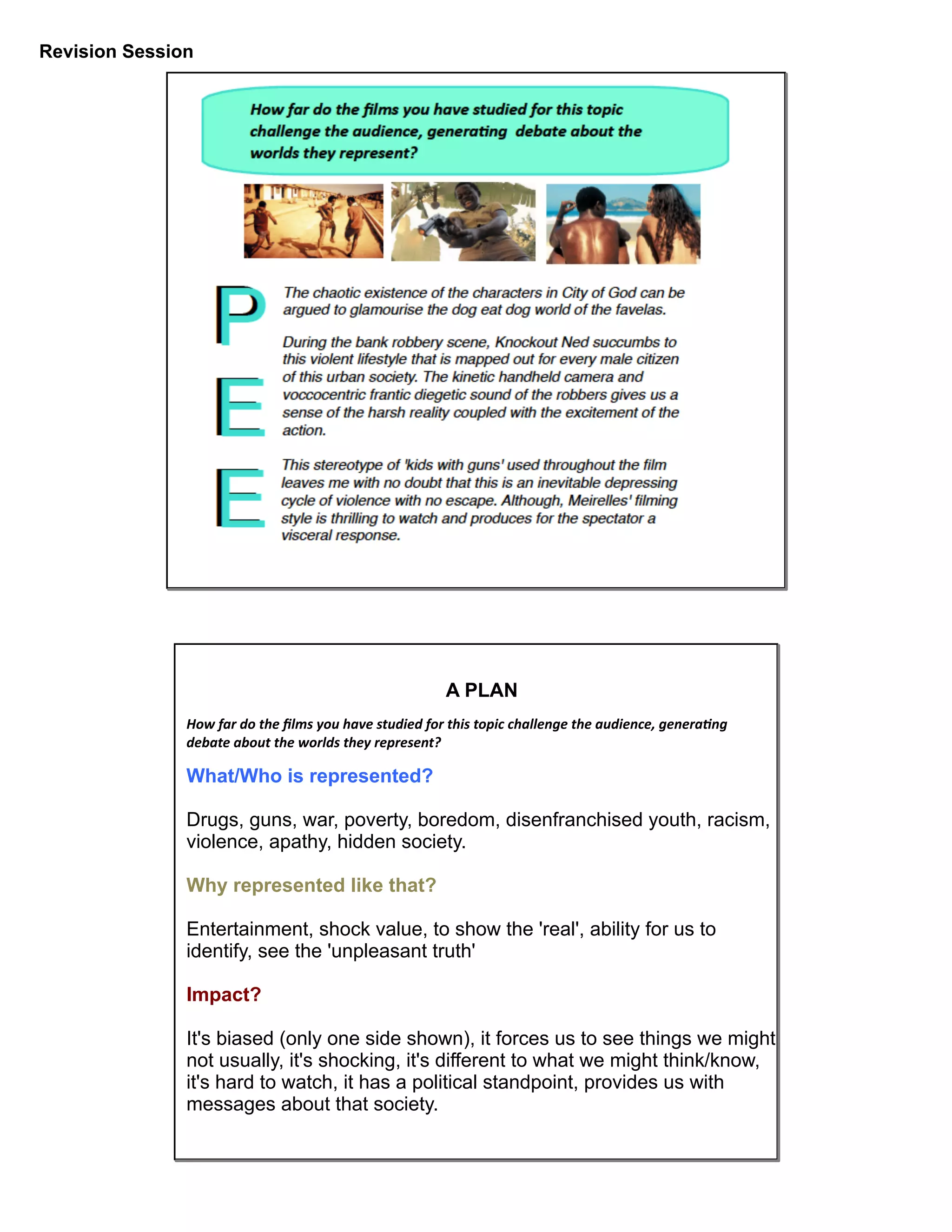
How	
  far	
  do	
  the	
  films	
  you	
  have	
  studied	
  for	
  this	
  topic	
  challenge	
  the	
  audience,	
  genera9ng	
  	
  
debate	
  about	
  the	
  worlds	
  they	
  represent?
What/Who is represented?
Drugs, guns, war, poverty, boredom, disenfranchised youth, racism,
violence, apathy, hidden society.
Why represented like that?
Entertainment, shock value, to show the 'real', ability for us to
identify, see the 'unpleasant truth'
Impact?
It's biased (only one side shown), it forces us to see things we might
not usually, it's shocking, it's different to what we might think/know,
it's hard to watch, it has a political standpoint, provides us with
messages about that society.
Revision Session
Section A
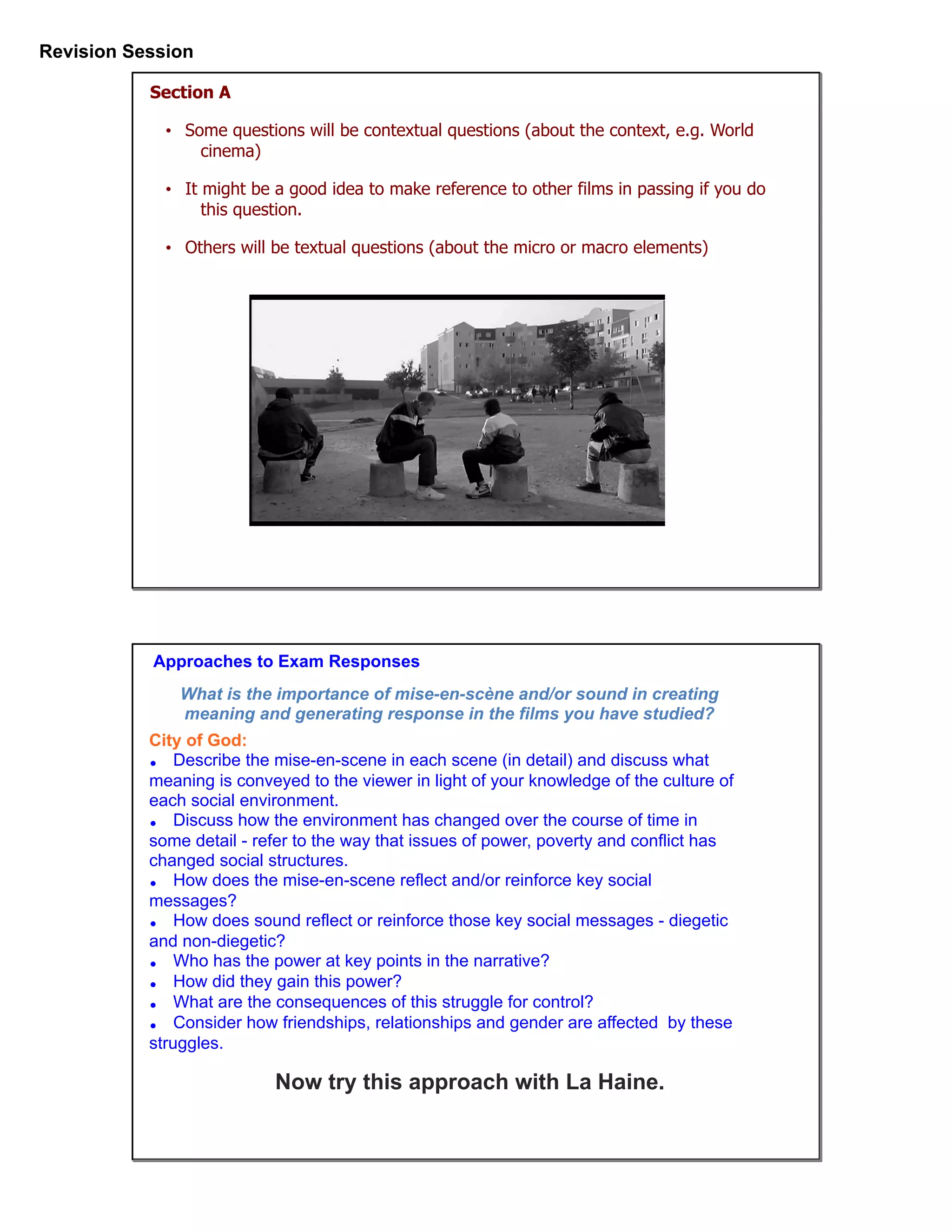
• Some questions will be contextual questions (about the context, e.g. World
cinema)
• It might be a good idea to make reference to other films in passing if you do
this question.
• Others will be textual questions (about the micro or macro elements)
Approaches to Exam Responses
City of God:
• Describe the mise-en-scene in each scene (in detail) and discuss what
meaning is conveyed to the viewer in light of your knowledge of the culture of
each social environment.
• Discuss how the environment has changed over the course of time in
some detail - refer to the way that issues of power, poverty and conflict has
changed social structures.
• How does the mise-en-scene reflect and/or reinforce key social
messages?
• How does sound reflect or reinforce those key social messages - diegetic
and non-diegetic?
• Who has the power at key points in the narrative?
• How did they gain this power?
• What are the consequences of this struggle for control?
• Consider how friendships, relationships and gender are affected by these
struggles.
Now try this approach with La Haine.
What is the importance of mise-en-scène and/or sound in creating
meaning and generating response in the films you have studied?
Revision Session
Spectatorship is absolutely central to this section.
How we watch and respond to films requires a careful consideration
of our role and behaviour as spectator.
Documentary raises real issues for the spectator, particularly around
watching the ‘real’ as opposed to the fictional.
In addition, as a spectator it is possible to evaluate the different effects
achieved by different styles of documentary and different kinds of
documentary practice.
SECTION B
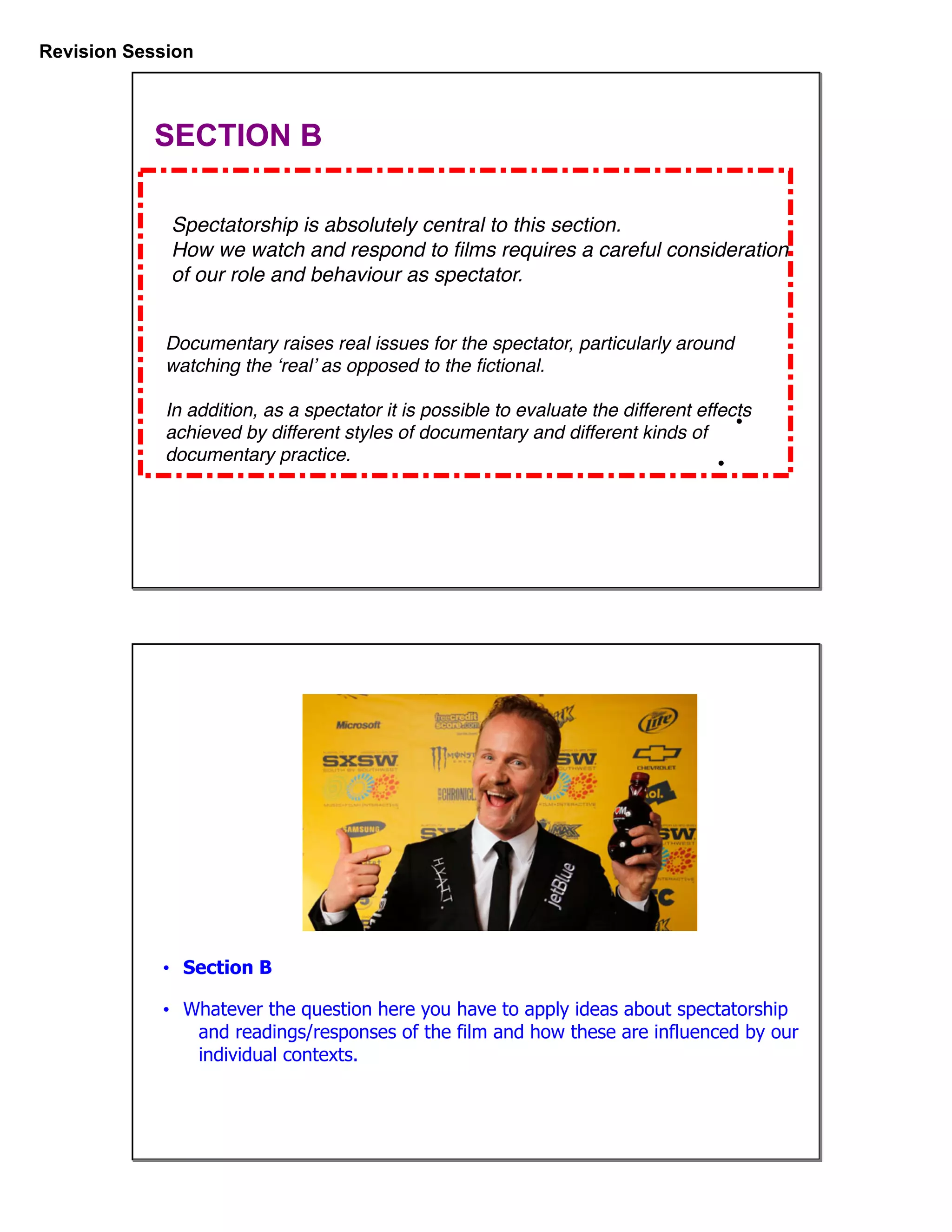
• Section B
• Whatever the question here you have to apply ideas about spectatorship
and readings/responses of the film and how these are influenced by our
individual contexts.
Revision Session
Pom Wonderful Presents The Greatest Movie Ever Sold immediately
positions the spectator of the film on the boundary of how we expect a
documentary to address its
audience.
The primary protagonist, who happens to be Spurlock himself, is
introduced, after an opening montage sequence which bombards us
with example adverts, leading into further examples of product
placement in films, such as Converse in 'i Robot'. He uses a mix of
voice over, non-diegetic music and the visual juxtapositioning of a
series of disparate images.
This postmodern, MTV aesthetic at work here, draws the viewer in
aligning us with his point of view. In this way the work transcends the
expected (documentary) boundaries, combining both entertainment
and factual communication.
Spectatorship and Documentary
How far is it preferable as a spectator to be presented with a
documentary that offers a very definite point of view towards it
subject?
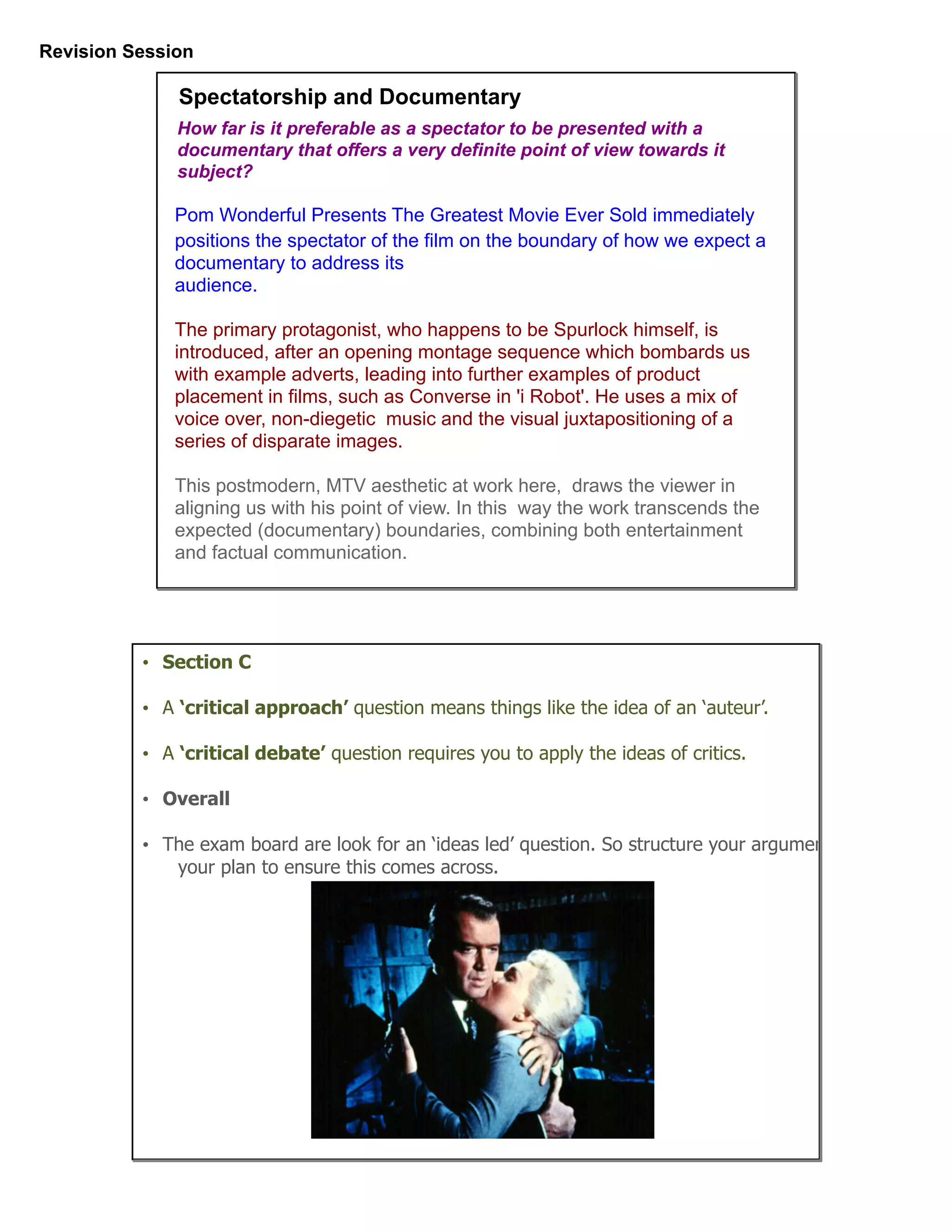
• Section C
• A ‘critical approach’ question means things like the idea of an ‘auteur’.
• A ‘critical debate’ question requires you to apply the ideas of critics.
• Overall
• The exam board are look for an ‘ideas led’ question. So structure your argument in
your plan to ensure this comes across.
Revision Session
As the story unravels we see Scottie portrayed as being rather
obsessive in nature.
He becomes the pursuer who chases Madeleine into somewhat
extreme circumstances, which are eventually out of both his and
her control, such the scene at old Fort Point where he rescues
her from the supposed drowning.
It is this pursuit of Madeleine that Mulvey sees as Scottie’s erotic
obsession based on a castration anxiety (Mulvey 23). It is for this
reason that the camera resorts to framing women as icons or
objects to be looked at, interrupting the film’s narrative flow.
Rather than being subjects, women in classical Hollywood film
function instead as objects of visual pleasure.
Single Film: Close Critical Study
How far has critical debate about your chosen film
shaped and altered your response?
How important is it that students are aware of critical writing on
their chosen close study film?
This section is described as a “critical study”. The primary energy for
this will come from the student’s own application of learning.
However, reading, reflecting upon and debating a variety of critical
writing on the chosen film is also invited.
It is expected that students will go into the examination aware of the
major debates surrounding their chosen film and will
have established their own critical views in the context of this
knowledge.
SECTION C

Revision summer2014fm4

  • 1.
    Revision Session Section A:World Cinema (35) - 55 minutes Section B: Spectatorship Topics (35) - 55 minutes Section C: Close Study (30) - 50 minutes Total exam time: 165 mins (2hr 45) 5 minutes for checking work WORK STATIONS SECTION A How are the films world cinema films? (top 3 most important points) What are the themes (apart from Power, poverty, conflict?) Can you accuse these films of style over substance? SECTION B What does it mean by ‘manipulation’ in an exam question? The best documentaries make you think. Discuss. Preferred, negotiated, optional readings? Apply! SECTION C How many terms can you remember? Remember one thing a critic has said. Come up with your own idea about Vertigo.
  • 2.
    Revision Session An urbanstory can be any film in which the city is a defining presence – in which characters’ lives are defined by existence within the urban environment. SECTION A
  • 3.
    Revision Session A PLAN How  far  do  the  films  you  have  studied  for  this  topic  challenge  the  audience,  genera9ng     debate  about  the  worlds  they  represent? What/Who is represented? Drugs, guns, war, poverty, boredom, disenfranchised youth, racism, violence, apathy, hidden society. Why represented like that? Entertainment, shock value, to show the 'real', ability for us to identify, see the 'unpleasant truth' Impact? It's biased (only one side shown), it forces us to see things we might not usually, it's shocking, it's different to what we might think/know, it's hard to watch, it has a political standpoint, provides us with messages about that society.
  • 4.
    Revision Session Section A •Some questions will be contextual questions (about the context, e.g. World cinema) • It might be a good idea to make reference to other films in passing if you do this question. • Others will be textual questions (about the micro or macro elements) Approaches to Exam Responses City of God: • Describe the mise-en-scene in each scene (in detail) and discuss what meaning is conveyed to the viewer in light of your knowledge of the culture of each social environment. • Discuss how the environment has changed over the course of time in some detail - refer to the way that issues of power, poverty and conflict has changed social structures. • How does the mise-en-scene reflect and/or reinforce key social messages? • How does sound reflect or reinforce those key social messages - diegetic and non-diegetic? • Who has the power at key points in the narrative? • How did they gain this power? • What are the consequences of this struggle for control? • Consider how friendships, relationships and gender are affected by these struggles. Now try this approach with La Haine. What is the importance of mise-en-scène and/or sound in creating meaning and generating response in the films you have studied?
  • 5.
    Revision Session Spectatorship isabsolutely central to this section. How we watch and respond to films requires a careful consideration of our role and behaviour as spectator. Documentary raises real issues for the spectator, particularly around watching the ‘real’ as opposed to the fictional. In addition, as a spectator it is possible to evaluate the different effects achieved by different styles of documentary and different kinds of documentary practice. SECTION B • Section B • Whatever the question here you have to apply ideas about spectatorship and readings/responses of the film and how these are influenced by our individual contexts.
  • 6.
    Revision Session Pom WonderfulPresents The Greatest Movie Ever Sold immediately positions the spectator of the film on the boundary of how we expect a documentary to address its audience. The primary protagonist, who happens to be Spurlock himself, is introduced, after an opening montage sequence which bombards us with example adverts, leading into further examples of product placement in films, such as Converse in 'i Robot'. He uses a mix of voice over, non-diegetic music and the visual juxtapositioning of a series of disparate images. This postmodern, MTV aesthetic at work here, draws the viewer in aligning us with his point of view. In this way the work transcends the expected (documentary) boundaries, combining both entertainment and factual communication. Spectatorship and Documentary How far is it preferable as a spectator to be presented with a documentary that offers a very definite point of view towards it subject? • Section C • A ‘critical approach’ question means things like the idea of an ‘auteur’. • A ‘critical debate’ question requires you to apply the ideas of critics. • Overall • The exam board are look for an ‘ideas led’ question. So structure your argument in your plan to ensure this comes across.
  • 7.
    Revision Session As thestory unravels we see Scottie portrayed as being rather obsessive in nature. He becomes the pursuer who chases Madeleine into somewhat extreme circumstances, which are eventually out of both his and her control, such the scene at old Fort Point where he rescues her from the supposed drowning. It is this pursuit of Madeleine that Mulvey sees as Scottie’s erotic obsession based on a castration anxiety (Mulvey 23). It is for this reason that the camera resorts to framing women as icons or objects to be looked at, interrupting the film’s narrative flow. Rather than being subjects, women in classical Hollywood film function instead as objects of visual pleasure. Single Film: Close Critical Study How far has critical debate about your chosen film shaped and altered your response? How important is it that students are aware of critical writing on their chosen close study film? This section is described as a “critical study”. The primary energy for this will come from the student’s own application of learning. However, reading, reflecting upon and debating a variety of critical writing on the chosen film is also invited. It is expected that students will go into the examination aware of the major debates surrounding their chosen film and will have established their own critical views in the context of this knowledge. SECTION C