Life in the Universe 4th Edition Bennett Test
Bank download
https://testbankfan.com/product/life-in-the-universe-4th-edition-
bennett-test-bank/
Explore and download more test bank or solution manual
at testbankfan.com
We have selected some products that you may be interested in
Click the link to download now or visit testbankfan.com
for more options!.
Life in the Universe 3rd Edition Bennett Test Bank
https://testbankfan.com/product/life-in-the-universe-3rd-edition-
bennett-test-bank/
Statistical Reasoning for Everyday Life 4th Edition
Bennett Test Bank
https://testbankfan.com/product/statistical-reasoning-for-everyday-
life-4th-edition-bennett-test-bank/
Statistical Reasoning for Everyday Life 5th Edition
Bennett Test Bank
https://testbankfan.com/product/statistical-reasoning-for-everyday-
life-5th-edition-bennett-test-bank/
Biochemistry 4th Edition Mathews Test Bank
https://testbankfan.com/product/biochemistry-4th-edition-mathews-test-
bank/
Introduction to Mathematical Statistics 8th Edition Hogg
Solutions Manual
https://testbankfan.com/product/introduction-to-mathematical-
statistics-8th-edition-hogg-solutions-manual/
Conceptual and Historical Issues in Psychology 1st Edition
Piekkola Test Bank
https://testbankfan.com/product/conceptual-and-historical-issues-in-
psychology-1st-edition-piekkola-test-bank/
Financial Management Principles and Applications 11th
Edition Titman Test Bank
https://testbankfan.com/product/financial-management-principles-and-
applications-11th-edition-titman-test-bank/
Statistics for Business and Economics 8th Edition Newbold
Test Bank
https://testbankfan.com/product/statistics-for-business-and-
economics-8th-edition-newbold-test-bank/
Development Through the Lifespan 7th Edition Berk
Solutions Manual
https://testbankfan.com/product/development-through-the-lifespan-7th-
edition-berk-solutions-manual/
Strategic Marketing 10th Edition Cravens Test Bank
https://testbankfan.com/product/strategic-marketing-10th-edition-
cravens-test-bank/
1
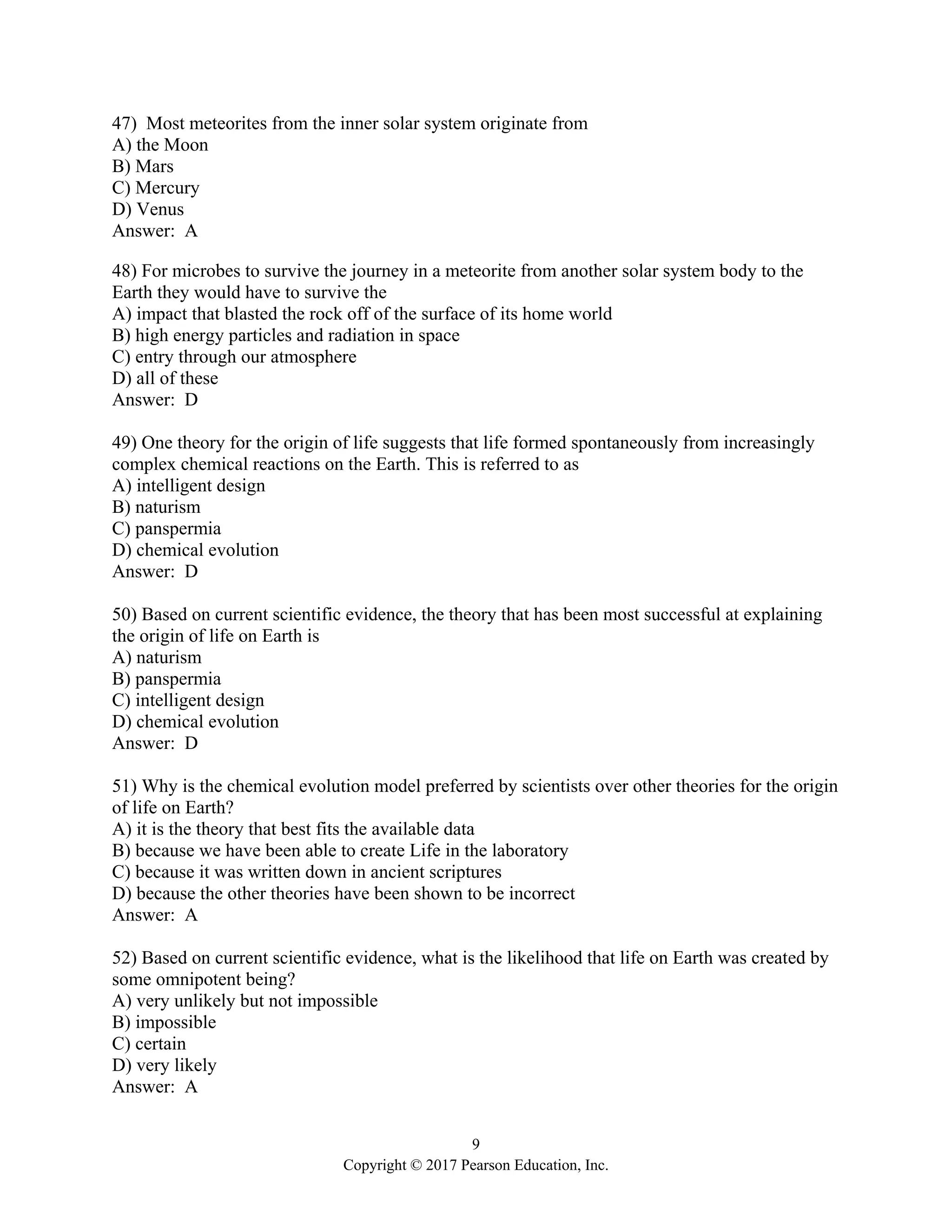
Copyright © 2017 Pearson Education, Inc.
Life in the Universe, 4e (Bennett)
Chapter 6 The Origin and Evolution of Life on Earth
1) Why have studies of the geological record not enabled us to determine how life on Earth
originated?
A) the first living organisms would have left absolutely no trace of their existence
B) life was planted on the Earth by an advanced civilization so there is no evidence in the
geological record to find
C) the geological record does not extend back to the time that life originated
D) the oldest rocks are too deep inside the Earth for us to retrieve
Answer: C
2) Which approach is currently proving to be the most promising way of determining how life on
Earth originated?
A) studies of Martian meteorites
B) studies of organisms living around deep-sea ocean vents
C) studies of the fossil record
D) laboratory simulations of conditions present on the early Earth
Answer: D
3) The first life to originate on Earth must be
A) at least as old as the oldest fossils
B) exactly the same age as the oldest fossils
C) younger than the oldest fossils
D) much older than the oldest fossils
Answer: A
4) If a fossil were to be discovered which was 3.7 billion years old this would tell us that life on
Earth must have arisen
A) exactly 3.7 billion years ago
B) at least 3.7 billion years ago
C) less than 3.7 billion years ago
D) much later than 3.7 billion years ago
Answer: B
5) Stromatolites are
A) fossils of the first organisms to introduce oxygen into the atmosphere
B) fossils of the first multicellular organisms
C) layers of sediment that once contained colonies of ancient microbes
D) fossils of the first eukaryotes
Answer: C
2
Copyright © 2017 Pearson Education, Inc.
6) Stromatolites date back to approximately
A) 4.6 billion years ago
B) 3.5 billion years ago
C) 3.85 billion years ago
D) 4.0 billion years ago
Answer: B
7) Modern day living stromatolites which resemble ancient stromatolites very closely have been
found in
A) the Yucatan peninsula, Mexico
B) South West Greenland
C) Western Australia
D) Yellowstone National Park, U.S.A.
Answer: C
8) Microfossils are
A) fossilized microbes
B) the remains of very small dinosaurs
C) the remains of the very first multicellular organisms
D) the remains of the tiny organisms which were first to colonize onto land
Answer: A
9) Why is the claim of the discovery of microfossils controversial?
A) they are found in rocks from the Hadean Eon
B) it is not clear whether they are of biological or mineral origin
C) the rocks they are found in are probably contaminated by terrestrial bacteria
D) they are too small to be of biological origin
Answer: B
10) Currently, the strongest evidence for microfossils dates to approximately
A) 4.0 billion years ago
B) 3.5 billion years ago
C) 3.4 billion years ago
D) 3.9 billion years ago
Answer: C
11) Microfossils found in northwestern Australia in 2011 appears to have used compounds based
on which element for metabolism?
A) sulfur
B) oxygen
C) nitrogen
D) carbon
Answer: A
3
Copyright © 2017 Pearson Education, Inc.
12) Microfossils found in northwestern Australia in 2011 appear to have been
A) photoheterotrophs
B) chemoheterotrophs
C) photoautotrophs
D) chemoautotrophs
Answer: C
13) Microfossil evidence suggests that life
A) originated when the Earth formed 4.6 billion years ago
B) originated about 3.4 billion years ago
C) existed 3.85 billion years ago
D) existed and was well established by 3.4 to 3.5 billion years ago
Answer: D
14) Why can studies of carbon isotopes be used to detect the presence of past biological activity
in rocks?
A) living organisms absorb only the most common carbon isotope
B) living organisms remove all carbon from rocks
C) living organisms absorb certain carbon isotopes more easily than others
D) carbon isotopes are found only in living organisms
Answer: C
15) A sample of an ancient sedimentary rock contains slightly less of the isotope carbon-13 than
found in inorganic material. One possible explanation for this is that
A) it was a meteorite that fell from the sky
B) some kind of radioactive decay occurred in it in the past
C) it used to be at the bottom of an ancient ocean
D) some kind of biological activity occurred in it in the past
Answer: D
16) Carbon isotope evidence from rocks found on an island off the coast of Greenland, although
controversial, suggests that life may have
A) existed and was well established by3.4 to 3.5 billion years ago
B) originated about 3.4 billion years ago
C) existed 3.85 billion years ago
D) originated when the Earth formed 4.6 billion years ago
Answer: C
17) The rocks found in Greenland with carbon isotope ratios suggestive of life are
A) igneous
B) sedimentary
C) metamorphic
D) a mixture of sedimentary and metamorphic
Answer: B
4
Copyright © 2017 Pearson Education, Inc.
18) Current geological evidence suggests that life
A) took billions of years to appear
B) appeared as soon as the Earth formed
C) appeared quite early in Earth's history
D) appeared relatively recently in Earth's history
Answer: C
19) Where in the "Tree of Life" will current organisms be located that are most closely related to
the common ancestor of all life on Earth?
A) at the branch between animals and plants
B) very close to the root
C) at the branch between Archaea and Eukarya
D) very far from the root
Answer: B
20) Organisms close to each other on the "Tree of Life"
A) are genetically very different
B) look very similar to the eye
C) are genetically identical
D) are genetically very similar
Answer: D
21) Organisms far from each other on the "Tree of Life"
A) are genetically very similar
B) are genetically very different
C) look very similar to the eye
D) are genetically identical
Answer: B
22) As life on Earth evolved, its DNA
A) changed gradually into RNA
B) stayed the same
C) became gradually less complex
D) became gradually more complex
Answer: D
23) Life probably did not originate on the land surface because
A) impacts would have destroyed any life that appeared
B) water was not plentiful on land
C) there was no ozone layer to shield out harmful UV rays
D) organic materials were not present on the land
Answer: C
5
Copyright © 2017 Pearson Education, Inc.
24) In the 19th century, Charles Darwin suggested that life may have originated
A) in shallow ponds on land
B) deep beneath the oceans
C) beneath the surface of the Earth
D) in the atmosphere
Answer: A
25) Current evidence suggests that life on Earth
A) originated in shallow ponds on land
B) was delivered from elsewhere in meteorites
C) was deliberately planted by an advanced civilization
D) originated close to deep-sea volcanic vents or underground
Answer: D
26) In order for organic molecules to have formed on the early Earth, what do we know could
not have been present in the atmosphere in significant quantities?
A) oxygen (O2)
B) nitrogen (N2)
C) carbon dioxide (CO2)
D) argon (Ar)
Answer: A
27) In the original Miller—Urey experiment it was assumed that carbon and nitrogen in the early
atmosphere were present as
A) carbon dioxide (CO2) and nitrogen (N2)
B) carbonates (CO3-) and nitrates (NO3-)
C) methane (CH4) and ammonia (NH3)
D) carbon and nitrogen atoms
Answer: C
28) In modern Miller—Urey experiments it is assumed that carbon and nitrogen in the early
atmosphere were present as
A) methane (CH4) and ammonia (NH3)
B) carbon dioxide (CO2) and nitrogen (N2)
C) carbonates (CO3-) and nitrates (NO3-)
D) carbon and nitrogen atoms
Answer: B
6
Copyright © 2017 Pearson Education, Inc.
29) Under what conditions will prebiotic molecules NOT be manufactured in Miller—Urey
experiments?
A) if ammonia (NH3) is present in the flask
B) if methane (CH4) is present in the flask
C) if oxygen (O2) is present in the flask
D) if carbon dioxide (CO2) is present in the flask
Answer: C
30) Which of the following was an important source of prebiotic molecules (e.g., amino acids)
on the early Earth?
A) molecules produced on the surface by impacts
B) molecules produced by chemical reactions near deep-sea ocean vents
C) molecules transported to the surface by impacts
D) all of these
Answer: D
31) In 2014, when scientists used a laser to simulate the conditions generated when a large
impact hits a mixture of prebiotic molecules, they were able to produce
A) all 20 amino acids used in life
B) all four DNA bases used in life
C) complex carbohydrates
D) simple proteins
Answer: B
32) The transition from chemistry to biology occurred
A) gradually in a number of distinct steps
B) very quickly in in one single step
C) very quickly in a number of distinct steps
D) gradually in one single step
Answer: A
33) The first self-replicating molecule was probably
A) a simple carbohydrate
B) DNA
C) a simple protein
D) RNA
Answer: D
34) What is the "chicken-and-egg" type problem we face when trying to decide which came
first–proteins or nucleic acids?
A) proteins and nucleic acids probably looked very different before the origin of life
B) nucleic acids cannot replicate without proteins, and proteins cannot be made without nucleic
acids
C) early proteins and nucleic acids were very similar to each other
D) proteins and nucleic acids are always present together at the same time
Answer: B
7
Copyright © 2017 Pearson Education, Inc.
35) Why do we think that RNA was probably the first self-replicating molecule?
A) it is able to replicate at high temperatures found near deep-sea ocean vents
B) it is much simpler than DNA
C) in laboratory studies researchers have shown that it is able to catalyze its own replication
D) it is able to replicate using carbohydrates rather than proteins
Answer: C
36) RNA catalysts in cells are referred to as
A) enzymes
B) ribozymes
C) ribosomes
D) chemzymes
Answer: B
37) Why do we think that DNA was probably NOT the first self-replicating molecule?
A) it is able to replicate using carbohydrates rather than proteins
B) it is far to complex to have been the first self-replicating molecule
C) it is able to replicate at high temperatures found near deep ocean vents
D) laboratory have shown that it is able to catalyze its own replication
Answer: B
38) The first molecules of RNA were probably made
A) on the surfaces of clays or other minerals
B) deep within the earth
C) in the atmosphere
D) in space and then transported to the Earth in meteorites
Answer: A
39) Why are clay surfaces good at promoting the formation of biological polymers?
A) they are the only types of material monomers will stick to
B) they bring monomers close together, allowing them to react with each other
C) they are very common on the Earth
D) clays are made of biological polymers
Answer: B
40) What is one reason that early life formed cells?
A) cell walls prevent heat from escaping
B) cells concentrate molecules together so they react more easily
C) only cells can replicate
D) biological reactions can occur only within cells
Answer: B
8
Copyright © 2017 Pearson Education, Inc.
41) What is one reason that early life formed cells?
A) only cells can replicate
B) cell walls prevent heat from escaping
C) cells help to protect fragile biological molecules from the outside environment
D) biological reactions can occur only within cells
Answer: C
42) One type of early protocell (pre-cells) probably consisted of small droplets of
A) water
B) clay
C) concentrated amino acids
D) nucleic acids
Answer: C
43) One type of early protocell (pre-cells) probably consisted of small droplets of
A) water
B) clay
C) lipids
D) nucleic acids
Answer: C
44) What was one reason that RNA was eventually replaced by DNA as the molecule of choice
for storing genetic information?
A) the bases that make up DNA became much more common
B) DNA is far more stable than RNA
C) DNA can catalyze its own replication
D) the double helix of DNA is better able to correct errors in replication
Answer: D
45) One theory for the origin of life suggests that the earth and Life were created by some
omnipotent being. This is referred to as
A) panspermia
B) intelligent design
C) naturism
D) chemical evolution
Answer: B
46) One theory for the origin of life suggests that life was transported to Earth in meteorites. This
is referred to as
A) naturism
B) intelligent design
C) panspermia
D) chemical evolution
Answer: C
9
Copyright © 2017 Pearson Education, Inc.
47) Most meteorites from the inner solar system originate from
A) the Moon
B) Mars
C) Mercury
D) Venus
Answer: A
48) For microbes to survive the journey in a meteorite from another solar system body to the
Earth they would have to survive the
A) impact that blasted the rock off of the surface of its home world
B) high energy particles and radiation in space
C) entry through our atmosphere
D) all of these
Answer: D
49) One theory for the origin of life suggests that life formed spontaneously from increasingly
complex chemical reactions on the Earth. This is referred to as
A) intelligent design
B) naturism
C) panspermia
D) chemical evolution
Answer: D
50) Based on current scientific evidence, the theory that has been most successful at explaining
the origin of life on Earth is
A) naturism
B) panspermia
C) intelligent design
D) chemical evolution
Answer: D
51) Why is the chemical evolution model preferred by scientists over other theories for the origin
of life on Earth?
A) it is the theory that best fits the available data
B) because we have been able to create Life in the laboratory
C) because it was written down in ancient scriptures
D) because the other theories have been shown to be incorrect
Answer: A
52) Based on current scientific evidence, what is the likelihood that life on Earth was created by
some omnipotent being?
A) very unlikely but not impossible
B) impossible
C) certain
D) very likely
Answer: A
10
Copyright © 2017 Pearson Education, Inc.
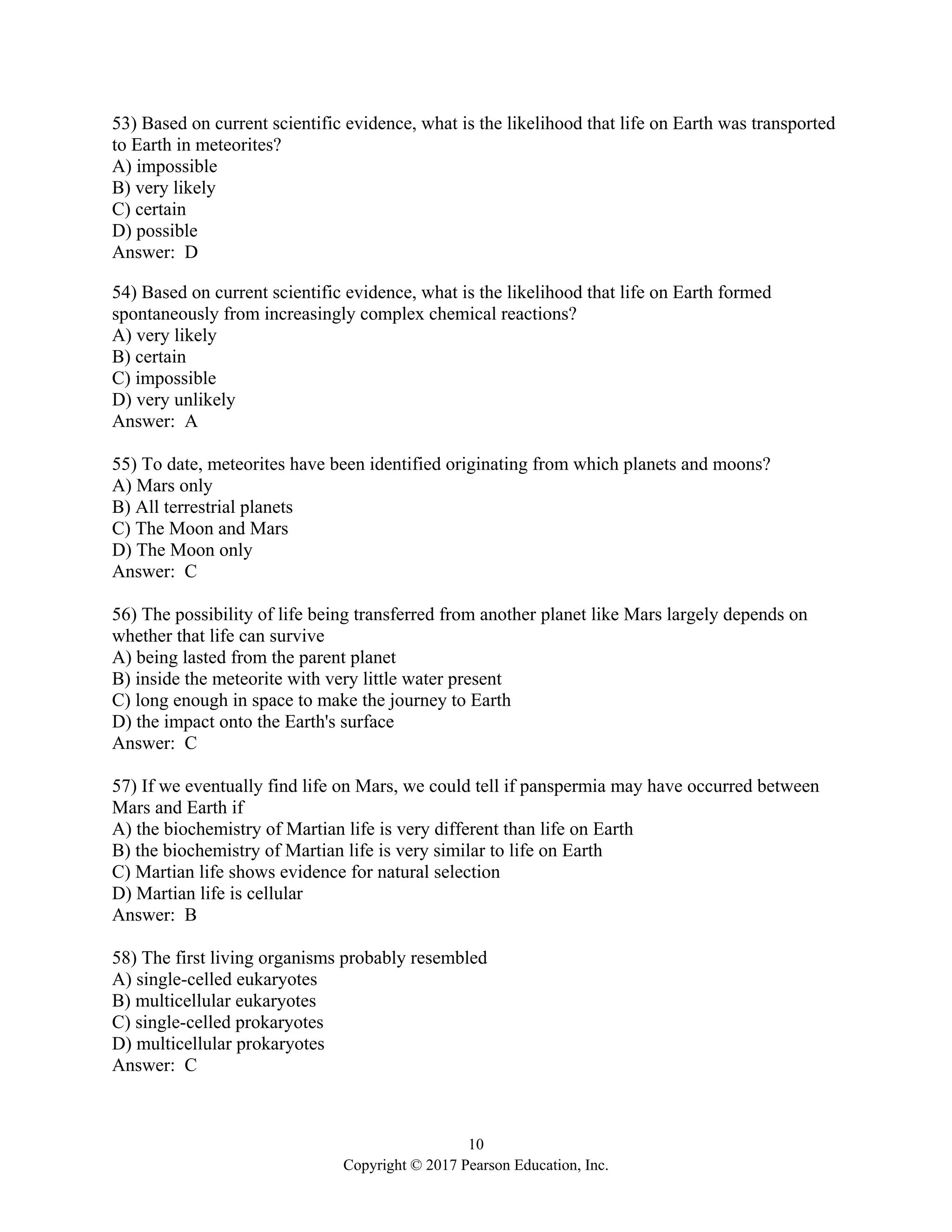
53) Based on current scientific evidence, what is the likelihood that life on Earth was transported
to Earth in meteorites?
A) impossible
B) very likely
C) certain
D) possible
Answer: D
54) Based on current scientific evidence, what is the likelihood that life on Earth formed
spontaneously from increasingly complex chemical reactions?
A) very likely
B) certain
C) impossible
D) very unlikely
Answer: A
55) To date, meteorites have been identified originating from which planets and moons?
A) Mars only
B) All terrestrial planets
C) The Moon and Mars
D) The Moon only
Answer: C
56) The possibility of life being transferred from another planet like Mars largely depends on
whether that life can survive
A) being lasted from the parent planet
B) inside the meteorite with very little water present
C) long enough in space to make the journey to Earth
D) the impact onto the Earth's surface
Answer: C
57) If we eventually find life on Mars, we could tell if panspermia may have occurred between
Mars and Earth if
A) the biochemistry of Martian life is very different than life on Earth
B) the biochemistry of Martian life is very similar to life on Earth
C) Martian life shows evidence for natural selection
D) Martian life is cellular
Answer: B
58) The first living organisms probably resembled
A) single-celled eukaryotes
B) multicellular eukaryotes
C) single-celled prokaryotes
D) multicellular prokaryotes
Answer: C
Visit https://testbankbell.com
now to explore a rich
collection of testbank,
solution manual and enjoy
exciting offers!
11
Copyright © 2017 Pearson Education, Inc.
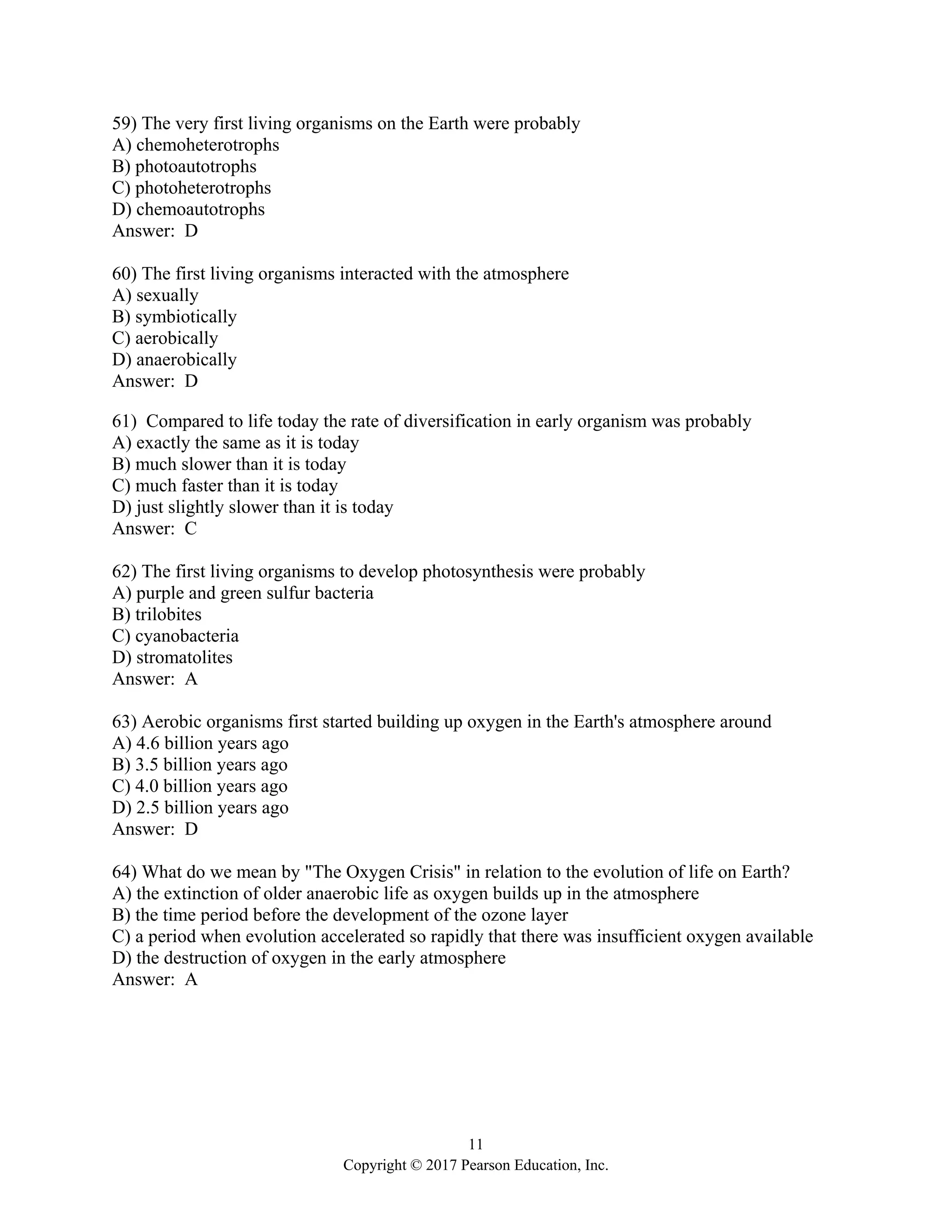
59) The very first living organisms on the Earth were probably
A) chemoheterotrophs
B) photoautotrophs
C) photoheterotrophs
D) chemoautotrophs
Answer: D
60) The first living organisms interacted with the atmosphere
A) sexually
B) symbiotically
C) aerobically
D) anaerobically
Answer: D
61) Compared to life today the rate of diversification in early organism was probably
A) exactly the same as it is today
B) much slower than it is today
C) much faster than it is today
D) just slightly slower than it is today
Answer: C
62) The first living organisms to develop photosynthesis were probably
A) purple and green sulfur bacteria
B) trilobites
C) cyanobacteria
D) stromatolites
Answer: A
63) Aerobic organisms first started building up oxygen in the Earth's atmosphere around
A) 4.6 billion years ago
B) 3.5 billion years ago
C) 4.0 billion years ago
D) 2.5 billion years ago
Answer: D
64) What do we mean by "The Oxygen Crisis" in relation to the evolution of life on Earth?
A) the extinction of older anaerobic life as oxygen builds up in the atmosphere
B) the time period before the development of the ozone layer
C) a period when evolution accelerated so rapidly that there was insufficient oxygen available
D) the destruction of oxygen in the early atmosphere
Answer: A
12
Copyright © 2017 Pearson Education, Inc.
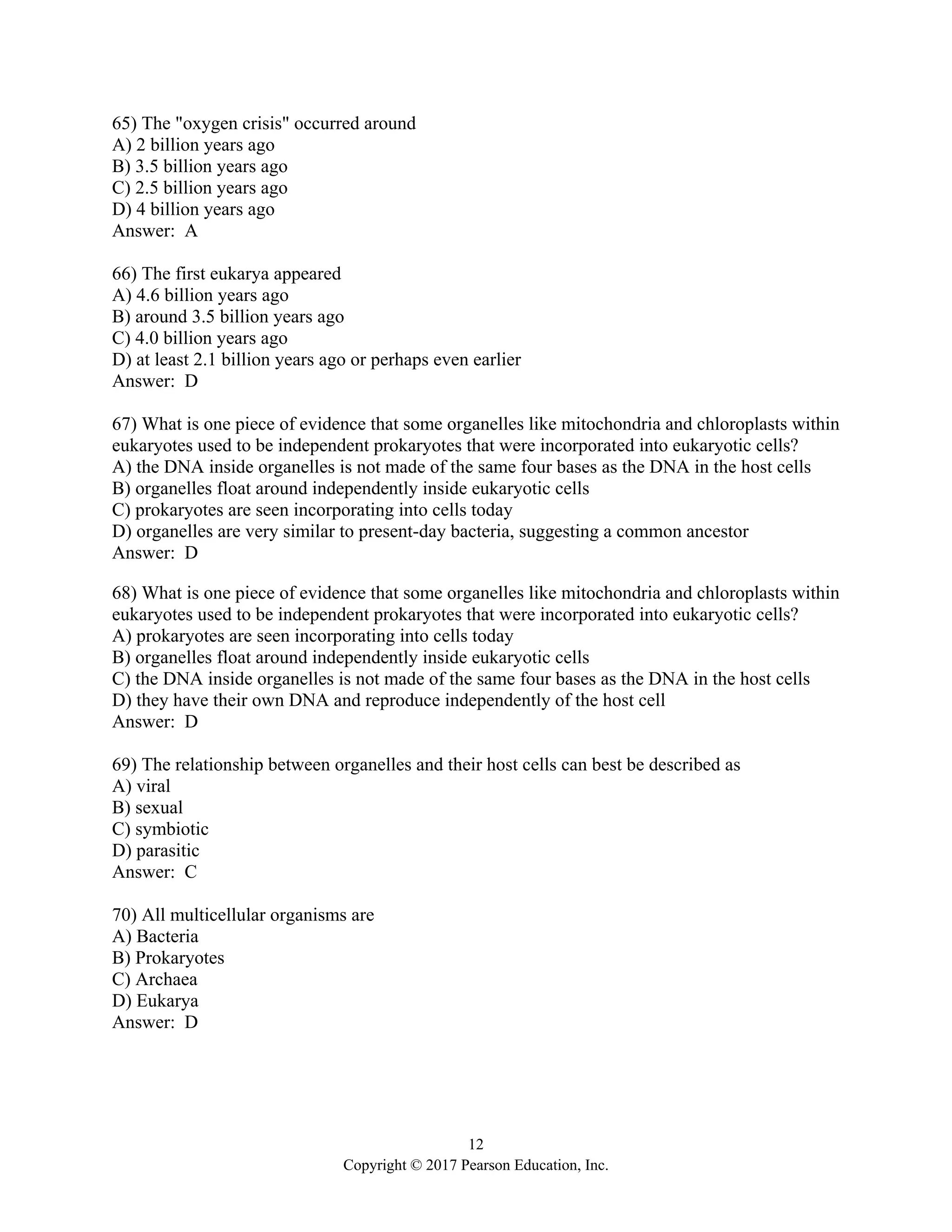
65) The "oxygen crisis" occurred around
A) 2 billion years ago
B) 3.5 billion years ago
C) 2.5 billion years ago
D) 4 billion years ago
Answer: A
66) The first eukarya appeared
A) 4.6 billion years ago
B) around 3.5 billion years ago
C) 4.0 billion years ago
D) at least 2.1 billion years ago or perhaps even earlier
Answer: D
67) What is one piece of evidence that some organelles like mitochondria and chloroplasts within
eukaryotes used to be independent prokaryotes that were incorporated into eukaryotic cells?
A) the DNA inside organelles is not made of the same four bases as the DNA in the host cells
B) organelles float around independently inside eukaryotic cells
C) prokaryotes are seen incorporating into cells today
D) organelles are very similar to present-day bacteria, suggesting a common ancestor
Answer: D
68) What is one piece of evidence that some organelles like mitochondria and chloroplasts within
eukaryotes used to be independent prokaryotes that were incorporated into eukaryotic cells?
A) prokaryotes are seen incorporating into cells today
B) organelles float around independently inside eukaryotic cells
C) the DNA inside organelles is not made of the same four bases as the DNA in the host cells
D) they have their own DNA and reproduce independently of the host cell
Answer: D
69) The relationship between organelles and their host cells can best be described as
A) viral
B) sexual
C) symbiotic
D) parasitic
Answer: C
70) All multicellular organisms are
A) Bacteria
B) Prokaryotes
C) Archaea
D) Eukarya
Answer: D
13
Copyright © 2017 Pearson Education, Inc.
71) The first multicellular organism appears around
A) 542 million years ago
B) 1.2 billion years ago
C) 65 million years ago
D) 3.5 billion years ago
Answer: B
72) Today, which organisms have the highest biomass?
A) fungi
B) plants
C) animals
D) microbes
Answer: D
73) The highest level of classification of plants and animals is a
A) kingdom
B) phylum
C) class
D) order
Answer: B
74) Plants and animals belong to the phylum
A) annelida
B) echinodemata
C) cnidaria
D) chordata
Answer: D
75) The Cambrian Explosion began approximately
A) 2.1 billion years ago
B) 542 million years ago
C) 1.2 billion years ago
D) 65 million years ago
Answer: B
76) What happened at the start of the Cambrian Period?
A) the first oxygen-producing bacteria appeared
B) the first dinosaurs appeared
C) early humans first appeared
D) an explosion of genetic diversity appeared, leading to the appearance of the first animals
Answer: D
14
Copyright © 2017 Pearson Education, Inc.
77) Why do we believe the Cambrian explosion occurred so suddenly?
A) oxygen concentrations reached critical levels necessary to support more complex life
B) organisms became sufficiently complex that more diversity became possible
C) climate change due the end of the last snowball Earth phase
D) all of these
Answer: D
78) An explosion of genetic diversity similar to that which occurred during the Cambrian Period
hasn't happened recently, most likely because
A) evolution of life on Earth is no longer occurring
B) such an explosion can occur only for simple organisms and not complex ones
C) there are no more ecological niches available to allow this to happen
D) of the widespread presence of efficient predators that make it much more difficult for entirely
new organisms to appear
Answer: D
79) The colonization of life onto land was closely tied to the
A) appearance of multicellular organisms
B) development of photosynthesis
C) oceans being overcrowded
D) development of the ozone layer
Answer: D
80) The colonization of land by plants appears to have begun about
A) 542 million years ago
B) 360 million years ago
C) 65 million years ago
D) 475 million years ago
Answer: D
81) One of the first large organisms to develop the means to live on land were probably
A) plants
B) insects
C) reptiles
D) mammals
Answer: A
82) The first plants probably evolved from
A) plankton
B) algae
C) corals
D) seaweed
Answer: B
15
Copyright © 2017 Pearson Education, Inc.
83) During the Carboniferous Period,
A) the carbon dioxide cycle started to operate for the first time
B) carbon-rich meteorites impacted the Earth
C) the first carbon-based life appeared
D) land was covered with dense forests with the appearance of the first insects and amphibians
Answer: D
84) The Carboniferous Period began about
A) 475 million years ago
B) 65 million years ago
C) 360 million years ago
D) 542 million years ago
Answer: C
85) The fossil fuel deposits we use today are the remains of organisms from which period in
Earth's history?
A) The Cretaceous Period
B) The Carboniferous Period
C) The Cambrian Period
D) The Archaean Eon
Answer: B
86) Chemical reactions which remove oxygen from the atmosphere are known as
A) oxidation reactions
B) hydrolysis reactions
C) precipitation reactions
D) acid-base reactions
Answer: A
87) Most likely, oxygen was first released into the atmosphere by
A) the decomposition of dead organisms
B) plants
C) cyanobacteria
D) oxidation reactions
Answer: C
88) The presence of which rocks show that between 2 and 3 billion years ago the atmosphere
contained less than 1% of the amount of oxygen it contains today?
A) limestone
B) banded iron formations
C) silicate clays
D) sandstone
Answer: B
Other documents randomly have
different content
know how hard he pulls to pull those logs. To pull those logs he does
his very best.
And when he was gone away the mamma did spank me most hard
with the hair-brush. Then she put me out the door. And I did go
from the house we do live in to where do dwell King Edward III and
Queen Philippa of Hainault. They are grand trees. We are friends.
Often it is I go to where they dwell when the mamma does put me
out of the house. To-day I did stay long with them and I did talk
long with them. Mostly it was about the lovely England when they
were there, we did have talks about to-day. And the wind was
talking too. I think the wind does have knowing of this being their
wedding day in 1328. As he did come near unto where they dwell,
he did walk among the willows by the singing creek. And I did climb
down from the arms of Queen Philippa of Hainault and go to gather
water-cress for the mamma. She does have such a fondness for it.
Then I did say good-bye, and I did say good-bye to all those
twelve trees growing near unto them. And all those twelve trees that
do grow near unto King Edward III and Queen Philippa of Hainault—
those twelve trees are their twelve children. The tree most near unto
Edward III, that is Edward Prince of Wales; and the one next unto
him is Lionel Duke of Clarence; and the one most near unto him,
that is John of Gaunt, Duke of Lancaster. The time was when there
were only ten trees growing there, and I did have needs to plant two
more. Two little ones I did plant, and one is for baby Blanche and
one is for baby William, the other one.
CHAPTER XIV
How Opal Feels Satisfaction Feels, and Takes a Ride on William
Shakespeare; and all that Came of it.
After I did dish-towel all the dishes that we did use in the
breakfast meal, the mamma did send me to get barks for the
warming stove. While I was getting barks I did stop to screwtineyes
the plump wiggles that were in and under all the barks. Those plump
wiggles will grow and change. They will grow and change into
beetles. I have seen them do so. I have taken them from the bark
and they did so grow into beetles—after some long time. In the
nursery I kept them while they did so change.
After the barks was in I did go my way to school. I went aside to
Saint Firmin by Nonette. I made a stop where the willows grow. I
love to touch fingers with the willows. Then I do feel the feels the
willows feel. I did tell them all and every one about this being the
going-away day of Charlemagne in 814 and the borning day of
Henry VII in 1457. Each pussy-willow baby did wear a gray silk
tricot. He did look warm. He smiled, “Bonjour, petite Françoise,” in a
friendly way. I think he does remember the days in summer when I
did drink in inspirations dabbling my toes by his toes there in the
singing brook.
When I did have talks with them for a little time, I did go on. And
all along I stopped very often on the way to talk to the other pussy-
willows. I was quite late to school. Teacher made me stand in the
corner to get my lesson with my face to the wall. I did n’t mind that
at all. There was a window in that part of the wall. It was near the
corner. I looked looks at my book sometimes. Most of the times I
looked looks out the window. I had seeing of little plant folks just
peeping out of the earth to see what they could see. I did have
thinks it would be nice to be one of them, and then grow up and
have a flower and bees a-coming and seed-children at fall-time. I
have thinks this is a very interest world to live in. There is so much
to see out the window when teacher does have one to stand in the
corner to study one’s lesson.
When teacher did send me to my seat to get my slate for
arithmetic, I did put Lucian Horace Ovid Virgil in my desk by my
Cyr’s Reader. I keep my books in one little corner of my desk, and
that does leave a lot of room for my animal friends. There was room
enough for Lucian Horace Ovid Virgil to take little nice hops. But
while I was having recites with arithmetic, he hopped a little hop too
far and he fell out of my desk. I had quivers, and it was hard to pay
attentions to arithmetic. When our lessons were done I made a
quick go to my seat. I looked a look under for him. He was not
there. I looked more looks about. He was rows away over by the
seat-row where Lola has her sitting. I did almost sit sideways in my
seat, I had such anxious feels about him.
Lola had seeing. She made a reach over. She picked him up in a
gentle way. She put him in her apron pocket. She made a begin to
study her geography. She asked teacher if she might get a drink
from the dipper in the wrap-room. She went. She made a come-back
from the wrap-room down our row, going to her geography class.
When she went by my desk, she put her hand in my pocket. She
went on to the recite bench. Lucian Horace Ovid Virgil was back
again in my apron pocket. I felt an immense amount of satisfaction
feels.
Some days there is cream to be shaked into butter. The mamma
does have me to make a handle go up and down a lot of times in
the churn. This makes the butter come. When there is only a little
cream to be shaked into butter, then the mamma has me to shake it
to and fro in a glass jar. Sometimes it gets awfully heavy and my
arms do get ache feels up and down. There are most ache feels
when the butter is a long time in coming. It so was to-day. I gave it
many shakes, and I was having hopes it soon would be come. After
some long time, when it was most come, the lid came off and it all
shaked out. Then the mamma did have cross feels and the spanks
she gave made me to have sore feels on the back part of me. I was
making tries to be helps to her. That butter was almost come.
After I did give the floor washes and mops up where the splashes
of buttermilk did jump, then the mamma put me out the door and
told me to get out and stay out of her way. I so did. I went out
across the field and in along the lane. Lars Porsena of Clusium had
going with me. I looked looks away to the meeting of the roads.
There was a horse come near unto it. A man was riding on this
horse. I like to ride upon a horse. I like to stand up when I ride upon
a horse. It is so much joy. I feel the feels the horse does feel when
he puts each foot to the ground.
When I did see that horse go on and on, then I did have feels it
would be nice to go a long way on explores. I did have thinks
William Shakespeare had wants to go. He was in the lane. I gave
him pats on the nose and I talked with him about it. We did start on.
When we were come to the end of the lane there was the gate. It
did take some long time to get it open. The plug did stick so tight
and more yet. I did pull and I made more pulls. It came out. It did
come out in a quick way. I did have a quick set-down. I got up in a
slow way. I did show William Shakespeare the way to go out the
gate. He went, I went. We went adown the road. A little way we
went and we were come to a stump. I made a climb upon it. From
the stump I did climb upon the back of William Shakespeare.
We went on. When we were come to the meeting of the roads, we
went the way of the road that goes to the upper camps. We made
no stops until we were come to where a long time ago the road had
a longing to go across the rivière, and some men that had
understanding made it a bridge to go across on. When we were
come to the bridge, we made a stop and I did sing to the rivière a
song. I sang it Le chant de Seine, de Havre, et Essonne et Nonette
et Roullon et Iton et Darnetal et Ourcq et Rille et Loing et Eure et
Audelle et Nonette et Sarc. I sang it as Angel Father did teach me to,
and as he has wrote it in the book.
And after I did sing it all, we did watch the water splash itself
against the legs of the bridge. The water goes not now slow as it did
in summer days. We went on. And the boards of the bridge did
make squeaks as we went across. And they said in their squeaks,
“Petite Françoise, we have been waiting a long time for you to go
across the rivière.” And I did have William Shakespeare to make a
little stop so I could tell the boards I have been waiting waits a long
time to go across. While I so was doing, they did not squeak. When
we made a start to go on, they did squeak.
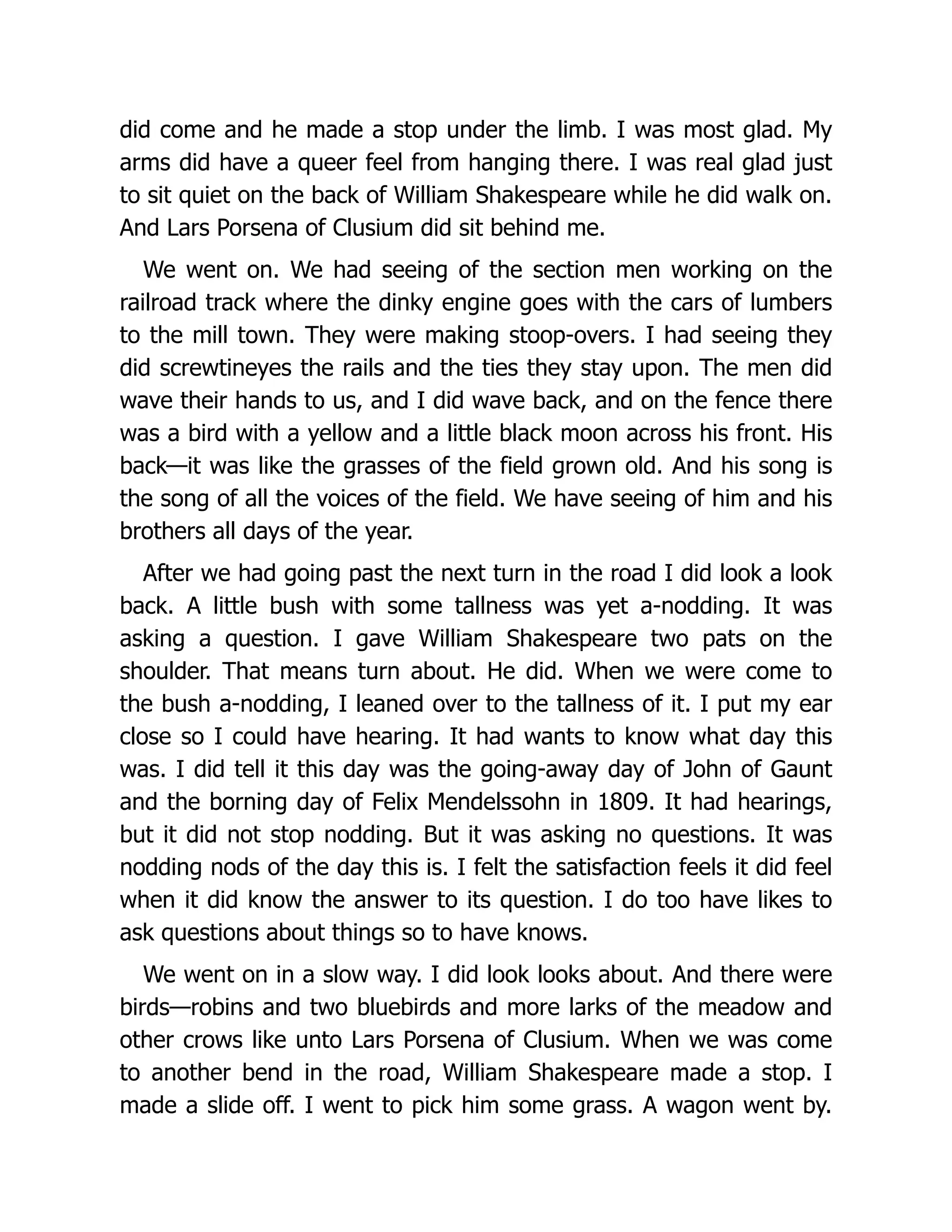
“AFTER WE WERE ACROSS THE RIVIÈRE WE WENT IN A MORE SLOW WAY”
After we were across the rivière we went in a more slow way.
There was so many things to see. Trees and trees were all along the
way. There were more ranch-houses. I did have seeing of them set
always back from the road, and smoke did come in curls from out
their chimneys. At a bend in the road there was a big chêne tree—it
was a very big one. On its arms there was bunches of mistletoe. I
made a stop to have looks at them. I had thinks I might reach up to
them. I stood on tiptoe on the back of William Shakespeare. I could
reach a reach to one limb. I put my arms around it and had a swing.
It was very nice to swing one forward and two back again.
But when I was ready to stand on William Shakespeare again, he
was not there. I looked a look down and about. He was gone on a
little way. I had wonders what to do. There was most too many
rocks to drop down on. Lars Porsena came and perched on the limb
above. I did call William Shakespeare four times, and in between I
called him by the bird-call that does mean I have needs of him. He
did come and he made a stop under the limb. I was most glad. My
arms did have a queer feel from hanging there. I was real glad just
to sit quiet on the back of William Shakespeare while he did walk on.
And Lars Porsena of Clusium did sit behind me.
We went on. We had seeing of the section men working on the
railroad track where the dinky engine goes with the cars of lumbers
to the mill town. They were making stoop-overs. I had seeing they
did screwtineyes the rails and the ties they stay upon. The men did
wave their hands to us, and I did wave back, and on the fence there
was a bird with a yellow and a little black moon across his front. His
back—it was like the grasses of the field grown old. And his song is
the song of all the voices of the field. We have seeing of him and his
brothers all days of the year.
After we had going past the next turn in the road I did look a look
back. A little bush with some tallness was yet a-nodding. It was
asking a question. I gave William Shakespeare two pats on the
shoulder. That means turn about. He did. When we were come to
the bush a-nodding, I leaned over to the tallness of it. I put my ear
close so I could have hearing. It had wants to know what day this
was. I did tell it this day was the going-away day of John of Gaunt
and the borning day of Felix Mendelssohn in 1809. It had hearings,
but it did not stop nodding. But it was asking no questions. It was
nodding nods of the day this is. I felt the satisfaction feels it did feel
when it did know the answer to its question. I do too have likes to
ask questions about things so to have knows.
We went on in a slow way. I did look looks about. And there were
birds—robins and two bluebirds and more larks of the meadow and
other crows like unto Lars Porsena of Clusium. When we was come
to another bend in the road, William Shakespeare made a stop. I
made a slide off. I went to pick him some grass. A wagon went by.
Two horses were in front of it, and on its high seat was a man with
his hat on sideways and a woman with a big fascinator most hiding
her face. There was seven children in the wagon—two with sleeps
upon them and a little girl with a tam-o’-shanter and a frown and a
cape on her. I have thinks from the looks on their faces they all did
have wants to get soon to where they were going to. I brought the
grass back to the road to William Shakespeare. I smiled a smile and
waved to the last little girl of all on the wagon. She smiled and
waved her hand. Then three more of them waved. I waved some
more. The wagon had its going on, and William Shakespeare had
begins to nibble at the grass I was holding in my fingers. While he
did nibble nibbles I did tell him poems. William Shakespeare does
have such a fondness for poetry and nibbles of grass and apples and
sugar-lumps.
While we did have waiting at the bend of the road, I saw a maple
tree with begins of buds upon it. I did walk up to the tree. I put my
ear to it to have listens to the sap going up. It is a sound I like to
hear. There is so much of springtime in it. While I did listen, in the
other ear that was not to the maple tree I did have hearings of the
talkings of the wind and petite plants just having begins to grow out
of the earth. The wind did say, “Je viens—je viens.” The plants did
answer make, “Nous entendons—nous entendons.” So they did
speak. Then the wind did say, “Le printemps viendra bientôt.” And
the plants did answer make, “Nous fleurirons bientôt.”
I did have glad feels. William Shakespeare moved a little move. I
had some doubts if he did hear all plainly they did say, so I went up
to his nose and said it all over to him. He had understanding. We
went on. When we were come again to a stump, I did climb again
upon his back. We went by a big mill with piles of lumber to its near
side, and a long wide roof it had. There was a row of lumber-
shanties and some more. There was children about and dogs. They
did smile and wave and I did too. We went on. More fir trees of
great tallness was on either side the road. They did stretch out their
great arms to welcome to us. I so do love trees. I have thinks I was
once a tree growing in the forest; now all trees are my brothers.
When we were gone a little way on from the very tall trees, in the
sky the light of day was going from blue to silver. And thoughts had
coming down the road to meet us. They were thoughts from out the
mountains where are the mines. They were thoughts from the
canyons that come down to meet the road by the rivière. I did feel
their coming close about us. Very near they were and all about. We
went on a little way only. We went very slow. We had listens to the
thoughts. They were thoughts of blooming-time and coming-time.
They were the soul thoughts of little things that soon will have their
borning-time.
When we did go on we did hear little sounds coming from a long
way down the road. They were like the shoe on the foot of a horse
making touches on the road in a hurry way. The sound, it came
more near. We made a stop to have a listen. It was coming more
near gray-light-time and we could not have plain sees until the horse
was come more near a way down the road. Then we had sees a
man was riding on the horse. They came on in the quick way that
made the little fast patter sounds on the ground. When he was most
come to where we were, the man did have the horse to go in a more
slow way. When he was come to where we were he did have the
horse to stop. The man upon the horse was the man that wears gray
neckties and is kind to mice. He did seem most glad that we were on
the road he was on. He did breathe some satisfaction breathes just
like Sadie McKibben does when she finds I have n’t broken my bones
when I fall out of a tree. Then he made begins. He said, “The fairies
—” And I said, “What?” He said, “The fairies have left a note on a
leaf in the moss-box by the old log. It was a note for me to go until I
find you and William Shakespeare—to bring you home again before
starlight-time.”
There was a little fern-plant with the note on the leaf. He gave
them to me. And we came our way home. Now I have thinks it was
God in his goodness did send the fairies to leave that fern-note on
the leaf. And William Shakespeare and I were glad he was come to
meet us, for the stars were not and dark was before we were come
home. But the man that wears gray neckties and is kind to mice, he
did have knows of the way of the road by night.
CHAPTER XV
Of Jenny Strong’s Visit, its Gladness and its Sadness.
Jenny Strong is come to visit us. She came in the morning of to-
day. She came on the logging train. She brought her bags with her.
The mamma did send me to meet her at the meeting of the roads.
The bags, they were heavy to carry, and my arms got some tired. As
we did go along, in-between times I did look looks at Jenny Strong.
There is so much of interest about her. The gray curls about her face
did have the proper look she wants them to have. To get that proper
look she does them up on curl-papers. I have seen her so do when
she was come to visit us before. And this morning her plump cheeks
were roses. And all her plumpness did most fill the gray dresses she
was wearing. Jenny Strong has little ruffles around the neck of that
dress, like the little ruffles that was around the neck of the man with
the glove when Titian made his picture. Those ruffles on the neck of
the gray dress of Jenny Strong did look like it was their joy to cuddle
up against the back of her black bonnet.
That black bonnet has a pink rosebud on it, and every time that
Jenny Strong does give her head a nod, that pink rosebud does give
itself a nod. It must be interest to be a pink rosebud on a black
bonnet that Jenny Strong wears. When we were come to the gate
Jenny Strong did hold her cape and her gray dress up in a careful
way. She had blue stockings on, and they was fastened up with pink
ribbons. She went on while I did shut the gate. I did come after. I
could not come after in a quick way because the bags was heavy.
Pretty soon Jenny Strong did have seeing I was not there beside her,
and she did wait waits for me a little while, and I did come to where
she was.
We went on. The way was dampness near the singing creek and
Jenny Strong did take dainty steps as we did go along. Lars Porsena
of Clusium did come to meet us. And so came Brave Horatius. And
Lars Porsena of Clusium did perch upon his back. We went on. The
pink rosebud on the black bonnet of Jenny Strong did nod itself
twelve times as we did go along. When we were come near unto the
house, there was a rooster by our front door. He was strutting along.
He was that same rooster that I tied a slice of bacon around his neck
this morning because he had queer actions in the throat. When
Jenny Strong saw him strutting along with the bacon wrapped
around his throat, she did turn her head to the side with a delicate
cough.
After Jenny Strong took off her cape and her black bonnet with
the pink rosebud on it, I did pull the best rocking-chair out in the
middle of the room for her. She sat down in it and she did start to
have talks with the mamma. I did go to teeter the baby on the bed
as the mamma did say for me to do. Jenny Strong did rock big rocks
in that rocking-chair while she did talk. One time she did almost rock
over. She breathed a big breath. Then, that she might not rock over
again, I did put a stick of wood under the rocker. That helped some.
But, too, it did keep her from rocking. She went on talking. I went
back to the bed to teeter the baby. While I did teeter the baby I did
look looks out the window. In a bush that I do tie pieces of suet to,
there was a little gray bird with a black cap and his throat it was
black. He was a fluffy ball and he almost did turn himself upside-
down on that branch. Then he went a go-away. Only a little way he
went. Then he was with more like himself. They went on together.
By and by the mamma’s baby did go to sleep, and I climbed off
the bed and made a start to go to the nursery. Jenny Strong did ask
me where I was going. I did tell her. She said she thought she would
like to go with me. We did go out the door. Then I ran a quick run
back to get her black bonnet with the pink rosebud on it. I brought it
to her. She said, being as I did bring it to her, she would wear it, but
she had not in tent chuns to when we started. She had forgot it. But
I did n’t have forgets. I do so like to see that pink rosebud nod itself.
We went on. We went a little way down the path. Then I did go
aside. Jenny Strong did follow after me. She came over the little logs
in a slow way. I did make stops to help her. The pink rosebud on the
black bonnet did nod itself fifteen times on the way. I did count its
times. When we were come to the nursery, first I did show her the
many baby seeds I did gather by the wayside in the falltime. I did
tell her how I was going to plant them when come springtime. She
did nod her head. Every time she so did, the pink rosebud on the
black bonnet did nod itself.
After I told her most all about the seeds, I did show her the silk
bags with spider eggs in them. Then I did show her all the cradles
the velvety caterpillars did make at falltime. I did give her
explainings how butterflies and moths would be a-coming out of the
cradles when springtime was come. She looked concentration looks
at them. She gave her head some more nods and the pink rosebud
on the black bonnet gave itself some more nods. I moved on to
where the wood-mouse folks are. I was just going to show her what
a nice nose and little hands Nannerl Mozart has, and what a velvety
mouse Felix Mendelssohn is. When I did turn about to so do, there
was Jenny Strong going in funny little hops over the logs. She was
going in a hurry way to the house.
I did have a wonder why was it she so went. I gave Felix
Mendelssohn more pats and I put him in my apron pocket. And
Nannerl Mozart did curl up in the bed I have fixed for her in the
nursery. Then I did sing a lullaby song to all the wood-mice in the
nursery. And they are a goodly number. I did sing to them the song
La Nonette sings as it goes on its way to Oise.
Then I did go through the near woods to the mill by the far
woods. I so did go to see the man that wears gray neckties and is
kind to mice. When he had seeing that I was come by the big tree,
he did say in his gentle way, “What is it, little one? Is Thomas
Chatterton Jupiter Zeus not well?” “Oh, yes,” I said, “he is most well
and he did have likes for that piece of cheese you did give to him on
yesterday. He is a most lovely wood-rat, and what I have come to
tell you about is, we got company. She has a fondness for pinkness.
Her name is Jenny Strong. And she has a pink rosebud on her black
bonnet and ties her blue stockings up with pink ribbons.”
And then I did ask him if he did not have thinks a pink ribbon
would be nice for Thomas Chatterton Jupiter Zeus to wear on some
days—on days when he goes to cathedral service with me. And, too,
I did tell him how I did have thinks a pink ribbon would be nice for
William Shakespeare and Felix Mendelssohn and Lars Porsena of
Clusium and Brave Horatius.
The man that wears gray neckties and is kind to mice did have
thinks like my thinks. He did say for me to go write the fairies about
it. And I did. I did write it on a gray leaf. I put the gray leaf in a
moss-box at the end of an old log near unto the altar of Saint Louis.
The man that wears gray neckties and is kind to mice knows about
that moss-box where I do put letters for the fairies. He believes in
fairies, too. And we talk about them. He does ask me what I write to
them about and what things I have needs for them to bring. I do tell
him, and when the fairies do leave the things at the end of the old
log, I do take and show them to the man that wears gray neckties
and is kind to mice. He is so glad. He does believe in fairies, too.
As I did come back through the near woods, I did stop by some
grand fir trees to pray. When one does look looks up at the grand
trees growing up almost to the sky, one does always have longings
to pray. When I did come on, I did hear the mamma calling. When I
was come to the door, she made me go stand in the corner of the
wood-shed. Soon she came out. She did shut the door tight behind
her. Then she did ask me what for was it I gave Jenny Strong such a
scare, and she did spank me most hard. Now I have sore feels and I
have thinks it would be nice to have a cushion to sit on. And I do
have wonders what it was Jenny Strong got scares about. I think
grown-ups are queer sometimes.
When I did go into the house, all the scares was gone off Jenny
Strong. The mamma soon did make me to go under the bed. Here I
print. Jenny Strong sits by the fire. She does sit in a rocking-chair
with her feet propped up on a soap-box. She hums as she sits. She
crochets as she hums. She does make lace in a quick way.
Now Jenny Strong and the mamma is gone to the house of Elsie
to see the new baby. When she did go, the mamma did tell me to
put the baby to sleep. I so did. I did sing it to sleep in the rocking-
chair. I did sing it the Rivière and Fleuve song: “A is for Adour, Avre,
Ain, Aube, Arroux, and Allier.” When I did get to “D is for Douze and
Dordogne and Durance,” the baby did move its arm. When I did get
to “G is for Garonne and Gers and Gard,” the baby did open its eyes.
When I did get to “I is for Indre, and Isère and Iraouaddy,” it did
close its eyes. I did sing on. And sleeps did come upon the baby.
We had lots on the table to eat to-night, because Jenny Strong is
come. And most everything I did get to eat I did make divides of it
for my animal friends. They will all have a good share. And they will
be glad. There is enough for all to have a good amount to eat, which
often is n’t. I did feel a goodly amount of satisfaction sitting there at
the supper-table to-night for a little time. I was thinking how glad
the mice will be for the corn I have saved for them; and too Brave
Horatius will have good feels in his mouth when he sees that big
bone. And the birds will like all the scraps that are on the plate of
Jenny Strong if I can get them before the mamma gives them to
that big gray cat.
I have seeings that the folks, they are almost through eating. I
now am not at the table. I was only there for a very little while. I
now am under the bed. The mamma did send me away from the
table—it seems a long time ago. She did send me away from the
table because when Jenny Strong asked me if I liked her dress, I
said, “Yes, and the ruffles around your neck are like the ruffles
around the neck of the man with the glove, when Titian made his
picture.” Jenny Strong looked a queer look and she said to the
mamma, “What a naughty child!” The mamma did straightway tell
me to crawl under the bed and to stay there. I so am. I have feels
Jenny Strong has not had seeing of the picture of the man with the
glove that Titian did make. I thought it was nice to tell her her
ruffles were like his. They did look so nice.
I have wonders about folks. They are hard to understand. I think I
will just say a little prayer. My, I do have such hungry feels now.
They at the table are not through yet. I make swallows down my
throat. It is most hard not to eat what I have saved for my animal
friends. But they will like it—so I can wait waits until breakfast-time.
I can. In-between times I will have thinks and prayers.
CHAPTER XVI
Of the Woods on a Lonesome Day, and the Friendliness of the
Wood-Folks on December Days when you Put your Ears Close and
Listen.
This day—it was a lonely day. I did have longings all its hours for
Angel Mother and Angel Father. In-between times all day at school I
did print messages for them on gray leaves I did gather on the way
to school. I did tell on the leaves the longings I was having. Too, on
the leaves I did tell of William Shakespeare and our talks as we do
go walking down the lane, and the poetry I do tell him in the
manger. And I did print on more leaves how I do read out of the
books they did make—how I do sit in the manger and read what is
in them, and he does have understandings. And on other leaves I
did tell them as how the nose of Thomas Chatterton Jupiter Zeus
that was soreness has now well feels with prayers and mentholatum
that Sadie McKibben did give, and as how the head-ache of the most
big rooster has now well feels with camphoratum and vaselineatum;
and as how the stomach-ache of Aphrodite did get well feels with
caster oilatum that Sadie McKibben did give. And after, I did tell of
how on many days in gray-light-time I have had going on searches
for the kisses of Angel Father, what he did tell me to keep watches
for in the fleurs while he was away gone to the far lands. And on
more leaves I did tell them as how Peter Paul Rubens that was is not
now, and how I do carry about with me the little bell he always did
wear in the cathedral.
And when these leaves were so done, I did not go on for a time
little. For a little time I did have thinks. And the thinks I did have—
they were about the glad song. The glad song in my heart sings not
bright to-day. It is lonesome feels I have. But I do try to have thinks
as how I can bring happiness to folks about. That is such a help
when lonesome feels do come. Angel Mother did say, “Make earth
glad, little one—that is the way to keep the fire-tongue of the glad
song ever in your heart. It must not go out.” I so do try to keep it
there. I so do try, for it is helps on cold days and old days. And I did
have remembers as how it was Angel Mother did say, “When one
keeps the glad song singing in one’s heart then do the hearts of
others sing.”
So I did make hard swallows to swallow all the lonesome feels,
and I did have thinks as how I would stop to get water-cress for the
mamma on the way home from school. She does have such a
fondness for it. And too she does have longings for singing lessons. I
am saving my pennies to buy her one. All the pennies that the man
that wears gray neckties and is kind to mice does give to me I save.
I put them in the corner of the wood-shed where Brave Horatius
sleeps at night. I think I have most enough pennies to buy her a
singing lesson now. I have nineteen pennies. And when I grow up I
am going to buy her a whole rain-barrel full of singing lessons.
And then I did have thinks as how to-morrow I will be taking
Elizabeth Barrett Browning to visit the girl who has no seeing. They
do both have likings for one another. The girl who has no seeing has
an understanding soul. All my friends do have appreciations of the
pats she does give to them and the words she does say. And
sometimes a goodly number of them do have goings to her house
with me. That is when her folks are not at home. Then does
Elizabeth Barrett Browning walk right by my side up to the door. And
Thomas Chatterton Jupiter Zeus cuddles up in my arms, and in my
pockets do ride other folks—and Brave Horatius follows after.
When we are come, she does smooth back my curls and give me
a kiss. She says when we are come, “Here is come the kingdom of
heaven.” I have feels she has mistakes about that, because the
kingdom of heaven, being up in the sky, is there beyond the stars.
And when we are come, she does have asking about the voices. And
I do help her to get understandings of the thoughts growing with
the fleurs and the trees and the leaves. And I do tell her as how
those are God’s thoughts growing right up out of the earth. And she
wants to know more. Always she does ask for more. To-morrow we
will go—Elizabeth Barrett Browning and me—we will go the way that
does lead to the house of the girl that has no seeing.
To-day, after I did have thinks about it in school, I did print more
messages on leaves for Angel Father and Angel Mother. I did tell
them about the girl who has no seeing. And on more leaves I did
print all about the cathedral and how the presence of Saint Louis is
always near unto it. And then it was come time for school to let out.
I went adown the road. I went the way by the field where Aidan
of Iona come from Lindisfarne was on yesterday. I climbed the
fence. I looked looks about. He was not there to-day. But there were
Bede of Jarrow and Felix of Croyland. I did have talks with them. I
went on. I went on to the singing creek where the willows grew. I
gathered water-cress for the mamma. Then I did go my way to the
house we live in. No one was there. I put the water-cress for the
mamma on the cook table. Then I did bring much wood in and put it
in the wood-box back of the kitchen stove.
After the chickens did have their supper feed, I did go into the
near woods. I so went to tie the messages I did print on gray leaves
to the trees. And I tied one on one tree and one on another. I tied
them there that they may go in thoughts to Angel Mother and Angel
Father up in heaven there. And I did have thinks when the angels
come to walk in the near woods they would see and carry them on.
And I did say a little prayer every time I did tie on a leaf-message.
I did look looks about. This woods is gray in winter when come
cold days. And gray shadows walk among the trees. They touch
one’s face with velvet fingers when one goes walking there in the
woods. In the winter old gray leaves grow to look like lace. They are
very beautiful. As I did go along, I saw many gray rocks. Some gray
rocks had gray and green patches on them. Some of these patches
had ruffles all around their edges. The gray patches on gray rocks
are lichens. My Angel Father said so. Lichen folks talk in gray tones.
I think they do talk more when come winter days. I hear their voices
more in December than I do hear their voices in July and June time.
Angel Father did show me the way to listen to lichen voices. Most
grown-ups don’t hear them at all. I see them walk right by—in a
hurry sometimes. And all the time the lichen folks are saying things.
And the things they say are their thoughts about the gladness of a
winter day. I put my ear close to the rocks and I listen. That is how I
do hear what they are saying. Then I do take a reed for a flute. I
climb on a stump—on the most high stump that is near. I pipe on
the flute to the wind what the lichens are saying. I am piper for the
lichens that dwell on the gray rocks, and the lichens that cling to the
trees grown old.
CHAPTER XVII
Of Works to be Done; and how it Was that a Glad Light Came into
the Eyes of the Man who Wears Gray Neckties and Is Kind to
Mice.
Morning works is done—and some more already too. There is
enough barks in for to-day and to-morrow. And many kindlings are
now in on the floor by the big wood-box. I have had my dinner at
the noontime and I went into the barn. There were little sad sounds
in the stall. It was the moos of Mathilde Plantagenet. Now I have
thinks her moos were moos for some dinner at noontime. She has
breakfast at morningtime and supper she has at gray-light-time. But
when noontime is come, Mathilde Plantagenet is here in the barn,
and her mother, the most gentle Jersey cow, is away out in the
pasture. I have thinks there is needs for me to take Mathilde
Plantagenet from the barn to the pasture at noontimes so she may
have her dinner. I go now to so do.
I did give the latch of the barn-door a slip back. Then I led
Mathilde Plantagenet out by the little rope I did use to use to lead
Elizabeth Barrett Browning out by when she was a little calf. We
went our way to the pasture-bars. I did give to one a push, and it
made a drop down. Then I gave two more pushes, and they went
drop downs. We went on through in between. It took a more long
time to fix up the pasture-bars. They have so heavy feels when I go
to put them back again. When I did have them so put, we made a
go-on. We went a little way on. We did not have goes far, for the
gentle Jersey cow had sees of our coming and she came to meet us.
We was glad to have it so. I have thinks Mathilde Plantagenet did
have most joy feels about it. She did start to get her dinner from her
mother in a quick way. I watched her suck and suck some more.
Seeing her have her dinner from her mother a long time before
suppertime did make me to have such a big amount of satisfaction
feels.
The grandpa felt not so. There was disturbs on his temper. He was
at our house when I was come home from leading Mathilde
Plantagenet back to the barn after she had sucked her mother a
long time. The mamma did spank me some and some more. Now I
have wonders why was it the grandpa felt not satisfaction feels at
Mathilde Plantagenet having her dinner near noontime just like most
all other children.
After the mamma did spank me, she told me more works to do,
and she went with her father to the ranch-house to see her mother
that was newly come back from the mill town where she did go early
on this morning.
When the more works was done, I went in a quick soft way to the
woods. I made little hops over the bushes—the little bushes—as I
did go along. I went along the path until I came near unto the way
that does lead to the big old log where is the moss-box. I hid behind
a tree when I was almost come there. I so did to wait a wait to see
if the fairies were near about. I had not seeing of one about the
moss-box.
I looked looks about. I looked looks about the old root by the log.
It turned a big piece of bark over. Under it was something between
two layers of moss tied up with a pink ribbon. I felt glad feels. When
I did untie the pink ribbon around the moss, there was lots more of
pink ribbons. They did have little cards, and the little card on a nice
long piece of pink ribbon said, “For Thomas Chatterton Jupiter Zeus.”
Another card on a more long piece did say, “For William
Shakespeare.” Another card on a more short piece did say, “For Lars
Porsena of Clusium.” And there was a ribbon for Brave Horatius and
Isaiah and Elizabeth Barrett Browning and for Mathilde Plantagenet,
and there was more.
I did take them all in my arms and I did go to the mill in the far
woods. I so went to show all those pretty pink ribbons to the man
that wears gray neckties and is kind to mice. I did show him all the
cards that was on them. He was glad. I had seeing of the glad light
in his eyes. He and I—we do believe in fairies. Near him to-day was
working the man of the long step that whistles most all of the time.
He is a man with an understanding soul. When Brave Horatius did
get his leg hurt the other day, this man did wash it and mentholatum
it, and he wrapped his handkerchief in rounds around it. Brave
Horatius has likes for him, too.
To-day, when I did show to the man that wears gray neckties and
is kind to mice all the pink ribbons the fairies did bring, he did say he
thought the other man would like to see Brave Horatius’s new pink
ribbon that he was going to wear to cathedral service come a
Sunday. And he did have likes to see it. When I told him how it was
brought by the fairies to the moss-box by the old log, he said, “By
jolly—that’s fine.” And the man that wears gray neckties and is kind
to mice gave me pats on the head, and I brought the ribbons back
to a box where I do keep things in the woods.
I went on. When I was come to the house we live in, I had sees
the mamma was come back. When I was come into the house, I had
sees with her the mamma brought back a little bottle—it is called
china-mending glue—guaranteed to stick. That sounds great. I
believe that bottle is quite a blessing. It has an interest look. It will
be of much use in many ways. I’m glad the mamma set it on the
lamp-shelf, because I can climb on the stove and reach up to the
shelf.
Now I go to talk with the willows where Nonette flows. I am going
to tell them about this being the borning day of Queen Elizabeth of
York, in 1465. Then I am going goes to tell William Shakespeare and
Lars Porsena of Clusium about it.
CHAPTER XVIII
How Opal Pays One Visit to Elsie and Another to Dear Love, and
Learns how to Mend her Clothes in a Quick Way.
The nipple on Elsie’s baby’s milk-bottle has not stay-ons. It has had
come-offs a lot of times to-day. The last time it did come off, Elsie
did say, “I wish it would stick tight this time.” I was standing by with
the bacon she was sending back that she did borrow from the
mamma. When I did hear her express her wish, I did tell her I had
knows of a way to make that nipple stick tight on the baby’s milk-
bottle. She said, “That’s nice—I don’t know of a way.” Inside me I
had feels she ought to have knows of a way—now that her babies
are two. But I had sees how it was she had not knows of a way; on
her lamp-shelf back of the stove there is no bottle of china-mending
glue guaranteed to stick. I looked looks up to the shelf and there
was not any.
She had asks for me to show her the way. I told her it was as I
would have to go first to the house we live in. I so went in a quick
way. The mamma was not in. I put the bacon on the cook-table.
Then I made a climb up on the stove to get the bottle of china-
mending glue. I most fell off the stove, but I did n’t. If I did, I might
have broke the bottle of china-mending glue guaranteed to stick.
That would have been a cal lamb of tea.
When I was come to the house of Elsie, she had askings what was
she to do. I told her to go in the bedroom and shut her eyes while
her wish came true. She filled the baby’s bottle that used to be a
brandy bottle with warm milk. She gave it and the nipple to me, and
she went into the bedroom to wait waits for her wish to come true.
A little time it took. I had to have carefuls, so there would n’t be
glue in top of the bottle too. I made it in a nice ring around the top.
Then I put some more china-mending glue guaranteed to stick in a
ring around the edge of the nipple. That fixed it. When I put it on, I
had knows it would stick.
I put the china-mending glue in my pocket, and when I did say, “It
is fixed!” Elsie did come. I felt a big amount of satisfaction. It is nice
to help people to have what they wish for. It was as Elsie did have
wishes for it to be. When I did hand it to her, she did have askings
how was she going to have it stick on on other days when I was not
there to make it so do. She did have asks how did I do it. I told her
it was n’t me—it was the china-mending glue guaranteed to stick.
That was what did it.
She had a spell of cough. It came in a sudden way upon her while
I was telling her what it was that made the nipple stick like she had
wishes for it to. I had not knows in the morning of this day she had
a cold. Whenever she does have a cold or feels of a one coming, she
does send in a quick way for her mother. And her mother does
come. She comes down the road that goes up to the mines. She has
not come yet. And it’s an awful cough Elsie did have then, and tears
in her eyes.
When she did get better of the cough, I did give more explains
how she could always make the nipple stick on tight on the baby’s
bottle by keeping there on her lamp-shelf a bottle of mending glue
guaranteed to stick. She started to have coughs again and I gave
her some pats on the back, like I have seen a man by the mill by the
far woods pat his brother on the back. The pats on the back did help
her some. When she had coughs no more, I went out the door. She
stepped out on her back steps. She gave my curls a smooth back
and told me thanks for making her wish come true. And she told me
more thanks for the in form ashun about how to make the nipple
stick on the baby’s bottle other times.
When I was come into the house we live in, I had thinks to go to
visit Dear Love. When I did give my dress a smooth-out, I did have
feels of that tear I got in it yesterday on top the barn door when I
did go to talk with Michael Angelo Sanzio Raphael. That was not a
little tear. It was quite a big one. I had thinks it might get some
more tear if I did not mend it. I got a patch. It was almost like the
dress. It was a piece of a piece that was left when the mamma did
make for her baby a jacket of light blue outing flannel. The patch of
light blue looked nice on my dark blue calico dress, and the patch
did have a soft feel. I mended it onto my dress with china-mending
glue guaranteed to stick. Mending it that way saves so much time. It
is quicker than mending it with a needle and thread in the regular
way.
Then I went to get the cap of the husband of Dear Love. The
husband of Dear Love has given me one of his old caps to carry
some of my pets in. Sometimes caterpillars do ride in it—black and
brown ones that do roll up in a ball and sleep the all of the time that
I have them out for a walk. And sometimes Felix Mendelssohn and
Nannerl Mozart and Louis II, le Grand Condé, do all ride in it. It is a
nice warm place for them to ride when we do go on winter walks.
But mostly Louis II, le Grand Condé, has prefers to ride in the
sleeves of my warm red dress.
Sometimes Brave Horatius does wear this cap that was the cap of
the husband of Dear Love. It so was to-day when Brave Horatius
and I did go to visit Dear Love; Brave Horatius did wear the cap of
her husband. I put little pink-ribbon strings on it, and I did tie them
under his chin in a nice way. He was very quiet while I did so do,
and his being quiet did help me to get them tied in a nice way. He is
such a lovely dog. And he does have appreciations for all the things I
do for him. When I did have that cap tied on in a nice way, he did
bark a joy bark, and he gave his tail three wags, and we did start to
go to the house of Dear Love.
As we did go along I did make stops to look for cones and to get a
piece of long moss. I put them in my pocket. I put them there for
the girl who has no seeing. She has likes for the things I bring her to
feel. She says she has likes to have them near her in the house she
does live in. So most every day I do find something for her, so she
can have joy with its feels. She so does like pine-needles. I did
gather for her my little basket full of pine-needles under the most
tall pine tree of all.
We went on. Little blue fleurs are early blooming now, before the
oak and maple trees have yet their leaves. I do so like blue. It is
glad everywhere. When I grow up I am going to write a book about
the glads of blue—and about the dauphinelle and lin and cornette
and nigelle and herbe-de-la-trinité.
We made more stops to tell the willows by Nonette about this day
being the borning day of Galileo in 1564 and the going-away day of
Michael Angelo in 1564. And I did say another little thank prayer to
God for their borning. This morning we did have prayers of thanks in
the cathedral for the works they did on earth. And Elizabeth Barrett
Browning was there and Brave Horatius and most of the rest of us,
except Louis II, le Grand Condé.
When we were come to the house of Dear Love, the husband of
Dear Love was making for her a chair. He was putting much work on
Welcome to our website – the perfect destination for book lovers and
knowledge seekers. We believe that every book holds a new world,
offering opportunities for learning, discovery, and personal growth.
That’s why we are dedicated to bringing you a diverse collection of
books, ranging from classic literature and specialized publications to
self-development guides and children's books.
More than just a book-buying platform, we strive to be a bridge
connecting you with timeless cultural and intellectual values. With an
elegant, user-friendly interface and a smart search system, you can
quickly find the books that best suit your interests. Additionally,
our special promotions and home delivery services help you save time
and fully enjoy the joy of reading.
Join us on a journey of knowledge exploration, passion nurturing, and
personal growth every day!
testbankfan.com


Life in the Universe 4th Edition Bennett Test Bank

  • 1.
    Life in theUniverse 4th Edition Bennett Test Bank download https://testbankfan.com/product/life-in-the-universe-4th-edition- bennett-test-bank/ Explore and download more test bank or solution manual at testbankfan.com
  • 2.
    We have selectedsome products that you may be interested in Click the link to download now or visit testbankfan.com for more options!. Life in the Universe 3rd Edition Bennett Test Bank https://testbankfan.com/product/life-in-the-universe-3rd-edition- bennett-test-bank/ Statistical Reasoning for Everyday Life 4th Edition Bennett Test Bank https://testbankfan.com/product/statistical-reasoning-for-everyday- life-4th-edition-bennett-test-bank/ Statistical Reasoning for Everyday Life 5th Edition Bennett Test Bank https://testbankfan.com/product/statistical-reasoning-for-everyday- life-5th-edition-bennett-test-bank/ Biochemistry 4th Edition Mathews Test Bank https://testbankfan.com/product/biochemistry-4th-edition-mathews-test- bank/
  • 3.
    Introduction to MathematicalStatistics 8th Edition Hogg Solutions Manual https://testbankfan.com/product/introduction-to-mathematical- statistics-8th-edition-hogg-solutions-manual/ Conceptual and Historical Issues in Psychology 1st Edition Piekkola Test Bank https://testbankfan.com/product/conceptual-and-historical-issues-in- psychology-1st-edition-piekkola-test-bank/ Financial Management Principles and Applications 11th Edition Titman Test Bank https://testbankfan.com/product/financial-management-principles-and- applications-11th-edition-titman-test-bank/ Statistics for Business and Economics 8th Edition Newbold Test Bank https://testbankfan.com/product/statistics-for-business-and- economics-8th-edition-newbold-test-bank/ Development Through the Lifespan 7th Edition Berk Solutions Manual https://testbankfan.com/product/development-through-the-lifespan-7th- edition-berk-solutions-manual/
  • 4.
    Strategic Marketing 10thEdition Cravens Test Bank https://testbankfan.com/product/strategic-marketing-10th-edition- cravens-test-bank/
  • 5.
    1 Copyright © 2017Pearson Education, Inc. Life in the Universe, 4e (Bennett) Chapter 6 The Origin and Evolution of Life on Earth 1) Why have studies of the geological record not enabled us to determine how life on Earth originated? A) the first living organisms would have left absolutely no trace of their existence B) life was planted on the Earth by an advanced civilization so there is no evidence in the geological record to find C) the geological record does not extend back to the time that life originated D) the oldest rocks are too deep inside the Earth for us to retrieve Answer: C 2) Which approach is currently proving to be the most promising way of determining how life on Earth originated? A) studies of Martian meteorites B) studies of organisms living around deep-sea ocean vents C) studies of the fossil record D) laboratory simulations of conditions present on the early Earth Answer: D 3) The first life to originate on Earth must be A) at least as old as the oldest fossils B) exactly the same age as the oldest fossils C) younger than the oldest fossils D) much older than the oldest fossils Answer: A 4) If a fossil were to be discovered which was 3.7 billion years old this would tell us that life on Earth must have arisen A) exactly 3.7 billion years ago B) at least 3.7 billion years ago C) less than 3.7 billion years ago D) much later than 3.7 billion years ago Answer: B 5) Stromatolites are A) fossils of the first organisms to introduce oxygen into the atmosphere B) fossils of the first multicellular organisms C) layers of sediment that once contained colonies of ancient microbes D) fossils of the first eukaryotes Answer: C
  • 6.
    2 Copyright © 2017Pearson Education, Inc. 6) Stromatolites date back to approximately A) 4.6 billion years ago B) 3.5 billion years ago C) 3.85 billion years ago D) 4.0 billion years ago Answer: B 7) Modern day living stromatolites which resemble ancient stromatolites very closely have been found in A) the Yucatan peninsula, Mexico B) South West Greenland C) Western Australia D) Yellowstone National Park, U.S.A. Answer: C 8) Microfossils are A) fossilized microbes B) the remains of very small dinosaurs C) the remains of the very first multicellular organisms D) the remains of the tiny organisms which were first to colonize onto land Answer: A 9) Why is the claim of the discovery of microfossils controversial? A) they are found in rocks from the Hadean Eon B) it is not clear whether they are of biological or mineral origin C) the rocks they are found in are probably contaminated by terrestrial bacteria D) they are too small to be of biological origin Answer: B 10) Currently, the strongest evidence for microfossils dates to approximately A) 4.0 billion years ago B) 3.5 billion years ago C) 3.4 billion years ago D) 3.9 billion years ago Answer: C 11) Microfossils found in northwestern Australia in 2011 appears to have used compounds based on which element for metabolism? A) sulfur B) oxygen C) nitrogen D) carbon Answer: A
  • 7.
    3 Copyright © 2017Pearson Education, Inc. 12) Microfossils found in northwestern Australia in 2011 appear to have been A) photoheterotrophs B) chemoheterotrophs C) photoautotrophs D) chemoautotrophs Answer: C 13) Microfossil evidence suggests that life A) originated when the Earth formed 4.6 billion years ago B) originated about 3.4 billion years ago C) existed 3.85 billion years ago D) existed and was well established by 3.4 to 3.5 billion years ago Answer: D 14) Why can studies of carbon isotopes be used to detect the presence of past biological activity in rocks? A) living organisms absorb only the most common carbon isotope B) living organisms remove all carbon from rocks C) living organisms absorb certain carbon isotopes more easily than others D) carbon isotopes are found only in living organisms Answer: C 15) A sample of an ancient sedimentary rock contains slightly less of the isotope carbon-13 than found in inorganic material. One possible explanation for this is that A) it was a meteorite that fell from the sky B) some kind of radioactive decay occurred in it in the past C) it used to be at the bottom of an ancient ocean D) some kind of biological activity occurred in it in the past Answer: D 16) Carbon isotope evidence from rocks found on an island off the coast of Greenland, although controversial, suggests that life may have A) existed and was well established by3.4 to 3.5 billion years ago B) originated about 3.4 billion years ago C) existed 3.85 billion years ago D) originated when the Earth formed 4.6 billion years ago Answer: C 17) The rocks found in Greenland with carbon isotope ratios suggestive of life are A) igneous B) sedimentary C) metamorphic D) a mixture of sedimentary and metamorphic Answer: B
  • 8.
    4 Copyright © 2017Pearson Education, Inc. 18) Current geological evidence suggests that life A) took billions of years to appear B) appeared as soon as the Earth formed C) appeared quite early in Earth's history D) appeared relatively recently in Earth's history Answer: C 19) Where in the "Tree of Life" will current organisms be located that are most closely related to the common ancestor of all life on Earth? A) at the branch between animals and plants B) very close to the root C) at the branch between Archaea and Eukarya D) very far from the root Answer: B 20) Organisms close to each other on the "Tree of Life" A) are genetically very different B) look very similar to the eye C) are genetically identical D) are genetically very similar Answer: D 21) Organisms far from each other on the "Tree of Life" A) are genetically very similar B) are genetically very different C) look very similar to the eye D) are genetically identical Answer: B 22) As life on Earth evolved, its DNA A) changed gradually into RNA B) stayed the same C) became gradually less complex D) became gradually more complex Answer: D 23) Life probably did not originate on the land surface because A) impacts would have destroyed any life that appeared B) water was not plentiful on land C) there was no ozone layer to shield out harmful UV rays D) organic materials were not present on the land Answer: C
  • 9.
    5 Copyright © 2017Pearson Education, Inc. 24) In the 19th century, Charles Darwin suggested that life may have originated A) in shallow ponds on land B) deep beneath the oceans C) beneath the surface of the Earth D) in the atmosphere Answer: A 25) Current evidence suggests that life on Earth A) originated in shallow ponds on land B) was delivered from elsewhere in meteorites C) was deliberately planted by an advanced civilization D) originated close to deep-sea volcanic vents or underground Answer: D 26) In order for organic molecules to have formed on the early Earth, what do we know could not have been present in the atmosphere in significant quantities? A) oxygen (O2) B) nitrogen (N2) C) carbon dioxide (CO2) D) argon (Ar) Answer: A 27) In the original Miller—Urey experiment it was assumed that carbon and nitrogen in the early atmosphere were present as A) carbon dioxide (CO2) and nitrogen (N2) B) carbonates (CO3-) and nitrates (NO3-) C) methane (CH4) and ammonia (NH3) D) carbon and nitrogen atoms Answer: C 28) In modern Miller—Urey experiments it is assumed that carbon and nitrogen in the early atmosphere were present as A) methane (CH4) and ammonia (NH3) B) carbon dioxide (CO2) and nitrogen (N2) C) carbonates (CO3-) and nitrates (NO3-) D) carbon and nitrogen atoms Answer: B
  • 10.
    6 Copyright © 2017Pearson Education, Inc. 29) Under what conditions will prebiotic molecules NOT be manufactured in Miller—Urey experiments? A) if ammonia (NH3) is present in the flask B) if methane (CH4) is present in the flask C) if oxygen (O2) is present in the flask D) if carbon dioxide (CO2) is present in the flask Answer: C 30) Which of the following was an important source of prebiotic molecules (e.g., amino acids) on the early Earth? A) molecules produced on the surface by impacts B) molecules produced by chemical reactions near deep-sea ocean vents C) molecules transported to the surface by impacts D) all of these Answer: D 31) In 2014, when scientists used a laser to simulate the conditions generated when a large impact hits a mixture of prebiotic molecules, they were able to produce A) all 20 amino acids used in life B) all four DNA bases used in life C) complex carbohydrates D) simple proteins Answer: B 32) The transition from chemistry to biology occurred A) gradually in a number of distinct steps B) very quickly in in one single step C) very quickly in a number of distinct steps D) gradually in one single step Answer: A 33) The first self-replicating molecule was probably A) a simple carbohydrate B) DNA C) a simple protein D) RNA Answer: D 34) What is the "chicken-and-egg" type problem we face when trying to decide which came first–proteins or nucleic acids? A) proteins and nucleic acids probably looked very different before the origin of life B) nucleic acids cannot replicate without proteins, and proteins cannot be made without nucleic acids C) early proteins and nucleic acids were very similar to each other D) proteins and nucleic acids are always present together at the same time Answer: B
  • 11.
    7 Copyright © 2017Pearson Education, Inc. 35) Why do we think that RNA was probably the first self-replicating molecule? A) it is able to replicate at high temperatures found near deep-sea ocean vents B) it is much simpler than DNA C) in laboratory studies researchers have shown that it is able to catalyze its own replication D) it is able to replicate using carbohydrates rather than proteins Answer: C 36) RNA catalysts in cells are referred to as A) enzymes B) ribozymes C) ribosomes D) chemzymes Answer: B 37) Why do we think that DNA was probably NOT the first self-replicating molecule? A) it is able to replicate using carbohydrates rather than proteins B) it is far to complex to have been the first self-replicating molecule C) it is able to replicate at high temperatures found near deep ocean vents D) laboratory have shown that it is able to catalyze its own replication Answer: B 38) The first molecules of RNA were probably made A) on the surfaces of clays or other minerals B) deep within the earth C) in the atmosphere D) in space and then transported to the Earth in meteorites Answer: A 39) Why are clay surfaces good at promoting the formation of biological polymers? A) they are the only types of material monomers will stick to B) they bring monomers close together, allowing them to react with each other C) they are very common on the Earth D) clays are made of biological polymers Answer: B 40) What is one reason that early life formed cells? A) cell walls prevent heat from escaping B) cells concentrate molecules together so they react more easily C) only cells can replicate D) biological reactions can occur only within cells Answer: B
  • 12.
    8 Copyright © 2017Pearson Education, Inc. 41) What is one reason that early life formed cells? A) only cells can replicate B) cell walls prevent heat from escaping C) cells help to protect fragile biological molecules from the outside environment D) biological reactions can occur only within cells Answer: C 42) One type of early protocell (pre-cells) probably consisted of small droplets of A) water B) clay C) concentrated amino acids D) nucleic acids Answer: C 43) One type of early protocell (pre-cells) probably consisted of small droplets of A) water B) clay C) lipids D) nucleic acids Answer: C 44) What was one reason that RNA was eventually replaced by DNA as the molecule of choice for storing genetic information? A) the bases that make up DNA became much more common B) DNA is far more stable than RNA C) DNA can catalyze its own replication D) the double helix of DNA is better able to correct errors in replication Answer: D 45) One theory for the origin of life suggests that the earth and Life were created by some omnipotent being. This is referred to as A) panspermia B) intelligent design C) naturism D) chemical evolution Answer: B 46) One theory for the origin of life suggests that life was transported to Earth in meteorites. This is referred to as A) naturism B) intelligent design C) panspermia D) chemical evolution Answer: C
  • 13.
    9 Copyright © 2017Pearson Education, Inc. 47) Most meteorites from the inner solar system originate from A) the Moon B) Mars C) Mercury D) Venus Answer: A 48) For microbes to survive the journey in a meteorite from another solar system body to the Earth they would have to survive the A) impact that blasted the rock off of the surface of its home world B) high energy particles and radiation in space C) entry through our atmosphere D) all of these Answer: D 49) One theory for the origin of life suggests that life formed spontaneously from increasingly complex chemical reactions on the Earth. This is referred to as A) intelligent design B) naturism C) panspermia D) chemical evolution Answer: D 50) Based on current scientific evidence, the theory that has been most successful at explaining the origin of life on Earth is A) naturism B) panspermia C) intelligent design D) chemical evolution Answer: D 51) Why is the chemical evolution model preferred by scientists over other theories for the origin of life on Earth? A) it is the theory that best fits the available data B) because we have been able to create Life in the laboratory C) because it was written down in ancient scriptures D) because the other theories have been shown to be incorrect Answer: A 52) Based on current scientific evidence, what is the likelihood that life on Earth was created by some omnipotent being? A) very unlikely but not impossible B) impossible C) certain D) very likely Answer: A
  • 14.
    10 Copyright © 2017Pearson Education, Inc. 53) Based on current scientific evidence, what is the likelihood that life on Earth was transported to Earth in meteorites? A) impossible B) very likely C) certain D) possible Answer: D 54) Based on current scientific evidence, what is the likelihood that life on Earth formed spontaneously from increasingly complex chemical reactions? A) very likely B) certain C) impossible D) very unlikely Answer: A 55) To date, meteorites have been identified originating from which planets and moons? A) Mars only B) All terrestrial planets C) The Moon and Mars D) The Moon only Answer: C 56) The possibility of life being transferred from another planet like Mars largely depends on whether that life can survive A) being lasted from the parent planet B) inside the meteorite with very little water present C) long enough in space to make the journey to Earth D) the impact onto the Earth's surface Answer: C 57) If we eventually find life on Mars, we could tell if panspermia may have occurred between Mars and Earth if A) the biochemistry of Martian life is very different than life on Earth B) the biochemistry of Martian life is very similar to life on Earth C) Martian life shows evidence for natural selection D) Martian life is cellular Answer: B 58) The first living organisms probably resembled A) single-celled eukaryotes B) multicellular eukaryotes C) single-celled prokaryotes D) multicellular prokaryotes Answer: C
  • 15.
    Visit https://testbankbell.com now toexplore a rich collection of testbank, solution manual and enjoy exciting offers!
  • 16.
    11 Copyright © 2017Pearson Education, Inc. 59) The very first living organisms on the Earth were probably A) chemoheterotrophs B) photoautotrophs C) photoheterotrophs D) chemoautotrophs Answer: D 60) The first living organisms interacted with the atmosphere A) sexually B) symbiotically C) aerobically D) anaerobically Answer: D 61) Compared to life today the rate of diversification in early organism was probably A) exactly the same as it is today B) much slower than it is today C) much faster than it is today D) just slightly slower than it is today Answer: C 62) The first living organisms to develop photosynthesis were probably A) purple and green sulfur bacteria B) trilobites C) cyanobacteria D) stromatolites Answer: A 63) Aerobic organisms first started building up oxygen in the Earth's atmosphere around A) 4.6 billion years ago B) 3.5 billion years ago C) 4.0 billion years ago D) 2.5 billion years ago Answer: D 64) What do we mean by "The Oxygen Crisis" in relation to the evolution of life on Earth? A) the extinction of older anaerobic life as oxygen builds up in the atmosphere B) the time period before the development of the ozone layer C) a period when evolution accelerated so rapidly that there was insufficient oxygen available D) the destruction of oxygen in the early atmosphere Answer: A
  • 17.
    12 Copyright © 2017Pearson Education, Inc. 65) The "oxygen crisis" occurred around A) 2 billion years ago B) 3.5 billion years ago C) 2.5 billion years ago D) 4 billion years ago Answer: A 66) The first eukarya appeared A) 4.6 billion years ago B) around 3.5 billion years ago C) 4.0 billion years ago D) at least 2.1 billion years ago or perhaps even earlier Answer: D 67) What is one piece of evidence that some organelles like mitochondria and chloroplasts within eukaryotes used to be independent prokaryotes that were incorporated into eukaryotic cells? A) the DNA inside organelles is not made of the same four bases as the DNA in the host cells B) organelles float around independently inside eukaryotic cells C) prokaryotes are seen incorporating into cells today D) organelles are very similar to present-day bacteria, suggesting a common ancestor Answer: D 68) What is one piece of evidence that some organelles like mitochondria and chloroplasts within eukaryotes used to be independent prokaryotes that were incorporated into eukaryotic cells? A) prokaryotes are seen incorporating into cells today B) organelles float around independently inside eukaryotic cells C) the DNA inside organelles is not made of the same four bases as the DNA in the host cells D) they have their own DNA and reproduce independently of the host cell Answer: D 69) The relationship between organelles and their host cells can best be described as A) viral B) sexual C) symbiotic D) parasitic Answer: C 70) All multicellular organisms are A) Bacteria B) Prokaryotes C) Archaea D) Eukarya Answer: D
  • 18.
    13 Copyright © 2017Pearson Education, Inc. 71) The first multicellular organism appears around A) 542 million years ago B) 1.2 billion years ago C) 65 million years ago D) 3.5 billion years ago Answer: B 72) Today, which organisms have the highest biomass? A) fungi B) plants C) animals D) microbes Answer: D 73) The highest level of classification of plants and animals is a A) kingdom B) phylum C) class D) order Answer: B 74) Plants and animals belong to the phylum A) annelida B) echinodemata C) cnidaria D) chordata Answer: D 75) The Cambrian Explosion began approximately A) 2.1 billion years ago B) 542 million years ago C) 1.2 billion years ago D) 65 million years ago Answer: B 76) What happened at the start of the Cambrian Period? A) the first oxygen-producing bacteria appeared B) the first dinosaurs appeared C) early humans first appeared D) an explosion of genetic diversity appeared, leading to the appearance of the first animals Answer: D

  • 19.
    14 Copyright © 2017Pearson Education, Inc. 77) Why do we believe the Cambrian explosion occurred so suddenly? A) oxygen concentrations reached critical levels necessary to support more complex life B) organisms became sufficiently complex that more diversity became possible C) climate change due the end of the last snowball Earth phase D) all of these Answer: D 78) An explosion of genetic diversity similar to that which occurred during the Cambrian Period hasn't happened recently, most likely because A) evolution of life on Earth is no longer occurring B) such an explosion can occur only for simple organisms and not complex ones C) there are no more ecological niches available to allow this to happen D) of the widespread presence of efficient predators that make it much more difficult for entirely new organisms to appear Answer: D 79) The colonization of life onto land was closely tied to the A) appearance of multicellular organisms B) development of photosynthesis C) oceans being overcrowded D) development of the ozone layer Answer: D 80) The colonization of land by plants appears to have begun about A) 542 million years ago B) 360 million years ago C) 65 million years ago D) 475 million years ago Answer: D 81) One of the first large organisms to develop the means to live on land were probably A) plants B) insects C) reptiles D) mammals Answer: A 82) The first plants probably evolved from A) plankton B) algae C) corals D) seaweed Answer: B
  • 20.
    15 Copyright © 2017Pearson Education, Inc. 83) During the Carboniferous Period, A) the carbon dioxide cycle started to operate for the first time B) carbon-rich meteorites impacted the Earth C) the first carbon-based life appeared D) land was covered with dense forests with the appearance of the first insects and amphibians Answer: D 84) The Carboniferous Period began about A) 475 million years ago B) 65 million years ago C) 360 million years ago D) 542 million years ago Answer: C 85) The fossil fuel deposits we use today are the remains of organisms from which period in Earth's history? A) The Cretaceous Period B) The Carboniferous Period C) The Cambrian Period D) The Archaean Eon Answer: B 86) Chemical reactions which remove oxygen from the atmosphere are known as A) oxidation reactions B) hydrolysis reactions C) precipitation reactions D) acid-base reactions Answer: A 87) Most likely, oxygen was first released into the atmosphere by A) the decomposition of dead organisms B) plants C) cyanobacteria D) oxidation reactions Answer: C 88) The presence of which rocks show that between 2 and 3 billion years ago the atmosphere contained less than 1% of the amount of oxygen it contains today? A) limestone B) banded iron formations C) silicate clays D) sandstone Answer: B
  • 21.
    Other documents randomlyhave different content
  • 22.
    know how hardhe pulls to pull those logs. To pull those logs he does his very best. And when he was gone away the mamma did spank me most hard with the hair-brush. Then she put me out the door. And I did go from the house we do live in to where do dwell King Edward III and Queen Philippa of Hainault. They are grand trees. We are friends. Often it is I go to where they dwell when the mamma does put me out of the house. To-day I did stay long with them and I did talk long with them. Mostly it was about the lovely England when they were there, we did have talks about to-day. And the wind was talking too. I think the wind does have knowing of this being their wedding day in 1328. As he did come near unto where they dwell, he did walk among the willows by the singing creek. And I did climb down from the arms of Queen Philippa of Hainault and go to gather water-cress for the mamma. She does have such a fondness for it. Then I did say good-bye, and I did say good-bye to all those twelve trees growing near unto them. And all those twelve trees that do grow near unto King Edward III and Queen Philippa of Hainault— those twelve trees are their twelve children. The tree most near unto Edward III, that is Edward Prince of Wales; and the one next unto him is Lionel Duke of Clarence; and the one most near unto him, that is John of Gaunt, Duke of Lancaster. The time was when there were only ten trees growing there, and I did have needs to plant two more. Two little ones I did plant, and one is for baby Blanche and one is for baby William, the other one.
  • 23.
    CHAPTER XIV How OpalFeels Satisfaction Feels, and Takes a Ride on William Shakespeare; and all that Came of it. After I did dish-towel all the dishes that we did use in the breakfast meal, the mamma did send me to get barks for the warming stove. While I was getting barks I did stop to screwtineyes the plump wiggles that were in and under all the barks. Those plump wiggles will grow and change. They will grow and change into beetles. I have seen them do so. I have taken them from the bark and they did so grow into beetles—after some long time. In the nursery I kept them while they did so change. After the barks was in I did go my way to school. I went aside to Saint Firmin by Nonette. I made a stop where the willows grow. I love to touch fingers with the willows. Then I do feel the feels the willows feel. I did tell them all and every one about this being the going-away day of Charlemagne in 814 and the borning day of Henry VII in 1457. Each pussy-willow baby did wear a gray silk tricot. He did look warm. He smiled, “Bonjour, petite Françoise,” in a friendly way. I think he does remember the days in summer when I did drink in inspirations dabbling my toes by his toes there in the singing brook. When I did have talks with them for a little time, I did go on. And all along I stopped very often on the way to talk to the other pussy- willows. I was quite late to school. Teacher made me stand in the
  • 24.
    corner to getmy lesson with my face to the wall. I did n’t mind that at all. There was a window in that part of the wall. It was near the corner. I looked looks at my book sometimes. Most of the times I looked looks out the window. I had seeing of little plant folks just peeping out of the earth to see what they could see. I did have thinks it would be nice to be one of them, and then grow up and have a flower and bees a-coming and seed-children at fall-time. I have thinks this is a very interest world to live in. There is so much to see out the window when teacher does have one to stand in the corner to study one’s lesson. When teacher did send me to my seat to get my slate for arithmetic, I did put Lucian Horace Ovid Virgil in my desk by my Cyr’s Reader. I keep my books in one little corner of my desk, and that does leave a lot of room for my animal friends. There was room enough for Lucian Horace Ovid Virgil to take little nice hops. But while I was having recites with arithmetic, he hopped a little hop too far and he fell out of my desk. I had quivers, and it was hard to pay attentions to arithmetic. When our lessons were done I made a quick go to my seat. I looked a look under for him. He was not there. I looked more looks about. He was rows away over by the seat-row where Lola has her sitting. I did almost sit sideways in my seat, I had such anxious feels about him. Lola had seeing. She made a reach over. She picked him up in a gentle way. She put him in her apron pocket. She made a begin to study her geography. She asked teacher if she might get a drink from the dipper in the wrap-room. She went. She made a come-back from the wrap-room down our row, going to her geography class. When she went by my desk, she put her hand in my pocket. She went on to the recite bench. Lucian Horace Ovid Virgil was back
  • 25.
    again in myapron pocket. I felt an immense amount of satisfaction feels. Some days there is cream to be shaked into butter. The mamma does have me to make a handle go up and down a lot of times in the churn. This makes the butter come. When there is only a little cream to be shaked into butter, then the mamma has me to shake it to and fro in a glass jar. Sometimes it gets awfully heavy and my arms do get ache feels up and down. There are most ache feels when the butter is a long time in coming. It so was to-day. I gave it many shakes, and I was having hopes it soon would be come. After some long time, when it was most come, the lid came off and it all shaked out. Then the mamma did have cross feels and the spanks she gave made me to have sore feels on the back part of me. I was making tries to be helps to her. That butter was almost come. After I did give the floor washes and mops up where the splashes of buttermilk did jump, then the mamma put me out the door and told me to get out and stay out of her way. I so did. I went out across the field and in along the lane. Lars Porsena of Clusium had going with me. I looked looks away to the meeting of the roads. There was a horse come near unto it. A man was riding on this horse. I like to ride upon a horse. I like to stand up when I ride upon a horse. It is so much joy. I feel the feels the horse does feel when he puts each foot to the ground. When I did see that horse go on and on, then I did have feels it would be nice to go a long way on explores. I did have thinks William Shakespeare had wants to go. He was in the lane. I gave him pats on the nose and I talked with him about it. We did start on. When we were come to the end of the lane there was the gate. It
  • 26.
    did take somelong time to get it open. The plug did stick so tight and more yet. I did pull and I made more pulls. It came out. It did come out in a quick way. I did have a quick set-down. I got up in a slow way. I did show William Shakespeare the way to go out the gate. He went, I went. We went adown the road. A little way we went and we were come to a stump. I made a climb upon it. From the stump I did climb upon the back of William Shakespeare. We went on. When we were come to the meeting of the roads, we went the way of the road that goes to the upper camps. We made no stops until we were come to where a long time ago the road had a longing to go across the rivière, and some men that had understanding made it a bridge to go across on. When we were come to the bridge, we made a stop and I did sing to the rivière a song. I sang it Le chant de Seine, de Havre, et Essonne et Nonette et Roullon et Iton et Darnetal et Ourcq et Rille et Loing et Eure et Audelle et Nonette et Sarc. I sang it as Angel Father did teach me to, and as he has wrote it in the book. And after I did sing it all, we did watch the water splash itself against the legs of the bridge. The water goes not now slow as it did in summer days. We went on. And the boards of the bridge did make squeaks as we went across. And they said in their squeaks, “Petite Françoise, we have been waiting a long time for you to go across the rivière.” And I did have William Shakespeare to make a little stop so I could tell the boards I have been waiting waits a long time to go across. While I so was doing, they did not squeak. When we made a start to go on, they did squeak.
  • 27.
    “AFTER WE WEREACROSS THE RIVIÈRE WE WENT IN A MORE SLOW WAY” After we were across the rivière we went in a more slow way. There was so many things to see. Trees and trees were all along the way. There were more ranch-houses. I did have seeing of them set always back from the road, and smoke did come in curls from out their chimneys. At a bend in the road there was a big chêne tree—it was a very big one. On its arms there was bunches of mistletoe. I made a stop to have looks at them. I had thinks I might reach up to them. I stood on tiptoe on the back of William Shakespeare. I could reach a reach to one limb. I put my arms around it and had a swing. It was very nice to swing one forward and two back again. But when I was ready to stand on William Shakespeare again, he was not there. I looked a look down and about. He was gone on a little way. I had wonders what to do. There was most too many rocks to drop down on. Lars Porsena came and perched on the limb above. I did call William Shakespeare four times, and in between I called him by the bird-call that does mean I have needs of him. He
  • 28.
    did come andhe made a stop under the limb. I was most glad. My arms did have a queer feel from hanging there. I was real glad just to sit quiet on the back of William Shakespeare while he did walk on. And Lars Porsena of Clusium did sit behind me. We went on. We had seeing of the section men working on the railroad track where the dinky engine goes with the cars of lumbers to the mill town. They were making stoop-overs. I had seeing they did screwtineyes the rails and the ties they stay upon. The men did wave their hands to us, and I did wave back, and on the fence there was a bird with a yellow and a little black moon across his front. His back—it was like the grasses of the field grown old. And his song is the song of all the voices of the field. We have seeing of him and his brothers all days of the year. After we had going past the next turn in the road I did look a look back. A little bush with some tallness was yet a-nodding. It was asking a question. I gave William Shakespeare two pats on the shoulder. That means turn about. He did. When we were come to the bush a-nodding, I leaned over to the tallness of it. I put my ear close so I could have hearing. It had wants to know what day this was. I did tell it this day was the going-away day of John of Gaunt and the borning day of Felix Mendelssohn in 1809. It had hearings, but it did not stop nodding. But it was asking no questions. It was nodding nods of the day this is. I felt the satisfaction feels it did feel when it did know the answer to its question. I do too have likes to ask questions about things so to have knows. We went on in a slow way. I did look looks about. And there were birds—robins and two bluebirds and more larks of the meadow and other crows like unto Lars Porsena of Clusium. When we was come to another bend in the road, William Shakespeare made a stop. I made a slide off. I went to pick him some grass. A wagon went by.
  • 29.
    Two horses werein front of it, and on its high seat was a man with his hat on sideways and a woman with a big fascinator most hiding her face. There was seven children in the wagon—two with sleeps upon them and a little girl with a tam-o’-shanter and a frown and a cape on her. I have thinks from the looks on their faces they all did have wants to get soon to where they were going to. I brought the grass back to the road to William Shakespeare. I smiled a smile and waved to the last little girl of all on the wagon. She smiled and waved her hand. Then three more of them waved. I waved some more. The wagon had its going on, and William Shakespeare had begins to nibble at the grass I was holding in my fingers. While he did nibble nibbles I did tell him poems. William Shakespeare does have such a fondness for poetry and nibbles of grass and apples and sugar-lumps. While we did have waiting at the bend of the road, I saw a maple tree with begins of buds upon it. I did walk up to the tree. I put my ear to it to have listens to the sap going up. It is a sound I like to hear. There is so much of springtime in it. While I did listen, in the other ear that was not to the maple tree I did have hearings of the talkings of the wind and petite plants just having begins to grow out of the earth. The wind did say, “Je viens—je viens.” The plants did answer make, “Nous entendons—nous entendons.” So they did speak. Then the wind did say, “Le printemps viendra bientôt.” And the plants did answer make, “Nous fleurirons bientôt.” I did have glad feels. William Shakespeare moved a little move. I had some doubts if he did hear all plainly they did say, so I went up to his nose and said it all over to him. He had understanding. We went on. When we were come again to a stump, I did climb again upon his back. We went by a big mill with piles of lumber to its near side, and a long wide roof it had. There was a row of lumber-
  • 30.
    shanties and somemore. There was children about and dogs. They did smile and wave and I did too. We went on. More fir trees of great tallness was on either side the road. They did stretch out their great arms to welcome to us. I so do love trees. I have thinks I was once a tree growing in the forest; now all trees are my brothers. When we were gone a little way on from the very tall trees, in the sky the light of day was going from blue to silver. And thoughts had coming down the road to meet us. They were thoughts from out the mountains where are the mines. They were thoughts from the canyons that come down to meet the road by the rivière. I did feel their coming close about us. Very near they were and all about. We went on a little way only. We went very slow. We had listens to the thoughts. They were thoughts of blooming-time and coming-time. They were the soul thoughts of little things that soon will have their borning-time. When we did go on we did hear little sounds coming from a long way down the road. They were like the shoe on the foot of a horse making touches on the road in a hurry way. The sound, it came more near. We made a stop to have a listen. It was coming more near gray-light-time and we could not have plain sees until the horse was come more near a way down the road. Then we had sees a man was riding on the horse. They came on in the quick way that made the little fast patter sounds on the ground. When he was most come to where we were, the man did have the horse to go in a more slow way. When he was come to where we were he did have the horse to stop. The man upon the horse was the man that wears gray neckties and is kind to mice. He did seem most glad that we were on the road he was on. He did breathe some satisfaction breathes just like Sadie McKibben does when she finds I have n’t broken my bones when I fall out of a tree. Then he made begins. He said, “The fairies
  • 31.
    —” And Isaid, “What?” He said, “The fairies have left a note on a leaf in the moss-box by the old log. It was a note for me to go until I find you and William Shakespeare—to bring you home again before starlight-time.” There was a little fern-plant with the note on the leaf. He gave them to me. And we came our way home. Now I have thinks it was God in his goodness did send the fairies to leave that fern-note on the leaf. And William Shakespeare and I were glad he was come to meet us, for the stars were not and dark was before we were come home. But the man that wears gray neckties and is kind to mice, he did have knows of the way of the road by night.
  • 32.
    CHAPTER XV Of JennyStrong’s Visit, its Gladness and its Sadness. Jenny Strong is come to visit us. She came in the morning of to- day. She came on the logging train. She brought her bags with her. The mamma did send me to meet her at the meeting of the roads. The bags, they were heavy to carry, and my arms got some tired. As we did go along, in-between times I did look looks at Jenny Strong. There is so much of interest about her. The gray curls about her face did have the proper look she wants them to have. To get that proper look she does them up on curl-papers. I have seen her so do when she was come to visit us before. And this morning her plump cheeks were roses. And all her plumpness did most fill the gray dresses she was wearing. Jenny Strong has little ruffles around the neck of that dress, like the little ruffles that was around the neck of the man with the glove when Titian made his picture. Those ruffles on the neck of the gray dress of Jenny Strong did look like it was their joy to cuddle up against the back of her black bonnet. That black bonnet has a pink rosebud on it, and every time that Jenny Strong does give her head a nod, that pink rosebud does give itself a nod. It must be interest to be a pink rosebud on a black bonnet that Jenny Strong wears. When we were come to the gate Jenny Strong did hold her cape and her gray dress up in a careful way. She had blue stockings on, and they was fastened up with pink ribbons. She went on while I did shut the gate. I did come after. I
  • 33.
    could not comeafter in a quick way because the bags was heavy. Pretty soon Jenny Strong did have seeing I was not there beside her, and she did wait waits for me a little while, and I did come to where she was. We went on. The way was dampness near the singing creek and Jenny Strong did take dainty steps as we did go along. Lars Porsena of Clusium did come to meet us. And so came Brave Horatius. And Lars Porsena of Clusium did perch upon his back. We went on. The pink rosebud on the black bonnet of Jenny Strong did nod itself twelve times as we did go along. When we were come near unto the house, there was a rooster by our front door. He was strutting along. He was that same rooster that I tied a slice of bacon around his neck this morning because he had queer actions in the throat. When Jenny Strong saw him strutting along with the bacon wrapped around his throat, she did turn her head to the side with a delicate cough. After Jenny Strong took off her cape and her black bonnet with the pink rosebud on it, I did pull the best rocking-chair out in the middle of the room for her. She sat down in it and she did start to have talks with the mamma. I did go to teeter the baby on the bed as the mamma did say for me to do. Jenny Strong did rock big rocks in that rocking-chair while she did talk. One time she did almost rock over. She breathed a big breath. Then, that she might not rock over again, I did put a stick of wood under the rocker. That helped some. But, too, it did keep her from rocking. She went on talking. I went back to the bed to teeter the baby. While I did teeter the baby I did look looks out the window. In a bush that I do tie pieces of suet to, there was a little gray bird with a black cap and his throat it was black. He was a fluffy ball and he almost did turn himself upside-
  • 34.
    down on thatbranch. Then he went a go-away. Only a little way he went. Then he was with more like himself. They went on together. By and by the mamma’s baby did go to sleep, and I climbed off the bed and made a start to go to the nursery. Jenny Strong did ask me where I was going. I did tell her. She said she thought she would like to go with me. We did go out the door. Then I ran a quick run back to get her black bonnet with the pink rosebud on it. I brought it to her. She said, being as I did bring it to her, she would wear it, but she had not in tent chuns to when we started. She had forgot it. But I did n’t have forgets. I do so like to see that pink rosebud nod itself. We went on. We went a little way down the path. Then I did go aside. Jenny Strong did follow after me. She came over the little logs in a slow way. I did make stops to help her. The pink rosebud on the black bonnet did nod itself fifteen times on the way. I did count its times. When we were come to the nursery, first I did show her the many baby seeds I did gather by the wayside in the falltime. I did tell her how I was going to plant them when come springtime. She did nod her head. Every time she so did, the pink rosebud on the black bonnet did nod itself. After I told her most all about the seeds, I did show her the silk bags with spider eggs in them. Then I did show her all the cradles the velvety caterpillars did make at falltime. I did give her explainings how butterflies and moths would be a-coming out of the cradles when springtime was come. She looked concentration looks at them. She gave her head some more nods and the pink rosebud on the black bonnet gave itself some more nods. I moved on to where the wood-mouse folks are. I was just going to show her what a nice nose and little hands Nannerl Mozart has, and what a velvety mouse Felix Mendelssohn is. When I did turn about to so do, there
  • 35.
    was Jenny Stronggoing in funny little hops over the logs. She was going in a hurry way to the house. I did have a wonder why was it she so went. I gave Felix Mendelssohn more pats and I put him in my apron pocket. And Nannerl Mozart did curl up in the bed I have fixed for her in the nursery. Then I did sing a lullaby song to all the wood-mice in the nursery. And they are a goodly number. I did sing to them the song La Nonette sings as it goes on its way to Oise. Then I did go through the near woods to the mill by the far woods. I so did go to see the man that wears gray neckties and is kind to mice. When he had seeing that I was come by the big tree, he did say in his gentle way, “What is it, little one? Is Thomas Chatterton Jupiter Zeus not well?” “Oh, yes,” I said, “he is most well and he did have likes for that piece of cheese you did give to him on yesterday. He is a most lovely wood-rat, and what I have come to tell you about is, we got company. She has a fondness for pinkness. Her name is Jenny Strong. And she has a pink rosebud on her black bonnet and ties her blue stockings up with pink ribbons.” And then I did ask him if he did not have thinks a pink ribbon would be nice for Thomas Chatterton Jupiter Zeus to wear on some days—on days when he goes to cathedral service with me. And, too, I did tell him how I did have thinks a pink ribbon would be nice for William Shakespeare and Felix Mendelssohn and Lars Porsena of Clusium and Brave Horatius. The man that wears gray neckties and is kind to mice did have thinks like my thinks. He did say for me to go write the fairies about it. And I did. I did write it on a gray leaf. I put the gray leaf in a moss-box at the end of an old log near unto the altar of Saint Louis. The man that wears gray neckties and is kind to mice knows about
  • 36.
    that moss-box whereI do put letters for the fairies. He believes in fairies, too. And we talk about them. He does ask me what I write to them about and what things I have needs for them to bring. I do tell him, and when the fairies do leave the things at the end of the old log, I do take and show them to the man that wears gray neckties and is kind to mice. He is so glad. He does believe in fairies, too. As I did come back through the near woods, I did stop by some grand fir trees to pray. When one does look looks up at the grand trees growing up almost to the sky, one does always have longings to pray. When I did come on, I did hear the mamma calling. When I was come to the door, she made me go stand in the corner of the wood-shed. Soon she came out. She did shut the door tight behind her. Then she did ask me what for was it I gave Jenny Strong such a scare, and she did spank me most hard. Now I have sore feels and I have thinks it would be nice to have a cushion to sit on. And I do have wonders what it was Jenny Strong got scares about. I think grown-ups are queer sometimes. When I did go into the house, all the scares was gone off Jenny Strong. The mamma soon did make me to go under the bed. Here I print. Jenny Strong sits by the fire. She does sit in a rocking-chair with her feet propped up on a soap-box. She hums as she sits. She crochets as she hums. She does make lace in a quick way. Now Jenny Strong and the mamma is gone to the house of Elsie to see the new baby. When she did go, the mamma did tell me to put the baby to sleep. I so did. I did sing it to sleep in the rocking- chair. I did sing it the Rivière and Fleuve song: “A is for Adour, Avre, Ain, Aube, Arroux, and Allier.” When I did get to “D is for Douze and Dordogne and Durance,” the baby did move its arm. When I did get to “G is for Garonne and Gers and Gard,” the baby did open its eyes.
  • 37.
    When I didget to “I is for Indre, and Isère and Iraouaddy,” it did close its eyes. I did sing on. And sleeps did come upon the baby. We had lots on the table to eat to-night, because Jenny Strong is come. And most everything I did get to eat I did make divides of it for my animal friends. They will all have a good share. And they will be glad. There is enough for all to have a good amount to eat, which often is n’t. I did feel a goodly amount of satisfaction sitting there at the supper-table to-night for a little time. I was thinking how glad the mice will be for the corn I have saved for them; and too Brave Horatius will have good feels in his mouth when he sees that big bone. And the birds will like all the scraps that are on the plate of Jenny Strong if I can get them before the mamma gives them to that big gray cat. I have seeings that the folks, they are almost through eating. I now am not at the table. I was only there for a very little while. I now am under the bed. The mamma did send me away from the table—it seems a long time ago. She did send me away from the table because when Jenny Strong asked me if I liked her dress, I said, “Yes, and the ruffles around your neck are like the ruffles around the neck of the man with the glove, when Titian made his picture.” Jenny Strong looked a queer look and she said to the mamma, “What a naughty child!” The mamma did straightway tell me to crawl under the bed and to stay there. I so am. I have feels Jenny Strong has not had seeing of the picture of the man with the glove that Titian did make. I thought it was nice to tell her her ruffles were like his. They did look so nice. I have wonders about folks. They are hard to understand. I think I will just say a little prayer. My, I do have such hungry feels now. They at the table are not through yet. I make swallows down my throat. It is most hard not to eat what I have saved for my animal
  • 38.
    friends. But theywill like it—so I can wait waits until breakfast-time. I can. In-between times I will have thinks and prayers.
  • 39.
    CHAPTER XVI Of theWoods on a Lonesome Day, and the Friendliness of the Wood-Folks on December Days when you Put your Ears Close and Listen. This day—it was a lonely day. I did have longings all its hours for Angel Mother and Angel Father. In-between times all day at school I did print messages for them on gray leaves I did gather on the way to school. I did tell on the leaves the longings I was having. Too, on the leaves I did tell of William Shakespeare and our talks as we do go walking down the lane, and the poetry I do tell him in the manger. And I did print on more leaves how I do read out of the books they did make—how I do sit in the manger and read what is in them, and he does have understandings. And on other leaves I did tell them as how the nose of Thomas Chatterton Jupiter Zeus that was soreness has now well feels with prayers and mentholatum that Sadie McKibben did give, and as how the head-ache of the most big rooster has now well feels with camphoratum and vaselineatum; and as how the stomach-ache of Aphrodite did get well feels with caster oilatum that Sadie McKibben did give. And after, I did tell of how on many days in gray-light-time I have had going on searches for the kisses of Angel Father, what he did tell me to keep watches for in the fleurs while he was away gone to the far lands. And on more leaves I did tell them as how Peter Paul Rubens that was is not now, and how I do carry about with me the little bell he always did wear in the cathedral.
  • 40.
    And when theseleaves were so done, I did not go on for a time little. For a little time I did have thinks. And the thinks I did have— they were about the glad song. The glad song in my heart sings not bright to-day. It is lonesome feels I have. But I do try to have thinks as how I can bring happiness to folks about. That is such a help when lonesome feels do come. Angel Mother did say, “Make earth glad, little one—that is the way to keep the fire-tongue of the glad song ever in your heart. It must not go out.” I so do try to keep it there. I so do try, for it is helps on cold days and old days. And I did have remembers as how it was Angel Mother did say, “When one keeps the glad song singing in one’s heart then do the hearts of others sing.” So I did make hard swallows to swallow all the lonesome feels, and I did have thinks as how I would stop to get water-cress for the mamma on the way home from school. She does have such a fondness for it. And too she does have longings for singing lessons. I am saving my pennies to buy her one. All the pennies that the man that wears gray neckties and is kind to mice does give to me I save. I put them in the corner of the wood-shed where Brave Horatius sleeps at night. I think I have most enough pennies to buy her a singing lesson now. I have nineteen pennies. And when I grow up I am going to buy her a whole rain-barrel full of singing lessons. And then I did have thinks as how to-morrow I will be taking Elizabeth Barrett Browning to visit the girl who has no seeing. They do both have likings for one another. The girl who has no seeing has an understanding soul. All my friends do have appreciations of the pats she does give to them and the words she does say. And sometimes a goodly number of them do have goings to her house with me. That is when her folks are not at home. Then does Elizabeth Barrett Browning walk right by my side up to the door. And
  • 41.
    Thomas Chatterton JupiterZeus cuddles up in my arms, and in my pockets do ride other folks—and Brave Horatius follows after. When we are come, she does smooth back my curls and give me a kiss. She says when we are come, “Here is come the kingdom of heaven.” I have feels she has mistakes about that, because the kingdom of heaven, being up in the sky, is there beyond the stars. And when we are come, she does have asking about the voices. And I do help her to get understandings of the thoughts growing with the fleurs and the trees and the leaves. And I do tell her as how those are God’s thoughts growing right up out of the earth. And she wants to know more. Always she does ask for more. To-morrow we will go—Elizabeth Barrett Browning and me—we will go the way that does lead to the house of the girl that has no seeing. To-day, after I did have thinks about it in school, I did print more messages on leaves for Angel Father and Angel Mother. I did tell them about the girl who has no seeing. And on more leaves I did print all about the cathedral and how the presence of Saint Louis is always near unto it. And then it was come time for school to let out. I went adown the road. I went the way by the field where Aidan of Iona come from Lindisfarne was on yesterday. I climbed the fence. I looked looks about. He was not there to-day. But there were Bede of Jarrow and Felix of Croyland. I did have talks with them. I went on. I went on to the singing creek where the willows grew. I gathered water-cress for the mamma. Then I did go my way to the house we live in. No one was there. I put the water-cress for the mamma on the cook table. Then I did bring much wood in and put it in the wood-box back of the kitchen stove. After the chickens did have their supper feed, I did go into the near woods. I so went to tie the messages I did print on gray leaves
  • 42.
    to the trees.And I tied one on one tree and one on another. I tied them there that they may go in thoughts to Angel Mother and Angel Father up in heaven there. And I did have thinks when the angels come to walk in the near woods they would see and carry them on. And I did say a little prayer every time I did tie on a leaf-message. I did look looks about. This woods is gray in winter when come cold days. And gray shadows walk among the trees. They touch one’s face with velvet fingers when one goes walking there in the woods. In the winter old gray leaves grow to look like lace. They are very beautiful. As I did go along, I saw many gray rocks. Some gray rocks had gray and green patches on them. Some of these patches had ruffles all around their edges. The gray patches on gray rocks are lichens. My Angel Father said so. Lichen folks talk in gray tones. I think they do talk more when come winter days. I hear their voices more in December than I do hear their voices in July and June time. Angel Father did show me the way to listen to lichen voices. Most grown-ups don’t hear them at all. I see them walk right by—in a hurry sometimes. And all the time the lichen folks are saying things. And the things they say are their thoughts about the gladness of a winter day. I put my ear close to the rocks and I listen. That is how I do hear what they are saying. Then I do take a reed for a flute. I climb on a stump—on the most high stump that is near. I pipe on the flute to the wind what the lichens are saying. I am piper for the lichens that dwell on the gray rocks, and the lichens that cling to the trees grown old.
  • 43.
    CHAPTER XVII Of Worksto be Done; and how it Was that a Glad Light Came into the Eyes of the Man who Wears Gray Neckties and Is Kind to Mice. Morning works is done—and some more already too. There is enough barks in for to-day and to-morrow. And many kindlings are now in on the floor by the big wood-box. I have had my dinner at the noontime and I went into the barn. There were little sad sounds in the stall. It was the moos of Mathilde Plantagenet. Now I have thinks her moos were moos for some dinner at noontime. She has breakfast at morningtime and supper she has at gray-light-time. But when noontime is come, Mathilde Plantagenet is here in the barn, and her mother, the most gentle Jersey cow, is away out in the pasture. I have thinks there is needs for me to take Mathilde Plantagenet from the barn to the pasture at noontimes so she may have her dinner. I go now to so do. I did give the latch of the barn-door a slip back. Then I led Mathilde Plantagenet out by the little rope I did use to use to lead Elizabeth Barrett Browning out by when she was a little calf. We went our way to the pasture-bars. I did give to one a push, and it made a drop down. Then I gave two more pushes, and they went drop downs. We went on through in between. It took a more long time to fix up the pasture-bars. They have so heavy feels when I go to put them back again. When I did have them so put, we made a
  • 44.
    go-on. We wenta little way on. We did not have goes far, for the gentle Jersey cow had sees of our coming and she came to meet us. We was glad to have it so. I have thinks Mathilde Plantagenet did have most joy feels about it. She did start to get her dinner from her mother in a quick way. I watched her suck and suck some more. Seeing her have her dinner from her mother a long time before suppertime did make me to have such a big amount of satisfaction feels. The grandpa felt not so. There was disturbs on his temper. He was at our house when I was come home from leading Mathilde Plantagenet back to the barn after she had sucked her mother a long time. The mamma did spank me some and some more. Now I have wonders why was it the grandpa felt not satisfaction feels at Mathilde Plantagenet having her dinner near noontime just like most all other children. After the mamma did spank me, she told me more works to do, and she went with her father to the ranch-house to see her mother that was newly come back from the mill town where she did go early on this morning. When the more works was done, I went in a quick soft way to the woods. I made little hops over the bushes—the little bushes—as I did go along. I went along the path until I came near unto the way that does lead to the big old log where is the moss-box. I hid behind a tree when I was almost come there. I so did to wait a wait to see if the fairies were near about. I had not seeing of one about the moss-box. I looked looks about. I looked looks about the old root by the log. It turned a big piece of bark over. Under it was something between two layers of moss tied up with a pink ribbon. I felt glad feels. When
  • 45.
    I did untiethe pink ribbon around the moss, there was lots more of pink ribbons. They did have little cards, and the little card on a nice long piece of pink ribbon said, “For Thomas Chatterton Jupiter Zeus.” Another card on a more long piece did say, “For William Shakespeare.” Another card on a more short piece did say, “For Lars Porsena of Clusium.” And there was a ribbon for Brave Horatius and Isaiah and Elizabeth Barrett Browning and for Mathilde Plantagenet, and there was more. I did take them all in my arms and I did go to the mill in the far woods. I so went to show all those pretty pink ribbons to the man that wears gray neckties and is kind to mice. I did show him all the cards that was on them. He was glad. I had seeing of the glad light in his eyes. He and I—we do believe in fairies. Near him to-day was working the man of the long step that whistles most all of the time. He is a man with an understanding soul. When Brave Horatius did get his leg hurt the other day, this man did wash it and mentholatum it, and he wrapped his handkerchief in rounds around it. Brave Horatius has likes for him, too. To-day, when I did show to the man that wears gray neckties and is kind to mice all the pink ribbons the fairies did bring, he did say he thought the other man would like to see Brave Horatius’s new pink ribbon that he was going to wear to cathedral service come a Sunday. And he did have likes to see it. When I told him how it was brought by the fairies to the moss-box by the old log, he said, “By jolly—that’s fine.” And the man that wears gray neckties and is kind to mice gave me pats on the head, and I brought the ribbons back to a box where I do keep things in the woods. I went on. When I was come to the house we live in, I had sees the mamma was come back. When I was come into the house, I had sees with her the mamma brought back a little bottle—it is called
  • 46.
    china-mending glue—guaranteed tostick. That sounds great. I believe that bottle is quite a blessing. It has an interest look. It will be of much use in many ways. I’m glad the mamma set it on the lamp-shelf, because I can climb on the stove and reach up to the shelf. Now I go to talk with the willows where Nonette flows. I am going to tell them about this being the borning day of Queen Elizabeth of York, in 1465. Then I am going goes to tell William Shakespeare and Lars Porsena of Clusium about it.
  • 47.
    CHAPTER XVIII How OpalPays One Visit to Elsie and Another to Dear Love, and Learns how to Mend her Clothes in a Quick Way. The nipple on Elsie’s baby’s milk-bottle has not stay-ons. It has had come-offs a lot of times to-day. The last time it did come off, Elsie did say, “I wish it would stick tight this time.” I was standing by with the bacon she was sending back that she did borrow from the mamma. When I did hear her express her wish, I did tell her I had knows of a way to make that nipple stick tight on the baby’s milk- bottle. She said, “That’s nice—I don’t know of a way.” Inside me I had feels she ought to have knows of a way—now that her babies are two. But I had sees how it was she had not knows of a way; on her lamp-shelf back of the stove there is no bottle of china-mending glue guaranteed to stick. I looked looks up to the shelf and there was not any. She had asks for me to show her the way. I told her it was as I would have to go first to the house we live in. I so went in a quick way. The mamma was not in. I put the bacon on the cook-table. Then I made a climb up on the stove to get the bottle of china- mending glue. I most fell off the stove, but I did n’t. If I did, I might have broke the bottle of china-mending glue guaranteed to stick. That would have been a cal lamb of tea. When I was come to the house of Elsie, she had askings what was she to do. I told her to go in the bedroom and shut her eyes while
  • 48.
    her wish cametrue. She filled the baby’s bottle that used to be a brandy bottle with warm milk. She gave it and the nipple to me, and she went into the bedroom to wait waits for her wish to come true. A little time it took. I had to have carefuls, so there would n’t be glue in top of the bottle too. I made it in a nice ring around the top. Then I put some more china-mending glue guaranteed to stick in a ring around the edge of the nipple. That fixed it. When I put it on, I had knows it would stick. I put the china-mending glue in my pocket, and when I did say, “It is fixed!” Elsie did come. I felt a big amount of satisfaction. It is nice to help people to have what they wish for. It was as Elsie did have wishes for it to be. When I did hand it to her, she did have askings how was she going to have it stick on on other days when I was not there to make it so do. She did have asks how did I do it. I told her it was n’t me—it was the china-mending glue guaranteed to stick. That was what did it. She had a spell of cough. It came in a sudden way upon her while I was telling her what it was that made the nipple stick like she had wishes for it to. I had not knows in the morning of this day she had a cold. Whenever she does have a cold or feels of a one coming, she does send in a quick way for her mother. And her mother does come. She comes down the road that goes up to the mines. She has not come yet. And it’s an awful cough Elsie did have then, and tears in her eyes. When she did get better of the cough, I did give more explains how she could always make the nipple stick on tight on the baby’s bottle by keeping there on her lamp-shelf a bottle of mending glue guaranteed to stick. She started to have coughs again and I gave her some pats on the back, like I have seen a man by the mill by the far woods pat his brother on the back. The pats on the back did help
  • 49.
    her some. Whenshe had coughs no more, I went out the door. She stepped out on her back steps. She gave my curls a smooth back and told me thanks for making her wish come true. And she told me more thanks for the in form ashun about how to make the nipple stick on the baby’s bottle other times. When I was come into the house we live in, I had thinks to go to visit Dear Love. When I did give my dress a smooth-out, I did have feels of that tear I got in it yesterday on top the barn door when I did go to talk with Michael Angelo Sanzio Raphael. That was not a little tear. It was quite a big one. I had thinks it might get some more tear if I did not mend it. I got a patch. It was almost like the dress. It was a piece of a piece that was left when the mamma did make for her baby a jacket of light blue outing flannel. The patch of light blue looked nice on my dark blue calico dress, and the patch did have a soft feel. I mended it onto my dress with china-mending glue guaranteed to stick. Mending it that way saves so much time. It is quicker than mending it with a needle and thread in the regular way. Then I went to get the cap of the husband of Dear Love. The husband of Dear Love has given me one of his old caps to carry some of my pets in. Sometimes caterpillars do ride in it—black and brown ones that do roll up in a ball and sleep the all of the time that I have them out for a walk. And sometimes Felix Mendelssohn and Nannerl Mozart and Louis II, le Grand Condé, do all ride in it. It is a nice warm place for them to ride when we do go on winter walks. But mostly Louis II, le Grand Condé, has prefers to ride in the sleeves of my warm red dress. Sometimes Brave Horatius does wear this cap that was the cap of the husband of Dear Love. It so was to-day when Brave Horatius and I did go to visit Dear Love; Brave Horatius did wear the cap of
  • 50.
    her husband. Iput little pink-ribbon strings on it, and I did tie them under his chin in a nice way. He was very quiet while I did so do, and his being quiet did help me to get them tied in a nice way. He is such a lovely dog. And he does have appreciations for all the things I do for him. When I did have that cap tied on in a nice way, he did bark a joy bark, and he gave his tail three wags, and we did start to go to the house of Dear Love. As we did go along I did make stops to look for cones and to get a piece of long moss. I put them in my pocket. I put them there for the girl who has no seeing. She has likes for the things I bring her to feel. She says she has likes to have them near her in the house she does live in. So most every day I do find something for her, so she can have joy with its feels. She so does like pine-needles. I did gather for her my little basket full of pine-needles under the most tall pine tree of all. We went on. Little blue fleurs are early blooming now, before the oak and maple trees have yet their leaves. I do so like blue. It is glad everywhere. When I grow up I am going to write a book about the glads of blue—and about the dauphinelle and lin and cornette and nigelle and herbe-de-la-trinité. We made more stops to tell the willows by Nonette about this day being the borning day of Galileo in 1564 and the going-away day of Michael Angelo in 1564. And I did say another little thank prayer to God for their borning. This morning we did have prayers of thanks in the cathedral for the works they did on earth. And Elizabeth Barrett Browning was there and Brave Horatius and most of the rest of us, except Louis II, le Grand Condé. When we were come to the house of Dear Love, the husband of Dear Love was making for her a chair. He was putting much work on
  • 51.
    Welcome to ourwebsite – the perfect destination for book lovers and knowledge seekers. We believe that every book holds a new world, offering opportunities for learning, discovery, and personal growth. That’s why we are dedicated to bringing you a diverse collection of books, ranging from classic literature and specialized publications to self-development guides and children's books. More than just a book-buying platform, we strive to be a bridge connecting you with timeless cultural and intellectual values. With an elegant, user-friendly interface and a smart search system, you can quickly find the books that best suit your interests. Additionally, our special promotions and home delivery services help you save time and fully enjoy the joy of reading. Join us on a journey of knowledge exploration, passion nurturing, and personal growth every day! testbankfan.com