Multifunctional
Nucleolus in Plant Cell
Growth and
Development
Presented by : Bhawna Kumari Mishra
(A-2017-30-002)
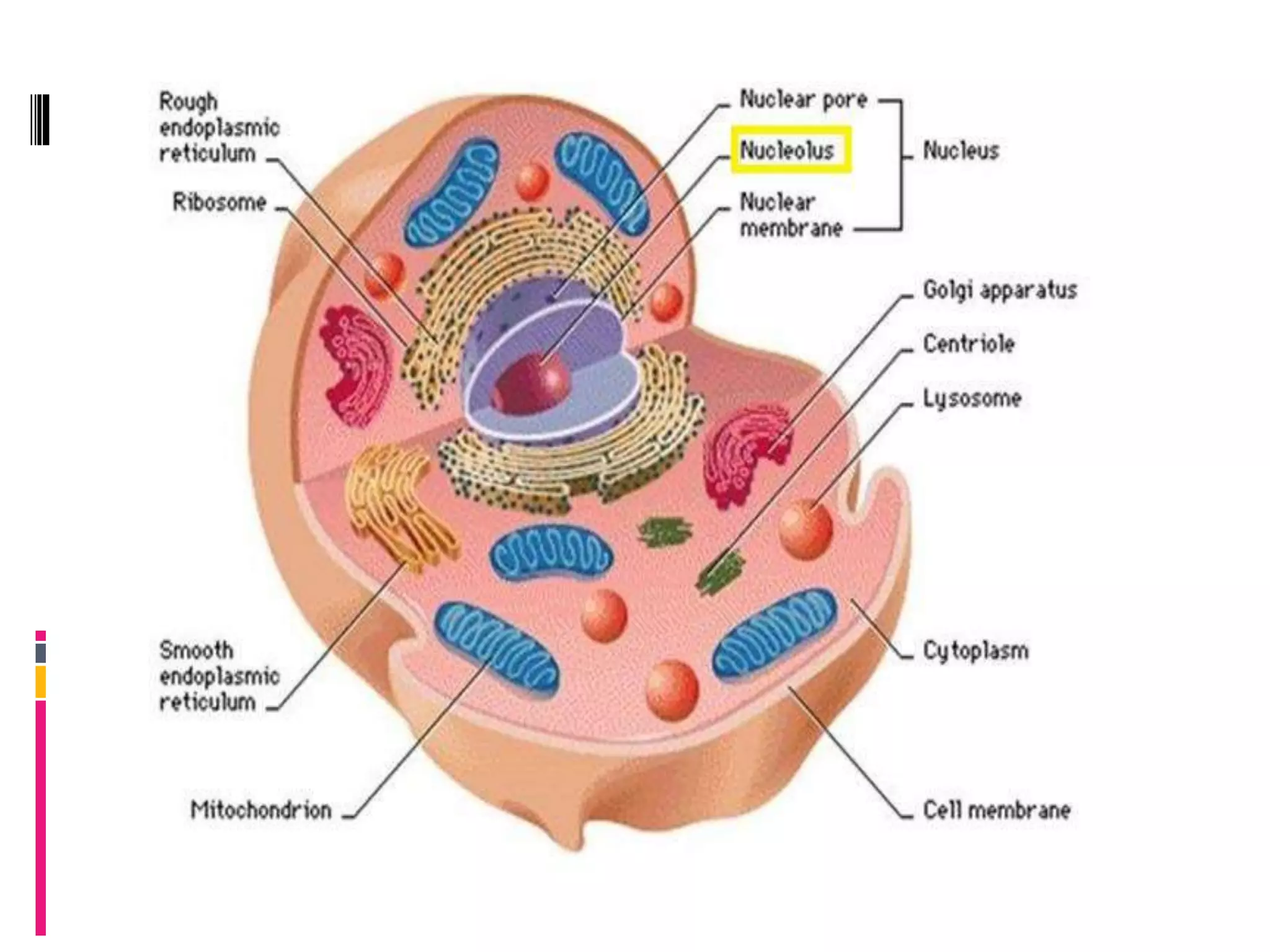
Nucleolus
General information
 Most prominent ovoid structure in a cell nucleus.
 Observed first by Fontana in eel’s skin in 1781 and
extensively studied for over a century.
 In 1934, McClintock related nucleolus with gene
activity.
 In 1950’s the presence of RNAs in the nucleolus was
demonstrated.
 In 1960’s in situ hybridization techniques made it
possible to identify ribosomal genes (rDNAs) in the
nucleolar organizer region(NOR).
 During the same period, mass isolation of
nucleoli became possible leading to the
biochemical characterization of nucleolar
components.
 Between 1980 and 2000, the functional
organization of the nucleolus was deciphered.
 Recently, a new field of investigation was
opened when molecules not involved in
ribosome biogenesis were detected in the
nucleolus.
 Thus, the area of Plurifunctional Nucleolus was
opened.
 It can be easily detected by Phase contrast
microscopy, Differential interference contrast or
Fluorescence microscpy.
 A dynamic structure that is organized around
the chromosomal regions that contain the genes
for 5.8s, 18S and 28S rRNAs.
 Contains relatively little chromosomal DNA but
it is rich in protein and ribonucleoprotein (RNP)
complexes.
 The nucleolus assembles during late telophase,
persists throughout the interphase and then
disassembles as cells enter mitosis.
 Nucleolus forms at specific chromosomal loci
that are called “secondary constrictions” or
“nucleolar organizer region” (NOR).
 NORs were found to consist of tandem arrays of
ribosomal genes (rDNA) that encode 18S, 28S
and 5.8S ribosomal RNAs (rRNAs).
The nucleolus has been proposed as the paradigm of
nuclear functional compartmentalization.
In higher eukaryotes, electron microscopy reveals
that during interphase nucleoli sustain a tripartite
structure:
 Fibrillar Center (FC),
 Dense Fibrillar Compartment (DFC), and
 Granular Center (GC)
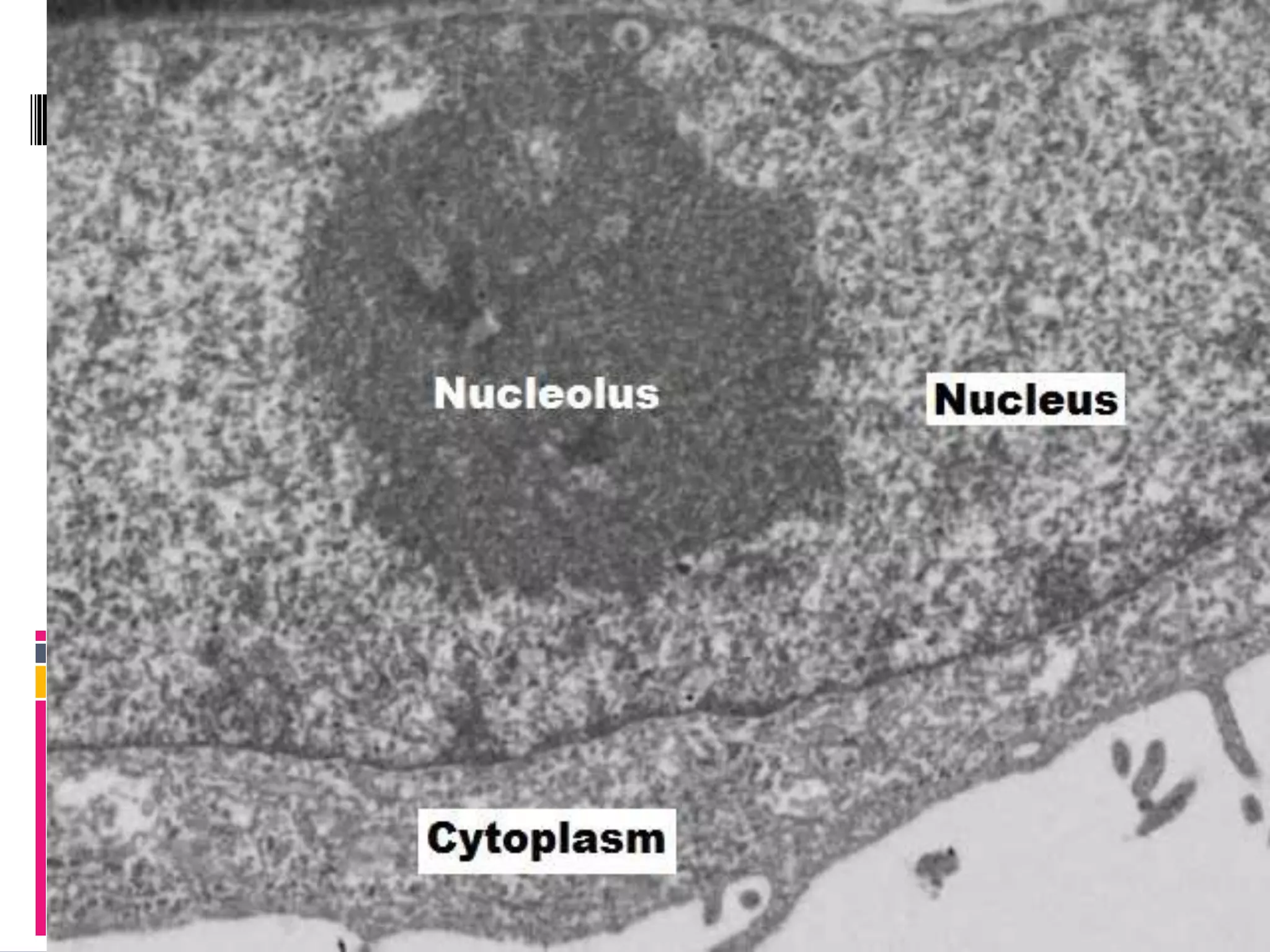
An electron micrograph of a HeLa cell demonstrates that the
nucleolus is comprised of three subcompartments: the fibrillar
center ( FC ), dense fibrillar component ( DFC ), and granular
component ( GC ).
 FCs contain inactive rDNA with the potential to be
directly activated and proteins of the transcription
machinery, such as RNA polymerase I,
Topoisomerase I and Upstream Binding Factor
(UBF).
 The DFC surrounds the FCs and consists of pre-
rRNA and early processing factors.
 The GC contains late processing factors and
ribosomal proteins and ribosomal assembly takes
place here.
It is now broadly accepted that transcription takes
place at the boundary of the FC and the DFC;
instead, rRNA processing begins at the DFC and is
completed in the GC.
Nucleolar proteins
 Ribosome biogenesis
 Histone chaperoning
 Centrosome duplication
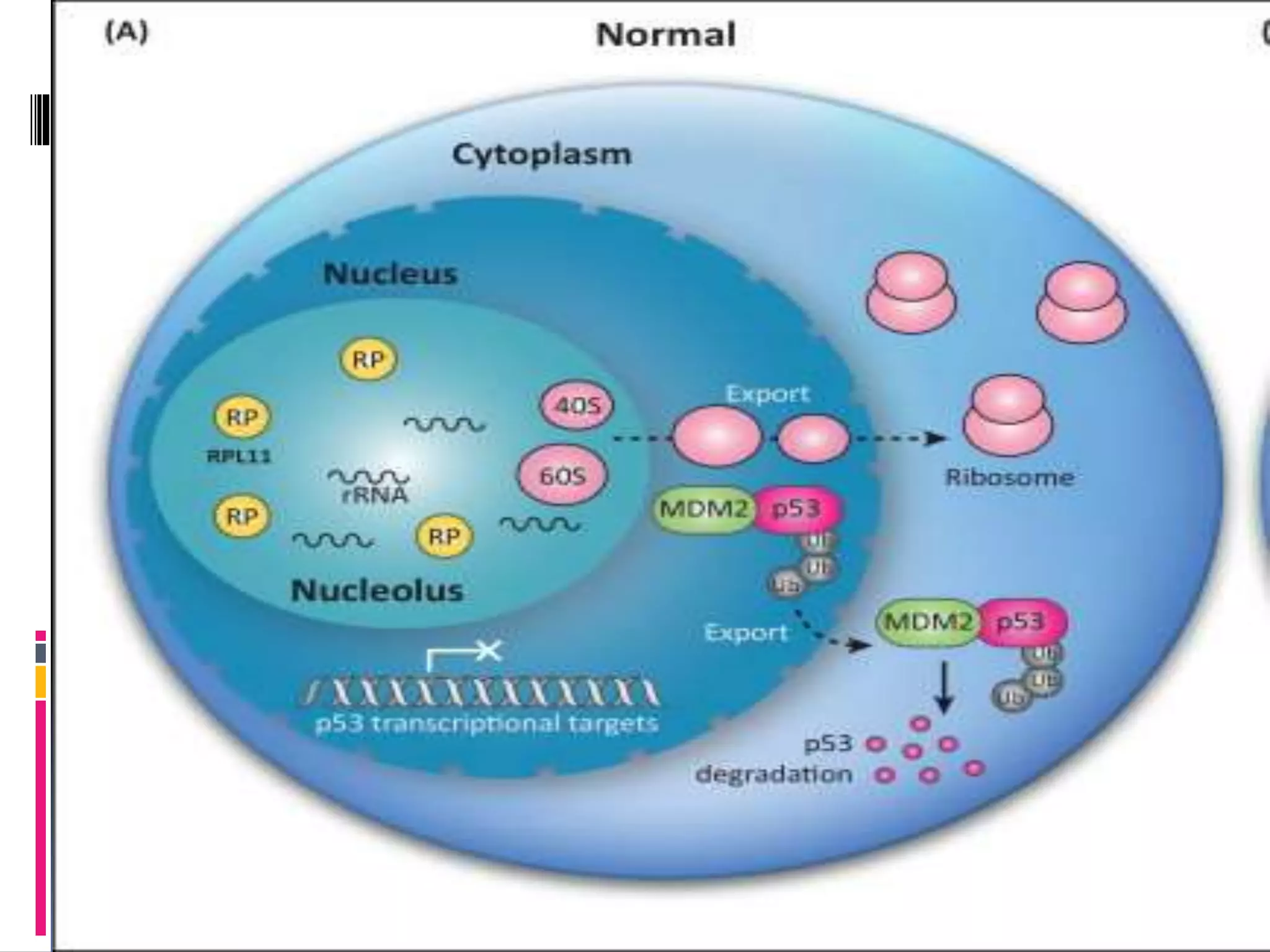
 Can regulate p53-HDM2 axis
 Modulates the HDM2-p53 axis
 Participates in rDNA chromatin remodeling
 Stress response
 Regulates p53 on the translational level.
 Telomerase maintenance.
Nucleophosmin (NPM1 or B23)
Nucleolin (NCL)
 Newly discovered
 Highly expressed by stem cells and cancer cells.
 Regulation of p53
 Cell cycle regulation
 Ribosomal processing pathway
 Key component of the box C/D snoRNP particles.
 Methyltransferase activity
 Spliceosomal snRNAs
 Macromolecular trafficking in plants.
Nucleostemin
Fibrillarin
FUNCTIONS OF NUCLEOLUS
 Ribosome Biosynthesis
 RNA regulatory pathway
 Cell cycle progression
 Genome maintenance
 Stress response
1.Ribosome Biosynthesis
Ribosome Biosynthesis
 Ribosomes are fundamental macromolecular
machines that are the main translation
machinery.
 One of the most energetically demanding of
all cellular processes.
 Requires the coordinated activity of all three
RNA polymerases and the orchestrated work
of many transiently associated ribosome
assembly factors.
80 S
Ribosome
60S subunit
(25S, 5.8S and 5S
rRNA, and 46 r-
proteins)
40S subunit
(containing the 18S
rRNA and 33 r-
proteins)
Small Nucleolar (sno)RNPs in rRNA
modification and processing
 Nucleoside modification of pre-rRNA occurs.
 2 types of modifications:
1. Methylation of 2’-OH group of sugar
residues.
2. Conversion of uridine to pseudouridine.
 The precise role of these modifications
remains unclear.
2. RNA regulatory functions
 EXON JUNCTION PATHWAY:
Nucleolus comprises of 6 EJC proteins :
UAP56, MAGO, ALY/REF, RNPS1, Y14 and
eIF4a-III
Components of EJC :
a. mark splice junctions in mRNAs after
mRNA splicing.
b. Post splicing processes such as export of
mRNA from nucleus to cytoplasm and non-
sense mediated decay (NMD) pathway of
mRNA surveillance.
GENE SILENCING PATHWAY
 Many Proteins involved in the miRNA, hc-
siRNA and ta-siRNA silencing pathways
accumulate within in the nucleolar periphery
which maybe Cajal Bodies.
 CBs maybe seat for assembly, re-cycling,
storage of RNA silencing component and also
site for specific RNA silencing Pathways.
3. Cell cycle progression
Cell cycle progression
 Experiments in which UV microbeam
irradiation of a nucleolus during interphase
resulted in a failure of the cells to reach
mitosis
 Perturbation of nucleolar homeostasis is
known to trigger a prompt arrest of cell cycle
progression
 Nucleolar Factors involved in cell cycle
regulation:
 Cdc 14 - Promotes exit from mitosis.
 Mdm2 - Inhibitor of tumor supressor
protein p53
 p19 - Stabilizes p53
 Pch2 - required in halting meiotic cell cycle
progression.
4.Genome maintenance
Genomemaintenance
 High transcription rates cause topological
stress.
 Leading to cytotoxic DNA double strand
breaks (DSB).
 Inhibition of topoisomerase also induces
DSBs.
 Nucleolus helps in maintenance of genome
stability by DSB repair.
DSB repair
 2 main pathways:
1. Non-homologous end joining pathway
(NHEJ)
2. Homologous recombination pathway (HR).
The HR pathway is considered to be less error
prone.
Telomerase maintenance
 Telomere shortening can lead to
chromosomal degradation causing aging and
untimely death.
 Counteracting telomere shortening :
telomerase activity.
 A preferential nucleolar accumulation was
shown for telomere binding proteins and the
telomerase RNA- binding protein, Dyskerin.
 Null mutants for Nucleolin 1 gene in
Arabidopsis, resulted in shortened telomeres.
5. Stress Response
Biotic and abiotic stresses
in Plants.
Virus interactios
 Nucleolar compartmentalization mechanism
maybe hijacked by viruses.
 Tomato bushy stunt virus responsible for p19
silencing suppressor encoding gene.The ALY
protein redistributes p19 to the nucleolar
region where it cannot reach its target
silencing RNA. ( A novel defense mechanism).
 Coilin depletion could increase systemic
infection by some viruses (barley stripe virus).
Other pathogens
 Potato cyst nematode delivers 2 protein
effectors into the nucleolus to supress host
defense.
 E3 ligase, involved in host resistance against
P.infestans is found in nucleolus.
Abiotic Stress response
 Stress response suppressor 1 and 2 proteins
function as negative regulators of stress
induced gene expression. STRs defective
mutants exhibit enhanced tolerance to salt,
osmotic and heat stress.
 Rab 28 lea over expression of this protein
exhibit relative water content, increased leaf
and root areas, reduced cholorophyll loss
when grown under osmotic stress.
Recent works related to the
Nucleolus
•Cdc14 is essential to fulfill recombinational DNA repair in
yeasts
•After DSB generation, Cdc14 is released
•It targets the Spindle pole body (SPB) component Spc110.
•Counterbalances the phosphorylation by Cdk.
•26S proteasome is intimately linked to nucleolar activity.
•26s proteasome is related with plant growth and
development and controls ribosome biogenesis
•How proteasome might regulate nucleolar functions
should be the next step to better understand the functional
link between the nucleolus and proteasome in plants.
• Oli 2 defiency exhibits pointed leaf phenotype.
•Gdp1 deficiency exhibits reduced number of leaf cells.
•Gdp1 and oli2 double mutants showed impaired cell
proliferation in leaves
•As2, gdp1, oli2 trible mutants did not enhance leaf polarity
and showed several growth defects.
THANK YOU

Multifunctional nucleolus in Plant cell growth and development.
  • 1.
    Multifunctional Nucleolus in PlantCell Growth and Development Presented by : Bhawna Kumari Mishra (A-2017-30-002)
  • 2.
  • 3.
    General information  Mostprominent ovoid structure in a cell nucleus.  Observed first by Fontana in eel’s skin in 1781 and extensively studied for over a century.  In 1934, McClintock related nucleolus with gene activity.  In 1950’s the presence of RNAs in the nucleolus was demonstrated.  In 1960’s in situ hybridization techniques made it possible to identify ribosomal genes (rDNAs) in the nucleolar organizer region(NOR).
  • 4.
     During thesame period, mass isolation of nucleoli became possible leading to the biochemical characterization of nucleolar components.  Between 1980 and 2000, the functional organization of the nucleolus was deciphered.  Recently, a new field of investigation was opened when molecules not involved in ribosome biogenesis were detected in the nucleolus.  Thus, the area of Plurifunctional Nucleolus was opened.
  • 6.
     It canbe easily detected by Phase contrast microscopy, Differential interference contrast or Fluorescence microscpy.  A dynamic structure that is organized around the chromosomal regions that contain the genes for 5.8s, 18S and 28S rRNAs.  Contains relatively little chromosomal DNA but it is rich in protein and ribonucleoprotein (RNP) complexes.
  • 7.
     The nucleolusassembles during late telophase, persists throughout the interphase and then disassembles as cells enter mitosis.  Nucleolus forms at specific chromosomal loci that are called “secondary constrictions” or “nucleolar organizer region” (NOR).  NORs were found to consist of tandem arrays of ribosomal genes (rDNA) that encode 18S, 28S and 5.8S ribosomal RNAs (rRNAs).
  • 9.
    The nucleolus hasbeen proposed as the paradigm of nuclear functional compartmentalization. In higher eukaryotes, electron microscopy reveals that during interphase nucleoli sustain a tripartite structure:  Fibrillar Center (FC),  Dense Fibrillar Compartment (DFC), and  Granular Center (GC)
  • 10.
    An electron micrographof a HeLa cell demonstrates that the nucleolus is comprised of three subcompartments: the fibrillar center ( FC ), dense fibrillar component ( DFC ), and granular component ( GC ).
  • 11.
     FCs containinactive rDNA with the potential to be directly activated and proteins of the transcription machinery, such as RNA polymerase I, Topoisomerase I and Upstream Binding Factor (UBF).  The DFC surrounds the FCs and consists of pre- rRNA and early processing factors.  The GC contains late processing factors and ribosomal proteins and ribosomal assembly takes place here. It is now broadly accepted that transcription takes place at the boundary of the FC and the DFC; instead, rRNA processing begins at the DFC and is completed in the GC.
  • 13.
  • 14.
     Ribosome biogenesis Histone chaperoning  Centrosome duplication  Can regulate p53-HDM2 axis  Modulates the HDM2-p53 axis  Participates in rDNA chromatin remodeling  Stress response  Regulates p53 on the translational level.  Telomerase maintenance. Nucleophosmin (NPM1 or B23) Nucleolin (NCL)
  • 15.
     Newly discovered Highly expressed by stem cells and cancer cells.  Regulation of p53  Cell cycle regulation  Ribosomal processing pathway  Key component of the box C/D snoRNP particles.  Methyltransferase activity  Spliceosomal snRNAs  Macromolecular trafficking in plants. Nucleostemin Fibrillarin
  • 16.
    FUNCTIONS OF NUCLEOLUS Ribosome Biosynthesis  RNA regulatory pathway  Cell cycle progression  Genome maintenance  Stress response
  • 17.
  • 18.
    Ribosome Biosynthesis  Ribosomesare fundamental macromolecular machines that are the main translation machinery.  One of the most energetically demanding of all cellular processes.  Requires the coordinated activity of all three RNA polymerases and the orchestrated work of many transiently associated ribosome assembly factors.
  • 19.
    80 S Ribosome 60S subunit (25S,5.8S and 5S rRNA, and 46 r- proteins) 40S subunit (containing the 18S rRNA and 33 r- proteins)
  • 22.
    Small Nucleolar (sno)RNPsin rRNA modification and processing  Nucleoside modification of pre-rRNA occurs.  2 types of modifications: 1. Methylation of 2’-OH group of sugar residues. 2. Conversion of uridine to pseudouridine.  The precise role of these modifications remains unclear.
  • 27.
  • 28.
     EXON JUNCTIONPATHWAY: Nucleolus comprises of 6 EJC proteins : UAP56, MAGO, ALY/REF, RNPS1, Y14 and eIF4a-III Components of EJC : a. mark splice junctions in mRNAs after mRNA splicing. b. Post splicing processes such as export of mRNA from nucleus to cytoplasm and non- sense mediated decay (NMD) pathway of mRNA surveillance.
  • 29.
    GENE SILENCING PATHWAY Many Proteins involved in the miRNA, hc- siRNA and ta-siRNA silencing pathways accumulate within in the nucleolar periphery which maybe Cajal Bodies.  CBs maybe seat for assembly, re-cycling, storage of RNA silencing component and also site for specific RNA silencing Pathways.
  • 30.
    3. Cell cycleprogression
  • 31.
    Cell cycle progression Experiments in which UV microbeam irradiation of a nucleolus during interphase resulted in a failure of the cells to reach mitosis  Perturbation of nucleolar homeostasis is known to trigger a prompt arrest of cell cycle progression
  • 32.
     Nucleolar Factorsinvolved in cell cycle regulation:  Cdc 14 - Promotes exit from mitosis.  Mdm2 - Inhibitor of tumor supressor protein p53  p19 - Stabilizes p53  Pch2 - required in halting meiotic cell cycle progression.
  • 36.
  • 37.
    Genomemaintenance  High transcriptionrates cause topological stress.  Leading to cytotoxic DNA double strand breaks (DSB).  Inhibition of topoisomerase also induces DSBs.  Nucleolus helps in maintenance of genome stability by DSB repair.
  • 39.
    DSB repair  2main pathways: 1. Non-homologous end joining pathway (NHEJ) 2. Homologous recombination pathway (HR). The HR pathway is considered to be less error prone.
  • 41.
    Telomerase maintenance  Telomereshortening can lead to chromosomal degradation causing aging and untimely death.  Counteracting telomere shortening : telomerase activity.  A preferential nucleolar accumulation was shown for telomere binding proteins and the telomerase RNA- binding protein, Dyskerin.  Null mutants for Nucleolin 1 gene in Arabidopsis, resulted in shortened telomeres.
  • 42.
  • 46.
    Biotic and abioticstresses in Plants.
  • 47.
    Virus interactios  Nucleolarcompartmentalization mechanism maybe hijacked by viruses.  Tomato bushy stunt virus responsible for p19 silencing suppressor encoding gene.The ALY protein redistributes p19 to the nucleolar region where it cannot reach its target silencing RNA. ( A novel defense mechanism).  Coilin depletion could increase systemic infection by some viruses (barley stripe virus).
  • 48.
    Other pathogens  Potatocyst nematode delivers 2 protein effectors into the nucleolus to supress host defense.  E3 ligase, involved in host resistance against P.infestans is found in nucleolus.
  • 49.
    Abiotic Stress response Stress response suppressor 1 and 2 proteins function as negative regulators of stress induced gene expression. STRs defective mutants exhibit enhanced tolerance to salt, osmotic and heat stress.  Rab 28 lea over expression of this protein exhibit relative water content, increased leaf and root areas, reduced cholorophyll loss when grown under osmotic stress.
  • 51.
    Recent works relatedto the Nucleolus
  • 52.
    •Cdc14 is essentialto fulfill recombinational DNA repair in yeasts •After DSB generation, Cdc14 is released •It targets the Spindle pole body (SPB) component Spc110. •Counterbalances the phosphorylation by Cdk.
  • 54.
    •26S proteasome isintimately linked to nucleolar activity. •26s proteasome is related with plant growth and development and controls ribosome biogenesis •How proteasome might regulate nucleolar functions should be the next step to better understand the functional link between the nucleolus and proteasome in plants.
  • 55.
    • Oli 2defiency exhibits pointed leaf phenotype. •Gdp1 deficiency exhibits reduced number of leaf cells. •Gdp1 and oli2 double mutants showed impaired cell proliferation in leaves •As2, gdp1, oli2 trible mutants did not enhance leaf polarity and showed several growth defects.
  • 56.

Editor's Notes

  • #4 3.Because of the difference in the density between the nucleolus and the surrounding nucleoplasm.
  • #5 1. Based on these result it was proposed that ribosome biogenesis occurs in nucleoli.
  • #8 Secondary constriction-I : Nucleolar organizer regions (NOR)- necessary for the formation of nucleolus; appears at one end of the chromosome, part beyond that called satellite chromosome is sat0chromosome.
  • #16 Fib- methylation of rRNA and splicing of snoRNA
  • #19 1.allowing the conversion of information encoded within mRNA into proteins.
  • #21 3. And in doing so it remains attached to those NORs that were active during the previous interphase to ensure the rapid re-initiation of transcription.
  • #38 Due to extensive formation of RNA:DNA hybrids.