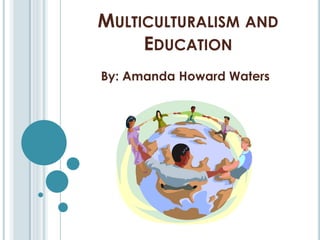
MULTICULTURALISM AND
     EDUCATION
By: Amanda Howard Waters
WHAT IS MULTICULTURALISM?
Multiculturalismis the state or
 condition of being multicultural
 (dictionary.com)
WHAT DOES MULTICULTURAL MEAN?
Consisting  of, relating to, or
 representing several different
 cultures or cultural elements
 (dictionary.com)
WHAT IS MULTICULTURAL EDUCATION?
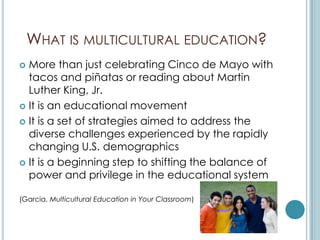
 More than just celebrating Cinco de Mayo with
  tacos and piñatas or reading about Martin
  Luther King, Jr.
 It is an educational movement

 It is a set of strategies aimed to address the
  diverse challenges experienced by the rapidly
  changing U.S. demographics
 It is a beginning step to shifting the balance of
  power and privilege in the educational system

(Garcia, Multicultural Education in Your Classroom)
GOALS OF MULTICULTURAL EDUCATION
 To create a safe, accepting and successful
  learning environment
 To increase awareness of global issues

 To strengthen cultural consciousness

 To strengthen intercultural awareness

 To teach students that there are multiple
  historical perspectives
 To encourage critical thinking

 To prevent prejudice and discrimination


       (Garcia, Multicultural Education in Your Classroom)
ADVANTAGES OF MULTICULTURAL EDUCATION
 According to the National Association for
  Multicultural Education, there are several
  advantages of multicultural education
 Multicultural education:
       Helps students develop positive self-image
       Offers students an equitable educational
        opportunity
       Allows multiple perspectives and ways of thinking
       Combats stereotypes and prejudicial behavior
       Teachers students to critique society in the interest
        of social justice
                  (Garcia, Multicultural Education in Your Classroom)
EARLY EDUCATION TEACHERS
          PLAY A HUGE ROLE
 What happens during a child’s early years
  shapes whether they will be open to or fearful
  of people with different backgrounds than their
  own
 These years determine whether children will
  feel proud or ashamed of their heritage
 You play a crucial role in laying these
  foundations
 Your classrooms are one of the first group
  environments students will encounter outside of
  their homes.
 Your challenge: to make it inclusive and
  respectful!

               (Chang, Many Languages, Many Cultures)
NEW TEACHER EVALUATION TOOL
 Beginning       in August 2008, North Carolina
  began implementing the new NC
  Teacher Evaluation Process (ncpublicschools.org)
 As of August 2010, every teacher in
  North Carolina is evaluated using this
  tool (ncpublicschools.org)
WHAT DOES THE NC TEACHER EVALUATION PROCESS
     HAVE TO DO WITH MULTICULTURALISM?

 This evaluation process is composed of five
  standards and each standard has goals
  beneath them (ncpublicschools.org)
 Standard II is teachers establish a respectful
  environment for a diverse population of
  students (ncpublicschools.org)
STANDARD II GOALS
   Teachers provide an environment in which each
    child has a positive, nurturing relationship with
    caring adults
       encourage an environment that is inviting, respectful,
        supportive, inclusive, and flexible
   Teachers embrace diversity in the school
    community and around the world
     Demonstrate knowledge of diverse cultures
     Select materials and develop lessons that counteract
      stereotypes and incorporate contributions
     Recognize the influences on a child’s development,
      personality, and performance
     Consider and incorporate different points of view

                            (ncpublicschools.org)
STANDARD II GOALS CONTINUED
   Teachers treat students as individuals
     Maintain high expectations for all students
     Appreciate differences and value contributions by
      building positive, appropriate relationships
   Teachers adapt their teaching for the benefit
    of students with special needs
     Collaborate with specialists
     Engage students and ensure to meet the needs of
      students through inclusion and other models of
      effective practice

         (ncpublicschools.org)
STANDARD II GOALS CONTINUED
   Teachers work collaboratively with the families
    and significant adults in the lives of their
    students
     Improve communication and collaboration
      between the school, the home, and the
      community
     Promote trust and understanding and build
      partnerships with school community
     Seek solutions to overcome obstacles that prevent
      family and community involvement

        (ncpublicschools.org)
HOW DO I MEET THESE GOALS?
 You may feel that attaining these goals is
  impossible, but they really are not
 Through this presentation we will look at ways in
  which we can successfully create multicultural
  classrooms
SELF-QUIZ: WHAT
           ARE YOUR ASSUMPTIONS?
   With your co-workers surrounding you, discuss the
    following questions:
       What are the different cultures in our school? (include
        categories such as ethnic groups, students with
        disabilities, new immigrants, residents of public housing,
        and any others that apply)
       What characteristics first come to mind when you think
        of each group?
       Where did these impressions come from? (Peers, family,
        media, religion, etc.)
       How do you treat people based on these impressions?
       Can you remember a time when someone made
        assumptions about you based on a group you belong
        to? How did it make you feel?
                 (Ross, Connect with Kids and Parents of Different Cultures)
WHERE DO OUR BIASES BEGIN?
   The way we react to those who are different than us is
    influenced by many factors:

     Our own personal experiences with those who are
      different than us
     What we’ve heard from our families, peers, the
      media, popular culture, school, religious institutions,
      etc.
     Whether we see ourselves sharing any values,
      goals, ways of doing things, etc. with those who
      are different than ourselves
     How much power we believe those who are
      different have in our society and any laws or
      special programs we know about that affect how
      these people are treated

              (Ross, Connect with Kids and Parents of Different Cultures)
HOW CAN WE BUILD A SHIELD
             AGAINST BIAS?
   Be aware of your assumptions
     Notice when you make a judgment, then figure
      out why and what it is based upon
     Invite an objective outsider to observe you in your
      classroom
   Be aware of cultural differences
       Everything we do is shaped by our culture
       You can learn a lot about other cultures from your
        co-workers
       Organize an after school gathering for all staff
        members to bring a cultural dish and discuss some
        of their cultures characteristics


                (Ross, Connect with Kids and Parents of Different Cultures)
   Keep every student in mind
     Be sensitive to any cultural shocks that new students
      experience
     Be direct and deal with any student biases right away
           For example, a kindergarten teacher shared a story of one of her students who
            had brought her new purse to show and tell. She innocently said that on the
            way to school her mom made her walk faster when an African American male
            was walking behind them, because her mom was afraid he might try to steal
            her new purse. In a situation like this, it’s important to ask the child why their
            mom would have felt that way. Then start a class discussion about how people
            who steal things come in many colors and why it’s a mistake to judge people
            by their outer appearance.

     Establish expectations and clearly communicate them,
      this way no one will feel superior or inferior
     Encourage students to be honest about their fears and
      misconceptions
     Make sure your classroom reflects diversity
           Do the pictures on your walls include a variety of cultures?
           Do you have a multicultural curriculum?

       Familiarize yourself with all the holidays/traditions your
        students celebrate or participate in
                        (Ross, Connect with Kids and Parents of Different Cultures)
A GREAT WAY TO START THE YEAR!
 At the first meeting between you and the parents of
  your students, usually Open House, set the right
  foundation in order to be as knowledgeable as
  possible about your students
 Ask the following questions:
     How would you like us to recognize your child
      ethnically?
     What family traditions would you like us to
      acknowledge?
     What can we learn about your culture to help us be as
      respectful as possible?
     What language, or languages, does your family speak?

                    (Chang, Many Languages, Many Cultures)
RELIGION IN THE CLASSROOM
 As a teacher, you must be careful not to ask a
  student to participate in anything that may
  have an effect on their religious beliefs
 Make sure you are aware of the different
  religious beliefs of your students
       Best way to do this is ask the parents along with the
        other questions at Open House
   Also, make sure that all students’ religions are
    respected and not ridiculed in the classroom
STUDENTS WITH SPECIAL NEEDS
   It is also very important that teachers remain aware of
    their students with special needs
   As a teacher you will be expected to make adaptations
    to your lessons for your students with special needs
   A helpful printable that I found on teachervison.com
    uses an acronym to help teachers before selecting
    possible adaptations
   The acronym is the FLEXIBLE acronym:
       Feasible
       Lively
       Eliminated
       eXplicit
       Intentional
       Beneficial
       Limelight
       Evaluated
   Let’s refer to the FLEXIBLE handout you received
FLEXIBLE ACRONYM
   Feasible
       Successful adaptations must be feasible for the
        classroom teachers to implement
   Lively
       Successful adaptations must be lively, engaging,
        and/or fun
   Eliminated
       Successful adaptations must be developed with
        the goal of working toward independence with a
        gradual fading and eventual elimination of the
        adaptation
FLEXIBLE ACRONYM CONTINUED
   eXplicit
       Successful adaptations must have a definite
        purpose, a purpose that is made explicit to
        students, other professionals in the classroom,
        parents, and if necessary the students peers
   Intentional
       Successful adaptations should be part of a
        comprehensive plan for the student with disabilities
   Beneficial
       Successful adaptations should benefit the student
        with disabilities and either enhance or at least not
        detract from the learning of other students in the
        classroom
FLEXIBLE ACRONYM CONTINUED
   Limelight
       Successful adaptations do not place undue
        attention on the student with the disabilities or put
        the student in a potentially embarrassing situation
   Evaluated
       Successful adaptations are evaluated on an
        ongoing basis
ROAD BLOCKS TO IMPLEMENTING
MULTICULTURAL EDUCATION SUCCESSFULLY
   Not as easy as a yearly celebration or
    supplemental unit here or there
       Require schools to reform their traditional curriculums
   Most curriculums focus on North America and
    Europe more so than any other region
   Multicultural Education is most successful when
    implemented as a school wide approach
   Unfortunately, most institutions are not prepared for
    implementation
   Implementation requires:
     A diverse, culturally competent staff
     Educators must be aware, responsive, and embracing of
      diverse beliefs, perspectives, and experiences
     Must also be willing to address issues of controversy
      (racism, sexism, religious
      intolerance, classism, ageism, etc.)
                     (Garcia, Multicultural Education in Your Classroom)
Let’s make it Eastern
     Elementary’s goal to
multiculturalize our classrooms
and help each of our students
become what they most want
             to be!

               Go Beavers!
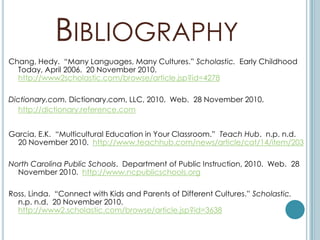
BIBLIOGRAPHY
Chang, Hedy. “Many Languages, Many Cultures.” Scholastic. Early Childhood
  Today, April 2006. 20 November 2010.
  http://www2scholastic.com/browse/article.jsp?id=4278

Dictionary.com. Dictionary.com, LLC, 2010. Web. 28 November 2010.
  http://dictionary.reference.com


Garcia, E.K. “Multicultural Education in Your Classroom.” Teach Hub. n.p. n.d.
  20 November 2010. http://www.teachhub.com/news/article/cat/14/item/203

North Carolina Public Schools. Department of Public Instruction, 2010. Web. 28
  November 2010. http://www.ncpublicschools.org

Ross, Linda. “Connect with Kids and Parents of Different Cultures.” Scholastic.
  n.p. n.d. 20 November 2010.
  http://www2.scholastic.com/browse/article.jsp?id=3638

Multiculturism in the classroom

  • 1.
    MULTICULTURALISM AND EDUCATION By: Amanda Howard Waters
  • 2.
    WHAT IS MULTICULTURALISM? Multiculturalismisthe state or condition of being multicultural (dictionary.com)
  • 3.
    WHAT DOES MULTICULTURALMEAN? Consisting of, relating to, or representing several different cultures or cultural elements (dictionary.com)
  • 4.
    WHAT IS MULTICULTURALEDUCATION?  More than just celebrating Cinco de Mayo with tacos and piñatas or reading about Martin Luther King, Jr.  It is an educational movement  It is a set of strategies aimed to address the diverse challenges experienced by the rapidly changing U.S. demographics  It is a beginning step to shifting the balance of power and privilege in the educational system (Garcia, Multicultural Education in Your Classroom)
  • 5.
    GOALS OF MULTICULTURALEDUCATION  To create a safe, accepting and successful learning environment  To increase awareness of global issues  To strengthen cultural consciousness  To strengthen intercultural awareness  To teach students that there are multiple historical perspectives  To encourage critical thinking  To prevent prejudice and discrimination (Garcia, Multicultural Education in Your Classroom)
  • 6.
    ADVANTAGES OF MULTICULTURALEDUCATION  According to the National Association for Multicultural Education, there are several advantages of multicultural education  Multicultural education:  Helps students develop positive self-image  Offers students an equitable educational opportunity  Allows multiple perspectives and ways of thinking  Combats stereotypes and prejudicial behavior  Teachers students to critique society in the interest of social justice (Garcia, Multicultural Education in Your Classroom)
  • 7.
    EARLY EDUCATION TEACHERS PLAY A HUGE ROLE  What happens during a child’s early years shapes whether they will be open to or fearful of people with different backgrounds than their own  These years determine whether children will feel proud or ashamed of their heritage  You play a crucial role in laying these foundations  Your classrooms are one of the first group environments students will encounter outside of their homes.  Your challenge: to make it inclusive and respectful! (Chang, Many Languages, Many Cultures)
  • 8.
    NEW TEACHER EVALUATIONTOOL  Beginning in August 2008, North Carolina began implementing the new NC Teacher Evaluation Process (ncpublicschools.org)  As of August 2010, every teacher in North Carolina is evaluated using this tool (ncpublicschools.org)
  • 9.
    WHAT DOES THENC TEACHER EVALUATION PROCESS HAVE TO DO WITH MULTICULTURALISM?  This evaluation process is composed of five standards and each standard has goals beneath them (ncpublicschools.org)  Standard II is teachers establish a respectful environment for a diverse population of students (ncpublicschools.org)
  • 10.
    STANDARD II GOALS  Teachers provide an environment in which each child has a positive, nurturing relationship with caring adults  encourage an environment that is inviting, respectful, supportive, inclusive, and flexible  Teachers embrace diversity in the school community and around the world  Demonstrate knowledge of diverse cultures  Select materials and develop lessons that counteract stereotypes and incorporate contributions  Recognize the influences on a child’s development, personality, and performance  Consider and incorporate different points of view (ncpublicschools.org)
  • 11.
    STANDARD II GOALSCONTINUED  Teachers treat students as individuals  Maintain high expectations for all students  Appreciate differences and value contributions by building positive, appropriate relationships  Teachers adapt their teaching for the benefit of students with special needs  Collaborate with specialists  Engage students and ensure to meet the needs of students through inclusion and other models of effective practice (ncpublicschools.org)
  • 12.
    STANDARD II GOALSCONTINUED  Teachers work collaboratively with the families and significant adults in the lives of their students  Improve communication and collaboration between the school, the home, and the community  Promote trust and understanding and build partnerships with school community  Seek solutions to overcome obstacles that prevent family and community involvement (ncpublicschools.org)
  • 13.
    HOW DO IMEET THESE GOALS?  You may feel that attaining these goals is impossible, but they really are not  Through this presentation we will look at ways in which we can successfully create multicultural classrooms
  • 14.
    SELF-QUIZ: WHAT ARE YOUR ASSUMPTIONS?  With your co-workers surrounding you, discuss the following questions:  What are the different cultures in our school? (include categories such as ethnic groups, students with disabilities, new immigrants, residents of public housing, and any others that apply)  What characteristics first come to mind when you think of each group?  Where did these impressions come from? (Peers, family, media, religion, etc.)  How do you treat people based on these impressions?  Can you remember a time when someone made assumptions about you based on a group you belong to? How did it make you feel? (Ross, Connect with Kids and Parents of Different Cultures)
  • 15.
    WHERE DO OURBIASES BEGIN?  The way we react to those who are different than us is influenced by many factors:  Our own personal experiences with those who are different than us  What we’ve heard from our families, peers, the media, popular culture, school, religious institutions, etc.  Whether we see ourselves sharing any values, goals, ways of doing things, etc. with those who are different than ourselves  How much power we believe those who are different have in our society and any laws or special programs we know about that affect how these people are treated (Ross, Connect with Kids and Parents of Different Cultures)
  • 16.
    HOW CAN WEBUILD A SHIELD AGAINST BIAS?  Be aware of your assumptions  Notice when you make a judgment, then figure out why and what it is based upon  Invite an objective outsider to observe you in your classroom  Be aware of cultural differences  Everything we do is shaped by our culture  You can learn a lot about other cultures from your co-workers  Organize an after school gathering for all staff members to bring a cultural dish and discuss some of their cultures characteristics (Ross, Connect with Kids and Parents of Different Cultures)
  • 17.
    Keep every student in mind  Be sensitive to any cultural shocks that new students experience  Be direct and deal with any student biases right away  For example, a kindergarten teacher shared a story of one of her students who had brought her new purse to show and tell. She innocently said that on the way to school her mom made her walk faster when an African American male was walking behind them, because her mom was afraid he might try to steal her new purse. In a situation like this, it’s important to ask the child why their mom would have felt that way. Then start a class discussion about how people who steal things come in many colors and why it’s a mistake to judge people by their outer appearance.  Establish expectations and clearly communicate them, this way no one will feel superior or inferior  Encourage students to be honest about their fears and misconceptions  Make sure your classroom reflects diversity  Do the pictures on your walls include a variety of cultures?  Do you have a multicultural curriculum?  Familiarize yourself with all the holidays/traditions your students celebrate or participate in (Ross, Connect with Kids and Parents of Different Cultures)
  • 18.
    A GREAT WAYTO START THE YEAR!  At the first meeting between you and the parents of your students, usually Open House, set the right foundation in order to be as knowledgeable as possible about your students  Ask the following questions:  How would you like us to recognize your child ethnically?  What family traditions would you like us to acknowledge?  What can we learn about your culture to help us be as respectful as possible?  What language, or languages, does your family speak? (Chang, Many Languages, Many Cultures)
  • 19.
    RELIGION IN THECLASSROOM  As a teacher, you must be careful not to ask a student to participate in anything that may have an effect on their religious beliefs  Make sure you are aware of the different religious beliefs of your students  Best way to do this is ask the parents along with the other questions at Open House  Also, make sure that all students’ religions are respected and not ridiculed in the classroom
  • 20.
    STUDENTS WITH SPECIALNEEDS  It is also very important that teachers remain aware of their students with special needs  As a teacher you will be expected to make adaptations to your lessons for your students with special needs  A helpful printable that I found on teachervison.com uses an acronym to help teachers before selecting possible adaptations  The acronym is the FLEXIBLE acronym:  Feasible  Lively  Eliminated  eXplicit  Intentional  Beneficial  Limelight  Evaluated  Let’s refer to the FLEXIBLE handout you received
  • 21.
    FLEXIBLE ACRONYM  Feasible  Successful adaptations must be feasible for the classroom teachers to implement  Lively  Successful adaptations must be lively, engaging, and/or fun  Eliminated  Successful adaptations must be developed with the goal of working toward independence with a gradual fading and eventual elimination of the adaptation
  • 22.
    FLEXIBLE ACRONYM CONTINUED  eXplicit  Successful adaptations must have a definite purpose, a purpose that is made explicit to students, other professionals in the classroom, parents, and if necessary the students peers  Intentional  Successful adaptations should be part of a comprehensive plan for the student with disabilities  Beneficial  Successful adaptations should benefit the student with disabilities and either enhance or at least not detract from the learning of other students in the classroom
  • 23.
    FLEXIBLE ACRONYM CONTINUED  Limelight  Successful adaptations do not place undue attention on the student with the disabilities or put the student in a potentially embarrassing situation  Evaluated  Successful adaptations are evaluated on an ongoing basis
  • 24.
    ROAD BLOCKS TOIMPLEMENTING MULTICULTURAL EDUCATION SUCCESSFULLY  Not as easy as a yearly celebration or supplemental unit here or there  Require schools to reform their traditional curriculums  Most curriculums focus on North America and Europe more so than any other region  Multicultural Education is most successful when implemented as a school wide approach  Unfortunately, most institutions are not prepared for implementation  Implementation requires:  A diverse, culturally competent staff  Educators must be aware, responsive, and embracing of diverse beliefs, perspectives, and experiences  Must also be willing to address issues of controversy (racism, sexism, religious intolerance, classism, ageism, etc.) (Garcia, Multicultural Education in Your Classroom)
  • 25.
    Let’s make itEastern Elementary’s goal to multiculturalize our classrooms and help each of our students become what they most want to be! Go Beavers!
  • 26.
    BIBLIOGRAPHY Chang, Hedy. “ManyLanguages, Many Cultures.” Scholastic. Early Childhood Today, April 2006. 20 November 2010. http://www2scholastic.com/browse/article.jsp?id=4278 Dictionary.com. Dictionary.com, LLC, 2010. Web. 28 November 2010. http://dictionary.reference.com Garcia, E.K. “Multicultural Education in Your Classroom.” Teach Hub. n.p. n.d. 20 November 2010. http://www.teachhub.com/news/article/cat/14/item/203 North Carolina Public Schools. Department of Public Instruction, 2010. Web. 28 November 2010. http://www.ncpublicschools.org Ross, Linda. “Connect with Kids and Parents of Different Cultures.” Scholastic. n.p. n.d. 20 November 2010. http://www2.scholastic.com/browse/article.jsp?id=3638

Editor's Notes

  • #22 Discuss the different questions that the FLEXIBLE acronym refer to in order to help select possible adaptations to lesson for students with special needs.