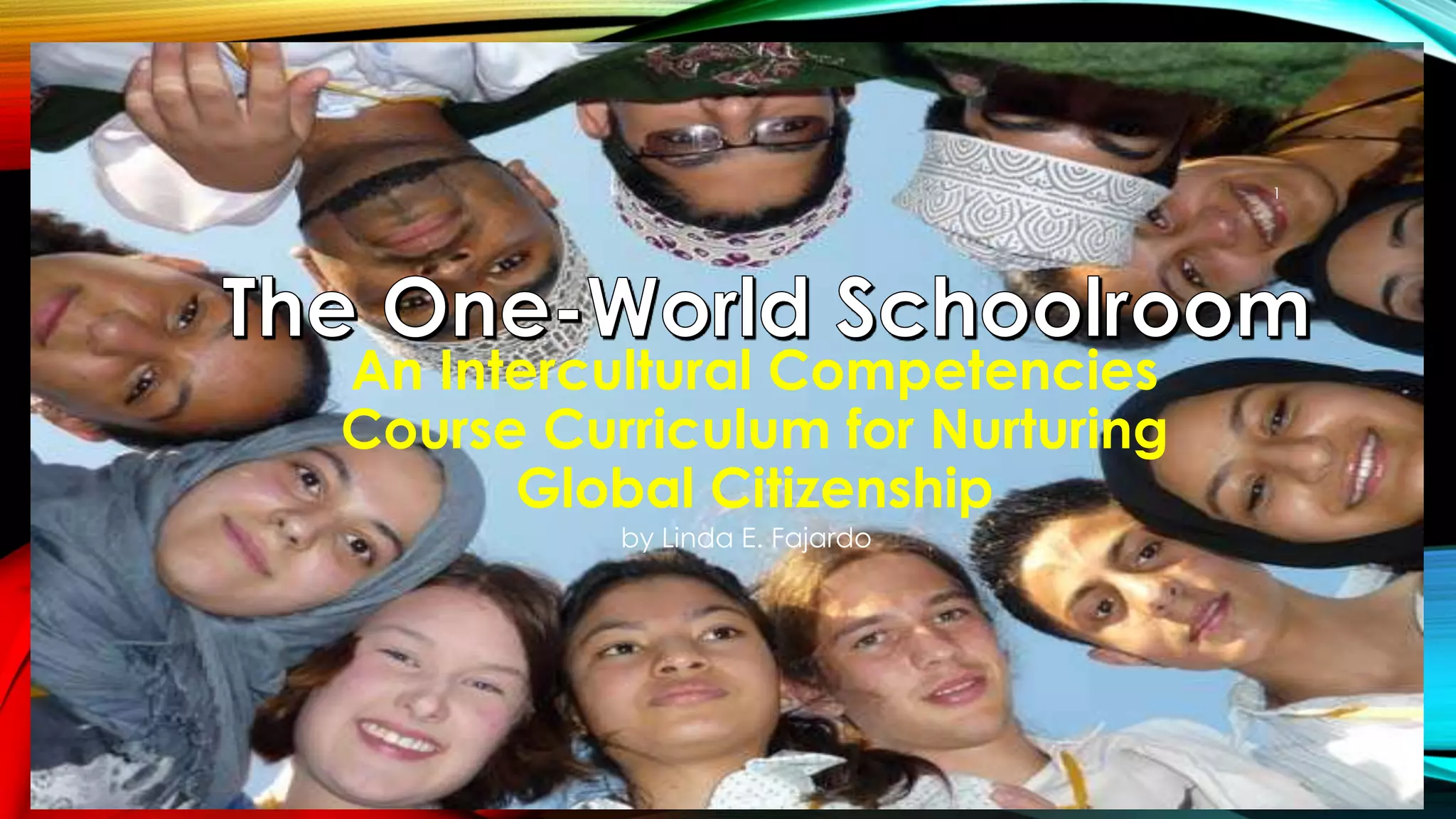
An Intercultural Competencies
Course Curriculum for Nurturing
Global Citizenship
by Linda E. Fajardo
1
MISSION STATEMENT
The mission of this curriculum is to prepare our
students to competitively enter the world stage as
individuals who have been unequivocally
predisposed to practicing intercultural
competencies through experiential learning.
This curriculum will be implemented within the K-12
Social Studies Core Curriculum of Broward County
Public Schools’ Innovative Programs, in any one of
the 21 High Theme programs offered, i.e.,
International Baccalaureate and Liberal Arts
Programs; Communications; International Affairs
and Business, etc.
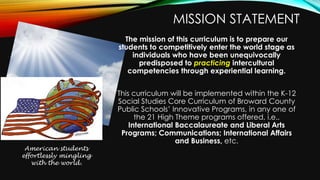
American students
effortlessly mingling
with the world.
2
CURRICULUM NEEDS
No. The Florida Department of Education’s
“CPALMS” website (Curriculum Planning and
Learning Management) indicates there is no
course dedicated to teaching Florida students
intercultural competencies.
Does the FLDOE
currently offer Florida
students this course?
3
CURRICULUM NEEDS:
EXISTING CURRICULUM
• Currently, CPALMS offers a “Multicultural Studies” course, it simply teaches
students the facts of how multiculturalism has impacted American society:
“[T]he chronological development of multicultural
and multiethnic groups in the United States and their
influence on the development of American culture.
Content should include, but is not limited to:
 the influence of geography on the
social and economic development
of Native American culture
 the influence of major historical
events on the development of a
multicultural American society
 a study of the political, economic
and social aspects of Native
American, Hispanic American,
African American and Asian
American culture.”
4
CURRICULUM NEEDS
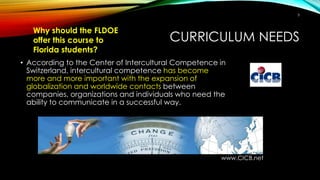
• According to the Center of Intercultural Competence in
Switzerland, intercultural competence has become
more and more important with the expansion of
globalization and worldwide contacts between
companies, organizations and individuals who need the
ability to communicate in a successful way.
www.CICB.net
Why should the FLDOE
offer this course to
Florida students?
5
CURRICULUM NEEDS
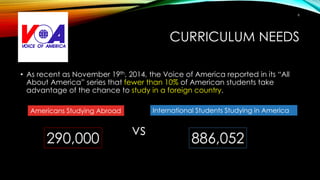
• As recent as November 19th, 2014, the Voice of America reported in its “All
About America” series that fewer than 10% of American students take
advantage of the chance to study in a foreign country.
Americans Studying Abroad International Students Studying in America
vs
290,000 886,052
6
CURRICULUM NEEDS
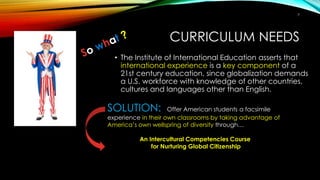
• The Institute of International Education asserts that
international experience is a key component of a
21st century education, since globalization demands
a U.S. workforce with knowledge of other countries,
cultures and languages other than English.
SOLUTION: Offer American students a facsimile
experience in their own classrooms by taking advantage of
America’s own wellspring of diversity through…
An Intercultural Competencies Course
for Nurturing Global Citizenship
7
CURRICULUM NEEDS: STUDENT
SELECTION PROCESS
• As previously explained, the best platform within which to begin teaching this curriculum
will be at schools that already support innovative programs with special application
procedures, thus allowing administrators to hand-pick an effective combination of
students for the success of this course.
• Specific selection criteria are already implemented by the FLDOE for program like STEM
and International Baccalaureate.
• With this course, however, student criteria will go beyond traditional rankings and GPA
requirements. In addition to those, this curriculum will choose students according their:
• gender
• race
• religion
• culture
• secondary language proficiency
• Of course, as with the other innovative programs students’ parents/guardians have
specifically sought out this kind of intercultural exposure and would be fully aware of the
sensitive criteria required to create a global microcosm within one classroom.
8
WHAT IS INTERCULTURAL
COMPETENCY?
• Evolving one’s intercultural social and communication skills toward a more
transparent way of:
• expressing point of view
• being clear with intentions
• aiming to be understood and respected
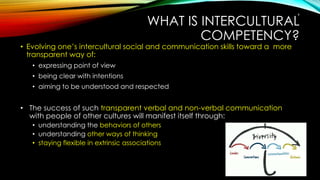
• The success of such transparent verbal and non-verbal communication
with people of other cultures will manifest itself through:
• understanding the behaviors of others
• understanding other ways of thinking
• staying flexible in extrinsic associations
9
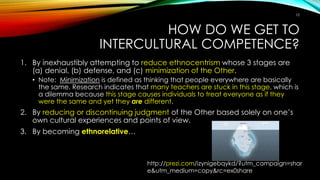
HOW DO WE GET TO
INTERCULTURAL COMPETENCE?
1. By inexhaustibly attempting to reduce ethnocentrism whose 3 stages are
(a) denial, (b) defense, and (c) minimization of the Other.
• Note: Minimization is defined as thinking that people everywhere are basically
the same. Research indicates that many teachers are stuck in this stage, which is
a dilemma because this stage causes individuals to treat everyone as if they
were the same and yet they are different.
2. By reducing or discontinuing judgment of the Other based solely on one’s
own cultural experiences and points of view.
3. By becoming ethnorelative…
10
http://prezi.com/izynigebqykd/?utm_campaign=shar
e&utm_medium=copy&rc=ex0share
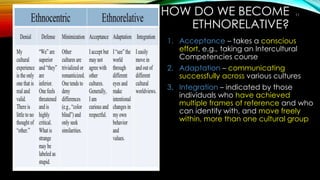
HOW DO WE BECOME
ETHNORELATIVE?
1. Acceptance – takes a conscious
effort, e.g., taking an Intercultural
Competencies course
2. Adaptation – communicating
successfully across various cultures
3. Integration – indicated by those
individuals who have achieved
multiple frames of reference and who
can identify with, and move freely
within, more than one cultural group
11
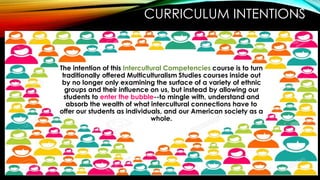
CURRICULUM INTENTIONS
The intention of this Intercultural Competencies course is to turn
traditionally offered Multiculturalism Studies courses inside out
by no longer only examining the surface of a variety of ethnic
groups and their influence on us, but instead by allowing our
students to enter the bubble--to mingle with, understand and
absorb the wealth of what intercultural connections have to
offer our students as individuals, and our American society as a
whole.
12
SUPPORTING LITERATURE (1)
• Sleeter, C. E. (2001, March)
PREPARING TEACHERS FOR CULTURALLY DIVERSE SCHOOLS:
Research and the Overwhelming Presence of Whiteness.
Journal of Teacher Education, 52(2), 94-106. doi:10.1177/0022487101052002002
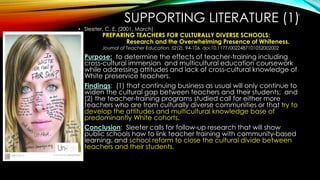
• Purpose: to determine the effects of teacher-training including
cross-cultural immersion and multicultural education coursework
while addressing attitudes and lack of cross-cultural knowledge of
White preservice teachers.
• Findings: (1) that continuing business as usual will only continue to
widen the cultural gap between teachers and their students; and
(2) the teacher-training programs studied call for either more
teachers who are from culturally diverse communities or that try to
develop the attitudes and multicultural knowledge base of
predominantly White cohorts.
• Conclusion: Sleeter calls for follow-up research that will show
public schools how to link teacher training with community-based
learning, and school reform to close the cultural divide between
teachers and their students.
13
SUPPORTING LITERATURE (2)
• Mydland, L. (2011, September 15)
The legacy of one-room schoolhouses:
A comparative study of the American Midwest and Norway.
European Journal of American Studies [Online], 6(1), 1-20. doi:10.4000/ejas.9205
• Purpose: a comparative study of the
American Midwest and the country of Norway
exploring the one-room schoolhouse in terms
of the societies’ differing value systems and
the power of the one-room schoolhouse in the
indoctrination of a society’s values.
• Findings/Conculsion: that the American
schoolhouse has been an object of heritage
with high national symbolic values, reflecting
the development of the nation and acting as
the “impetuses in political society” which were
establishing and maintaining national
common values.
14
SUPPORTING LITERATURE (3)
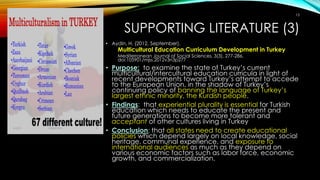
• Aydin, H. (2012, September).
Multicultural Education Curriculum Development in Turkey
Mediterranean Journal of Social Sciences, 3(3), 277-286.
doi:105901/mjss.2012v3n3p277
• Purpose: to examine the state of Turkey’s current
multicultural/intercultural education curricula in light of
recent developments toward Turkey’s attempt to accede
to the European Union, in the shadow of Turkey’s
continuing policy of banning the language of Turkey’s
largest ethnic minority, the Kurdish people.
• Findings: that experiential plurality is essential for Turkish
education which needs to educate the present and
future generations to become more tolerant and
acceptant of other cultures living in Turkey
• Conclusion: that all states need to create educational
policies which depend largely on local knowledge, social
heritage, communal experience, and exposure to
international audiences as much as they depend on
various economic factors such as labor force, economic
growth, and commercialization.
15
SUPPORTING LITERATURE (4)
• Moon, S. (2010)
Multicultural and Global Citizenship in the Transnational Age:
The Case of South Korea
International Journal of Multicultural Education, 12(1), 15. Retrieved 2014, from http://www.ijme-
journal.org/index.php/ijme/article/view/261/392
• Purpose: to demonstrate the paradigm shift necessary in methods of
teaching multicultural citizenship and global citizenship in this world that has
“changed from a space of ‘places’ to a space of ‘flows’…[where] people
residing in the transnational world need to develop new notions of
citizenship.” Moon explains that because the traditional understanding of a
nation-state with its homogenous culture and society has been “challenged
by a transnational population of immigrants,” multicultural education must
now meet that challenge and go beyond the “limited nation-state border
to the global community.”
• Findings: that the “global context [of] educating students to function in one
nation-state does not prepare them for global citizenship” as this would be
“inconsistent with the racial, ethnic, and cultural realities” …as “outside
forces of globalization interrupt the nation-state’s position as the
predominant unit of social organization.”
• Conclusion: in keeping with the founding ideology of Korea in 2333 BC,
which states that “the purpose of Korean education is to cultivate Korean
citizens to contribute to democracy and mutual prosperity of all human
beings,” Korean “educators and policy makers should think about how to
educate citizens that meet the needs of a transnational and cosmopolitan
society.”
16
SUPPORTING LITERATURE (5)
• Dervin, F., Paatela-Nieminen, M., Kuoppala, K., & Riitaoja, A.-L. (2012)
Multicultural Education in Finland:
Renewed Intercultural Competencies to the Rescue?
International Journal of Multicultural Education, 14(3), 1-13. Retrieved November
2014, from http://ijme-journal.org/index.php/ijme/article/view/564/784
• Purpose: to investigate intercultural competencies in the
European and Nordic country of Finland, including present
uses of multicultural education and the perception of
intercultural competencies by decision-makers, researchers
and teachers.
• Findings: the Finnish core curriculum approaches
multicultural education as if the majority and minority groups
were taught separately thereby not taking into consideration
the multiple diversities within majority student populations in
Finland; “multiculturalism has remained trapped within a set
of nation-centric assumptions as it continues to address issues
of cultural diversity within a national framework.”
• Conclusion: the way forward in Finland could lie in increasingly
glocally-oriented multicultural education that has its roots in cultural-
historical analysis and global ethics in terms of ethical engagement
with the Other.
17
CURRICULUM VALUE AND OBJECTIVES
(IMPERATIVES: INTEGRATION
AND RELEVANCE)
• To improve American students’ intercultural social skills and intercultural
communication skills by improving their sensitivity and understanding for other
cultures’:
• values
• points of view
• ways of living
• ways of thinking
• Furthermore, by American students improving themselves by learning to be self-
conscious while transferring one’s own values and views in a clear way, yet
appropriate for the culture being addressed.
• Overall, students will develop intercultural flexibility, humor, patience, openness,
interest, curiosity, empathy, tolerance for ambiguity, and suspending judgment,
among others.
18
PHILOSOPHICAL FOUNDATIONS
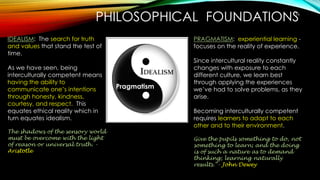
PRAGMATISM: experiential learning -
focuses on the reality of experience.
Since intercultural reality constantly
changes with exposure to each
different culture, we learn best
through applying the experiences
we’ve had to solve problems, as they
arise.
Becoming interculturally competent
requires learners to adapt to each
other and to their environment.
Give the pupils something to do, not
something to learn; and the doing
is of such a nature as to demand
thinking; learning naturally
results.”- John Dewey
IDEALISM: The search for truth
and values that stand the test of
time.
As we have seen, being
interculturally competent means
having the ability to
communicate one’s intentions
through honesty, kindness,
courtesy, and respect. This
equates ethical reality which in
turn equates idealism.
The shadows of the sensory world
must be overcome with the light
of reason or universal truth. -
Aristotle
Pragmatism
19
LEARNING EXPERIENCES:
WHAT WILL THEY DO?
• To begin, students will learn the conceptual
difference between Multiculturalism Studies and
Intercultural Competencies, thereby grasping the
purpose and goals of this particular year-long
course.
• Next, students will begin by choosing a target
culture and its language. [Note: whereas
proficiency in a second language would
complement the student’s experience, it will not be
a curriculum pre-requisite.]
• For the target culture, learners will:
1) explore its Family, Education, Law and Order or
Power and Politics;
2) gather material outside the classroom in relation
with these cultural topics;
20
LEARNING EXPERIENCES:
WHAT WILL THEY DO?
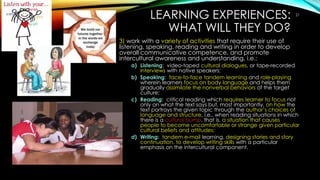
3) work with a variety of activities that require their use of
listening, speaking, reading and writing in order to develop
overall communicative competence, and promote
intercultural awareness and understanding, i.e.:
a) Listening: video-taped cultural dialogues, or tape-recorded
interviews with native speakers;
b) Speaking: face-to-face tandem learning and role-playing
wherein learners focus on body language and helps them
gradually assimilate the nonverbal behaviors of the target
culture;
c) Reading: critical reading which requires learner to focus not
only on what the text says but, most importantly, on how the
text portrays the given topic through the author’s choices of
language and structure, i.e., when reading situations in which
there is a cultural bump, that is, a situation that causes
people to become uncomfortable or strange given particular
cultural beliefs and attitudes;
d) Writing: tandem e-mail learning, designing stories and story
continuation, to develop writing skills with a particular
emphasis on the intercultural component.
21
EVALUATION APPROACHES
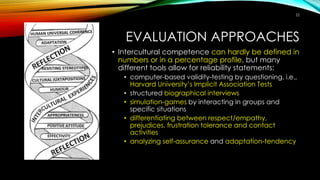
• Intercultural competence can hardly be defined in
numbers or in a percentage profile, but many
different tools allow for reliability statements:
• computer-based validity-testing by questioning, i.e.,
Harvard University’s Implicit Association Tests
• structured biographical interviews
• simulation-games by interacting in groups and
specific situations
• differentiating between respect/empathy,
prejudices, frustration tolerance and contact
activities
• analyzing self-assurance and adaptation-tendency
22
CURRICULUM’S DESIGN
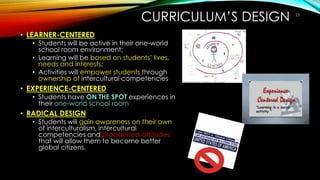
• LEARNER-CENTERED
• Students will be active in their one-world
school room environment;
• Learning will be based on students’ lives,
needs and interests;
• Activities will empower students through
ownership of intercultural competencies
• EXPERIENCE-CENTERED
• Students have ON THE SPOT experiences in
their one-world school room
• RADICAL DESIGN
• Students will gain awareness on their own
of interculturalism, intercultural
competencies and broadened attitudes
that will allow them to become better
global citizens.
23
SOURCES FOR CURRICULUM
DESIGN
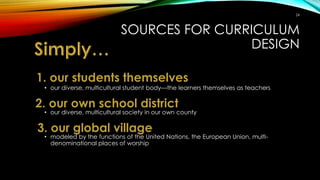
• our diverse, multicultural student body—the learners themselves as teachers
• our diverse, multicultural society in our own county
• modeled by the functions of the United Nations, the European Union, multi-
denominational places of worship
24
IMPERATIVES:
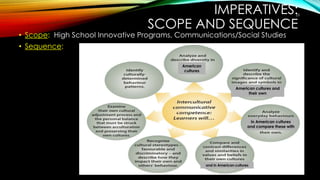
SCOPE AND SEQUENCE
• Scope: High School Innovative Programs, Communications/Social Studies
• Sequence:
American
cultures
American cultures and
their own
in American cultures
and compare these with
and in American cultures
25
IMPERATIVES:
SCOPE AND SEQUENCE
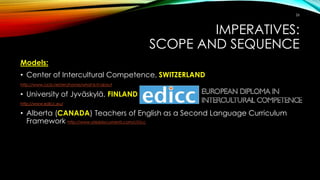
Models:
• Center of Intercultural Competence, SWITZERLAND
http://www.cicb.net/en/home/what-is-it-about
• University of Jyväskylä, FINLAND
http://www.edicc.eu/
• Alberta (CANADA) Teachers of English as a Second Language Curriculum
Framework http://www.atesldocuments.com/cf/icc
26
IMPERATIVES:
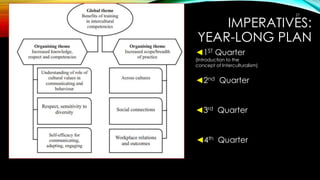
YEAR-LONG PLAN
◄1ST Quarter
(Introduction to the
concept of Interculturalism)
◄2nd Quarter
◄3rd Quarter
◄4th Quarter
27
IMPERATIVES:
THREE AXES OF ARTICULATION
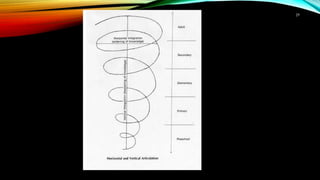
• VERTICAL: this curriculum can be taught throughout the length of
primary and secondary education (K-12) and therefore highlights
the continuity and value of learning Intercultural Competencies
• HORIZONTAL: this curriculum is naturally organized with horizontal
articulation since several classes across the curriculum can (and
should be) planned to simultaneously attempt to accomplish the
same objectives as this core Communications/Social Studies
course;
• INTERDISCIPLINARY and MULTIDISCIPLINARY: the study of
Intercultural Competencies as a school subject will associate with
other disciplines in the curriculum as it will reinforce what students
are learning in other disciplines that highlight other cultures.
28
29
SUNSHINE STATE STANDARDS
• Language Arts:
• LA.A.2.4.8 - construct meaning from a wide range of texts, synthesize information,
and draw conclusions
• LAAC.1.4.4 - identify bias, prejudice, or propaganda in oral
• LA.D.l.4.2 - recognize the shifts in language from informal to formal, social and
academic; and to refrain from gender and cultural biases when expressing
language
• LA.D.1.4.3 - understand that differences exist in dialects in the English language
• LA.D.2.4.1 – understand that language is a powerful tool in shaping the "reactions,
perceptions, and beliefs of the local, national, and global communities“
• LA.E.l .4.3 - understand multiple literary forms prevalent in the literature of all cultures
• LA.E.l.4.5 - recognize different styles, themes, and structures of literary forms within a
cultural and historical context
• LAE.2.4.8 - think about and respond critically to various texts and forms of literature,
knowing that individuals respond differently based on "their background knowledge,
purpose, and point of view''
30
http://digitalcommons.fiu.edu/cgi/viewcontent.cgi?article=1018&context=sferc
SUNSHINE STATE STANDARDS
• Social Studies:
• SS.912.P.10.1 - Define culture and diversity.
• SS.912.P.10.11 - Discuss the psychological research on gender and how the roles of women and men in societies are perceived.
• SS.912.P.10.12 - Examine how perspectives affect stereotypes and treatment of minority and majority groups in society.
• SS.912.P.10.2 - Identify how cultures change over time and vary within nations and internationally.
• SS.912.P.10.3 - Discuss the relationship between culture and conceptions of self and identity.
• SS.912.P.10.6 - Discuss how privilege and social power structures relate to stereotypes, prejudice, and discrimination.
• SS.912.P.10.8 - Discuss psychological research examining diversity in sexual orientation.
• SS.912.P.14.4 - Explain the role of culture in human motivation.
• SS.912.P.15.5 - Explain how culture and gender influence emotional interpretation and expression.
• SS.912.P.16.11 - Analyze how individualistic and collectivistic cultural perspectives relate to personality.
• SS.912.P.6.17 - Describe social, cultural, and emotional development through childhood.
• SS.912.P.9.5 - Describe effects of others’ presence on individuals’ behavior.
• SS.912.P.9.8 - Discuss the nature and effects of stereotyping, prejudice, and discrimination.
• SS.912.S.1.8 - Identify, evaluate and use appropriate reference materials and technology to interpret information about cultural life in the
United States and other world cultures, both in the past and today.
• SS.912.S.2.1 - Define the key components of a culture, such as knowledge, language and communication, customs, values, norms, and
physical objects.
• SS.912.S.2.12 - Compare and contrast ideas about citizenship and cultural participation from the past with those of the present community.
• SS.912.H.3.3 - Identify contributions made by various world cultures through trade and communication, and form a hypothesis on future
contributions and changes.
• etc., etc., etc.
31
http://www.cpalms.org/Standards/Standards_Coding_Schema.aspx
WIGGINS AND MCTIGHE:
UNDERSTANDING
• This Intercultural Competencies curriculum will give students knowledge,
understanding and skills that will lead them to have sophisticated insights
and abilities in intercultural communications and social skills.
• Students’ skills will be reflected in the context of the successful intercultural
connections they build throughout their K-12 experience with which mastery
will come as a result of their experiential learning in their one-world
schoolroom and beyond.
• This curriculum will move students through knowledge acquisition toward
understanding by (1) inexhaustibly attempting to reduce ethnocentrism,
specifically minimization of the Other, (2) by reducing or discontinuing
judgment of the Other based solely on one’s own cultural experiences and
points of view, and (3) by becoming ethnorelative…(see Slides #10-11)
32
McTighe & Wiggins
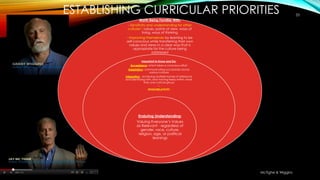
ESTABLISHING CURRICULAR PRIORITIES
Worth Being Familiar With:
- Sensitivity and understanding for other
cultures’: values, points of view, ways of
living, ways of thinking
- Improving themselves by learning to be
self-conscious while transferring their own
values and views in a clear way that is
appropriate for the culture being
addressed
Important to Know and Do:
Acceptance: which takes a conscious effort
Adaptation: communicating successfully across
various cultures
Integration: achieving multiple frames of reference
and identifying with, and moving freely within, more
than one cultural group
=
ETHNORELATIVITY
Enduring Understanding:
Valuing Everyone’s Values
as Relevant - regardless of
gender, race, culture,
religion, age, or political
leanings
33
McTighe & Wiggins
WIGGINS AND MCTIGHE:
TWO SAMPLE ASSESSMENTS
• Students will read about human rights violations and will engage in several
activities for them to think critically about how the situation might have changed
if the violating society had been interculturally competent.
• Involvement in the Model United Nations program: member states (student
groups will) realize that the expanding problems of a planet know no national
boundaries and understand that poverty, disease and pollution are a few of the
plagues affecting citizens of all states. Some policies (official or non-official) of
member states do not agree with the stated community goals of the UN.
However, all members choose to remain members of the UN despite their
differences - demonstrating the importance nations place on the institution.
Theories on why states participate are gaining a new focus on the emerging
global community and placing less emphasis on the state.
34
http://students.jccc.edu/orgs/un/valueMUN.htm#part2 McTighe & Wiggins
35

Global Citizenship: A One-World Curriculum for Intercultural Competence (L. Fajardo)

  • 1.
    An Intercultural Competencies CourseCurriculum for Nurturing Global Citizenship by Linda E. Fajardo 1
  • 2.
    MISSION STATEMENT The missionof this curriculum is to prepare our students to competitively enter the world stage as individuals who have been unequivocally predisposed to practicing intercultural competencies through experiential learning. This curriculum will be implemented within the K-12 Social Studies Core Curriculum of Broward County Public Schools’ Innovative Programs, in any one of the 21 High Theme programs offered, i.e., International Baccalaureate and Liberal Arts Programs; Communications; International Affairs and Business, etc. American students effortlessly mingling with the world. 2
  • 3.
    CURRICULUM NEEDS No. TheFlorida Department of Education’s “CPALMS” website (Curriculum Planning and Learning Management) indicates there is no course dedicated to teaching Florida students intercultural competencies. Does the FLDOE currently offer Florida students this course? 3
  • 4.
    CURRICULUM NEEDS: EXISTING CURRICULUM •Currently, CPALMS offers a “Multicultural Studies” course, it simply teaches students the facts of how multiculturalism has impacted American society: “[T]he chronological development of multicultural and multiethnic groups in the United States and their influence on the development of American culture. Content should include, but is not limited to:  the influence of geography on the social and economic development of Native American culture  the influence of major historical events on the development of a multicultural American society  a study of the political, economic and social aspects of Native American, Hispanic American, African American and Asian American culture.” 4
  • 5.
    CURRICULUM NEEDS • Accordingto the Center of Intercultural Competence in Switzerland, intercultural competence has become more and more important with the expansion of globalization and worldwide contacts between companies, organizations and individuals who need the ability to communicate in a successful way. www.CICB.net Why should the FLDOE offer this course to Florida students? 5
  • 6.
    CURRICULUM NEEDS • Asrecent as November 19th, 2014, the Voice of America reported in its “All About America” series that fewer than 10% of American students take advantage of the chance to study in a foreign country. Americans Studying Abroad International Students Studying in America vs 290,000 886,052 6
  • 7.
    CURRICULUM NEEDS • TheInstitute of International Education asserts that international experience is a key component of a 21st century education, since globalization demands a U.S. workforce with knowledge of other countries, cultures and languages other than English. SOLUTION: Offer American students a facsimile experience in their own classrooms by taking advantage of America’s own wellspring of diversity through… An Intercultural Competencies Course for Nurturing Global Citizenship 7
  • 8.
    CURRICULUM NEEDS: STUDENT SELECTIONPROCESS • As previously explained, the best platform within which to begin teaching this curriculum will be at schools that already support innovative programs with special application procedures, thus allowing administrators to hand-pick an effective combination of students for the success of this course. • Specific selection criteria are already implemented by the FLDOE for program like STEM and International Baccalaureate. • With this course, however, student criteria will go beyond traditional rankings and GPA requirements. In addition to those, this curriculum will choose students according their: • gender • race • religion • culture • secondary language proficiency • Of course, as with the other innovative programs students’ parents/guardians have specifically sought out this kind of intercultural exposure and would be fully aware of the sensitive criteria required to create a global microcosm within one classroom. 8
  • 9.
    WHAT IS INTERCULTURAL COMPETENCY? •Evolving one’s intercultural social and communication skills toward a more transparent way of: • expressing point of view • being clear with intentions • aiming to be understood and respected • The success of such transparent verbal and non-verbal communication with people of other cultures will manifest itself through: • understanding the behaviors of others • understanding other ways of thinking • staying flexible in extrinsic associations 9
  • 10.
    HOW DO WEGET TO INTERCULTURAL COMPETENCE? 1. By inexhaustibly attempting to reduce ethnocentrism whose 3 stages are (a) denial, (b) defense, and (c) minimization of the Other. • Note: Minimization is defined as thinking that people everywhere are basically the same. Research indicates that many teachers are stuck in this stage, which is a dilemma because this stage causes individuals to treat everyone as if they were the same and yet they are different. 2. By reducing or discontinuing judgment of the Other based solely on one’s own cultural experiences and points of view. 3. By becoming ethnorelative… 10 http://prezi.com/izynigebqykd/?utm_campaign=shar e&utm_medium=copy&rc=ex0share
  • 11.
    HOW DO WEBECOME ETHNORELATIVE? 1. Acceptance – takes a conscious effort, e.g., taking an Intercultural Competencies course 2. Adaptation – communicating successfully across various cultures 3. Integration – indicated by those individuals who have achieved multiple frames of reference and who can identify with, and move freely within, more than one cultural group 11
  • 12.
    CURRICULUM INTENTIONS The intentionof this Intercultural Competencies course is to turn traditionally offered Multiculturalism Studies courses inside out by no longer only examining the surface of a variety of ethnic groups and their influence on us, but instead by allowing our students to enter the bubble--to mingle with, understand and absorb the wealth of what intercultural connections have to offer our students as individuals, and our American society as a whole. 12
  • 13.
    SUPPORTING LITERATURE (1) •Sleeter, C. E. (2001, March) PREPARING TEACHERS FOR CULTURALLY DIVERSE SCHOOLS: Research and the Overwhelming Presence of Whiteness. Journal of Teacher Education, 52(2), 94-106. doi:10.1177/0022487101052002002 • Purpose: to determine the effects of teacher-training including cross-cultural immersion and multicultural education coursework while addressing attitudes and lack of cross-cultural knowledge of White preservice teachers. • Findings: (1) that continuing business as usual will only continue to widen the cultural gap between teachers and their students; and (2) the teacher-training programs studied call for either more teachers who are from culturally diverse communities or that try to develop the attitudes and multicultural knowledge base of predominantly White cohorts. • Conclusion: Sleeter calls for follow-up research that will show public schools how to link teacher training with community-based learning, and school reform to close the cultural divide between teachers and their students. 13
  • 14.
    SUPPORTING LITERATURE (2) •Mydland, L. (2011, September 15) The legacy of one-room schoolhouses: A comparative study of the American Midwest and Norway. European Journal of American Studies [Online], 6(1), 1-20. doi:10.4000/ejas.9205 • Purpose: a comparative study of the American Midwest and the country of Norway exploring the one-room schoolhouse in terms of the societies’ differing value systems and the power of the one-room schoolhouse in the indoctrination of a society’s values. • Findings/Conculsion: that the American schoolhouse has been an object of heritage with high national symbolic values, reflecting the development of the nation and acting as the “impetuses in political society” which were establishing and maintaining national common values. 14
  • 15.
    SUPPORTING LITERATURE (3) •Aydin, H. (2012, September). Multicultural Education Curriculum Development in Turkey Mediterranean Journal of Social Sciences, 3(3), 277-286. doi:105901/mjss.2012v3n3p277 • Purpose: to examine the state of Turkey’s current multicultural/intercultural education curricula in light of recent developments toward Turkey’s attempt to accede to the European Union, in the shadow of Turkey’s continuing policy of banning the language of Turkey’s largest ethnic minority, the Kurdish people. • Findings: that experiential plurality is essential for Turkish education which needs to educate the present and future generations to become more tolerant and acceptant of other cultures living in Turkey • Conclusion: that all states need to create educational policies which depend largely on local knowledge, social heritage, communal experience, and exposure to international audiences as much as they depend on various economic factors such as labor force, economic growth, and commercialization. 15
  • 16.
    SUPPORTING LITERATURE (4) •Moon, S. (2010) Multicultural and Global Citizenship in the Transnational Age: The Case of South Korea International Journal of Multicultural Education, 12(1), 15. Retrieved 2014, from http://www.ijme- journal.org/index.php/ijme/article/view/261/392 • Purpose: to demonstrate the paradigm shift necessary in methods of teaching multicultural citizenship and global citizenship in this world that has “changed from a space of ‘places’ to a space of ‘flows’…[where] people residing in the transnational world need to develop new notions of citizenship.” Moon explains that because the traditional understanding of a nation-state with its homogenous culture and society has been “challenged by a transnational population of immigrants,” multicultural education must now meet that challenge and go beyond the “limited nation-state border to the global community.” • Findings: that the “global context [of] educating students to function in one nation-state does not prepare them for global citizenship” as this would be “inconsistent with the racial, ethnic, and cultural realities” …as “outside forces of globalization interrupt the nation-state’s position as the predominant unit of social organization.” • Conclusion: in keeping with the founding ideology of Korea in 2333 BC, which states that “the purpose of Korean education is to cultivate Korean citizens to contribute to democracy and mutual prosperity of all human beings,” Korean “educators and policy makers should think about how to educate citizens that meet the needs of a transnational and cosmopolitan society.” 16
  • 17.
    SUPPORTING LITERATURE (5) •Dervin, F., Paatela-Nieminen, M., Kuoppala, K., & Riitaoja, A.-L. (2012) Multicultural Education in Finland: Renewed Intercultural Competencies to the Rescue? International Journal of Multicultural Education, 14(3), 1-13. Retrieved November 2014, from http://ijme-journal.org/index.php/ijme/article/view/564/784 • Purpose: to investigate intercultural competencies in the European and Nordic country of Finland, including present uses of multicultural education and the perception of intercultural competencies by decision-makers, researchers and teachers. • Findings: the Finnish core curriculum approaches multicultural education as if the majority and minority groups were taught separately thereby not taking into consideration the multiple diversities within majority student populations in Finland; “multiculturalism has remained trapped within a set of nation-centric assumptions as it continues to address issues of cultural diversity within a national framework.” • Conclusion: the way forward in Finland could lie in increasingly glocally-oriented multicultural education that has its roots in cultural- historical analysis and global ethics in terms of ethical engagement with the Other. 17
  • 18.
    CURRICULUM VALUE ANDOBJECTIVES (IMPERATIVES: INTEGRATION AND RELEVANCE) • To improve American students’ intercultural social skills and intercultural communication skills by improving their sensitivity and understanding for other cultures’: • values • points of view • ways of living • ways of thinking • Furthermore, by American students improving themselves by learning to be self- conscious while transferring one’s own values and views in a clear way, yet appropriate for the culture being addressed. • Overall, students will develop intercultural flexibility, humor, patience, openness, interest, curiosity, empathy, tolerance for ambiguity, and suspending judgment, among others. 18
  • 19.
    PHILOSOPHICAL FOUNDATIONS PRAGMATISM: experientiallearning - focuses on the reality of experience. Since intercultural reality constantly changes with exposure to each different culture, we learn best through applying the experiences we’ve had to solve problems, as they arise. Becoming interculturally competent requires learners to adapt to each other and to their environment. Give the pupils something to do, not something to learn; and the doing is of such a nature as to demand thinking; learning naturally results.”- John Dewey IDEALISM: The search for truth and values that stand the test of time. As we have seen, being interculturally competent means having the ability to communicate one’s intentions through honesty, kindness, courtesy, and respect. This equates ethical reality which in turn equates idealism. The shadows of the sensory world must be overcome with the light of reason or universal truth. - Aristotle Pragmatism 19
  • 20.
    LEARNING EXPERIENCES: WHAT WILLTHEY DO? • To begin, students will learn the conceptual difference between Multiculturalism Studies and Intercultural Competencies, thereby grasping the purpose and goals of this particular year-long course. • Next, students will begin by choosing a target culture and its language. [Note: whereas proficiency in a second language would complement the student’s experience, it will not be a curriculum pre-requisite.] • For the target culture, learners will: 1) explore its Family, Education, Law and Order or Power and Politics; 2) gather material outside the classroom in relation with these cultural topics; 20
  • 21.
    LEARNING EXPERIENCES: WHAT WILLTHEY DO? 3) work with a variety of activities that require their use of listening, speaking, reading and writing in order to develop overall communicative competence, and promote intercultural awareness and understanding, i.e.: a) Listening: video-taped cultural dialogues, or tape-recorded interviews with native speakers; b) Speaking: face-to-face tandem learning and role-playing wherein learners focus on body language and helps them gradually assimilate the nonverbal behaviors of the target culture; c) Reading: critical reading which requires learner to focus not only on what the text says but, most importantly, on how the text portrays the given topic through the author’s choices of language and structure, i.e., when reading situations in which there is a cultural bump, that is, a situation that causes people to become uncomfortable or strange given particular cultural beliefs and attitudes; d) Writing: tandem e-mail learning, designing stories and story continuation, to develop writing skills with a particular emphasis on the intercultural component. 21
  • 22.
    EVALUATION APPROACHES • Interculturalcompetence can hardly be defined in numbers or in a percentage profile, but many different tools allow for reliability statements: • computer-based validity-testing by questioning, i.e., Harvard University’s Implicit Association Tests • structured biographical interviews • simulation-games by interacting in groups and specific situations • differentiating between respect/empathy, prejudices, frustration tolerance and contact activities • analyzing self-assurance and adaptation-tendency 22
  • 23.
    CURRICULUM’S DESIGN • LEARNER-CENTERED •Students will be active in their one-world school room environment; • Learning will be based on students’ lives, needs and interests; • Activities will empower students through ownership of intercultural competencies • EXPERIENCE-CENTERED • Students have ON THE SPOT experiences in their one-world school room • RADICAL DESIGN • Students will gain awareness on their own of interculturalism, intercultural competencies and broadened attitudes that will allow them to become better global citizens. 23
  • 24.
    SOURCES FOR CURRICULUM DESIGN •our diverse, multicultural student body—the learners themselves as teachers • our diverse, multicultural society in our own county • modeled by the functions of the United Nations, the European Union, multi- denominational places of worship 24
  • 25.
    IMPERATIVES: SCOPE AND SEQUENCE •Scope: High School Innovative Programs, Communications/Social Studies • Sequence: American cultures American cultures and their own in American cultures and compare these with and in American cultures 25
  • 26.
    IMPERATIVES: SCOPE AND SEQUENCE Models: •Center of Intercultural Competence, SWITZERLAND http://www.cicb.net/en/home/what-is-it-about • University of Jyväskylä, FINLAND http://www.edicc.eu/ • Alberta (CANADA) Teachers of English as a Second Language Curriculum Framework http://www.atesldocuments.com/cf/icc 26
  • 27.
    IMPERATIVES: YEAR-LONG PLAN ◄1ST Quarter (Introductionto the concept of Interculturalism) ◄2nd Quarter ◄3rd Quarter ◄4th Quarter 27
  • 28.
    IMPERATIVES: THREE AXES OFARTICULATION • VERTICAL: this curriculum can be taught throughout the length of primary and secondary education (K-12) and therefore highlights the continuity and value of learning Intercultural Competencies • HORIZONTAL: this curriculum is naturally organized with horizontal articulation since several classes across the curriculum can (and should be) planned to simultaneously attempt to accomplish the same objectives as this core Communications/Social Studies course; • INTERDISCIPLINARY and MULTIDISCIPLINARY: the study of Intercultural Competencies as a school subject will associate with other disciplines in the curriculum as it will reinforce what students are learning in other disciplines that highlight other cultures. 28
  • 29.
  • 30.
    SUNSHINE STATE STANDARDS •Language Arts: • LA.A.2.4.8 - construct meaning from a wide range of texts, synthesize information, and draw conclusions • LAAC.1.4.4 - identify bias, prejudice, or propaganda in oral • LA.D.l.4.2 - recognize the shifts in language from informal to formal, social and academic; and to refrain from gender and cultural biases when expressing language • LA.D.1.4.3 - understand that differences exist in dialects in the English language • LA.D.2.4.1 – understand that language is a powerful tool in shaping the "reactions, perceptions, and beliefs of the local, national, and global communities“ • LA.E.l .4.3 - understand multiple literary forms prevalent in the literature of all cultures • LA.E.l.4.5 - recognize different styles, themes, and structures of literary forms within a cultural and historical context • LAE.2.4.8 - think about and respond critically to various texts and forms of literature, knowing that individuals respond differently based on "their background knowledge, purpose, and point of view'' 30 http://digitalcommons.fiu.edu/cgi/viewcontent.cgi?article=1018&context=sferc
  • 31.
    SUNSHINE STATE STANDARDS •Social Studies: • SS.912.P.10.1 - Define culture and diversity. • SS.912.P.10.11 - Discuss the psychological research on gender and how the roles of women and men in societies are perceived. • SS.912.P.10.12 - Examine how perspectives affect stereotypes and treatment of minority and majority groups in society. • SS.912.P.10.2 - Identify how cultures change over time and vary within nations and internationally. • SS.912.P.10.3 - Discuss the relationship between culture and conceptions of self and identity. • SS.912.P.10.6 - Discuss how privilege and social power structures relate to stereotypes, prejudice, and discrimination. • SS.912.P.10.8 - Discuss psychological research examining diversity in sexual orientation. • SS.912.P.14.4 - Explain the role of culture in human motivation. • SS.912.P.15.5 - Explain how culture and gender influence emotional interpretation and expression. • SS.912.P.16.11 - Analyze how individualistic and collectivistic cultural perspectives relate to personality. • SS.912.P.6.17 - Describe social, cultural, and emotional development through childhood. • SS.912.P.9.5 - Describe effects of others’ presence on individuals’ behavior. • SS.912.P.9.8 - Discuss the nature and effects of stereotyping, prejudice, and discrimination. • SS.912.S.1.8 - Identify, evaluate and use appropriate reference materials and technology to interpret information about cultural life in the United States and other world cultures, both in the past and today. • SS.912.S.2.1 - Define the key components of a culture, such as knowledge, language and communication, customs, values, norms, and physical objects. • SS.912.S.2.12 - Compare and contrast ideas about citizenship and cultural participation from the past with those of the present community. • SS.912.H.3.3 - Identify contributions made by various world cultures through trade and communication, and form a hypothesis on future contributions and changes. • etc., etc., etc. 31 http://www.cpalms.org/Standards/Standards_Coding_Schema.aspx
  • 32.
    WIGGINS AND MCTIGHE: UNDERSTANDING •This Intercultural Competencies curriculum will give students knowledge, understanding and skills that will lead them to have sophisticated insights and abilities in intercultural communications and social skills. • Students’ skills will be reflected in the context of the successful intercultural connections they build throughout their K-12 experience with which mastery will come as a result of their experiential learning in their one-world schoolroom and beyond. • This curriculum will move students through knowledge acquisition toward understanding by (1) inexhaustibly attempting to reduce ethnocentrism, specifically minimization of the Other, (2) by reducing or discontinuing judgment of the Other based solely on one’s own cultural experiences and points of view, and (3) by becoming ethnorelative…(see Slides #10-11) 32 McTighe & Wiggins
  • 33.
    ESTABLISHING CURRICULAR PRIORITIES WorthBeing Familiar With: - Sensitivity and understanding for other cultures’: values, points of view, ways of living, ways of thinking - Improving themselves by learning to be self-conscious while transferring their own values and views in a clear way that is appropriate for the culture being addressed Important to Know and Do: Acceptance: which takes a conscious effort Adaptation: communicating successfully across various cultures Integration: achieving multiple frames of reference and identifying with, and moving freely within, more than one cultural group = ETHNORELATIVITY Enduring Understanding: Valuing Everyone’s Values as Relevant - regardless of gender, race, culture, religion, age, or political leanings 33 McTighe & Wiggins
  • 34.
    WIGGINS AND MCTIGHE: TWOSAMPLE ASSESSMENTS • Students will read about human rights violations and will engage in several activities for them to think critically about how the situation might have changed if the violating society had been interculturally competent. • Involvement in the Model United Nations program: member states (student groups will) realize that the expanding problems of a planet know no national boundaries and understand that poverty, disease and pollution are a few of the plagues affecting citizens of all states. Some policies (official or non-official) of member states do not agree with the stated community goals of the UN. However, all members choose to remain members of the UN despite their differences - demonstrating the importance nations place on the institution. Theories on why states participate are gaining a new focus on the emerging global community and placing less emphasis on the state. 34 http://students.jccc.edu/orgs/un/valueMUN.htm#part2 McTighe & Wiggins
  • 35.