eTwinning Learning Events
- Pedagogical Objectives Tiina Sarisalmi, Miriam Schembri, Adam
Stepinski, Irina Vasilescu
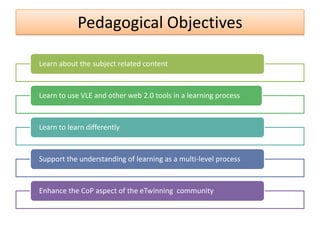
Pedagogical Objectives
Learn about the subject related content

Learn to use VLE and other web 2.0 tools in a learning process

Learn to learn differently

Support the understanding of learning as a multi-level process

Enhance the CoP aspect of the eTwinning community
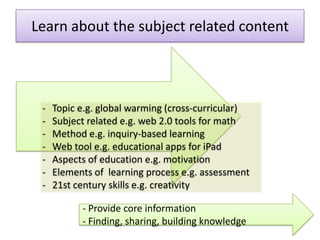
Learn about the subject related content

-

Topic e.g. global warming (cross-curricular)
Subject related e.g. web 2.0 tools for math
Method e.g. inquiry-based learning
Web tool e.g. educational apps for iPad
Aspects of education e.g. motivation
Elements of learning process e.g. assessment
21st century skills e.g. creativity
- Provide core information
- Finding, sharing, building knowledge
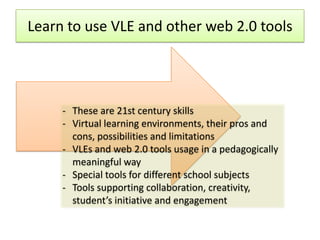
Learn to use VLE and other web 2.0 tools

- These are 21st century skills
- Virtual learning environments, their pros and
cons, possibilities and limitations
- VLEs and web 2.0 tools usage in a pedagogically
meaningful way
- Special tools for different school subjects
- Tools supporting collaboration, creativity,
student’s initiative and engagement
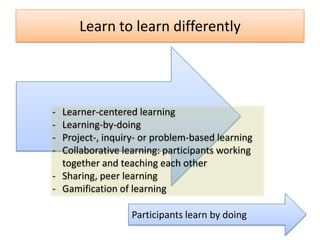
Learn to learn differently

-

Learner-centered learning
Learning-by-doing
Project-, inquiry- or problem-based learning
Collaborative learning: participants working
together and teaching each other
- Sharing, peer learning
- Gamification of learning

Participants learn by doing
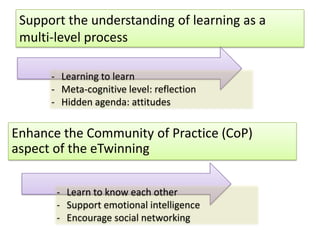
Support the understanding of learning as a
multi-level process
- Learning to learn
- Meta-cognitive level: reflection
- Hidden agenda: attitudes

Enhance the Community of Practice (CoP)
aspect of the eTwinning
- Learn to know each other
- Support emotional intelligence
- Encourage social networking
THANK YOU!
Tiina Sarisalmi, Finland
Miriam Schembri, Malta
Adam Stepinski, Poland
Irina Vasilescu, Romania

etwinning Learning Events - Pedagogical Objectives

  • 1.
    eTwinning Learning Events -Pedagogical Objectives Tiina Sarisalmi, Miriam Schembri, Adam Stepinski, Irina Vasilescu
  • 2.
    Pedagogical Objectives Learn aboutthe subject related content Learn to use VLE and other web 2.0 tools in a learning process Learn to learn differently Support the understanding of learning as a multi-level process Enhance the CoP aspect of the eTwinning community
  • 3.
    Learn about thesubject related content - Topic e.g. global warming (cross-curricular) Subject related e.g. web 2.0 tools for math Method e.g. inquiry-based learning Web tool e.g. educational apps for iPad Aspects of education e.g. motivation Elements of learning process e.g. assessment 21st century skills e.g. creativity - Provide core information - Finding, sharing, building knowledge
  • 4.
    Learn to useVLE and other web 2.0 tools - These are 21st century skills - Virtual learning environments, their pros and cons, possibilities and limitations - VLEs and web 2.0 tools usage in a pedagogically meaningful way - Special tools for different school subjects - Tools supporting collaboration, creativity, student’s initiative and engagement
  • 5.
    Learn to learndifferently - Learner-centered learning Learning-by-doing Project-, inquiry- or problem-based learning Collaborative learning: participants working together and teaching each other - Sharing, peer learning - Gamification of learning Participants learn by doing
  • 6.
    Support the understandingof learning as a multi-level process - Learning to learn - Meta-cognitive level: reflection - Hidden agenda: attitudes Enhance the Community of Practice (CoP) aspect of the eTwinning - Learn to know each other - Support emotional intelligence - Encourage social networking
  • 7.
    THANK YOU! Tiina Sarisalmi,Finland Miriam Schembri, Malta Adam Stepinski, Poland Irina Vasilescu, Romania