QUESTIONS
HOW DO YOU FEEL ABOUT
THE ACTIVITY?
HAVE YOU ENCOUNTERED
CHALLENGES IN
UNDERSTANDING THE
VIDEO?
WHAT IS THE FIRST THING
THAT CAME TO MIND WHILE
WATCHING?
MULTICULTURAL AND GLOBAL LITERACY
Module 5:
PRESENTOR: JERAH MAE B. HABIBON, LPT
Learning Outcomes:
• Discuss global and multicultural literacy
• Illustrate the Global Competence Framework
• Explain dimensions of multiculturism
• Elucidate on the assessment strategy for global competence and global
understanding
• Present effective ways on how to integrate global multiculturism in the lesson
using appropriate delivery strategies, instructional materials and assessment
tools.
• Draw relevant life lessons and significant values from personal experience in
demonstrating multicultural literacy
• Analyze research abstract on global and multicultural literacy and its
implications on the teaching-learning process
• Draft relevant policy in addressing multiculturism in school
MULTICULTURAL
LITERACY
 Multicultural literacy consists of the skills and ability to identify the creators of
knowledge and their interests (Banks, 1996) to reveal the assumptions of
knowledge, to view knowledge from diverse ethnic and cultural perspective,
and to use knowledge to guide action that will create a humane and just world
(Boutte, 2008).
 Multicultural literacy then, brings attention to diversity, equity and social justice
to foster cultural awareness by addressing difficult issues like discrimination
and oppression towards other ethnicities (Boutte, 2008).
 Accordingly, education for multicultural literacy should help students to develop
the 21st
century skills and attitudes that are needed to become active citizens
who will work towards achieving social justice within communities. Because the
growing racial, language and ethnic diversity in the country, multicultural
literacy needs to be transformed in substantial ways to prepare students to
function effectively in the 21st
Century (Boutte).
 Boutte (2008) reiterated that making small changes within the
classrooms can create big changes globally. As diversity grows,
there is a need for the emergence of multicultural education that is
more representative if the students in today’s classrooms. Banks
(2003) asserted that teaching students to be advocates of
multiculturism is also a matter of sending a message of empathy
and tolerance in schools to develop a deeper understanding of
others and appreciation of different cultures. Developing these
attitudes and skills requires basic knowledge prior to teaching
students how to question assumptions about cultural knowledge
and how to critique and critically think about these important cultural
issues, which is what essentially makes multiculturism literacy a 21st
century literacy (Banks, 2002).
GLOBAL
LITERACY
Global literacy aims to address issues of globalization,
racism, diversity and social justice (Guo, 2014). It
requires awareness and action, consistent with a broad
understanding of humanity, the planet, and the impact
of a human decision on both. It also aims to empower
students with knowledge and take action to make a
positive impact in the world and their community
(Guo, 2014).
According to the Ontario Ministry of Education
(2015), a global citizen should possess the following
characteristics: (1) respect for human regardless of race,
gender, religion pf political perspectives; (2) respect for diversity
and various perspectives; (3) promote sustainable patterns of
living, consumption, and production; and (4) appreciate the
natural world and demonstrate respect on the rights of all living
things.
INTERCONNECTING MULTICULTURAL
AND GLOBAL LITERACY
 Every classroom contains students of different races, religions and cultural
groups. Guo (2014) averred that students embrace diverse behaviors, cultural
values, patterns of practice, and communication, yet they all share one
commonality, which is their educational opportunity.
 Therefore, teachers should teach their students that other cultures exist and that
these deserve to be acknowledged and respected. Integrating a variety of
cultural context into lessons and activities teaches students to view the world
from many angles, creates respect for diversity and enables students to learn
exciting information. As classrooms become increasingly more diverse, it is
important for educators to analyze and address diversity issues and integrate
multiculturism information into the classroom curriculum (Guo, 2014)
The OECD Global
Competence Framework
(Source: https://www.oecd.org/pisa/pisa-
2018-global-competence.htm)
GLOBAL COMPETENCE
 The desire to participate in interconnected, complex and diverse societies has become a pressing need.
Recognizing the roles of schools in preparing the youth to participate in the world, the OECD’s Program for
International Student Assessment (PISA) developed a framework to explain, foster and assess students’
global competence, This design serves as a tool to policymakers, leaders and teachers in fostering global
competence among students worldwide.
 Global competence is multidimensional capacity. Therefore, globally competent individual can analyze and
rationalize local, global and intercultural issues, understand and appreciate different perspectives and
worldviews, interact successfully and respectfully with others, and take responsible action toward
sustainability and collective well-being (OECD publication).
 Global competence refers to skills, values and behaviors that prepare young people to thrive in a diverse,
interconnected and rapidly changing world. It is the ability to become engaged citizens and collaborative
problem solvers who are ready for the workforce.
PROMOTING GLOBAL COMPETENCE
IN SCHOOLS
Schools play a crucial role in helping young
people to develop global competence. They
can provide opportunities to critically
examine global developments that are
significant to both the world and to their
own lives. They can teach students how to
critically, effectively and responsibly use
digital information and social media
platforms.
Schools can encourage intercultural
sensitivity and respect by allowing students
to engage in experiences that foster an
appreciation for diverse peoples, languages
and cultures (Bennett, 1993; Sinicrope,
Norris and Watanabe, 2017). Schools are
also positioned to enhance student’s ability
to understand their place in the community
and the world and improve such ability to
make judgements and take action (Hanvey,
1975 in PISA, 2018).
The Need for Global Competence
The following are the reasons why global competence is necessary.
1. To live harmoniously in multicultural communities. Education for global competence can
promote cultural awareness and purposeful interactions in increasingly diverse societies
(Brubacker and Latin, 1998; Kymlicka, 1995; Sen. 2007). People with diverse cultures are
able to live peacefully, respect differences, find common sultutions, resolve conflicts and
learn to live together as global citizens (Delors,et. al., 1996; UNESCO, 2014b). Thus,
education can teach students the need to address cultural biases and stereotypes.
2. To thrive in a changing labor market. Education for global competence can boost
employability through effective communication and appropriate behavior within diverse teams
using technology in accessing and connecting to the world (British Council, 2013).
3. To use date platforms effectively and responsibly. Radical
transformations in digital technologies have shaped young people’s
outlook on the world, their interaction with others and their perception of
themselves. Online networks, social media and interactive technologies
give rise to new concepts of learning, wherein young people exercise to
take their freedom on what and how they learn (Zuckerman, 2014).
4. To support the sustainable development goals. Education for global
competence can help form new generations who care about global
issues and engage in school, political, economic and environmental
discussions.
DEMINSIONS OF GLOBAL
COMPETENCE:
IMPLICATIONS TO
EDUCATION
DEMINSIONS OF GLOBAL COMPETENCE:
IMPLICATIONS TO EDUCATION
 Education for global competence is founded on the ideas of different
models of global education, such as intercultural education, global
citizenship education and education for democratic citizenship
(UNESCO, 2014A; Council of Europe, 2016).
 PISA proposes a new perspective on the definition and assessment of
global competence that will help policy makers and school leaders
create learning resources and curricula that integrate global competence
as a multifaceted cognitive, socio-emotional and civic learning goal (Box
Mansilla, 2016).
FOUR DIMENSIONS OF GLOBAL COMPETENCE
Dimension 1:1 Examine issues of local,
global and cultural significance
 This dimension refers to globally competent people’s practices of
effectively utilizing knowledge about the world and critical reasoning
in forming their own opinion about a global issue.
Dimension 2:2 Understand and appreciate the
perspectives and world views of others
 This dimension highlights that globally competent people are willing
and capable of considering other people’s perspectives and
behaviors from multiple viewpoints to examine their own
assumptions.
Dimension 3:3 Engage and open,
appropriate and interactions
across cultures
 This dimension describe what globally
competent individuals can do when they
interact with people from different
cultures.
Dimension 4:5 Take action for collective
well-being and sustainable development
 This dimension focuses on young people’s role as active and
responsible members of society and refer to individual’s readiness
to respond to a given local, or intercultural issue or situation.
THE ASSESSMENT STRATEGY FOR GLOBAL
COMPETENCE
The assessment strategy for
global competence
The PISA 2018 assessment
of global competence
contributes development,
while considering challenges
and limitations.
Two components:
• A cognitive test exclusively focused
on the construct of “global
understanding”.
• A set of questionnaire items
collecting self-reported information
on students’ awareness.
Curriculum for global
competence:
Knowledg
e
Skills Attitudes Values
Four knowledge domains:
Culture and
intercultural
relations;
Socio-economic
development and
interdependence;
Environmental
sustainability; and
Global institutions,
conflict and human
rights.
Skills to understand the world
and to take action
Global competence
builds on specific
cognitive,
communication and
socio-emotional skills.
A school community
that desires to nurture
global competence
should focus on clear,
controllable and
realizable learning goals.
Knowledge
about the
world and
other
cultures
This knowledge helps people to
challenge misinformation and
stereotypes about other
countries and people.
This can be done
through the
following strategies
(OECD, 2018):
Perspective-taking
refers to the
cognitive and social
skills of
understanding how
other people think
and feel.
Adaptability refers
to the ability to
adapt systems
thinking and
behaviors to the
prevailing cultural
environment, or to
situations and
contexts that can
present new
demands or
challenges.
Opennes,
respect for
diversity
and global-
mindedness
Globally competent behavior requires an attitude of
openness towards people from other cultural
backgrounds, an attitude of respect for cultural
differences and an attitude of global mindedness. Such
attitude can be fostered explicitly through
participatory and learner-centered teaching, as well
as through a curriculum characterized by fair
practices and an accommodating school climate for
all students.
Opennes toward people from other cultural backgrounds
involves sensitivity towards curiosity about and
willingness to engage with other people and other
perspectives on the world (Bryam, 2008; Council of
Europe, 2016a).
Global-mindedness is defined as a worldview, in which
one sees him/herself connected to the community
and feels a sense of responsibility for its members
(Hansen, 2010).
Valuing human dignity and diversity
• Valuing human dignity and valuing cultural diversity contribute to global competence because
they constitute critical filters through which individuals process information about other cultures
and decide how to engage with others and the world. Hence, people, who cultivate these
values, become more aware of themselves and their surroundings, and are strongly motivated
to fight against exclusion, ignorance, violence, oppression and war.
• Clapham (2006) introduced the four aspects of valuing equality of core rights and dignity. To
wit; (1) the prohibitation of all types of inhuman treatment, humiliation or degradation by one
person over another; (2) the assurance of the possibility for individual choice and the conditions
for each individual’s self-fullfilment, autonomy or self-realization; (3) the recognition that
protection of group identity and culture may be essential for that of personal dignity; And (4)
creation of necessary conditions to have the essential needs satisfied
Global understanding
Understanding is the ability to use knowledge to find meaning and
connection between different pieces of information and
perspectives.
The framework distinguishes four interrelated cognitive processes
that globally competent students needs to use to understand fully
global or intercultural issues and situations (OECD, 2018).
1. the capacity to evaluate information, formulate arguments and explain
complex situations and problems by using and gaps in information and
managing conflicting arguments
2. the capacity to analyze multiple perspective and worldviews, positioning
and connecting their own and others’ perspective on the world
3. The capacity to understand differences in communication, recognizing the
importance of socially appropriate communication and adapting it to the
demands of diverse cultural contexts
4. The capacity to evaluate actions and consequences by identifying and
comparing different course of action and weighing actions on the basis of
consequences.
Thus, globally competent students should be able to
perform a wide variety of tasks utilizing different
cognitive processes, such as: reasoning with evidence
about an issue or situation of local, global and
intercultural significance; evaluating information on the
basis of its relevance and reliability; synthesizing
information to describe the main ideas in an
argumentative text or the salient passages of a
conversation; and combining their background
knowledge, new information and critical reasoning to
build multi-casual explanations of global or intercultural
issues (OECD, 2018).
Integrating Global and Intercultural
issues in the Curriculum
 For global education to translate abstraction into action, there is a need to
integrate global issues and topics into existing subjects (Klein, 2013; UNESCO,
2014). In the practice, content knowledge related to global competence is
integrate in the curriculum and taught in developmentally appropriate ways ( Boix
Mansilla and Jackson, 2011; UNESCO, 2015).
 Therefore, Gaudelli (2006) affirmed that teachers must have clear ideas on
global and intercultural issues that students may reflect on. They also need to
collaboratively research topics and carefully design the curriculum while giving
students multiple opportunities to learn those issues. Teacher may also engage
in professional learning communities and facilitate peer learning.
 More so, teaching about minority cultures in different subject areas entails accurate content information
about ethnically and racially diverse groups and experiences. Curricula should promote the integration of
knowledge of other people, places and perspective in the classroom throughout the year (UNESCO,
2014a), rather than using a “tourist approach’, or giving students a superficial glimpse of life in different
countries now and then.
 Textbooks and other instructional materials can also distort cultural and ethnic differences (Gay, 2015).
Teachers and their students should critically examine textbooks and other teaching resources and
supplement information when necessary.
 Connecting and intercultural topics to the reality, contexts and needs of the learning group is an effective
methodological approach to make them relevant to adolescents (North-South Centre of the Council of
Europe,2012). People learn better and become more engaged when they get connected with the content
and when they see its relevance to their lives and their immediate environment (Suarez-Orozco and
Todorova, 2008).
 Pedagogies for promoting global competence. Various student-centered pedagogies can
help students develop critical thinking along global issues, respectful communication, conflict
management skills, perspective taking and adaptability.
 Group-based cooperative project work can improve reasoning and collaborative skills. It
involves topic- or theme-based task suitable for various levels and ages, in which goal and
content are negotiated and learners cam create their own learning materials that they present
and evaluate together. Learners, participating in cooperative tasks, attentive, honest and
empathic (Barret, et al., 2014).
 Class discussion is an interactive approach that encourages proactive listening and responding
to ideas expressed by peers. By exchanging views in the classroom, students learn that there
is no single right answer to a problem, understand the reasons why others hold different views
and reflect on the origins of their own beliefs (Ritchhart, et.al., 2011)
 Service learning is another tool that can helps develop multiple
global skills through real-world experience. This requires
learners to participate in organized activities that are based on
what has been learned in the classroom and that benefit their
communities. After the activities, learners reflect critically on
their service experience to gain further understanding of course
content, and enhance their sense of role in society with regard
to civic, social, economic and political issues (Bringle and
Clayton, 2012). Through service learning, students not only
“serve to learn” which is applied learning, but also “learn to
serve” (Bringle, el al., 2016).
 The Story Circle Approach intends to practice key intercultural
skills, including respect, cultural self-awareness and empathy
( Deardorff, n.d). The students in groups of 5-6, take turns
sharing a 3-minutes story from their own experience based on
specific prompts, such as “Tell us about first experience when
you encountered someone who was different from you in some
ways .” after all students in the group have shared their personal
stories, srudents then, share the most memorable point from
each story in a “flash back” activity.
Attitudes and values integration toward global competence.
 Allocating teaching time to a specific subject that deals with human right issues
and non-discrimination is an important initial step in cultivating values for global
competence.
 Values and attributes are partly communicated through the formal curriculum and
also through ways, in which teachers and students interact, how discipline is
encouraged and the types of opinions and behavior that are validated in the
classroom environments’ influence on developing students values, would help
teachers become more aware of the impact of their teaching on students (Gay,
2015).
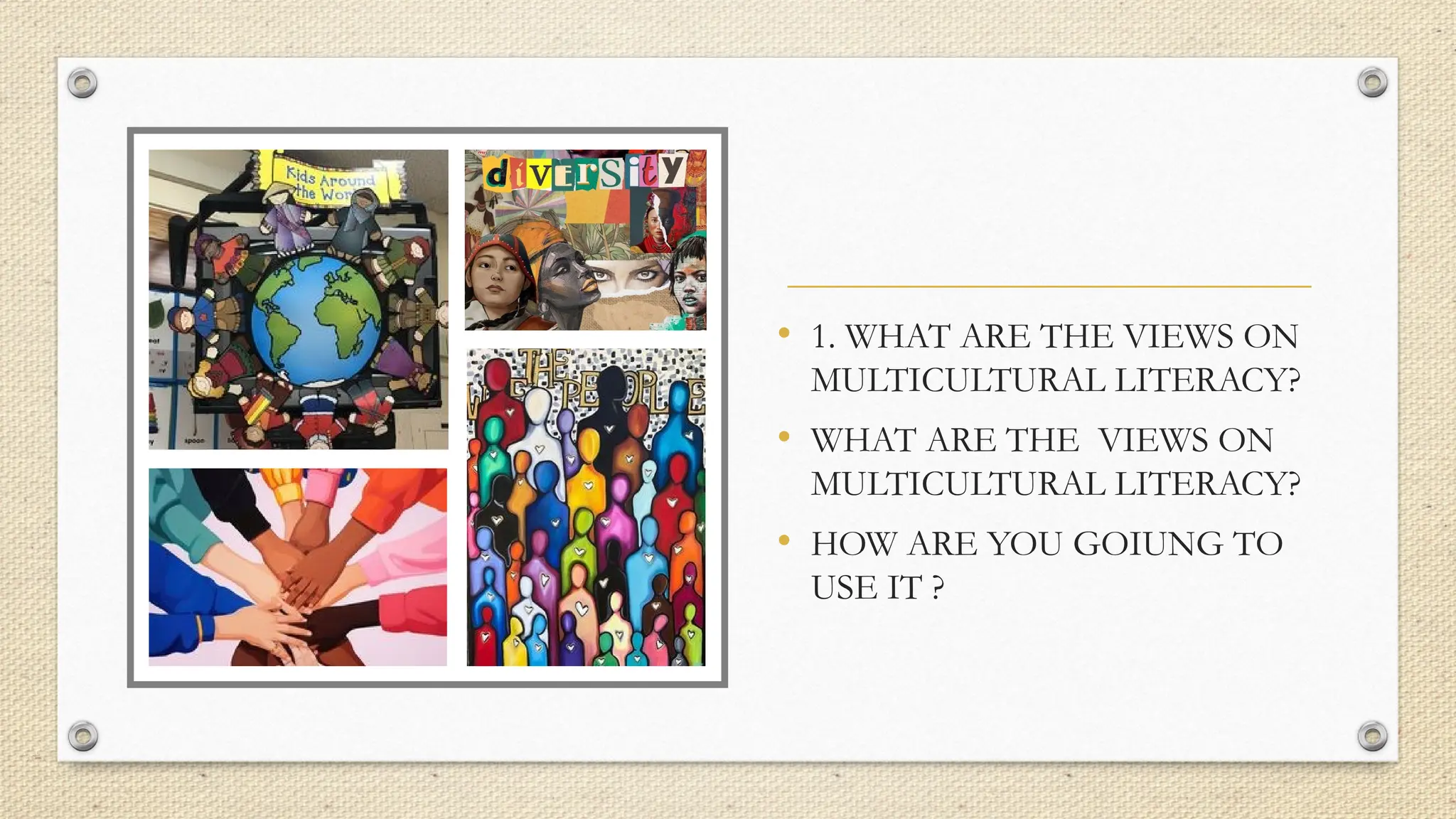
• 1. WHAT ARE THE VIEWS ON
MULTICULTURAL LITERACY?
• WHAT ARE THE VIEWS ON
MULTICULTURAL LITERACY?
• HOW ARE YOU GOIUNG TO
USE IT ?
multiculturalandgloballiteracy-1-240412030209-0f0e6893.pptx

multiculturalandgloballiteracy-1-240412030209-0f0e6893.pptx

  • 3.
    QUESTIONS HOW DO YOUFEEL ABOUT THE ACTIVITY? HAVE YOU ENCOUNTERED CHALLENGES IN UNDERSTANDING THE VIDEO? WHAT IS THE FIRST THING THAT CAME TO MIND WHILE WATCHING?
  • 4.
    MULTICULTURAL AND GLOBALLITERACY Module 5: PRESENTOR: JERAH MAE B. HABIBON, LPT
  • 5.
    Learning Outcomes: • Discussglobal and multicultural literacy • Illustrate the Global Competence Framework • Explain dimensions of multiculturism • Elucidate on the assessment strategy for global competence and global understanding • Present effective ways on how to integrate global multiculturism in the lesson using appropriate delivery strategies, instructional materials and assessment tools. • Draw relevant life lessons and significant values from personal experience in demonstrating multicultural literacy • Analyze research abstract on global and multicultural literacy and its implications on the teaching-learning process • Draft relevant policy in addressing multiculturism in school
  • 6.
    MULTICULTURAL LITERACY  Multicultural literacyconsists of the skills and ability to identify the creators of knowledge and their interests (Banks, 1996) to reveal the assumptions of knowledge, to view knowledge from diverse ethnic and cultural perspective, and to use knowledge to guide action that will create a humane and just world (Boutte, 2008).  Multicultural literacy then, brings attention to diversity, equity and social justice to foster cultural awareness by addressing difficult issues like discrimination and oppression towards other ethnicities (Boutte, 2008).  Accordingly, education for multicultural literacy should help students to develop the 21st century skills and attitudes that are needed to become active citizens who will work towards achieving social justice within communities. Because the growing racial, language and ethnic diversity in the country, multicultural literacy needs to be transformed in substantial ways to prepare students to function effectively in the 21st Century (Boutte).
  • 7.
     Boutte (2008)reiterated that making small changes within the classrooms can create big changes globally. As diversity grows, there is a need for the emergence of multicultural education that is more representative if the students in today’s classrooms. Banks (2003) asserted that teaching students to be advocates of multiculturism is also a matter of sending a message of empathy and tolerance in schools to develop a deeper understanding of others and appreciation of different cultures. Developing these attitudes and skills requires basic knowledge prior to teaching students how to question assumptions about cultural knowledge and how to critique and critically think about these important cultural issues, which is what essentially makes multiculturism literacy a 21st century literacy (Banks, 2002).
  • 8.
    GLOBAL LITERACY Global literacy aimsto address issues of globalization, racism, diversity and social justice (Guo, 2014). It requires awareness and action, consistent with a broad understanding of humanity, the planet, and the impact of a human decision on both. It also aims to empower students with knowledge and take action to make a positive impact in the world and their community (Guo, 2014). According to the Ontario Ministry of Education (2015), a global citizen should possess the following characteristics: (1) respect for human regardless of race, gender, religion pf political perspectives; (2) respect for diversity and various perspectives; (3) promote sustainable patterns of living, consumption, and production; and (4) appreciate the natural world and demonstrate respect on the rights of all living things.
  • 9.
    INTERCONNECTING MULTICULTURAL AND GLOBALLITERACY  Every classroom contains students of different races, religions and cultural groups. Guo (2014) averred that students embrace diverse behaviors, cultural values, patterns of practice, and communication, yet they all share one commonality, which is their educational opportunity.  Therefore, teachers should teach their students that other cultures exist and that these deserve to be acknowledged and respected. Integrating a variety of cultural context into lessons and activities teaches students to view the world from many angles, creates respect for diversity and enables students to learn exciting information. As classrooms become increasingly more diverse, it is important for educators to analyze and address diversity issues and integrate multiculturism information into the classroom curriculum (Guo, 2014)
  • 10.
    The OECD Global CompetenceFramework (Source: https://www.oecd.org/pisa/pisa- 2018-global-competence.htm)
  • 11.
    GLOBAL COMPETENCE  Thedesire to participate in interconnected, complex and diverse societies has become a pressing need. Recognizing the roles of schools in preparing the youth to participate in the world, the OECD’s Program for International Student Assessment (PISA) developed a framework to explain, foster and assess students’ global competence, This design serves as a tool to policymakers, leaders and teachers in fostering global competence among students worldwide.  Global competence is multidimensional capacity. Therefore, globally competent individual can analyze and rationalize local, global and intercultural issues, understand and appreciate different perspectives and worldviews, interact successfully and respectfully with others, and take responsible action toward sustainability and collective well-being (OECD publication).  Global competence refers to skills, values and behaviors that prepare young people to thrive in a diverse, interconnected and rapidly changing world. It is the ability to become engaged citizens and collaborative problem solvers who are ready for the workforce.
  • 12.
    PROMOTING GLOBAL COMPETENCE INSCHOOLS Schools play a crucial role in helping young people to develop global competence. They can provide opportunities to critically examine global developments that are significant to both the world and to their own lives. They can teach students how to critically, effectively and responsibly use digital information and social media platforms. Schools can encourage intercultural sensitivity and respect by allowing students to engage in experiences that foster an appreciation for diverse peoples, languages and cultures (Bennett, 1993; Sinicrope, Norris and Watanabe, 2017). Schools are also positioned to enhance student’s ability to understand their place in the community and the world and improve such ability to make judgements and take action (Hanvey, 1975 in PISA, 2018).
  • 13.
    The Need forGlobal Competence The following are the reasons why global competence is necessary. 1. To live harmoniously in multicultural communities. Education for global competence can promote cultural awareness and purposeful interactions in increasingly diverse societies (Brubacker and Latin, 1998; Kymlicka, 1995; Sen. 2007). People with diverse cultures are able to live peacefully, respect differences, find common sultutions, resolve conflicts and learn to live together as global citizens (Delors,et. al., 1996; UNESCO, 2014b). Thus, education can teach students the need to address cultural biases and stereotypes. 2. To thrive in a changing labor market. Education for global competence can boost employability through effective communication and appropriate behavior within diverse teams using technology in accessing and connecting to the world (British Council, 2013).
  • 14.
    3. To usedate platforms effectively and responsibly. Radical transformations in digital technologies have shaped young people’s outlook on the world, their interaction with others and their perception of themselves. Online networks, social media and interactive technologies give rise to new concepts of learning, wherein young people exercise to take their freedom on what and how they learn (Zuckerman, 2014). 4. To support the sustainable development goals. Education for global competence can help form new generations who care about global issues and engage in school, political, economic and environmental discussions.
  • 15.
  • 16.
    DEMINSIONS OF GLOBALCOMPETENCE: IMPLICATIONS TO EDUCATION  Education for global competence is founded on the ideas of different models of global education, such as intercultural education, global citizenship education and education for democratic citizenship (UNESCO, 2014A; Council of Europe, 2016).  PISA proposes a new perspective on the definition and assessment of global competence that will help policy makers and school leaders create learning resources and curricula that integrate global competence as a multifaceted cognitive, socio-emotional and civic learning goal (Box Mansilla, 2016).
  • 17.
    FOUR DIMENSIONS OFGLOBAL COMPETENCE
  • 18.
    Dimension 1:1 Examineissues of local, global and cultural significance  This dimension refers to globally competent people’s practices of effectively utilizing knowledge about the world and critical reasoning in forming their own opinion about a global issue.
  • 19.
    Dimension 2:2 Understandand appreciate the perspectives and world views of others  This dimension highlights that globally competent people are willing and capable of considering other people’s perspectives and behaviors from multiple viewpoints to examine their own assumptions.
  • 20.
    Dimension 3:3 Engageand open, appropriate and interactions across cultures  This dimension describe what globally competent individuals can do when they interact with people from different cultures.
  • 21.
    Dimension 4:5 Takeaction for collective well-being and sustainable development  This dimension focuses on young people’s role as active and responsible members of society and refer to individual’s readiness to respond to a given local, or intercultural issue or situation.
  • 22.
    THE ASSESSMENT STRATEGYFOR GLOBAL COMPETENCE
  • 23.
    The assessment strategyfor global competence The PISA 2018 assessment of global competence contributes development, while considering challenges and limitations. Two components: • A cognitive test exclusively focused on the construct of “global understanding”. • A set of questionnaire items collecting self-reported information on students’ awareness.
  • 24.
  • 25.
    Four knowledge domains: Cultureand intercultural relations; Socio-economic development and interdependence; Environmental sustainability; and Global institutions, conflict and human rights.
  • 26.
    Skills to understandthe world and to take action Global competence builds on specific cognitive, communication and socio-emotional skills. A school community that desires to nurture global competence should focus on clear, controllable and realizable learning goals.
  • 27.
    Knowledge about the world and other cultures Thisknowledge helps people to challenge misinformation and stereotypes about other countries and people. This can be done through the following strategies (OECD, 2018): Perspective-taking refers to the cognitive and social skills of understanding how other people think and feel. Adaptability refers to the ability to adapt systems thinking and behaviors to the prevailing cultural environment, or to situations and contexts that can present new demands or challenges.
  • 28.
    Opennes, respect for diversity and global- mindedness Globallycompetent behavior requires an attitude of openness towards people from other cultural backgrounds, an attitude of respect for cultural differences and an attitude of global mindedness. Such attitude can be fostered explicitly through participatory and learner-centered teaching, as well as through a curriculum characterized by fair practices and an accommodating school climate for all students. Opennes toward people from other cultural backgrounds involves sensitivity towards curiosity about and willingness to engage with other people and other perspectives on the world (Bryam, 2008; Council of Europe, 2016a). Global-mindedness is defined as a worldview, in which one sees him/herself connected to the community and feels a sense of responsibility for its members (Hansen, 2010).
  • 29.
    Valuing human dignityand diversity • Valuing human dignity and valuing cultural diversity contribute to global competence because they constitute critical filters through which individuals process information about other cultures and decide how to engage with others and the world. Hence, people, who cultivate these values, become more aware of themselves and their surroundings, and are strongly motivated to fight against exclusion, ignorance, violence, oppression and war. • Clapham (2006) introduced the four aspects of valuing equality of core rights and dignity. To wit; (1) the prohibitation of all types of inhuman treatment, humiliation or degradation by one person over another; (2) the assurance of the possibility for individual choice and the conditions for each individual’s self-fullfilment, autonomy or self-realization; (3) the recognition that protection of group identity and culture may be essential for that of personal dignity; And (4) creation of necessary conditions to have the essential needs satisfied
  • 30.
    Global understanding Understanding isthe ability to use knowledge to find meaning and connection between different pieces of information and perspectives. The framework distinguishes four interrelated cognitive processes that globally competent students needs to use to understand fully global or intercultural issues and situations (OECD, 2018).
  • 31.
    1. the capacityto evaluate information, formulate arguments and explain complex situations and problems by using and gaps in information and managing conflicting arguments 2. the capacity to analyze multiple perspective and worldviews, positioning and connecting their own and others’ perspective on the world 3. The capacity to understand differences in communication, recognizing the importance of socially appropriate communication and adapting it to the demands of diverse cultural contexts 4. The capacity to evaluate actions and consequences by identifying and comparing different course of action and weighing actions on the basis of consequences.
  • 32.
    Thus, globally competentstudents should be able to perform a wide variety of tasks utilizing different cognitive processes, such as: reasoning with evidence about an issue or situation of local, global and intercultural significance; evaluating information on the basis of its relevance and reliability; synthesizing information to describe the main ideas in an argumentative text or the salient passages of a conversation; and combining their background knowledge, new information and critical reasoning to build multi-casual explanations of global or intercultural issues (OECD, 2018).
  • 33.
    Integrating Global andIntercultural issues in the Curriculum  For global education to translate abstraction into action, there is a need to integrate global issues and topics into existing subjects (Klein, 2013; UNESCO, 2014). In the practice, content knowledge related to global competence is integrate in the curriculum and taught in developmentally appropriate ways ( Boix Mansilla and Jackson, 2011; UNESCO, 2015).  Therefore, Gaudelli (2006) affirmed that teachers must have clear ideas on global and intercultural issues that students may reflect on. They also need to collaboratively research topics and carefully design the curriculum while giving students multiple opportunities to learn those issues. Teacher may also engage in professional learning communities and facilitate peer learning.
  • 34.
     More so,teaching about minority cultures in different subject areas entails accurate content information about ethnically and racially diverse groups and experiences. Curricula should promote the integration of knowledge of other people, places and perspective in the classroom throughout the year (UNESCO, 2014a), rather than using a “tourist approach’, or giving students a superficial glimpse of life in different countries now and then.  Textbooks and other instructional materials can also distort cultural and ethnic differences (Gay, 2015). Teachers and their students should critically examine textbooks and other teaching resources and supplement information when necessary.  Connecting and intercultural topics to the reality, contexts and needs of the learning group is an effective methodological approach to make them relevant to adolescents (North-South Centre of the Council of Europe,2012). People learn better and become more engaged when they get connected with the content and when they see its relevance to their lives and their immediate environment (Suarez-Orozco and Todorova, 2008).
  • 35.
     Pedagogies forpromoting global competence. Various student-centered pedagogies can help students develop critical thinking along global issues, respectful communication, conflict management skills, perspective taking and adaptability.  Group-based cooperative project work can improve reasoning and collaborative skills. It involves topic- or theme-based task suitable for various levels and ages, in which goal and content are negotiated and learners cam create their own learning materials that they present and evaluate together. Learners, participating in cooperative tasks, attentive, honest and empathic (Barret, et al., 2014).  Class discussion is an interactive approach that encourages proactive listening and responding to ideas expressed by peers. By exchanging views in the classroom, students learn that there is no single right answer to a problem, understand the reasons why others hold different views and reflect on the origins of their own beliefs (Ritchhart, et.al., 2011)
  • 36.
     Service learningis another tool that can helps develop multiple global skills through real-world experience. This requires learners to participate in organized activities that are based on what has been learned in the classroom and that benefit their communities. After the activities, learners reflect critically on their service experience to gain further understanding of course content, and enhance their sense of role in society with regard to civic, social, economic and political issues (Bringle and Clayton, 2012). Through service learning, students not only “serve to learn” which is applied learning, but also “learn to serve” (Bringle, el al., 2016).  The Story Circle Approach intends to practice key intercultural skills, including respect, cultural self-awareness and empathy ( Deardorff, n.d). The students in groups of 5-6, take turns sharing a 3-minutes story from their own experience based on specific prompts, such as “Tell us about first experience when you encountered someone who was different from you in some ways .” after all students in the group have shared their personal stories, srudents then, share the most memorable point from each story in a “flash back” activity.
  • 37.
    Attitudes and valuesintegration toward global competence.  Allocating teaching time to a specific subject that deals with human right issues and non-discrimination is an important initial step in cultivating values for global competence.  Values and attributes are partly communicated through the formal curriculum and also through ways, in which teachers and students interact, how discipline is encouraged and the types of opinions and behavior that are validated in the classroom environments’ influence on developing students values, would help teachers become more aware of the impact of their teaching on students (Gay, 2015).
  • 38.
    • 1. WHATARE THE VIEWS ON MULTICULTURAL LITERACY? • WHAT ARE THE VIEWS ON MULTICULTURAL LITERACY? • HOW ARE YOU GOIUNG TO USE IT ?