MULTICULTURAL
LANGUAGE
TEACHING
Ahmad Fahmi Dahlan
13131018
Pendidikan Bahasa Inggris
Fakultas Keguruan dan Ilmu Pendidikan
Universitas Mercu Buana Yogyakarta
WHAT?
Multicultural Language Teaching
The multicultural education may be alternative way of improving the
culturalawarness in the practice of ELT. Sinagatullin defines
multicultural education as an idea stating that all students, regardless
of their gender, ethnicity, race, culture, social class, religion, or
exceptionality, should have an equal opportunity to learn at school.
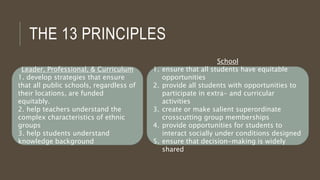
THE 13 PRINCIPLES
Leader, Professional, & Curriculum
1. develop strategies that ensure
that all public schools, regardless of
their locations, are funded
equitably.
2. help teachers understand the
complex characteristics of ethnic
groups
3. help students understand
knowledge background
School
1. ensure that all students have equitable
opportunities
2. provide all students with opportunities to
participate in extra- and curricular
activities
3. create or make salient superordinate
crosscutting group memberships
4. provide opportunities for students to
interact socially under conditions designed
5. ensure that decision-making is widely
shared
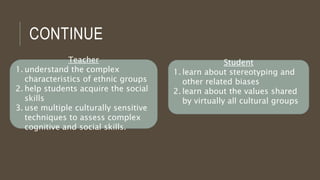
CONTINUE
Teacher
1. understand the complex
characteristics of ethnic groups
2. help students acquire the social
skills
3. use multiple culturally sensitive
techniques to assess complex
cognitive and social skills.
Student
1. learn about stereotyping and
other related biases
2. learn about the values shared
by virtually all cultural groups
WHY CULTURE MATTERS IN
EDUCATION
1. The cultural and social background of students, teacher, and
parents should be taken into account in order to understand their
atitudes, actions, and learning problems as well as personal and
social needs.
2. The international and multicultural character of society as a
consequence of imigration and other phenomena related to
globalization should be include as topics in order to change the
cultural contents of the curricula.
3. The cultural contents of education should be revised altogether in
the name of a universalist idea of education, free from any form of
ethocentrism, so the contents include different perspective and
educate for pluralism and relativism.
CONT...
4. Concerning the notion of culture within the interculturaleducation,
they suggest four main elements for an education respectful of
sociocultural and linguistic diversity. Those are:
1. Subjective and objective support of the identity of socio-cultural
and linguistic minority students.
2. Constructing curriculum contens implying and reflecting the
positive value of the pkuarlity of cultutres and languages.
3. Building communicative, action-oriented skills.
4. Accepting socio-cultural diversity and the pluarality of ideas as a
challenge for democracy.
WHY DO WE LEARN MLT?
1. To be aware of students diversity
2. To know when and in what condition MLT can be used
3. To enable the students understand not only English but its culture also
4. To make diversity among students become an opportunity to learn other
cultures
5. To help students acquire attitudes, knowledge, and skills needed to
succesfully function within their own microculture, mainstream culture, and the
global community.
6. Foreign language teachers were expected to increase students’ awareness of
cultural,
ethnic, and linguistic diversity.
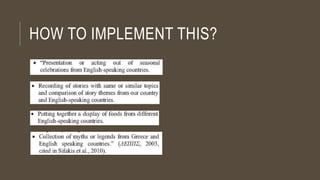
HOW TO IMPLEMENT THIS?
CONCLUSION
Teacher should have multicultural awareness (improving the
educators’ interest)
Multicultural language teaching is important in maintaining the
students’ understanding towards their own culture and avoiding their
having a semantic frame towards their own culture.
Brown via Richards and Renandya (2002:12)
“Whenever you teach a langauge, you also teach a complex system of
cultural customs, values, and ways of thingking, feeling, and acting.”
REFERENCES
Developing Multicultural Awareness Through English Reflections on
Culture and Multiculturalism. Achilleas I. Kostoulas. The university of
Manchester.
James A. Banks. University of Washington
Siti Sudarti. MULTICULTURAL-BASED ENGLISH LANGUAGE TEACHING:
ONE WAY OF MAINTAINING NATION IDENTITY. Yogyakarta State
University.
Kathryn S. Lee, PhD . Understanding Multicultural Perspectives in
Foreign Language Education: A Curricular and Pre-service Teacher
Point of View.Texas State University-San Marcos

Multicultural Language & Learning By Adoed El Zhyreva

  • 1.
    MULTICULTURAL LANGUAGE TEACHING Ahmad Fahmi Dahlan 13131018 PendidikanBahasa Inggris Fakultas Keguruan dan Ilmu Pendidikan Universitas Mercu Buana Yogyakarta
  • 2.
  • 3.
    The multicultural educationmay be alternative way of improving the culturalawarness in the practice of ELT. Sinagatullin defines multicultural education as an idea stating that all students, regardless of their gender, ethnicity, race, culture, social class, religion, or exceptionality, should have an equal opportunity to learn at school.
  • 4.
    THE 13 PRINCIPLES Leader,Professional, & Curriculum 1. develop strategies that ensure that all public schools, regardless of their locations, are funded equitably. 2. help teachers understand the complex characteristics of ethnic groups 3. help students understand knowledge background School 1. ensure that all students have equitable opportunities 2. provide all students with opportunities to participate in extra- and curricular activities 3. create or make salient superordinate crosscutting group memberships 4. provide opportunities for students to interact socially under conditions designed 5. ensure that decision-making is widely shared
  • 5.
    CONTINUE Teacher 1. understand thecomplex characteristics of ethnic groups 2. help students acquire the social skills 3. use multiple culturally sensitive techniques to assess complex cognitive and social skills. Student 1. learn about stereotyping and other related biases 2. learn about the values shared by virtually all cultural groups
  • 6.
    WHY CULTURE MATTERSIN EDUCATION 1. The cultural and social background of students, teacher, and parents should be taken into account in order to understand their atitudes, actions, and learning problems as well as personal and social needs. 2. The international and multicultural character of society as a consequence of imigration and other phenomena related to globalization should be include as topics in order to change the cultural contents of the curricula. 3. The cultural contents of education should be revised altogether in the name of a universalist idea of education, free from any form of ethocentrism, so the contents include different perspective and educate for pluralism and relativism.
  • 7.
    CONT... 4. Concerning thenotion of culture within the interculturaleducation, they suggest four main elements for an education respectful of sociocultural and linguistic diversity. Those are: 1. Subjective and objective support of the identity of socio-cultural and linguistic minority students. 2. Constructing curriculum contens implying and reflecting the positive value of the pkuarlity of cultutres and languages. 3. Building communicative, action-oriented skills. 4. Accepting socio-cultural diversity and the pluarality of ideas as a challenge for democracy.
  • 8.
    WHY DO WELEARN MLT? 1. To be aware of students diversity 2. To know when and in what condition MLT can be used 3. To enable the students understand not only English but its culture also 4. To make diversity among students become an opportunity to learn other cultures 5. To help students acquire attitudes, knowledge, and skills needed to succesfully function within their own microculture, mainstream culture, and the global community. 6. Foreign language teachers were expected to increase students’ awareness of cultural, ethnic, and linguistic diversity.
  • 9.
  • 10.
    CONCLUSION Teacher should havemulticultural awareness (improving the educators’ interest) Multicultural language teaching is important in maintaining the students’ understanding towards their own culture and avoiding their having a semantic frame towards their own culture.
  • 11.
    Brown via Richardsand Renandya (2002:12) “Whenever you teach a langauge, you also teach a complex system of cultural customs, values, and ways of thingking, feeling, and acting.”
  • 12.
    REFERENCES Developing Multicultural AwarenessThrough English Reflections on Culture and Multiculturalism. Achilleas I. Kostoulas. The university of Manchester. James A. Banks. University of Washington Siti Sudarti. MULTICULTURAL-BASED ENGLISH LANGUAGE TEACHING: ONE WAY OF MAINTAINING NATION IDENTITY. Yogyakarta State University. Kathryn S. Lee, PhD . Understanding Multicultural Perspectives in Foreign Language Education: A Curricular and Pre-service Teacher Point of View.Texas State University-San Marcos