Impact and challengesImpact and challenges
of MTB-MLE inof MTB-MLE in
North Western PakistanNorth Western Pakistan
by Muhammad Zaman Sagarby Muhammad Zaman Sagar
Forum for Language Initiatives (FLI) PakistanForum for Language Initiatives (FLI) Pakistan
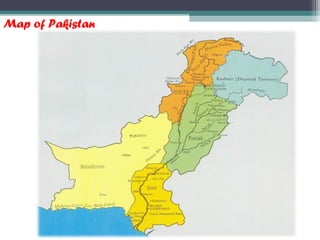
Map of Pakistan
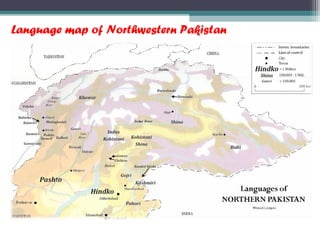
Language map of Northwestern Pakistan
Language map of Southern Pakistan
MLE programmes in Pakistan
Northwestern Pakistan Southern Pakistan
Language
name
Total
centers
Total
students
Gawri 5
Gojri 33
Kalasha 1
Palula 2
Torwali 2
Language
name
Total
centers
Total
students
Balochi
Kachhi
Odhki
Parkari
The research project - background
• Pakistani parents often prefer to send their
children to an Urdu or English-medium school,
because these two languages are important, and
they see no use for education of the children in
their own mother tongue.
• Government agencies are often not convinced
about the advantages of mother-tongue-based
multilingual education, and are concerned about
the cost of developing and printing curriculum
materials in many different languages.
The research project – background (cont’d)
• We aim to look at the MLE programs that have
been started in Pakistan, and see if there is a
difference between students that have started
education in their mother tongue as compared to
students that have been immersed in another
language from the beginning.
• Our research was sponsored by the British
Council in Islamabad.
• This was a first, exploratory effort. It should be
followed up by a more formal study.
The research question
• What is the effectiveness of English language
learning in the mother-tongue-based MLE schools
as compared to English language learning in the
Urdu and English-medium schools?
• We visited each of the 8 MLE programs that were in
operation in Pakistan at that time.
• We compared the English language proficiency of
students that had been studying in an MLE program,
with the proficiency of students in that same grade-
level who had started education in a non-native
language.
The research tools:
• (1) where possible we administered a number of
simple tests and scored the number of correct
responses.
• (2) interviews with teachers, students, parents and
other family members, to get their impression about
the proficiency of both groups of students (students
in an MLE program and students in a government
school or other Urdu or English-medium program).
• (3) Observation in the classroom.
• (4) Inspection of report cards and other records.
Tests:
• Different types of tests were administered to find
out the performance of the learners in English,
Urdu and math.
• Oral and written proficiency in their mother tongues
were assessed through tests as well.
• Relationship between proficiency in mother tongue
and Urdu and English was looked at.
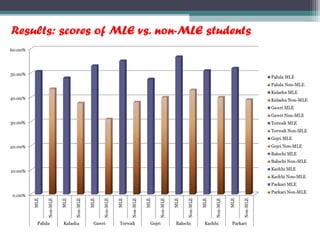
Results: scores of MLE vs. non-MLE students
Results: MT vs. Urdu and English
• Individuals who scored high in the mother tongue
tests, also scored high in the English tests and vice
versa.
Comments gleaned from the interviews
• “Students coming from the MLE schools perform
better in all subjects, including the learning of
English, as compared to those students who start
their pre-schooling in gov’t school.”
• “Parents are requesting admission for their
children in the MLE Schools.”
• “I think this program is providing us with two
types of benefits: firstly, our children perform
academically better, and secondly, saving our
heritage language, which was otherwise being
abandoned by the younger generations.”
Comments gleaned from the interviews (continued…)
• “English language learning is much easier for the
Kalasha MLE students, as they start with the
Roman alphabet letters, and consequently find it
easier to learn reading and writing English than
learning Urdu.”
• “The teachers in the Kalasha School teach more
efficiently to our children than the government
schools.”
• “Children spend time solving problems in groups
allowing themselves to listen and learn from
their peers.”
Comments gleaned from the interviews
(continued…)
• “Children are confident to present their stories or
give a speech in class or during functions.”
• “We could easily understand the lessons while
other students memorize them.”
• “Now parents are ready to send their girls to the
government schools after completing their
earlier education in the MLE School.”
Comments gleaned from the interviews
(continued…)
• “Now we learned the effectiveness of being
educated. Whatever we can offer to save this
school we will do it.”
• “We are happy that our girls are getting
education as well at their door-step.”
Challenges to the MTB MLE programs
• Resistance from ‘educated’ policy makers.
• The policy makers have not realized the
advantages of the MLE programs yet.
• Starting through Urdu and English is considered
to be more beneficial than a local language.
• It is time is to raise awareness among the agents of
change in Pakistan, especially the policy makers,
and convince them that MTB education can make
it easier to learn other languages especially
English.
Challenges to the MTB MLE programs (continued…)
• Almost all mother tongue based MLE programs are
supported financially and technically by
international agencies.
• The volatile nature of the country may cause these
agencies to stop their programs at any time as
nothing is predictable in the country.
• Local organisations running these programs do not
have the capacity to continue it on their own.
Challenges to the MTB MLE programs (continued…)
• Most people still support English medium school
education and think that the children perform
better by directly enrolling into it.
• Seasonal migration in Gawri community is a big
challenge.
• Resources are not sufficient to meet the needs of
all communities.
• Too many small languages all over the country,
and sometimes several local languages co-exist
in a small village/location.
Results and impact
• Students studying in the MLE schools are
performing better than the non-MLE students.
• Apart from saving the endangered languages of the
region, the MTB-MLE programs have positively
contributed towards increasing the literacy level
among the marginalized communities.
• These programs seem to have made a difference and
it is expected that they will expand further in future,
and society will accept it as a norm rather than an
exception.
Results and impact (continued…)
• If the MTB-MLE programs expand, it will discourage
the traditional rote learning and develop creative
and critical thinking among the students.
Suggestions for further research
• The scope of the present study was limited. A
follow-up study involving more subjects and a
research design that controls for interfering
factors is needed.
• A detailed study of the attitudes of society
(especially the elite) towards MTB-MLE can help
us to improve the program, and to cope with the
challenges successfully. This is crucial, as we the
only way out of the current educational crisis in
Pakistan is expansion of Mother Tongue Based
Multilingual Education.
Thank you!

2D_Sagar

  • 1.
    Impact and challengesImpactand challenges of MTB-MLE inof MTB-MLE in North Western PakistanNorth Western Pakistan by Muhammad Zaman Sagarby Muhammad Zaman Sagar Forum for Language Initiatives (FLI) PakistanForum for Language Initiatives (FLI) Pakistan
  • 2.
  • 3.
    Language map ofNorthwestern Pakistan
  • 4.
    Language map ofSouthern Pakistan
  • 5.
    MLE programmes inPakistan Northwestern Pakistan Southern Pakistan Language name Total centers Total students Gawri 5 Gojri 33 Kalasha 1 Palula 2 Torwali 2 Language name Total centers Total students Balochi Kachhi Odhki Parkari
  • 6.
    The research project- background • Pakistani parents often prefer to send their children to an Urdu or English-medium school, because these two languages are important, and they see no use for education of the children in their own mother tongue. • Government agencies are often not convinced about the advantages of mother-tongue-based multilingual education, and are concerned about the cost of developing and printing curriculum materials in many different languages.
  • 7.
    The research project– background (cont’d) • We aim to look at the MLE programs that have been started in Pakistan, and see if there is a difference between students that have started education in their mother tongue as compared to students that have been immersed in another language from the beginning. • Our research was sponsored by the British Council in Islamabad. • This was a first, exploratory effort. It should be followed up by a more formal study.
  • 8.
    The research question •What is the effectiveness of English language learning in the mother-tongue-based MLE schools as compared to English language learning in the Urdu and English-medium schools? • We visited each of the 8 MLE programs that were in operation in Pakistan at that time. • We compared the English language proficiency of students that had been studying in an MLE program, with the proficiency of students in that same grade- level who had started education in a non-native language.
  • 9.
    The research tools: •(1) where possible we administered a number of simple tests and scored the number of correct responses. • (2) interviews with teachers, students, parents and other family members, to get their impression about the proficiency of both groups of students (students in an MLE program and students in a government school or other Urdu or English-medium program). • (3) Observation in the classroom. • (4) Inspection of report cards and other records.
  • 10.
    Tests: • Different typesof tests were administered to find out the performance of the learners in English, Urdu and math. • Oral and written proficiency in their mother tongues were assessed through tests as well. • Relationship between proficiency in mother tongue and Urdu and English was looked at.
  • 11.
    Results: scores ofMLE vs. non-MLE students
  • 12.
    Results: MT vs.Urdu and English • Individuals who scored high in the mother tongue tests, also scored high in the English tests and vice versa.
  • 13.
    Comments gleaned fromthe interviews • “Students coming from the MLE schools perform better in all subjects, including the learning of English, as compared to those students who start their pre-schooling in gov’t school.” • “Parents are requesting admission for their children in the MLE Schools.” • “I think this program is providing us with two types of benefits: firstly, our children perform academically better, and secondly, saving our heritage language, which was otherwise being abandoned by the younger generations.”
  • 14.
    Comments gleaned fromthe interviews (continued…) • “English language learning is much easier for the Kalasha MLE students, as they start with the Roman alphabet letters, and consequently find it easier to learn reading and writing English than learning Urdu.” • “The teachers in the Kalasha School teach more efficiently to our children than the government schools.” • “Children spend time solving problems in groups allowing themselves to listen and learn from their peers.”
  • 15.
    Comments gleaned fromthe interviews (continued…) • “Children are confident to present their stories or give a speech in class or during functions.” • “We could easily understand the lessons while other students memorize them.” • “Now parents are ready to send their girls to the government schools after completing their earlier education in the MLE School.”
  • 16.
    Comments gleaned fromthe interviews (continued…) • “Now we learned the effectiveness of being educated. Whatever we can offer to save this school we will do it.” • “We are happy that our girls are getting education as well at their door-step.”
  • 17.
    Challenges to theMTB MLE programs • Resistance from ‘educated’ policy makers. • The policy makers have not realized the advantages of the MLE programs yet. • Starting through Urdu and English is considered to be more beneficial than a local language. • It is time is to raise awareness among the agents of change in Pakistan, especially the policy makers, and convince them that MTB education can make it easier to learn other languages especially English.
  • 18.
    Challenges to theMTB MLE programs (continued…) • Almost all mother tongue based MLE programs are supported financially and technically by international agencies. • The volatile nature of the country may cause these agencies to stop their programs at any time as nothing is predictable in the country. • Local organisations running these programs do not have the capacity to continue it on their own.
  • 19.
    Challenges to theMTB MLE programs (continued…) • Most people still support English medium school education and think that the children perform better by directly enrolling into it. • Seasonal migration in Gawri community is a big challenge. • Resources are not sufficient to meet the needs of all communities. • Too many small languages all over the country, and sometimes several local languages co-exist in a small village/location.
  • 20.
    Results and impact •Students studying in the MLE schools are performing better than the non-MLE students. • Apart from saving the endangered languages of the region, the MTB-MLE programs have positively contributed towards increasing the literacy level among the marginalized communities. • These programs seem to have made a difference and it is expected that they will expand further in future, and society will accept it as a norm rather than an exception.
  • 21.
    Results and impact(continued…) • If the MTB-MLE programs expand, it will discourage the traditional rote learning and develop creative and critical thinking among the students.
  • 22.
    Suggestions for furtherresearch • The scope of the present study was limited. A follow-up study involving more subjects and a research design that controls for interfering factors is needed. • A detailed study of the attitudes of society (especially the elite) towards MTB-MLE can help us to improve the program, and to cope with the challenges successfully. This is crucial, as we the only way out of the current educational crisis in Pakistan is expansion of Mother Tongue Based Multilingual Education.
  • 23.