Global Health Sector Strategy for HIV, 2011-2015: Overview Department of HIV/AIDS 12 January 2011
Resolution WHA 63.19 asks for …. A WHO HIV/AIDS strategy for 2011-15 To be developed through inclusive consultative process Be aligned with broader strategic frameworks Considers the changing international public health architecture
Presentation structure Structure and key features of Strategy  Consultation process Next steps
Background Three elements Reaffirms global goals for the health sector response to HIV  Proposes four strategic directions to guide national HIV responses Provides a framework  for WHO action at global, regional and country levels (a "corporate approach to HIV") Alignment & coherence Aligned with UNAIDS Strategy 2011-2015  Coherent with other health sector strategies (e.g. reproductive health; Stop TB; STIs; Public Health, Innovation and IP)…  Compliments strategies of partners (e.g. PEPFAR)
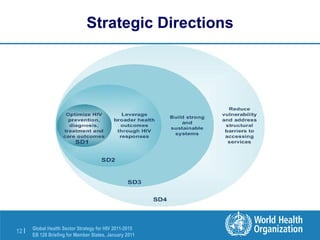
Strategy Outline Introduction Alignment with UNAIDS and other strategies Principle features and guiding principles of strategy Strategic context ("situation analysis") Global vision, goals and four strategic directions ("the onion") Policies and interventions for countries WHO action Strategy implementation
Section I: Introduction Principal features Defines health sector role within a multisectoral response   Global in scope but recognizes diversity of epidemics and need to tailor responses in countries.   Embeds HIV in the broader health agenda, aims at programmatic linkages and broader health outcomes. Aims to enhance effectiveness and efficiency, ensure equity and improve quality and coverage of HIV programmes Looks towards sustainability through strengthening health and community systems and addressing social determinants.
Section II: Strategic Context & Considerations HIV service coverage low, poorly targeted & poor quality Linkages between HIV and other programmes not optimized – e.g. MNCH, TB services Weak health systems hinder HIV responses – e.g. data use, access to medicines, inadequate human resources Structural barriers impede access to services and increase vulnerability – e.g. stigma in the health work force that marginalizes most-at-risk populations
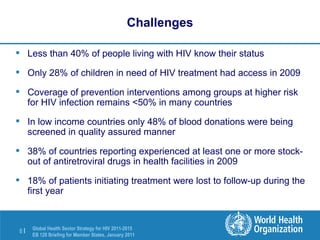
Challenges Less than 40% of people living with HIV know their status Only 28% of children in need of HIV treatment had access in 2009 Coverage of prevention interventions among groups at higher risk for HIV infection remains <50% in many countries In low income countries only 48% of blood donations were being screened in quality assured manner 38% of countries reporting experienced at least one or more stock-out of antiretroviral drugs in health facilities in 2009 18% of patients initiating treatment were lost to follow-up during the first year
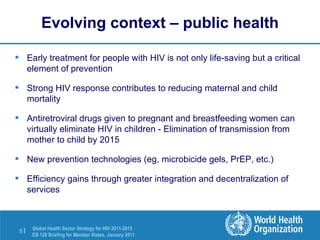
Evolving context – public health Early treatment for people with HIV is not only life-saving but a critical element of prevention Strong HIV response contributes to reducing maternal and child mortality  Antiretroviral drugs given to pregnant and breastfeeding women can virtually eliminate HIV in children - Elimination of transmission from mother to child by 2015 New prevention technologies (eg, microbicide gels, PrEP, etc.) Efficiency gains through greater integration and decentralization of services
Section III: Global Vision A world free of new HIV infections and where all people living with HIV enjoy long and healthy lives
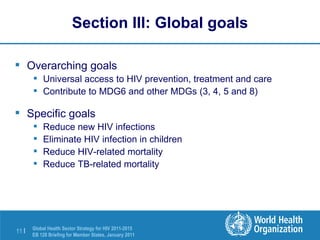
Section III: Global goals Overarching goals Universal access to HIV prevention, treatment and care Contribute to MDG6 and other MDGs (3, 4, 5 and 8) Specific goals Reduce new HIV infections Eliminate HIV infection in children Reduce HIV-related mortality Reduce TB-related mortality
Strategic Directions
Section IV: Priority policies & interventions for countries SD1 – Optimize HIV specific interventions HIV testing & counselling HIV prevention (including PMTCT, sexual transmission, IDUs) HIV treatment and care (including HIV/TB) Comprehensive HIV services for MARPs SD2 – Strengthen linkages with key services: TB MNCH Sexual and reproductive health Drug dependence treatment and harm reduction Chronic care and non-communicable diseases Blood and injection safety
Section IV: Priority policies & interventions for countries SD3 – Build strong systems Service delivery models Health financing Health workforce Strategic information HIV medicines, diagnostics and other commodities Strategic planning SD4 – Reduce vulnerability and remove structural barriers Health in all policies Stigma and discrimination and human rights Gender equality  Community systems Humanitarian crises Laws and regulations
Section V: What WHO will do Support countries implement national HIV programmes through WHO's six core functions  Focus on 5 key contributions Scale-up and innovation in HIV prevention (Prevention Revolution) Treatment and care optimization (Treatment 2.0) Health for women and children (Elimination of HIV in Children) Health sector information and planning Health equity and HIV
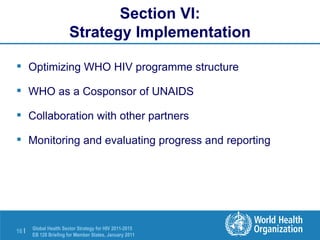
Section VI: Strategy Implementation Optimizing WHO HIV programme structure WHO as a Cosponsor of UNAIDS Collaboration with other partners Monitoring and evaluating progress and reporting
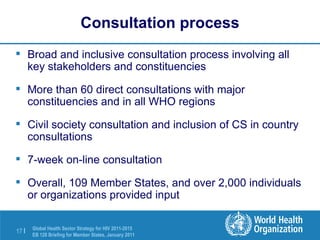
Consultation process Broad and inclusive consultation process involving all key stakeholders and constituencies More than 60 direct consultations with major constituencies and in all WHO regions Civil society consultation and inclusion of CS in country consultations 7-week on-line consultation Overall, 109 Member States, and over 2,000 individuals or organizations provided input
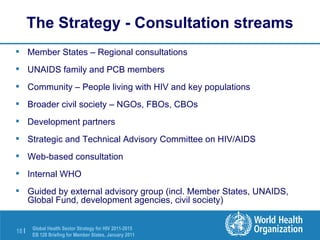
The Strategy - Consultation streams Member States – Regional consultations UNAIDS family and PCB members Community – People living with HIV and key populations Broader civil society – NGOs, FBOs, CBOs Development partners Strategic and Technical Advisory Committee on HIV/AIDS Web-based consultation Internal WHO Guided by external advisory group (incl. Member States, UNAIDS, Global Fund, development agencies, civil society)
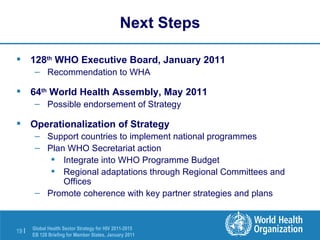
Next Steps 128 th  WHO Executive Board, January 2011 Recommendation to WHA  64 th  World Health Assembly, May 2011 Possible endorsement of Strategy Operationalization of Strategy Support countries to implement national programmes Plan WHO Secretariat action Integrate into WHO Programme Budget Regional adaptations through Regional Committees and Offices Promote coherence with key partner strategies and plans

Eb briefing hiv_strategy

  • 1.
    Global Health SectorStrategy for HIV, 2011-2015: Overview Department of HIV/AIDS 12 January 2011
  • 2.
    Resolution WHA 63.19asks for …. A WHO HIV/AIDS strategy for 2011-15 To be developed through inclusive consultative process Be aligned with broader strategic frameworks Considers the changing international public health architecture
  • 3.
    Presentation structure Structureand key features of Strategy Consultation process Next steps
  • 4.
    Background Three elementsReaffirms global goals for the health sector response to HIV Proposes four strategic directions to guide national HIV responses Provides a framework for WHO action at global, regional and country levels (a &quot;corporate approach to HIV&quot;) Alignment & coherence Aligned with UNAIDS Strategy 2011-2015 Coherent with other health sector strategies (e.g. reproductive health; Stop TB; STIs; Public Health, Innovation and IP)… Compliments strategies of partners (e.g. PEPFAR)
  • 5.
    Strategy Outline IntroductionAlignment with UNAIDS and other strategies Principle features and guiding principles of strategy Strategic context (&quot;situation analysis&quot;) Global vision, goals and four strategic directions (&quot;the onion&quot;) Policies and interventions for countries WHO action Strategy implementation
  • 6.
    Section I: IntroductionPrincipal features Defines health sector role within a multisectoral response Global in scope but recognizes diversity of epidemics and need to tailor responses in countries. Embeds HIV in the broader health agenda, aims at programmatic linkages and broader health outcomes. Aims to enhance effectiveness and efficiency, ensure equity and improve quality and coverage of HIV programmes Looks towards sustainability through strengthening health and community systems and addressing social determinants.
  • 7.
    Section II: StrategicContext & Considerations HIV service coverage low, poorly targeted & poor quality Linkages between HIV and other programmes not optimized – e.g. MNCH, TB services Weak health systems hinder HIV responses – e.g. data use, access to medicines, inadequate human resources Structural barriers impede access to services and increase vulnerability – e.g. stigma in the health work force that marginalizes most-at-risk populations
  • 8.
    Challenges Less than40% of people living with HIV know their status Only 28% of children in need of HIV treatment had access in 2009 Coverage of prevention interventions among groups at higher risk for HIV infection remains <50% in many countries In low income countries only 48% of blood donations were being screened in quality assured manner 38% of countries reporting experienced at least one or more stock-out of antiretroviral drugs in health facilities in 2009 18% of patients initiating treatment were lost to follow-up during the first year
  • 9.
    Evolving context –public health Early treatment for people with HIV is not only life-saving but a critical element of prevention Strong HIV response contributes to reducing maternal and child mortality Antiretroviral drugs given to pregnant and breastfeeding women can virtually eliminate HIV in children - Elimination of transmission from mother to child by 2015 New prevention technologies (eg, microbicide gels, PrEP, etc.) Efficiency gains through greater integration and decentralization of services
  • 10.
    Section III: GlobalVision A world free of new HIV infections and where all people living with HIV enjoy long and healthy lives
  • 11.
    Section III: Globalgoals Overarching goals Universal access to HIV prevention, treatment and care Contribute to MDG6 and other MDGs (3, 4, 5 and 8) Specific goals Reduce new HIV infections Eliminate HIV infection in children Reduce HIV-related mortality Reduce TB-related mortality
  • 12.
  • 13.
    Section IV: Prioritypolicies & interventions for countries SD1 – Optimize HIV specific interventions HIV testing & counselling HIV prevention (including PMTCT, sexual transmission, IDUs) HIV treatment and care (including HIV/TB) Comprehensive HIV services for MARPs SD2 – Strengthen linkages with key services: TB MNCH Sexual and reproductive health Drug dependence treatment and harm reduction Chronic care and non-communicable diseases Blood and injection safety
  • 14.
    Section IV: Prioritypolicies & interventions for countries SD3 – Build strong systems Service delivery models Health financing Health workforce Strategic information HIV medicines, diagnostics and other commodities Strategic planning SD4 – Reduce vulnerability and remove structural barriers Health in all policies Stigma and discrimination and human rights Gender equality Community systems Humanitarian crises Laws and regulations
  • 15.
    Section V: WhatWHO will do Support countries implement national HIV programmes through WHO's six core functions Focus on 5 key contributions Scale-up and innovation in HIV prevention (Prevention Revolution) Treatment and care optimization (Treatment 2.0) Health for women and children (Elimination of HIV in Children) Health sector information and planning Health equity and HIV
  • 16.
    Section VI: StrategyImplementation Optimizing WHO HIV programme structure WHO as a Cosponsor of UNAIDS Collaboration with other partners Monitoring and evaluating progress and reporting
  • 17.
    Consultation process Broadand inclusive consultation process involving all key stakeholders and constituencies More than 60 direct consultations with major constituencies and in all WHO regions Civil society consultation and inclusion of CS in country consultations 7-week on-line consultation Overall, 109 Member States, and over 2,000 individuals or organizations provided input
  • 18.
    The Strategy -Consultation streams Member States – Regional consultations UNAIDS family and PCB members Community – People living with HIV and key populations Broader civil society – NGOs, FBOs, CBOs Development partners Strategic and Technical Advisory Committee on HIV/AIDS Web-based consultation Internal WHO Guided by external advisory group (incl. Member States, UNAIDS, Global Fund, development agencies, civil society)
  • 19.
    Next Steps 128th WHO Executive Board, January 2011 Recommendation to WHA 64 th World Health Assembly, May 2011 Possible endorsement of Strategy Operationalization of Strategy Support countries to implement national programmes Plan WHO Secretariat action Integrate into WHO Programme Budget Regional adaptations through Regional Committees and Offices Promote coherence with key partner strategies and plans