Adapting health systems  to the challenge of diversity  in the USA  and Europe Practice, policy and politics Julia Puebla Fortier Executive Director
Key messages Good models drive policy Policy drives institutionalization Integration with mainstream health agendas Social and political support is key
Early practice models Organizational settings  community clinics, public health departments, public hospitals Interventions  Ethnic-specific practices/hours Bilingual/bicultural staff  Interpretation/translation Community health workers/cultural liaisons Cultural competence training
Some advanced practices Institution-wide cultural competence plans Race-ethnicity-language (REL) data collection Video medical interpreting – internal and multi-institution Mentorship-quality improvement projects Certification and practice standards
The policy ladder – U.S. Title VI of the Civil Rights Act  State activity: CA, WA and MA Federal demonstrations and program requirements Office of Minority Health HRSA (Community and migrant health centers)
CLAS Standards:  Categories of interventions Culturally Sensitive Interventions Cultural competence education Race, ethnic and linguistic concordance Community  health workers and culturally competent health promotion Language Assistance Bilingual services, oral interpretation, translated written materials
CLAS Standards:  Categories of interventions Organizational Supports for Cultural Competence Management and policy strategies Community engagement Information and data for planning and evaluation Appropriate ethics and conflict resolution processes Public reporting
A foot in the door  and the power of perception Recommended standards, not regulations Something to point to Leverage to move forward Plethora of voluntary  ‘compliance’ efforts
Picking up the ball Initiatives from key health care quality and accreditation organizations: The Joint Commission National Committee for Quality Assurance The National Quality Forum
The Joint Commission Required accreditation process  Early interest in cultural, linguistic issues Crosswalk of CLAS standards and JC standards Hospital, Language and Culture  study Standards and implementation guide released this year
National Committee  for Quality Assurance Voluntary standards and accrediting body for managed care plans Test waters with CLAS awards program – highlight best practices Multicultural Health Standards released this year Focus on data collection, staff diversity/ cultural competence, language services
National Quality Forum Comprehensive voluntary framework and preferred practices for measuring and reporting cultural competency 45 preferred practices in 6 domains: Leadership Integration into management systems Patient-provider communication Care delivery structures Workforce diversity and training Community engagement
Health care reform Federal requirements that extend to all health plans related to: Language access REL data collection Disparities reduction
Fitting in to the mainstream Access to care (civil rights/advocacy) Legal and quasi-legal (requirements/liability avoidance) Business case (cost effectiveness, ROI) Quality improvement (process)  Does it make a difference (outcomes)
Other mainstream agendas Patient safety Health literacy Emergency preparedness Outcomes, evidence base
Social acceptance Civil rights movement Rise of minority group power Political Demographic Disgrace of disparities Health professions societies
Political and financial challenges Anti-immigrant sentiment Interpersonal Political Financial crisis New paradigms, new imperatives
Role of foundations and government The California Endowment, The Commonwealth Fund, The Robert Wood Johnson Foundation Funding for demonstration projects and research
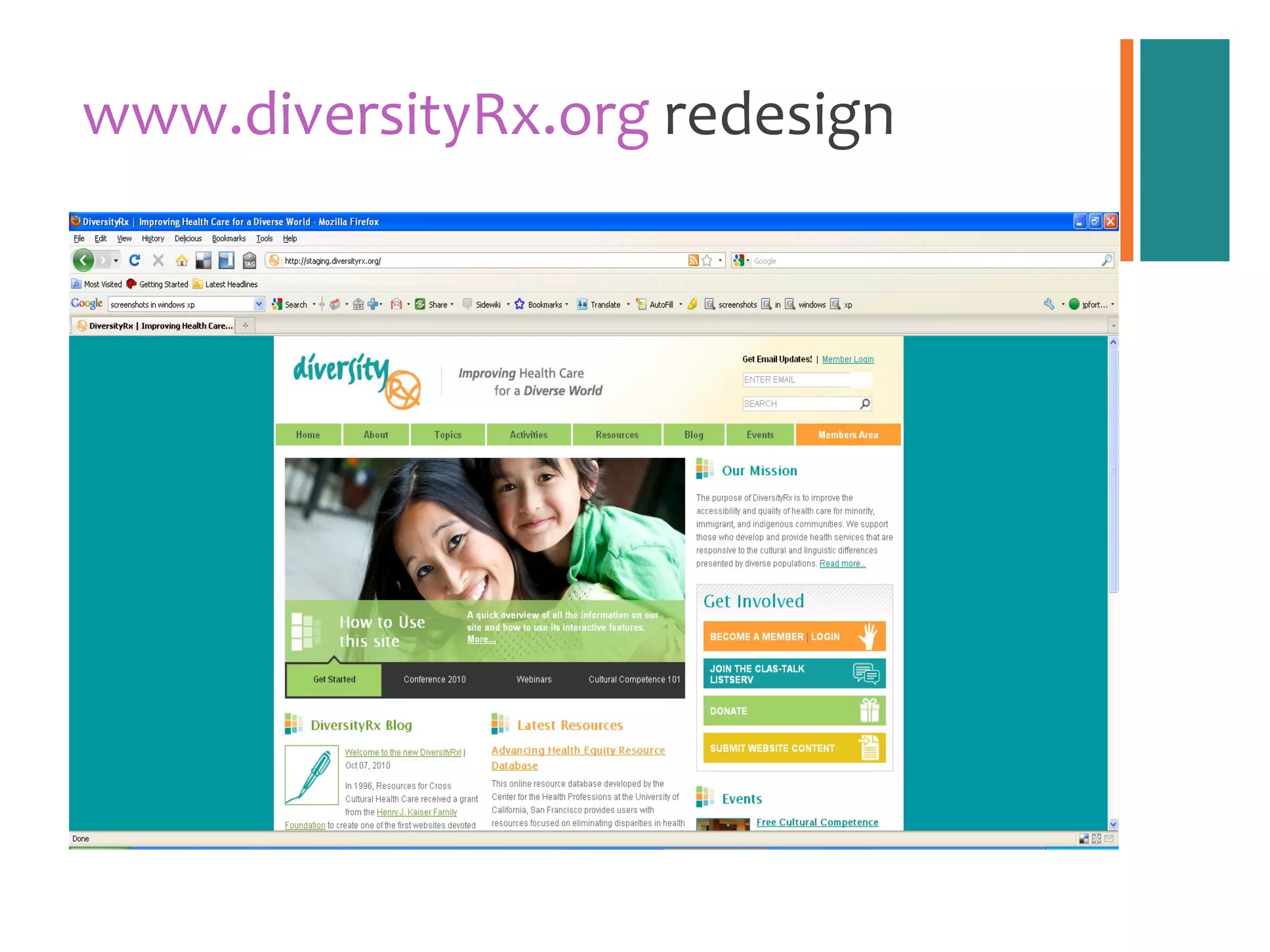
For more information: Julia Puebla Fortier, Executive Director [email_address] DiversityRx  - Resources for Cross Cultural Health Care www.diversityRx.org
www.diversityRx.org   redesign

Adapting health systems to the challenge of diversity in the US and Europe

  • 1.
    Adapting health systems to the challenge of diversity in the USA and Europe Practice, policy and politics Julia Puebla Fortier Executive Director
  • 2.
    Key messages Goodmodels drive policy Policy drives institutionalization Integration with mainstream health agendas Social and political support is key
  • 3.
    Early practice modelsOrganizational settings community clinics, public health departments, public hospitals Interventions Ethnic-specific practices/hours Bilingual/bicultural staff Interpretation/translation Community health workers/cultural liaisons Cultural competence training
  • 4.
    Some advanced practicesInstitution-wide cultural competence plans Race-ethnicity-language (REL) data collection Video medical interpreting – internal and multi-institution Mentorship-quality improvement projects Certification and practice standards
  • 5.
    The policy ladder– U.S. Title VI of the Civil Rights Act State activity: CA, WA and MA Federal demonstrations and program requirements Office of Minority Health HRSA (Community and migrant health centers)
  • 6.
    CLAS Standards: Categories of interventions Culturally Sensitive Interventions Cultural competence education Race, ethnic and linguistic concordance Community health workers and culturally competent health promotion Language Assistance Bilingual services, oral interpretation, translated written materials
  • 7.
    CLAS Standards: Categories of interventions Organizational Supports for Cultural Competence Management and policy strategies Community engagement Information and data for planning and evaluation Appropriate ethics and conflict resolution processes Public reporting
  • 8.
    A foot inthe door and the power of perception Recommended standards, not regulations Something to point to Leverage to move forward Plethora of voluntary ‘compliance’ efforts
  • 9.
    Picking up theball Initiatives from key health care quality and accreditation organizations: The Joint Commission National Committee for Quality Assurance The National Quality Forum
  • 10.
    The Joint CommissionRequired accreditation process Early interest in cultural, linguistic issues Crosswalk of CLAS standards and JC standards Hospital, Language and Culture study Standards and implementation guide released this year
  • 11.
    National Committee for Quality Assurance Voluntary standards and accrediting body for managed care plans Test waters with CLAS awards program – highlight best practices Multicultural Health Standards released this year Focus on data collection, staff diversity/ cultural competence, language services
  • 12.
    National Quality ForumComprehensive voluntary framework and preferred practices for measuring and reporting cultural competency 45 preferred practices in 6 domains: Leadership Integration into management systems Patient-provider communication Care delivery structures Workforce diversity and training Community engagement
  • 13.
    Health care reformFederal requirements that extend to all health plans related to: Language access REL data collection Disparities reduction
  • 14.
    Fitting in tothe mainstream Access to care (civil rights/advocacy) Legal and quasi-legal (requirements/liability avoidance) Business case (cost effectiveness, ROI) Quality improvement (process) Does it make a difference (outcomes)
  • 15.
    Other mainstream agendasPatient safety Health literacy Emergency preparedness Outcomes, evidence base
  • 16.
    Social acceptance Civilrights movement Rise of minority group power Political Demographic Disgrace of disparities Health professions societies
  • 17.
    Political and financialchallenges Anti-immigrant sentiment Interpersonal Political Financial crisis New paradigms, new imperatives
  • 18.
    Role of foundationsand government The California Endowment, The Commonwealth Fund, The Robert Wood Johnson Foundation Funding for demonstration projects and research
  • 19.
    For more information:Julia Puebla Fortier, Executive Director [email_address] DiversityRx - Resources for Cross Cultural Health Care www.diversityRx.org
  • 20.

Editor's Notes

  • #3 Tell the story of how a combination of obscure issues, practices and policies came to capture the attention of the Federal government and the top health care quality agencies in the United States. Rooted in the minority and refugee health programs and civil rights law, the CLAS standards evolved from an interplay of practice, policy and perception that continues to this day. We ’ll review. Tell this story from as the Principle Investigator that led two Federally funded projects to develop the CLAS standards, supported before and after by years of gathering and disseminating information about best practices, policies and research related to culturally and linguistically appropriate health care.
  • #6 Title VI (this is the Federal requirement for offering language access services): http://www.usdoj.gov/crt/cor/lep/hhsrevisedlepguidance.php http://www.hhs.gov/ocr/civilrights/activities/examples/LEP/complaintcompliance.html http://www.hhs.gov/ocr/civilrights/resources/specialtopics/hospitalcommunication/index.html State activity: http://www.healthlaw.org/library/item.174993
  • #7 CLAS Standards: http://www.omhrc.gov/templates/browse.aspx?lvl=2&lvlID=15
  • #11 http://www.jointcommission.org/PatientSafety/HLC/
  • #12 NCQA awards program, best practices and toolkit: http://www.ncqa.org/tabid/451/Default.aspx Proposed CLAS standards within their overall standards framework: http://www.ncqa.org/Portals/0/PublicComment/2010_Products_Update/Appendix_3_Creation_of_CLAS_Standard.pdf http://www.ncqa.org/Portals/0/PublicComment/2010_Products_Update/Appendix_2_Incorporating_Aspects_of_CLAS.pdf Final standards and accompanying tools: http://www.ncqa.org/tabid/1157/Default.aspx
  • #13 Project summary: http://www.qualityforum.org/projects/ongoing/cultural-comp/ Framework summary: http://www.qualityforum.org/pdf/projects/cultural-comp/txReportDraft%2002-25-09PREPUB.pdf
  • #14 Linguistic Access Services in the United States: Do They Measure Up to the National Culturally and Linguistically Appropriate Services Standards? http://dx.confex.com/dx/10/webprogrampreliminary/Paper2474.html
  • #19 The California Endowment: www.Calendow.org: click on: Publications -> Program Areas -> Cultural Competent Health Systems The Robert Wood Johnson Foundation www.rwjf.org Search cultural competence and interpretation for a full list of publications and projects The Commonwealth Fund: http://www.commonwealthfund.org/Grants-and-Programs/Browse-Grants.aspx?program=Health+Care+Disparities Also search cultural competence and interpretation for a full list of publications and projects