THE Foodservice Industry Introduction Types of Foodservice Operations Sectors of the Foodservice Industry Variables in Foodservice Operations The Meal Experience Food and Beverage Service Methods Food and Beverage Service Personnel Attributes of Food and Beverage Service Personnel
Introduction More people are eating outside the home and meet his demand there is widening diversity in the nature and type of food and beverages on offer Expansion of the industry and increasing pressures for improved professionalism in food and beverage service staff.
Food and beverage service is the essential link between the customers and the menu, beverages and other services on offer in an establishment. The server is the main point of contact between the customers and the establishment and plays an important role in a profession with increasing national and international status.
To be successful in food and beverage service requires: Sound product knowledge Well developed interpersonal skills A range of technical skills and The ability to work as part of a team
Working in the food and beverage service offers a wealth of opportunity for professional development and advancement- for those committed to the hospitality industry and to working in food and beverage service, a fulfilling, exciting and enjoyable career awaits…………………………………………………………..
1. TYPES of Foodservice Operations Food  can include a wide range of styles and cuisine types. These can be classified by country, for example, traditional British or Italian; by type of cuisine, for example, oriental; or a particular specialty such as fish, vegetarian or health food.
Beverages All alcoholic and non- alcoholic drinks Alcoholic beverages :  wines and all other types of alcoholic drinks-----cocktails, beers and cider, spirits and liqueurs. Non- alcoholic beverages: bar beverages such as mineral waters, juices, squashes and aerated waters, tea, coffee, chocolate, milk and milk drinks.
Types of Foodservice Operations 1. BISTRO Often a smaller establishment, with check tablecloths, bentwood chairs, cluttered décor and friendly informal staff. Tends to offer honest, basic and robust cooking.
2. BRASSERIE Largish, styled room, with a long bar Normally serving one-plate items Service by waiters, often in traditional style of long aprons and black waistcoats.
3. NEW WAVE BRASSERIE Gastrodome Slick modern interior design, coupled with similar approaches to contemporary cuisine and service Busy and bustling and often large and multileveled.
4. COFFEE SHOP Similar to brasserie- style operation, often themed. May be open all day and serve all meal types from breakfast through to supper.
5. FIRST CLASS RESTAURANT Tend to be formal fine dining restaurants with classical preparation and presentation of food and offering a high level of table (silver, gueridon and/or plated. Often associated with classic/haute cuisine.
6. RESTAURANT Term used to cover a wide variety of operations.  Price, level and type of service, décor, style, cuisine and degree of choice varies enormously across the range of operation.  Service ranges from full table service to assisted service such as in carvery- style operations.
7. ETHNIC RESTAURANT Indian, Oriental, Asian, Spanish, Greek, Italian, Creole and Cajun Tends to reflect ethnic origin 8. THEMED RESTAURANT Often international in orientation Themes such as jungle, rainforest or music/opera, where waiting staff perform as well as serve
9. INTERNATIONAL DESTINATION RESTAURANT Often Michelin- starred fine dining restaurants, offering a distinctive personality, cuisine, ambiance, beverages and service. Usually table service at various levels but mostly personal and attentive. Expensive but value laden.
10. HEALTH FOOD AND VEGETARIAN RESTAURANTS Increasing specialization of operations into vegetarianism and/or health foods ( though vegetarian food is not necessarily healthy), to meet lifestyle needs as well as dietary requirements.
12. CAFETERIA Primarily self- service with customer choosing selection from a counter or counters in varying designs and layouts. Originally developed for the industrial feeding market but now seen in a variety of sectors
13. POPULAR CATERING AND FAST-FOOD OUTLETS Developed from table service teashops and cafes through to steakhouses, and now incorporating snack bars, kiosks, diners, takeaways and cafeterias, with modern-day burger, chicken and fish concepts, and with ethnic foods also being incorporated. Meeting the needs of all-day meal taking and also the need for “grab and go” service, especially for the leisure, industrial and traveling markets.
14. PUBLIC HOUSES Licensed environment primarily for drinking alcoholic beverages. May be simply a serving bar with standing room for customers or may have more plush surroundings incorporating the offer of a variety of foods. These can range from simple plated dishes through to establishments offering full restaurant service ( SOMETIMES CALLED GASTROPUBS)
15. WINE BARS Often a mixture of bar and brasserie- style operation, commonly wine themed, serving a variety of foods.
SECTORS OF THE FOODSERVICE INDUSTRY
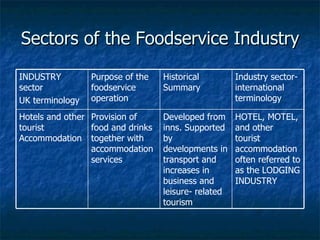
Sectors of the Foodservice Industry HOTEL, MOTEL, and other tourist accommodation often referred to as the LODGING INDUSTRY Developed from inns. Supported by developments in transport and increases in business and leisure- related tourism  Provision of food and drinks together with accommodation services Hotels and other tourist Accommodation Industry sector- international terminology Historical Summary Purpose of the foodservice operation INDUSTRY sector UK terminology
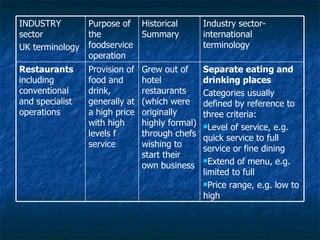
Separate eating and drinking places Categories usually defined by reference to three criteria: Level of service, e.g. quick service to full service or fine dining Extend of menu, e.g. limited to full Price range, e.g. low to high  Grew out of hotel restaurants (which were originally highly formal) through chefs wishing to start their own business Provision of food and drink, generally at a high price with high levels f service Restaurants  including conventional and specialist operations Industry sector- international terminology Historical Summary Purpose of the foodservice operation INDUSTRY sector UK terminology
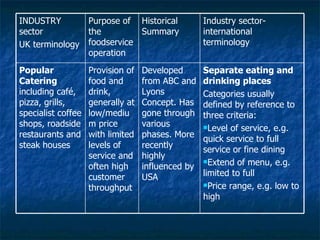
Separate eating and drinking places Categories usually defined by reference to three criteria: Level of service, e.g. quick service to full service or fine dining Extend of menu, e.g. limited to full Price range, e.g. low to high  Developed from ABC and Lyons Concept. Has gone through various phases. More recently highly influenced by USA Provision of food and drink, generally at low/medium price with limited levels of service and often high customer throughput Popular Catering  including café, pizza, grills, specialist coffee shops, roadside restaurants and steak houses Industry sector- international terminology Historical Summary Purpose of the foodservice operation INDUSTRY sector UK terminology
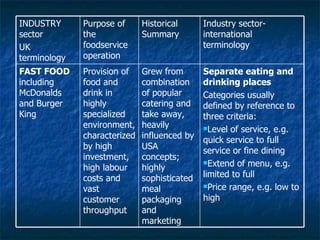
Separate eating and drinking places Categories usually defined by reference to three criteria: Level of service, e.g. quick service to full service or fine dining Extend of menu, e.g. limited to full Price range, e.g. low to high  Grew from combination of popular catering and take away, heavily influenced by USA concepts; highly sophisticated meal packaging and marketing Provision of food and drink in highly specialized environment, characterized by high investment, high labour costs and vast customer throughput FAST FOOD  including McDonalds and Burger King Industry sector- international terminology Historical Summary Purpose of the foodservice operation INDUSTRY sector UK terminology
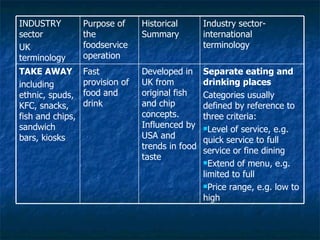
Separate eating and drinking places Categories usually defined by reference to three criteria: Level of service, e.g. quick service to full service or fine dining Extend of menu, e.g. limited to full Price range, e.g. low to high  Developed in UK from original fish and chip  concepts. Influenced by USA and trends in food taste Fast provision of food and drink TAKE AWAY including ethnic, spuds, KFC, snacks, fish and chips, sandwich bars, kiosks Industry sector- international terminology Historical Summary Purpose of the foodservice operation INDUSTRY sector UK terminology
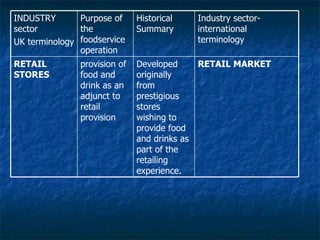
RETAIL MARKET Developed originally from prestigious stores wishing to provide food and drinks as part of the retailing experience. provision of food and drink as an adjunct to retail provision RETAIL STORES Industry sector- international terminology Historical Summary Purpose of the foodservice operation INDUSTRY sector UK terminology
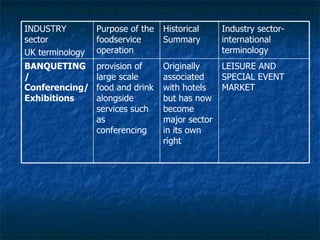
LEISURE AND SPECIAL EVENT MARKET Originally associated with hotels but has now become major sector in its own right provision of large scale food and drink alongside services such as conferencing BANQUETING/ Conferencing/ Exhibitions Industry sector- international terminology Historical Summary Purpose of the foodservice operation INDUSTRY sector UK terminology
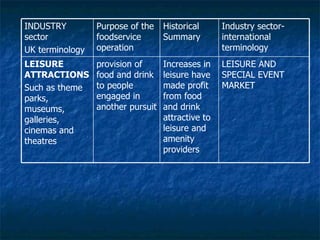
LEISURE AND SPECIAL EVENT MARKET Increases in leisure have made profit from food and drink attractive to leisure and amenity providers provision of food and drink to people engaged in another pursuit  LEISURE ATTRACTIONS Such as theme parks, museums, galleries, cinemas and theatres Industry sector- international terminology Historical Summary Purpose of the foodservice operation INDUSTRY sector UK terminology
HIGHWAY (interstate) market Born in UK in 1960s with the advent of motorway building. Influenced by USA and became specialized because of government regulations on provision of foodservice operations, retail and fuel as well as location provision of food and drink together with petrol and other retail services, often in isolated locations  MOTORWAY SERVCE STATIONS Industry sector- international terminology Historical Summary Purpose of the foodservice operation INDUSTRY sector UK terminology
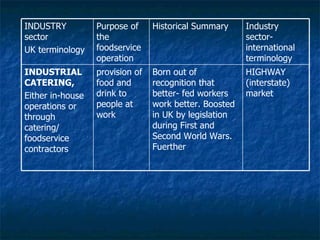
HIGHWAY (interstate) market Born out of recognition that better- fed workers work better. Boosted in UK by legislation during First and Second World Wars. Fuerther  provision of food and drink to people at work INDUSTRIAL CATERING, Either in-house operations or through catering/ foodservice contractors Industry sector- international terminology Historical Summary Purpose of the foodservice operation INDUSTRY sector UK terminology
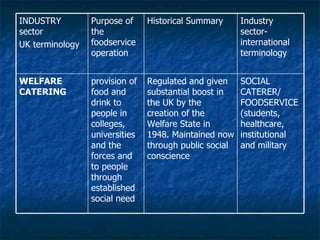
SOCIAL CATERER/ FOODSERVICE (students, healthcare, institutional and military Regulated and given substantial boost in the UK by the creation of the Welfare State in 1948. Maintained now through public social conscience provision of food and drink to people in colleges, universities and the forces and to people through established social need WELFARE CATERING Industry sector- international terminology Historical Summary Purpose of the foodservice operation INDUSTRY sector UK terminology
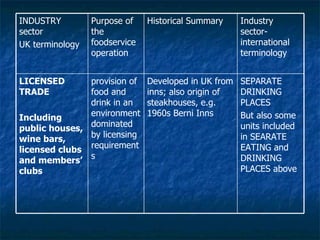
SEPARATE DRINKING PLACES But also some units included in SEARATE EATING and DRINKING PLACES above Developed in UK from inns; also origin of steakhouses, e.g. 1960s Berni Inns provision of food and drink in an environment dominated by licensing requirements LICENSED TRADE Including public houses, wine bars, licensed clubs and members’ clubs Industry sector- international terminology Historical Summary Purpose of the foodservice operation INDUSTRY sector UK terminology
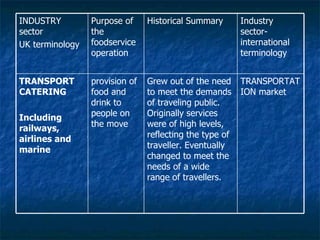
TRANSPORTATION market Grew out of the need to meet the demands of traveling public. Originally services were of high levels, reflecting the type of traveller. Eventually changed to meet the needs of a wide range of travellers. provision of food and drink to people on the move TRANSPORT CATERING Including railways, airlines and marine Industry sector- international terminology Historical Summary Purpose of the foodservice operation INDUSTRY sector UK terminology
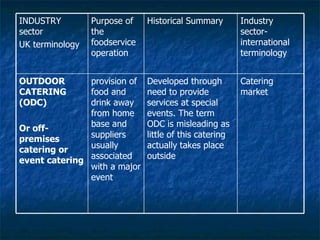
Catering market Developed through need to provide services at special events. The term ODC is misleading as little of this catering actually takes place outside provision of food and drink away from home base and suppliers usually associated with a major event OUTDOOR CATERING (ODC) Or off-premises catering or event catering Industry sector- international terminology Historical Summary Purpose of the foodservice operation INDUSTRY sector UK terminology
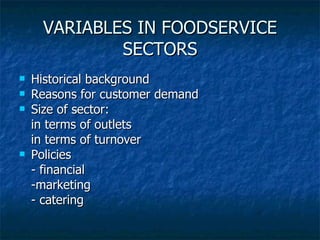
VARIABLES IN FOODSERVICE SECTORS Historical background Reasons for customer demand Size of sector:  in terms of outlets in terms of turnover Policies - financial -marketing - catering
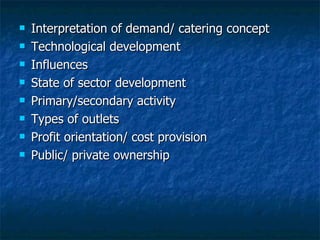
Interpretation of demand/ catering concept Technological development Influences State of sector development Primary/secondary activity Types of outlets Profit orientation/ cost provision Public/ private ownership
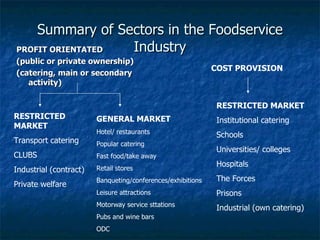
Summary of Sectors in the Foodservice Industry PROFIT ORIENTATED (public or private ownership) (catering, main or secondary activity) RESTRICTED MARKET Transport catering CLUBS Industrial (contract) Private welfare GENERAL MARKET Hotel/ restaurants Popular catering Fast food/take away Retail stores Banqueting/conferences/exhibitions Leisure attractions Motorway service sttations Pubs and wine bars ODC COST PROVISION RESTRICTED MARKET Institutional catering Schools Universities/ colleges Hospitals The Forces Prisons Industrial (own catering)
Different Types of Market  GENERAL Market - Non- captive: customers have a full choice RESTRICTED Market - Captive: costumers have no choice, e.g. welfare - Semi-captive: costumers have a choice befor entering, e.g. marine, airline, trains, some hotels and some leisure activities
VARIABLES IN FOODSERVICE OPERATIONS Organizational variables Nature of market being met Legislative controls Scale of operation Marketing/ merchandising Style of menu and drink list Range of choice Opening time/ service period  Production method Type and capability of equipment Service methods Dining arrangements Seating time Number of covers available Capacity Staff working hours Staff  organization Staff capability Number of staff Specialized service requirements Provisioning and storage methods Billing methods checking (order taking) methods Clearing methods Dishwashing methods Control method costs/ revenue
2. Customer experience variables Food and drink available Level of service and other services Price range/ value for money Cleanliness and hygiene Atmosphere (including décor, lighting, air-conditioning, acoustics, noise, size, and shape of room, other customers, attitude of staff
3. Performance measure variables Seat turnover/ customer throughput Customer send/average check Revenue per member of staff Productivity index Ratio of food and beverage sales to total sales Sales/profit per sq m (or ft)/ per seat Sales analysis Departmental profit Stock turnover Stock holding Complaint levels Level of repeat business
THE MEAL EXPERENCE The main aim of food and beverage operations is to ACHIVE CUSTOMER SATISFACTION. In the other words, to MEET THE CUSTOMERS’ NEEDS.
The needs that customers might be seeking to satisfy include: Physiological:  the need to sate one’s appetite or quench one’the s thirst, or the need for special foods such as diabetic or vegetarian. Economic:  for example, the need for good value; rapid, fast service; a convenient location Psychological : for example, the need for enhancement of self-esteem; fulfilling life-style needs; the need for variety; as result of advertising and promotion. Social:  for example, going out with friends or business colleagues; attending a function in order to meet others. Convenience : for example, as a result of being unable to get home (shoppers, workers) or attending some other event (cinema, theatre); the desire for someone else to do the work; the physical impossibility of catering at home (weddings and other special functions)
MEAL EXPERIENCE FACTORS THE FOOD AND BEVERAGES OFFER Includes the range of foods and beverages, choice, availability, flexibility for special orders and the quality of the food and beverages. LEVEL OF SERVICE Depending on the needs people have at the time, the level of service sought will be appropriate to these needs LEVEL OF CLEANLINESS AND HYGIENE This factor relates to the premises, equipment and staff. ATMOSPHERE OF THE ESTABLISHMENT This factor takes account of issues such as design, décor, lighting, heating, furnishing, acoustics and noise levels, other customers, the smartness of the staff and the attitude of the staff
Customer Service Customer service in foodservice operations can be defined as being a combination of five characteristics. These are: Service level:  the intensity of or limitations in, the individual personal attention given to customers. Service availability:  for example, the opening times and variations in the menu and beverage list on offer. Level of standards:  for example, the food and beverage quality, décor, standard of equipment being used, level of staffing professionalism. Service reliability:  the extent to which the product is intended to be consistent and its consistency in practice/. Service flexibility:  the extent to which alternatives are available, and to which there can be variations in the standard products that are offered. Note: a foodservice operation will determine the  customer service specification  of the operation by taking account of these five customer service factors.
Use of resources MATERIALS - food, beverages and short use of equipment (such as paper napkins) LABOUR - staffing costs FACILITIES - premises and plant
Level of Customer Service 1.   TECHNICAL SPECIFICATION: refers to the food and beverage items on offer, the portion size or measure, the cooking method, the degree of cooking, the method of presentation, the cover, accompaniments, the cleanliness of items etc. 2. SERVICE SPECIFICATION: refers to two aspects: first the procedures for service and second, the way in which the procedures are carried out.
Level of service and Standards of service LEVEL OF SERVICE in foodservice operations can range from being very limited to complex, with high levels of personal attention. STANDARDS OF SERVICE are a measure of the ability of the operation to deliver the service level it is offering.
FOOD AND BEVERAGE SERVICE METHODS The service of food and beverages may be carried out in many ways depending on the following factors: Type of establishment Time available for the meal Type of menu presented Site of the establishments Type of customer to be served Turnover of custom expected Cost of the meal served.
A food service operation can be seen as a simple model comprising three operating systems: FOOD PRODUCTION BEVERAGE PROVISION FOOD AND BEVERAGE SERVICE
Food and Beverage service sequence Preparation for service Taking bookings Greeting and seating/ directing Taking food and beverage orders Serving of food Serving beverages Clearing during service Billing Dealing with payments Dishwashing Clearing following service
FOOD AND BEVERAGE SERVICE METHOD GROUP A: TABLE SERVICE Service to customer at a laid cover WAITER Silver/ ENGLISH-  presentation and service of food by waiting staff, using a spoon and fork, onto a customer’s plate, from food flats or dishes Family:  Main courses plated (but may be silver served) with vegetables placed in multi-portion dishes on tables for customers to help themselves; sauces offered separately. Plate/ AMERICAN-  service of pre-plated foods to customers. Now also widely used for banqueting.
d.  Butler/FRENCH-  Presentation of foods to customers by foodservice staff for customers to serve themselves. e. RUSSIAN-  Table laid with food for customers to help themselves ( this is a modern interpretation and may also sometimes be used to indicate GUERIDON or BUTLER service. f. GUERIDON-  Food served onto customer’s plate at a side table or trolley; may also include carving, jointing and fish filleting , the preparation of foods such as salads and dressings and flambage
2. Bar Counter- service to customers seated at bar counter (often U shaped) on stools. GROUP B: ASSISTED SERVICE Combination of table service and self- service 3 . Assisted a. Carvery-  some parts of the meal are served to seated customers. Also used for breakfast service and for banqueting. b. Buffets-  customers select food and drink from displays or passed trays; consumption is either at tables, standing or in lounge area.
GROUP C: SELF-SERVICE Self- service of customers 4. Cafeteria a. Counter b. Free- flow c. Echelon d. Supermarket
GROUP D: SINGLE POINT SERVICE Service of customers at single point- consumed on premises or taken away 5. Take away a. Take away b. Drive-thru c. Fast food 6. Vending –  provision of food service and beverage service by means of automatic retailing.
7. Kiosks-  Outstation used to provide service for peak demand or in specific location; may be open for customers to order and be served, or used for dispensing to staff only. 8. Food court-  series of autonomous counter where customers may either order and eat (as in 2 Bar counter, above) or buy from a number of counters and eat in separate eating area or take away. 9. BAR-  term used to describe order, service and payment point and consumption area in licensed premises
GROUP E: SPECIALIZED (or in situ) Service to customers in areas not primarily designed for service. 10.TRAY 11. TROLLEY 12. Home Delivery 13. Lounge- service of variety of foods and beverages in lounge area. E.g. hotel lounge 14. Room- in guest bedrooms or in meeting rooms 15. Drive- in- customers park motor vehicle and are served at their vehicles
FOOD AND BEVERAGE SERVICE PERSONNEL FOOD & BEVERAGE MANAGER Depending on the size of the establishment, the food and beverage manager is either responsible for the implementation of agreed policies or for contributing to the setting of catering policies Ensuring that the required profit margins are achieved for each food and beverage service area, in financial period Updating and compiling new wine lists according to availability of stocks, current trends and customer needs.
Compiling, in liaison with the kitchen, menus for the various food service areas and for special occasions. The purchasing of all materials, both food and drinks Ensuring the quality in relation to the price paid is maintained Determining portion size in relation to selling price Departmental training and promotions, plus the maintenance of the highest professional standards Employing and dismissing staff Holding regular meetings with section heads to ensure all areas are working effectively, efficiently and well coordinated
Restaurant manager/ supervisor Overall responsibility for the organization and administration of particular food and beverage service areas. This may include the lounges, room service (in hotels), restaurants and possibly some of the private banqueting suites. Sets the standards for service and is responsible for any staff training that may required.  He/she may make out duty rotas, holiday lists and hours on and off duty and contribute to operational duties.
RECEPTION HEADWAITER Responsible for accepting any bookings and for keeping the booking diary up to date. Reserve tables and allocate these reservations to particular stations Greets the guest on arrival and tae them to the table and seats them
HEADWAITER/Maitre d hotel/supervisor Overall charge of the staff team and is responsible for seeing that all the duties necessary for the pre-preparation for service are efficiently carried out and that nothing is forgotten.  Aid the reception headwaiter during the service and will possibly take some orders if the station waiter is busy. Helps with the compilation of duty rotas and holiday lists, and may relieve the restaurant manager or reception headwaiter on their days off
Station headwaiter/ section supervisor Overall responsibility for a team of staff serving a number of sets of tables (which may be anything from four to eight in number), from one sideboard. Each set of tables under the station headwaiter’s control is called a station. Must have a good knowledge of food and wine and its correct service, and be able to instruct other members of the staff. He/she will take the order (usually from the host) and carry out all the service at the table with the help of the chef de rang, who is in command of one station.
Station waiter Chef de rang Must be able to carry out the same work as the station headwaiter and relieve him on days off. Less experience than the station headwaiter. Must work together as a team to provide an efficient and speedy service with the station headwaiter/
Assistant station waiter Demi-chef de rang A person next in seniority to the chef de rang and assists where necessary.
Waiter Server/ commis de rang Acts by instruction from the chef de rang. Mainly fetches and carries, may do a little service of either vegetables or sauces, offers rolls, places plates upon the table and so on, helps to clear the tables after each course. During the pre- preparation period some of the cleaning and preparatory tasks will be carried out.
Trainee commis Debarrassuer/ apprentice Learner- having joined the foodservice staff, and possibly wishing to take up food service as a career. During the service this person will keep the sideboard well filled with equipment and may help to fetch and carry items as required. Carry out certain of the cleaning tasks during the pre-preparation periods. May be given the responsibility of looking after and serving hors-d’oeuvre, cold sweets or assorted cheeses from the appropriate trolleys.
Carver Trancheur Responsible for the carving trolley and the carving of joints at the table as required. Will plate up each portion with the appropriate accompaniments.
Floor service staff Chef d’etage/ floor waiter Responsible for  complete floor in an establishment or depending on the size of the establishment, a number of rooms or suites.
Lounge staff Chef de sale Deal with lounge service as a specific duty only in a first-class establishment. Responsible for setting up the lounge in the morning and maintaining its cleanliness and presentation throughout the day.
Wine butler Wine waiter/ sommelier Responsible of all alcoholic drinks during the service of meals. Must also be a sales person Should have a thorough knowledge of all drink to be served, of the best wines to go with certain foods, and of the licensing laws in respect of the particular establishment and area.
Cocktail bar staff Works on the cocktail bar must be responsible and well versed in the skills of shaking and stirring cocktails. Should have a thorough knowledge of all alcoholic and non-alcoholic beverages, the ingredients necessary for making of cocktails and of the licensing laws.
Buffet assistant Buffet chef/ chef de buffet In charge of the buffet in the room, its presentation, the carving and portioning of food and its service. Member of the kitchen team.
Cashier Responsible for billing and taking payments, or making ledger account entries for a food and beverage operation. Making up bills from food and drinks checks or, alternatively, in a cafeteria, for example, charging customers for their selection of items on the tray.
Counter assistants Are found in cafeterias where they would stock the counter and sometimes serve or portion food for customers. Duties may also include some cooking of call order items
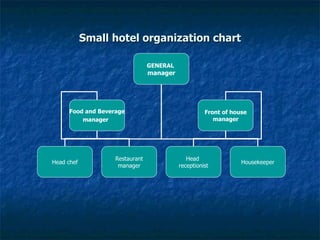
Small hotel organization chart GENERAL   manager Food and Beverage manager Front of house manager Head chef Restaurant manager Head  receptionist Housekeeper


food service industry

  • 1.
    THE Foodservice IndustryIntroduction Types of Foodservice Operations Sectors of the Foodservice Industry Variables in Foodservice Operations The Meal Experience Food and Beverage Service Methods Food and Beverage Service Personnel Attributes of Food and Beverage Service Personnel
  • 2.
    Introduction More peopleare eating outside the home and meet his demand there is widening diversity in the nature and type of food and beverages on offer Expansion of the industry and increasing pressures for improved professionalism in food and beverage service staff.
  • 3.
    Food and beverageservice is the essential link between the customers and the menu, beverages and other services on offer in an establishment. The server is the main point of contact between the customers and the establishment and plays an important role in a profession with increasing national and international status.
  • 4.
    To be successfulin food and beverage service requires: Sound product knowledge Well developed interpersonal skills A range of technical skills and The ability to work as part of a team
  • 5.
    Working in thefood and beverage service offers a wealth of opportunity for professional development and advancement- for those committed to the hospitality industry and to working in food and beverage service, a fulfilling, exciting and enjoyable career awaits…………………………………………………………..
  • 6.
    1. TYPES ofFoodservice Operations Food can include a wide range of styles and cuisine types. These can be classified by country, for example, traditional British or Italian; by type of cuisine, for example, oriental; or a particular specialty such as fish, vegetarian or health food.
  • 7.
    Beverages All alcoholicand non- alcoholic drinks Alcoholic beverages : wines and all other types of alcoholic drinks-----cocktails, beers and cider, spirits and liqueurs. Non- alcoholic beverages: bar beverages such as mineral waters, juices, squashes and aerated waters, tea, coffee, chocolate, milk and milk drinks.
  • 8.
    Types of FoodserviceOperations 1. BISTRO Often a smaller establishment, with check tablecloths, bentwood chairs, cluttered décor and friendly informal staff. Tends to offer honest, basic and robust cooking.
  • 9.
    2. BRASSERIE Largish,styled room, with a long bar Normally serving one-plate items Service by waiters, often in traditional style of long aprons and black waistcoats.
  • 10.
    3. NEW WAVEBRASSERIE Gastrodome Slick modern interior design, coupled with similar approaches to contemporary cuisine and service Busy and bustling and often large and multileveled.
  • 11.
    4. COFFEE SHOPSimilar to brasserie- style operation, often themed. May be open all day and serve all meal types from breakfast through to supper.
  • 12.
    5. FIRST CLASSRESTAURANT Tend to be formal fine dining restaurants with classical preparation and presentation of food and offering a high level of table (silver, gueridon and/or plated. Often associated with classic/haute cuisine.
  • 13.
    6. RESTAURANT Termused to cover a wide variety of operations. Price, level and type of service, décor, style, cuisine and degree of choice varies enormously across the range of operation. Service ranges from full table service to assisted service such as in carvery- style operations.
  • 14.
    7. ETHNIC RESTAURANTIndian, Oriental, Asian, Spanish, Greek, Italian, Creole and Cajun Tends to reflect ethnic origin 8. THEMED RESTAURANT Often international in orientation Themes such as jungle, rainforest or music/opera, where waiting staff perform as well as serve
  • 15.
    9. INTERNATIONAL DESTINATIONRESTAURANT Often Michelin- starred fine dining restaurants, offering a distinctive personality, cuisine, ambiance, beverages and service. Usually table service at various levels but mostly personal and attentive. Expensive but value laden.
  • 16.
    10. HEALTH FOODAND VEGETARIAN RESTAURANTS Increasing specialization of operations into vegetarianism and/or health foods ( though vegetarian food is not necessarily healthy), to meet lifestyle needs as well as dietary requirements.
  • 17.
    12. CAFETERIA Primarilyself- service with customer choosing selection from a counter or counters in varying designs and layouts. Originally developed for the industrial feeding market but now seen in a variety of sectors
  • 18.
    13. POPULAR CATERINGAND FAST-FOOD OUTLETS Developed from table service teashops and cafes through to steakhouses, and now incorporating snack bars, kiosks, diners, takeaways and cafeterias, with modern-day burger, chicken and fish concepts, and with ethnic foods also being incorporated. Meeting the needs of all-day meal taking and also the need for “grab and go” service, especially for the leisure, industrial and traveling markets.
  • 19.
    14. PUBLIC HOUSESLicensed environment primarily for drinking alcoholic beverages. May be simply a serving bar with standing room for customers or may have more plush surroundings incorporating the offer of a variety of foods. These can range from simple plated dishes through to establishments offering full restaurant service ( SOMETIMES CALLED GASTROPUBS)
  • 20.
    15. WINE BARSOften a mixture of bar and brasserie- style operation, commonly wine themed, serving a variety of foods.
  • 21.
    SECTORS OF THEFOODSERVICE INDUSTRY
  • 22.
    Sectors of theFoodservice Industry HOTEL, MOTEL, and other tourist accommodation often referred to as the LODGING INDUSTRY Developed from inns. Supported by developments in transport and increases in business and leisure- related tourism Provision of food and drinks together with accommodation services Hotels and other tourist Accommodation Industry sector- international terminology Historical Summary Purpose of the foodservice operation INDUSTRY sector UK terminology
  • 23.
    Separate eating anddrinking places Categories usually defined by reference to three criteria: Level of service, e.g. quick service to full service or fine dining Extend of menu, e.g. limited to full Price range, e.g. low to high Grew out of hotel restaurants (which were originally highly formal) through chefs wishing to start their own business Provision of food and drink, generally at a high price with high levels f service Restaurants including conventional and specialist operations Industry sector- international terminology Historical Summary Purpose of the foodservice operation INDUSTRY sector UK terminology
  • 24.
    Separate eating anddrinking places Categories usually defined by reference to three criteria: Level of service, e.g. quick service to full service or fine dining Extend of menu, e.g. limited to full Price range, e.g. low to high Developed from ABC and Lyons Concept. Has gone through various phases. More recently highly influenced by USA Provision of food and drink, generally at low/medium price with limited levels of service and often high customer throughput Popular Catering including café, pizza, grills, specialist coffee shops, roadside restaurants and steak houses Industry sector- international terminology Historical Summary Purpose of the foodservice operation INDUSTRY sector UK terminology
  • 25.
    Separate eating anddrinking places Categories usually defined by reference to three criteria: Level of service, e.g. quick service to full service or fine dining Extend of menu, e.g. limited to full Price range, e.g. low to high Grew from combination of popular catering and take away, heavily influenced by USA concepts; highly sophisticated meal packaging and marketing Provision of food and drink in highly specialized environment, characterized by high investment, high labour costs and vast customer throughput FAST FOOD including McDonalds and Burger King Industry sector- international terminology Historical Summary Purpose of the foodservice operation INDUSTRY sector UK terminology
  • 26.
    Separate eating anddrinking places Categories usually defined by reference to three criteria: Level of service, e.g. quick service to full service or fine dining Extend of menu, e.g. limited to full Price range, e.g. low to high Developed in UK from original fish and chip concepts. Influenced by USA and trends in food taste Fast provision of food and drink TAKE AWAY including ethnic, spuds, KFC, snacks, fish and chips, sandwich bars, kiosks Industry sector- international terminology Historical Summary Purpose of the foodservice operation INDUSTRY sector UK terminology
  • 27.
    RETAIL MARKET Developedoriginally from prestigious stores wishing to provide food and drinks as part of the retailing experience. provision of food and drink as an adjunct to retail provision RETAIL STORES Industry sector- international terminology Historical Summary Purpose of the foodservice operation INDUSTRY sector UK terminology
  • 28.
    LEISURE AND SPECIALEVENT MARKET Originally associated with hotels but has now become major sector in its own right provision of large scale food and drink alongside services such as conferencing BANQUETING/ Conferencing/ Exhibitions Industry sector- international terminology Historical Summary Purpose of the foodservice operation INDUSTRY sector UK terminology
  • 29.
    LEISURE AND SPECIALEVENT MARKET Increases in leisure have made profit from food and drink attractive to leisure and amenity providers provision of food and drink to people engaged in another pursuit LEISURE ATTRACTIONS Such as theme parks, museums, galleries, cinemas and theatres Industry sector- international terminology Historical Summary Purpose of the foodservice operation INDUSTRY sector UK terminology
  • 30.
    HIGHWAY (interstate) marketBorn in UK in 1960s with the advent of motorway building. Influenced by USA and became specialized because of government regulations on provision of foodservice operations, retail and fuel as well as location provision of food and drink together with petrol and other retail services, often in isolated locations MOTORWAY SERVCE STATIONS Industry sector- international terminology Historical Summary Purpose of the foodservice operation INDUSTRY sector UK terminology
  • 31.
    HIGHWAY (interstate) marketBorn out of recognition that better- fed workers work better. Boosted in UK by legislation during First and Second World Wars. Fuerther provision of food and drink to people at work INDUSTRIAL CATERING, Either in-house operations or through catering/ foodservice contractors Industry sector- international terminology Historical Summary Purpose of the foodservice operation INDUSTRY sector UK terminology
  • 32.
    SOCIAL CATERER/ FOODSERVICE(students, healthcare, institutional and military Regulated and given substantial boost in the UK by the creation of the Welfare State in 1948. Maintained now through public social conscience provision of food and drink to people in colleges, universities and the forces and to people through established social need WELFARE CATERING Industry sector- international terminology Historical Summary Purpose of the foodservice operation INDUSTRY sector UK terminology
  • 33.
    SEPARATE DRINKING PLACESBut also some units included in SEARATE EATING and DRINKING PLACES above Developed in UK from inns; also origin of steakhouses, e.g. 1960s Berni Inns provision of food and drink in an environment dominated by licensing requirements LICENSED TRADE Including public houses, wine bars, licensed clubs and members’ clubs Industry sector- international terminology Historical Summary Purpose of the foodservice operation INDUSTRY sector UK terminology
  • 34.
    TRANSPORTATION market Grewout of the need to meet the demands of traveling public. Originally services were of high levels, reflecting the type of traveller. Eventually changed to meet the needs of a wide range of travellers. provision of food and drink to people on the move TRANSPORT CATERING Including railways, airlines and marine Industry sector- international terminology Historical Summary Purpose of the foodservice operation INDUSTRY sector UK terminology
  • 35.
    Catering market Developedthrough need to provide services at special events. The term ODC is misleading as little of this catering actually takes place outside provision of food and drink away from home base and suppliers usually associated with a major event OUTDOOR CATERING (ODC) Or off-premises catering or event catering Industry sector- international terminology Historical Summary Purpose of the foodservice operation INDUSTRY sector UK terminology
  • 36.
    VARIABLES IN FOODSERVICESECTORS Historical background Reasons for customer demand Size of sector: in terms of outlets in terms of turnover Policies - financial -marketing - catering
  • 37.
    Interpretation of demand/catering concept Technological development Influences State of sector development Primary/secondary activity Types of outlets Profit orientation/ cost provision Public/ private ownership
  • 38.
    Summary of Sectorsin the Foodservice Industry PROFIT ORIENTATED (public or private ownership) (catering, main or secondary activity) RESTRICTED MARKET Transport catering CLUBS Industrial (contract) Private welfare GENERAL MARKET Hotel/ restaurants Popular catering Fast food/take away Retail stores Banqueting/conferences/exhibitions Leisure attractions Motorway service sttations Pubs and wine bars ODC COST PROVISION RESTRICTED MARKET Institutional catering Schools Universities/ colleges Hospitals The Forces Prisons Industrial (own catering)
  • 39.
    Different Types ofMarket GENERAL Market - Non- captive: customers have a full choice RESTRICTED Market - Captive: costumers have no choice, e.g. welfare - Semi-captive: costumers have a choice befor entering, e.g. marine, airline, trains, some hotels and some leisure activities
  • 40.
    VARIABLES IN FOODSERVICEOPERATIONS Organizational variables Nature of market being met Legislative controls Scale of operation Marketing/ merchandising Style of menu and drink list Range of choice Opening time/ service period Production method Type and capability of equipment Service methods Dining arrangements Seating time Number of covers available Capacity Staff working hours Staff organization Staff capability Number of staff Specialized service requirements Provisioning and storage methods Billing methods checking (order taking) methods Clearing methods Dishwashing methods Control method costs/ revenue
  • 41.
    2. Customer experiencevariables Food and drink available Level of service and other services Price range/ value for money Cleanliness and hygiene Atmosphere (including décor, lighting, air-conditioning, acoustics, noise, size, and shape of room, other customers, attitude of staff
  • 42.
    3. Performance measurevariables Seat turnover/ customer throughput Customer send/average check Revenue per member of staff Productivity index Ratio of food and beverage sales to total sales Sales/profit per sq m (or ft)/ per seat Sales analysis Departmental profit Stock turnover Stock holding Complaint levels Level of repeat business
  • 43.
    THE MEAL EXPERENCEThe main aim of food and beverage operations is to ACHIVE CUSTOMER SATISFACTION. In the other words, to MEET THE CUSTOMERS’ NEEDS.
  • 44.
    The needs thatcustomers might be seeking to satisfy include: Physiological: the need to sate one’s appetite or quench one’the s thirst, or the need for special foods such as diabetic or vegetarian. Economic: for example, the need for good value; rapid, fast service; a convenient location Psychological : for example, the need for enhancement of self-esteem; fulfilling life-style needs; the need for variety; as result of advertising and promotion. Social: for example, going out with friends or business colleagues; attending a function in order to meet others. Convenience : for example, as a result of being unable to get home (shoppers, workers) or attending some other event (cinema, theatre); the desire for someone else to do the work; the physical impossibility of catering at home (weddings and other special functions)
  • 45.
    MEAL EXPERIENCE FACTORSTHE FOOD AND BEVERAGES OFFER Includes the range of foods and beverages, choice, availability, flexibility for special orders and the quality of the food and beverages. LEVEL OF SERVICE Depending on the needs people have at the time, the level of service sought will be appropriate to these needs LEVEL OF CLEANLINESS AND HYGIENE This factor relates to the premises, equipment and staff. ATMOSPHERE OF THE ESTABLISHMENT This factor takes account of issues such as design, décor, lighting, heating, furnishing, acoustics and noise levels, other customers, the smartness of the staff and the attitude of the staff
  • 46.
    Customer Service Customerservice in foodservice operations can be defined as being a combination of five characteristics. These are: Service level: the intensity of or limitations in, the individual personal attention given to customers. Service availability: for example, the opening times and variations in the menu and beverage list on offer. Level of standards: for example, the food and beverage quality, décor, standard of equipment being used, level of staffing professionalism. Service reliability: the extent to which the product is intended to be consistent and its consistency in practice/. Service flexibility: the extent to which alternatives are available, and to which there can be variations in the standard products that are offered. Note: a foodservice operation will determine the customer service specification of the operation by taking account of these five customer service factors.
  • 47.
    Use of resourcesMATERIALS - food, beverages and short use of equipment (such as paper napkins) LABOUR - staffing costs FACILITIES - premises and plant
  • 48.
    Level of CustomerService 1. TECHNICAL SPECIFICATION: refers to the food and beverage items on offer, the portion size or measure, the cooking method, the degree of cooking, the method of presentation, the cover, accompaniments, the cleanliness of items etc. 2. SERVICE SPECIFICATION: refers to two aspects: first the procedures for service and second, the way in which the procedures are carried out.
  • 49.
    Level of serviceand Standards of service LEVEL OF SERVICE in foodservice operations can range from being very limited to complex, with high levels of personal attention. STANDARDS OF SERVICE are a measure of the ability of the operation to deliver the service level it is offering.
  • 50.
    FOOD AND BEVERAGESERVICE METHODS The service of food and beverages may be carried out in many ways depending on the following factors: Type of establishment Time available for the meal Type of menu presented Site of the establishments Type of customer to be served Turnover of custom expected Cost of the meal served.
  • 51.
    A food serviceoperation can be seen as a simple model comprising three operating systems: FOOD PRODUCTION BEVERAGE PROVISION FOOD AND BEVERAGE SERVICE
  • 52.
    Food and Beverageservice sequence Preparation for service Taking bookings Greeting and seating/ directing Taking food and beverage orders Serving of food Serving beverages Clearing during service Billing Dealing with payments Dishwashing Clearing following service
  • 53.
    FOOD AND BEVERAGESERVICE METHOD GROUP A: TABLE SERVICE Service to customer at a laid cover WAITER Silver/ ENGLISH- presentation and service of food by waiting staff, using a spoon and fork, onto a customer’s plate, from food flats or dishes Family: Main courses plated (but may be silver served) with vegetables placed in multi-portion dishes on tables for customers to help themselves; sauces offered separately. Plate/ AMERICAN- service of pre-plated foods to customers. Now also widely used for banqueting.
  • 54.
    d. Butler/FRENCH- Presentation of foods to customers by foodservice staff for customers to serve themselves. e. RUSSIAN- Table laid with food for customers to help themselves ( this is a modern interpretation and may also sometimes be used to indicate GUERIDON or BUTLER service. f. GUERIDON- Food served onto customer’s plate at a side table or trolley; may also include carving, jointing and fish filleting , the preparation of foods such as salads and dressings and flambage
  • 55.
    2. Bar Counter-service to customers seated at bar counter (often U shaped) on stools. GROUP B: ASSISTED SERVICE Combination of table service and self- service 3 . Assisted a. Carvery- some parts of the meal are served to seated customers. Also used for breakfast service and for banqueting. b. Buffets- customers select food and drink from displays or passed trays; consumption is either at tables, standing or in lounge area.
  • 56.
    GROUP C: SELF-SERVICESelf- service of customers 4. Cafeteria a. Counter b. Free- flow c. Echelon d. Supermarket
  • 57.
    GROUP D: SINGLEPOINT SERVICE Service of customers at single point- consumed on premises or taken away 5. Take away a. Take away b. Drive-thru c. Fast food 6. Vending – provision of food service and beverage service by means of automatic retailing.
  • 58.
    7. Kiosks- Outstation used to provide service for peak demand or in specific location; may be open for customers to order and be served, or used for dispensing to staff only. 8. Food court- series of autonomous counter where customers may either order and eat (as in 2 Bar counter, above) or buy from a number of counters and eat in separate eating area or take away. 9. BAR- term used to describe order, service and payment point and consumption area in licensed premises
  • 59.
    GROUP E: SPECIALIZED(or in situ) Service to customers in areas not primarily designed for service. 10.TRAY 11. TROLLEY 12. Home Delivery 13. Lounge- service of variety of foods and beverages in lounge area. E.g. hotel lounge 14. Room- in guest bedrooms or in meeting rooms 15. Drive- in- customers park motor vehicle and are served at their vehicles
  • 60.
    FOOD AND BEVERAGESERVICE PERSONNEL FOOD & BEVERAGE MANAGER Depending on the size of the establishment, the food and beverage manager is either responsible for the implementation of agreed policies or for contributing to the setting of catering policies Ensuring that the required profit margins are achieved for each food and beverage service area, in financial period Updating and compiling new wine lists according to availability of stocks, current trends and customer needs.
  • 61.
    Compiling, in liaisonwith the kitchen, menus for the various food service areas and for special occasions. The purchasing of all materials, both food and drinks Ensuring the quality in relation to the price paid is maintained Determining portion size in relation to selling price Departmental training and promotions, plus the maintenance of the highest professional standards Employing and dismissing staff Holding regular meetings with section heads to ensure all areas are working effectively, efficiently and well coordinated
  • 62.
    Restaurant manager/ supervisorOverall responsibility for the organization and administration of particular food and beverage service areas. This may include the lounges, room service (in hotels), restaurants and possibly some of the private banqueting suites. Sets the standards for service and is responsible for any staff training that may required. He/she may make out duty rotas, holiday lists and hours on and off duty and contribute to operational duties.
  • 63.
    RECEPTION HEADWAITER Responsiblefor accepting any bookings and for keeping the booking diary up to date. Reserve tables and allocate these reservations to particular stations Greets the guest on arrival and tae them to the table and seats them
  • 64.
    HEADWAITER/Maitre d hotel/supervisorOverall charge of the staff team and is responsible for seeing that all the duties necessary for the pre-preparation for service are efficiently carried out and that nothing is forgotten. Aid the reception headwaiter during the service and will possibly take some orders if the station waiter is busy. Helps with the compilation of duty rotas and holiday lists, and may relieve the restaurant manager or reception headwaiter on their days off
  • 65.
    Station headwaiter/ sectionsupervisor Overall responsibility for a team of staff serving a number of sets of tables (which may be anything from four to eight in number), from one sideboard. Each set of tables under the station headwaiter’s control is called a station. Must have a good knowledge of food and wine and its correct service, and be able to instruct other members of the staff. He/she will take the order (usually from the host) and carry out all the service at the table with the help of the chef de rang, who is in command of one station.
  • 66.
    Station waiter Chefde rang Must be able to carry out the same work as the station headwaiter and relieve him on days off. Less experience than the station headwaiter. Must work together as a team to provide an efficient and speedy service with the station headwaiter/
  • 67.
    Assistant station waiterDemi-chef de rang A person next in seniority to the chef de rang and assists where necessary.
  • 68.
    Waiter Server/ commisde rang Acts by instruction from the chef de rang. Mainly fetches and carries, may do a little service of either vegetables or sauces, offers rolls, places plates upon the table and so on, helps to clear the tables after each course. During the pre- preparation period some of the cleaning and preparatory tasks will be carried out.
  • 69.
    Trainee commis Debarrassuer/apprentice Learner- having joined the foodservice staff, and possibly wishing to take up food service as a career. During the service this person will keep the sideboard well filled with equipment and may help to fetch and carry items as required. Carry out certain of the cleaning tasks during the pre-preparation periods. May be given the responsibility of looking after and serving hors-d’oeuvre, cold sweets or assorted cheeses from the appropriate trolleys.
  • 70.
    Carver Trancheur Responsiblefor the carving trolley and the carving of joints at the table as required. Will plate up each portion with the appropriate accompaniments.
  • 71.
    Floor service staffChef d’etage/ floor waiter Responsible for complete floor in an establishment or depending on the size of the establishment, a number of rooms or suites.
  • 72.
    Lounge staff Chefde sale Deal with lounge service as a specific duty only in a first-class establishment. Responsible for setting up the lounge in the morning and maintaining its cleanliness and presentation throughout the day.
  • 73.
    Wine butler Winewaiter/ sommelier Responsible of all alcoholic drinks during the service of meals. Must also be a sales person Should have a thorough knowledge of all drink to be served, of the best wines to go with certain foods, and of the licensing laws in respect of the particular establishment and area.
  • 74.
    Cocktail bar staffWorks on the cocktail bar must be responsible and well versed in the skills of shaking and stirring cocktails. Should have a thorough knowledge of all alcoholic and non-alcoholic beverages, the ingredients necessary for making of cocktails and of the licensing laws.
  • 75.
    Buffet assistant Buffetchef/ chef de buffet In charge of the buffet in the room, its presentation, the carving and portioning of food and its service. Member of the kitchen team.
  • 76.
    Cashier Responsible forbilling and taking payments, or making ledger account entries for a food and beverage operation. Making up bills from food and drinks checks or, alternatively, in a cafeteria, for example, charging customers for their selection of items on the tray.
  • 77.
    Counter assistants Arefound in cafeterias where they would stock the counter and sometimes serve or portion food for customers. Duties may also include some cooking of call order items
  • 78.
    Small hotel organizationchart GENERAL manager Food and Beverage manager Front of house manager Head chef Restaurant manager Head receptionist Housekeeper
  • 79.
  • 80.
  • 81.
  • 82.
  • 83.
  • 84.