Listening
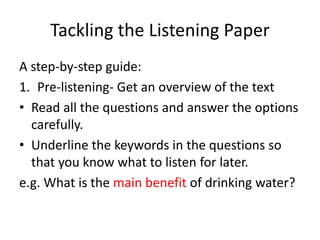
Tackling the Listening Paper
A step-by-step guide:
1. Pre-listening- Get an overview of the text
• Read all the questions and answer the options
carefully.
• Underline the keywords in the questions so
that you know what to listen for later.
e.g. What is the main benefit of drinking water?
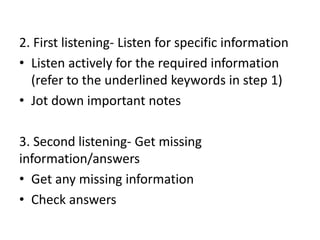
2. First listening- Listen for specific information
• Listen actively for the required information
(refer to the underlined keywords in step 1)
• Jot down important notes
3. Second listening- Get missing
information/answers
• Get any missing information
• Check answers
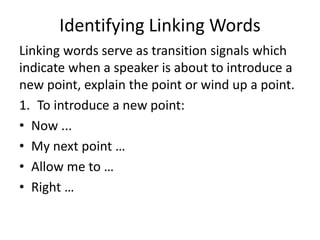
Identifying Linking Words
Linking words serve as transition signals which
indicate when a speaker is about to introduce a
new point, explain the point or wind up a point.
1. To introduce a new point:
• Now ...
• My next point …
• Allow me to …
• Right …
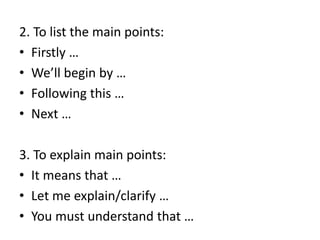
2. To list the main points:
• Firstly …
• We’ll begin by …
• Following this …
• Next …
3. To explain main points:
• It means that …
• Let me explain/clarify …
• You must understand that …
4. To state examples:
• For instance …
• Let me show you …
• Further to this …
• … such as …
5. To talk about another side of the issue:
• However …
• On the other hand, …
• On the contrary, …
• … but …
6. To sum up the topic/topic:
• Therefore, it is clear that …
• In conclusion, …
• To conclude, …
• Let me sum up …
Developing Listening Skills
Skills:
1. Recalling info
• To recollect info that you’ve already listened.
• Look out for questions that ask you to list,
name, state, etc.
2. Recognising main ideas
• To get the main idea of the text
3. Recognising supporting main details
• To get the specific details that support a main
point
4. Deriving meaning of words, phrases,
sentences from text
• To infer and elicit the meaning of words,
sentences based on situations and examples
presented in the text.
• Look out for questions that ask you to provide
definitions, restate in your own words.
5. Paraphrasing
• To restate or retell the info in your own words.
6. Predicting outcomes
• To predict what is going to happen next
7. Applying a concept to a new situation
• Using previously learned methods, concepts,
theories in new situation.
• Look out for questions that ask you to solve,
use, illustrate, complete, etc.
8. Understanding language functions
• Refer to its purpose : what it does and its uses,
for example, to express feeling to give
instructions.
9. Distinguishing the relevant from the irrelevant
• Determine which info is linked to the subject
or an issue.
• Use your good judgement and think critically.
10. Drawing inferences
• When you infer you form an opinion or a
conclusion based on the fact or info given.
11. Identifying roles and relationships
• Different speakers have different roles to play.
• A speaker may play a role of a doc, student,
etc.
• The relationship between speaker could be
that of manager and subordinate, teacher and
student, mother and son, etc.
12. Distinguishing facts from opinions
• Facts are statement that can be proved or are
known to be true.
• Opinions express how a person feels about
something. Opinions do not have to be based
on logical reasoning.
13. Following the development of a point or an
argument
• To follow the logical progression of a point or
an argument.
14. Summarising information
• To extract the main ideas of a text.
• You may also be asked to get the gist of the
whole passage.
15. Appraising information
• To evaluate and verify the value of evidence or
info.
• Look out for questions that ask you to justify,
evaluate, etc.
16. Making judgements
• To make value judgements on something
based on personal values or opinions.
• Look out for questions that ask you to assess,
decide, choose, etc.
17. Drawing conclusion
• To arrive at a conclusion based on facts and
info given.
18. Recognising and interpreting speakers’
views, attitudes, or intentions
• The speakers’ views could be biased, negative,
positive, etc.
• The speakers’ attitudes may be one of anxiety,
concern, indifference, anger, etc.
• The speaker’s intentions could be to advise,
educate, etc.
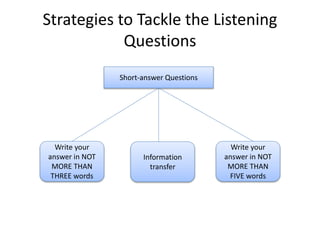
Strategies to Tackle the Listening
Questions
Short-answer Questions
Write your
answer in NOT
MORE THAN
THREE words
Information
transfer
Write your
answer in NOT
MORE THAN
FIVE words
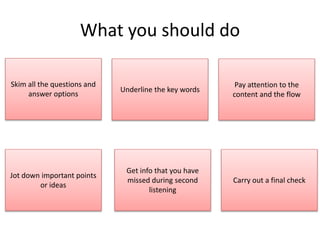
What you should do
Skim all the questions and
answer options
Carry out a final check
Get info that you have
missed during second
listening
Jot down important points
or ideas
Underline the key words
Pay attention to the
content and the flow
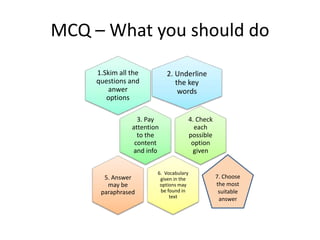
MCQ – What you should do
2. Underline
the key
words
1.Skim all the
questions and
anwer
options
3. Pay
attention
to the
content
and info
4. Check
each
possible
option
given
6. Vocabulary
given in the
options may
be found in
text
5. Answer
may be
paraphrased
7. Choose
the most
suitable
answer
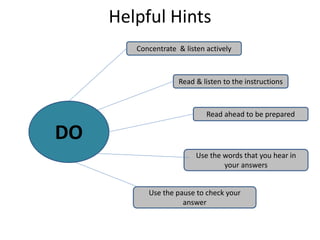
Helpful Hints
DO
Concentrate & listen actively
Read & listen to the instructions
Read ahead to be prepared
Use the words that you hear in
your answers
Use the pause to check your
answer
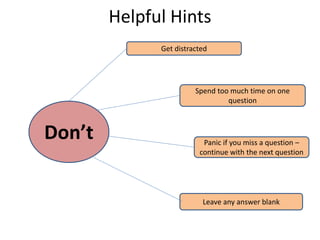
Helpful Hints
Don’t
Get distracted
Spend too much time on one
question
Panic if you miss a question –
continue with the next question
Leave any answer blank

MUET Listening

  • 1.
  • 2.
    Tackling the ListeningPaper A step-by-step guide: 1. Pre-listening- Get an overview of the text • Read all the questions and answer the options carefully. • Underline the keywords in the questions so that you know what to listen for later. e.g. What is the main benefit of drinking water?
  • 3.
    2. First listening-Listen for specific information • Listen actively for the required information (refer to the underlined keywords in step 1) • Jot down important notes 3. Second listening- Get missing information/answers • Get any missing information • Check answers
  • 4.
    Identifying Linking Words Linkingwords serve as transition signals which indicate when a speaker is about to introduce a new point, explain the point or wind up a point. 1. To introduce a new point: • Now ... • My next point … • Allow me to … • Right …
  • 5.
    2. To listthe main points: • Firstly … • We’ll begin by … • Following this … • Next … 3. To explain main points: • It means that … • Let me explain/clarify … • You must understand that …
  • 6.
    4. To stateexamples: • For instance … • Let me show you … • Further to this … • … such as … 5. To talk about another side of the issue: • However … • On the other hand, … • On the contrary, … • … but …
  • 7.
    6. To sumup the topic/topic: • Therefore, it is clear that … • In conclusion, … • To conclude, … • Let me sum up …
  • 8.
    Developing Listening Skills Skills: 1.Recalling info • To recollect info that you’ve already listened. • Look out for questions that ask you to list, name, state, etc. 2. Recognising main ideas • To get the main idea of the text
  • 9.
    3. Recognising supportingmain details • To get the specific details that support a main point 4. Deriving meaning of words, phrases, sentences from text • To infer and elicit the meaning of words, sentences based on situations and examples presented in the text. • Look out for questions that ask you to provide definitions, restate in your own words.
  • 10.
    5. Paraphrasing • Torestate or retell the info in your own words. 6. Predicting outcomes • To predict what is going to happen next 7. Applying a concept to a new situation • Using previously learned methods, concepts, theories in new situation. • Look out for questions that ask you to solve, use, illustrate, complete, etc.
  • 11.
    8. Understanding languagefunctions • Refer to its purpose : what it does and its uses, for example, to express feeling to give instructions. 9. Distinguishing the relevant from the irrelevant • Determine which info is linked to the subject or an issue. • Use your good judgement and think critically.
  • 12.
    10. Drawing inferences •When you infer you form an opinion or a conclusion based on the fact or info given. 11. Identifying roles and relationships • Different speakers have different roles to play. • A speaker may play a role of a doc, student, etc. • The relationship between speaker could be that of manager and subordinate, teacher and student, mother and son, etc.
  • 13.
    12. Distinguishing factsfrom opinions • Facts are statement that can be proved or are known to be true. • Opinions express how a person feels about something. Opinions do not have to be based on logical reasoning. 13. Following the development of a point or an argument • To follow the logical progression of a point or an argument.
  • 14.
    14. Summarising information •To extract the main ideas of a text. • You may also be asked to get the gist of the whole passage. 15. Appraising information • To evaluate and verify the value of evidence or info. • Look out for questions that ask you to justify, evaluate, etc.
  • 15.
    16. Making judgements •To make value judgements on something based on personal values or opinions. • Look out for questions that ask you to assess, decide, choose, etc. 17. Drawing conclusion • To arrive at a conclusion based on facts and info given.
  • 16.
    18. Recognising andinterpreting speakers’ views, attitudes, or intentions • The speakers’ views could be biased, negative, positive, etc. • The speakers’ attitudes may be one of anxiety, concern, indifference, anger, etc. • The speaker’s intentions could be to advise, educate, etc.
  • 17.
    Strategies to Tacklethe Listening Questions Short-answer Questions Write your answer in NOT MORE THAN THREE words Information transfer Write your answer in NOT MORE THAN FIVE words
  • 18.
    What you shoulddo Skim all the questions and answer options Carry out a final check Get info that you have missed during second listening Jot down important points or ideas Underline the key words Pay attention to the content and the flow
  • 19.
    MCQ – Whatyou should do 2. Underline the key words 1.Skim all the questions and anwer options 3. Pay attention to the content and info 4. Check each possible option given 6. Vocabulary given in the options may be found in text 5. Answer may be paraphrased 7. Choose the most suitable answer
  • 20.
    Helpful Hints DO Concentrate &listen actively Read & listen to the instructions Read ahead to be prepared Use the words that you hear in your answers Use the pause to check your answer
  • 21.
    Helpful Hints Don’t Get distracted Spendtoo much time on one question Panic if you miss a question – continue with the next question Leave any answer blank