By:
Mohammed Alghanoudi
Supervised by:
DR. Hamed
Sabratha Faculty of Engineering
Petroleum engineering department
Drilling fluids laboratory
Water Content Determination
Contents Introduction
01
Objective
02
Test Procedure
03
RESULTS &
CALCULATIONS
04
INTRODUCTION
 Knowledge of the liquid and solids content of a drilling mud is
essential for good control of the mud properties. Such information will
often explain poor performance of the mud and indicate whether the
mud can best be conditioned by the addition of water or whether
treatment with chemical thinner or the removal of the contaminant is
required.
 For muds containing only water and solids, the quantity of each can
be determined from the mud density and from the evaporation of a
weighed sample of mud. water content can also be obtained by
measuring the liquid fraction.
OBJECTIVE
The aim of this experiment is to:
o To determine the water
contents of each of the
drilling fluid samples.
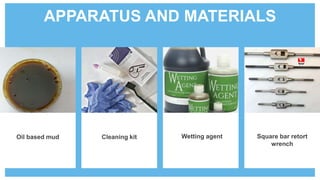
APPARATUS AND MATERIALS
Oil based mud Cleaning kit Wetting agent Square bar retort
wrench
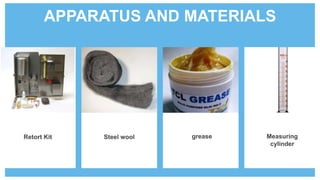
APPARATUS AND MATERIALS
Retort Kit Steel wool grease Measuring
cylinder
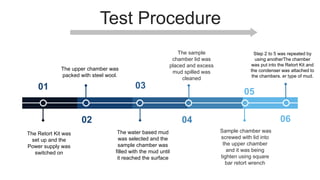
Test Procedure
The upper chamber was
packed with steel wool.
The water based mud
was selected and the
sample chamber was
filled with the mud until
it reached the surface
The sample
chamber lid was
placed and excess
mud spilled was
cleaned
Sample chamber was
screwed with lid into
the upper chamber
and it was being
tighten using square
bar retort wrench
04
02 06
03
01
The Retort Kit was
set up and the
Power supply was
switched on
05
Step 2 to 5 was repeated by
using anotherThe chamber
was put into the Retort Kit and
the condenser was attached to
the chambers. er type of mud.
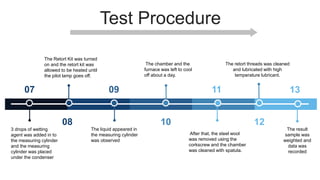
Test Procedure
10
08 12
09
07 11 13
3 drops of wetting
agent was added in to
the measuring cylinder
and the measuring
cylinder was placed
under the condenser
The Retort Kit was turned
on and the retort kit was
allowed to be heated until
the pilot lamp goes off.
The liquid appeared in
the measuring cylinder
was observed
The chamber and the
furnace was left to cool
off about a day.
After that, the steel wool
was removed using the
corkscrew and the chamber
was cleaned with spatula.
The retort threads was cleaned
and lubricated with high
temperature lubricant.
The result
sample was
weighted and
data was
recorded
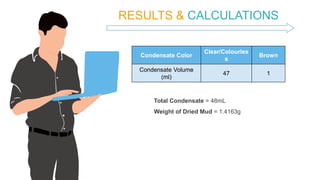
RESULTS & CALCULATIONS
Brown
Clear/Colourles
s
Condensate Color
1
47
Condensate Volume
(ml)
Total Condensate = 48mL
Weight of Dried Mud = 1.4163g
References:
• ASTM D 2216 - Standard Test Method for Laboratory
Determination of Water (Moisture) Content of Soil, Rock, and Soil-
Aggreg
• http://petrowiki.spe.org/Functions_of_drilling_fluid
• http://www.drilling-mud.org/electrical-stability-oil-based-mud-
properties/ate Mixtures .
THANK YOU

Water Content.pptx

  • 1.
    By: Mohammed Alghanoudi Supervised by: DR.Hamed Sabratha Faculty of Engineering Petroleum engineering department Drilling fluids laboratory Water Content Determination
  • 2.
  • 3.
    INTRODUCTION  Knowledge ofthe liquid and solids content of a drilling mud is essential for good control of the mud properties. Such information will often explain poor performance of the mud and indicate whether the mud can best be conditioned by the addition of water or whether treatment with chemical thinner or the removal of the contaminant is required.  For muds containing only water and solids, the quantity of each can be determined from the mud density and from the evaporation of a weighed sample of mud. water content can also be obtained by measuring the liquid fraction.
  • 4.
    OBJECTIVE The aim ofthis experiment is to: o To determine the water contents of each of the drilling fluid samples.
  • 5.
    APPARATUS AND MATERIALS Oilbased mud Cleaning kit Wetting agent Square bar retort wrench
  • 6.
    APPARATUS AND MATERIALS RetortKit Steel wool grease Measuring cylinder
  • 7.
    Test Procedure The upperchamber was packed with steel wool. The water based mud was selected and the sample chamber was filled with the mud until it reached the surface The sample chamber lid was placed and excess mud spilled was cleaned Sample chamber was screwed with lid into the upper chamber and it was being tighten using square bar retort wrench 04 02 06 03 01 The Retort Kit was set up and the Power supply was switched on 05 Step 2 to 5 was repeated by using anotherThe chamber was put into the Retort Kit and the condenser was attached to the chambers. er type of mud.
  • 8.
    Test Procedure 10 08 12 09 0711 13 3 drops of wetting agent was added in to the measuring cylinder and the measuring cylinder was placed under the condenser The Retort Kit was turned on and the retort kit was allowed to be heated until the pilot lamp goes off. The liquid appeared in the measuring cylinder was observed The chamber and the furnace was left to cool off about a day. After that, the steel wool was removed using the corkscrew and the chamber was cleaned with spatula. The retort threads was cleaned and lubricated with high temperature lubricant. The result sample was weighted and data was recorded
  • 9.
    RESULTS & CALCULATIONS Brown Clear/Colourles s CondensateColor 1 47 Condensate Volume (ml) Total Condensate = 48mL Weight of Dried Mud = 1.4163g
  • 10.
    References: • ASTM D2216 - Standard Test Method for Laboratory Determination of Water (Moisture) Content of Soil, Rock, and Soil- Aggreg • http://petrowiki.spe.org/Functions_of_drilling_fluid • http://www.drilling-mud.org/electrical-stability-oil-based-mud- properties/ate Mixtures .
  • 11.

Editor's Notes

  • #4 المقدمة: تعد معرفة محتوى السائل والمواد الصلبة في طين الحفر أمرًا ضروريًا للتحكم الجيد في خصائص الطين. غالبًا ما تفسر هذه المعلومات الأداء الضعيف للوحل وتشير إلى ما إذا كان يمكن تكييف الطين بشكل أفضل عن طريق إضافة الماء أو ما إذا كانت المعالجة باستخدام المرقق الكيميائي أو إزالة الملوثات مطلوبة. بالنسبة للطين الذي يحتوي فقط على الماء والمواد الصلبة ، يمكن تحديد كمية كل منها من كثافة الطين ومن تبخر عينة موزونة من الطين. يمكن أيضًا الحصول على محتوى الماء عن طريق قياس جزء السائل.
  • #5 الهدف من هذه التجربة هو: لتحديد محتويات الماء لكل عينة من مائع الحفر.
  • #6 الأجهزة و المواد
  • #7 الأجهزة و المواد
  • #8 خطوات التجربة: 1. يتم إعداد Retort Kit وتشغيل مزود الطاقة. 2. يتم تعبئة الغرفة العلوية بصوف الفولاذ. 3. يتم اختيار الطين ذو الأساس المائي و من ثم ملء حجرة العينة بالطين حتى تصل إلى السطح. 4. يتم وضع غطاء حجرة العينة وتنظيف الطين الزائد. 5. يتم شد حجرة العينة بغطاء في الغرفة العلوية ومن ثم إحكام ربطها باستخدام مفتاح ربط معوج بقضيب مربع. 6. يتم وضع الحجرة في Retort Kit وتم توصيل المكثف بالغرف.
  • #9 الخطوات: 7. يتم إضافة 3 قطرات من عامل الترطيب إلى أسطوانة القياس و توضع أسطوانة القياس تحت المكثف. 8. يتم تشغيل مجموعة أدوات المعوجة ومن ثم السماح بتسخين مجموعة أدوات المعوجة حتى ينطفئ المصباح التجريبي. 9. يلاحظ وجود السائل في أسطوانة القياس. 10. تترك الغرفة والفرن ليبرد حوالي يوم. 11. بعد ذلك ، يتم إزالة الصوف الفولاذي باستخدام المفتاح اللولبي و تنظيف الغرفة بملعقة. 12. يتم تنظيف سن اللولب المعوجة وتشحيمها بمواد تشحيم ذات درجة حرارة عالية. 13. يتم وزن العينة الناتجة وتسجيل البيانات.
  • #10 النتائج و الحسابات إجمالي المكثفات = 48 مل وزن الطين المجفف = 1.4163 جرام
  • #11 المراجع: