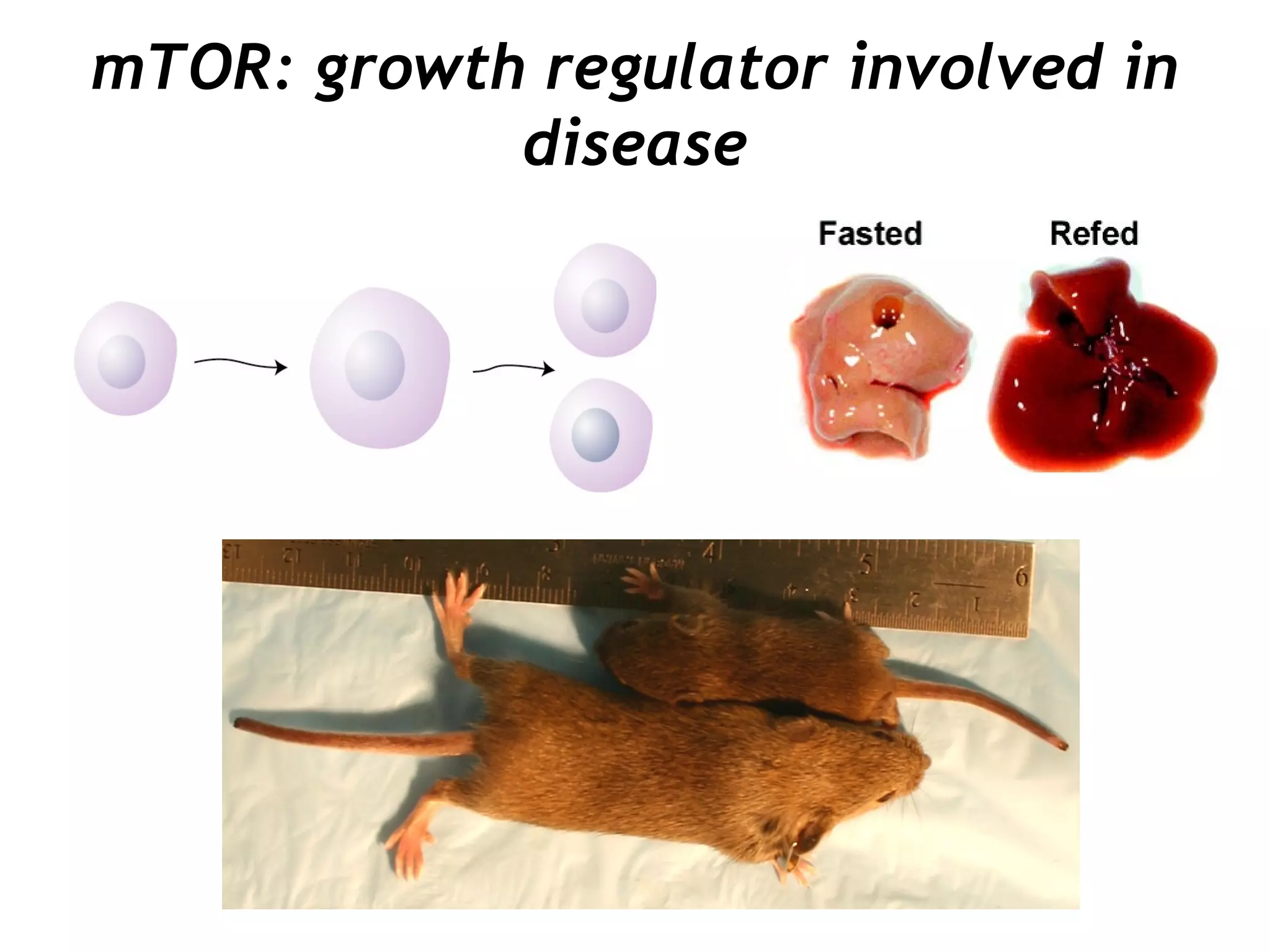
mTOR: growth regulator involved in disease
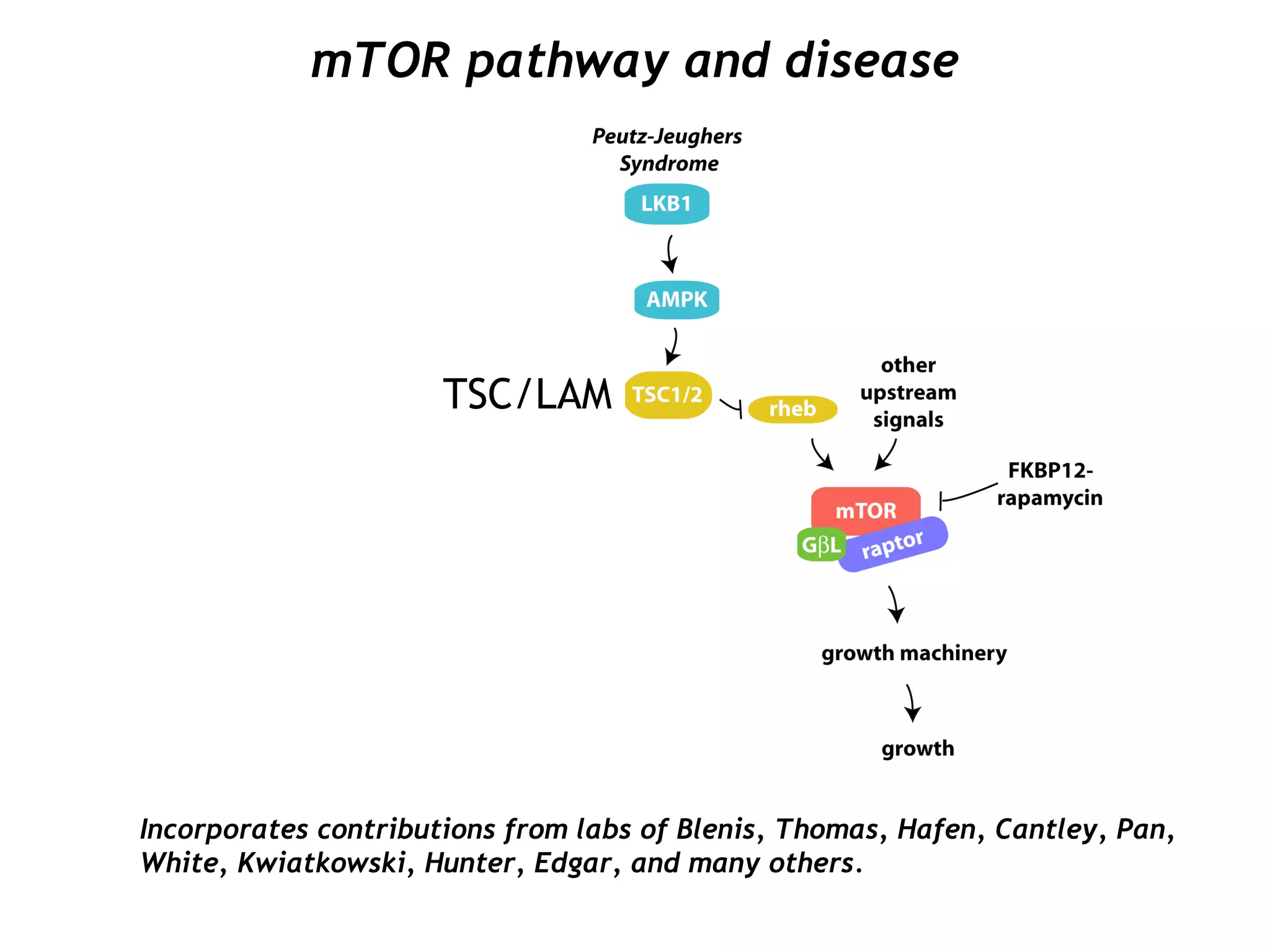
mTOR pathway and disease Incorporates contributions from labs of Blenis, Thomas, Hafen, Cantley, Pan, White, Kwiatkowski, Hunter, Edgar, and many others. TSC/LAM
mTOR pathway and disease TSC/LAM
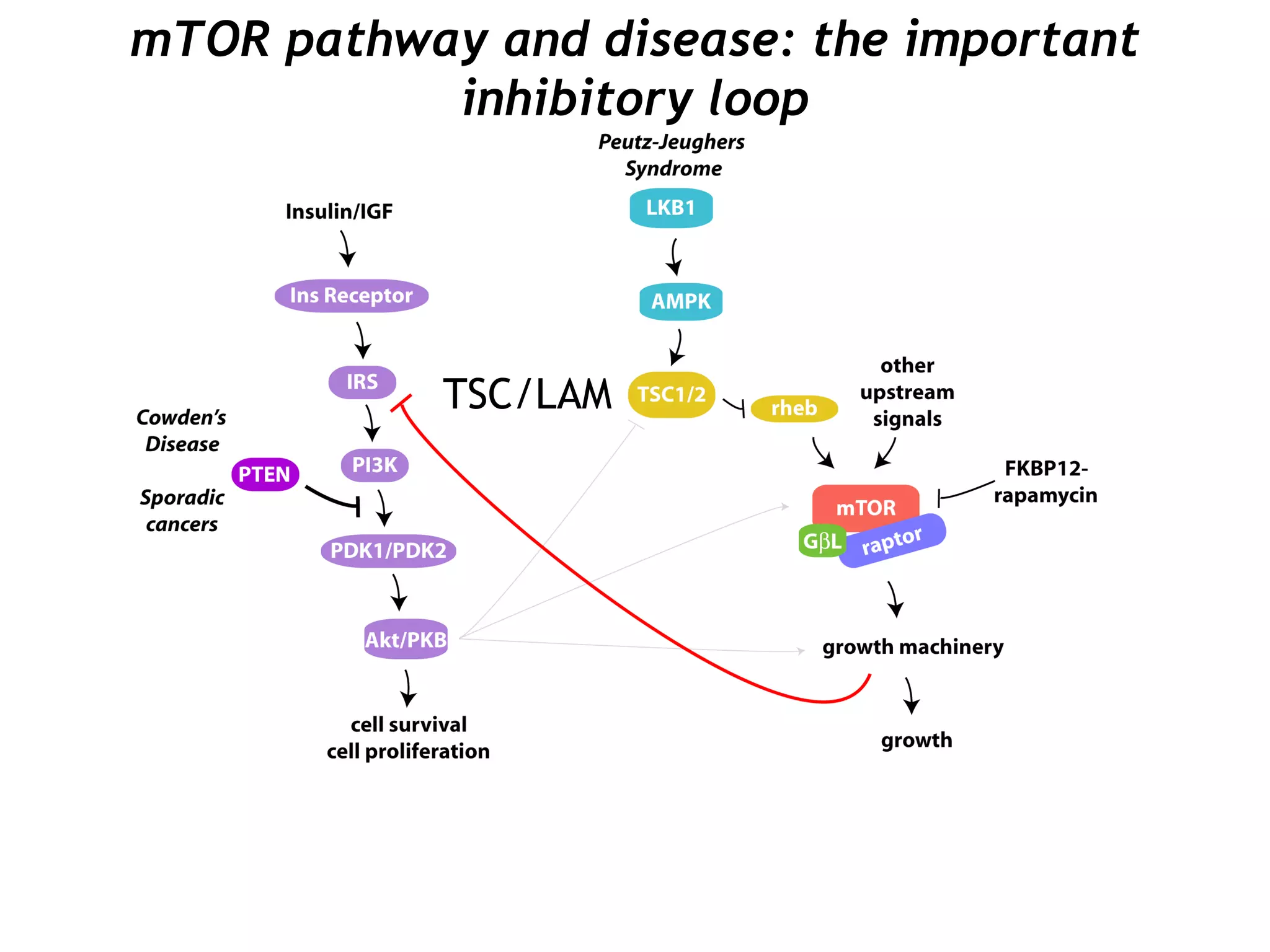
mTOR pathway and disease: the important inhibitory loop TSC/LAM
rapamycin Rapamycin and its uses Immunosuppressant blocks acute rejection by inhibiting T-cell mediated  immunity Anti-cancer CCI-779, RAD001, AP23573 derivatives in clinical trials  (PTEN null cancers, TSC tumors? LAM?) Prevents restenosis after angioplasty
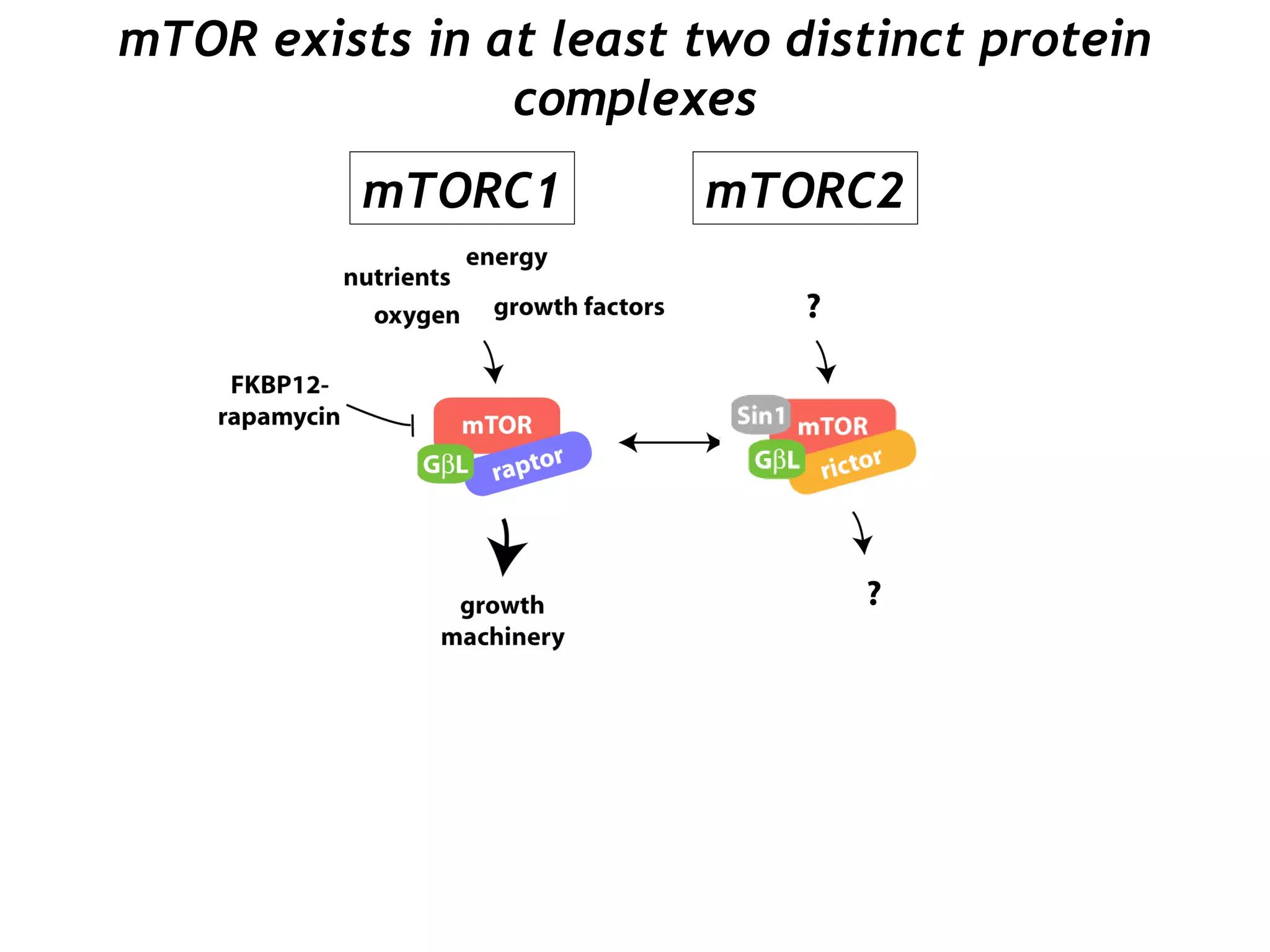
mTOR exists in at least two distinct protein complexes mTORC1 mTORC2
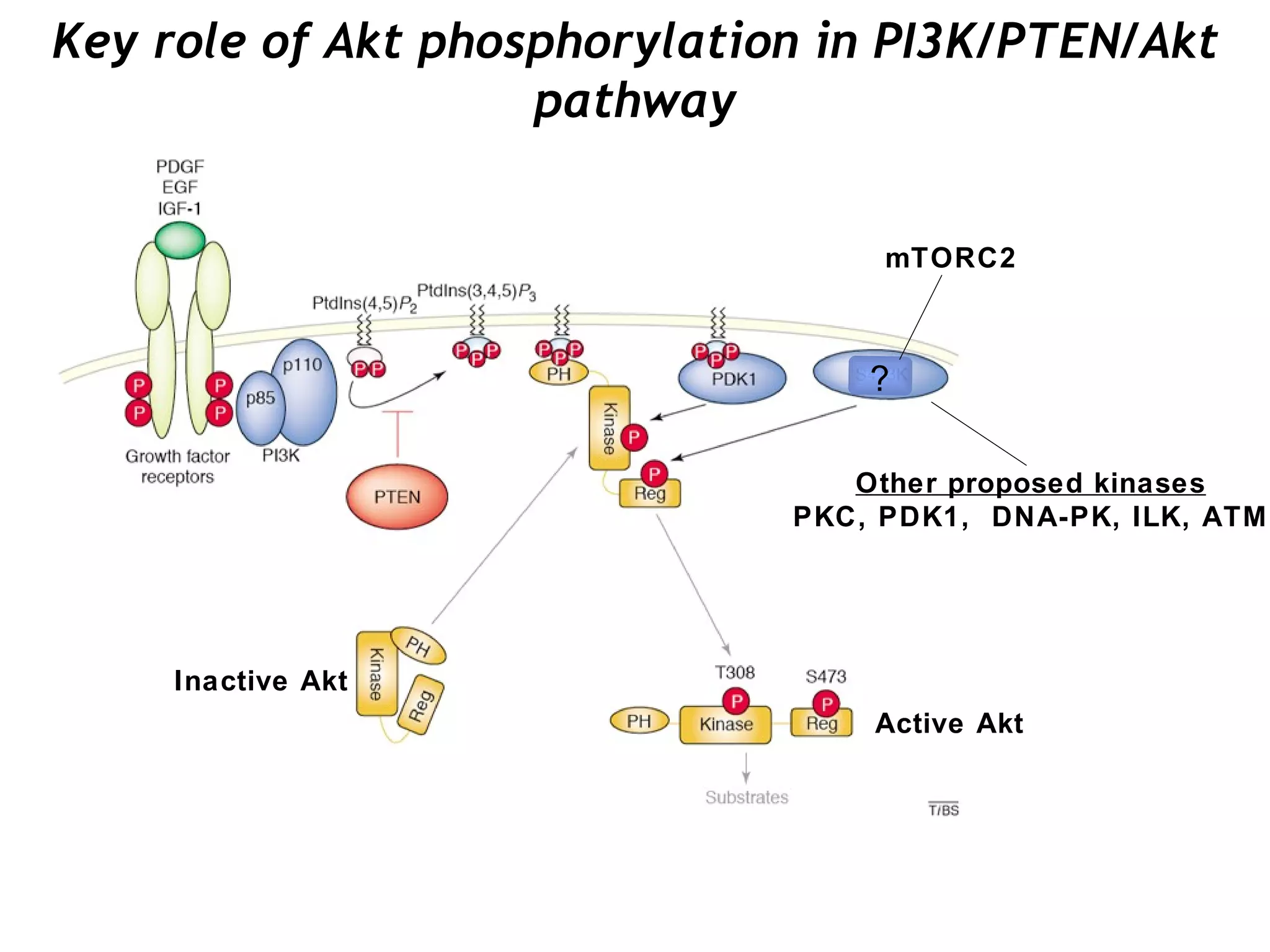
Key role of Akt phosphorylation in PI3K/PTEN/Akt pathway Active Akt Inactive Akt mTORC2 ? Other proposed kinases PKC, PDK1,  DNA-PK, ILK, ATM
Characterization of mice missing mTORC components mTOR, raptor, mLST8/GbL, or rictor Open questions around the mTOR pathway and LAM/TSC
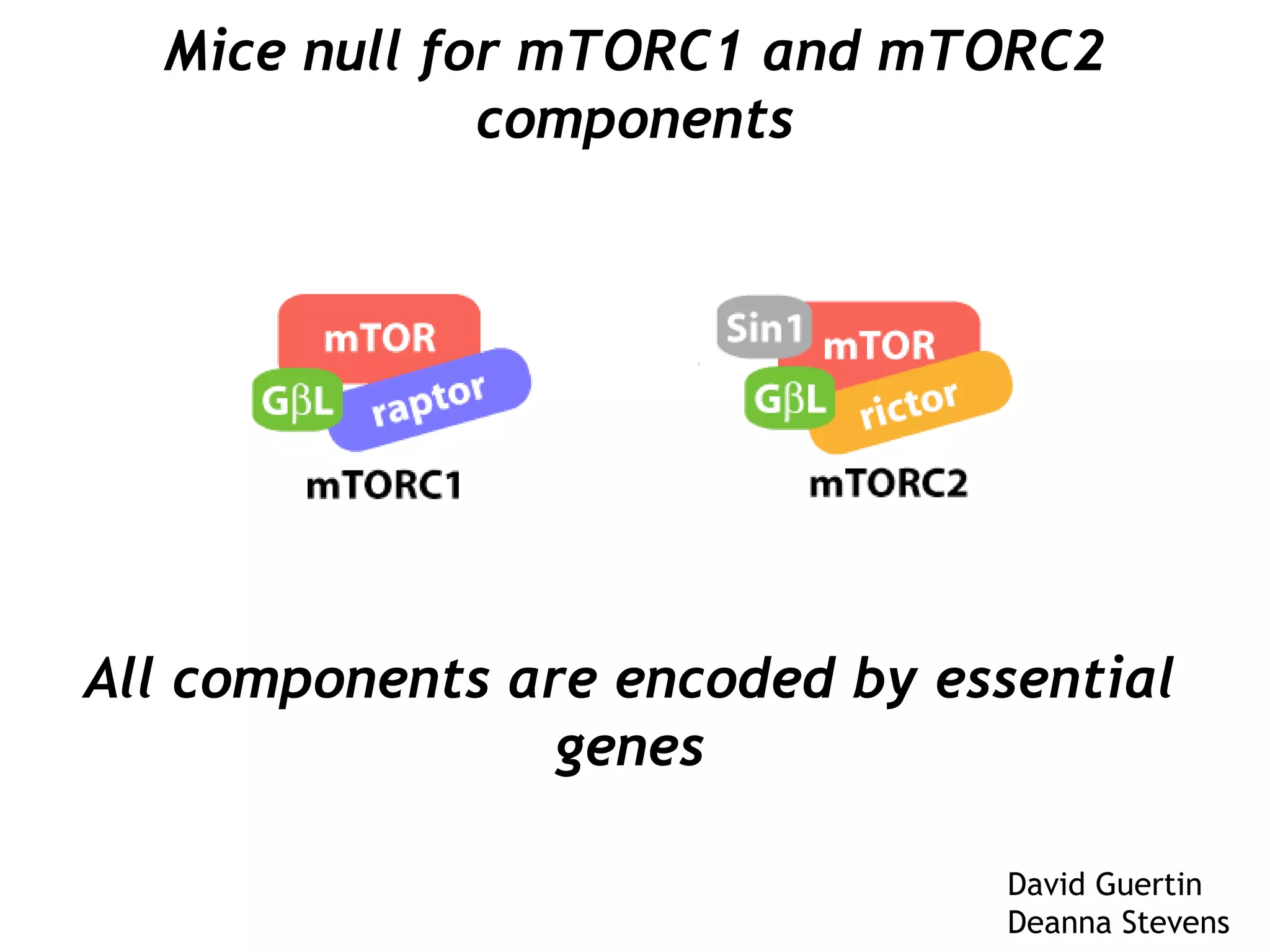
Mice null for mTORC1 and mTORC2 components David Guertin Deanna Stevens All components are encoded by essential genes
wild- type Raptor -/- mTOR -/- G  L -/- (mLST8)
rictor G  L/mLST8 G  L G  L
Vessel defects in G  L/mLST8-null yolk sacs and embryos mTOR, rictor, raptor, and G  L/mLST8 KOs fall into two classes, likely reflecting absence of mTORC1 or mTORC2 function
Biochemical analysis of E10.5 rictor & G  L/mLST8 null embryos Rictor   G  L/mLST8
mTORC1 pathway activity in G  L null MEFs Loss of G  L/mLST8 has no apparent effect on any mTORC1 pathway assay Why?
G  L/mLST8 is necessary for mTORC2 but  not mTORC1 integrity G  L: G  L: G  L:
Signaling by hemi-phosphorylated Akt mTORC2 is necessary only for signaling to FOXO Why does hemi-phosphorylated Akt signal to some effectors but not others?  What does G  L/mLST8 do for mTORC1?
mTOR functions in two distinct complexes and pathways FOXO
Open questions around targeting mTOR pathway Is rheb the disease-relevant effector of TSC1/2? If so, is mTOR the disease-relevant effector of TSC/rheb? Is it best to target mTOR or a downstream effector like S6K1? Will long-term removal by rapamycin of the inhibitory signal from S6K1 to the PI3K pathway produce unacceptable toxicities? Will effect of long term rapamycin on mTORC2 have clinical implications Will TSC and LAM differ in above questions?
Is rheb the disease-relevant effector of TSC1/2? Is mTOR the disease-relevant effector of TSC/rheb? PRO Much work in Drosophila and mammalian tissue culture What is the key evidence needed to be able to say  yes  with confidence? CON Other known effects of TSC2 loss. Other known targets of rheb. Incapacity of rapamycin to reverse all effects of TSC1/TSC2 loss. How can we rule out or in other potential effectors?
Tavazoie et al. Nat Neuro (2005) 8: 1727
Crino et al. NEJM (2006) 355: 1345
Is it best to target mTOR or a downstream effector like S6K1? No evidence either way. How can this be tested?
Will long-term removal by rapamycin of the inhibitory signal from S6K1 to the PI3K pathway produce unacceptable toxicities? Will TSC and LAM cells differ in above question? Will effect of long term rapamycin on mTORC2 have clinical implications?
 
Anne Carpenter Jacob Chudnovsky Xana Frias David Guertin Peggy Hsu Ray Jones Nada Kalaany Tony Kang Mike Lamprecht Kathleen Ottina Funding Whitehead Institute, NIH (NIAID, NCI, GM), Keck Foundation, Pew Charitable Trust, Rita Allen Foundation The RNAi Consortium  (TRC) Jason Moffat  Adam Papallo Tim Peterson Jan Reiling Yasemin Sancak Dos Sarbassov  Shomit Sengupta Joon-Ho Sheen  Deanna Stevens Carson Thoreen

mTOR: growth regulator involved in disease

  • 1.
  • 2.
    mTOR: growth regulatorinvolved in disease
  • 3.
    mTOR pathway anddisease Incorporates contributions from labs of Blenis, Thomas, Hafen, Cantley, Pan, White, Kwiatkowski, Hunter, Edgar, and many others. TSC/LAM
  • 4.
    mTOR pathway anddisease TSC/LAM
  • 5.
    mTOR pathway anddisease: the important inhibitory loop TSC/LAM
  • 6.
    rapamycin Rapamycin andits uses Immunosuppressant blocks acute rejection by inhibiting T-cell mediated immunity Anti-cancer CCI-779, RAD001, AP23573 derivatives in clinical trials (PTEN null cancers, TSC tumors? LAM?) Prevents restenosis after angioplasty
  • 7.
    mTOR exists inat least two distinct protein complexes mTORC1 mTORC2
  • 8.
    Key role ofAkt phosphorylation in PI3K/PTEN/Akt pathway Active Akt Inactive Akt mTORC2 ? Other proposed kinases PKC, PDK1, DNA-PK, ILK, ATM
  • 9.
    Characterization of micemissing mTORC components mTOR, raptor, mLST8/GbL, or rictor Open questions around the mTOR pathway and LAM/TSC
  • 10.
    Mice null formTORC1 and mTORC2 components David Guertin Deanna Stevens All components are encoded by essential genes
  • 11.
    wild- type Raptor-/- mTOR -/- G  L -/- (mLST8)
  • 12.
    rictor G L/mLST8 G  L G  L
  • 13.
    Vessel defects inG  L/mLST8-null yolk sacs and embryos mTOR, rictor, raptor, and G  L/mLST8 KOs fall into two classes, likely reflecting absence of mTORC1 or mTORC2 function
  • 14.
    Biochemical analysis ofE10.5 rictor & G  L/mLST8 null embryos Rictor G  L/mLST8
  • 15.
    mTORC1 pathway activityin G  L null MEFs Loss of G  L/mLST8 has no apparent effect on any mTORC1 pathway assay Why?
  • 16.
    G  L/mLST8is necessary for mTORC2 but not mTORC1 integrity G  L: G  L: G  L:
  • 17.
    Signaling by hemi-phosphorylatedAkt mTORC2 is necessary only for signaling to FOXO Why does hemi-phosphorylated Akt signal to some effectors but not others? What does G  L/mLST8 do for mTORC1?
  • 18.
    mTOR functions intwo distinct complexes and pathways FOXO
  • 19.
    Open questions aroundtargeting mTOR pathway Is rheb the disease-relevant effector of TSC1/2? If so, is mTOR the disease-relevant effector of TSC/rheb? Is it best to target mTOR or a downstream effector like S6K1? Will long-term removal by rapamycin of the inhibitory signal from S6K1 to the PI3K pathway produce unacceptable toxicities? Will effect of long term rapamycin on mTORC2 have clinical implications Will TSC and LAM differ in above questions?
  • 20.
    Is rheb thedisease-relevant effector of TSC1/2? Is mTOR the disease-relevant effector of TSC/rheb? PRO Much work in Drosophila and mammalian tissue culture What is the key evidence needed to be able to say yes with confidence? CON Other known effects of TSC2 loss. Other known targets of rheb. Incapacity of rapamycin to reverse all effects of TSC1/TSC2 loss. How can we rule out or in other potential effectors?
  • 21.
    Tavazoie et al.Nat Neuro (2005) 8: 1727
  • 22.
    Crino et al.NEJM (2006) 355: 1345
  • 23.
    Is it bestto target mTOR or a downstream effector like S6K1? No evidence either way. How can this be tested?
  • 24.
    Will long-term removalby rapamycin of the inhibitory signal from S6K1 to the PI3K pathway produce unacceptable toxicities? Will TSC and LAM cells differ in above question? Will effect of long term rapamycin on mTORC2 have clinical implications?
  • 25.
  • 26.
    Anne Carpenter JacobChudnovsky Xana Frias David Guertin Peggy Hsu Ray Jones Nada Kalaany Tony Kang Mike Lamprecht Kathleen Ottina Funding Whitehead Institute, NIH (NIAID, NCI, GM), Keck Foundation, Pew Charitable Trust, Rita Allen Foundation The RNAi Consortium (TRC) Jason Moffat Adam Papallo Tim Peterson Jan Reiling Yasemin Sancak Dos Sarbassov Shomit Sengupta Joon-Ho Sheen Deanna Stevens Carson Thoreen