HIGH VOLTAGE DIRECT CURRENT TRANSMISSION
“MULTI TERMINALDC SYSTEMS”
MULTI TERMINAL DC SYSTEMS 1
MULTI TERMINAL DC SYSTEMS 2
“MULTI TERMINAL DC SYSTEMS”
VIEWS :
 MULTI TERMINAL DC SYSTEMS.
 APPLICATIONS OF MTDC.
 TYPES OF MTDC.
 SERIES MTDC.
 PARALLEL MTDC.
 RADIALAND MESH.
 CONCLUSION.
 REFERENCES.
MULTI TERMINAL DC SYSTEMS 3
“MULTI TERMINAL DC SYSTEMS”
MULTI TERMINAL DC SYSTEMS:
 Hvdc systems designed as point to point with terminals.
 MTDC used when multi terminals present in the system.
 Terminals – Rec and Inv.
 Tapping –simple way to build MTDC from existing two terminal
system.
 Complexity, production and controls are increased in MTDC.
MULTI TERMINAL DC SYSTEMS 4
“MULTI TERMINALDC SYSTEMS”
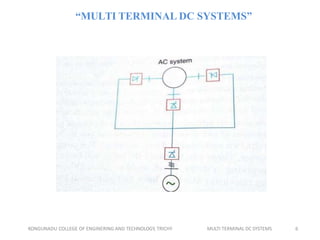
APPLICATIONS OF MTDC:
Tapping power.
APPLICATION 1:
 Bulk power transmission from remote gen stations to different
load centres.
 No need ofAC Collectors. Gen unit directly connected to Rec
Station.
 In load side also no need of additional lines.
 Consider two converter and two inverter system by MTDC Type.
 For the same flexibility power exchange get by three two terminal
system .
 increases additional DC links to connecting the receiving systems.
 So lines, increased losses and cost compare than MTDC.
 Elimination ofAC collector give good efficiency .
“MULTI TERMINALDC SYSTEMS”
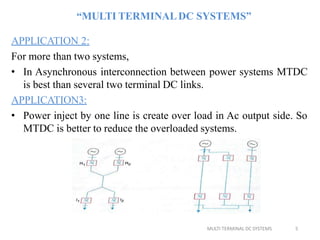
APPLICATION 2:
For more than two systems,
• In Asynchronous interconnection between power systems MTDC
is best than several two terminal DC links.
APPLICATION3:
• Power inject by one line is create over load in Ac output side. So
MTDC is better to reduce the overloaded systems.
MULTI TERMINAL DC SYSTEMS 5
“MULTI TERMINAL DC SYSTEMS”
KONGUNADU COLLEGE OF ENGINERING AND TECHNOLOGY, TRICHY MULTI TERMINAL DC SYSTEMS 6
KONGUNADU COLLEGE OF ENGINERING AND TECHNOLOGY, TRICHY MULTI TERMINAL DC SYSTEMS 7
“MULTI TERMINAL DC SYSTEMS”
TYPES OF MTDC:
 Series system
 Parallel system
 Radial type
 Mesh type
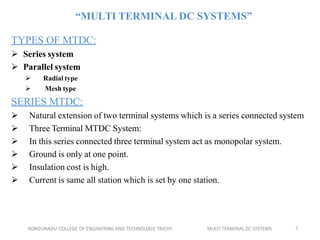
SERIES MTDC:
 Natural extension of two terminal systems which is a series connected system
 Three Terminal MTDC System:
 In this series connected three terminal system act as monopolar system.
 Ground is only at one point.
 Insulation cost is high.
 Current is same all station which is set by one station.
“MULTI TERMINALDC SYSTEMS”
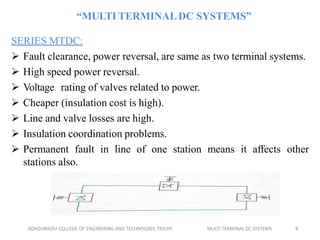
SERIES MTDC:
 Fault clearance, power reversal, are same as two terminal systems.
 High speed power reversal.
 Voltage rating of valves related to power.
 Cheaper (insulation cost is high).
 Line and valve losses are high.
 Insulation coordination problems.
 Permanent fault in line of one station means it affects other
stations also.
KONGUNADU COLLEGE OF ENGINERING AND TECHNOLOGY, TRICHY MULTI TERMINAL DC SYSTEMS 8
MULTI TERMINAL DC SYSTEMS 9
“MULTI TERMINALDC SYSTEMS”
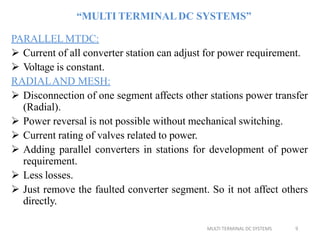
PARALLEL MTDC:
 Current of all converter station can adjust for power requirement.
 Voltage is constant.
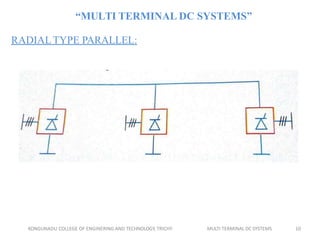
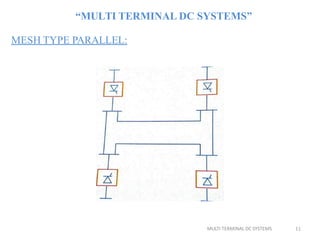
RADIALAND MESH:
 Disconnection of one segment affects other stations power transfer
(Radial).
 Power reversal is not possible without mechanical switching.
 Current rating of valves related to power.
 Adding parallel converters in stations for development of power
requirement.
 Less losses.
 Just remove the faulted converter segment. So it not affect others
directly.
“MULTI TERMINAL DC SYSTEMS”
RADIALTYPE PARALLEL:
KONGUNADU COLLEGE OF ENGINERING AND TECHNOLOGY, TRICHY MULTI TERMINAL DC SYSTEMS 10
“MULTI TERMINAL DC SYSTEMS”
MESH TYPE PARALLEL:
MULTI TERMINAL DC SYSTEMS 11
KONGUNADU COLLEGE OF ENGINERING AND TECHNOLOGY, TRICHY MULTI TERMINAL DC SYSTEMS 12
“MULTI TERMINAL DC SYSTEMS”
CONCLUSION:
 In this above presentation we can learn about basic concept of
multi terminal dc systems, applications of MTDC, types of
MTDC, series MTDC, parallel MTDC, radial and mesh.
REFERENCES:
 Padiyar, K. R., “HVDC power transmission system”, New Age
International (P) Ltd., New Delhi, Second Edition, 2010.
 Edward Wilson Kimbark, “Direct Current Transmission”, Vol. I,
Wiley interscience, New York, London, Sydney, 1971.
 Kundur P., “Power System Stability and Control”, McGraw-Hill,
1993.
 Google and wikipedia.

multiterminaldcsystemsmtdc-181127083545.pptx

  • 1.
    HIGH VOLTAGE DIRECTCURRENT TRANSMISSION “MULTI TERMINALDC SYSTEMS” MULTI TERMINAL DC SYSTEMS 1
  • 2.
    MULTI TERMINAL DCSYSTEMS 2 “MULTI TERMINAL DC SYSTEMS” VIEWS :  MULTI TERMINAL DC SYSTEMS.  APPLICATIONS OF MTDC.  TYPES OF MTDC.  SERIES MTDC.  PARALLEL MTDC.  RADIALAND MESH.  CONCLUSION.  REFERENCES.
  • 3.
    MULTI TERMINAL DCSYSTEMS 3 “MULTI TERMINAL DC SYSTEMS” MULTI TERMINAL DC SYSTEMS:  Hvdc systems designed as point to point with terminals.  MTDC used when multi terminals present in the system.  Terminals – Rec and Inv.  Tapping –simple way to build MTDC from existing two terminal system.  Complexity, production and controls are increased in MTDC.
  • 4.
    MULTI TERMINAL DCSYSTEMS 4 “MULTI TERMINALDC SYSTEMS” APPLICATIONS OF MTDC: Tapping power. APPLICATION 1:  Bulk power transmission from remote gen stations to different load centres.  No need ofAC Collectors. Gen unit directly connected to Rec Station.  In load side also no need of additional lines.  Consider two converter and two inverter system by MTDC Type.  For the same flexibility power exchange get by three two terminal system .  increases additional DC links to connecting the receiving systems.  So lines, increased losses and cost compare than MTDC.  Elimination ofAC collector give good efficiency .
  • 5.
    “MULTI TERMINALDC SYSTEMS” APPLICATION2: For more than two systems, • In Asynchronous interconnection between power systems MTDC is best than several two terminal DC links. APPLICATION3: • Power inject by one line is create over load in Ac output side. So MTDC is better to reduce the overloaded systems. MULTI TERMINAL DC SYSTEMS 5
  • 6.
    “MULTI TERMINAL DCSYSTEMS” KONGUNADU COLLEGE OF ENGINERING AND TECHNOLOGY, TRICHY MULTI TERMINAL DC SYSTEMS 6
  • 7.
    KONGUNADU COLLEGE OFENGINERING AND TECHNOLOGY, TRICHY MULTI TERMINAL DC SYSTEMS 7 “MULTI TERMINAL DC SYSTEMS” TYPES OF MTDC:  Series system  Parallel system  Radial type  Mesh type SERIES MTDC:  Natural extension of two terminal systems which is a series connected system  Three Terminal MTDC System:  In this series connected three terminal system act as monopolar system.  Ground is only at one point.  Insulation cost is high.  Current is same all station which is set by one station.
  • 8.
    “MULTI TERMINALDC SYSTEMS” SERIESMTDC:  Fault clearance, power reversal, are same as two terminal systems.  High speed power reversal.  Voltage rating of valves related to power.  Cheaper (insulation cost is high).  Line and valve losses are high.  Insulation coordination problems.  Permanent fault in line of one station means it affects other stations also. KONGUNADU COLLEGE OF ENGINERING AND TECHNOLOGY, TRICHY MULTI TERMINAL DC SYSTEMS 8
  • 9.
    MULTI TERMINAL DCSYSTEMS 9 “MULTI TERMINALDC SYSTEMS” PARALLEL MTDC:  Current of all converter station can adjust for power requirement.  Voltage is constant. RADIALAND MESH:  Disconnection of one segment affects other stations power transfer (Radial).  Power reversal is not possible without mechanical switching.  Current rating of valves related to power.  Adding parallel converters in stations for development of power requirement.  Less losses.  Just remove the faulted converter segment. So it not affect others directly.
  • 10.
    “MULTI TERMINAL DCSYSTEMS” RADIALTYPE PARALLEL: KONGUNADU COLLEGE OF ENGINERING AND TECHNOLOGY, TRICHY MULTI TERMINAL DC SYSTEMS 10
  • 11.
    “MULTI TERMINAL DCSYSTEMS” MESH TYPE PARALLEL: MULTI TERMINAL DC SYSTEMS 11
  • 12.
    KONGUNADU COLLEGE OFENGINERING AND TECHNOLOGY, TRICHY MULTI TERMINAL DC SYSTEMS 12 “MULTI TERMINAL DC SYSTEMS” CONCLUSION:  In this above presentation we can learn about basic concept of multi terminal dc systems, applications of MTDC, types of MTDC, series MTDC, parallel MTDC, radial and mesh. REFERENCES:  Padiyar, K. R., “HVDC power transmission system”, New Age International (P) Ltd., New Delhi, Second Edition, 2010.  Edward Wilson Kimbark, “Direct Current Transmission”, Vol. I, Wiley interscience, New York, London, Sydney, 1971.  Kundur P., “Power System Stability and Control”, McGraw-Hill, 1993.  Google and wikipedia.