Simplifying web-scale systems management with
the Dell PowerEdge Embedded RESTful Interface
Paul Rubin
Senior Product Manager
Dell EMC Systems Management Marketing
2
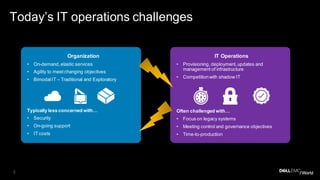
Today’s IT operations challenges
Organization
• On-demand,elastic services
• Agility to meetchanging objectives
• BimodalIT – Traditional and Exploratory
Typically less concerned with…
• Security
• On-going support
• IT costs
IT Operations
• Provisioning, deployment,updates and
management of infrastructure
• Competitionwith shadow IT
Often challenged with…
• Focus on legacy systems
• Meeting control and governance objectives
• Time-to-production
3
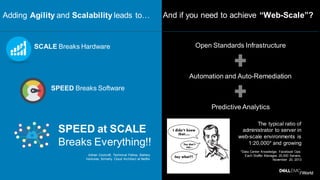
And if you need to achieve “Web-Scale”?
Open Standards Infrastructure
Automation and Auto-Remediation
Predictive Analytics
The typical ratio of
administrator to server in
web-scale environments is
1:20,000* and growing
*Data Center Knowledge, Facebook Ops:
Each Staffer Manages 20,000 Servers,
November 20, 2013
SPEED Breaks Software
SCALE Breaks Hardware
Adding Agility and Scalability leads to…
SPEED at SCALE
Breaks Everything!!
Adrian Cockroft, Technical Fellow, Battery
Ventures, formerly Cloud Architect at Netflix
4
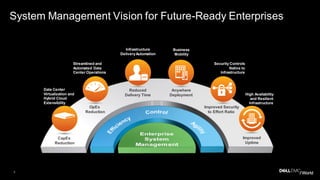
System Management Vision for Future-Ready Enterprises
Data Center
Virtualization and
Hybrid Cloud
Extensibility
CapEx
Reduction
Infrastructure
DeliveryAutomation
Reduced
Delivery Time
Streamlined and
Automated Data
Center Operations
OpEx
Reduction
Business
Mobility
Anywhere
Deployment
Security Controls
Native to
Infrastructure
Improved Security
to Effort Ratio
High Availability
and Resilient
Infrastructure
Improved
Uptime
5
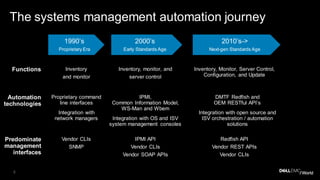
The systems management automation journey
1990’s
Proprietary Era
2000’s
Early Standards Age
2010’s->
Next-gen Standards Age
Functions
Automation
technologies
Predominate
management
interfaces
Inventory
and monitor
Inventory, monitor, and
server control
Inventory, Monitor, Server Control,
Configuration, and Update
Proprietary command
line interfaces
Integration with
network managers
IPMI,
Common Information Model,
WS-Man and Wbem
Integration with OS and ISV
system management consoles
DMTF Redfish and
OEM RESTful API’s
Integration with open source and
ISV orchestration / automation
solutions
Vendor CLIs
SNMP
IPMI API
Vendor CLIs
Vendor SOAP APIs
Redfish API
Vendor REST APIs
Vendor CLIs
6
Introducing – Redfish, a new systems management
standard for an evolving IT environment
DMTF Scalable Platform Management Forum has created
an open industry standard specificationand schema for
simple, modern, and secure management of scalable
platform hardware
A secure, multi-node, RESTful management interface built
upon HTTPS in JSON format based upon OData v4
Schema-based but human-readable; usable by client
applications and browser-based GUIs
Covers key use cases and customer requirements
7
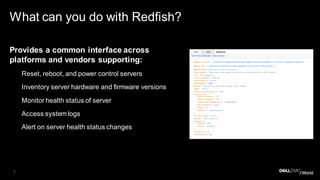
What can you do with Redfish?
Provides a common interface across
platforms and vendors supporting:
Reset, reboot, and power control servers
Inventory server hardware and firmware versions
Monitor health status of server
Access system logs
Alert on server health status changes
8
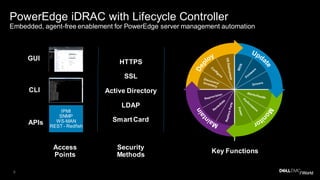
PowerEdge iDRAC with Lifecycle Controller
Embedded, agent-free enablement for PowerEdge server management automation
GUI
HTTPS
SSL
Active Directory
LDAP
SmartCard
CLI
APIs
IPMI
SNMP
WS-MAN
REST - Redfish
Access
Points
Security
Methods
Key Functions
9
PowerEdge embedded RESTful API overview
Uniting Redfish with PowerEdge REST
PowerEdge RESTful API enables modern, secure, scalable
management automation
Conformant with Redfish v1.0.2
PowerEdge REST API extensions
– RESTful server configuration
– Detailed inventory and health status of server storage – controllers,
enclosures and drives - and network interfaces
– Chassis-level health monitoring for PowerEdge FX2 Modular
Infrastructure
10
PowerEdge embedded RESTful API overview
Modern tools for management automation
Server inventory with Python scripting
importrequests
importjson
system = requests.get('https://<iDRAC
IP>/redfish/v1/Systems/System.Embedded.1',verify=False,auth=('root','calvin'))
storage = requests.get('https://<iDRAC
IP>/redfish/v1/Systems/System.Embedded.1/Storage/Controllers/RAID.Integrated.1-
1',verify=False,auth=('root','calvin'))
systemData = system.json()
storageData = storage.json()
print "Model: {}".format(systemData[u'Model'])
print "Manufacturer: {}".format(systemData[u'Manufacturer'])
print "Service tag {}".format(systemData[u'SKU'])
print "Serial number: {}".format(systemData[u'SerialNumber'])
print "Hostname: {}".format(systemData[u'HostName'])
print "Power state: {}".format(systemData[u'PowerState'])
print "Asset tag:
{}".format(systemData[u'AssetTag'])
print "Memory size:
{}".format(systemData[u'MemorySummary'][u'TotalSystemMemoryGiB'])
print "CPU type: {}".format(systemData[u'ProcessorSummary'][u'Model'])
print "Number of CPUs: {}".format(systemData[u'ProcessorSummary'][u'Count'])
print "System status: {}".format(systemData[u'Status'][u'Health'])
print "RAID health: {}".format(storageData[u'Status'][u'Health'])
Server storage health status via Postman plug-in
11
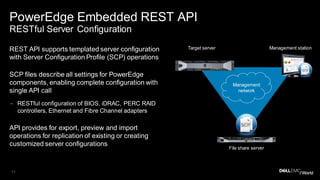
PowerEdge Embedded REST API
RESTful Server Configuration
REST API supports templated server configuration
with Server Configuration Profile (SCP) operations
SCP files describe all settings for PowerEdge
components, enabling complete configuration with
single API call
– RESTful configuration of BIOS, iDRAC, PERC RAID
controllers, Ethernet and Fibre Channel adapters
API provides for export, preview and import
operations for replication of existing or creating
customized server configurations
SCP
Target server Management station
File share server
Management
network
SCP
12
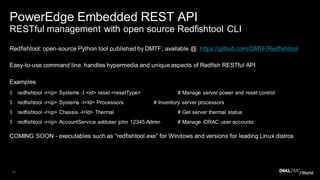
PowerEdge Embedded REST API
RESTful management with open source Redfishtool CLI
Redfishtool: open-source Python tool published by DMTF; available @ https://github.com/DMTF/Redfishtool
Easy-to-use command line, handles hypermedia and unique aspects of Redfish RESTful API
Examples
$ redfishtool -r<ip> Systems -I <id> reset <resetType> # Manage server power and reset control
$ redfishtool -r<ip> Systems -I<Id> Processors # Inventory server processors
$ redfishtool -r<ip> Chassis -I<Id> Thermal # Get server thermal status
$ redfishtool -r<ip> AccountService adduser john 12345 Admin # Manage iDRAC user accounts
COMING SOON - executables such as “redfishtool.exe” for Windows and versions for leading Linux distros
13
DevOps automation with REST APIs
Benefits
Fast, reliable, and repeatable outcome
On-demand runtime environment creation
Consistent environment for staging and production
Automated provisioning
PowerEdge hardware settings
PowerEdge firmware
Operating Systems and drivers
OS-based agents and applications
Deployment approach
“Infrastructure as a Code”
Bottom-to-top version control covering code,
configuration, and data
Aligns development and operations
iDRAC with LC REST
APIs / Scripts
Server
Configuration
Profile
Version controlServer
template
Ansible Playbook
Provisioning Plays Update Plays
Staging Environment Production EnvironmentReference Server
Component
Settings
BIOS
RAID
NIC
iDRAC
iDRAC with LC REST
APIs / Scripts
ImportSCP
iDRAC with LC REST
APIs / Scripts
Illustrative only
Chef, Puppet,Salt…
14
What’s coming next for Redfish?
Dell and the SPMF driving development of Redfish
with significant additions planned
Redfish standards planned include
– BIOS configuration
– Firmware update
– Secure boot configuration
– Detailed inventory and health status monitoring
for storage, memory and NIC/HBAs
15
A future vision of management automation
REST APIs such as Redfish are just the beginning…
– “Swordfish” extends Redfish concept to shared storage
– Network switching REST API
– Environmental REST APIs for power and HVAC
Management automation AI via “Big Data”
– Current x86 servers produce 1000’s of data points
– As data center instrumentation standardizes, management
data grows to millions of data points
– Big data science coupled with AI can deliver actionable
information to optimize physical and virtual component
operations
16
How many of you…
Currently use APIs or CLIs to automate server management?
Currently / plan to use RESTful APIs to manage server hardware?
– If not, will you use other APIs or CLIs for management automation?
What is your preferred scripting language for RESTful server management?
– PowerShell? Python? Ruby? Go? Other?
Currently / plan to use Orchestration and Automation (O&A) solutions to
configure server hardware?
– Ansible? Chef? Puppet? Salt? Other?
Is there need for server-local support for RESTful API via a CLI tool such as
Redfishtool?
17
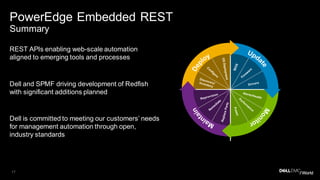
PowerEdge Embedded REST
Summary
REST APIs enabling web-scale automation
aligned to emerging tools and processes
Dell and SPMF driving development of Redfish
with significant additions planned
Dell is committed to meeting our customers’ needs
for management automation through open,
industry standards
18
PowerEdge Embedded REST
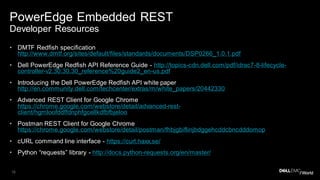
Developer Resources
• DMTF Redfish specification
http://www.dmtf.org/sites/default/files/standards/documents/DSP0266_1.0.1.pdf
• Dell PowerEdge Redfish API Reference Guide - http://topics-cdn.dell.com/pdf/idrac7-8-lifecycle-
controller-v2.30.30.30_reference%20guide2_en-us.pdf
• Introducing the Dell PowerEdge Redfish API white paper
http://en.community.dell.com/techcenter/extras/m/white_papers/20442330
• Advanced REST Client for Google Chrome
https://chrome.google.com/webstore/detail/advanced-rest-
client/hgmloofddffdnphfgcellkdfbfbjeloo
• Postman REST Client for Google Chrome
https://chrome.google.com/webstore/detail/postman/fhbjgbiflinjbdggehcddcbncdddomop
• cURL command line interface - https://curl.haxx.se/
• Python “requests” library - http://docs.python-requests.org/en/master/
Simplifying web-scale systems management with
the Dell PowerEdge Embedded RESTful Interface
Thank You!
20
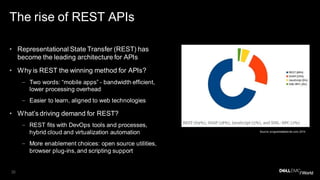
The rise of REST APIs
• Representational State Transfer (REST) has
become the leading architecture for APIs
• Why is REST the winning method for APIs?
– Two words: “mobile apps” - bandwidth efficient,
lower processing overhead
– Easier to learn, aligned to web technologies
• What’s driving demand for REST?
– REST fits with DevOps tools and processes,
hybrid cloud and virtualization automation
– More enablement choices: open source utilities,
browser plug-ins, and scripting support
Source: programmablew eb.com, 2014
21
Redfish enabling technologies
• HTTP/HTTPS communications: the Redfish API is accessed using this well-known and highly
secure interface. Individual management objects addressed as Universal Resource Identifiers (URIs)
• RESTful API: management objects read and written using REpresentational State Transfer (REST)
approach with standard HTTP “verbs” such as GET, POST and PATCH. RESTful APIs are a
preferred approach for IT automation
• JSON data representation: Java Script Notation (JSON) is a lightweight data interchange format
designed to be human readable and writeable. JSON uses computer language conventions well
known to IT developers
• OData data exchange protocol: created by Microsoft and standardized by the OASIS standards
body, OData enables standardization of data formats for the management data objects
• These technologies were chosen to support the needs for simple, scalable, and secure server
management that fits well with modern IT developers’ tools and processes
22
Standard Redfish specifications and schemas
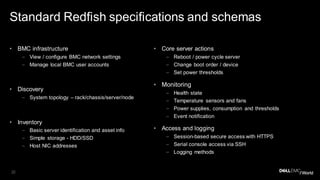
• BMC infrastructure
– View / configure BMC network settings
– Manage local BMC user accounts
• Discovery
– System topology – rack/chassis/server/node
• Inventory
– Basic server identification and asset info
– Simple storage - HDD/SSD
– Host NIC addresses
• Core server actions
– Reboot / power cycle server
– Change boot order / device
– Set power thresholds
• Monitoring
– Health state
– Temperature sensors and fans
– Power supplies, consumption and thresholds
– Event notification
• Access and logging
– Session-based secure access with HTTPS
– Serial console access via SSH
– Logging methods
23
PowerEdge Embedded REST API
Dell unique capabilities
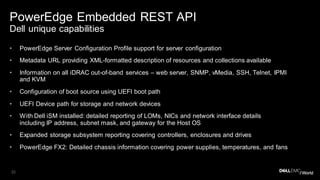
• PowerEdge Server Configuration Profile support for server configuration
• Metadata URL providing XML-formatted description of resources and collections available
• Information on all iDRAC out-of-band services – web server, SNMP, vMedia, SSH, Telnet, IPMI
and KVM
• Configuration of boot source using UEFI boot path
• UEFI Device path for storage and network devices
• With Dell iSM installed: detailed reporting of LOMs, NICs and network interface details
including IP address, subnet mask, and gateway for the Host OS
• Expanded storage subsystem reporting covering controllers, enclosures and drives
• PowerEdge FX2: Detailed chassis information covering power supplies, temperatures, and fans

MT135_Simplifying web-scale systems management with the Dell PowerEdge Embedded RESTful Interface

  • 1.
    Simplifying web-scale systemsmanagement with the Dell PowerEdge Embedded RESTful Interface Paul Rubin Senior Product Manager Dell EMC Systems Management Marketing
  • 2.
    2 Today’s IT operationschallenges Organization • On-demand,elastic services • Agility to meetchanging objectives • BimodalIT – Traditional and Exploratory Typically less concerned with… • Security • On-going support • IT costs IT Operations • Provisioning, deployment,updates and management of infrastructure • Competitionwith shadow IT Often challenged with… • Focus on legacy systems • Meeting control and governance objectives • Time-to-production
  • 3.
    3 And if youneed to achieve “Web-Scale”? Open Standards Infrastructure Automation and Auto-Remediation Predictive Analytics The typical ratio of administrator to server in web-scale environments is 1:20,000* and growing *Data Center Knowledge, Facebook Ops: Each Staffer Manages 20,000 Servers, November 20, 2013 SPEED Breaks Software SCALE Breaks Hardware Adding Agility and Scalability leads to… SPEED at SCALE Breaks Everything!! Adrian Cockroft, Technical Fellow, Battery Ventures, formerly Cloud Architect at Netflix
  • 4.
    4 System Management Visionfor Future-Ready Enterprises Data Center Virtualization and Hybrid Cloud Extensibility CapEx Reduction Infrastructure DeliveryAutomation Reduced Delivery Time Streamlined and Automated Data Center Operations OpEx Reduction Business Mobility Anywhere Deployment Security Controls Native to Infrastructure Improved Security to Effort Ratio High Availability and Resilient Infrastructure Improved Uptime
  • 5.
    5 The systems managementautomation journey 1990’s Proprietary Era 2000’s Early Standards Age 2010’s-> Next-gen Standards Age Functions Automation technologies Predominate management interfaces Inventory and monitor Inventory, monitor, and server control Inventory, Monitor, Server Control, Configuration, and Update Proprietary command line interfaces Integration with network managers IPMI, Common Information Model, WS-Man and Wbem Integration with OS and ISV system management consoles DMTF Redfish and OEM RESTful API’s Integration with open source and ISV orchestration / automation solutions Vendor CLIs SNMP IPMI API Vendor CLIs Vendor SOAP APIs Redfish API Vendor REST APIs Vendor CLIs
  • 6.
    6 Introducing – Redfish,a new systems management standard for an evolving IT environment DMTF Scalable Platform Management Forum has created an open industry standard specificationand schema for simple, modern, and secure management of scalable platform hardware A secure, multi-node, RESTful management interface built upon HTTPS in JSON format based upon OData v4 Schema-based but human-readable; usable by client applications and browser-based GUIs Covers key use cases and customer requirements
  • 7.
    7 What can youdo with Redfish? Provides a common interface across platforms and vendors supporting: Reset, reboot, and power control servers Inventory server hardware and firmware versions Monitor health status of server Access system logs Alert on server health status changes
  • 8.
    8 PowerEdge iDRAC withLifecycle Controller Embedded, agent-free enablement for PowerEdge server management automation GUI HTTPS SSL Active Directory LDAP SmartCard CLI APIs IPMI SNMP WS-MAN REST - Redfish Access Points Security Methods Key Functions
  • 9.
    9 PowerEdge embedded RESTfulAPI overview Uniting Redfish with PowerEdge REST PowerEdge RESTful API enables modern, secure, scalable management automation Conformant with Redfish v1.0.2 PowerEdge REST API extensions – RESTful server configuration – Detailed inventory and health status of server storage – controllers, enclosures and drives - and network interfaces – Chassis-level health monitoring for PowerEdge FX2 Modular Infrastructure
  • 10.
    10 PowerEdge embedded RESTfulAPI overview Modern tools for management automation Server inventory with Python scripting importrequests importjson system = requests.get('https://<iDRAC IP>/redfish/v1/Systems/System.Embedded.1',verify=False,auth=('root','calvin')) storage = requests.get('https://<iDRAC IP>/redfish/v1/Systems/System.Embedded.1/Storage/Controllers/RAID.Integrated.1- 1',verify=False,auth=('root','calvin')) systemData = system.json() storageData = storage.json() print "Model: {}".format(systemData[u'Model']) print "Manufacturer: {}".format(systemData[u'Manufacturer']) print "Service tag {}".format(systemData[u'SKU']) print "Serial number: {}".format(systemData[u'SerialNumber']) print "Hostname: {}".format(systemData[u'HostName']) print "Power state: {}".format(systemData[u'PowerState']) print "Asset tag: {}".format(systemData[u'AssetTag']) print "Memory size: {}".format(systemData[u'MemorySummary'][u'TotalSystemMemoryGiB']) print "CPU type: {}".format(systemData[u'ProcessorSummary'][u'Model']) print "Number of CPUs: {}".format(systemData[u'ProcessorSummary'][u'Count']) print "System status: {}".format(systemData[u'Status'][u'Health']) print "RAID health: {}".format(storageData[u'Status'][u'Health']) Server storage health status via Postman plug-in
  • 11.
    11 PowerEdge Embedded RESTAPI RESTful Server Configuration REST API supports templated server configuration with Server Configuration Profile (SCP) operations SCP files describe all settings for PowerEdge components, enabling complete configuration with single API call – RESTful configuration of BIOS, iDRAC, PERC RAID controllers, Ethernet and Fibre Channel adapters API provides for export, preview and import operations for replication of existing or creating customized server configurations SCP Target server Management station File share server Management network SCP
  • 12.
    12 PowerEdge Embedded RESTAPI RESTful management with open source Redfishtool CLI Redfishtool: open-source Python tool published by DMTF; available @ https://github.com/DMTF/Redfishtool Easy-to-use command line, handles hypermedia and unique aspects of Redfish RESTful API Examples $ redfishtool -r<ip> Systems -I <id> reset <resetType> # Manage server power and reset control $ redfishtool -r<ip> Systems -I<Id> Processors # Inventory server processors $ redfishtool -r<ip> Chassis -I<Id> Thermal # Get server thermal status $ redfishtool -r<ip> AccountService adduser john 12345 Admin # Manage iDRAC user accounts COMING SOON - executables such as “redfishtool.exe” for Windows and versions for leading Linux distros
  • 13.
    13 DevOps automation withREST APIs Benefits Fast, reliable, and repeatable outcome On-demand runtime environment creation Consistent environment for staging and production Automated provisioning PowerEdge hardware settings PowerEdge firmware Operating Systems and drivers OS-based agents and applications Deployment approach “Infrastructure as a Code” Bottom-to-top version control covering code, configuration, and data Aligns development and operations iDRAC with LC REST APIs / Scripts Server Configuration Profile Version controlServer template Ansible Playbook Provisioning Plays Update Plays Staging Environment Production EnvironmentReference Server Component Settings BIOS RAID NIC iDRAC iDRAC with LC REST APIs / Scripts ImportSCP iDRAC with LC REST APIs / Scripts Illustrative only Chef, Puppet,Salt…
  • 14.
    14 What’s coming nextfor Redfish? Dell and the SPMF driving development of Redfish with significant additions planned Redfish standards planned include – BIOS configuration – Firmware update – Secure boot configuration – Detailed inventory and health status monitoring for storage, memory and NIC/HBAs
  • 15.
    15 A future visionof management automation REST APIs such as Redfish are just the beginning… – “Swordfish” extends Redfish concept to shared storage – Network switching REST API – Environmental REST APIs for power and HVAC Management automation AI via “Big Data” – Current x86 servers produce 1000’s of data points – As data center instrumentation standardizes, management data grows to millions of data points – Big data science coupled with AI can deliver actionable information to optimize physical and virtual component operations
  • 16.
    16 How many ofyou… Currently use APIs or CLIs to automate server management? Currently / plan to use RESTful APIs to manage server hardware? – If not, will you use other APIs or CLIs for management automation? What is your preferred scripting language for RESTful server management? – PowerShell? Python? Ruby? Go? Other? Currently / plan to use Orchestration and Automation (O&A) solutions to configure server hardware? – Ansible? Chef? Puppet? Salt? Other? Is there need for server-local support for RESTful API via a CLI tool such as Redfishtool?
  • 17.
    17 PowerEdge Embedded REST Summary RESTAPIs enabling web-scale automation aligned to emerging tools and processes Dell and SPMF driving development of Redfish with significant additions planned Dell is committed to meeting our customers’ needs for management automation through open, industry standards
  • 18.
    18 PowerEdge Embedded REST DeveloperResources • DMTF Redfish specification http://www.dmtf.org/sites/default/files/standards/documents/DSP0266_1.0.1.pdf • Dell PowerEdge Redfish API Reference Guide - http://topics-cdn.dell.com/pdf/idrac7-8-lifecycle- controller-v2.30.30.30_reference%20guide2_en-us.pdf • Introducing the Dell PowerEdge Redfish API white paper http://en.community.dell.com/techcenter/extras/m/white_papers/20442330 • Advanced REST Client for Google Chrome https://chrome.google.com/webstore/detail/advanced-rest- client/hgmloofddffdnphfgcellkdfbfbjeloo • Postman REST Client for Google Chrome https://chrome.google.com/webstore/detail/postman/fhbjgbiflinjbdggehcddcbncdddomop • cURL command line interface - https://curl.haxx.se/ • Python “requests” library - http://docs.python-requests.org/en/master/
  • 19.
    Simplifying web-scale systemsmanagement with the Dell PowerEdge Embedded RESTful Interface Thank You!
  • 20.
    20 The rise ofREST APIs • Representational State Transfer (REST) has become the leading architecture for APIs • Why is REST the winning method for APIs? – Two words: “mobile apps” - bandwidth efficient, lower processing overhead – Easier to learn, aligned to web technologies • What’s driving demand for REST? – REST fits with DevOps tools and processes, hybrid cloud and virtualization automation – More enablement choices: open source utilities, browser plug-ins, and scripting support Source: programmablew eb.com, 2014
  • 21.
    21 Redfish enabling technologies •HTTP/HTTPS communications: the Redfish API is accessed using this well-known and highly secure interface. Individual management objects addressed as Universal Resource Identifiers (URIs) • RESTful API: management objects read and written using REpresentational State Transfer (REST) approach with standard HTTP “verbs” such as GET, POST and PATCH. RESTful APIs are a preferred approach for IT automation • JSON data representation: Java Script Notation (JSON) is a lightweight data interchange format designed to be human readable and writeable. JSON uses computer language conventions well known to IT developers • OData data exchange protocol: created by Microsoft and standardized by the OASIS standards body, OData enables standardization of data formats for the management data objects • These technologies were chosen to support the needs for simple, scalable, and secure server management that fits well with modern IT developers’ tools and processes
  • 22.
    22 Standard Redfish specificationsand schemas • BMC infrastructure – View / configure BMC network settings – Manage local BMC user accounts • Discovery – System topology – rack/chassis/server/node • Inventory – Basic server identification and asset info – Simple storage - HDD/SSD – Host NIC addresses • Core server actions – Reboot / power cycle server – Change boot order / device – Set power thresholds • Monitoring – Health state – Temperature sensors and fans – Power supplies, consumption and thresholds – Event notification • Access and logging – Session-based secure access with HTTPS – Serial console access via SSH – Logging methods
  • 23.
    23 PowerEdge Embedded RESTAPI Dell unique capabilities • PowerEdge Server Configuration Profile support for server configuration • Metadata URL providing XML-formatted description of resources and collections available • Information on all iDRAC out-of-band services – web server, SNMP, vMedia, SSH, Telnet, IPMI and KVM • Configuration of boot source using UEFI boot path • UEFI Device path for storage and network devices • With Dell iSM installed: detailed reporting of LOMs, NICs and network interface details including IP address, subnet mask, and gateway for the Host OS • Expanded storage subsystem reporting covering controllers, enclosures and drives • PowerEdge FX2: Detailed chassis information covering power supplies, temperatures, and fans