Unit-V b
The Small-Scale Sector
Prof. Mahendra Kumar Ghadoliya
Contents
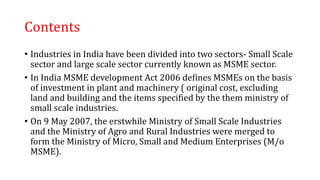
• Industries in India have been divided into two sectors- Small Scale
sector and large scale sector currently known as MSME sector.
• In India MSME development Act 2006 defines MSMEs on the basis
of investment in plant and machinery ( original cost, excluding
land and building and the items specified by the them ministry of
small scale industries.
• On 9 May 2007, the erstwhile Ministry of Small Scale Industries
and the Ministry of Agro and Rural Industries were merged to
form the Ministry of Micro, Small and Medium Enterprises (M/o
MSME).
Meaning and Definition
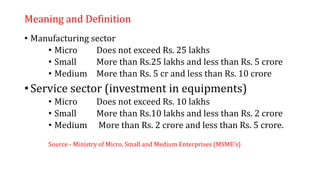
• Manufacturing sector
• Micro Does not exceed Rs. 25 lakhs
• Small More than Rs.25 lakhs and less than Rs. 5 crore
• Medium More than Rs. 5 cr and less than Rs. 10 crore
• Service sector (investment in equipments)
• Micro Does not exceed Rs. 10 lakhs
• Small More than Rs.10 lakhs and less than Rs. 2 crore
• Medium More than Rs. 2 crore and less than Rs. 5 crore.
Source - Ministry of Micro, Small and Medium Enterprises (MSME’s)
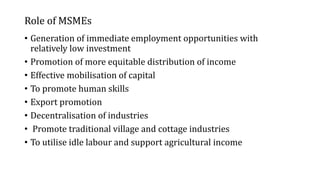
Role of MSMEs
• Generation of immediate employment opportunities with
relatively low investment
• Promotion of more equitable distribution of income
• Effective mobilisation of capital
• To promote human skills
• Export promotion
• Decentralisation of industries
• Promote traditional village and cottage industries
• To utilise idle labour and support agricultural income
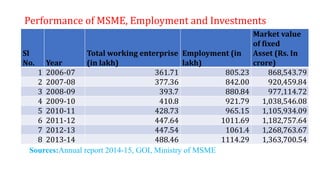
Performance of MSME, Employment and Investments
Sl
No. Year
Total working enterprise
(in lakh)
Employment (in
lakh)
Market value
of fixed
Asset (Rs. In
crore)
1 2006-07 361.71 805.23 868,543.79
2 2007-08 377.36 842.00 920,459.84
3 2008-09 393.7 880.84 977,114.72
4 2009-10 410.8 921.79 1,038,546.08
5 2010-11 428.73 965.15 1,105,934.09
6 2011-12 447.64 1011.69 1,182,757.64
7 2012-13 447.54 1061.4 1,268,763.67
8 2013-14 488.46 1114.29 1,363,700.54
Sources:Annual report 2014-15, GOI, Ministry of MSME
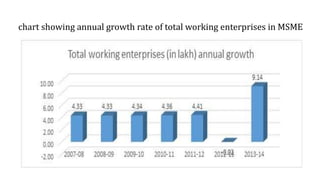
chart showing annual growth rate of total working enterprises in MSME
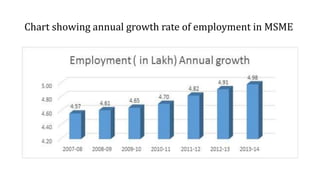
Chart showing annual growth rate of employment in MSME
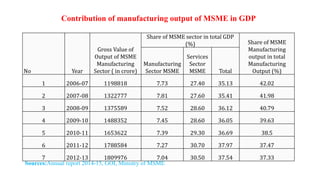
No Year
Gross Value of
Output of MSME
Manufacturing
Sector ( in crore)
Share of MSME sector in total GDP
(%) Share of MSME
Manufacturing
output in total
Manufacturing
Output (%)
Manufacturing
Sector MSME
Services
Sector
MSME Total
1 2006-07 1198818 7.73 27.40 35.13 42.02
2 2007-08 1322777 7.81 27.60 35.41 41.98
3 2008-09 1375589 7.52 28.60 36.12 40.79
4 2009-10 1488352 7.45 28.60 36.05 39.63
5 2010-11 1653622 7.39 29.30 36.69 38.5
6 2011-12 1788584 7.27 30.70 37.97 37.47
7 2012-13 1809976 7.04 30.50 37.54 37.33
Sources:Annual report 2014-15, GOI, Ministry of MSME
Contribution of manufacturing output of MSME in GDP
GOVERNMENT POLICY INITIATIVES:
 Implementation of MSME development act 2006, which provides rules and
regulation for MSME
 Reservation and de reservation of products for manufacture in MSME sector-
to achieve socio economic development, enhancing technological and achieving
economies of scale.
 National manufacturing competitiveness program - to build sustainable
capacity, overcoming global competitiveness and healthy growth through eight
components which includes: incubator, intellectual property awareness, quality
management, technology up gradation, marketing assistance, design expertise
and promotion of ICT.
 Public procurement policy through implementation of technology in tenders.
 E-governance – to facilitate employment, virtual cluster, share database, B2B
portal and mobile friendly website.
CENTRAL GOVERNMENT ROLE ( POLICY) FOR THE DEVELOPMENT OF MSME’s:
 Prime Minister’s Employment Generation Programme
 All India Census of MSMEs
 Credit Guarantee Scheme
 National Manufacturing Competitiveness Programme
 MSE-Cluster Development Programme (MSE-CDP)
 Credit Linked Capital Subsidy Scheme
 Entrepreneurship and Skill Development
 Rajiv Gandhi Udyami Mitra Yojana
 Performance and Credit Rating Scheme
 Financial assistance on bar code
 Employment exchange for industries
 Framework for revival and rehabilitation of MSMEs
 A scheme for promoting innovation and Rural enterprises
Problems of MSME’s:
 - Credit
 - Absence of adequate and timely banking finance,
 - Limited capital and knowledge,
 - Infrastructure
 - Globalization of trade and commerce
 - Non-availability of suitable technology,
 - Low production capacity, ineffective marketing strategy,
 - Identification of new markets or market access,
 - Constraints on modernization & expansions,
 - Non availability of highly skilled labour at affordable cost,
 - Follow-up with various government agencies to resolve problems
 - Exit mechanism
 - Strategy interventions for revitalization and growth etc.

Small scale industries

  • 1.
    Unit-V b The Small-ScaleSector Prof. Mahendra Kumar Ghadoliya
  • 2.
    Contents • Industries inIndia have been divided into two sectors- Small Scale sector and large scale sector currently known as MSME sector. • In India MSME development Act 2006 defines MSMEs on the basis of investment in plant and machinery ( original cost, excluding land and building and the items specified by the them ministry of small scale industries. • On 9 May 2007, the erstwhile Ministry of Small Scale Industries and the Ministry of Agro and Rural Industries were merged to form the Ministry of Micro, Small and Medium Enterprises (M/o MSME).
  • 3.
    Meaning and Definition •Manufacturing sector • Micro Does not exceed Rs. 25 lakhs • Small More than Rs.25 lakhs and less than Rs. 5 crore • Medium More than Rs. 5 cr and less than Rs. 10 crore • Service sector (investment in equipments) • Micro Does not exceed Rs. 10 lakhs • Small More than Rs.10 lakhs and less than Rs. 2 crore • Medium More than Rs. 2 crore and less than Rs. 5 crore. Source - Ministry of Micro, Small and Medium Enterprises (MSME’s)
  • 4.
    Role of MSMEs •Generation of immediate employment opportunities with relatively low investment • Promotion of more equitable distribution of income • Effective mobilisation of capital • To promote human skills • Export promotion • Decentralisation of industries • Promote traditional village and cottage industries • To utilise idle labour and support agricultural income
  • 5.
    Performance of MSME,Employment and Investments Sl No. Year Total working enterprise (in lakh) Employment (in lakh) Market value of fixed Asset (Rs. In crore) 1 2006-07 361.71 805.23 868,543.79 2 2007-08 377.36 842.00 920,459.84 3 2008-09 393.7 880.84 977,114.72 4 2009-10 410.8 921.79 1,038,546.08 5 2010-11 428.73 965.15 1,105,934.09 6 2011-12 447.64 1011.69 1,182,757.64 7 2012-13 447.54 1061.4 1,268,763.67 8 2013-14 488.46 1114.29 1,363,700.54 Sources:Annual report 2014-15, GOI, Ministry of MSME
  • 6.
    chart showing annualgrowth rate of total working enterprises in MSME
  • 7.
    Chart showing annualgrowth rate of employment in MSME
  • 8.
    No Year Gross Valueof Output of MSME Manufacturing Sector ( in crore) Share of MSME sector in total GDP (%) Share of MSME Manufacturing output in total Manufacturing Output (%) Manufacturing Sector MSME Services Sector MSME Total 1 2006-07 1198818 7.73 27.40 35.13 42.02 2 2007-08 1322777 7.81 27.60 35.41 41.98 3 2008-09 1375589 7.52 28.60 36.12 40.79 4 2009-10 1488352 7.45 28.60 36.05 39.63 5 2010-11 1653622 7.39 29.30 36.69 38.5 6 2011-12 1788584 7.27 30.70 37.97 37.47 7 2012-13 1809976 7.04 30.50 37.54 37.33 Sources:Annual report 2014-15, GOI, Ministry of MSME Contribution of manufacturing output of MSME in GDP
  • 9.
    GOVERNMENT POLICY INITIATIVES: Implementation of MSME development act 2006, which provides rules and regulation for MSME  Reservation and de reservation of products for manufacture in MSME sector- to achieve socio economic development, enhancing technological and achieving economies of scale.  National manufacturing competitiveness program - to build sustainable capacity, overcoming global competitiveness and healthy growth through eight components which includes: incubator, intellectual property awareness, quality management, technology up gradation, marketing assistance, design expertise and promotion of ICT.  Public procurement policy through implementation of technology in tenders.  E-governance – to facilitate employment, virtual cluster, share database, B2B portal and mobile friendly website.
  • 10.
    CENTRAL GOVERNMENT ROLE( POLICY) FOR THE DEVELOPMENT OF MSME’s:  Prime Minister’s Employment Generation Programme  All India Census of MSMEs  Credit Guarantee Scheme  National Manufacturing Competitiveness Programme  MSE-Cluster Development Programme (MSE-CDP)  Credit Linked Capital Subsidy Scheme  Entrepreneurship and Skill Development  Rajiv Gandhi Udyami Mitra Yojana  Performance and Credit Rating Scheme  Financial assistance on bar code  Employment exchange for industries  Framework for revival and rehabilitation of MSMEs  A scheme for promoting innovation and Rural enterprises
  • 11.
    Problems of MSME’s: - Credit  - Absence of adequate and timely banking finance,  - Limited capital and knowledge,  - Infrastructure  - Globalization of trade and commerce  - Non-availability of suitable technology,  - Low production capacity, ineffective marketing strategy,  - Identification of new markets or market access,  - Constraints on modernization & expansions,  - Non availability of highly skilled labour at affordable cost,  - Follow-up with various government agencies to resolve problems  - Exit mechanism  - Strategy interventions for revitalization and growth etc.