INTENSIFICATION OF MSMEs –
LEADING A PODIUM FOR STEADY
ECONOMIC GROWTH
Mrs. LUBNA SURAIYA MBA., DIT., (M.Com)
Assistant Professor
Department of Business Administration
TBAK College for Women
Kilakarai
INTRODUCTION
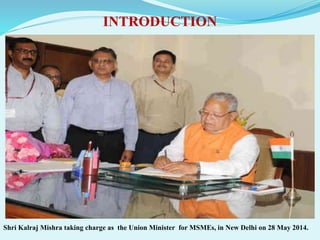
Shri Kalraj Mishra taking charge as the Union Minister for MSMEs, in New Delhi on 28 May 2014.
OBJECTIVES
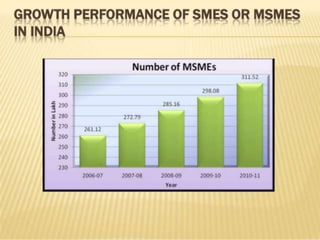
To examine the growth and performance MSMEs in
economic growth.
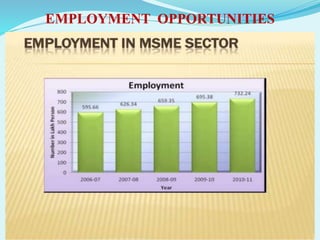
To evaluate the employment opportunities and products
created by MSMEs.
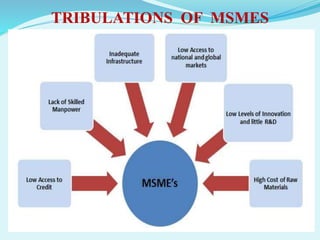
To understand the various tribulations (problems) of
MSMEs.
To suggest the policy measures for the exponential growth
of MSMEs.
METHODOLOGY
Based on secondary data, collected for a period of 7 years
from 2005- 12.
Annual Reports of Ministry of Micro, Small and Medium
Enterprises, Government of India and Final Report
Fourth All India Census of MSME 2006-2007.
Various Websites connected with the relevant topics of
MSMEs.
Journal papers, Articles and relevant sources for MSMEs.
CRITERIA IN INDIA
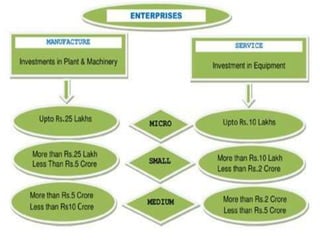
In accordance with the provisions for Micro, Small and Medium
Enterprises Development (MSMED) Act 2006, the MSME are classified
into two classes:
Manufacturing Enterprises
Micro : Rs. 25 Lakhs
Small : Less than 5 Crores
Medium : Less than 10 Crores
Service Enterprises
Micro : Less than 10 Lakhs
Small : Less than 2 Crores
Medium : Less than 5 Crores
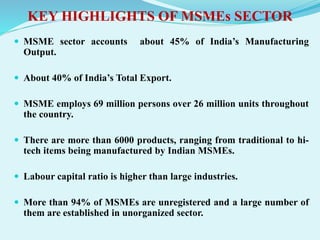
KEY HIGHLIGHTS OF MSMEs SECTOR
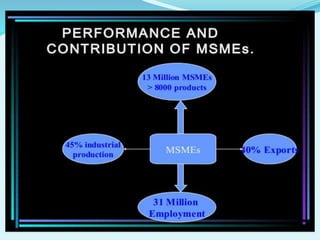
 MSME sector accounts about 45% of India’s Manufacturing
Output.
 About 40% of India’s Total Export.
 MSME employs 69 million persons over 26 million units throughout
the country.
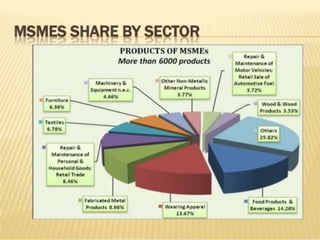
 There are more than 6000 products, ranging from traditional to hi-
tech items being manufactured by Indian MSMEs.
 Labour capital ratio is higher than large industries.
 More than 94% of MSMEs are unregistered and a large number of
them are established in unorganized sector.
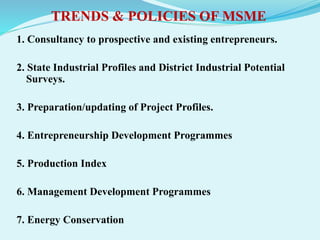
TRENDS & POLICIES OF MSME
1. Consultancy to prospective and existing entrepreneurs.
2. State Industrial Profiles and District Industrial Potential
Surveys.
3. Preparation/updating of Project Profiles.
4. Entrepreneurship Development Programmes
5. Production Index
6. Management Development Programmes
7. Energy Conservation
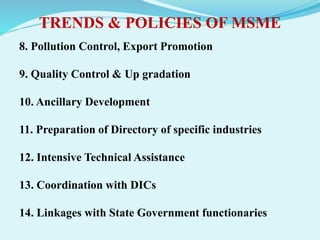
TRENDS & POLICIES OF MSME
8. Pollution Control, Export Promotion
9. Quality Control & Up gradation
10. Ancillary Development
11. Preparation of Directory of specific industries
12. Intensive Technical Assistance
13. Coordination with DICs
14. Linkages with State Government functionaries
TRIBULATIONS OF MSMES
EMPLOYMENT OPPORTUNITIES
CONCLUSIONS
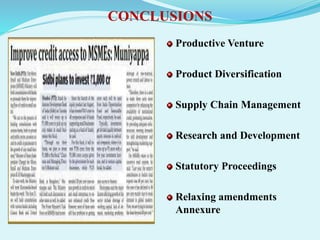
Productive Venture
Product Diversification
Supply Chain Management
Research and Development
Statutory Proceedings
Relaxing amendments
Annexure
Basic intro on MSMEs

Basic intro on MSMEs

  • 2.
    INTENSIFICATION OF MSMEs– LEADING A PODIUM FOR STEADY ECONOMIC GROWTH Mrs. LUBNA SURAIYA MBA., DIT., (M.Com) Assistant Professor Department of Business Administration TBAK College for Women Kilakarai
  • 3.
    INTRODUCTION Shri Kalraj Mishrataking charge as the Union Minister for MSMEs, in New Delhi on 28 May 2014.
  • 4.
    OBJECTIVES To examine thegrowth and performance MSMEs in economic growth. To evaluate the employment opportunities and products created by MSMEs. To understand the various tribulations (problems) of MSMEs. To suggest the policy measures for the exponential growth of MSMEs.
  • 5.
    METHODOLOGY Based on secondarydata, collected for a period of 7 years from 2005- 12. Annual Reports of Ministry of Micro, Small and Medium Enterprises, Government of India and Final Report Fourth All India Census of MSME 2006-2007. Various Websites connected with the relevant topics of MSMEs. Journal papers, Articles and relevant sources for MSMEs.
  • 6.
    CRITERIA IN INDIA Inaccordance with the provisions for Micro, Small and Medium Enterprises Development (MSMED) Act 2006, the MSME are classified into two classes: Manufacturing Enterprises Micro : Rs. 25 Lakhs Small : Less than 5 Crores Medium : Less than 10 Crores Service Enterprises Micro : Less than 10 Lakhs Small : Less than 2 Crores Medium : Less than 5 Crores
  • 9.
    KEY HIGHLIGHTS OFMSMEs SECTOR  MSME sector accounts about 45% of India’s Manufacturing Output.  About 40% of India’s Total Export.  MSME employs 69 million persons over 26 million units throughout the country.  There are more than 6000 products, ranging from traditional to hi- tech items being manufactured by Indian MSMEs.  Labour capital ratio is higher than large industries.  More than 94% of MSMEs are unregistered and a large number of them are established in unorganized sector.
  • 12.
    TRENDS & POLICIESOF MSME 1. Consultancy to prospective and existing entrepreneurs. 2. State Industrial Profiles and District Industrial Potential Surveys. 3. Preparation/updating of Project Profiles. 4. Entrepreneurship Development Programmes 5. Production Index 6. Management Development Programmes 7. Energy Conservation
  • 13.
    TRENDS & POLICIESOF MSME 8. Pollution Control, Export Promotion 9. Quality Control & Up gradation 10. Ancillary Development 11. Preparation of Directory of specific industries 12. Intensive Technical Assistance 13. Coordination with DICs 14. Linkages with State Government functionaries
  • 14.
  • 15.
  • 17.
    CONCLUSIONS Productive Venture Product Diversification SupplyChain Management Research and Development Statutory Proceedings Relaxing amendments Annexure