Recommended
PPTX
PDF
MSME ( Micro, small, and medium-sized enterprises MSMEs) Classification, Loan...
PPTX
PPTX
PPTX
Medium, Small and Micro Enterprises: Overview and Benefits
PPTX
PPTX
MSMEs in India: An overview
PPTX
PDF
Growth and Future Prospects of MSME in India
PDF
PDF
India's MSME Ecosystem – A Case study with In depth Analysis - Garima singh
PPT
Creating competitive msm es 21_56_74
PPTX
DOC
MSMEs in India Growth Catalyst
DOC
MSMEs in India Growth Catalyst
PPTX
Empowering MSMEs Harnessing Technology, Skill, and Innovation for Sustainable...
PPT
PDF
MSMEs: The Backbone of India’s Economy — Features, Benefits & Their Growing I...
PPTX
MSME Presentation.pptx MSME Customers of Bank
PPTX
PDF
Empowering MSMEs through financing and linkages
PPT
Medium, Small and Micro enterprises MSM
PDF
PDF
Impact of COVID-19 on Indian MSME Sector: 16th September 2020
PPTX
PPTX
PPTX
The future looks bright for msme sector
PDF
MSME Sector - Growth, Challenges & Opportunities
PDF
Unsung Britain conference: Context setting presentation from Resolution Found...
PDF
Trade Facilitation Monitoring in Ukraine № 98
More Related Content
PPTX
PDF
MSME ( Micro, small, and medium-sized enterprises MSMEs) Classification, Loan...
PPTX
PPTX
PPTX
Medium, Small and Micro Enterprises: Overview and Benefits
PPTX
PPTX
MSMEs in India: An overview
PPTX
Similar to Micro Small and Medium enterprises in India
PDF
Growth and Future Prospects of MSME in India
PDF
PDF
India's MSME Ecosystem – A Case study with In depth Analysis - Garima singh
PPT
Creating competitive msm es 21_56_74
PPTX
DOC
MSMEs in India Growth Catalyst
DOC
MSMEs in India Growth Catalyst
PPTX
Empowering MSMEs Harnessing Technology, Skill, and Innovation for Sustainable...
PPT
PDF
MSMEs: The Backbone of India’s Economy — Features, Benefits & Their Growing I...
PPTX
MSME Presentation.pptx MSME Customers of Bank
PPTX
PDF
Empowering MSMEs through financing and linkages
PPT
Medium, Small and Micro enterprises MSM
PDF
PDF
Impact of COVID-19 on Indian MSME Sector: 16th September 2020
PPTX
PPTX
PPTX
The future looks bright for msme sector
PDF
MSME Sector - Growth, Challenges & Opportunities
Recently uploaded
PDF
Unsung Britain conference: Context setting presentation from Resolution Found...
PDF
Trade Facilitation Monitoring in Ukraine № 98
PDF
NVIDIA Corporation Leading the AI Revolution
PDF
10 Best Sites to Buy (X) Twitter Accounts for Sellers Top 11....pdf
PDF
Financial Analysis Report ROCHE - Finance Club UoM.pdf
PPTX
Dr. D. Sundari PRICING STRATEGIES ppt.pptx
PDF
Tisza Párt programjának makroökonómiai elemzése ( EN )
DOCX
Buy Verified Binance Accounts with Guaranteed Security and Trust not risk .docx
PPTX
Precious Metals Performance in 2025 and Outlook Outlook 2026
PDF
Best Sites to Buy Verified Remitly Account Online (1).pdf
PDF
The Blue Economy Paradox: Power, Survival, and Sustainability in the Indo-Pac...
DOCX
11 Best Trusted Places to Buy Verified Remitly Accounts in 2026.docx
PDF
Andhra Pradesh_Socio_Economic_Survey_2024_25.pdf
PDF
Bladex Earnings Call Presentation 4Q2025
PDF
"Free AI Tools for Optimizing College Operations: Scheduling, Financial Manag...
PDF
India_Structural_Re-Rating_Beyond_Gold.pdf
PDF
Veritas Financial Statement presentation 2025
PDF
"Customs & Excise Amendments from Budget 2026 - Key Changes Explained by CA S...
DOCX
Buy A Verified Remitly Account for Freelancers & Businesses.docx
PDF
SUB-SAHARAN AFRICA'S OIL SECTOR: SITUATION, DEVELOPMENTS AND PROSPECTS.pdf
Micro Small and Medium enterprises in India 1. MSMEs in India
• Problems, Policy Response & Prospects
• (Your Name | Date | Institution)
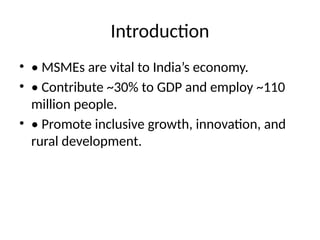
2. Introduction
• • MSMEs are vital to India’s economy.
• • Contribute ~30% to GDP and employ ~110
million people.
• • Promote inclusive growth, innovation, and
rural development.
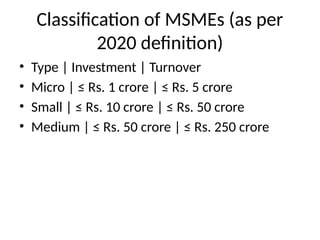
3. Classification of MSMEs (as per
2020 definition)
• Type | Investment | Turnover
• Micro | ≤ Rs. 1 crore | ≤ Rs. 5 crore
• Small | ≤ Rs. 10 crore | ≤ Rs. 50 crore
• Medium | ≤ Rs. 50 crore | ≤ Rs. 250 crore
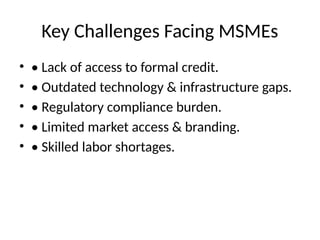
4. Key Challenges Facing MSMEs
• • Lack of access to formal credit.
• • Outdated technology & infrastructure gaps.
• • Regulatory compliance burden.
• • Limited market access & branding.
• • Skilled labor shortages.
5. Financial Constraints
• • 85% MSMEs rely on informal sources.
• • Collateral demands by banks.
• • Delay in payment cycles, especially from
public sector buyers.
6. Policy Responses
• 1. Credit Support:
• - MUDRA Yojana
• - CGTMSE
• - ECLGS (COVID-19 relief)
• 2. Technology Upgradation:
• - CLCSS
• - Digital MSME scheme
7. Market Access & Infrastructure
• • GeM: Government e-Marketplace.
• • MSME Champions Portal: Support &
grievance redressal.
• • Cluster Development Programme (CDP):
Infrastructure creation.
8. Skilling & Innovation Support
• • Skill India Mission
• • Incubation centers & startup support
• • Collaboration with NSDC & academic
institutions
9. Prospects
• • Growing digitization (UPI, ONDC, GST
integration)
• • Export promotion opportunities
• • Green and sustainable MSMEs
• • Rural employment generator
10. Role in Atmanirbhar Bharat
• • MSMEs key to self-reliant India vision
• • Reducing import dependency
• • Boosting local manufacturing & innovation
11. Conclusion
• • MSMEs are central to India’s growth and
employment.
• • Challenges exist, but with strong policy
support and reforms, the sector can thrive
globally.
12.