Academic Language
Development for All
A Culturally and Linguistically Responsive
Professional Learning Study
Icela Pelayo, Ph.D. New Mexico Public Education Department
Susana Ibarra Johnson, Ph.D. New Mexico Education Continuum
Vincent Werito, Ph.D. University of New Mexico
Elisabeth Valenzuela, Ph.D. New Mexico Public Education Department
Supported by the W. K. Kellogg Foundation
A
L
D
4
A
L
L
2
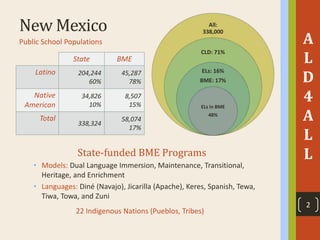
New Mexico
State-funded BME Programs
• Models: Dual Language Immersion, Maintenance, Transitional,
Heritage, and Enrichment
• Languages: Diné (Navajo), Jicarilla (Apache), Keres, Spanish, Tewa,
Tiwa, Towa, and Zuni
22 Indigenous Nations (Pueblos, Tribes)
All:
338,000
CLD: 71%
ELs: 16%
BME: 17%
ELs in BME
48%
State BME
Latino 204,244
60%
45,287
78%
Native
American
34,826
10%
8,507
15%
Total
338,324
58,074
17%
A
L
D
4
A
L
L
Public School Populations
ALD4ALL Purpose
• Align BMEB vision and mission to PED strategic plan
• Connect CCSS 21st century skills and BMEPs
• Strengthen and support New Mexico BMEPs for CLD students
and ELs
• What’s working well in NM bilingual education?
• Identify best practices to inform professional learning
• Use Culturally and Linguistically Responsive Approach
A
L
D
4
A
L
L
3
Theoretical Framework
A
L
D
4
A
L
L
Sociocultural Theory: Teaching and learning is
socially-mediated and context-dependent
(Vygotsky, 1978)
• Culturally and Linguistically Responsive Pedagogy
• Lucas, Villegas & Freedson-Gonzalez, 2008
• Villegas & Lucas, 2002
• ‘Funds of Knowledge’
• Gonzalez, Moll & Amanti, 2005
• Effective Bilingual Education Practices
• Cadiero-Kaplan, 2004
• Generative Theory
• Ball, 2009 4
Study Questions
A
L
D
4
A
L
L
1. How do effective BMEPs identify and conduct PL for
educators of CLD and EL students?
2. How do educators in these BMEPs work with coaches and
external facilitators to improve the effectiveness of their
professional learning tasks and activities?
3. What are CLD and EL student outcomes that result from
the instructional activities implemented in the classroom
by participating educators?
BMEP: Bilingual Multicultural Education Program
CLD: Culturally and Linguistically Diverse
EL: English Learner
PL: Professional Learning 5
Toward a Generativity Mindset
A
L
D
4
A
L
L
— Ball, 2009
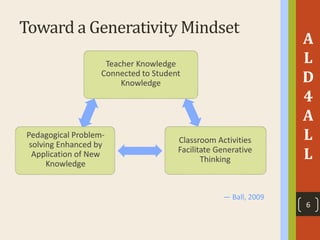
Teacher Knowledge
Connected to Student
Knowledge
Classroom Activities
Facilitate Generative
Thinking
Pedagogical Problem-
solving Enhanced by
Application of New
Knowledge
6
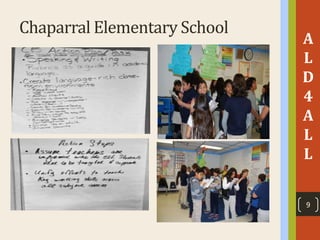
Chaparral Elementary School
A
L
D
4
A
L
L
7
Generative Professional Learning
A
L
D
4
A
L
L
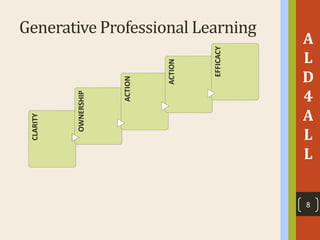
CLARITY
OWNERSHIP
ACTION
ACTION
EFFICACY
8
Chaparral Elementary School
A
L
D
4
A
L
L
9
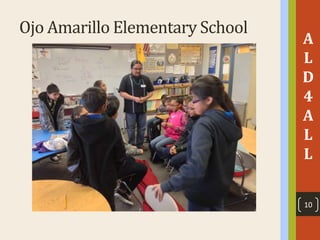
Ojo Amarillo Elementary School
A
L
D
4
A
L
L
10
Ojo Amarillo Elementary School
A
L
D
4
A
L
L
11
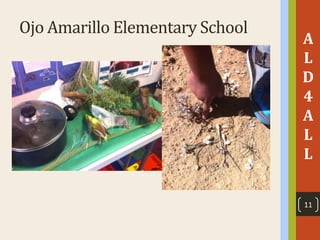
Ojo Amarillo Elementary School
A
L
D
4
A
L
L
Bridge Navajo Literacy
to Oral Language Development
• Navajo Literacy Nights
• Encourage parent involvement through literacy based cultural
events
• Culture-based experiential learning
• Connect traditional Navajo knowledge (stories and language)
to academic content knowledge
• Emphasize Navajo holistic academic language and literacy
orientation
12
Re: Study Question 1
A
L
D
4
A
L
L
Identification of Need Areas
• Students’ identified learning needs, based on data
• Interview and focus group data
• Teacher self-efficacy survey data
• Classroom observation data, based on indicators of effective
bilingual practices (Cadiero-Kaplan, 2004)
• Holistic Academic Language and Literacy Orientation
• School/Program-wide Instructional Planning
• Student-Centered Value of Learners
• Responsive BME Program Models
• Development/implementation of action plans
13
Re: Study Question 2
A
L
D
4
A
L
L
Collaboration with Facilitators
• Tap prior experiential knowledge of all participants
• Co-generate and co-construct learning experiences
• Use data to make decisions
• Exercise ownership of professional learning
• Engage in critical reflection
14
Re: Study Question 3
A
L
D
4
A
L
L
Connection of Student Outcomes to
Professional Learning
• Professional Learning influenced changes in teachers’
practices:
• Implementation of uniform writing rubric used school-wide
• Production of student-written play to be performed at NHCC
• Development of school-district partnership to support
community language revitalization goals
• Increased teacher buy-in for applying new learning
• Increased teacher efficacy
15
Reflections
• Shift in mindset about the professional learning process
• Teachers are developing, implementing, and reflecting on their
own professional learning; owning the process
• The SEA supports locally-generated professional learning
• Educator buy-in
• Increased educator engagement, agency, efficacy
• Sustainability
• Affordability
• Effectiveness
A
L
D
4
A
L
L
16
Implications
• Descriptive case studies to provide state guidance on effective
implementation of BMEPs
• ALD4ALL project connects to larger NMPED strategic initiatives
and legitimates CLR Pedagogy
• NMTEACH Educator Effectiveness System
• Results for All: Culturally & Linguistically Responsive Instruction
Conference
• Paradigmatic shifts: changing practices around curriculum,
instruction and assessment
• From “English-only” to CLR pedagogy lens
• From compensatory to equitable education for all students
A
L
D
4
A
L
L
17
For more information…
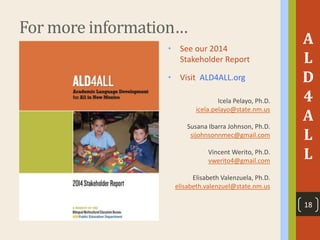
• See our 2014
Stakeholder Report
• Visit ALD4ALL.org
Icela Pelayo, Ph.D.
icela.pelayo@state.nm.us
Susana Ibarra Johnson, Ph.D.
sijohnsonnmec@gmail.com
Vincent Werito, Ph.D.
vwerito4@gmail.com
Elisabeth Valenzuela, Ph.D.
elisabeth.valenzuel@state.nm.us
A
L
D
4
A
L
L
18

ALD4ALL Team Presents at AERA 2015

  • 1.
    Academic Language Development forAll A Culturally and Linguistically Responsive Professional Learning Study Icela Pelayo, Ph.D. New Mexico Public Education Department Susana Ibarra Johnson, Ph.D. New Mexico Education Continuum Vincent Werito, Ph.D. University of New Mexico Elisabeth Valenzuela, Ph.D. New Mexico Public Education Department Supported by the W. K. Kellogg Foundation A L D 4 A L L
  • 2.
    2 New Mexico State-funded BMEPrograms • Models: Dual Language Immersion, Maintenance, Transitional, Heritage, and Enrichment • Languages: Diné (Navajo), Jicarilla (Apache), Keres, Spanish, Tewa, Tiwa, Towa, and Zuni 22 Indigenous Nations (Pueblos, Tribes) All: 338,000 CLD: 71% ELs: 16% BME: 17% ELs in BME 48% State BME Latino 204,244 60% 45,287 78% Native American 34,826 10% 8,507 15% Total 338,324 58,074 17% A L D 4 A L L Public School Populations
  • 3.
    ALD4ALL Purpose • AlignBMEB vision and mission to PED strategic plan • Connect CCSS 21st century skills and BMEPs • Strengthen and support New Mexico BMEPs for CLD students and ELs • What’s working well in NM bilingual education? • Identify best practices to inform professional learning • Use Culturally and Linguistically Responsive Approach A L D 4 A L L 3
  • 4.
    Theoretical Framework A L D 4 A L L Sociocultural Theory:Teaching and learning is socially-mediated and context-dependent (Vygotsky, 1978) • Culturally and Linguistically Responsive Pedagogy • Lucas, Villegas & Freedson-Gonzalez, 2008 • Villegas & Lucas, 2002 • ‘Funds of Knowledge’ • Gonzalez, Moll & Amanti, 2005 • Effective Bilingual Education Practices • Cadiero-Kaplan, 2004 • Generative Theory • Ball, 2009 4
  • 5.
    Study Questions A L D 4 A L L 1. Howdo effective BMEPs identify and conduct PL for educators of CLD and EL students? 2. How do educators in these BMEPs work with coaches and external facilitators to improve the effectiveness of their professional learning tasks and activities? 3. What are CLD and EL student outcomes that result from the instructional activities implemented in the classroom by participating educators? BMEP: Bilingual Multicultural Education Program CLD: Culturally and Linguistically Diverse EL: English Learner PL: Professional Learning 5
  • 6.
    Toward a GenerativityMindset A L D 4 A L L — Ball, 2009 Teacher Knowledge Connected to Student Knowledge Classroom Activities Facilitate Generative Thinking Pedagogical Problem- solving Enhanced by Application of New Knowledge 6
  • 7.
  • 8.
  • 9.
  • 10.
    Ojo Amarillo ElementarySchool A L D 4 A L L 10
  • 11.
    Ojo Amarillo ElementarySchool A L D 4 A L L 11
  • 12.
    Ojo Amarillo ElementarySchool A L D 4 A L L Bridge Navajo Literacy to Oral Language Development • Navajo Literacy Nights • Encourage parent involvement through literacy based cultural events • Culture-based experiential learning • Connect traditional Navajo knowledge (stories and language) to academic content knowledge • Emphasize Navajo holistic academic language and literacy orientation 12
  • 13.
    Re: Study Question1 A L D 4 A L L Identification of Need Areas • Students’ identified learning needs, based on data • Interview and focus group data • Teacher self-efficacy survey data • Classroom observation data, based on indicators of effective bilingual practices (Cadiero-Kaplan, 2004) • Holistic Academic Language and Literacy Orientation • School/Program-wide Instructional Planning • Student-Centered Value of Learners • Responsive BME Program Models • Development/implementation of action plans 13
  • 14.
    Re: Study Question2 A L D 4 A L L Collaboration with Facilitators • Tap prior experiential knowledge of all participants • Co-generate and co-construct learning experiences • Use data to make decisions • Exercise ownership of professional learning • Engage in critical reflection 14
  • 15.
    Re: Study Question3 A L D 4 A L L Connection of Student Outcomes to Professional Learning • Professional Learning influenced changes in teachers’ practices: • Implementation of uniform writing rubric used school-wide • Production of student-written play to be performed at NHCC • Development of school-district partnership to support community language revitalization goals • Increased teacher buy-in for applying new learning • Increased teacher efficacy 15
  • 16.
    Reflections • Shift inmindset about the professional learning process • Teachers are developing, implementing, and reflecting on their own professional learning; owning the process • The SEA supports locally-generated professional learning • Educator buy-in • Increased educator engagement, agency, efficacy • Sustainability • Affordability • Effectiveness A L D 4 A L L 16
  • 17.
    Implications • Descriptive casestudies to provide state guidance on effective implementation of BMEPs • ALD4ALL project connects to larger NMPED strategic initiatives and legitimates CLR Pedagogy • NMTEACH Educator Effectiveness System • Results for All: Culturally & Linguistically Responsive Instruction Conference • Paradigmatic shifts: changing practices around curriculum, instruction and assessment • From “English-only” to CLR pedagogy lens • From compensatory to equitable education for all students A L D 4 A L L 17
  • 18.
    For more information… •See our 2014 Stakeholder Report • Visit ALD4ALL.org Icela Pelayo, Ph.D. icela.pelayo@state.nm.us Susana Ibarra Johnson, Ph.D. sijohnsonnmec@gmail.com Vincent Werito, Ph.D. vwerito4@gmail.com Elisabeth Valenzuela, Ph.D. elisabeth.valenzuel@state.nm.us A L D 4 A L L 18

Editor's Notes

  • #2 Add ALD4ALL picture
  • #3 Either this slide #2 OR slide #3….which is better?
  • #5 This study is grounded in sociocultural theory, a social constructivist perspective of teaching and learning that recognizes that learning is not only an individual endeavor, but also socially mediated and context-dependent (Vygotsky, 1978) and recognizes that individuals possess valuable funds of knowledge (Gonzalez, Moll & Amanti, 2005). As a critical component of and to model a sociocultural approach to professional learning (PL), teacher coaching and on-going support are an integral component to PL (Walqui, 2011). Furthermore, this study used generative theory (Ball, 2009) to design and deliver educator training. A generative approach to PL builds on teachers’ ability to connect their own personal and professional knowledge with what they learn from their students to implement instruction that meets students’ educational needs (Ball, 2009).
  • #7 Generative Theory (Ball, 2009) The ALD4ALL project takes-up a generative theoretical approach to designing and delivering professional development. Generativity is the teachers’ ability to continually add to their understanding by connecting their personal and professional knowledge with the knowledge that they gain from their students to produce or originate knowledge that is useful to them in pedagogical problem solving and in meeting the educational needs of their students (Ball, 2009, p. 47). A generative approach to professional learning encourages teachers to connect their personal and professional knowledge with what they learn about their students to implement instruction that meets their students’ educational needs, interests, and inquiries (Ball, 2009).
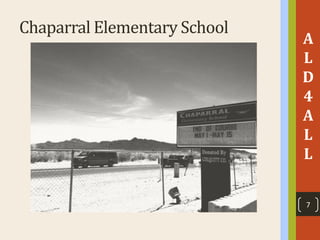
  • #8 School context. Chaparral Elementary School (CES) is nestled in between the Franklin Mountains and part of the sprawling Gadsden Independent School District (GISD) that embraces the border with both Texas and Mexico. At GISD, 96 percent of students are Hispano. CES is a predominantly Hispano school community that supports its student's bilingualism by implementing a 50/50 dual language bilingual education. In the last decade, the CES has seen an increase of teachers from the community returning to teach at the school they once attended, a districtwide trend observed GISD has experienced. CES teachers are taking up bilingual practices to promote bilingualism and biliteracy in their classrooms, yet also bring up the challenges of being a bilingual educator. CES's one-way dual language bilingual program values its students' knowledge of Spanish and English. This is evident in the school's balanced literacy approach where teachers gauge new students' abilities based on how they read, write, and comprehend in their strongest language―whether or not that language is English. Further, technology is a focal point at the school. All teachers are trained to use their dual technology boards which provide students with the opportunity to do math and build comprehension in literacy through digital learning in multiple languages. district that has five "A" schools and ten "B" schools. The teachers, students, and families strive to accomplish this goal together by valuing the community's rich linguistic and cultural diversity with strong bilingual approaches in literacy and language across the content areas. 1 CES earned an "A," as per the state's school grading accountability system1, in a school New Mexico's ESEA (2001 NCLB) flexibility request was granted in 2012 and was recently approved through the 2018-2019 school year. Since then, New Mexico has implemented an A-F School Grading accountability system, which uses a growth-to-standard model.  
  • #9 Generative Theory: The processes through which teachers and students develop voice, generativity, and efficacy in their thinking and practice (Ball, 2009, p. 66). Drawing from Generative theory and a Model of Generative Change; we developed a Generative professional learning Trajectory for the project. Phase 1 CLARITY: We began the inquiry-based project with classroom observations followed by focus group interviews with parents, students , teachers, and administrators. We listened to their needs, desires, interests, and inquiries about their school community. Their narratives and experiences from the inquiry data collection provided clarity informing the kind of professional learning action plan to develop. Phase 2 OWNERSHIP: The professional learning plans were developed with the educators involved. The project schools were introduced to the effective practices in bilingual multicultural education program models in New Mexico. These effective practices provided the project schools with a tool to self-examine their own instructional practices Phase 3 & Phase 4 ACTION: The professional learning was customized to each local context and instructional practices identified in each schools action plan. The ALD4ALL research team facilitated and differentiated each professional learning activity to provide a space for generative thinking about the areas of growth the school identified as needing support, in turn transforming their instructional practices to better meet the educational needs of their students. Each teacher self-selected a Lesson Plan of ACTION an ALD4ALL facilitator (Individual PD at each local sites). Phase 5 EFFICACY: Implementation of their lesson plan of action required teachers to combine theory, best practices, and student knowledge of diverse populations learned in the ALD4ALL professional learning. Each professional learning session entailed for pedagogical reflection, problem solving and new learnings to shared with the school community and beyond.
  • #10 Professional learning. In the fall 2014, CES attended two Academic Language   CES'saction plan had as an end goal to develop academic language, specifically writing, across the content area in order to promote academic success., the research team facilitated three professional learning sessions once a month from November 2014 to January 2015. The learning objectives for the book study PL were to: • Discuss ideas for implementing WIDA ELD and SLD standards and performance definitions to monitor students language development progress. • Explore and integrate ideas for differentiating writing according to students language needs using the WIDA language framework with the Teaching and Learning Cycle (Gibbons, 2009) (Phase 1: Building the Field, Phase 2: Modeling Genre, Phase 3: Joint Construction, Phase 4: Independent Writing) . • Develop and implement a writing lesson with supports and scaffolds engaging all students at various language, literacy and content knowledge and skill levels. After the three sessions of the book study PL, the teachers at CES learned and began to implement the following pedagogical practices: • Use the ELD and SLD language standards by identifying the overall strengths of students writing and other language modalities in which they need support by integrating listening, speaking, reading, and writing to learn content area. • Use the WIDA English and Spanish performance definitions which describe the English/Spanish language progression from 1-5 proficiency levels and provide details of skills for each level. • Document and monitor their students' academic writing progress using the WIDA English and Spanish performance definitions providing the teachers with empirical data to guide their decision making about writing. Due to the teachers and administration interest of the performance definitions in measuring and monitoring students academic language development, as a school, decided to use the performance definitions as a writing rubric to help them monitor their students' academic writing. • Plan and implement for instruction using the Common Core State Standards, Balance Literacy approach, and differentiating supports, by developing an individual/collective (grade level) plan of action to instruct students in writing. The CES book study PL provided the teachers with an opportunity for deep reflection about their teaching and learning practice. Reflection did not stop at the end of each book study session rather continued at each grade level collaboration. In the next section, we highlight how Sr. Carbajal enacted his plan of action for decision-making and development of resources. This transformation of his pedagogy happened because of his level of responsiveness towards his students learning needs and inquiries involving the development of self-assessment tools and model texts focused on writing in Spanish.
  • #11 Ojo Amarillo Elementary School is geographically located in the northwest part of New Mexico near Shiprock, New Mexico. The school is one of the seventeen schools that make up the Central Consolidated School District. It is located on between the Navajo Agricultural Products Industry (NAPI) Region 2 area and the long standing Navajo communities of Upper Fruitland and Nenahnazad, New Mexico. Since 2011-2012, Ojo Amarillo has established an upward trajectory from being a D school to becoming a B school and it has maintained this school grade of B for two academic school years now; 2012-2013 and 2013 -2014. The student population at Ojo Amarillo consists of mainly Navajo (American Indian/Native American) students. According to the district bilingual program office, the percentage of students at Ojo are 98% Navajo and 2% other. The other being non-Native children of the non-Native teachers who work at the school. There are approximately 155 students who were identified as ELLs in 2012-2013 out of a school population of 256 students.
  • #12 During the first classroom teacher observations of the Navajo language teacher, she was implementing some instructional strategies that were in line with the summative indicators for effective teaching practice in bilingual programs. For example, one important instructional strategy that was observed involved experiential learning and integrating different content areas like math, science, and social studies with Navajo culture based activities using the target language of Navajo. Specifically, in this example the teacher took her students outside and away from the school campus on a walk to find wild onions and carrots that are used traditionally by Navajos as a source of food often used in deer or mutton stews. According to the teacher, a culminating activity she does with her students involved showing them how other types of traditional Navajo foods were prepared. Navajo Literacy Nights: As part of the district’s attempts to increase parental involvement, several of the CCSD schools like Ojo Amarillo host family literacy nights to teach, share, and learn with and from parents about seasonal winter- culture based activities like storytelling and Navajo Mocassin (Shoe) Game.
  • #13 Professional Learning After the initial visits to the school in April 2014 and the ALD4ALL professional development meetings in August and September 2014, the teacher along with district leadership began to develop a district wide plan. The next step involved developing a customized individual action plan (IAP) with the teacher at the school to increase positive student outcomes. Afterwards, the facilitator and teacher selected a specific target area from the IAP which acknowledge and built upon the teacher previous knowledge to build or construct new learning. This process, based on the generative theory model, allowed for teacher collaboration with the facilitator as well as district leadership to identify important ‘targeted’ professional learning goals, objectives, and outcomes for the teacher as well as students. One area of focus that was stressed and emphasized was how to use and build upon Navajo literacy to increase oral language development using Guided Language Acquisition strategies, Total Physical Response, and other Second language acquisition approaches. These individual lesson/activity planning with the facilitator supported teachers’ culturally and linguistically responsive pedagogy that led to implementation of interdisciplinary academic language for their students.
  • #14 Indicators specific to schools profiled in paper
  • #19 Joseph, please add Stakeholder report picture and website or contact info for Icela -- You can tell the audience that they can download the Stakeholder Report online as well