Enzymatic Hydrolysis of Cellulose in NMMOBrett RobbinsMaster’s ThesisFAMU-FSU College of EngineeringDepartment of Chemical and Biomedical Engineering
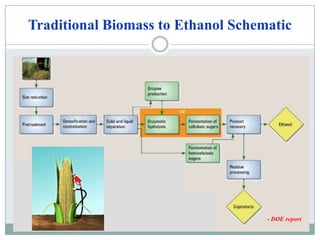
Traditional Biomass to Ethanol Schematic- DOE report
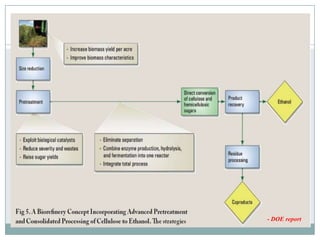
- DOE report
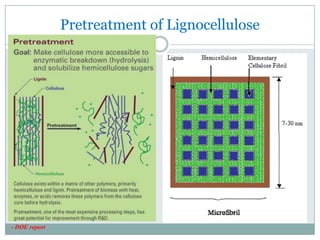
Pretreatment of Lignocellulose- DOE report
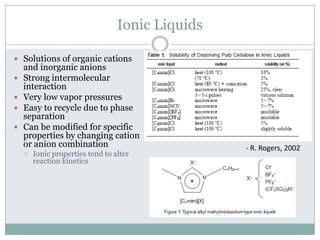
Ionic LiquidsSolutions of organic cations and inorganic anions
Strong intermolecular interaction
Very low vapor pressures
Easy to recycle due to phase separation
Can be modified for specific properties by changing cation or anion combination
Ionic properties tend to alter reaction kinetics- R. Rogers, 2002
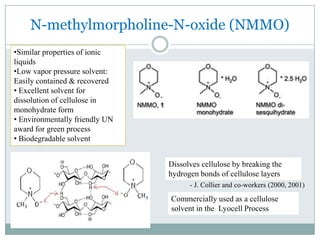
N-methylmorpholine-N-oxide (NMMO)Similar properties of ionic liquids
Low vapor pressure solvent: Easily contained & recovered
 Excellent solvent for dissolution of cellulose in monohydrate form
 Environmentally friendly UN award for green process
 Biodegradable solventDissolves cellulose by breaking the hydrogen bonds of cellulose layers- J. Collier and co-workers (2000, 2001)Commercially used as a cellulose solvent in the  Lyocell Process
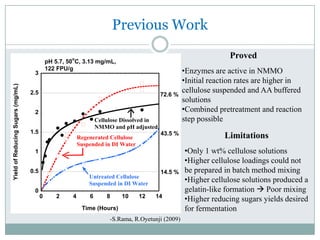
Previous WorkProvedEnzymes are active in NMMO
Initial reaction rates are higher in cellulose suspended and AA buffered solutions
Combined pretreatment and reaction step possible LimitationsOnly 1 wt% cellulose solutions
Higher cellulose loadings could not be prepared in batch method mixing
Higher cellulose solutions produced a gelatin-like formation  Poor mixing
Higher reducing sugars yields desired for fermentation-S.Rama, R.Oyetunji (2009)
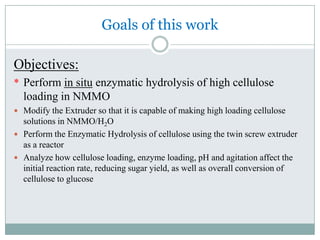
Goals of this workObjectives:*	Perform in situ enzymatic hydrolysis of high cellulose loading in NMMOModify the Extruder so that it is capable of making high loading cellulose solutions in NMMO/H2OPerform the Enzymatic Hydrolysis of cellulose using the twin screw extruder as a reactorAnalyze how cellulose loading, enzyme loading, pH and agitation affect the initial reaction rate, reducing sugar yield, as well as overall conversion of cellulose to glucose
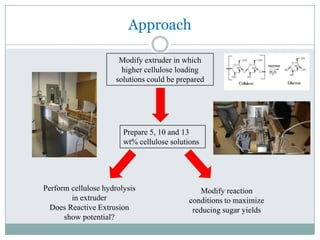
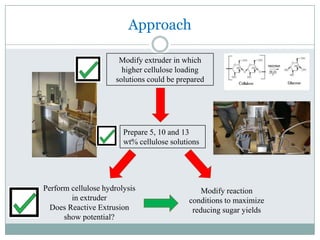
ApproachModify extruder in which higher cellulose loading solutions could be preparedPrepare 5, 10 and 13 wt% cellulose solutionsPerform cellulose hydrolysis in extruderDoes Reactive Extrusion show potential?Modify reaction conditions to maximize reducing sugar yields
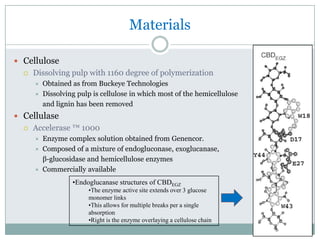
MaterialsCelluloseDissolving pulp with 1160 degree of polymerizationObtained as from Buckeye TechnologiesDissolving pulp is cellulose in which most of the hemicellulose	and lignin has been removedCellulaseAccelerase ™ 1000 Enzyme complex solution obtained from Genencor.  Composed of a mixture of endogluconase, exoglucanase, 	β-glucosidase and hemicellulose enzymesCommercially availableEndoglucanase structures of CBDEGZ
The enzyme active site extends over 3 glucose monomer links
This allows for multiple breaks per a single absorption
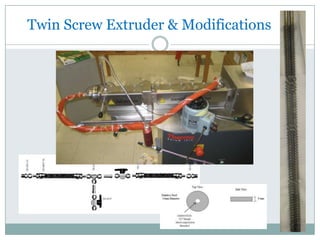
Right is the enzyme overlaying a cellulose chainTwin Screw Extruder & Modifications
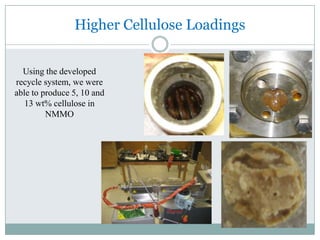
Higher Cellulose LoadingsUsing the developed recycle system, we were able to produce 5, 10 and 13 wt% cellulose in NMMO
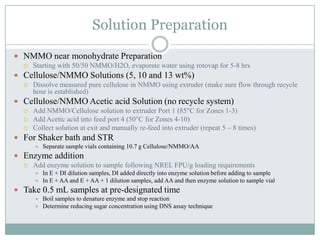
Solution PreparationNMMO near monohydrate PreparationStarting with 50/50 NMMO/H2O, evaporate water using rotovap for 5-8 hrsCellulose/NMMO Solutions (5, 10 and 13 wt%)Dissolve measured pure cellulose in NMMO using extruder (make sure flow through recycle hose is established)Cellulose/NMMO Acetic acid Solution (no recycle system)Add NMMO/Cellulose solution to extruder Port 1 (85C for Zones 1-3)Add Acetic acid into feed port 4 (50C for Zones 4-10)Collect solution at exit and manually re-feed into extruder (repeat 5 – 8 times)For Shaker bath and STRSeparate sample vials containing 10.7 g Cellulose/NMMO/AA Enzyme additionAdd enzyme solution to sample following NREL FPU/g loading requirementsIn E + DI dilution samples, DI added directly into enzyme solution before adding to sampleIn E + AA and E + AA + 1 dilution samples, add AA and then enzyme solution to sample vialTake 0.5 mL samples at pre-designated timeBoil samples to denature enzyme and stop reactionDetermine reducing sugar concentration using DNS assay technique
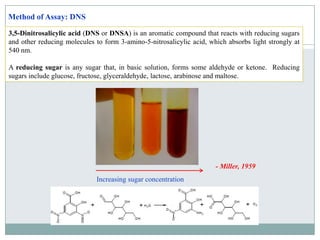
Method of Assay: DNS3,5-Dinitrosalicylic acid (DNS or DNSA) is an aromatic compound that reacts with reducing sugars and other reducing molecules to form 3-amino-5-nitrosalicylic acid, which absorbs light strongly at 540 nm.  A reducing sugar is any sugar that, in basic solution, forms some aldehydeor ketone.  Reducing sugars include glucose, fructose, glyceraldehyde, lactose, arabinose and maltose. - Miller, 1959Increasing sugar concentration
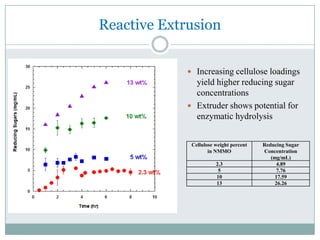
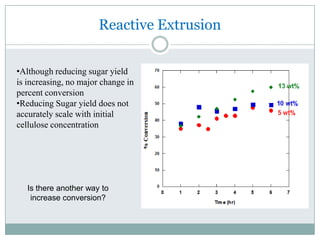
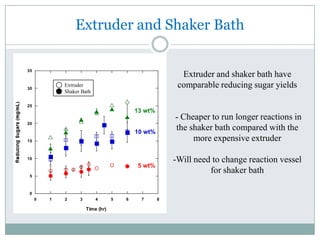
Reactive ExtrusionIncreasing cellulose loadings yield higher reducing sugar concentrationsExtruder shows potential for enzymatic hydrolysis
ApproachModify extruder in which higher cellulose loading solutions could be preparedPrepare 5, 10 and 13 wt% cellulose solutionsPerform cellulose hydrolysis in extruderDoes Reactive Extrusion show potential?Modify reaction conditions to maximize reducing sugar yields
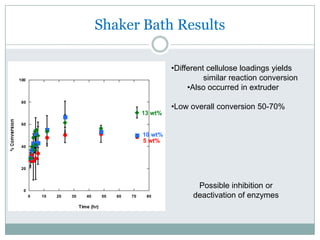
Reactive ExtrusionAlthough reducing sugar yield is increasing, no major change in percent conversion

Thesis Defense Presentation

  • 1.
    Enzymatic Hydrolysis ofCellulose in NMMOBrett RobbinsMaster’s ThesisFAMU-FSU College of EngineeringDepartment of Chemical and Biomedical Engineering
  • 2.
    Traditional Biomass toEthanol Schematic- DOE report
  • 3.
  • 4.
  • 5.
    Ionic LiquidsSolutions oforganic cations and inorganic anions
  • 6.
  • 7.
  • 8.
    Easy to recycledue to phase separation
  • 9.
    Can be modifiedfor specific properties by changing cation or anion combination
  • 10.
    Ionic properties tendto alter reaction kinetics- R. Rogers, 2002
  • 11.
  • 12.
    Low vapor pressuresolvent: Easily contained & recovered
  • 13.
    Excellent solventfor dissolution of cellulose in monohydrate form
  • 14.
    Environmentally friendlyUN award for green process
  • 15.
    Biodegradable solventDissolvescellulose by breaking the hydrogen bonds of cellulose layers- J. Collier and co-workers (2000, 2001)Commercially used as a cellulose solvent in the Lyocell Process
  • 16.
  • 17.
    Initial reaction ratesare higher in cellulose suspended and AA buffered solutions
  • 18.
    Combined pretreatment andreaction step possible LimitationsOnly 1 wt% cellulose solutions
  • 19.
    Higher cellulose loadingscould not be prepared in batch method mixing
  • 20.
    Higher cellulose solutionsproduced a gelatin-like formation  Poor mixing
  • 21.
    Higher reducing sugarsyields desired for fermentation-S.Rama, R.Oyetunji (2009)
  • 22.
    Goals of thisworkObjectives:* Perform in situ enzymatic hydrolysis of high cellulose loading in NMMOModify the Extruder so that it is capable of making high loading cellulose solutions in NMMO/H2OPerform the Enzymatic Hydrolysis of cellulose using the twin screw extruder as a reactorAnalyze how cellulose loading, enzyme loading, pH and agitation affect the initial reaction rate, reducing sugar yield, as well as overall conversion of cellulose to glucose
  • 23.
    ApproachModify extruder inwhich higher cellulose loading solutions could be preparedPrepare 5, 10 and 13 wt% cellulose solutionsPerform cellulose hydrolysis in extruderDoes Reactive Extrusion show potential?Modify reaction conditions to maximize reducing sugar yields
  • 24.
    MaterialsCelluloseDissolving pulp with1160 degree of polymerizationObtained as from Buckeye TechnologiesDissolving pulp is cellulose in which most of the hemicellulose and lignin has been removedCellulaseAccelerase ™ 1000 Enzyme complex solution obtained from Genencor. Composed of a mixture of endogluconase, exoglucanase, β-glucosidase and hemicellulose enzymesCommercially availableEndoglucanase structures of CBDEGZ
  • 25.
    The enzyme activesite extends over 3 glucose monomer links
  • 26.
    This allows formultiple breaks per a single absorption
  • 27.
    Right is theenzyme overlaying a cellulose chainTwin Screw Extruder & Modifications
  • 28.
    Higher Cellulose LoadingsUsingthe developed recycle system, we were able to produce 5, 10 and 13 wt% cellulose in NMMO
  • 29.
    Solution PreparationNMMO nearmonohydrate PreparationStarting with 50/50 NMMO/H2O, evaporate water using rotovap for 5-8 hrsCellulose/NMMO Solutions (5, 10 and 13 wt%)Dissolve measured pure cellulose in NMMO using extruder (make sure flow through recycle hose is established)Cellulose/NMMO Acetic acid Solution (no recycle system)Add NMMO/Cellulose solution to extruder Port 1 (85C for Zones 1-3)Add Acetic acid into feed port 4 (50C for Zones 4-10)Collect solution at exit and manually re-feed into extruder (repeat 5 – 8 times)For Shaker bath and STRSeparate sample vials containing 10.7 g Cellulose/NMMO/AA Enzyme additionAdd enzyme solution to sample following NREL FPU/g loading requirementsIn E + DI dilution samples, DI added directly into enzyme solution before adding to sampleIn E + AA and E + AA + 1 dilution samples, add AA and then enzyme solution to sample vialTake 0.5 mL samples at pre-designated timeBoil samples to denature enzyme and stop reactionDetermine reducing sugar concentration using DNS assay technique
  • 30.
    Method of Assay:DNS3,5-Dinitrosalicylic acid (DNS or DNSA) is an aromatic compound that reacts with reducing sugars and other reducing molecules to form 3-amino-5-nitrosalicylic acid, which absorbs light strongly at 540 nm. A reducing sugar is any sugar that, in basic solution, forms some aldehydeor ketone. Reducing sugars include glucose, fructose, glyceraldehyde, lactose, arabinose and maltose. - Miller, 1959Increasing sugar concentration
  • 31.
    Reactive ExtrusionIncreasing celluloseloadings yield higher reducing sugar concentrationsExtruder shows potential for enzymatic hydrolysis
  • 32.
    ApproachModify extruder inwhich higher cellulose loading solutions could be preparedPrepare 5, 10 and 13 wt% cellulose solutionsPerform cellulose hydrolysis in extruderDoes Reactive Extrusion show potential?Modify reaction conditions to maximize reducing sugar yields
  • 33.
    Reactive ExtrusionAlthough reducingsugar yield is increasing, no major change in percent conversion

Editor's Notes

  • #15 The first step is to develop an assay to see if sugars are released. Started of by miller in 1959.