Application for booking
Indian Railways
Circular Journey Ticket
by Dhyan Suman
Methodology		 			
Understanding Circular Journey Ticket
Travellers
Design goal
Initial Concepts
Final Concept
In this document we will cover
ETHODOLOGYM
The first task for any project is to start with the research.
Firstly the secondary research/literature review; study
what are the existing project, literature to understand
the system and users. Secondly Primary research;
directly talking to end users. This is an important phase
in project lifecycle, which establishes a direction to the
project.
Looking at the time frame and duration for this
project, for research the focus would mainly be on the
information gathered from secondary sources. If time
allows, a quick talk with the railway officers would be
managed.
Next phase is to search out the needs and opportunities
of the targeted users, understanding user’s mind-sets
through mind maps, their activities related to ticket
booking and use-cases which would help, in next step;
brainstorming and conceptualization.
The next step was to generate concepts based on
the Design goal. Coming out with lots of rough ideas
to funnel down potentially promising concepts. After
finalizing the concept, quick wireframes and then the
final visual look and feel.
Methodology
NDERSTANDING CIRCULAR
JOURNEY TICKET
U
What is Circular Journey Ticket?
I went through the Indian railways site and few online
forums also to understand the concept of Circular
Journey Ticket (CJT). I went to the Divisional Commercial
Manager and Chief Booking manager to get a better
understanding about CJT.
In simple words in CJT
- The travel route is in circular fashion.
- The traveller do not travel from any station again
- The traveller finishes the journey at the same station
from where he started.
- Indian railways have some fixed routes and travellers
are free to design their own routes too.
Understanding CJT
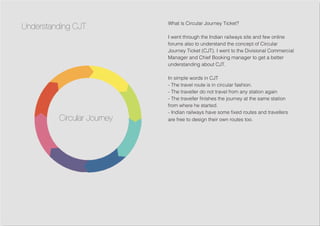
Circular Journey
circular map
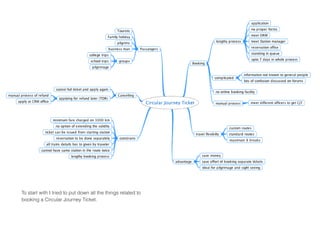
To start with I tried to put down all the things related to
booking a Circular Journey Ticket.
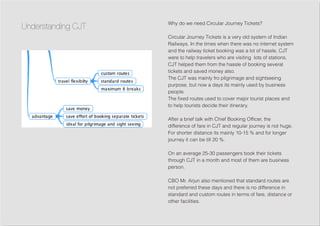
Why do we need Circular Journey Tickets?
Circular Journey Tickets is a very old system of Indian
Railways. In the times when there was no internet system
and the railway ticket booking was a lot of hassle, CJT
were to help travelers who are visiting lots of stations.
CJT helped them from the hassle of booking several
tickets and saved money also.
The CJT was mainly fro pilgrimage and sightseeing
purpose, but now a days its mainly used by business
people.
The fixed routes used to cover major tourist places and
to help tourists decide their itinerary.
After a brief talk with Chief Booking Officer, the
difference of fare in CJT and regular journey is not huge.
For shorter distance its mainly 10-15 % and for longer
journey it can be till 20 %.
On an average 25-30 passengers book their tickets
through CJT in a month and most of them are business
person.
CBO Mr. Arjun also mentioned that standard routes are
not preferred these days and there is no difference in
standard and custom routes in terms of fare, distance or
other facilities.
Understanding CJT
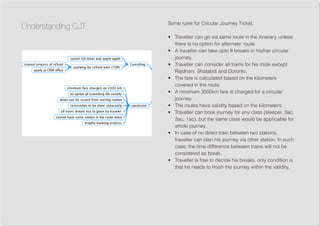
Some rules for Circular Journey Ticket.
•	 Traveller can go via same route in the itinerary, unless
there is no option for alternate route.
•	 A traveller can take upto 8 breaks in his/her circular
journey.
•	 Traveller can consider all trains for his route except
Rajdhani, Shatabdi and Doronto.
•	 The fare is calculated based on the kilometers
covered in the route.
•	 A minimum 3000km fare is charged for a circular
journey.
•	 The routes have validity based on the kilometers.
•	 Traveller can book journey for any class (sleeper, 3ac,
2ac, 1ac), but the same class would be applicable for
whole journey.
•	 In case of no direct train between two stations,
traveller can plan his journey via other station. In such
case, the time difference between trains will not be
considered as break.
•	 Traveller is free to decide his breaks, only condition is
that he needs to finish the journey within the validity.
Understanding CJT
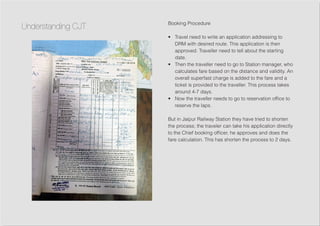
Booking Procedure
•	 Travel need to write an application addressing to
DRM with desired route. This application is then
approved. Traveller need to tell about the starting
date.
•	 Then the traveller need to go to Station manager, who
calculates fare based on the distance and validity. An
overall superfast charge is added to the fare and a
ticket is provided to the traveller. This process takes
around 4-7 days.
•	 Now the traveller needs to go to reservation office to
reserve the laps.
But in Jaipur Railway Station they have tried to shorten
the process; the traveler can take his application directly
to the Chief booking officer, he approves and does the
fare calculation. This has shorten the process to 2 days.
Understanding CJT
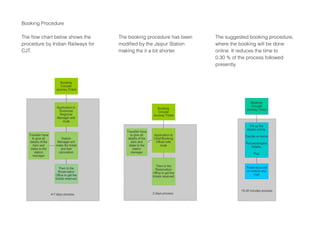
Booking Procedure
The flow chart below shows the
procedure by Indian Railways for
CJT.
The booking procedure has been
modified by the Jaipur Station
making the it a bit shorter.
The suggested booking procedure,
where the booking will be done
online. It reduces the time to
0.30 % of the process followed
presently.
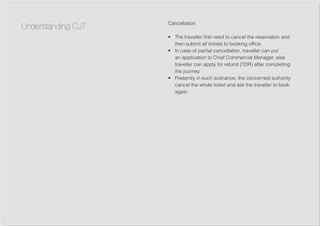
Cancellation
•	 The traveller first need to cancel the reservation and
then submit all tickets to booking office.
•	 In case of partial cancellation, traveller can put
an application to Chief Commercial Manager, else
traveller can apply for refund (TDR) after completing
the journey.
•	 Presently in such scenarios, the concerned authority
cancel the whole ticket and ask the traveller to book
again.
Understanding CJT
RAVELLERST
Users
Users
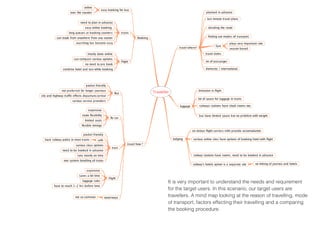
It is very important to understand the needs and requirement
for the target users. In this scenario, our target users are
travellers. A mind map looking at the reason of travelling, mode
of transport, factors effecting their travelling and a comparing
the booking procedure.
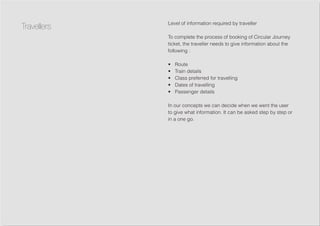
Level of information required by traveller
To complete the process of booking of Circular Journey
ticket, the traveller needs to give information about the
following :
•	 Route
•	 Train details
•	 Class preferred for travelling
•	 Dates of travelling
•	 Passenger details
In our concepts we can decide when we went the user
to give what information. It can be asked step by step or
in a one go.
Travellers
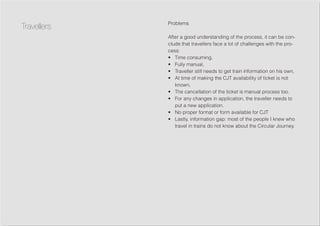
Problems
After a good understanding of the process, it can be con-
clude that travellers face a lot of challenges with the pro-
cess:
•	 Time consuming,
•	 Fully manual,
•	 Traveller still needs to get train information on his own,
•	 At time of making the CJT availability of ticket is not
known,
•	 The cancellation of the ticket is manual process too.
•	 For any changes in application, the traveller needs to
put a new application.
•	 No proper format or form available for CJT
•	 Lastly, information gap: most of the people I knew who
travel in trains do not know about the Circular Journey.
Travellers
ESIGN GOALD
Based on the research and analysis of process, the aim
will be to design an application for booking Circular Jour-
ney Tickets online that
•	 Help travellers book CJT without hassle.
•	 Intuitive and easy to understand process.
•	 Promoting Circular Journey among travellers.
Design Goal
NITIAL CONCEPTSI
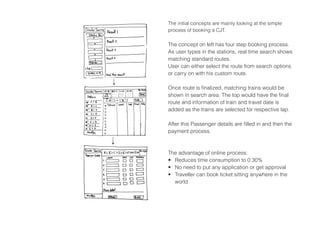
The initial concepts are mainly looking at the simple
process of booking a CJT.
The concept on left has four step booking process.
As user types in the stations, real time search shows
matching standard routes.
User can either select the route from search options
or carry on with his custom route.
Once route is finalized, matching trains would be
shown in search area. The top would have the final
route and information of train and travel date is
added as the trains are selected for respective lap.
After this Passenger details are filled in and then the
payment process.
The advantage of online process:
•	 Reduces time consumption to 0.30%
•	 No need to put any application or get approval
•	 Traveller can book ticket sitting anywhere in the
world.
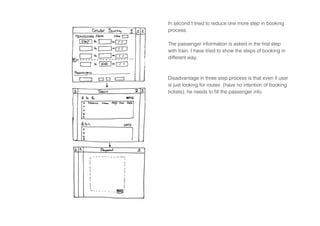
In second I tried to reduce one more step in booking
process.
The passenger information is asked in the first step
with train. I have tried to show the steps of booking in
different way.
Disadvantage in three step process is that even if user
is just looking for routes (have no intention of booking
tickets), he needs to fill the passenger info.
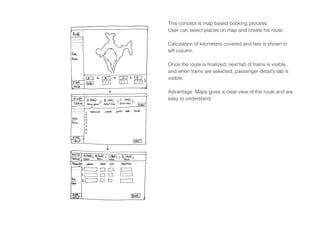
This concept is map based booking process.
User can select places on map and create his route.
Calculation of kilometers covered and fare is shown in
left column.
Once the route is finalized, next tab of trains is visible,
and when trains are selected, passenger detail’s tab is
visible.
Advantage: Maps gives a clear view of the route and are
easy to understand.
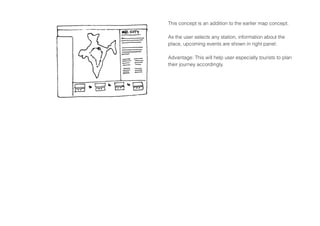
This concept is an addition to the earlier map concept.
As the user selects any station, information about the
place, upcoming events are shown in right panel.
Advantage: This will help user especially tourists to plan
their journey accordingly.
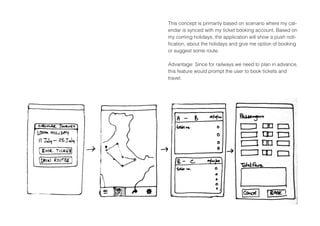
This concept is primarily based on scenario where my cal-
endar is synced with my ticket booking account. Based on
my coming holidays, the application will show a push noti-
fication, about the holidays and give me option of booking
or suggest some route.
Advantage: Since for railways we need to plan in advance,
this feature would prompt the user to book tickets and
travel.
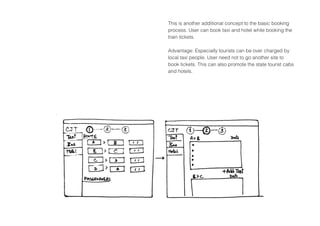
This is another additional concept to the basic booking
process. User can book taxi and hotel while booking the
train tickets.
Advantage: Especially tourists can be over charged by
local taxi people. User need not to go another site to
book tickets. This can also promote the state tourist cabs
and hotels.
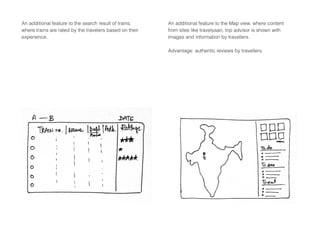
An additional feature to the Map view, where content
from sites like travelyaari, trip advisor is shown with
images and information by travellers.
Advantage: authentic reviews by travellers.
An additional feature to the search result of trains,
where trains are rated by the travelers based on their
experience.
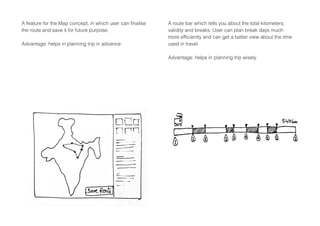
A route bar which tells you about the total kilometers,
validity and breaks. User can plan break days much
more efficiently and can get a better view about the time
used in travel.
Advantage: helps in planning trip wisely.
A feature for the Map concept, in which user can finalise
the route and save it for future purpose.
Advantage: helps in planning trip in advance.
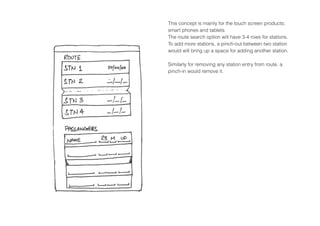
This concept is mainly for the touch screen products;
smart phones and tablets.
The route search option will have 3-4 rows for stations.
To add more stations, a pinch-out between two station
would will bring up a space for adding another station.
Similarly for removing any station entry from route, a
pinch-in would remove it.
INAL DESIGNF
The Final concept consist of flow of booking a CJT. It has
been designed for the web experience. With the basic
booking procedure, various features have been added
to it.
I have tried to give the site a cleaner, flat and less
cluttered look.
Here I have assumed that CJT would be part of the
regular booking site for railway tickets. I felt that there
was no need of introducing a new application just for
CJT. It is a part of railway system, so it would be ideal
that booking a CJT should be as easy as booking a
regular ticket.
Another assumption is that since standard and custom
routes have no difference as per fare or other facilities.
These standard routes were introduced long ago when
there was no internet facility. In today’s scenario, I do
not see need to confusing user by saying standard and
custom routes.
Final concept and visuals
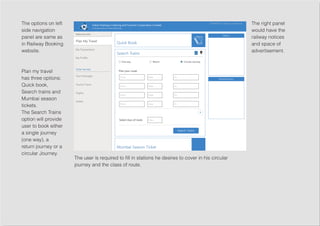
The options on left
side navigation
panel are same as
in Railway Booking
website.
Plan my travel
has three options;
Quick book,
Search trains and
Mumbai season
tickets.
The Search Trains
option will provide
user to book either
a single journey
(one way), a
return journey or a
circular Journey.
The right panel
would have the
railway notices
and space of
advertisement.
The user is required to fill in stations he desires to cover in his circular
journey and the class of route.
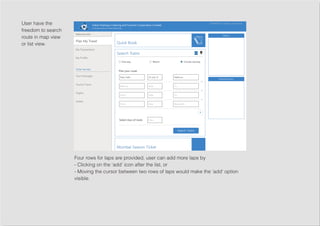
User have the
freedom to search
route in map view
or list view.
Four rows for laps are provided, user can add more laps by
- Clicking on the ‘add’ icon after the list, or
- Moving the cursor between two rows of laps would make the ‘add’ option
visible.
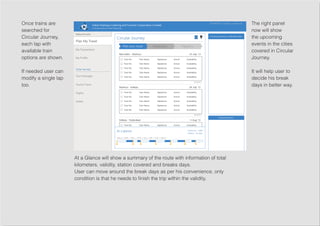
Once trains are
searched for
Circular Journey,
each lap with
available train
options are shown.
If needed user can
modify a single lap
too.
The right panel
now will show
the upcoming
events in the cities
covered in Circular
Journey.
It will help user to
decide his break
days in better way.
At a Glance will show a summary of the route with information of total
kilometers, validity, station covered and breaks days.
User can move around the break days as per his convenience, only
condition is that he needs to finish the trip within the validity.
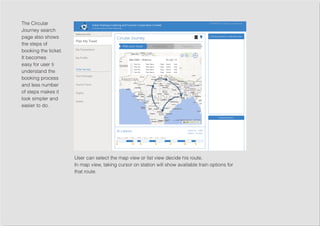
The Circular
Journey search
page also shows
the steps of
booking the ticket.
It becomes
easy for user ti
understand the
booking process
and less number
of steps makes it
look simpler and
easier to do.
User can select the map view or list view decide his route.
In map view, taking cursor on station will show available train options for
that route.
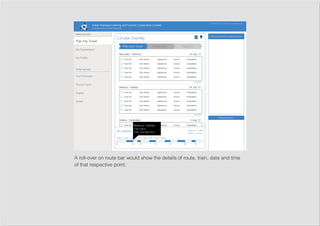
A roll-over on route bar would show the details of route, train, date and time
of that respective point.
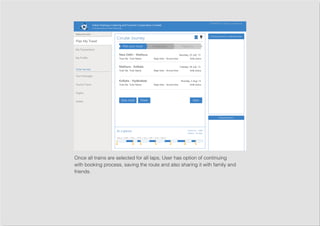
Once all trains are selected for all laps, User has option of continuing
with booking process, saving the route and also sharing it with family and
friends.
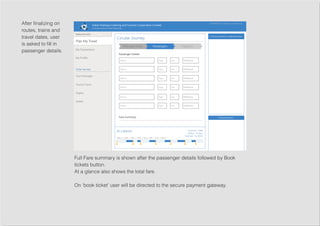
After finalizing on
routes, trains and
travel dates, user
is asked to fill in
passenger details.
Full Fare summary is shown after the passenger details followed by Book
tickets button.
At a glance also shows the total fare.
On ‘book ticket’ user will be directed to the secure payment gateway.
This exercise was very challenging and informative. I,
my family and friends have been using Indian railways
but never knew about such service.
It had been an amazing test, I thoroughly enjoyed
doing it. The solution is still at a initial level, it can be
detailed out more. Lots of other issues related to CJT like
cancellation, partial cancellation, refund process and
booking via journey are yet to be covered.
ONCLUSIONC

Circular Journey Ticket

  • 1.
    Application for booking IndianRailways Circular Journey Ticket by Dhyan Suman
  • 2.
    Methodology Understanding CircularJourney Ticket Travellers Design goal Initial Concepts Final Concept In this document we will cover
  • 3.
  • 4.
    The first taskfor any project is to start with the research. Firstly the secondary research/literature review; study what are the existing project, literature to understand the system and users. Secondly Primary research; directly talking to end users. This is an important phase in project lifecycle, which establishes a direction to the project. Looking at the time frame and duration for this project, for research the focus would mainly be on the information gathered from secondary sources. If time allows, a quick talk with the railway officers would be managed. Next phase is to search out the needs and opportunities of the targeted users, understanding user’s mind-sets through mind maps, their activities related to ticket booking and use-cases which would help, in next step; brainstorming and conceptualization. The next step was to generate concepts based on the Design goal. Coming out with lots of rough ideas to funnel down potentially promising concepts. After finalizing the concept, quick wireframes and then the final visual look and feel. Methodology
  • 5.
  • 6.
    What is CircularJourney Ticket? I went through the Indian railways site and few online forums also to understand the concept of Circular Journey Ticket (CJT). I went to the Divisional Commercial Manager and Chief Booking manager to get a better understanding about CJT. In simple words in CJT - The travel route is in circular fashion. - The traveller do not travel from any station again - The traveller finishes the journey at the same station from where he started. - Indian railways have some fixed routes and travellers are free to design their own routes too. Understanding CJT Circular Journey
  • 7.
    circular map To startwith I tried to put down all the things related to booking a Circular Journey Ticket.
  • 8.
    Why do weneed Circular Journey Tickets? Circular Journey Tickets is a very old system of Indian Railways. In the times when there was no internet system and the railway ticket booking was a lot of hassle, CJT were to help travelers who are visiting lots of stations. CJT helped them from the hassle of booking several tickets and saved money also. The CJT was mainly fro pilgrimage and sightseeing purpose, but now a days its mainly used by business people. The fixed routes used to cover major tourist places and to help tourists decide their itinerary. After a brief talk with Chief Booking Officer, the difference of fare in CJT and regular journey is not huge. For shorter distance its mainly 10-15 % and for longer journey it can be till 20 %. On an average 25-30 passengers book their tickets through CJT in a month and most of them are business person. CBO Mr. Arjun also mentioned that standard routes are not preferred these days and there is no difference in standard and custom routes in terms of fare, distance or other facilities. Understanding CJT
  • 9.
    Some rules forCircular Journey Ticket. • Traveller can go via same route in the itinerary, unless there is no option for alternate route. • A traveller can take upto 8 breaks in his/her circular journey. • Traveller can consider all trains for his route except Rajdhani, Shatabdi and Doronto. • The fare is calculated based on the kilometers covered in the route. • A minimum 3000km fare is charged for a circular journey. • The routes have validity based on the kilometers. • Traveller can book journey for any class (sleeper, 3ac, 2ac, 1ac), but the same class would be applicable for whole journey. • In case of no direct train between two stations, traveller can plan his journey via other station. In such case, the time difference between trains will not be considered as break. • Traveller is free to decide his breaks, only condition is that he needs to finish the journey within the validity. Understanding CJT
  • 10.
    Booking Procedure • Travelneed to write an application addressing to DRM with desired route. This application is then approved. Traveller need to tell about the starting date. • Then the traveller need to go to Station manager, who calculates fare based on the distance and validity. An overall superfast charge is added to the fare and a ticket is provided to the traveller. This process takes around 4-7 days. • Now the traveller needs to go to reservation office to reserve the laps. But in Jaipur Railway Station they have tried to shorten the process; the traveler can take his application directly to the Chief booking officer, he approves and does the fare calculation. This has shorten the process to 2 days. Understanding CJT
  • 11.
    Booking Procedure The flowchart below shows the procedure by Indian Railways for CJT. The booking procedure has been modified by the Jaipur Station making the it a bit shorter. The suggested booking procedure, where the booking will be done online. It reduces the time to 0.30 % of the process followed presently.
  • 12.
    Cancellation • The travellerfirst need to cancel the reservation and then submit all tickets to booking office. • In case of partial cancellation, traveller can put an application to Chief Commercial Manager, else traveller can apply for refund (TDR) after completing the journey. • Presently in such scenarios, the concerned authority cancel the whole ticket and ask the traveller to book again. Understanding CJT
  • 13.
  • 14.
    Users Users It is veryimportant to understand the needs and requirement for the target users. In this scenario, our target users are travellers. A mind map looking at the reason of travelling, mode of transport, factors effecting their travelling and a comparing the booking procedure.
  • 15.
    Level of informationrequired by traveller To complete the process of booking of Circular Journey ticket, the traveller needs to give information about the following : • Route • Train details • Class preferred for travelling • Dates of travelling • Passenger details In our concepts we can decide when we went the user to give what information. It can be asked step by step or in a one go. Travellers
  • 16.
    Problems After a goodunderstanding of the process, it can be con- clude that travellers face a lot of challenges with the pro- cess: • Time consuming, • Fully manual, • Traveller still needs to get train information on his own, • At time of making the CJT availability of ticket is not known, • The cancellation of the ticket is manual process too. • For any changes in application, the traveller needs to put a new application. • No proper format or form available for CJT • Lastly, information gap: most of the people I knew who travel in trains do not know about the Circular Journey. Travellers
  • 17.
  • 18.
    Based on theresearch and analysis of process, the aim will be to design an application for booking Circular Jour- ney Tickets online that • Help travellers book CJT without hassle. • Intuitive and easy to understand process. • Promoting Circular Journey among travellers. Design Goal
  • 19.
  • 20.
    The initial conceptsare mainly looking at the simple process of booking a CJT. The concept on left has four step booking process. As user types in the stations, real time search shows matching standard routes. User can either select the route from search options or carry on with his custom route. Once route is finalized, matching trains would be shown in search area. The top would have the final route and information of train and travel date is added as the trains are selected for respective lap. After this Passenger details are filled in and then the payment process. The advantage of online process: • Reduces time consumption to 0.30% • No need to put any application or get approval • Traveller can book ticket sitting anywhere in the world.
  • 21.
    In second Itried to reduce one more step in booking process. The passenger information is asked in the first step with train. I have tried to show the steps of booking in different way. Disadvantage in three step process is that even if user is just looking for routes (have no intention of booking tickets), he needs to fill the passenger info.
  • 22.
    This concept ismap based booking process. User can select places on map and create his route. Calculation of kilometers covered and fare is shown in left column. Once the route is finalized, next tab of trains is visible, and when trains are selected, passenger detail’s tab is visible. Advantage: Maps gives a clear view of the route and are easy to understand.
  • 23.
    This concept isan addition to the earlier map concept. As the user selects any station, information about the place, upcoming events are shown in right panel. Advantage: This will help user especially tourists to plan their journey accordingly.
  • 24.
    This concept isprimarily based on scenario where my cal- endar is synced with my ticket booking account. Based on my coming holidays, the application will show a push noti- fication, about the holidays and give me option of booking or suggest some route. Advantage: Since for railways we need to plan in advance, this feature would prompt the user to book tickets and travel.
  • 25.
    This is anotheradditional concept to the basic booking process. User can book taxi and hotel while booking the train tickets. Advantage: Especially tourists can be over charged by local taxi people. User need not to go another site to book tickets. This can also promote the state tourist cabs and hotels.
  • 26.
    An additional featureto the Map view, where content from sites like travelyaari, trip advisor is shown with images and information by travellers. Advantage: authentic reviews by travellers. An additional feature to the search result of trains, where trains are rated by the travelers based on their experience.
  • 27.
    A route barwhich tells you about the total kilometers, validity and breaks. User can plan break days much more efficiently and can get a better view about the time used in travel. Advantage: helps in planning trip wisely. A feature for the Map concept, in which user can finalise the route and save it for future purpose. Advantage: helps in planning trip in advance.
  • 28.
    This concept ismainly for the touch screen products; smart phones and tablets. The route search option will have 3-4 rows for stations. To add more stations, a pinch-out between two station would will bring up a space for adding another station. Similarly for removing any station entry from route, a pinch-in would remove it.
  • 29.
  • 30.
    The Final conceptconsist of flow of booking a CJT. It has been designed for the web experience. With the basic booking procedure, various features have been added to it. I have tried to give the site a cleaner, flat and less cluttered look. Here I have assumed that CJT would be part of the regular booking site for railway tickets. I felt that there was no need of introducing a new application just for CJT. It is a part of railway system, so it would be ideal that booking a CJT should be as easy as booking a regular ticket. Another assumption is that since standard and custom routes have no difference as per fare or other facilities. These standard routes were introduced long ago when there was no internet facility. In today’s scenario, I do not see need to confusing user by saying standard and custom routes. Final concept and visuals
  • 31.
    The options onleft side navigation panel are same as in Railway Booking website. Plan my travel has three options; Quick book, Search trains and Mumbai season tickets. The Search Trains option will provide user to book either a single journey (one way), a return journey or a circular Journey. The right panel would have the railway notices and space of advertisement. The user is required to fill in stations he desires to cover in his circular journey and the class of route.
  • 32.
    User have the freedomto search route in map view or list view. Four rows for laps are provided, user can add more laps by - Clicking on the ‘add’ icon after the list, or - Moving the cursor between two rows of laps would make the ‘add’ option visible.
  • 33.
    Once trains are searchedfor Circular Journey, each lap with available train options are shown. If needed user can modify a single lap too. The right panel now will show the upcoming events in the cities covered in Circular Journey. It will help user to decide his break days in better way. At a Glance will show a summary of the route with information of total kilometers, validity, station covered and breaks days. User can move around the break days as per his convenience, only condition is that he needs to finish the trip within the validity.
  • 34.
    The Circular Journey search pagealso shows the steps of booking the ticket. It becomes easy for user ti understand the booking process and less number of steps makes it look simpler and easier to do. User can select the map view or list view decide his route. In map view, taking cursor on station will show available train options for that route.
  • 35.
    A roll-over onroute bar would show the details of route, train, date and time of that respective point.
  • 36.
    Once all trainsare selected for all laps, User has option of continuing with booking process, saving the route and also sharing it with family and friends.
  • 37.
    After finalizing on routes,trains and travel dates, user is asked to fill in passenger details. Full Fare summary is shown after the passenger details followed by Book tickets button. At a glance also shows the total fare. On ‘book ticket’ user will be directed to the secure payment gateway.
  • 38.
    This exercise wasvery challenging and informative. I, my family and friends have been using Indian railways but never knew about such service. It had been an amazing test, I thoroughly enjoyed doing it. The solution is still at a initial level, it can be detailed out more. Lots of other issues related to CJT like cancellation, partial cancellation, refund process and booking via journey are yet to be covered. ONCLUSIONC