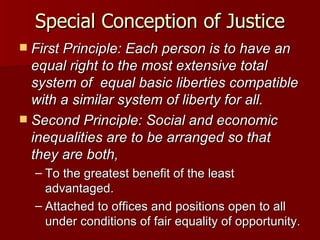
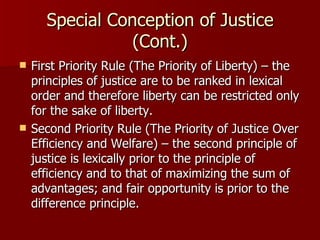
Rawlsian contract theory attempts to reconcile utilitarianism and intuitionism through a theory of distributive justice. Rawls proposes an "original position" behind a "veil of ignorance" where individuals would choose principles of justice not knowing their place in society. He argues they would choose two principles: 1) Equal basic liberties for all and 2) Social and economic inequalities must benefit the least advantaged and arise from fair equality of opportunity.