“BISPHOSPHONATES”
Under the esteemed guidance of ;-
Prof. Dr. SUHAIL MAJID JAN
(HOD / Guide)
Dr. ROOBAL BEHAL
(Associate Prof & Co-Guide)
Presented By:-
MOHAMMAD IMRAN BHATT
PG (2nd Year)
‘’POST GRADUATE DEPARTMENT OF PERIODONTICS ANDORAL
IMPLANTOLOGY’’
CONTENTS
• INTRODUCTION
• HISTORY
• STRUCTURE OF BISPHOSPHONATES
• INDICATIONS
• BIOAVAILABILITY, PHARMACOKINETICS
• HOW TO TAKE BISPHOSHONATES
• CLASSIFICATION
• MECHANISM OF ACTION
• ROLE IN PERIODONTAL THERAPY
• SIDE EFFECTS
• BRONJ
• DENTAL MANAGEMENT OF PATIENTS RECEIVING ORAL
BISPHOSPHONATE THERAPY
• REFERENCES
HISTORY
• Designed as synthetic ( Non-biodegradable)analogues of
pyrophosphate.
• Initially used in industry as water softening agents in
irrigation systems in the earlier 1920s. After that the medical
use of the bisphosphonates came into existence.
• Etidronate, first bisphosphonate for medical use.

• In 1969, bisphosphonates discovered as bone loss inhibitors.
• Initial launch of Fosamax (alendronate) by Merck & Co.
( 1990)
• blocks precipitation of calcium phosphate in
plasma, urine, and soft tissues.
• commonly used as an anti-tartar agent in
toothpaste.
STRUCTU
RE
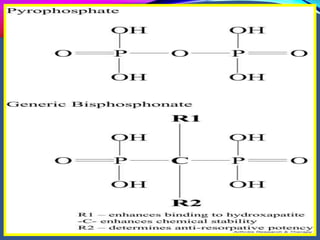
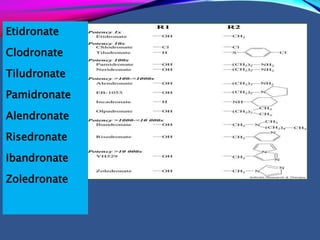
The long side-chain (R2 in the diagram)
determines the chemical properties, the
mode of action and the strength of
bisphosphonate drugs. The short side-
chain (R1), often called the 'hook', mainly
influences chemical properties and
pharmacokinetics.
Etidronate
Clodronate
Tiludronate
Pamidronate
Alendronate
Risedronate
Ibandronate
Zoledronate
INDICATIONS
FDA APPROVED
INDICATIONS
• 1. Osteoporosis
• 2. Paget’s disease
• 3. Malignant hypercalcemia
• 4. Bone metastasis
• 5. Multiple myeloma,
• 6. Primary hyperparathyroidism,
• 7. Osteogenesis imperfecta and
• 8. Carcinoma of breast.
Their use also has been proposed in the management
of periodontal diseases,
Bisphosphonates inhibit the osteoclastic bone
resorption & hence are used as a host modulating
factor for prevention of bone loss.
(Parfitt AM. Journal of Cell Biochemistry 1994;
55(3):273–286.)
Treatment concept that aims to reduce tissue
destruction and stabilize or even regenerate the
periodontium by modifying or downregulating
destructive aspects of host response and
upregulating protective or regenerative
responses. (CARRANZA)
.
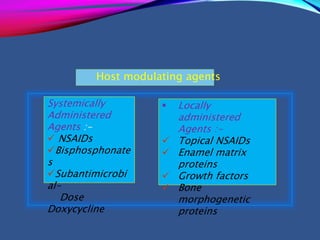
Systemically
Administered
Agents :-
 NSAIDs
Bisphosphonate
s
Subantimicrobi
al-
Dose
Doxycycline
 Locally
administered
Agents :-
 Topical NSAIDs
 Enamel matrix
proteins
 Growth factors
 Bone
morphogenetic
proteins
Host modulating agents
Bisphosphonates also
possess anti-collagenase
properties
( Nakaya, 2000)
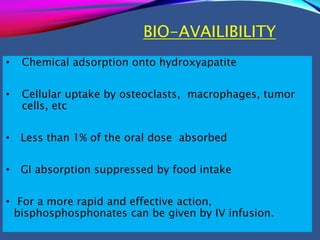
BIO-AVAILIBILITY
• Chemical adsorption onto hydroxyapatite
• Cellular uptake by osteoclasts, macrophages, tumor
cells, etc
• Less than 1% of the oral dose absorbed
• GI absorption suppressed by food intake
• For a more rapid and effective action,
bisphosphosphonates can be given by IV infusion.
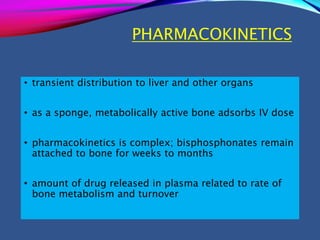
PHARMACOKINETICS
• transient distribution to liver and other organs
• as a sponge, metabolically active bone adsorbs IV dose
• pharmacokinetics is complex; bisphosphonates remain
attached to bone for weeks to months
• amount of drug released in plasma related to rate of
bone metabolism and turnover
HOW TO TAKE
BISPHOSPHONATES?
• Usually takes between 6-12 months for
bisphosphonates to work, and they are normally taken
for at least five years (some people take them for much
longer).
• Always taken with a full glass of water on an empty
stomach, and you must stand or sit upright for 30
minutes after you take them.
• Wait between 30 minutes and 2 hours before you eat
any food or have any other drinks.
• Most people are given calcium and vitamin D to take (at
a different time to the bisphosphonate) when they are
CLASSIFICATION
• According to chemical structure:-
 1. Alkyl side chains ( Etridonate )
2. Amino side chains (Alendronate )
3. Cyclic chains (Zelandronate )
• They can also be classified as:
1. Nitrogenous compounds which include
Pamidronate, neridronate, Olpadronate
2. Non-nitrogenous compounds which include
Etidronate, Clodronate, Tiludronate.
• The non-nitrogenous
bisphosphonates(disphosphonates) are metabolised in
the cell to compounds that replace the terminal
pyrophosphate moiety of ATP, forming a non-
functional molecule that competes with adenosine
triphosphate(ATP) in the cellular energy metabolism.
The osteoclast initiates apoptosis and dies, leading to
an overall decrease in the breakdown of bone
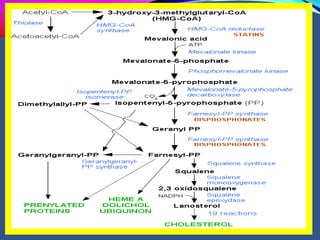
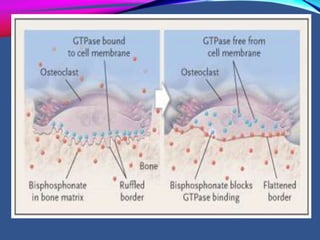
• Nitrogenous bisphosphonates act on bone metabolism
by binding and blocking the enzyme farnesyl
diphosphate synthase (FPPS) in the HMG-CoA
reductase pathway (also known as the mevalonate
pathway)
• Disruption of the HMG CoA-reductase pathway at the
level of FPPS prevents the formation of two metabolites
(farnesol and geranylgeraniol) that are essential for
connecting some small proteins to the cell membrane.
This phenomenon is known as prenylation, and is
important for proper sub-cellular protein trafficking .
• While inhibition of protein prenylation may affect many
proteins found in an osteoclast, disruption to the lipid
modification of Ras, Rho, Rac proteins has been
speculated to underlie the effects of bisphosphonates.
These proteins can affect both osteoclastogenesis, cell
survival, and cytoskeletal dynamics. In particular, the
cytoskeleton is vital for maintaining the "ruffled
border" that is required for contact between a
resorbing osteoclast and a bone surface
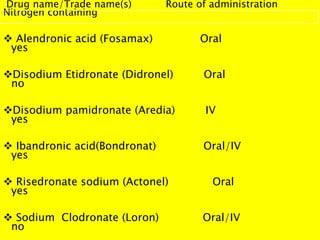
Drug name/Trade name(s) Route of administration
Nitrogen containing
 Alendronic acid (Fosamax) Oral
yes
Disodium Etidronate (Didronel) Oral
no
Disodium pamidronate (Aredia) IV
yes
 Ibandronic acid(Bondronat) Oral/IV
yes
 Risedronate sodium (Actonel) Oral
yes
 Sodium Clodronate (Loron) Oral/IV
no
MECHANISM OF ACTION
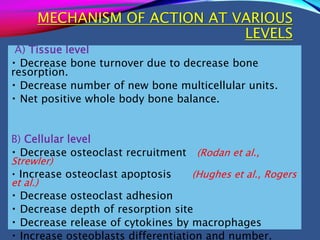
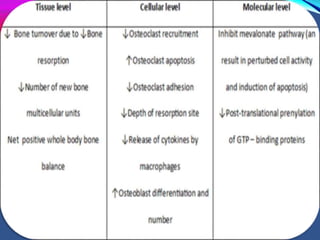
MECHANISM OF ACTION AT VARIOUS
LEVELS
A) Tissue level
Decrease bone turnover due to decrease bone
resorption.
Decrease number of new bone multicellular units.
Net positive whole body bone balance.
B) Cellular level
Decrease osteoclast recruitment (Rodan et al.,
Strewler)
Increase osteoclast apoptosis (Hughes et al., Rogers
et al.)
Decrease osteoclast adhesion
Decrease depth of resorption site
Decrease release of cytokines by macrophages
Increase osteoblasts differentiation and number.
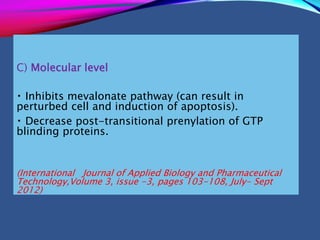
C) Molecular level
Inhibits mevalonate pathway (can result in
perturbed cell and induction of apoptosis).
Decrease post-transitional prenylation of GTP
blinding proteins.
(International Journal of Applied Biology and Pharmaceutical
Technology,Volume 3, issue -3, pages 103-108, July- Sept
2012)
A bisphosphonate group mimics pyrophosphate’s
structure, thereby inhibiting activation of enzymes that
utilize pyrophosphate. Bisphosphonate-based drugs’
specificity comes from the two phosphonate groups (and
possibly a hydroxyl at R1) that work together to
coordinate calcium ions.
Bisphosphonate molecules thus bind preferentially to
calcium, and bones being the largest source of calcium in
body, accumulates maximum bisphosphonate molecules.
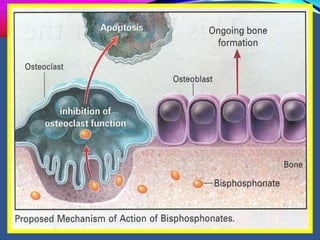
Bisphosphonates, when attached to bone tissue, are taken
up by osteoclasts.
Bisphosphonates affect both bone resorption and
deposition by various mechanisms.
• 1. They bind to hydroxyappatite thus preventing its
dissolution.
• 2. They inhibit osteoclast activation thus reducing
the rate of bone resorption.
• 3. They increase osteoblast differentiation thus
aiding in bone formation.
• 4. Their anti- collagenase activity prevents
degradation of the organic components of bone.
These actions of bisphosphonates have made them
highly popular for the management of bone metabolic
diseases like osteoporosis and other bone resorptive
conditions like Paget’s disease and malignant
hypercalcemia.
It is this bone sparing property of bisphosphonates
that has attracted Periodontists towards the use of
these drugs for prevention of alveolar bone loss that
occurs in periodontal disease, thus opening a new
chapter in periodontal host modulation therapy.
ROLE IN PERIODONTAL THERAPY
Early 1990’s saw an increasing interest in
application of bisphosphonates as host modulating
agents for the treatment of periodontal disease.
Many animal studies proved the high clinical
efficacy of bisphosphonates in inhibiting the
progression of experimentally induced
periodontitis. These improvements in periodontal
clinical parameters, especially alveolar bone gain,
were also achieved in many human clinical trials.
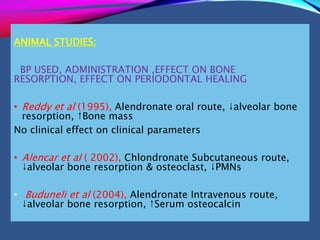
ANIMAL STUDIES:
BP USED, ADMINISTRATION ,EFFECT ON BONE
RESORPTION, EFFECT ON PERIODONTAL HEALING
• Reddy et al (1995), Alendronate oral route, ↓alveolar bone
resorption, ↑Bone mass
No clinical effect on clinical parameters
• Alencar et al ( 2002), Chlondronate Subcutaneous route,
↓alveolar bone resorption & osteoclast, ↓PMNs
• Buduneli et al (2004), Alendronate Intravenous route,
↓alveolar bone resorption, ↑Serum osteocalcin
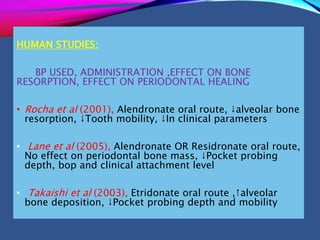
HUMAN STUDIES:
BP USED, ADMINISTRATION ,EFFECT ON BONE
RESORPTION, EFFECT ON PERIODONTAL HEALING
• Rocha et al (2001), Alendronate oral route, ↓alveolar bone
resorption, ↓Tooth mobility, ↓In clinical parameters
• Lane et al (2005), Alendronate OR Residronate oral route,
No effect on periodontal bone mass, ↓Pocket probing
depth, bop and clinical attachment level
• Takaishi et al (2003), Etridonate oral route ,↑alveolar
bone deposition, ↓Pocket probing depth and mobility
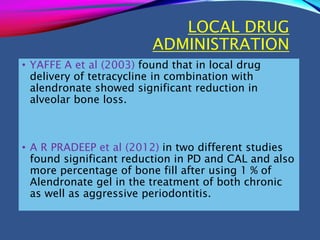
LOCAL DRUG
ADMINISTRATION
• YAFFE A et al (2003) found that in local drug
delivery of tetracycline in combination with
alendronate showed significant reduction in
alveolar bone loss.
• A R PRADEEP et al (2012) in two different studies
found significant reduction in PD and CAL and also
more percentage of bone fill after using 1 % of
Alendronate gel in the treatment of both chronic
as well as aggressive periodontitis.
• A Yaffe et al, Alendronate Local drug delivery with
tetracycline fibres_ ↓alveolar bone resorption, ↓Pocket
probing depth and clinical attachment level
• Pradeep A R et al (2012)( chronic periodontitis)
,Alendronate Local drug delivery as 1% gel_ ↑% of bone
fill , ↓Pocket probing depth , clinical attachment level
• Pradeep A R et al (2012) (aggressive periodontitis)
Alendronate Local drug delivery as 1% gel _↑% of bone
fill, ↓Pocket probing depth , clinical attachment level,
As these human studies indicate, local drug delivery
of bis- phosphonates show a ray of hope in the use
of these drugs as local host modulating agents in
periodontal therapy. This mode of application can
overcome the adverse effects associated with
systemic administration of bisphosphonates, while at
the same time retaining the property of bone sparing.
BISPHOSPHONATES
AS ANALGESICS
PRE- CLINICAL STUDIES
DOSE DEPENDENT ANALGESIC EFFECT in
animal models of inflammatory pain, cancer
pain, neuropathic pain
• Goicoechea et al., J Pharmacol, 1999;
• Cui et al., Pain, 2000;
• Oelzner et al. Inflamm Res, 2000;
• Bonabello et al., Pain, 2001;
• Walker et al., Pain , 2002;
• Harada et al., Inflamm Res, 2004;
• Kawabata et al., Neuropharmacology,
2006;
• Bianchi et al., European Journal of Pain,
2007;
IV PAMIDRONATE AS ANALGESIC
• Metastatic bone pain
• Ankylosing spondylitis
• Paget’s disease
• Rheumatoid arthritis
• Chronic back pain
( Hortobagyi et al., 1996; Lipton et al., 1994; Maksymowych et
al., 1998; Van Offel et al., 2001; Maccagno et al., 1994;
Kubalek et al., 2001; Fulfaro et al., 1998; Varenna et al.,
2000; Pappagallo et al,. 2003)
CONTRA-INDICATIONS
• Sensitivity to phosphate.
• GI upset
• Parathyroid dysfunction
• Pregnant or breast feeding mothers
• Kidney or hepatic trouble
• Hypocalcemia
• Poor Oral Hygiene and Active Endodontic /
Periodontal Disease
Nase JB, Suzuki JB (August 2006)
DRAW BACKS
• Chronic administration over long periods to be
effective.
• High cost and accessibility.
• A full body irradiation that would occur since these
agents have to be administered IV.
SIDE-EFFECTS
• 1. Gastro intestinal intolerance, e.g., drug induced
oesophagitis.
• 2. Renal toxicity
• 3. Hypocalcaemia caused by reduced bone
resorption leading to reduced calcium efflux from
bone
• 4. Hepatotoxicity
• 5. Acute phase reaction- transient and
manageable
• 6. Ocular inflammation
• 7. Dermatologic reactions
• 8. Osteonecrosis of jaws seen after tooth
extraction because of over suppression of bone
turnover.
• 9. Changes in White blood cell count.
• 10. Atrial fibrillation
(N Engl J Med. 2007;356(18):1809–1822)
• Oral bisphosphonates can cause
upset stomach and inflammation and erosions of
the esophagus, which is the main problem of
oral N-containing preparations. This can be
prevented by remaining seated upright for 30 to 60
minutes after taking the medication.
• Intravenous bisphosphonates can give fever
and flu-like symptoms after the first infusion,
which is thought to occur because of their potential
to activate human T cells. These symptoms do not
recur with subsequent infusions.
• FDA Review 2008: don’t factor atrial fibrillation in
bisphosphonate decision
OPTIMAL DURATION OF USE FOR
BISPHOSPHONATES
• Bisphosphonates effective in reducing
fractures for up to 4.5 years (trials)
• What is optimal duration of treatment?
– Longer treatment may further decrease
fracture risk
– On the other hand, concerns have been raised
that longer treatment may compromise bone
quality and lead to increased fracture risk
• Long term fracture trials are not feasible so
must rely on extensions of shorter studies
OSTEO-RADIO NECROSIS OF JAW
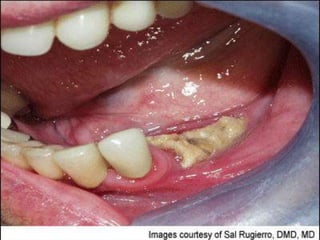
BRONJ
• First recognized in 2003 as a complication of
bisphosphonate therapy
• Higher frequency in the mandible (63%) than in the
maxilla (38%)
• Etiology is unclear and is the subject of current
research and investigation
BIONJ
• Can be related to dental treatment
• Can be related to dental pathology
• Can be spontaneous with dental etiology
• Can be related to denture irritation or wear
• can be unrelated to any of the above
• Can be related to local trauma
• Can be unknown in etiology
in a subgroup of oncological patients
(multiple myeloma, breast, prostate,
lung cancer bone metastases)
receiving prolonged treatment with
potent bisphosphonates (i.e. monthly
IV administration)
DIAGNOSIS
• A diagnosis of bisphosphonate-associated
osteonecrosis of the jaw relies on three
criteria:
1. the patient possesses an area of exposed
bone in the jaw persisting for more than 8
weeks,
2. the patient must present with no history
of radiation therapy to the head and neck,
3. the patient must be taking or have taken
bisphosphonate medication.
American Dental Association/National Osteoporosis
According to the updated 2009 BRONJ Position
Paper published by the American Association of
Oral and Maxillofacial Surgeons, both
the potency of and the length of exposure to
bisphosphonates are linked to the risk of
developing bisphosphonate-associated
osteonecrosis of the jaw
AAOMS Updates BRONJ Position Paper, January 23, 2009
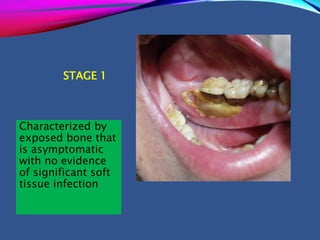
STAGE 1
Characterized by
exposed bone that
is asymptomatic
with no evidence
of significant soft
tissue infection
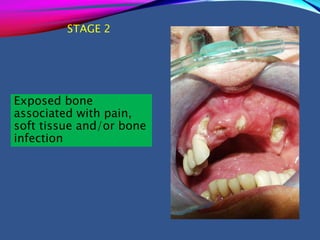
STAGE 2
Exposed bone
associated with pain,
soft tissue and/or bone
infection
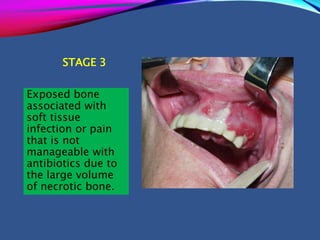
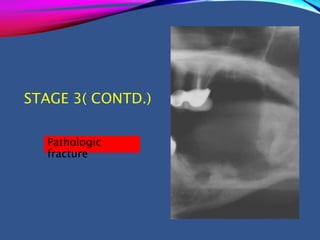
STAGE 3
Exposed bone
associated with
soft tissue
infection or pain
that is not
manageable with
antibiotics due to
the large volume
of necrotic bone.
STAGE 3( CONTD.)
Pathologic
fracture
ONJ
• Bone histology - necrosis and osteomyelitis
• Microbiology - actinomycetes and mixed
bacteria
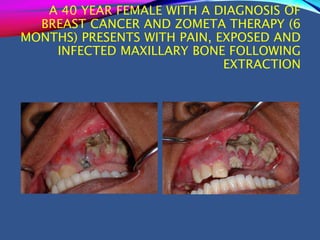
A 40 YEAR FEMALE WITH A DIAGNOSIS OF
BREAST CANCER AND ZOMETA THERAPY (6
MONTHS) PRESENTS WITH PAIN, EXPOSED AND
INFECTED MAXILLARY BONE FOLLOWING
EXTRACTION
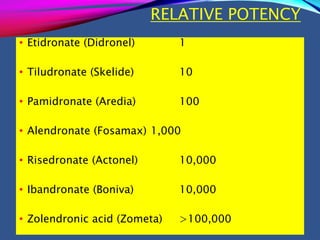
RELATIVE POTENCY
• Etidronate (Didronel) 1
• Tiludronate (Skelide) 10
• Pamidronate (Aredia) 100
• Alendronate (Fosamax) 1,000
• Risedronate (Actonel) 10,000
• Ibandronate (Boniva) 10,000
• Zolendronic acid (Zometa) >100,000
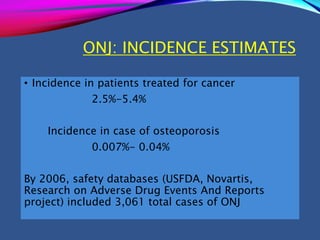
ONJ: INCIDENCE ESTIMATES
• Incidence in patients treated for cancer
2.5%-5.4%
Incidence in case of osteoporosis
0.007%- 0.04%
By 2006, safety databases (USFDA, Novartis,
Research on Adverse Drug Events And Reports
project) included 3,061 total cases of ONJ
• From April 1999 until May 2006, 10 of 310 (3%)
patients with ONJ while receiving bisphosphonate
therapy
• Except one, all ONJ patients had recent dental
extractions
Matrix metalloproteinase 2 (MMP2) is a
candidate gene for bisphosphonate-induced
ONJ for 3 reasons:
1) MMP2 is associated with bone abnormalities
which could be related to ONJ.
2) 2) Bisphosphonates are associated with atrial
fibrillation, and MMP2 is the only gene
known to be associated with both bone
abnormalities and atrial fibrillation.
3) 3) A network of disorders and disease genes
linked by known disorder-gene associations
indicates that cardiovascular disease and
bone disease are closely related, suggesting
that a single drug such as bisphosphonate,
acting on a single gene, MMP2, could have
both bone and cardiovascular side effects
different from the osteoclast inhibition that
is characteristic of bisphosphonate
RISK FACTORS
• Poor oral hygiene
• Dental procedures (tooth extractions,
implants)
• Chemotherapy
• Corticosteroid use
• Coagulopathies
• Immunosuppression / post-
transplantation
• Local cancerous invasion
• Local radiation therapy
• Heavy nicotine use
• Oral herpes infection
• Episodes of osteonecrosis / osteomyelitis
Others? (white phosphorus?, pyrophosphate
in tooth paste?, statins?)
REPORTED FACTORS
LEADING TO BRONJ
• Extractions
• RCT
• Periodontal infections
• Periodontal surgery
• Implant surgery
EVALUATION
• C-terminal telopeptide, commonly known as CTX,
a serum biomarker for bone turnover rate and a
tool used to evaluate patient risk for
complications due to BRONJ
• Reduced CTX values, Increase risk
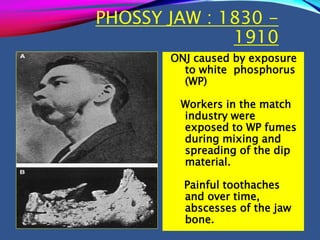
PHOSSY JAW : 1830 -
1910
ONJ caused by exposure
to white phosphorus
(WP)
Workers in the match
industry were
exposed to WP fumes
during mixing and
spreading of the dip
material.
Painful toothaches
and over time,
abscesses of the jaw
bone.
White Phosphorus
 Elemental phosphorus
can exist in several
allotropes, most
commonly white, red,
and black.
 WP is used for signaling,
smoke-screening,
incendiary (military)
purposes; however
 WP is also the most
abundant form of phosphorus
produced industrially.
 Most forms of phosphorus
chemicals are produced from
WP, including chemicals in
fertilizers, food additives,
pesticides, sodas, tooth-
paste, cleaning compounds,
and drugs (e.g. illicit
production of
methamphetamine)
TREATMENT
• Antimicrobial mouth washes and oral antibiotics
to help the immune system fight the attendant
infection,
• Local resection of the necrotic bone lesion.
• Many patients with BRONJ have successful
outcomes after treatment, meaning that the local
osteonecrosis is stopped, the infection is cleared,
and the mucosa heals and once again covers the
bone.
• There is no known prevention for bisphosphonate-
associated osteonecrosis of the jaw.
• Avoiding the use of bisphosphonates is not a viable
prevention on a general-population basis because the
drugs have more benefit throughout the population
(preventing osteoporotic fractures and treating bone
cancers) than harm (BRONJ)
American Dental Association/National Osteoporosis
Foundation, 2008
Dental Management of Patients
Receiving Oral Bisphosphonate Therapy
• The recommendations focus on conservative surgical
procedures, proper sterile technique, appropriate use
of oral disinfectants and the principles of effective
antibiotic therapy.
• Because of a paucity of clinical data on the dental
management of patients on oral bisphosphonate
therapy, these recommendations primarily are based
on expert opinion.
• Intended to help dentists make clinical decisions.
GENERAL RECOMMENDATIONS
• Routine dental treatment generally should not
be modified solely due to use of oral
bisphosphonates.
• All patients should receive routine dental
examinations.
• All patients taking the drug should be
informed that:
 Oral bisphosphonate use places them at very
low risk for developing BON.
The low risk for developing BON may be
minimized but not eliminated.
 An oral health program consisting of sound oral
hygiene practices and regular dental care may be
the optimal approach for lowering the risk for
developing BON.
There is no validated diagnostic technique
currently available to determine if patients are at
increased risk for developing BON.
Discontinuing bisphosphonate therapy may not
eliminate any risk for developing BON.
• The patient also should be informed of the
dental treatment needed, alternative treatments,
how any treatment relates to the risk of BON.
• The patient should be encouraged to consult
with his/her physician about health risks
associated with discontinuation of
bisphosphonate treatment.
• BON can occur spontaneously, due to dental
disease or secondary to dental therapy.
Therefore, patients taking oral bisphosphonates
should be instructed to contact their dentist if
any problem develops in the oral cavity.
• The dentist should retain in his/her file the
acknowledgment and consent for the treatment.
MANAGEMENT OF PERIODONTAL
DISEASES
• Bisphosphonate users who have active
periodontal diseases should receive appropriate
forms of non-surgical therapy, which should be
combined with the commonly recommended re-
evaluation at four to six weeks.
If the disease fails to resolve, the goal of surgical
treatment should be to obtain access to root
surfaces.
When necessary, modest bone re-contouring
techniques should be used.
At this time, there is no evidence that :
• periodontal procedures such as guided tissue
regeneration or bone replacement grafts increase or
decrease the risk for BON or success of implant treatment.
• Use of such techniques should be judiciously considered
based on patient need.
• Primary soft tissue closure following periodontal surgical
procedures is desirable, when feasible.
• Patients without periodontal disease should receive
preventive therapy for periodontal disease. Patients should
be regularly monitored.
IMPLANT PLACEMENT AND
MAINTENANCE
• There is a paucity of data on the effects of implant
placement in patients taking oral bisphosphonates.
• Because implant placement requires the preparation
of the osteotomy site, treatment plans should be
carefully considered.
• The patient may be at increased risk for BON when
extensive implant placement or guided bone
regeneration is necessary to augment the deficient
alveolar ridge prior to implant placement.
• Before implant placement, the dentist and the
patient should discuss the risks, benefits and
treatment alternatives.
• Maintenance of implants should follow accepted
mechanical and pharmaceutical methods to
prevent peri-implantitis, with regular monitoring
of the patient.
ORAL AND MAXILLOFACIAL
SURGERY
• When treatment of dental and/or periodontal diseases has
failed, surgical intervention may be the best alternative.
• Patients receiving oral bisphosphonates who are undergoing
invasive surgical procedures should be informed of the risk,
although small, of developing BON.
• Alternative treatment plans should be discussed with the
patient, which include:
 endodontics (including endodontic treatment followed by
removal of the clinical crown),
allowing the roots to exfoliate (instead of extraction),
bridges and partial dentures (instead of implant placement).
• If extractions or bone surgery are necessary,
conservative surgical technique with primary tissue
closure, when feasible, should be considered.
• In addition, immediately before and after any surgical
procedures involving bone, the patient should gently
rinse with a chlorhexidine until healed.
• The regimen may be extended based on the patient’s
healing progress.
• Prophylactic antibiotics after a surgical procedure
should be based on the risk of an infection and NOT
because the patient is taking a bisphosphonate.
• There is no evidence that the use of antibiotics is
effective in preventing BON.
ENDODONTICS
• Endodontic treatment is preferable to surgical
manipulation if a tooth is salvageable.
• Routine endodontic technique should be used.
• Manipulation beyond the apex is not
recommended.
• In some situations, depending on risk,
endodontic treatment of non-restored teeth after
removal of the clinical crown, which allows
passive exfoliation of the root tip, may be
considered.
RESTORATIVE DENTISTRY
AND PROSTHODONTICS
• There is no evidence that malocclusion or
masticatory forces increase the risk for BON.
• All routine restorative procedures may be
conducted.
• Prosthodontic appliances in patients should be
promptly adjusted for fit in order to avoid ulceration
and possible bone exposure.
UNRESOLVED
QUESTIONS????????
• Bisphosphonates have been and continue to be used for
other conditions without an FDA-approved indication for
therapy.
• As noted, these include various pediatric populations
with low bone mass, incident fractures, and prolonged
immobility.
• Many healthy premenopausal women with either
radiographic osteopenia or osteoporosis without
fractures and postmenopausal women with osteopenia
but without fractures now receive bisphosphonate
therapy.
• Until further studies address these important clinical
questions, it is important to tell such patients that we
currently lack sufficient data from well-controlled clinical
trials to determine either benefits or risks assumed with
these pharmacological interventions.
The 2014 update of a position paper from the
American Association of Oral and Maxillofacial
Surgeons recommended changing the name of
bisphosphonate-related osteonecrosis of the
jaw (BRONJ) to medication-related
osteonecrosis of the jaw (MRONJ), owing to the
increased number of maxillary and mandibular
osteonecrosis cases that have been linked to
other antiresorptive (denosumab) or
antiangiogenic treatments
Bisphosphonates

Bisphosphonates

  • 1.
    “BISPHOSPHONATES” Under the esteemedguidance of ;- Prof. Dr. SUHAIL MAJID JAN (HOD / Guide) Dr. ROOBAL BEHAL (Associate Prof & Co-Guide) Presented By:- MOHAMMAD IMRAN BHATT PG (2nd Year) ‘’POST GRADUATE DEPARTMENT OF PERIODONTICS ANDORAL IMPLANTOLOGY’’
  • 2.
    CONTENTS • INTRODUCTION • HISTORY •STRUCTURE OF BISPHOSPHONATES • INDICATIONS • BIOAVAILABILITY, PHARMACOKINETICS • HOW TO TAKE BISPHOSHONATES • CLASSIFICATION • MECHANISM OF ACTION • ROLE IN PERIODONTAL THERAPY • SIDE EFFECTS • BRONJ • DENTAL MANAGEMENT OF PATIENTS RECEIVING ORAL BISPHOSPHONATE THERAPY • REFERENCES
  • 3.
    HISTORY • Designed assynthetic ( Non-biodegradable)analogues of pyrophosphate. • Initially used in industry as water softening agents in irrigation systems in the earlier 1920s. After that the medical use of the bisphosphonates came into existence. • Etidronate, first bisphosphonate for medical use. • In 1969, bisphosphonates discovered as bone loss inhibitors. • Initial launch of Fosamax (alendronate) by Merck & Co. ( 1990)
  • 4.
    • blocks precipitationof calcium phosphate in plasma, urine, and soft tissues. • commonly used as an anti-tartar agent in toothpaste.
  • 5.
  • 7.
    The long side-chain(R2 in the diagram) determines the chemical properties, the mode of action and the strength of bisphosphonate drugs. The short side- chain (R1), often called the 'hook', mainly influences chemical properties and pharmacokinetics.
  • 8.
  • 9.
  • 10.
    FDA APPROVED INDICATIONS • 1.Osteoporosis • 2. Paget’s disease • 3. Malignant hypercalcemia • 4. Bone metastasis • 5. Multiple myeloma, • 6. Primary hyperparathyroidism, • 7. Osteogenesis imperfecta and • 8. Carcinoma of breast.
  • 11.
    Their use alsohas been proposed in the management of periodontal diseases, Bisphosphonates inhibit the osteoclastic bone resorption & hence are used as a host modulating factor for prevention of bone loss. (Parfitt AM. Journal of Cell Biochemistry 1994; 55(3):273–286.)
  • 12.
    Treatment concept thataims to reduce tissue destruction and stabilize or even regenerate the periodontium by modifying or downregulating destructive aspects of host response and upregulating protective or regenerative responses. (CARRANZA)
  • 13.
    . Systemically Administered Agents :-  NSAIDs Bisphosphonate s Subantimicrobi al- Dose Doxycycline Locally administered Agents :-  Topical NSAIDs  Enamel matrix proteins  Growth factors  Bone morphogenetic proteins Host modulating agents
  • 14.
  • 15.
    BIO-AVAILIBILITY • Chemical adsorptiononto hydroxyapatite • Cellular uptake by osteoclasts, macrophages, tumor cells, etc • Less than 1% of the oral dose absorbed • GI absorption suppressed by food intake • For a more rapid and effective action, bisphosphosphonates can be given by IV infusion.
  • 16.
    PHARMACOKINETICS • transient distributionto liver and other organs • as a sponge, metabolically active bone adsorbs IV dose • pharmacokinetics is complex; bisphosphonates remain attached to bone for weeks to months • amount of drug released in plasma related to rate of bone metabolism and turnover
  • 17.
  • 18.
    • Usually takesbetween 6-12 months for bisphosphonates to work, and they are normally taken for at least five years (some people take them for much longer). • Always taken with a full glass of water on an empty stomach, and you must stand or sit upright for 30 minutes after you take them. • Wait between 30 minutes and 2 hours before you eat any food or have any other drinks. • Most people are given calcium and vitamin D to take (at a different time to the bisphosphonate) when they are
  • 19.
  • 20.
    • According tochemical structure:-  1. Alkyl side chains ( Etridonate ) 2. Amino side chains (Alendronate ) 3. Cyclic chains (Zelandronate ) • They can also be classified as: 1. Nitrogenous compounds which include Pamidronate, neridronate, Olpadronate 2. Non-nitrogenous compounds which include Etidronate, Clodronate, Tiludronate.
  • 21.
    • The non-nitrogenous bisphosphonates(disphosphonates)are metabolised in the cell to compounds that replace the terminal pyrophosphate moiety of ATP, forming a non- functional molecule that competes with adenosine triphosphate(ATP) in the cellular energy metabolism. The osteoclast initiates apoptosis and dies, leading to an overall decrease in the breakdown of bone • Nitrogenous bisphosphonates act on bone metabolism by binding and blocking the enzyme farnesyl diphosphate synthase (FPPS) in the HMG-CoA reductase pathway (also known as the mevalonate pathway)
  • 23.
    • Disruption ofthe HMG CoA-reductase pathway at the level of FPPS prevents the formation of two metabolites (farnesol and geranylgeraniol) that are essential for connecting some small proteins to the cell membrane. This phenomenon is known as prenylation, and is important for proper sub-cellular protein trafficking . • While inhibition of protein prenylation may affect many proteins found in an osteoclast, disruption to the lipid modification of Ras, Rho, Rac proteins has been speculated to underlie the effects of bisphosphonates. These proteins can affect both osteoclastogenesis, cell survival, and cytoskeletal dynamics. In particular, the cytoskeleton is vital for maintaining the "ruffled border" that is required for contact between a resorbing osteoclast and a bone surface
  • 24.
    Drug name/Trade name(s)Route of administration Nitrogen containing  Alendronic acid (Fosamax) Oral yes Disodium Etidronate (Didronel) Oral no Disodium pamidronate (Aredia) IV yes  Ibandronic acid(Bondronat) Oral/IV yes  Risedronate sodium (Actonel) Oral yes  Sodium Clodronate (Loron) Oral/IV no
  • 25.
  • 26.
    MECHANISM OF ACTIONAT VARIOUS LEVELS A) Tissue level Decrease bone turnover due to decrease bone resorption. Decrease number of new bone multicellular units. Net positive whole body bone balance. B) Cellular level Decrease osteoclast recruitment (Rodan et al., Strewler) Increase osteoclast apoptosis (Hughes et al., Rogers et al.) Decrease osteoclast adhesion Decrease depth of resorption site Decrease release of cytokines by macrophages Increase osteoblasts differentiation and number.
  • 27.
    C) Molecular level Inhibitsmevalonate pathway (can result in perturbed cell and induction of apoptosis). Decrease post-transitional prenylation of GTP blinding proteins. (International Journal of Applied Biology and Pharmaceutical Technology,Volume 3, issue -3, pages 103-108, July- Sept 2012)
  • 30.
    A bisphosphonate groupmimics pyrophosphate’s structure, thereby inhibiting activation of enzymes that utilize pyrophosphate. Bisphosphonate-based drugs’ specificity comes from the two phosphonate groups (and possibly a hydroxyl at R1) that work together to coordinate calcium ions. Bisphosphonate molecules thus bind preferentially to calcium, and bones being the largest source of calcium in body, accumulates maximum bisphosphonate molecules. Bisphosphonates, when attached to bone tissue, are taken up by osteoclasts.
  • 31.
    Bisphosphonates affect bothbone resorption and deposition by various mechanisms. • 1. They bind to hydroxyappatite thus preventing its dissolution. • 2. They inhibit osteoclast activation thus reducing the rate of bone resorption. • 3. They increase osteoblast differentiation thus aiding in bone formation. • 4. Their anti- collagenase activity prevents degradation of the organic components of bone.
  • 33.
    These actions ofbisphosphonates have made them highly popular for the management of bone metabolic diseases like osteoporosis and other bone resorptive conditions like Paget’s disease and malignant hypercalcemia. It is this bone sparing property of bisphosphonates that has attracted Periodontists towards the use of these drugs for prevention of alveolar bone loss that occurs in periodontal disease, thus opening a new chapter in periodontal host modulation therapy.
  • 34.
  • 35.
    Early 1990’s sawan increasing interest in application of bisphosphonates as host modulating agents for the treatment of periodontal disease. Many animal studies proved the high clinical efficacy of bisphosphonates in inhibiting the progression of experimentally induced periodontitis. These improvements in periodontal clinical parameters, especially alveolar bone gain, were also achieved in many human clinical trials.
  • 36.
    ANIMAL STUDIES: BP USED,ADMINISTRATION ,EFFECT ON BONE RESORPTION, EFFECT ON PERIODONTAL HEALING • Reddy et al (1995), Alendronate oral route, ↓alveolar bone resorption, ↑Bone mass No clinical effect on clinical parameters • Alencar et al ( 2002), Chlondronate Subcutaneous route, ↓alveolar bone resorption & osteoclast, ↓PMNs • Buduneli et al (2004), Alendronate Intravenous route, ↓alveolar bone resorption, ↑Serum osteocalcin
  • 37.
    HUMAN STUDIES: BP USED,ADMINISTRATION ,EFFECT ON BONE RESORPTION, EFFECT ON PERIODONTAL HEALING • Rocha et al (2001), Alendronate oral route, ↓alveolar bone resorption, ↓Tooth mobility, ↓In clinical parameters • Lane et al (2005), Alendronate OR Residronate oral route, No effect on periodontal bone mass, ↓Pocket probing depth, bop and clinical attachment level • Takaishi et al (2003), Etridonate oral route ,↑alveolar bone deposition, ↓Pocket probing depth and mobility
  • 38.
    LOCAL DRUG ADMINISTRATION • YAFFEA et al (2003) found that in local drug delivery of tetracycline in combination with alendronate showed significant reduction in alveolar bone loss. • A R PRADEEP et al (2012) in two different studies found significant reduction in PD and CAL and also more percentage of bone fill after using 1 % of Alendronate gel in the treatment of both chronic as well as aggressive periodontitis.
  • 39.
    • A Yaffeet al, Alendronate Local drug delivery with tetracycline fibres_ ↓alveolar bone resorption, ↓Pocket probing depth and clinical attachment level • Pradeep A R et al (2012)( chronic periodontitis) ,Alendronate Local drug delivery as 1% gel_ ↑% of bone fill , ↓Pocket probing depth , clinical attachment level • Pradeep A R et al (2012) (aggressive periodontitis) Alendronate Local drug delivery as 1% gel _↑% of bone fill, ↓Pocket probing depth , clinical attachment level,
  • 40.
    As these humanstudies indicate, local drug delivery of bis- phosphonates show a ray of hope in the use of these drugs as local host modulating agents in periodontal therapy. This mode of application can overcome the adverse effects associated with systemic administration of bisphosphonates, while at the same time retaining the property of bone sparing.
  • 41.
  • 42.
    PRE- CLINICAL STUDIES DOSEDEPENDENT ANALGESIC EFFECT in animal models of inflammatory pain, cancer pain, neuropathic pain • Goicoechea et al., J Pharmacol, 1999; • Cui et al., Pain, 2000; • Oelzner et al. Inflamm Res, 2000; • Bonabello et al., Pain, 2001; • Walker et al., Pain , 2002; • Harada et al., Inflamm Res, 2004; • Kawabata et al., Neuropharmacology, 2006; • Bianchi et al., European Journal of Pain, 2007;
  • 43.
    IV PAMIDRONATE ASANALGESIC • Metastatic bone pain • Ankylosing spondylitis • Paget’s disease • Rheumatoid arthritis • Chronic back pain ( Hortobagyi et al., 1996; Lipton et al., 1994; Maksymowych et al., 1998; Van Offel et al., 2001; Maccagno et al., 1994; Kubalek et al., 2001; Fulfaro et al., 1998; Varenna et al., 2000; Pappagallo et al,. 2003)
  • 44.
  • 45.
    • Sensitivity tophosphate. • GI upset • Parathyroid dysfunction • Pregnant or breast feeding mothers • Kidney or hepatic trouble
  • 46.
    • Hypocalcemia • PoorOral Hygiene and Active Endodontic / Periodontal Disease Nase JB, Suzuki JB (August 2006)
  • 47.
  • 48.
    • Chronic administrationover long periods to be effective. • High cost and accessibility. • A full body irradiation that would occur since these agents have to be administered IV.
  • 49.
  • 50.
    • 1. Gastrointestinal intolerance, e.g., drug induced oesophagitis. • 2. Renal toxicity • 3. Hypocalcaemia caused by reduced bone resorption leading to reduced calcium efflux from bone • 4. Hepatotoxicity • 5. Acute phase reaction- transient and manageable • 6. Ocular inflammation • 7. Dermatologic reactions • 8. Osteonecrosis of jaws seen after tooth extraction because of over suppression of bone turnover. • 9. Changes in White blood cell count. • 10. Atrial fibrillation (N Engl J Med. 2007;356(18):1809–1822)
  • 51.
    • Oral bisphosphonatescan cause upset stomach and inflammation and erosions of the esophagus, which is the main problem of oral N-containing preparations. This can be prevented by remaining seated upright for 30 to 60 minutes after taking the medication. • Intravenous bisphosphonates can give fever and flu-like symptoms after the first infusion, which is thought to occur because of their potential to activate human T cells. These symptoms do not recur with subsequent infusions. • FDA Review 2008: don’t factor atrial fibrillation in bisphosphonate decision
  • 52.
    OPTIMAL DURATION OFUSE FOR BISPHOSPHONATES • Bisphosphonates effective in reducing fractures for up to 4.5 years (trials) • What is optimal duration of treatment? – Longer treatment may further decrease fracture risk – On the other hand, concerns have been raised that longer treatment may compromise bone quality and lead to increased fracture risk • Long term fracture trials are not feasible so must rely on extensions of shorter studies
  • 53.
  • 54.
    BRONJ • First recognizedin 2003 as a complication of bisphosphonate therapy • Higher frequency in the mandible (63%) than in the maxilla (38%) • Etiology is unclear and is the subject of current research and investigation
  • 55.
    BIONJ • Can berelated to dental treatment • Can be related to dental pathology • Can be spontaneous with dental etiology • Can be related to denture irritation or wear • can be unrelated to any of the above • Can be related to local trauma • Can be unknown in etiology
  • 56.
    in a subgroupof oncological patients (multiple myeloma, breast, prostate, lung cancer bone metastases) receiving prolonged treatment with potent bisphosphonates (i.e. monthly IV administration)
  • 57.
    DIAGNOSIS • A diagnosisof bisphosphonate-associated osteonecrosis of the jaw relies on three criteria: 1. the patient possesses an area of exposed bone in the jaw persisting for more than 8 weeks, 2. the patient must present with no history of radiation therapy to the head and neck, 3. the patient must be taking or have taken bisphosphonate medication. American Dental Association/National Osteoporosis
  • 58.
    According to theupdated 2009 BRONJ Position Paper published by the American Association of Oral and Maxillofacial Surgeons, both the potency of and the length of exposure to bisphosphonates are linked to the risk of developing bisphosphonate-associated osteonecrosis of the jaw AAOMS Updates BRONJ Position Paper, January 23, 2009
  • 59.
    STAGE 1 Characterized by exposedbone that is asymptomatic with no evidence of significant soft tissue infection
  • 60.
    STAGE 2 Exposed bone associatedwith pain, soft tissue and/or bone infection
  • 61.
    STAGE 3 Exposed bone associatedwith soft tissue infection or pain that is not manageable with antibiotics due to the large volume of necrotic bone.
  • 62.
  • 63.
    ONJ • Bone histology- necrosis and osteomyelitis • Microbiology - actinomycetes and mixed bacteria
  • 64.
    A 40 YEARFEMALE WITH A DIAGNOSIS OF BREAST CANCER AND ZOMETA THERAPY (6 MONTHS) PRESENTS WITH PAIN, EXPOSED AND INFECTED MAXILLARY BONE FOLLOWING EXTRACTION
  • 65.
    RELATIVE POTENCY • Etidronate(Didronel) 1 • Tiludronate (Skelide) 10 • Pamidronate (Aredia) 100 • Alendronate (Fosamax) 1,000 • Risedronate (Actonel) 10,000 • Ibandronate (Boniva) 10,000 • Zolendronic acid (Zometa) >100,000
  • 66.
    ONJ: INCIDENCE ESTIMATES •Incidence in patients treated for cancer 2.5%-5.4% Incidence in case of osteoporosis 0.007%- 0.04% By 2006, safety databases (USFDA, Novartis, Research on Adverse Drug Events And Reports project) included 3,061 total cases of ONJ
  • 68.
    • From April1999 until May 2006, 10 of 310 (3%) patients with ONJ while receiving bisphosphonate therapy • Except one, all ONJ patients had recent dental extractions
  • 69.
    Matrix metalloproteinase 2(MMP2) is a candidate gene for bisphosphonate-induced ONJ for 3 reasons: 1) MMP2 is associated with bone abnormalities which could be related to ONJ. 2) 2) Bisphosphonates are associated with atrial fibrillation, and MMP2 is the only gene known to be associated with both bone abnormalities and atrial fibrillation. 3) 3) A network of disorders and disease genes linked by known disorder-gene associations indicates that cardiovascular disease and bone disease are closely related, suggesting that a single drug such as bisphosphonate, acting on a single gene, MMP2, could have both bone and cardiovascular side effects different from the osteoclast inhibition that is characteristic of bisphosphonate
  • 70.
    RISK FACTORS • Poororal hygiene • Dental procedures (tooth extractions, implants) • Chemotherapy • Corticosteroid use • Coagulopathies • Immunosuppression / post- transplantation • Local cancerous invasion
  • 71.
    • Local radiationtherapy • Heavy nicotine use • Oral herpes infection • Episodes of osteonecrosis / osteomyelitis Others? (white phosphorus?, pyrophosphate in tooth paste?, statins?)
  • 72.
    REPORTED FACTORS LEADING TOBRONJ • Extractions • RCT • Periodontal infections • Periodontal surgery • Implant surgery
  • 73.
    EVALUATION • C-terminal telopeptide,commonly known as CTX, a serum biomarker for bone turnover rate and a tool used to evaluate patient risk for complications due to BRONJ • Reduced CTX values, Increase risk
  • 74.
    PHOSSY JAW :1830 - 1910 ONJ caused by exposure to white phosphorus (WP) Workers in the match industry were exposed to WP fumes during mixing and spreading of the dip material. Painful toothaches and over time, abscesses of the jaw bone.
  • 75.
    White Phosphorus  Elementalphosphorus can exist in several allotropes, most commonly white, red, and black.  WP is used for signaling, smoke-screening, incendiary (military) purposes; however  WP is also the most abundant form of phosphorus produced industrially.  Most forms of phosphorus chemicals are produced from WP, including chemicals in fertilizers, food additives, pesticides, sodas, tooth- paste, cleaning compounds, and drugs (e.g. illicit production of methamphetamine)
  • 76.
    TREATMENT • Antimicrobial mouthwashes and oral antibiotics to help the immune system fight the attendant infection, • Local resection of the necrotic bone lesion. • Many patients with BRONJ have successful outcomes after treatment, meaning that the local osteonecrosis is stopped, the infection is cleared, and the mucosa heals and once again covers the bone.
  • 77.
    • There isno known prevention for bisphosphonate- associated osteonecrosis of the jaw. • Avoiding the use of bisphosphonates is not a viable prevention on a general-population basis because the drugs have more benefit throughout the population (preventing osteoporotic fractures and treating bone cancers) than harm (BRONJ) American Dental Association/National Osteoporosis Foundation, 2008
  • 78.
    Dental Management ofPatients Receiving Oral Bisphosphonate Therapy
  • 79.
    • The recommendationsfocus on conservative surgical procedures, proper sterile technique, appropriate use of oral disinfectants and the principles of effective antibiotic therapy. • Because of a paucity of clinical data on the dental management of patients on oral bisphosphonate therapy, these recommendations primarily are based on expert opinion. • Intended to help dentists make clinical decisions.
  • 80.
    GENERAL RECOMMENDATIONS • Routinedental treatment generally should not be modified solely due to use of oral bisphosphonates. • All patients should receive routine dental examinations. • All patients taking the drug should be informed that:  Oral bisphosphonate use places them at very low risk for developing BON. The low risk for developing BON may be minimized but not eliminated.
  • 81.
     An oralhealth program consisting of sound oral hygiene practices and regular dental care may be the optimal approach for lowering the risk for developing BON. There is no validated diagnostic technique currently available to determine if patients are at increased risk for developing BON. Discontinuing bisphosphonate therapy may not eliminate any risk for developing BON.
  • 82.
    • The patientalso should be informed of the dental treatment needed, alternative treatments, how any treatment relates to the risk of BON. • The patient should be encouraged to consult with his/her physician about health risks associated with discontinuation of bisphosphonate treatment. • BON can occur spontaneously, due to dental disease or secondary to dental therapy. Therefore, patients taking oral bisphosphonates should be instructed to contact their dentist if any problem develops in the oral cavity. • The dentist should retain in his/her file the acknowledgment and consent for the treatment.
  • 83.
    MANAGEMENT OF PERIODONTAL DISEASES •Bisphosphonate users who have active periodontal diseases should receive appropriate forms of non-surgical therapy, which should be combined with the commonly recommended re- evaluation at four to six weeks. If the disease fails to resolve, the goal of surgical treatment should be to obtain access to root surfaces. When necessary, modest bone re-contouring techniques should be used.
  • 84.
    At this time,there is no evidence that : • periodontal procedures such as guided tissue regeneration or bone replacement grafts increase or decrease the risk for BON or success of implant treatment. • Use of such techniques should be judiciously considered based on patient need. • Primary soft tissue closure following periodontal surgical procedures is desirable, when feasible. • Patients without periodontal disease should receive preventive therapy for periodontal disease. Patients should be regularly monitored.
  • 85.
    IMPLANT PLACEMENT AND MAINTENANCE •There is a paucity of data on the effects of implant placement in patients taking oral bisphosphonates. • Because implant placement requires the preparation of the osteotomy site, treatment plans should be carefully considered. • The patient may be at increased risk for BON when extensive implant placement or guided bone regeneration is necessary to augment the deficient alveolar ridge prior to implant placement.
  • 86.
    • Before implantplacement, the dentist and the patient should discuss the risks, benefits and treatment alternatives. • Maintenance of implants should follow accepted mechanical and pharmaceutical methods to prevent peri-implantitis, with regular monitoring of the patient.
  • 87.
    ORAL AND MAXILLOFACIAL SURGERY •When treatment of dental and/or periodontal diseases has failed, surgical intervention may be the best alternative. • Patients receiving oral bisphosphonates who are undergoing invasive surgical procedures should be informed of the risk, although small, of developing BON. • Alternative treatment plans should be discussed with the patient, which include:  endodontics (including endodontic treatment followed by removal of the clinical crown), allowing the roots to exfoliate (instead of extraction), bridges and partial dentures (instead of implant placement).
  • 88.
    • If extractionsor bone surgery are necessary, conservative surgical technique with primary tissue closure, when feasible, should be considered. • In addition, immediately before and after any surgical procedures involving bone, the patient should gently rinse with a chlorhexidine until healed. • The regimen may be extended based on the patient’s healing progress. • Prophylactic antibiotics after a surgical procedure should be based on the risk of an infection and NOT because the patient is taking a bisphosphonate. • There is no evidence that the use of antibiotics is effective in preventing BON.
  • 89.
    ENDODONTICS • Endodontic treatmentis preferable to surgical manipulation if a tooth is salvageable. • Routine endodontic technique should be used. • Manipulation beyond the apex is not recommended. • In some situations, depending on risk, endodontic treatment of non-restored teeth after removal of the clinical crown, which allows passive exfoliation of the root tip, may be considered.
  • 90.
    RESTORATIVE DENTISTRY AND PROSTHODONTICS •There is no evidence that malocclusion or masticatory forces increase the risk for BON. • All routine restorative procedures may be conducted. • Prosthodontic appliances in patients should be promptly adjusted for fit in order to avoid ulceration and possible bone exposure.
  • 91.
  • 92.
    • Bisphosphonates havebeen and continue to be used for other conditions without an FDA-approved indication for therapy. • As noted, these include various pediatric populations with low bone mass, incident fractures, and prolonged immobility. • Many healthy premenopausal women with either radiographic osteopenia or osteoporosis without fractures and postmenopausal women with osteopenia but without fractures now receive bisphosphonate therapy. • Until further studies address these important clinical questions, it is important to tell such patients that we currently lack sufficient data from well-controlled clinical trials to determine either benefits or risks assumed with these pharmacological interventions.
  • 93.
    The 2014 updateof a position paper from the American Association of Oral and Maxillofacial Surgeons recommended changing the name of bisphosphonate-related osteonecrosis of the jaw (BRONJ) to medication-related osteonecrosis of the jaw (MRONJ), owing to the increased number of maxillary and mandibular osteonecrosis cases that have been linked to other antiresorptive (denosumab) or antiangiogenic treatments