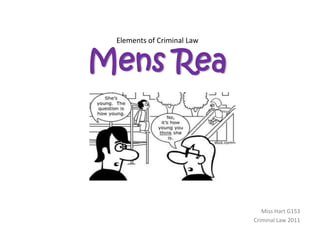
Elements of Criminal LawMens ReaMiss Hart G153Criminal Law 2011
Are they as guilty as they look?Crime:Innocent Action:
How much guilt does the mind need?...It depends on the definition!Element One:Element Two:Sometimes there is more than one option for the mens rea. Can you think of a crime which has more than one element?AO2 development:Why do you think that there might be more than one option?
Motive?R v Steane 1947“A man is taken to intend the natural consequences of his acts…but the motive of a man’s act and his intention in doing the act are, in law, different things”Why might motive still be relevant in a criminal court?
Types of Mens Rea:IntentionWait until we look at intoxicationfor this section!SpecificDirect aka expressBasicObliqueaka indirect
How do we prove intention?Foresight of ConsequencesFor each of the following scenarios, decide how likely it is and put the number in the box!A man fires a shotgun out of the window of a remote farmhouseA man fires a shotgun which he is holding directly at the head of his victimA man fires a shotgun out of the window of a shop in the high streetA man fires a shotgun in the direction of a bus queue twenty feet awayA man fires a shotgun into the air on the moon (no other astronauts around)A man fires a shotgun at the head of someone stood in his doorway.A man fires a shotgun at a bus queue six foot away.Now decide at what point you think they should be liable for the murder of V
Intention Type One:Direct IntentYou both foresee and intend the consequence which occurs.R v Mohan 1975“a decision to bring about, in so far as it lies within the accused power( the prohibited consequence), no matter whether the accused desired that consequence of his act or not”Which of the following has a direct intent? I point a gun and pull the trigger
I set fire, intending to scare, and someone dies
I say “I’m going to kill you” and then put my hands round your throat.
I put my hands up and walk towards you.Intention Type Two:Oblique IntentMeans?D intends one consequence (e.g. arson) but another occurs (e.g. murder). Clearly we can’t say that he has a direct intent to kill...  But does he still legally intend the consequences?Is he still legally liable for them?What if I am sick of a pupil and decide to blow up E52, knowing that the student will be in there during lesson time. The classroom blows up, killing the rest of the class as well
Foresight of ConsequencesWhy was there a problem?DPP v Smith 1961Why was this outcome unfair to Mr Smith?Why could the House of Lords not simply just change their minds and change the law?
The Response?A court or jury, in determining whether a person has committed an offence:shall not be bound in law to infer that he intended or foresaw a result of his actions by reasons only of its being a natural and probable consequence of those actions: butshall decide whether he did intend or foresee that result by reference to all the evidence, drawing such inferences as appear proper in the circumstances.
Development of the test on Foresight of Consequences [1]Hyam v DPP 1975Decision:Critical Comment:
Development of the test on Foresight of Consequences [2]R v Moloney 1985AO2 AssessmentWhat has Lord Bridge forgotten?Should oblique intent have even been an issue here?Two important sections to this decision:Foresight of  consequences are only evidence of intention.Bridge LJ set down a two stage test (to decide whether consequences were foreseen) to be put before juries: Was death or really serious injury a natural consequence of the defendant’s act? AndDid D foresee that consequence as being a natural result of his act?
Development of the test on Foresight of Consequences [3]Hancock & Shankland 1986What did the court do to the decision in Moloney?What was the decision here?“the greater the probability of a consequence the more likely it is that the consequence was foreseen and that if that consequence was foreseen the greater the probability is that consequence was also intended.
Development of the test on Foresight of Consequences [4]R v Nedrick 1986What do you notice about the two branches of this test?How might this have changed the outcome for D in Hyam v DPP?3. Why might the word ‘infer’ be important here?
Development of the test on Foresight of Consequences [5]R v Woollin 1998What happened?Do Woollin’s actions amount to the AR of murder?What was the decision of the House of Lords?How did the House of Lords modify the Court of Appeal in Nedrick?What is the new ‘model direction’?Explain the fact that Woollin may have been convicted under the new law.
Development of the test on Foresight of Consequences [6]The final word?R v Matthews & Alleyne“the law has not yet reached a definition of intent in murder in terms of appreciation of a virtual certainty…however, we think that, once what is required is an appreciation of virtual certainty of death, and not some lesser foresight of merely probable consequences, there is very little to choose between a rule of evidence and one of substantive law.”
To Sum up… What degree of foresight is enough?Is foresight of consequences intention, or only evidence of intention?
….So how far must you foresee something for it to be evidence of intention?Remember the table? Go back and write in the crime, which D would be liable for under each heading following the Woollin decision, and the mens rea!
Starter: Match the terms to their definition?Direct Intent1. A failure to do something, which doesn’t normally bring criminal liabilityAOmission2. A true desire to bring about the consequenceBMens Rea3. A crime where the outcome is the action prohibitedCConsequence Crime4. Sometimes known as the fault element which often turns an innocent act into a guilty one. DState of Affairs Crime5. A crime where D is liable in spite of having no voluntary actus reus or mens rea.E
Applying the lawLook at the following scenario:is Bob guilty of murder?Bob is a member of Chocolate Only, a group which believes that people should only be eating chocolate. To get publicity for his cause, he plants a bomb in Buckingham Palace. He phones the police to let them know that it will explode in 15 minutes. The operator, Susie, mishears and thinks he says 50 minutes.They evacuate the Palace, and after 15 minutes, Jeremy the bomb disposal expert goes in. The bomb explodes, killing Jeremy.
Do you understand intention?Without your handouts,  match them up, and put them in order!	Task:Now use these are your own understanding to complete the table  on page 14*These don’t match!*
How are the essays marked?
Mark this one!Mark the AO1 and AO2 in the essay (use the margin to help you)Then look at the grade descriptors. Which band do they sound like? Finally:Pick one section you think is particularly strong and explain whyHighlight one area you think could be improved and say why.
Mens Rea Type Two:RecklessnessMeaning:The conscious taking of an unjustifiable riskR v Cunningham 1957
So, that all seems straightforward…… so guess what happens now!R v Caldwell 1981What are the implications of this decision?The court decided that liability through recklessness could occur in two situations:D realised the risk and went ahead; orD had not thought about the possibility of any risk but went ahead
In your pairs, look at the statement you have been given and explain your point of criticism (the why)

Mr 2011 12

  • 1.
    Elements of CriminalLawMens ReaMiss Hart G153Criminal Law 2011
  • 2.
    Are they asguilty as they look?Crime:Innocent Action:
  • 3.
    How much guiltdoes the mind need?...It depends on the definition!Element One:Element Two:Sometimes there is more than one option for the mens rea. Can you think of a crime which has more than one element?AO2 development:Why do you think that there might be more than one option?
  • 4.
    Motive?R v Steane1947“A man is taken to intend the natural consequences of his acts…but the motive of a man’s act and his intention in doing the act are, in law, different things”Why might motive still be relevant in a criminal court?
  • 5.
    Types of MensRea:IntentionWait until we look at intoxicationfor this section!SpecificDirect aka expressBasicObliqueaka indirect
  • 6.
    How do weprove intention?Foresight of ConsequencesFor each of the following scenarios, decide how likely it is and put the number in the box!A man fires a shotgun out of the window of a remote farmhouseA man fires a shotgun which he is holding directly at the head of his victimA man fires a shotgun out of the window of a shop in the high streetA man fires a shotgun in the direction of a bus queue twenty feet awayA man fires a shotgun into the air on the moon (no other astronauts around)A man fires a shotgun at the head of someone stood in his doorway.A man fires a shotgun at a bus queue six foot away.Now decide at what point you think they should be liable for the murder of V
  • 7.
    Intention Type One:DirectIntentYou both foresee and intend the consequence which occurs.R v Mohan 1975“a decision to bring about, in so far as it lies within the accused power( the prohibited consequence), no matter whether the accused desired that consequence of his act or not”Which of the following has a direct intent? I point a gun and pull the trigger
  • 8.
    I set fire,intending to scare, and someone dies
  • 9.
    I say “I’mgoing to kill you” and then put my hands round your throat.
  • 10.
    I put myhands up and walk towards you.Intention Type Two:Oblique IntentMeans?D intends one consequence (e.g. arson) but another occurs (e.g. murder). Clearly we can’t say that he has a direct intent to kill... But does he still legally intend the consequences?Is he still legally liable for them?What if I am sick of a pupil and decide to blow up E52, knowing that the student will be in there during lesson time. The classroom blows up, killing the rest of the class as well
  • 11.
    Foresight of ConsequencesWhywas there a problem?DPP v Smith 1961Why was this outcome unfair to Mr Smith?Why could the House of Lords not simply just change their minds and change the law?
  • 12.
    The Response?A courtor jury, in determining whether a person has committed an offence:shall not be bound in law to infer that he intended or foresaw a result of his actions by reasons only of its being a natural and probable consequence of those actions: butshall decide whether he did intend or foresee that result by reference to all the evidence, drawing such inferences as appear proper in the circumstances.
  • 13.
    Development of thetest on Foresight of Consequences [1]Hyam v DPP 1975Decision:Critical Comment:
  • 14.
    Development of thetest on Foresight of Consequences [2]R v Moloney 1985AO2 AssessmentWhat has Lord Bridge forgotten?Should oblique intent have even been an issue here?Two important sections to this decision:Foresight of consequences are only evidence of intention.Bridge LJ set down a two stage test (to decide whether consequences were foreseen) to be put before juries: Was death or really serious injury a natural consequence of the defendant’s act? AndDid D foresee that consequence as being a natural result of his act?
  • 15.
    Development of thetest on Foresight of Consequences [3]Hancock & Shankland 1986What did the court do to the decision in Moloney?What was the decision here?“the greater the probability of a consequence the more likely it is that the consequence was foreseen and that if that consequence was foreseen the greater the probability is that consequence was also intended.
  • 16.
    Development of thetest on Foresight of Consequences [4]R v Nedrick 1986What do you notice about the two branches of this test?How might this have changed the outcome for D in Hyam v DPP?3. Why might the word ‘infer’ be important here?
  • 17.
    Development of thetest on Foresight of Consequences [5]R v Woollin 1998What happened?Do Woollin’s actions amount to the AR of murder?What was the decision of the House of Lords?How did the House of Lords modify the Court of Appeal in Nedrick?What is the new ‘model direction’?Explain the fact that Woollin may have been convicted under the new law.
  • 18.
    Development of thetest on Foresight of Consequences [6]The final word?R v Matthews & Alleyne“the law has not yet reached a definition of intent in murder in terms of appreciation of a virtual certainty…however, we think that, once what is required is an appreciation of virtual certainty of death, and not some lesser foresight of merely probable consequences, there is very little to choose between a rule of evidence and one of substantive law.”
  • 19.
    To Sum up…What degree of foresight is enough?Is foresight of consequences intention, or only evidence of intention?
  • 20.
    ….So how farmust you foresee something for it to be evidence of intention?Remember the table? Go back and write in the crime, which D would be liable for under each heading following the Woollin decision, and the mens rea!
  • 21.
    Starter: Match theterms to their definition?Direct Intent1. A failure to do something, which doesn’t normally bring criminal liabilityAOmission2. A true desire to bring about the consequenceBMens Rea3. A crime where the outcome is the action prohibitedCConsequence Crime4. Sometimes known as the fault element which often turns an innocent act into a guilty one. DState of Affairs Crime5. A crime where D is liable in spite of having no voluntary actus reus or mens rea.E
  • 22.
    Applying the lawLookat the following scenario:is Bob guilty of murder?Bob is a member of Chocolate Only, a group which believes that people should only be eating chocolate. To get publicity for his cause, he plants a bomb in Buckingham Palace. He phones the police to let them know that it will explode in 15 minutes. The operator, Susie, mishears and thinks he says 50 minutes.They evacuate the Palace, and after 15 minutes, Jeremy the bomb disposal expert goes in. The bomb explodes, killing Jeremy.
  • 23.
    Do you understandintention?Without your handouts, match them up, and put them in order! Task:Now use these are your own understanding to complete the table on page 14*These don’t match!*
  • 24.
    How are theessays marked?
  • 25.
    Mark this one!Markthe AO1 and AO2 in the essay (use the margin to help you)Then look at the grade descriptors. Which band do they sound like? Finally:Pick one section you think is particularly strong and explain whyHighlight one area you think could be improved and say why.
  • 26.
    Mens Rea TypeTwo:RecklessnessMeaning:The conscious taking of an unjustifiable riskR v Cunningham 1957
  • 27.
    So, that allseems straightforward…… so guess what happens now!R v Caldwell 1981What are the implications of this decision?The court decided that liability through recklessness could occur in two situations:D realised the risk and went ahead; orD had not thought about the possibility of any risk but went ahead
  • 28.
    In your pairs,look at the statement you have been given and explain your point of criticism (the why)

Editor's Notes

  • #29 ALLEYNE CALDWELL CUNNINGHAM ELLIOT GANDR HANCOCK HYAM MATTHEWS MOHAN MOLONEY NEDRICK SHANKLAND WOOLLIN