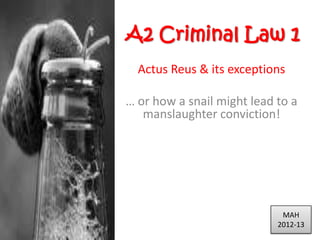
A2 Criminal Law 1
  Actus Reus & its exceptions

… or how a snail might lead to a
   manslaughter conviction!


                             MAH
                            2012-13
All of these we have come across at AS… can you work them out?
          What’s the legal word?
Introduction:

            What do we do at A2?
      Criminal Law G153
          60% of A2 Law
     3 questions in two hours
        One essay question
      One problem question
     One application question                        1. Be here
                                                     2. Be equipped

      Criminal Law G154                              3. Do your work
                                                     4. Complete the case
           40% of A2 Law                                studies (more on this on
Synoptic – Insanity and Automatism                      Friday!)
          Source Booklet
      3 questions, no choice                         5. Listen
             One essay
         One case analysis
      Three short problems
So what are the general rules in criminal law?

1. All crimes require two
   elements*
                                       Actus Reus
2. To convict it must be proven
   beyond all reasonable doubt by   Should be a positive, voluntary act
   P

            Applying it.
Which element of the crime do the
following refer to?

I’m going to steal a car.
A punch in the face causing a
black eye
I just shot a man and I’m glad.

                                                Leicester v Pearson 1952
Applying the Law
      At A2, there are more marks for applying than explaining the law. This means
         you need to be able to use the rules you learn to decide on D’s liability.
        Using just what you know so far, decide on the liability of each defendant:

 D is at the doctors, having his reflexes
 tested. His leg kicks out, causing the
       doctor to suffer a black eye

D is dancing around, and clips V with her
     elbow, sending her over a small
      balcony, causing a broken leg.

  D is angry at V, and argues with him.
      Losing his temper he punches
         him, breaking his nose.

D1 spikes D2’s lemonade, hoping he will
 stay and talk to her. D2 doesn’t realise
     and drives his car home whilst
               intoxicated.
Last bit of general knowledge:

     The many ways to commit a crime
                   (types of actus reus)


Consequence or                 You stab James, who dies.
    Result

   Conduct             You use James’ phone without permission


                        You are in the wrong place… wrong time!
State of Affairs                           Winzar


                       You forget to close a gate and your child
   Omission                runs onto the road and is killed.
So which type are each of
                 these?
                                                D is expelled from the UK. She goes
 D takes £1000 out of the company               to Ireland, who don’t want her and
safe, intending to replace it when he            forcibly deport her back to the UK
  is paid at the end of the month.               where she is arrested for being an
               Velyuml                                      illegal alien.
                                                             Larsonneur


 D was sitting on a chair when an eight-         D puts metal bars across the exits
 year-old girl put her hand on his penis        doors from a theatre. He then turns
   outside his trousers for about five
                                                the light off and shouts fire. People
minutes. The pressure of the child's hand
    caused him to have an erection.              are injured running into the bars.
                  Speck                                         Martin


    Challenge yourself: Can you identify a legal issue with each one of these. In
             other words D is arguing that they are not guilty… why?
Omissions:
            Our first real                                                     Student Task:


           area of the law!
                                                                           On your table there are
                                                                           five sets of facts. In only
                                                                           one of them is there no
                          D walks home from       DD’s daughter had                  crime.
D invites his sister to         his job as a     diabetes. As a result
 come and stay with          lifeguard. As he    of their beliefs, they
  him. Whilst she is      walks past the local       refused to let       All of you should be able
there, she refuses to         river, he sees a     doctors treat her      to decide as a group
  eat any food and             child in there    with insulin and she     which is the odd one out
 dies of malnutrition     struggling. He walks           died.
                                    past.                                 Most of you will be able
                                                                          to explain why the others
 D is searched by a                                                       should be liable.
                           D walks home from his job as a
 police officer who
                           lifeguard. As he walks, he sees
 asks him if he has
                                a child in the local river                Some of you will be able
   anything in his
                           struggling. He jumps in to save                to explain why the
 pockets. D replies
                               V, but in the resuscitation                majority of these
no, but has a needle
                             accidently breaks one of her                 scenarios are exceptions
  which stabs the
                              ribs, resulting in V’s death.
       officer.                                                           to the general rule on
                                                                          criminal liabilty and justify
                                                                          those exceptions.
So, if those are the exceptions… what’s the
                  general rule?
Definition:          An omission is a failure to do something. They come largely from the
                     common law which means that they are created by the courts


 General Rule:


         At A2, to prove our points, we need an illustration or precedent .
             Here it is a case we have met at AS Airedale NHS v Bland


   AO2 Thinking:        Is it always easy to divide actions into acts and omissions?
What do I mean by a ‘duty of care’?
                          This is a legal not moral decision


   Donoghue v Stevenson 1932                          A criminal example...

                                                         R v Winters 2010
  "You must take reasonable care to
avoid acts or omissions which you can
reasonably foresee would be likely to
 injure your neighbour. Who then, in
   law is my neighbour? The answer
   seems to be - persons who are so
  closely and directly affected by my
  act that I ought reasonably to have
    them in contemplation as being
affected when I am directing my mind
 to the acts or omissions which are in                         The list of situations we
               question."                                       are going to look at is
                                                               not finite. Khan & Khan
Duty arising from specific relationships
            R v Gibbons & Proctor 1918


         s.1 Child and Young Person’s Act 1933
Duty arising from contractual obligations
              R v Pittwood 1902
              R v Adomako 1993
Duty arising from public office
         R v Dytham 1979
Voluntary Assumption of Duty
      R v Stone & Dobinson 1977
            R v Instan 1893
Duty Arising from Dangerous Prior Conduct
                  R v Miller 1983
           R v Santana-Bermudez 2003
Starter:
      Can you name the following cases and tell me which duty of care
                             was identified?


1.   Neigh neigh... choo choo...


                                                              Sticker Challenge:
2.   Fanny's been awfully quiet recently

3.   Is that a needle in your pocket, or are you just
     unhappy to see me?                                                   15/20
                                                              1 mark for name or ½ for facts
4.   My wicked stepmother didn't even give me an                     1 mark for duty
     apple!

5.   I may be a policeman, but I don't care.

6.   Cigarette, mattress

7.   Ah don’t think that’s going to help him breathe!

8.   Isn't he just veging out? Can't we (not) do
     something?

9.   Aunt I a lovely girl?

10. A cold explosion proves deadly?
A new situation?
                                      R v Evans (Gemma) 2009

                  Remember that Khan and Khan had made it clear that the courts
                  could develop more duty situations...

                  They had already done this with the case of Wacker, but the most
                  recent situation is detailed in the edited law report.


1. What happened?                                5. Name one case which was followed by the CA in
                                                    this decision

2. What is the main problem with omissions?
                                                 6. What was the duty, which was developed by the
                                                    CA here?
3. What was the outcome of the appeal?

                                                 7. Do you agree that D was “under a plain and
4. Which duty could not be used to convict D and    obvious duty”? Why?
   why?
Statutory Duties
  In addition to those common law areas, there are some specific situations where
          Parliament has decided that an omission attracts criminal liability.
   s.170 Road       S.1 Child and Young   S.6 Road Traffic Act   S.19 Terrorist Act
 Traffic Act 1988    Persons Act 1933            1988                  2000


s.5 Domestic Violence, Crime and
       Victims Act 2004
What is the offence created under this
act?

Why was the mother convicted? What
was her ‘omission’?

Do you agree with the new law? What
kind of situations do you think it was
created to prevent?
Homework
    Applying your understanding of the topic of omissions, and the skills required to
   apply the law successfully, write a paragraph explaining the liability of each of the
                                  following defendants
1. D, a teacher, decides to read her book
   whilst on a school trip. V, a pupil, slips and
   falls into a pond drowning.

2. D, a paramedic on duty, cycles past a
   woman lying on the pavement bleeding.
   She dies.

3. D tells V that his car is safe to borrow, even
   though it is made of two separate cars
   welded together. V is driving down the
   motorway when the car splits in two and V
   crashes, dying.

4. D takes care of her elderly mother, bringing
   her food each day. D then wins the lottery
   and books herself on a cruise, but doesn’t
   arrange care for her mum, and she dies of                Due next Friday 22nd June
   malnutrition.
AO2: Applying the Law


                              Are they liable?
            SITUATION                       DUTY?                     EXPLANATION
Jack & Isabel are having a picnic on a
farm. Jack lights a fire near a haystack.
The haystack catches fire, burning
down the barn next to it. Jack and
Isabel run off and do nothing to prevent
the spread of the fire.

Mitch is a lifeguard at a swimming pool.
While on duty, a child drowns. Mitch
didn’t realise what was happening
because he was chatting to one of his
friends.

Mark starts to look after his elderly
aunt. She is frail and needs to be helped
with her feeding. After 3 weeks, Mark
gets a new girlfriend. He forgets to take
food to his aunt and she dies of
starvation.


                         Remember: Use cases to illustrate your conclusions
True or False?

1. Omissions are not an exception to the general
   rules on criminal liability

2. The list of duty situations is not finite, and has
   most recently been added to in the case of
   Evans (Gemma)

3. The principle of liability for a failure to act is
   based on a civil decision, even though it can
   bring criminal liability.

4. Stone and Dobinson were liable for the death
   of their daughter as they are under a legal
   duty to ensure she is taken care of.                              Challenge:

5. The case of Wacker illustrates that the civil        Can you support your decision
   and criminal interpretations of duty situations        with relevant precedent?
   are identical
… now use this information and your
              Student Task:
       understanding to complete the grid on p.13.

       All of you should be able to explain what is
          In your pair, you have one sheet of paper
       meant by the question (in other words why it
              with a critical statement relating to
       is an issue)
                         omissions on it.
       Most of you will be able to use a case to
          You are going to add one of the pieces of
       illustrate the issue (top box)
          information and then throw it to another
       pair, who will help you to complete it (and so
       Some of you will be able to evaluate whether
                              on…)
       or not it really is a problem (bottom box)


Tip:       Use your fellow students to help you…
           between you, you have all the issues covered!


         *DON’T THROW THE SNOWBALL AWAY*
Writing a good, well developed response
     You are going to use the
  information on your snowball                 What do you mean?
to produce a well explained and
            evaluated              The case of Stone and Dobinson, where the
 paragraph, combining AO1 and     defendants attempted to care for the victim, who
               AO2                refused their help, and the defendants couldn’t get
                                  help because they didn’t know how to use a
                                  telephone, shows how harsh the duties can be on
                                  the defendant. People are liable who should not
                                  be. The defendants did try to help Stone’s sister
                                  and did their best considering their low level of
                                  intellect. This case does not demonstrate a
                                  justifiable exception – it is morally unjust that they
                                  were convicted and sent to prison.

                                  However, in the case of Instan, the imposition of a
                                  duty was justified as she was the only carer for the
                                  victim, and although D may not realise they are
                                  under a legal duty as well as a moral one, by
                                  imposing this duty, the courts are helping to
                                  protect vulnerable victims.
Finally:

                  Was Jesus right?
                                                          Should the
         What about                                       law have a
         the helper                                         moral
         who makes                                          basis?
          it worse?


                              In your pairs discuss the                Consistency
                                                                       in the law?
                                  proposition that:
How does this
 compare to
                           “The law expects too little from
other areas of
   the law?               us, and instead should require us
                               to help, not walk on by.“
                                                                         Can you
                                                                       use a case
                                                                        as part of
               Are all                                                     the
             vulnerable                                                argument?
               victims
             protected?
Plenary:
Answer one of the following questions


    A
        Discuss whether the law on omissions should have a
        moral basis, using a case to illustrate your argument


    B   Explain why omissions are an exception to the general
        rule on criminal liability.

    C   Describe what is meant by a ‘duty of care’


    D
        What is meant by a ‘consequence crime’ and give an
        example of one.


    E   Identify the two key elements in criminal responsibility.
Plenary:

How much have you understood?

On the front of your handout you
have the assessment objectives.

  This is what the examiner will
  expect you to be comfortable
    explaining and discussing.

       To demonstrate your
understanding, I would like you to
  answer one of the three AO1
bullet points on a post it, and one
        of the AO2 points.

   (Separate post its people!)
Homework
   Write up your response to the
                                        Yup, this is how hard I want you to work
            statement:
                                                          at A2!

 “The law expects too little
from us, and instead should
require us to help, not walk
          on by.“
 You should aim to write at least a
 side, and include at least four well
   described and evaluated cases.

   Due: Thursday 21st June 2012

Ar ppt 2012 13

  • 1.
    A2 Criminal Law1 Actus Reus & its exceptions … or how a snail might lead to a manslaughter conviction! MAH 2012-13
  • 2.
    All of thesewe have come across at AS… can you work them out? What’s the legal word?
  • 3.
    Introduction: What do we do at A2? Criminal Law G153 60% of A2 Law 3 questions in two hours One essay question One problem question One application question 1. Be here 2. Be equipped Criminal Law G154 3. Do your work 4. Complete the case 40% of A2 Law studies (more on this on Synoptic – Insanity and Automatism Friday!) Source Booklet 3 questions, no choice 5. Listen One essay One case analysis Three short problems
  • 4.
    So what arethe general rules in criminal law? 1. All crimes require two elements* Actus Reus 2. To convict it must be proven beyond all reasonable doubt by Should be a positive, voluntary act P Applying it. Which element of the crime do the following refer to? I’m going to steal a car. A punch in the face causing a black eye I just shot a man and I’m glad. Leicester v Pearson 1952
  • 5.
    Applying the Law At A2, there are more marks for applying than explaining the law. This means you need to be able to use the rules you learn to decide on D’s liability. Using just what you know so far, decide on the liability of each defendant: D is at the doctors, having his reflexes tested. His leg kicks out, causing the doctor to suffer a black eye D is dancing around, and clips V with her elbow, sending her over a small balcony, causing a broken leg. D is angry at V, and argues with him. Losing his temper he punches him, breaking his nose. D1 spikes D2’s lemonade, hoping he will stay and talk to her. D2 doesn’t realise and drives his car home whilst intoxicated.
  • 6.
    Last bit ofgeneral knowledge: The many ways to commit a crime (types of actus reus) Consequence or You stab James, who dies. Result Conduct You use James’ phone without permission You are in the wrong place… wrong time! State of Affairs Winzar You forget to close a gate and your child Omission runs onto the road and is killed.
  • 7.
    So which typeare each of these? D is expelled from the UK. She goes D takes £1000 out of the company to Ireland, who don’t want her and safe, intending to replace it when he forcibly deport her back to the UK is paid at the end of the month. where she is arrested for being an Velyuml illegal alien. Larsonneur D was sitting on a chair when an eight- D puts metal bars across the exits year-old girl put her hand on his penis doors from a theatre. He then turns outside his trousers for about five the light off and shouts fire. People minutes. The pressure of the child's hand caused him to have an erection. are injured running into the bars. Speck Martin Challenge yourself: Can you identify a legal issue with each one of these. In other words D is arguing that they are not guilty… why?
  • 8.
    Omissions: Our first real Student Task: area of the law! On your table there are five sets of facts. In only one of them is there no D walks home from DD’s daughter had crime. D invites his sister to his job as a diabetes. As a result come and stay with lifeguard. As he of their beliefs, they him. Whilst she is walks past the local refused to let All of you should be able there, she refuses to river, he sees a doctors treat her to decide as a group eat any food and child in there with insulin and she which is the odd one out dies of malnutrition struggling. He walks died. past. Most of you will be able to explain why the others D is searched by a should be liable. D walks home from his job as a police officer who lifeguard. As he walks, he sees asks him if he has a child in the local river Some of you will be able anything in his struggling. He jumps in to save to explain why the pockets. D replies V, but in the resuscitation majority of these no, but has a needle accidently breaks one of her scenarios are exceptions which stabs the ribs, resulting in V’s death. officer. to the general rule on criminal liabilty and justify those exceptions.
  • 9.
    So, if thoseare the exceptions… what’s the general rule? Definition: An omission is a failure to do something. They come largely from the common law which means that they are created by the courts General Rule: At A2, to prove our points, we need an illustration or precedent . Here it is a case we have met at AS Airedale NHS v Bland AO2 Thinking: Is it always easy to divide actions into acts and omissions?
  • 10.
    What do Imean by a ‘duty of care’? This is a legal not moral decision Donoghue v Stevenson 1932 A criminal example... R v Winters 2010 "You must take reasonable care to avoid acts or omissions which you can reasonably foresee would be likely to injure your neighbour. Who then, in law is my neighbour? The answer seems to be - persons who are so closely and directly affected by my act that I ought reasonably to have them in contemplation as being affected when I am directing my mind to the acts or omissions which are in The list of situations we question." are going to look at is not finite. Khan & Khan
  • 11.
    Duty arising fromspecific relationships R v Gibbons & Proctor 1918 s.1 Child and Young Person’s Act 1933
  • 12.
    Duty arising fromcontractual obligations R v Pittwood 1902 R v Adomako 1993
  • 13.
    Duty arising frompublic office R v Dytham 1979
  • 14.
    Voluntary Assumption ofDuty R v Stone & Dobinson 1977 R v Instan 1893
  • 15.
    Duty Arising fromDangerous Prior Conduct R v Miller 1983 R v Santana-Bermudez 2003
  • 16.
    Starter: Can you name the following cases and tell me which duty of care was identified? 1. Neigh neigh... choo choo... Sticker Challenge: 2. Fanny's been awfully quiet recently 3. Is that a needle in your pocket, or are you just unhappy to see me? 15/20 1 mark for name or ½ for facts 4. My wicked stepmother didn't even give me an 1 mark for duty apple! 5. I may be a policeman, but I don't care. 6. Cigarette, mattress 7. Ah don’t think that’s going to help him breathe! 8. Isn't he just veging out? Can't we (not) do something? 9. Aunt I a lovely girl? 10. A cold explosion proves deadly?
  • 17.
    A new situation? R v Evans (Gemma) 2009 Remember that Khan and Khan had made it clear that the courts could develop more duty situations... They had already done this with the case of Wacker, but the most recent situation is detailed in the edited law report. 1. What happened? 5. Name one case which was followed by the CA in this decision 2. What is the main problem with omissions? 6. What was the duty, which was developed by the CA here? 3. What was the outcome of the appeal? 7. Do you agree that D was “under a plain and 4. Which duty could not be used to convict D and obvious duty”? Why? why?
  • 18.
    Statutory Duties In addition to those common law areas, there are some specific situations where Parliament has decided that an omission attracts criminal liability. s.170 Road S.1 Child and Young S.6 Road Traffic Act S.19 Terrorist Act Traffic Act 1988 Persons Act 1933 1988 2000 s.5 Domestic Violence, Crime and Victims Act 2004 What is the offence created under this act? Why was the mother convicted? What was her ‘omission’? Do you agree with the new law? What kind of situations do you think it was created to prevent?
  • 19.
    Homework Applying your understanding of the topic of omissions, and the skills required to apply the law successfully, write a paragraph explaining the liability of each of the following defendants 1. D, a teacher, decides to read her book whilst on a school trip. V, a pupil, slips and falls into a pond drowning. 2. D, a paramedic on duty, cycles past a woman lying on the pavement bleeding. She dies. 3. D tells V that his car is safe to borrow, even though it is made of two separate cars welded together. V is driving down the motorway when the car splits in two and V crashes, dying. 4. D takes care of her elderly mother, bringing her food each day. D then wins the lottery and books herself on a cruise, but doesn’t arrange care for her mum, and she dies of Due next Friday 22nd June malnutrition.
  • 20.
    AO2: Applying theLaw Are they liable? SITUATION DUTY? EXPLANATION Jack & Isabel are having a picnic on a farm. Jack lights a fire near a haystack. The haystack catches fire, burning down the barn next to it. Jack and Isabel run off and do nothing to prevent the spread of the fire. Mitch is a lifeguard at a swimming pool. While on duty, a child drowns. Mitch didn’t realise what was happening because he was chatting to one of his friends. Mark starts to look after his elderly aunt. She is frail and needs to be helped with her feeding. After 3 weeks, Mark gets a new girlfriend. He forgets to take food to his aunt and she dies of starvation. Remember: Use cases to illustrate your conclusions
  • 21.
    True or False? 1.Omissions are not an exception to the general rules on criminal liability 2. The list of duty situations is not finite, and has most recently been added to in the case of Evans (Gemma) 3. The principle of liability for a failure to act is based on a civil decision, even though it can bring criminal liability. 4. Stone and Dobinson were liable for the death of their daughter as they are under a legal duty to ensure she is taken care of. Challenge: 5. The case of Wacker illustrates that the civil Can you support your decision and criminal interpretations of duty situations with relevant precedent? are identical
  • 22.
    … now usethis information and your Student Task: understanding to complete the grid on p.13. All of you should be able to explain what is In your pair, you have one sheet of paper meant by the question (in other words why it with a critical statement relating to is an issue) omissions on it. Most of you will be able to use a case to You are going to add one of the pieces of illustrate the issue (top box) information and then throw it to another pair, who will help you to complete it (and so Some of you will be able to evaluate whether on…) or not it really is a problem (bottom box) Tip: Use your fellow students to help you… between you, you have all the issues covered! *DON’T THROW THE SNOWBALL AWAY*
  • 23.
    Writing a good,well developed response You are going to use the information on your snowball What do you mean? to produce a well explained and evaluated The case of Stone and Dobinson, where the paragraph, combining AO1 and defendants attempted to care for the victim, who AO2 refused their help, and the defendants couldn’t get help because they didn’t know how to use a telephone, shows how harsh the duties can be on the defendant. People are liable who should not be. The defendants did try to help Stone’s sister and did their best considering their low level of intellect. This case does not demonstrate a justifiable exception – it is morally unjust that they were convicted and sent to prison. However, in the case of Instan, the imposition of a duty was justified as she was the only carer for the victim, and although D may not realise they are under a legal duty as well as a moral one, by imposing this duty, the courts are helping to protect vulnerable victims.
  • 24.
    Finally: Was Jesus right? Should the What about law have a the helper moral who makes basis? it worse? In your pairs discuss the Consistency in the law? proposition that: How does this compare to “The law expects too little from other areas of the law? us, and instead should require us to help, not walk on by.“ Can you use a case as part of Are all the vulnerable argument? victims protected?
  • 25.
    Plenary: Answer one ofthe following questions A Discuss whether the law on omissions should have a moral basis, using a case to illustrate your argument B Explain why omissions are an exception to the general rule on criminal liability. C Describe what is meant by a ‘duty of care’ D What is meant by a ‘consequence crime’ and give an example of one. E Identify the two key elements in criminal responsibility.
  • 26.
    Plenary: How much haveyou understood? On the front of your handout you have the assessment objectives. This is what the examiner will expect you to be comfortable explaining and discussing. To demonstrate your understanding, I would like you to answer one of the three AO1 bullet points on a post it, and one of the AO2 points. (Separate post its people!)
  • 27.
    Homework Write up your response to the Yup, this is how hard I want you to work statement: at A2! “The law expects too little from us, and instead should require us to help, not walk on by.“ You should aim to write at least a side, and include at least four well described and evaluated cases. Due: Thursday 21st June 2012