MPI Tutorial
Shao-Ching Huang
IDRE High Performance Computing Workshop
2013-02-13
Distributed Memory
 Each CPU has its own (local) memory
2
This needs to be fast for parallel scalability (e.g. Infiniband, Myrinet, etc.)
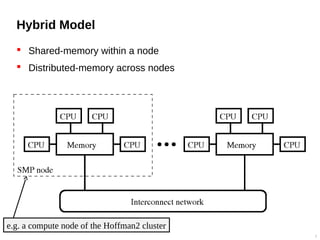
Hybrid Model
 Shared-memory within a node
 Distributed-memory across nodes
3
e.g. a compute node of the Hoffman2 cluster
Today’s Topics
 What is MPI
 Message passing basics
 Point to point communication
 Collective communication
 Derived data types
 Examples
4
MPI = Message Passing Interface
 API for distributed-memory programming
– parallel code that runs across multiple computers (nodes)
– http://www.mpi-forum.org/
 De facto industry standard
– available on (almost) every parallel computer for scientific computing
 Use from C/C++, Fortran, Python, R, ...
 More than 200 routines
 Using only 10 routines are enough in many cases
– Problem dependent
5
Clarification
 You can mix MPI and OpenMP in one program
 You could run multiple MPI processes on a single CPU
– e.g. debug MPI codes on your laptop
– An MPI job can span across multiple computer nodes (distributed memory)
 You could run multiple OpenMP threads on a single CPU
– e.g. debug OpenMP codes on your laptop
MPI Facts
 High-quality implementation available for free
– Easy to install one on your desktop/laptop
– OpenMPI: http://www.open-mpi.org/
– MPICH2: http://www.mcs.anl.gov/research/projects/mpich2/
 Installation Steps
– download the software
– (assuming you already have C/C++/Fortran compilers)
– On Mac or Linux: “configure, make, make install”
7
Communicator
 A group of processes
– processes are numbered 0,1,.. to N-1
 Default communicator
– MPI_COMM_WORLD
– contains all processes
 Query functions:
– How many processes in total?
MPI_Comm_size(MPI_COMM_WORLD, &nproc)
– What is my process ID?
MPI_Comm_rank(MPI_COMM_WORLD, &rank)
…
8
Hello world (C)
9
#include "mpi.h” // MPI header file
#include <stdio.h>
main(int argc, char *argv[])
{
int np, pid;
MPI_Init(&argc, &argv); // initialize MPI
MPI_Comm_size(MPI_COMM_WORLD, &np);
MPI_Comm_rank(MPI_COMM_WORLD, &pid);
printf("N. of procs = %d, proc ID = %dn", np, pid);
MPI_Finalize(); // clean up
}
Hello world (Fortran)
10
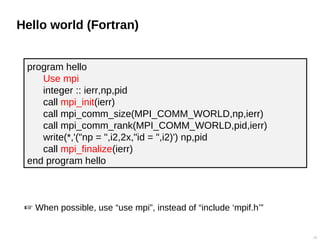
program hello
Use mpi
integer :: ierr,np,pid
call mpi_init(ierr)
call mpi_comm_size(MPI_COMM_WORLD,np,ierr)
call mpi_comm_rank(MPI_COMM_WORLD,pid,ierr)
write(*,'("np = ",i2,2x,"id = ",i2)') np,pid
call mpi_finalize(ierr)
end program hello
 When possible, use “use mpi”, instead of “include ‘mpif.h’”
Error checking
 Most MPI routines returns an error code
– C routines as the function value
– Fortran routines in the last argument
 Examples
– Fortran
MPI_Comm_rank(MPI_COMM_WORLD, myid, ierr)
– C/C++
int ierr = MPI_Comm_rank(MPI_COMM_WORLD, &myid);
11
MPI built-in data types
 See MPI standard for a complete list
 New types can be (recursively) created/defined
– based on existing types
– called “derived data type”
– discussed later
12
C/C++ Fortran
MPI_CHAR MPI_CHARACTER
MPI_INT MPI_INTEGER
MPI_FLOAT MPI_REAL
MPI_DOUBLE MPI_DOUBLE_PRECISI
ON
… …
Today’s Topics
 Message passing basics
 Point to point communication
 Collective communication
 Derived data types
 Examples
13
Point to point communication
14
process 0process 0 process 1process 1
process 2process 2
process 3process 3
MPI_Send(…,dest=1)
MPI_Recv(…, src=2)
data
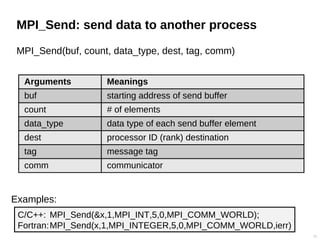
MPI_Send: send data to another process
MPI_Send(buf, count, data_type, dest, tag, comm)
15
Arguments Meanings
buf starting address of send buffer
count # of elements
data_type data type of each send buffer element
dest processor ID (rank) destination
tag message tag
comm communicator
C/C++: MPI_Send(&x,1,MPI_INT,5,0,MPI_COMM_WORLD);
Fortran:MPI_Send(x,1,MPI_INTEGER,5,0,MPI_COMM_WORLD,ierr)
Examples:
MPI_Recv: receive data from another process
MPI_Recv(buf, count, datatype, src, tag, comm, status)
16
Arguments Meanings
buf starting address of send buffer
count # of elements
datatype data type of each send buffer element
src processor ID (rank) destination
tag message tag
comm communicator
status status object (an integer array in Fortran)
C/C++: MPI_Recv(&x,1,MPI_INT,5,0,MPI_COMM_WORLD,&stat);
Fortran: MPI_Recv(x,1,MPI_INTEGER,5,0,MPI_COMM_WORLD,stat,ierr)
Examples:
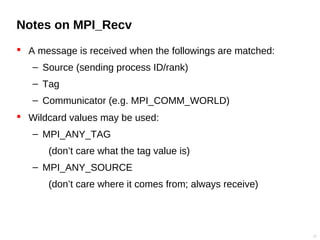
Notes on MPI_Recv
 A message is received when the followings are matched:
– Source (sending process ID/rank)
– Tag
– Communicator (e.g. MPI_COMM_WORLD)
 Wildcard values may be used:
– MPI_ANY_TAG
(don’t care what the tag value is)
– MPI_ANY_SOURCE
(don’t care where it comes from; always receive)
17
Send/recv example (C)
 Send an integer array f[N] from process 0 to process 1
18
int f[N], src=0, dest=1;
MPI_Status status;
// ...
MPI_Comm_rank( MPI_COMM_WORLD, &rank);
if (rank == src) // process “dest” ignores this
MPI_Send(f, N, MPI_INT, dest, 0, MPI_COMM_WORLD);
if (rank == dest) // process “src” ignores this
MPI_Recv(f, N, MPI_INT, src, 0, MPI_COMM_WORLD, &status);
//...
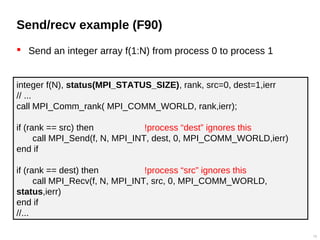
Send/recv example (F90)
 Send an integer array f(1:N) from process 0 to process 1
19
integer f(N), status(MPI_STATUS_SIZE), rank, src=0, dest=1,ierr
// ...
call MPI_Comm_rank( MPI_COMM_WORLD, rank,ierr);
if (rank == src) then !process “dest” ignores this
call MPI_Send(f, N, MPI_INT, dest, 0, MPI_COMM_WORLD,ierr)
end if
if (rank == dest) then !process “src” ignores this
call MPI_Recv(f, N, MPI_INT, src, 0, MPI_COMM_WORLD,
status,ierr)
end if
//...
Send/Recv example (cont’d)
 Before
 After
20
process 0 (send) process 1 (recv)
f[0]=0
f[1]=1
f[2]=2
f[0]=0
f[1]=0
f[2]=0
process 0 (send) process 1 (recv)
f[0]=0
f[1]=1
f[2]=2
f[0]=0
f[1]=1
f[2]=2
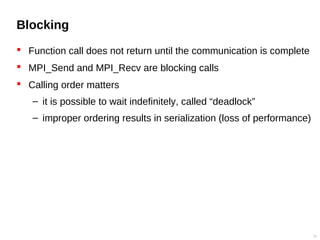
Blocking
 Function call does not return until the communication is complete
 MPI_Send and MPI_Recv are blocking calls
 Calling order matters
– it is possible to wait indefinitely, called “deadlock”
– improper ordering results in serialization (loss of performance)
21
Deadlock
 This code always works:
22
MPI_Comm_rank(comm, &rank);
if (rank == 0) {
MPI_Send(sendbuf, cnt, MPI_INT, 1, tag, comm);
MPI_Recv(recvbuf, cnt, MPI_INT, 1, tag, comm, &stat);
} else { // rank==1
MPI_Recv(recvbuf, cnt, MPI_INT, 0, tag, comm, &stat);
MPI_Send(sendbuf, cnt, MPI_INT, 0, tag, comm);
}
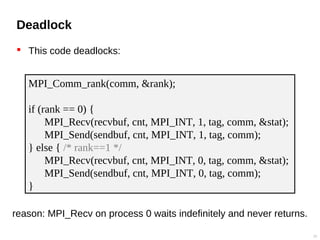
Deadlock
 This code deadlocks:
23
MPI_Comm_rank(comm, &rank);
if (rank == 0) {
MPI_Recv(recvbuf, cnt, MPI_INT, 1, tag, comm, &stat);
MPI_Send(sendbuf, cnt, MPI_INT, 1, tag, comm);
} else { /* rank==1 */
MPI_Recv(recvbuf, cnt, MPI_INT, 0, tag, comm, &stat);
MPI_Send(sendbuf, cnt, MPI_INT, 0, tag, comm);
}
reason: MPI_Recv on process 0 waits indefinitely and never returns.
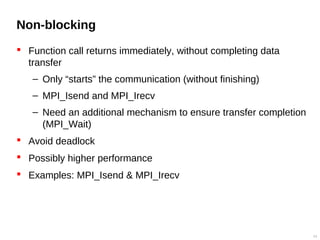
Non-blocking
 Function call returns immediately, without completing data
transfer
– Only “starts” the communication (without finishing)
– MPI_Isend and MPI_Irecv
– Need an additional mechanism to ensure transfer completion
(MPI_Wait)
 Avoid deadlock
 Possibly higher performance
 Examples: MPI_Isend & MPI_Irecv
24
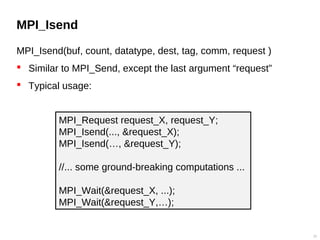
MPI_Isend
MPI_Isend(buf, count, datatype, dest, tag, comm, request )
 Similar to MPI_Send, except the last argument “request”
 Typical usage:
25
MPI_Request request_X, request_Y;
MPI_Isend(..., &request_X);
MPI_Isend(…, &request_Y);
//... some ground-breaking computations ...
MPI_Wait(&request_X, ...);
MPI_Wait(&request_Y,…);
MPI_Irecv
MPI_Irecv(buf, count, datatype, src, tag, comm, request )
 Similar to MPI_Recv, except the last argument “request”
 Typical usage:
26
MPI_Request request_X, request_Y;
MPI_Irecv(..., &request_X);
MPI_Irecv(…, &request_Y);
//... more ground-breaking computations ...
MPI_Wait(&request_X, ...);
MPI_Wait(&request_Y,…);
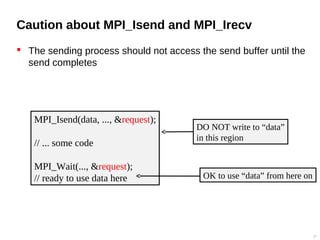
Caution about MPI_Isend and MPI_Irecv
 The sending process should not access the send buffer until the
send completes
27
MPI_Isend(data, ..., &request);
// ... some code
MPI_Wait(..., &request);
// ready to use data here
DO NOT write to “data”
in this region
OK to use “data” from here on
MPI_Wait
MPI_Wait(MPI_Request, MPI_Status)
 Wait for an MPI_Isend/recv to complete
 Use the same “request” used in an earlier MPI_Isend or
MPI_Irecv
 If they are multiple requests, one can use
MPI_Waitall(count, request[], status[]);
request[] and status[] are arrays.
28
Other variants of MPI Send/Recv
 MPI_Sendrecv
– send and receive in one call
 Mixing blocking and non-blocking calls
– e.g. MPI_Isend + MPI_Recv
 MPI_Bsend
– buffered send
 MPI_Ibsend
 … (see MPI standard for more)
29
Today’s Topics
 Message passing basics
– communicators
– data types
 Point to point communication
 Collective communication
 Derived data types
 Examples
30
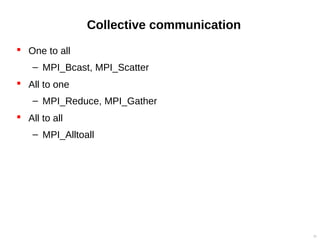
Collective communication
 One to all
– MPI_Bcast, MPI_Scatter
 All to one
– MPI_Reduce, MPI_Gather
 All to all
– MPI_Alltoall
31
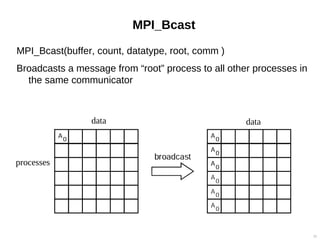
MPI_Bcast
MPI_Bcast(buffer, count, datatype, root, comm )
Broadcasts a message from “root” process to all other processes in
the same communicator
32
data
processes
data
MPI_Bcast Example
 Broadcast 100 integers from process “3” to all other processes
33
MPI_Comm comm;
int array[100];
//...
MPI_Bcast( array, 100, MPI_INT, 3, comm);
INTEGER comm
integer array(100)
//...
call MPI_Bcast( array, 100, MPI_INTEGER, 3, comm,ierr)
C/C++
Fortran
MPI_Gather & MPI_Scatter
MPI_Gather (sbuf, scnt, stype, rbuf, rcnt, rtype, root, comm )
MPI_Scatter(sbuf, scnt, stype, rbuf, rcnt, rtype, root, comm )
34
processes
data
 When gathering, make sure the root process has big enough memory to
hold the data (especially when you scale up the problem size).
MPI_Gather Example
35
MPI_Comm comm;
int np, myid, sendarray[N], root;
double *rbuf;
MPI_Comm_size( comm, &np); // # of processes
MPI_Comm_rank( comm, &myid); // process ID
if (myid == root) // allocate space on process root
rbuf = new double [np*N];
MPI_Gather( sendarray, N, MPI_INT, rbuf, N, MPI_INT,
root, comm);
Variations of MPI_Gather/Scatter
 Variable data size
– MPI_Gatherv
– MPI_Scatterv
 Gather + broadcast (in one call)
– MPI_Allgather
– MPI_Allgatherv
36
MPI_Alltoall
MPI_Alltoall( send_buf, send_count, send_data_type,
recv_buf, recv_count, recv_data_type, comm)
The j-th block send_buf from process i is received by process j and
is placed in the i-th block of rbuf:
37
processes
data data
MPI_Reduce
MPI_Reduce (send_buf, recv_buf, data_type, OP, root, comm)
 Apply operation OP to send_buf from all processes and return
result in the recv_buf on process “root”.
 Some predefined operations:
38
Operations (OP) Meaning
MPI_MAX maximum value
MPI_MIN minimum value
MPI_SUM sum
MPI_PROD products
…
(see MPI standard for more predefined reduce operations)
MPI_Reduce example
 Parallel vector inner product:
39
// loc_sum = local sum
float loc_sum = 0.0; // probably should use double
for (i = 0; i < N; i++)
loc_sum += x[i] * y[i];
// sum = global sum
MPI_Reduce(&loc_sum, &sum, 1, MPI_FLOAT, MPI_SUM,
root, MPI_COMM_WORLD);
Today’s Topics
 Message passing basics
– communicators
– data types
 Point to point communication
 Collective communication
 Derived data types
 Examples
40
Derived Data Type
 Define data objects of various sizes and shapes (memory layout)
 Example
– The send and recv ends have same data size but different
memory layouts
41
memory layout
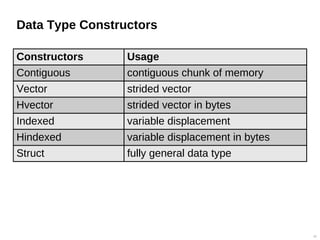
Data Type Constructors
42
Constructors Usage
Contiguous contiguous chunk of memory
Vector strided vector
Hvector strided vector in bytes
Indexed variable displacement
Hindexed variable displacement in bytes
Struct fully general data type
MPI_Type_contiguous
MPI_Type_contiguous(count, old_type, newtype)
 Define a contiguous chunk of memory
 Example – a memory block of 10 integers
43
int a[10];
MPI_Datatype intvec;
MPI_Type_contiguous(10, MPI_INT, &intvec);
MPI_Type_commit(&intvec);
MPI_Send(a, 1, intvec, ...); /* send 1 10-int vector */
MPI_Send(a, 10, MPI_INT,...); /* send 10 ints */
is equivalent to
new type
MPI_Type_vector
MPI_Type_vector(count, blocklen, stride, old_type, newtype )
To create a strided vector (i.e. with “holes”):
44
MPI_Datatype yellow_vec;
MPI_Type_vector(3, 4, 6, MPI_FLOAT, &yellow_vec);
MPI_Type_commit(&yellow_vec);
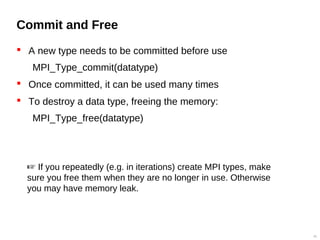
Commit and Free
 A new type needs to be committed before use
MPI_Type_commit(datatype)
 Once committed, it can be used many times
 To destroy a data type, freeing the memory:
MPI_Type_free(datatype)
45
 If you repeatedly (e.g. in iterations) create MPI types, make
sure you free them when they are no longer in use. Otherwise
you may have memory leak.
Examples
 Poisson equation
 Fast Fourier Transform (FFT)
46
Poisson equation (or any elliptic PDE)
47
process 0
process 1
process 2
partition
boundary
Computational grid:
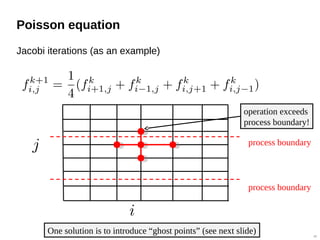
Poisson equation
Jacobi iterations (as an example)
48
operation exceeds
process boundary!
process boundary
process boundary
One solution is to introduce “ghost points” (see next slide)
Ghost points
Redundant copy of data held on neighboring processes
49
process 0
process 1
ghost points
Update ghost points in one iteration
 2-step process
 Repeat for many iterations until convergence
50
pass 1
pass 2
MPI_SendMPI_Recv
Poisson solution
Dirichlet boundary conditions
51
“Parallel” FFT
52
Doing multiple (sequential) FFT in parallel
Timing
 MPI_Wtime
– elapsed wall-clock time in seconds
– Note: wall-clock time is not CPU time
 Example
53
double t1,t2;
t1 = MPI_Wtime();
//... some heavy work ...
t2 = MPI_Wtime();
printf("elapsed time = %f secondsn", t2-t1);
Parallel
How to run an MPI program
 Compile
C: mpicc foo.c
C++: mpicxx foo.cpp
F90: mpif90 foo.f90
 Run
mpiexec –n 4 [options] a.out
– The options in mpiexec are implementation dependent
– Check out the user’s manual
54
 mpicc, mpicxx and mpif90 are
sometimes called the MPI compilers
(wrappers)
Summary
 MPI for distributed-memory programming
– works on shared-memory parallel computers too
 Communicator
– a group of processes, numbered 0,1,…,to N-1
 Data Types
– derived types can be defined based on built-in ones
 Point-to-point Communication
– blocking (Send/Recv) and non-blocking (Isend/Irecv)
 Collective Communication
– gather, scatter, alltoall
55
Online Resources
 MPI-1 standard
http://www.mpi-forum.org/docs/mpi-11-html/mpi-report.html
 MPI-2 standard
http://www.mpi-forum.org/docs/mpi-20-html/mpi2-report.html
 MPI-3 standard
http://www.mpi-forum.org/docs/mpi-3.0/mpi30-report.pdf
56

Mpi

  • 1.
    MPI Tutorial Shao-Ching Huang IDREHigh Performance Computing Workshop 2013-02-13
  • 2.
    Distributed Memory  EachCPU has its own (local) memory 2 This needs to be fast for parallel scalability (e.g. Infiniband, Myrinet, etc.)
  • 3.
    Hybrid Model  Shared-memorywithin a node  Distributed-memory across nodes 3 e.g. a compute node of the Hoffman2 cluster
  • 4.
    Today’s Topics  Whatis MPI  Message passing basics  Point to point communication  Collective communication  Derived data types  Examples 4
  • 5.
    MPI = MessagePassing Interface  API for distributed-memory programming – parallel code that runs across multiple computers (nodes) – http://www.mpi-forum.org/  De facto industry standard – available on (almost) every parallel computer for scientific computing  Use from C/C++, Fortran, Python, R, ...  More than 200 routines  Using only 10 routines are enough in many cases – Problem dependent 5
  • 6.
    Clarification  You canmix MPI and OpenMP in one program  You could run multiple MPI processes on a single CPU – e.g. debug MPI codes on your laptop – An MPI job can span across multiple computer nodes (distributed memory)  You could run multiple OpenMP threads on a single CPU – e.g. debug OpenMP codes on your laptop
  • 7.
    MPI Facts  High-qualityimplementation available for free – Easy to install one on your desktop/laptop – OpenMPI: http://www.open-mpi.org/ – MPICH2: http://www.mcs.anl.gov/research/projects/mpich2/  Installation Steps – download the software – (assuming you already have C/C++/Fortran compilers) – On Mac or Linux: “configure, make, make install” 7
  • 8.
    Communicator  A groupof processes – processes are numbered 0,1,.. to N-1  Default communicator – MPI_COMM_WORLD – contains all processes  Query functions: – How many processes in total? MPI_Comm_size(MPI_COMM_WORLD, &nproc) – What is my process ID? MPI_Comm_rank(MPI_COMM_WORLD, &rank) … 8
  • 9.
    Hello world (C) 9 #include"mpi.h” // MPI header file #include <stdio.h> main(int argc, char *argv[]) { int np, pid; MPI_Init(&argc, &argv); // initialize MPI MPI_Comm_size(MPI_COMM_WORLD, &np); MPI_Comm_rank(MPI_COMM_WORLD, &pid); printf("N. of procs = %d, proc ID = %dn", np, pid); MPI_Finalize(); // clean up }
  • 10.
    Hello world (Fortran) 10 programhello Use mpi integer :: ierr,np,pid call mpi_init(ierr) call mpi_comm_size(MPI_COMM_WORLD,np,ierr) call mpi_comm_rank(MPI_COMM_WORLD,pid,ierr) write(*,'("np = ",i2,2x,"id = ",i2)') np,pid call mpi_finalize(ierr) end program hello  When possible, use “use mpi”, instead of “include ‘mpif.h’”
  • 11.
    Error checking  MostMPI routines returns an error code – C routines as the function value – Fortran routines in the last argument  Examples – Fortran MPI_Comm_rank(MPI_COMM_WORLD, myid, ierr) – C/C++ int ierr = MPI_Comm_rank(MPI_COMM_WORLD, &myid); 11
  • 12.
    MPI built-in datatypes  See MPI standard for a complete list  New types can be (recursively) created/defined – based on existing types – called “derived data type” – discussed later 12 C/C++ Fortran MPI_CHAR MPI_CHARACTER MPI_INT MPI_INTEGER MPI_FLOAT MPI_REAL MPI_DOUBLE MPI_DOUBLE_PRECISI ON … …
  • 13.
    Today’s Topics  Messagepassing basics  Point to point communication  Collective communication  Derived data types  Examples 13
  • 14.
    Point to pointcommunication 14 process 0process 0 process 1process 1 process 2process 2 process 3process 3 MPI_Send(…,dest=1) MPI_Recv(…, src=2) data
  • 15.
    MPI_Send: send datato another process MPI_Send(buf, count, data_type, dest, tag, comm) 15 Arguments Meanings buf starting address of send buffer count # of elements data_type data type of each send buffer element dest processor ID (rank) destination tag message tag comm communicator C/C++: MPI_Send(&x,1,MPI_INT,5,0,MPI_COMM_WORLD); Fortran:MPI_Send(x,1,MPI_INTEGER,5,0,MPI_COMM_WORLD,ierr) Examples:
  • 16.
    MPI_Recv: receive datafrom another process MPI_Recv(buf, count, datatype, src, tag, comm, status) 16 Arguments Meanings buf starting address of send buffer count # of elements datatype data type of each send buffer element src processor ID (rank) destination tag message tag comm communicator status status object (an integer array in Fortran) C/C++: MPI_Recv(&x,1,MPI_INT,5,0,MPI_COMM_WORLD,&stat); Fortran: MPI_Recv(x,1,MPI_INTEGER,5,0,MPI_COMM_WORLD,stat,ierr) Examples:
  • 17.
    Notes on MPI_Recv A message is received when the followings are matched: – Source (sending process ID/rank) – Tag – Communicator (e.g. MPI_COMM_WORLD)  Wildcard values may be used: – MPI_ANY_TAG (don’t care what the tag value is) – MPI_ANY_SOURCE (don’t care where it comes from; always receive) 17
  • 18.
    Send/recv example (C) Send an integer array f[N] from process 0 to process 1 18 int f[N], src=0, dest=1; MPI_Status status; // ... MPI_Comm_rank( MPI_COMM_WORLD, &rank); if (rank == src) // process “dest” ignores this MPI_Send(f, N, MPI_INT, dest, 0, MPI_COMM_WORLD); if (rank == dest) // process “src” ignores this MPI_Recv(f, N, MPI_INT, src, 0, MPI_COMM_WORLD, &status); //...
  • 19.
    Send/recv example (F90) Send an integer array f(1:N) from process 0 to process 1 19 integer f(N), status(MPI_STATUS_SIZE), rank, src=0, dest=1,ierr // ... call MPI_Comm_rank( MPI_COMM_WORLD, rank,ierr); if (rank == src) then !process “dest” ignores this call MPI_Send(f, N, MPI_INT, dest, 0, MPI_COMM_WORLD,ierr) end if if (rank == dest) then !process “src” ignores this call MPI_Recv(f, N, MPI_INT, src, 0, MPI_COMM_WORLD, status,ierr) end if //...
  • 20.
    Send/Recv example (cont’d) Before  After 20 process 0 (send) process 1 (recv) f[0]=0 f[1]=1 f[2]=2 f[0]=0 f[1]=0 f[2]=0 process 0 (send) process 1 (recv) f[0]=0 f[1]=1 f[2]=2 f[0]=0 f[1]=1 f[2]=2
  • 21.
    Blocking  Function calldoes not return until the communication is complete  MPI_Send and MPI_Recv are blocking calls  Calling order matters – it is possible to wait indefinitely, called “deadlock” – improper ordering results in serialization (loss of performance) 21
  • 22.
    Deadlock  This codealways works: 22 MPI_Comm_rank(comm, &rank); if (rank == 0) { MPI_Send(sendbuf, cnt, MPI_INT, 1, tag, comm); MPI_Recv(recvbuf, cnt, MPI_INT, 1, tag, comm, &stat); } else { // rank==1 MPI_Recv(recvbuf, cnt, MPI_INT, 0, tag, comm, &stat); MPI_Send(sendbuf, cnt, MPI_INT, 0, tag, comm); }
  • 23.
    Deadlock  This codedeadlocks: 23 MPI_Comm_rank(comm, &rank); if (rank == 0) { MPI_Recv(recvbuf, cnt, MPI_INT, 1, tag, comm, &stat); MPI_Send(sendbuf, cnt, MPI_INT, 1, tag, comm); } else { /* rank==1 */ MPI_Recv(recvbuf, cnt, MPI_INT, 0, tag, comm, &stat); MPI_Send(sendbuf, cnt, MPI_INT, 0, tag, comm); } reason: MPI_Recv on process 0 waits indefinitely and never returns.
  • 24.
    Non-blocking  Function callreturns immediately, without completing data transfer – Only “starts” the communication (without finishing) – MPI_Isend and MPI_Irecv – Need an additional mechanism to ensure transfer completion (MPI_Wait)  Avoid deadlock  Possibly higher performance  Examples: MPI_Isend & MPI_Irecv 24
  • 25.
    MPI_Isend MPI_Isend(buf, count, datatype,dest, tag, comm, request )  Similar to MPI_Send, except the last argument “request”  Typical usage: 25 MPI_Request request_X, request_Y; MPI_Isend(..., &request_X); MPI_Isend(…, &request_Y); //... some ground-breaking computations ... MPI_Wait(&request_X, ...); MPI_Wait(&request_Y,…);
  • 26.
    MPI_Irecv MPI_Irecv(buf, count, datatype,src, tag, comm, request )  Similar to MPI_Recv, except the last argument “request”  Typical usage: 26 MPI_Request request_X, request_Y; MPI_Irecv(..., &request_X); MPI_Irecv(…, &request_Y); //... more ground-breaking computations ... MPI_Wait(&request_X, ...); MPI_Wait(&request_Y,…);
  • 27.
    Caution about MPI_Isendand MPI_Irecv  The sending process should not access the send buffer until the send completes 27 MPI_Isend(data, ..., &request); // ... some code MPI_Wait(..., &request); // ready to use data here DO NOT write to “data” in this region OK to use “data” from here on
  • 28.
    MPI_Wait MPI_Wait(MPI_Request, MPI_Status)  Waitfor an MPI_Isend/recv to complete  Use the same “request” used in an earlier MPI_Isend or MPI_Irecv  If they are multiple requests, one can use MPI_Waitall(count, request[], status[]); request[] and status[] are arrays. 28
  • 29.
    Other variants ofMPI Send/Recv  MPI_Sendrecv – send and receive in one call  Mixing blocking and non-blocking calls – e.g. MPI_Isend + MPI_Recv  MPI_Bsend – buffered send  MPI_Ibsend  … (see MPI standard for more) 29
  • 30.
    Today’s Topics  Messagepassing basics – communicators – data types  Point to point communication  Collective communication  Derived data types  Examples 30
  • 31.
    Collective communication  Oneto all – MPI_Bcast, MPI_Scatter  All to one – MPI_Reduce, MPI_Gather  All to all – MPI_Alltoall 31
  • 32.
    MPI_Bcast MPI_Bcast(buffer, count, datatype,root, comm ) Broadcasts a message from “root” process to all other processes in the same communicator 32 data processes data
  • 33.
    MPI_Bcast Example  Broadcast100 integers from process “3” to all other processes 33 MPI_Comm comm; int array[100]; //... MPI_Bcast( array, 100, MPI_INT, 3, comm); INTEGER comm integer array(100) //... call MPI_Bcast( array, 100, MPI_INTEGER, 3, comm,ierr) C/C++ Fortran
  • 34.
    MPI_Gather & MPI_Scatter MPI_Gather(sbuf, scnt, stype, rbuf, rcnt, rtype, root, comm ) MPI_Scatter(sbuf, scnt, stype, rbuf, rcnt, rtype, root, comm ) 34 processes data  When gathering, make sure the root process has big enough memory to hold the data (especially when you scale up the problem size).
  • 35.
    MPI_Gather Example 35 MPI_Comm comm; intnp, myid, sendarray[N], root; double *rbuf; MPI_Comm_size( comm, &np); // # of processes MPI_Comm_rank( comm, &myid); // process ID if (myid == root) // allocate space on process root rbuf = new double [np*N]; MPI_Gather( sendarray, N, MPI_INT, rbuf, N, MPI_INT, root, comm);
  • 36.
    Variations of MPI_Gather/Scatter Variable data size – MPI_Gatherv – MPI_Scatterv  Gather + broadcast (in one call) – MPI_Allgather – MPI_Allgatherv 36
  • 37.
    MPI_Alltoall MPI_Alltoall( send_buf, send_count,send_data_type, recv_buf, recv_count, recv_data_type, comm) The j-th block send_buf from process i is received by process j and is placed in the i-th block of rbuf: 37 processes data data
  • 38.
    MPI_Reduce MPI_Reduce (send_buf, recv_buf,data_type, OP, root, comm)  Apply operation OP to send_buf from all processes and return result in the recv_buf on process “root”.  Some predefined operations: 38 Operations (OP) Meaning MPI_MAX maximum value MPI_MIN minimum value MPI_SUM sum MPI_PROD products … (see MPI standard for more predefined reduce operations)
  • 39.
    MPI_Reduce example  Parallelvector inner product: 39 // loc_sum = local sum float loc_sum = 0.0; // probably should use double for (i = 0; i < N; i++) loc_sum += x[i] * y[i]; // sum = global sum MPI_Reduce(&loc_sum, &sum, 1, MPI_FLOAT, MPI_SUM, root, MPI_COMM_WORLD);
  • 40.
    Today’s Topics  Messagepassing basics – communicators – data types  Point to point communication  Collective communication  Derived data types  Examples 40
  • 41.
    Derived Data Type Define data objects of various sizes and shapes (memory layout)  Example – The send and recv ends have same data size but different memory layouts 41 memory layout
  • 42.
    Data Type Constructors 42 ConstructorsUsage Contiguous contiguous chunk of memory Vector strided vector Hvector strided vector in bytes Indexed variable displacement Hindexed variable displacement in bytes Struct fully general data type
  • 43.
    MPI_Type_contiguous MPI_Type_contiguous(count, old_type, newtype) Define a contiguous chunk of memory  Example – a memory block of 10 integers 43 int a[10]; MPI_Datatype intvec; MPI_Type_contiguous(10, MPI_INT, &intvec); MPI_Type_commit(&intvec); MPI_Send(a, 1, intvec, ...); /* send 1 10-int vector */ MPI_Send(a, 10, MPI_INT,...); /* send 10 ints */ is equivalent to new type
  • 44.
    MPI_Type_vector MPI_Type_vector(count, blocklen, stride,old_type, newtype ) To create a strided vector (i.e. with “holes”): 44 MPI_Datatype yellow_vec; MPI_Type_vector(3, 4, 6, MPI_FLOAT, &yellow_vec); MPI_Type_commit(&yellow_vec);
  • 45.
    Commit and Free A new type needs to be committed before use MPI_Type_commit(datatype)  Once committed, it can be used many times  To destroy a data type, freeing the memory: MPI_Type_free(datatype) 45  If you repeatedly (e.g. in iterations) create MPI types, make sure you free them when they are no longer in use. Otherwise you may have memory leak.
  • 46.
    Examples  Poisson equation Fast Fourier Transform (FFT) 46
  • 47.
    Poisson equation (orany elliptic PDE) 47 process 0 process 1 process 2 partition boundary Computational grid:
  • 48.
    Poisson equation Jacobi iterations(as an example) 48 operation exceeds process boundary! process boundary process boundary One solution is to introduce “ghost points” (see next slide)
  • 49.
    Ghost points Redundant copyof data held on neighboring processes 49 process 0 process 1 ghost points
  • 50.
    Update ghost pointsin one iteration  2-step process  Repeat for many iterations until convergence 50 pass 1 pass 2 MPI_SendMPI_Recv
  • 51.
  • 52.
    “Parallel” FFT 52 Doing multiple(sequential) FFT in parallel
  • 53.
    Timing  MPI_Wtime – elapsedwall-clock time in seconds – Note: wall-clock time is not CPU time  Example 53 double t1,t2; t1 = MPI_Wtime(); //... some heavy work ... t2 = MPI_Wtime(); printf("elapsed time = %f secondsn", t2-t1); Parallel
  • 54.
    How to runan MPI program  Compile C: mpicc foo.c C++: mpicxx foo.cpp F90: mpif90 foo.f90  Run mpiexec –n 4 [options] a.out – The options in mpiexec are implementation dependent – Check out the user’s manual 54  mpicc, mpicxx and mpif90 are sometimes called the MPI compilers (wrappers)
  • 55.
    Summary  MPI fordistributed-memory programming – works on shared-memory parallel computers too  Communicator – a group of processes, numbered 0,1,…,to N-1  Data Types – derived types can be defined based on built-in ones  Point-to-point Communication – blocking (Send/Recv) and non-blocking (Isend/Irecv)  Collective Communication – gather, scatter, alltoall 55
  • 56.
    Online Resources  MPI-1standard http://www.mpi-forum.org/docs/mpi-11-html/mpi-report.html  MPI-2 standard http://www.mpi-forum.org/docs/mpi-20-html/mpi2-report.html  MPI-3 standard http://www.mpi-forum.org/docs/mpi-3.0/mpi30-report.pdf 56