
Open Badges 101
Digging into Badges
Presented by:
Jade Forester
@OpenBadges
Today’s Webinar
What is a Badge
Why Open Badges
Details on the OBI
Current Status of Ecosystem
Badgekit Launch
And more...
@OpenBadges
#OpenBadges
What are the problems
we need to solve?
Education and workforce
are changing.
“GPAs are worthless as a criteria for hiring and
test scores are worthless...Your ability to perform
at Google is completely unrelated to how you
performed when you were in school, because the
skills you acquired in college are very different...
http://techcrunch.com/2013/06/22/the-technical-interview-is-
Tension between economic
mobility, innovation and
access.
Challenges by sector:
• Current system is broken: drop
outs, not ready for college/careers
• Exploring new approaches:
personalized learning, competency-
based
• Wrong accountability measures,
wrong credentials
K-12
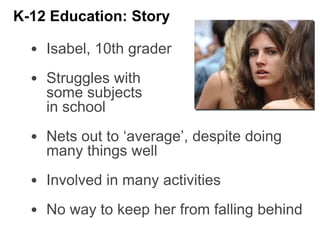
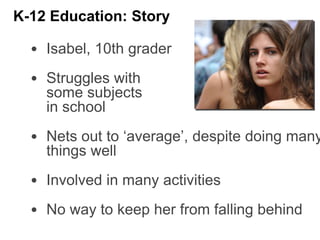
• Isabel, 10th grader
• Struggles with
some subjects
in school
• Nets out to ‘average’, despite doing
many things well
• Involved in many activities
• No way to keep her from falling behind
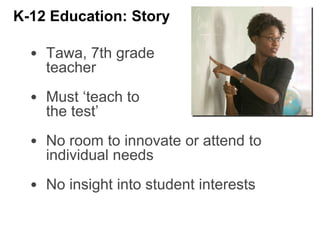
K-12 Education: Story
• Tawa, 7th grade
teacher
• Must ‘teach to
the test’
• No room to innovate or attend to
individual needs
• No insight into student interests
K-12 Education: Story
• Strong networks, compelling
learning
• Not connected to schools
• Does not ‘count’ for learners
Afterschool
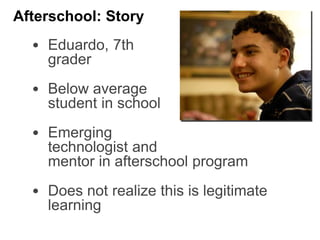
• Eduardo, 7th
grader
• Below average
student in school
• Emerging
technologist and
mentor in afterschool program
• Does not realize this is legitimate
learning
Afterschool: Story
• Expensive, inconsistent quality
• Growing gap between university
and careers
• Monopoly on credentials
Higher Education / University
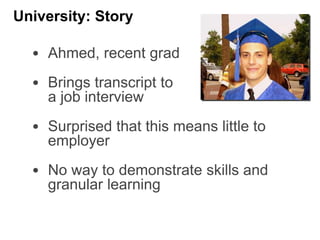
• Ahmed, recent grad
• Brings transcript to
a job interview
• Surprised that this means little to
employer
• No way to demonstrate skills and
granular learning
University: Story
• Workforce changing, its not always
enough to have a degree
• New skills are important, new economies
have emerged
• Employers can't find right matches
Workforce
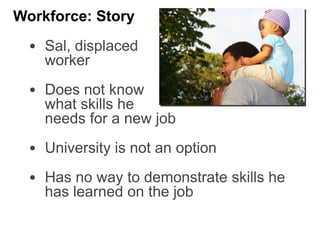
• Sal, displaced
worker
• Does not know
what skills he
needs for a new job
• University is not an option
• Has no way to demonstrate skills he
has learned on the job
Workforce: Story
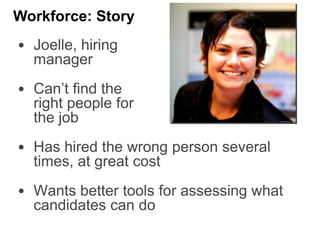
• Joelle, hiring
manager
• Can’t find the
right people for
the job
• Has hired the wrong person several
times, at great cost
• Wants better tools for assessing what
candidates can do
Workforce: Story
Education and workforce
are changing.
No single institution can
prepare someone.
Need a connected
ecosystem of learning.
Need credentials that
capture and communicate
learning and skills.
Reimagining credentials.
What are badges?
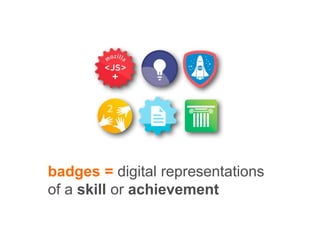
badges = digital representations
of a skill or achievement
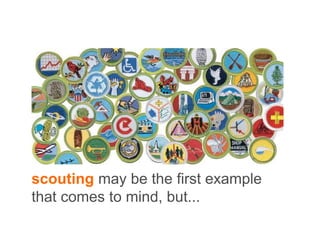
scouting may be the first example
that comes to mind, but...
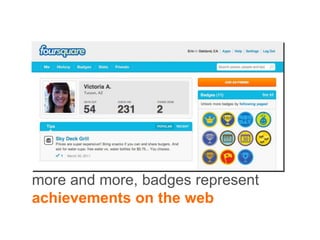
more and more, badges represent
achievements on the web
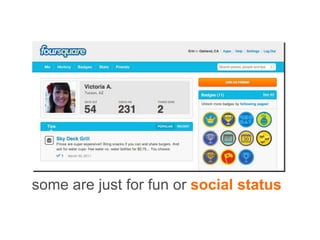
some are just for fun or social status
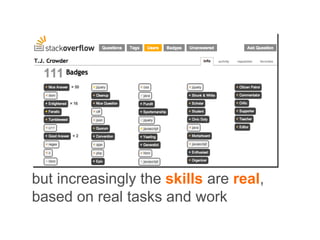
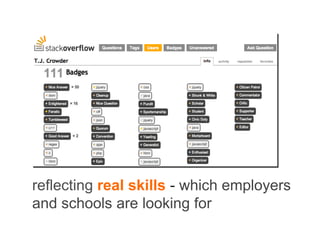
but increasingly the skills are real,
based on real tasks and work
reflecting real skills - which employers
and schools are looking for
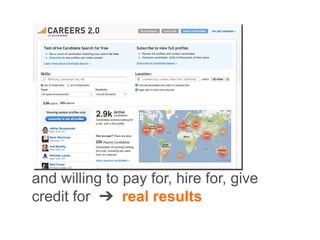
and willing to pay for, hire for, give
credit for ➔ real results
Why badges?
Capture complete
learning path.
Build and communicate
reputation and identity.
Reinvent or augment
existing credentials:
granular, evidenced-based
and transferable.
Surface skills and
competencies that are
important and give people a
way to plug in.
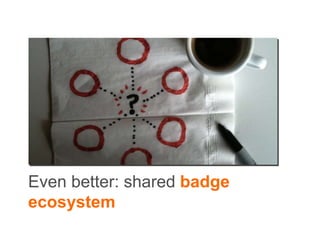
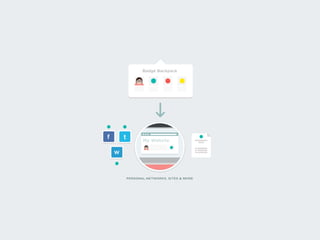
Even better: shared badge
ecosystem
Not just digital badges,
but open badges.
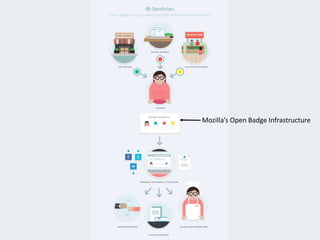
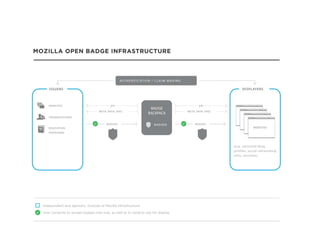
Mozilla’s Open Badge Infrastructure
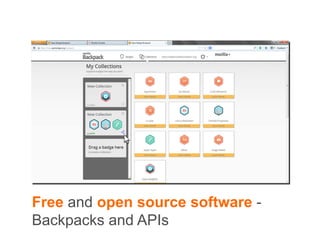
Free and open source software -
Backpacks and APIs
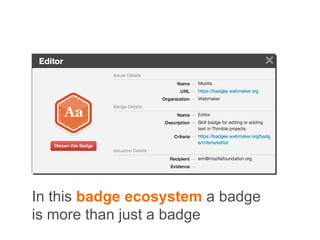
In this badge ecosystem a badge
is more than just a badge
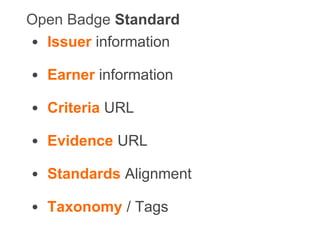
• Issuer information
• Earner information
• Criteria URL
• Evidence URL
• Standards Alignment
• Taxonomy / Tags
Open Badge Standard
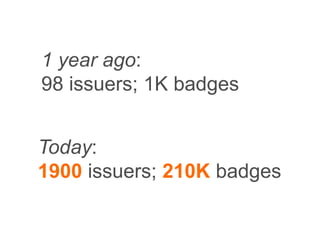
1 year ago:
98 issuers; 1K badges
Today:
1900 issuers; 210K badges
Who is using badges?
(and how are they using them?)
Stories, revisited.
• Isabel, 10th grader
• Struggles with
some subjects
in school
• Nets out to ‘average’, despite doing many
things well
• Involved in many activities
• No way to keep her from falling behind
K-12 Education: Story
• Get badges for all
activities
• Reward granular
accomplishments
and strengths in school
• Use combination of badges to better
understand and guide her
• Includes badges on college applications
K-12 Education: Story
• Tawa, 7th grade
teacher
• Must ‘teach to
the test’
• No room to innovate or attend to
individual needs
• No insight into student interests
K-12 Education: Story
• Issue badges for skills
and ‘extra’ learning in
the classroom
• Use badges from out of school to
better understand and guide students
• Even earn badges herself for
innovative practices
K-12 Education: Story
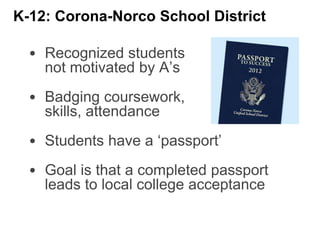
• Recognized students
not motivated by A’s
• Badging coursework,
skills, attendance
• Students have a ‘passport’
• Goal is that a completed passport
leads to local college acceptance
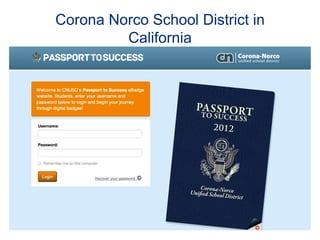
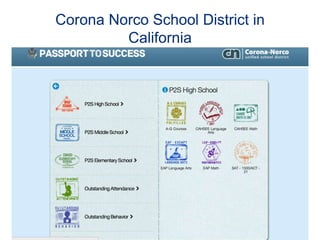
K-12: Corona-Norco School District
Corona Norco School District in
California
Corona Norco School District in
California
• Eduardo, 7th
grader
• Below average
student in school
• Emerging
technologist and
mentor in afterschool program
• Does not realize this is legitimate
learning
Afterschool: Story
• Badges for his
learning outside of
school
• Badges can ‘unlock’
access to more learning or mentors
• Carries with him back into school
• Shares with interest groups and
builds reputation
Afterschool: Story
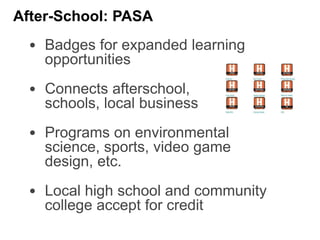
• Badges for expanded learning
opportunities
• Connects afterschool,
schools, local business
• Programs on environmental
science, sports, video game
design, etc.
• Local high school and community
college accept for credit
After-School: PASA
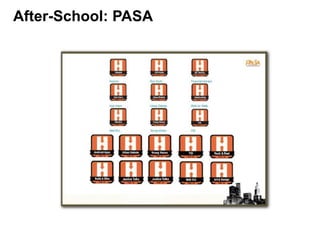
After-School: PASA
• Ahmed, recent grad
• Brings transcript to
a job interview
• Surprised that this means little to
employer
• No way to demonstrate skills and
granular learning
University: Story
• Badges for skills
developed in courses
at university
• Shares his digital resume + badges
with prospective employer
• Tells a more complete story about
what he knows and can do
• His work in university ‘counts’
University: Story
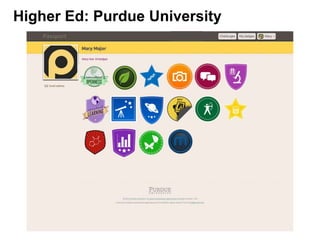
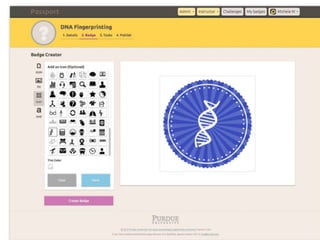
Higher Ed: Purdue University
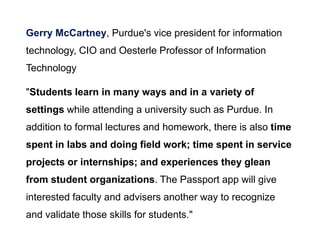
Gerry McCartney, Purdue's vice president for information
technology, CIO and Oesterle Professor of Information
Technology
"Students learn in many ways and in a variety of
settings while attending a university such as Purdue. In
addition to formal lectures and homework, there is also time
spent in labs and doing field work; time spent in service
projects or internships; and experiences they glean
from student organizations. The Passport app will give
interested faculty and advisers another way to recognize
and validate those skills for students."
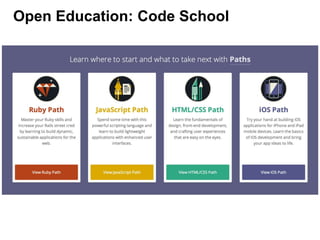
Open Education: Code School
• Sal, displaced
worker
• Does not know
what skills he
needs for a new job
• University is not an option
• Has no way to demonstrate skills he
has learned on the job
Workforce: Story
• Earn badges for skills
he already has
• View badges recommended for
particular industry
• Find open education courses to
develop those skills
• Share badges with potential
employers
Workforce: Story
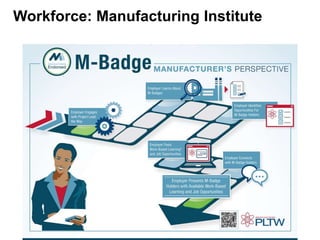
Workforce: Manufacturing Institute
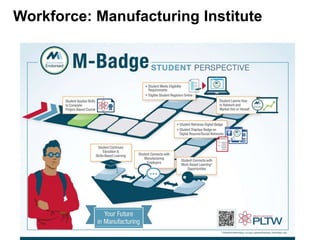
• Use badges to define skills important
to the industry
• Badges recognize prior learning and
on-the-job training
• Ties directly into jobs and
advancement
Workforce: Manufacturing Institute
• Joelle, hiring
manager
• Can’t find the
right people for
the job
• Has hired the wrong person several
times, at great cost
• Wants better tools for assessing what
candidates can do
Workforce: Story
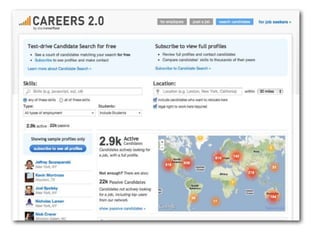
• Search for
candidates
through badges
• Use information
‘behind’ the badge to easily vet
candidate’s skills
• Find better matches, have more
confidence in hiring
Workforce: Story
http://www.youtube.com/watch?v=ZN93OPQdmEY
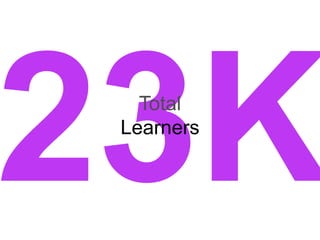
Total
Learners
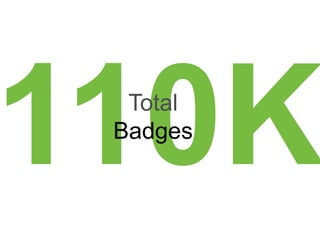
Total
Badges
What is BadgeKit?
A set of open, foundational tools to make the badging
process easy and simple.
Our Goal with BadgeKit
To improve the badging experience for
issuers, learners and consumers, making open
badging simple and easy to do.
Close the gap with lightweight, free open badging tools.
Our Goal with BadgeKit
Provide the foundational tools to stoke the growth
and development of the Open Badges ecosystem.
Given the open source model of
BadgeKit, improvements made by anyone can
benefit everyone, from bug fixes to new features and
more.
Our Goal with BadgeKit
Build our values of
openness, interoperability, agency, choice, and
connectedness into the core and help shape
emerging badge systems.
Let’s make it easier to build and issue an open badge.
BadgeKit will:
Support each key point in the badging experience
including
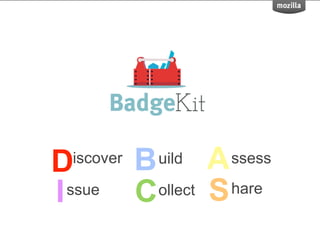
discovering, building, assessing, issuing, collecting
and sharing.
D B A
I C
iscover uild ssess
ssue ollect Share
Summary.
Open Badges are
digital credentials for the
modern age.
Evidence-based and verified.
Recognition of skills
and achievements.
Collected across lifetimes
as portfolio of
what you know and can do.
Digital ‘currency’ to
carry with you and
share across the Web.
Get Connected
Join our weekly Community call
Wednesdays at 9am PDT / 12pm EDT
http://bit.ly/OBCommCalls
Post questions to our Google Group
https://groups.google.com/d/forum/openbadges
Reach out to us for information
badges@mozillafoundation.org
Stay up-to-date with our Blog
http://openbadges.tumblr.com/
Mozilla Open Badges 101: Jan. 29 webinar

Mozilla Open Badges 101: Jan. 29 webinar

  • 2.
    Open Badges 101 Digginginto Badges Presented by: Jade Forester @OpenBadges
  • 3.
    Today’s Webinar What isa Badge Why Open Badges Details on the OBI Current Status of Ecosystem Badgekit Launch And more...
  • 4.
  • 6.
    What are theproblems we need to solve?
  • 7.
  • 8.
    “GPAs are worthlessas a criteria for hiring and test scores are worthless...Your ability to perform at Google is completely unrelated to how you performed when you were in school, because the skills you acquired in college are very different... http://techcrunch.com/2013/06/22/the-technical-interview-is-
  • 9.
    Tension between economic mobility,innovation and access.
  • 10.
  • 11.
    • Current systemis broken: drop outs, not ready for college/careers • Exploring new approaches: personalized learning, competency- based • Wrong accountability measures, wrong credentials K-12
  • 12.
    • Isabel, 10thgrader • Struggles with some subjects in school • Nets out to ‘average’, despite doing many things well • Involved in many activities • No way to keep her from falling behind K-12 Education: Story
  • 13.
    • Tawa, 7thgrade teacher • Must ‘teach to the test’ • No room to innovate or attend to individual needs • No insight into student interests K-12 Education: Story
  • 14.
    • Strong networks,compelling learning • Not connected to schools • Does not ‘count’ for learners Afterschool
  • 15.
    • Eduardo, 7th grader •Below average student in school • Emerging technologist and mentor in afterschool program • Does not realize this is legitimate learning Afterschool: Story
  • 16.
    • Expensive, inconsistentquality • Growing gap between university and careers • Monopoly on credentials Higher Education / University
  • 17.
    • Ahmed, recentgrad • Brings transcript to a job interview • Surprised that this means little to employer • No way to demonstrate skills and granular learning University: Story
  • 18.
    • Workforce changing,its not always enough to have a degree • New skills are important, new economies have emerged • Employers can't find right matches Workforce
  • 19.
    • Sal, displaced worker •Does not know what skills he needs for a new job • University is not an option • Has no way to demonstrate skills he has learned on the job Workforce: Story
  • 20.
    • Joelle, hiring manager •Can’t find the right people for the job • Has hired the wrong person several times, at great cost • Wants better tools for assessing what candidates can do Workforce: Story
  • 21.
  • 22.
    No single institutioncan prepare someone.
  • 23.
  • 24.
    Need credentials that captureand communicate learning and skills.
  • 26.
  • 27.
  • 28.
    badges = digitalrepresentations of a skill or achievement
  • 29.
    scouting may bethe first example that comes to mind, but...
  • 30.
    more and more,badges represent achievements on the web
  • 31.
    some are justfor fun or social status
  • 32.
    but increasingly theskills are real, based on real tasks and work
  • 33.
    reflecting real skills- which employers and schools are looking for
  • 34.
    and willing topay for, hire for, give credit for ➔ real results
  • 35.
  • 36.
  • 37.
  • 38.
    Reinvent or augment existingcredentials: granular, evidenced-based and transferable.
  • 39.
    Surface skills and competenciesthat are important and give people a way to plug in.
  • 40.
    Even better: sharedbadge ecosystem
  • 41.
    Not just digitalbadges, but open badges.
  • 47.
    Mozilla’s Open BadgeInfrastructure
  • 48.
    Free and opensource software - Backpacks and APIs
  • 49.
    In this badgeecosystem a badge is more than just a badge
  • 51.
    • Issuer information •Earner information • Criteria URL • Evidence URL • Standards Alignment • Taxonomy / Tags Open Badge Standard
  • 52.
    1 year ago: 98issuers; 1K badges Today: 1900 issuers; 210K badges
  • 54.
    Who is usingbadges? (and how are they using them?)
  • 55.
  • 56.
    • Isabel, 10thgrader • Struggles with some subjects in school • Nets out to ‘average’, despite doing many things well • Involved in many activities • No way to keep her from falling behind K-12 Education: Story
  • 57.
    • Get badgesfor all activities • Reward granular accomplishments and strengths in school • Use combination of badges to better understand and guide her • Includes badges on college applications K-12 Education: Story
  • 58.
    • Tawa, 7thgrade teacher • Must ‘teach to the test’ • No room to innovate or attend to individual needs • No insight into student interests K-12 Education: Story
  • 59.
    • Issue badgesfor skills and ‘extra’ learning in the classroom • Use badges from out of school to better understand and guide students • Even earn badges herself for innovative practices K-12 Education: Story
  • 60.
    • Recognized students notmotivated by A’s • Badging coursework, skills, attendance • Students have a ‘passport’ • Goal is that a completed passport leads to local college acceptance K-12: Corona-Norco School District
  • 61.
    Corona Norco SchoolDistrict in California
  • 62.
    Corona Norco SchoolDistrict in California
  • 63.
    • Eduardo, 7th grader •Below average student in school • Emerging technologist and mentor in afterschool program • Does not realize this is legitimate learning Afterschool: Story
  • 64.
    • Badges forhis learning outside of school • Badges can ‘unlock’ access to more learning or mentors • Carries with him back into school • Shares with interest groups and builds reputation Afterschool: Story
  • 65.
    • Badges forexpanded learning opportunities • Connects afterschool, schools, local business • Programs on environmental science, sports, video game design, etc. • Local high school and community college accept for credit After-School: PASA
  • 66.
  • 67.
    • Ahmed, recentgrad • Brings transcript to a job interview • Surprised that this means little to employer • No way to demonstrate skills and granular learning University: Story
  • 68.
    • Badges forskills developed in courses at university • Shares his digital resume + badges with prospective employer • Tells a more complete story about what he knows and can do • His work in university ‘counts’ University: Story
  • 69.
  • 71.
    Gerry McCartney, Purdue'svice president for information technology, CIO and Oesterle Professor of Information Technology "Students learn in many ways and in a variety of settings while attending a university such as Purdue. In addition to formal lectures and homework, there is also time spent in labs and doing field work; time spent in service projects or internships; and experiences they glean from student organizations. The Passport app will give interested faculty and advisers another way to recognize and validate those skills for students."
  • 72.
  • 73.
    • Sal, displaced worker •Does not know what skills he needs for a new job • University is not an option • Has no way to demonstrate skills he has learned on the job Workforce: Story
  • 74.
    • Earn badgesfor skills he already has • View badges recommended for particular industry • Find open education courses to develop those skills • Share badges with potential employers Workforce: Story
  • 75.
    Workforce: Manufacturing Institute •Use badges to define skills important to the industry • Badges recognize prior learning and on-the-job training • Ties directly into jobs and advancement
  • 76.
  • 77.
  • 78.
    • Joelle, hiring manager •Can’t find the right people for the job • Has hired the wrong person several times, at great cost • Wants better tools for assessing what candidates can do Workforce: Story
  • 79.
    • Search for candidates throughbadges • Use information ‘behind’ the badge to easily vet candidate’s skills • Find better matches, have more confidence in hiring Workforce: Story
  • 87.
  • 90.
  • 91.
  • 93.
    What is BadgeKit? Aset of open, foundational tools to make the badging process easy and simple.
  • 94.
    Our Goal withBadgeKit To improve the badging experience for issuers, learners and consumers, making open badging simple and easy to do. Close the gap with lightweight, free open badging tools.
  • 95.
    Our Goal withBadgeKit Provide the foundational tools to stoke the growth and development of the Open Badges ecosystem. Given the open source model of BadgeKit, improvements made by anyone can benefit everyone, from bug fixes to new features and more.
  • 96.
    Our Goal withBadgeKit Build our values of openness, interoperability, agency, choice, and connectedness into the core and help shape emerging badge systems. Let’s make it easier to build and issue an open badge.
  • 97.
    BadgeKit will: Support eachkey point in the badging experience including discovering, building, assessing, issuing, collecting and sharing.
  • 98.
    D B A IC iscover uild ssess ssue ollect Share
  • 99.
  • 100.
    Open Badges are digitalcredentials for the modern age.
  • 101.
  • 102.
  • 103.
    Collected across lifetimes asportfolio of what you know and can do.
  • 104.
    Digital ‘currency’ to carrywith you and share across the Web.
  • 105.
    Get Connected Join ourweekly Community call Wednesdays at 9am PDT / 12pm EDT http://bit.ly/OBCommCalls Post questions to our Google Group https://groups.google.com/d/forum/openbadges Reach out to us for information badges@mozillafoundation.org Stay up-to-date with our Blog http://openbadges.tumblr.com/

Editor's Notes

  • #4 - What is a badge - Why digital badges - Details on the Open Badges Infrastructure - Current status of the ecosystem - Details on the Clinton Global Initiative commitment - And more
  • #8 This is a complicated world with a lot of complicated challenges. Learning is not just seat time. Learning is happening in more ways, across lifetimes. Career changes are more frequent and commonplace. Not to mention how do we prepare the workforce for jobs that have not yet come into existence? New technologies and advancement dictate new skills. Expectation that workers must continue to uplevel their skills to compete.
  • #9 Google’s head of HR admits that “Brainteasers are a complete waste of time.” He goes on to say, “Academic environments are artificial environments. People who succeed there are sort of finely trained, they’re conditioned to succeed in that environment.” http://techcrunch.com/2013/06/22/the-technical-interview-is-dead/
  • #10 Education has always been seen as the ticket out of poverty or towards success. But in many cases, that’s not enough or its not meeting the needs. How do we better connect people with opportunities to succeed?
  • #11 We’ll quickly visit challenges by sector starting with K12
  • #13 We’ve heard time and time again that the current system is broken with high drop out rates, and low student college and career readiness. We’re hearing a lot about creating curriculum for personalized learning; the importance of supporting different paces and abilities and also an increasing emphasis on competency based learning over seat time
  • #15 All the while we have a ton of wonderful afterschool programs. By “not connected to schools” we mean, the learning that took place don’t count and is not recognized.
  • #17 Google exec: Your ability to perform well at Google is unrelated to how you did in school.
  • #22 Learning is not just seat time. Learning is happening in more ways, across lifetimes. New technologies and advancement dictate new skills. Expectation that workers are continuing to up their skills to compete.
  • #23 No single institution can solve this or prepare someone alone.
  • #24 We need to find a way to connect learning for people across their lifetimes. Connect them to more learning. Connect that learning to real results like jobs.
  • #25 That connection boils down to the record of that learning. We need new credentials that can communicate skills across contexts.
  • #30 Scout badges were tied to achievement, skills, leveling up and reputation but they are one time, flat badges that don’t carry evidence or sharing capacity.
  • #31 Digital!
  • #33 Stackoverflow: badges issued for participation in a question and answer forum - social skills and hard skills like programming proficiency
  • #34 The combination = more complete story about these individuals
  • #35 So much so that employers are willing to pay for it!!
  • #37 Recognize more granular skills. Recognize more skills in general, like social skills. Build a collection that tells a more complete story about what you know and can do.
  • #39 Credentials that fit our world today.
  • #40 Explicitly define the skills that an org or industry cares about. Create a learning map of what someone needs to know and help them find ways to get those skills.
  • #41 Not just more silo’d systems, let’s do this at the connected ecosystem level.
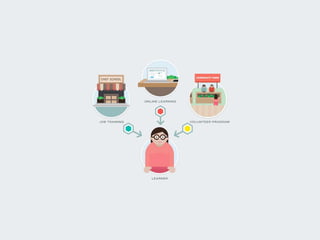
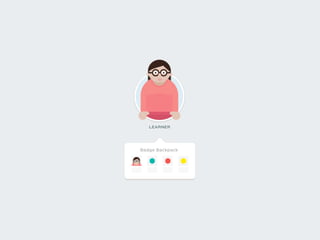
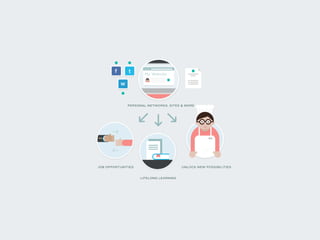
  • #44 Learners earn badges across various issuers and learning experiences over their lifetime. We want to help learners better capture that learning in the form of badges.
  • #45 Store them in one collection that they manage and control
  • #46 Share them out...
  • #47 ...for real results like jobs and advancement
  • #48 Mozilla has built the ‘plumbing’ to allow badges to work at the ecosystem level
  • #49 Includes Backpacks, where learners collect and manage their badges
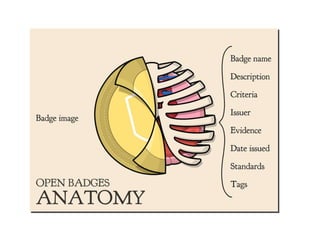
  • #50 Most importantly, includes the standard for badges - definition of what information must be included in each badge (Badges are evidence based!)
  • #51 It its the “bones” or “insides” of a badge.
  • #52 Standard is the minimum info needed to understand that badge. Ensures that all badges in the ecosystem are interoperable.
  • #54 Ecosystem with Mozilla infrastructure in the middle, or underneath. Educators / issuers, as well as Employers / badge ‘users’ are critical pieces to making this real and beneficial for learners.
  • #56 Let’s go back to the user stories and see how badges could help.
  • #63 When student completes passport, they get university acceptance. Great! In conversation with local universities. 
  • #70 Bill Watson, an assistant professor in Purdue's Department of Curriculum and Instruction, wasinstrumental in creating the Passport platform and will be using Passport in a graduate-level course this semester. He says the advantage of badges is that they allow faculty to focus on competencies, skills and learner performance.
  • #72 http://www.purdue.edu/newsroom/releases/2012/Q3/digital-badges-show-students-skills-along-with-degree.html Bill Watson, an assistant professor in Purdue's Department of Curriculum and Instruction, wasinstrumental in creating the Passport platform and will be using Passport in a graduate-level course this semester. He says the advantage of badges is that they allow faculty to focus on competencies, skills and learner performance.