I.F.D.C. LENGUAS VIVAS
TALLER DE PRÁCTICA DOCENTE
ALUMNO RESIDENTE: Mozetich Flavia
Período de Práctica: Primaria
Institución Educativa: E.P N° 35 Piloto Basilio Villarino
Dirección: Ruta Nacional 3 N° 803
Sala / Grado / Año - sección: 5to sección unica
Cantidad de alumnos: 19
Nivel lingüístico del curso: beginner
Tipo de Planificación:
Unidad Temática:
Clase Nº: 3
Fecha: 28th August
Hora: 15:20 a 16:05
Duración de la clase: 45’
Fecha de entrega:
· Aims or goals:
During this lesson, learners will be able to recognize the different aromatic
plant and their uses. However they will be able to improve their reading and
speaking skills.
Teaching points: - language focus:
Functions Lexis Structures Pronunciation
Roots Identify plant’s It has…
Revision Flower-Steam parts and their It needs…
Seed- bud- needs
Lavender
Thyme Identify the It is used for...
Mint aromatic herbs It grows…
New Rosemary and their
Use.
· Teaching approach or combination of methods / approaches: communicative
approach
· Integration of skills: reading and speaking
· Materials and resources: copies, markers, posters, boards.
· Seating arrangement: Students will work together.
· Assessment: Teacher will check that students have understood what they have read.
She will walk around the class to listen to students.
Routine 2’
Teacher will greet students.
T: Hello children! How are you?
S: Hello! Teacher!
Presentation 5’
Teacher will show some images of different aromatic herbs and their names in Spanish (they
know it from a previous lesson). Then teacher will show different names to students to
match with the correct image
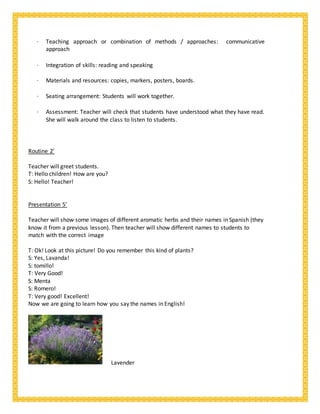
T: Ok! Look at this picture! Do you remember this kind of plants?
S: Yes, Lavanda!
S: tomillo!
T: Very Good!
S: Menta
S: Romero!
T: Very good! Excellent!
Now we are going to learn how you say the names in English!
Lavender
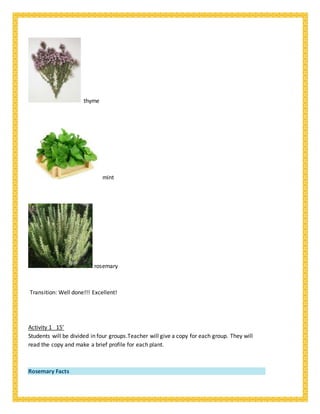
thyme
mint
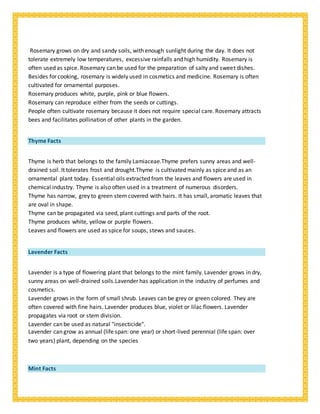
rosemary
Transition: Well done!!! Excellent!
Activity 1 15’
Students will be divided in four groups.Teacher will give a copy for each group. They will
read the copy and make a brief profile for each plant.
Rosemary Facts
Rosemary grows on dry and sandy soils, with enough sunlight during the day. It does not
tolerate extremely low temperatures, excessive rainfalls and high humidity. Rosemary is
often used as spice. Rosemary can be used for the preparation of salty and sweet dishes.
Besides for cooking, rosemary is widely used in cosmetics and medicine. Rosemary is often
cultivated for ornamental purposes.
Rosemary produces white, purple, pink or blue flowers.
Rosemary can reproduce either from the seeds or cuttings.
People often cultivate rosemary because it does not require special care. Rosemary attracts
bees and facilitates pollination of other plants in the garden.
Thyme Facts
Thyme is herb that belongs to the family Lamiaceae.Thyme prefers sunny areas and well-
drained soil. It tolerates frost and drought.Thyme is cultivated mainly as spice and as an
ornamental plant today. Essential oils extracted from the leaves and flowers are used in
chemical industry. Thyme is also often used in a treatment of numerous disorders.
Thyme has narrow, grey to green stem covered with hairs. It has small, aromatic leaves that
are oval in shape.
Thyme can be propagated via seed, plant cuttings and parts of the root.
Thyme produces white, yellow or purple flowers.
Leaves and flowers are used as spice for soups, stews and sauces.
Lavender Facts
Lavender is a type of flowering plant that belongs to the mint family. Lavender grows in dry,
sunny areas on well-drained soils.Lavender has application in the industry of perfumes and
cosmetics.
Lavender grows in the form of small shrub. Leaves can be grey or green colored. They are
often covered with fine hairs. Lavender produces blue, violet or lilac flowers. Lavender
propagates via root or stem division.
Lavender can be used as natural "insecticide".
Lavender can grow as annual (life span: one year) or short-lived perennial (life span: over
two years) plant, depending on the species
Mint Facts
Mint is herbaceous plant that belongs to the family Lamiaceae. Mint grows in temperate
climate, usually on the moist soil in areas that provide enoughdirect sunlight. Aromatic
chemicals and essential oils extracted are often used in cosmetic and medical industry. Mint
is sometimes classified as invasive species.
Leaves of mint can be dark green, grayish-green or purple in color.
Flower can be white or pink in color. Mint produces fruit called nutley which contains one to
four seeds.
Mint is used in traditional medicine mainly for the treatment of painful stomach and chests.
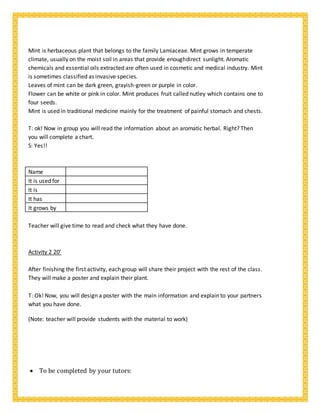
T: ok! Now in group you will read the information about an aromatic herbal. Right? Then
you will complete a chart.
S: Yes!!
Name
It is used for
It is
It has
It grows by
Teacher will give time to read and check what they have done.
Activity 2 20’
After finishing the first activity, each group will share their project with the rest of the class.
They will make a poster and explain their plant.
T: Ok! Now, you will design a poster with the main information and explain to your partners
what you have done.
(Note: teacher will provide students with the material to work)
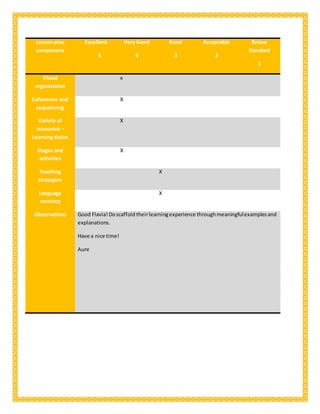
 To be completed by your tutors:
Lesson plan
component
Excellent
5
Very Good
4
Good
3
Acceptable
2
Below
Standard
1
Visual
organization
x
Coherence and
sequencing
X
Variety of
resources –
Learning styles
X
Stages and
activities
X
Teaching
strategies
X
Language
accuracy
X
Observations Good Flavia!Doscaffold theirlearningexperience throughmeaningfulexamplesand
explanations.
Have a nice time!
Aure

Mozetich lesson plan 3 primaria

  • 1.
    I.F.D.C. LENGUAS VIVAS TALLERDE PRÁCTICA DOCENTE ALUMNO RESIDENTE: Mozetich Flavia Período de Práctica: Primaria Institución Educativa: E.P N° 35 Piloto Basilio Villarino Dirección: Ruta Nacional 3 N° 803 Sala / Grado / Año - sección: 5to sección unica Cantidad de alumnos: 19 Nivel lingüístico del curso: beginner Tipo de Planificación: Unidad Temática: Clase Nº: 3 Fecha: 28th August Hora: 15:20 a 16:05 Duración de la clase: 45’ Fecha de entrega: · Aims or goals: During this lesson, learners will be able to recognize the different aromatic plant and their uses. However they will be able to improve their reading and speaking skills. Teaching points: - language focus: Functions Lexis Structures Pronunciation Roots Identify plant’s It has… Revision Flower-Steam parts and their It needs… Seed- bud- needs Lavender Thyme Identify the It is used for... Mint aromatic herbs It grows… New Rosemary and their Use.
  • 2.
    · Teaching approachor combination of methods / approaches: communicative approach · Integration of skills: reading and speaking · Materials and resources: copies, markers, posters, boards. · Seating arrangement: Students will work together. · Assessment: Teacher will check that students have understood what they have read. She will walk around the class to listen to students. Routine 2’ Teacher will greet students. T: Hello children! How are you? S: Hello! Teacher! Presentation 5’ Teacher will show some images of different aromatic herbs and their names in Spanish (they know it from a previous lesson). Then teacher will show different names to students to match with the correct image T: Ok! Look at this picture! Do you remember this kind of plants? S: Yes, Lavanda! S: tomillo! T: Very Good! S: Menta S: Romero! T: Very good! Excellent! Now we are going to learn how you say the names in English! Lavender
  • 3.
    thyme mint rosemary Transition: Well done!!!Excellent! Activity 1 15’ Students will be divided in four groups.Teacher will give a copy for each group. They will read the copy and make a brief profile for each plant. Rosemary Facts
  • 4.
    Rosemary grows ondry and sandy soils, with enough sunlight during the day. It does not tolerate extremely low temperatures, excessive rainfalls and high humidity. Rosemary is often used as spice. Rosemary can be used for the preparation of salty and sweet dishes. Besides for cooking, rosemary is widely used in cosmetics and medicine. Rosemary is often cultivated for ornamental purposes. Rosemary produces white, purple, pink or blue flowers. Rosemary can reproduce either from the seeds or cuttings. People often cultivate rosemary because it does not require special care. Rosemary attracts bees and facilitates pollination of other plants in the garden. Thyme Facts Thyme is herb that belongs to the family Lamiaceae.Thyme prefers sunny areas and well- drained soil. It tolerates frost and drought.Thyme is cultivated mainly as spice and as an ornamental plant today. Essential oils extracted from the leaves and flowers are used in chemical industry. Thyme is also often used in a treatment of numerous disorders. Thyme has narrow, grey to green stem covered with hairs. It has small, aromatic leaves that are oval in shape. Thyme can be propagated via seed, plant cuttings and parts of the root. Thyme produces white, yellow or purple flowers. Leaves and flowers are used as spice for soups, stews and sauces. Lavender Facts Lavender is a type of flowering plant that belongs to the mint family. Lavender grows in dry, sunny areas on well-drained soils.Lavender has application in the industry of perfumes and cosmetics. Lavender grows in the form of small shrub. Leaves can be grey or green colored. They are often covered with fine hairs. Lavender produces blue, violet or lilac flowers. Lavender propagates via root or stem division. Lavender can be used as natural "insecticide". Lavender can grow as annual (life span: one year) or short-lived perennial (life span: over two years) plant, depending on the species Mint Facts
  • 5.
    Mint is herbaceousplant that belongs to the family Lamiaceae. Mint grows in temperate climate, usually on the moist soil in areas that provide enoughdirect sunlight. Aromatic chemicals and essential oils extracted are often used in cosmetic and medical industry. Mint is sometimes classified as invasive species. Leaves of mint can be dark green, grayish-green or purple in color. Flower can be white or pink in color. Mint produces fruit called nutley which contains one to four seeds. Mint is used in traditional medicine mainly for the treatment of painful stomach and chests. T: ok! Now in group you will read the information about an aromatic herbal. Right? Then you will complete a chart. S: Yes!! Name It is used for It is It has It grows by Teacher will give time to read and check what they have done. Activity 2 20’ After finishing the first activity, each group will share their project with the rest of the class. They will make a poster and explain their plant. T: Ok! Now, you will design a poster with the main information and explain to your partners what you have done. (Note: teacher will provide students with the material to work)  To be completed by your tutors:
  • 6.
    Lesson plan component Excellent 5 Very Good 4 Good 3 Acceptable 2 Below Standard 1 Visual organization x Coherenceand sequencing X Variety of resources – Learning styles X Stages and activities X Teaching strategies X Language accuracy X Observations Good Flavia!Doscaffold theirlearningexperience throughmeaningfulexamplesand explanations. Have a nice time! Aure