Government Innovation Through
                       Cloud Computing
                       Advantages for developing countries

                       Arthur Riel
                       February 14, 2013


This material is a product of the staff of the International Bank for Reconstruction and Development/The World Bank. The findings, interpretations, and conclusions expressed in this presentation do not necessarily reflect the views of the Executive Directors of The World Bank or
the governments they represent. The World Bank does not guarantee the accuracy of the data included in this work. This material should not be reproduced or distributed without The World Bank's prior consent.
Cloud: The Sweet Spot

 The virtualization and commoditization of
  infrastructure has benefited numerous
  organizations
 Data center decentralization has become very
  inexpensive, benefiting larger countries
 Data center centralization has become very
  inexpensive (e.g. Indonesia)
 Servers, storage and bandwidth are now priced
  like electricity
 Many large organizations are effectively using
  cloud to run 100% of their operations: Netflix,
  Four Square.
Cloud: Benefits to Government

 Pay as you go servers can be cheaper than
  providing data centers, especially in countries
  with poor infrastructure
 Hosting mobile applications in the cloud can
  eliminate the need for intermediate servers, e.g.
  cloud to smart phone.
 No large capital upfront fee
 No hardware/technology refresh to strategize
 As businesses and citizens increase usage there
  is no extensibility planning required
eGovernment in the Cloud

 eGovernment services are ideally hosted in the
  cloud
 The EU is benchmarking member countries as
  part of the EU2020 Digital Agenda on
  eGovernment services
 Hosting in the cloud allows for countries to focus
  on data cleanup (always a big problem) and
  service implementation solely
 As the number of services is increased (and the
  associated added transactions) the cloud allows
  for nearly infinite scale at a linear or better cost
  model
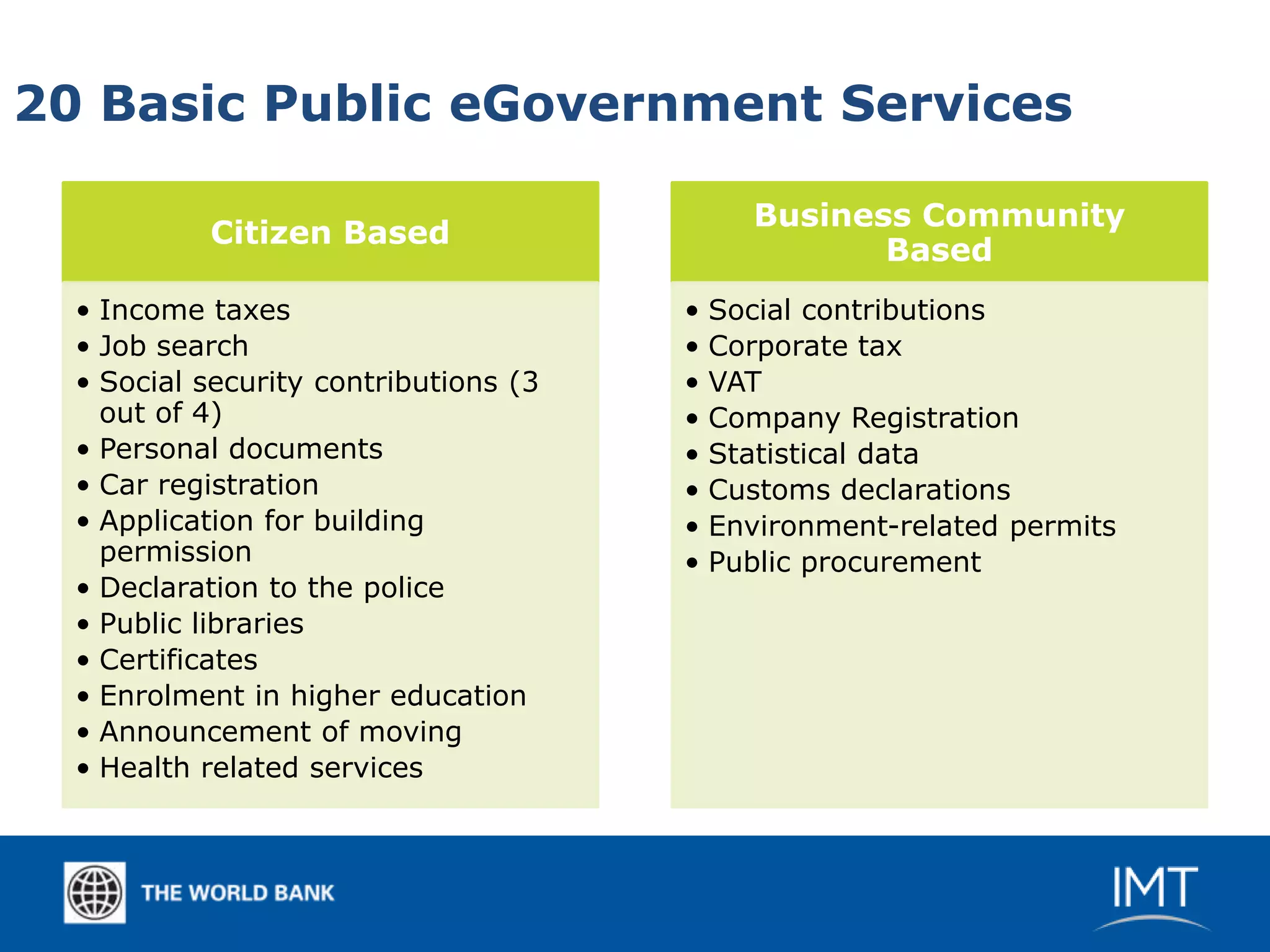
20 Basic Public eGovernment Services

                                             Business Community
           Citizen Based
                                                    Based
  • Income taxes                       •   Social contributions
  • Job search                         •   Corporate tax
  • Social security contributions (3   •   VAT
    out of 4)                          •   Company Registration
  • Personal documents                 •   Statistical data
  • Car registration                   •   Customs declarations
  • Application for building           •   Environment-related permits
    permission                         •   Public procurement
  • Declaration to the police
  • Public libraries
  • Certificates
  • Enrolment in higher education
  • Announcement of moving
  • Health related services
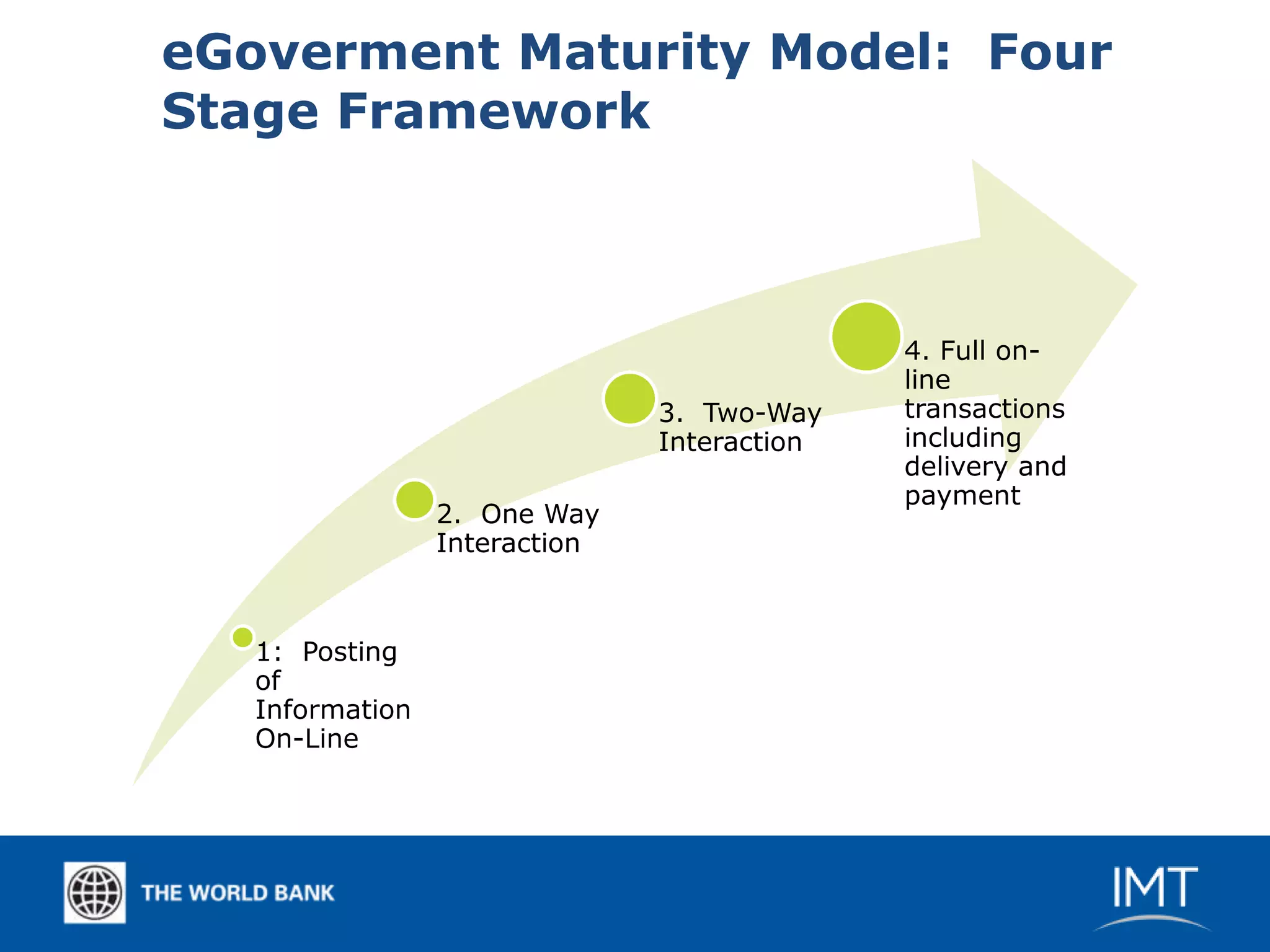
eGoverment Maturity Model: Four
Stage Framework


                                             4. Full on-
                                             line
                               3. Two-Way    transactions
                               Interaction   including
                                             delivery and
                                             payment
                 2. One Way
                 Interaction


   1: Posting
   of
   Information
   On-Line
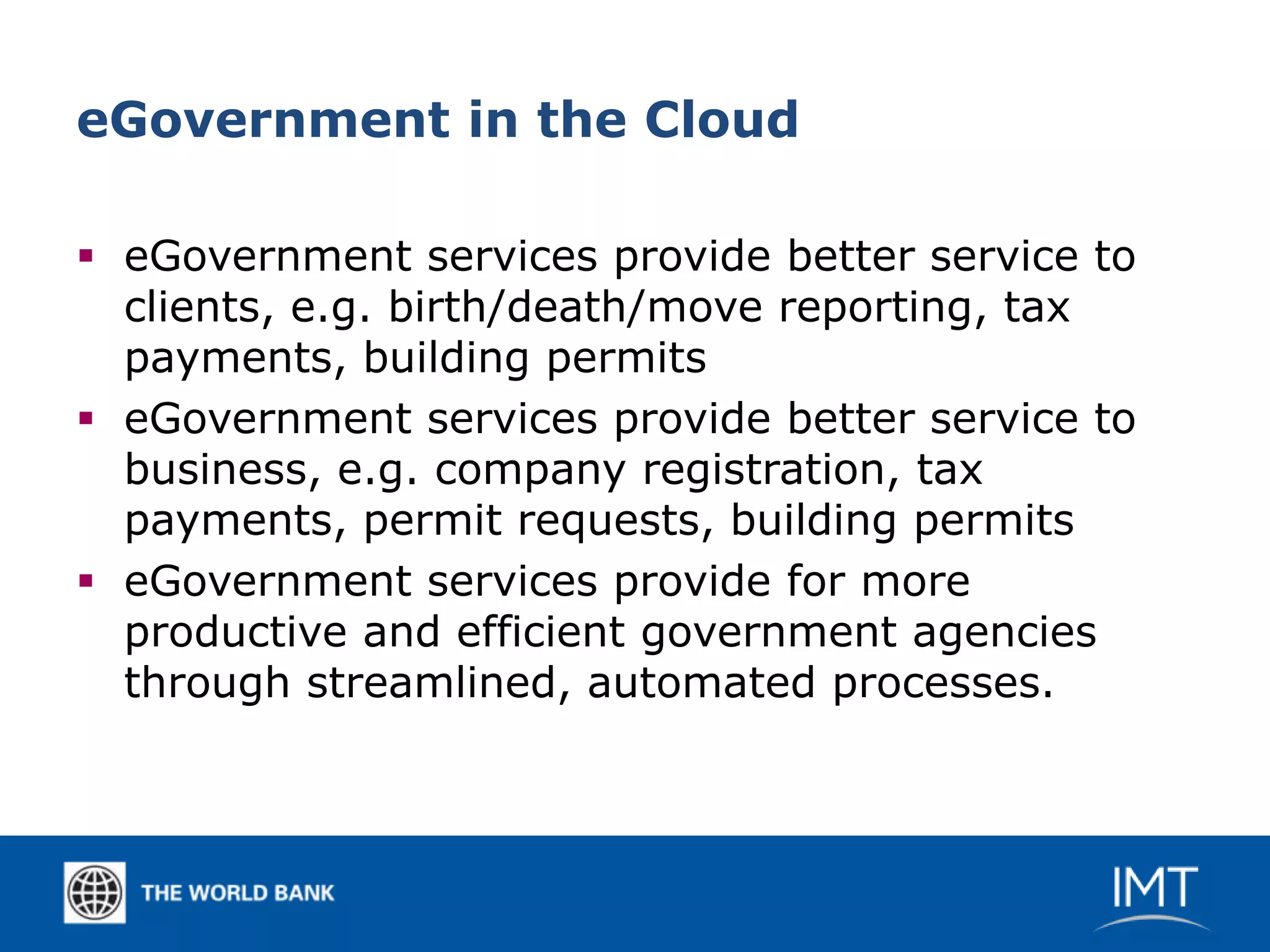
eGovernment in the Cloud

 eGovernment services provide better service to
  clients, e.g. birth/death/move reporting, tax
  payments, building permits
 eGovernment services provide better service to
  business, e.g. company registration, tax
  payments, permit requests, building permits
 eGovernment services provide for more
  productive and efficient government agencies
  through streamlined, automated processes.
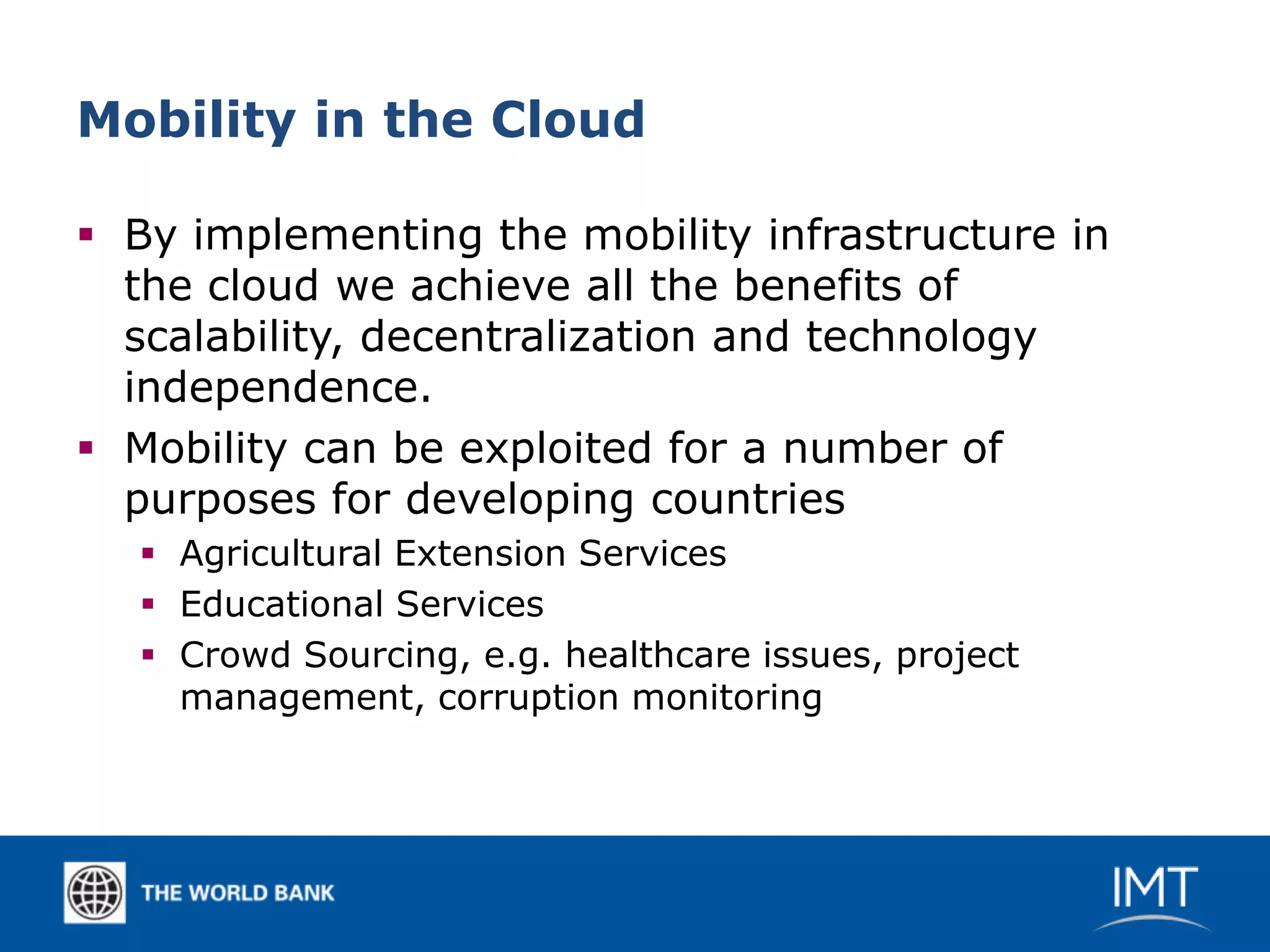
Mobility in the Cloud

 By implementing the mobility infrastructure in
  the cloud we achieve all the benefits of
  scalability, decentralization and technology
  independence.
 Mobility can be exploited for a number of
  purposes for developing countries
   Agricultural Extension Services
   Educational Services
   Crowd Sourcing, e.g. healthcare issues, project
    management, corruption monitoring
Document Management in the Cloud

 By managing government documents in a public
  cloud they are highly accessible at much lower
  cost (one popular vendor offers a low end
  solution at 18 cents per GB/year and high end at
  less than 90 cents per GB/year)
 Sensitive documents can be stored in a virtual
  private cloud for not much higher costs
 Scalability, backup and technology replacement
  are no longer government issues
 What about security?
Email and Collaboration in the Cloud

 There are many vendors offering collaboration
  solutions that are cloud-based
 No need for capital upfront expenditures
 Fast initiation and setup
 Scalability, backup and technology replacement
  are no longer government issues
A Caveat for the Cloud
 There is little case law in cross border cloud disputes
  and issues
 As the cloud obscures where data and solutions exist,
  as well as the number of instances and jurisdictions,
  there are possible complexities
 Some governments implement their own internal
  cloud to avoid these legal issues
 Others use a virtual private cloud with encryption at
  rest technologies
 The World Bank has an issue on privileges in the cloud
 These types of issues are not new to the cloud, US/EU
  email case study
Questions and Comments?

Government innovation through cloud computing arthur riel

  • 1.
    Government Innovation Through Cloud Computing Advantages for developing countries Arthur Riel February 14, 2013 This material is a product of the staff of the International Bank for Reconstruction and Development/The World Bank. The findings, interpretations, and conclusions expressed in this presentation do not necessarily reflect the views of the Executive Directors of The World Bank or the governments they represent. The World Bank does not guarantee the accuracy of the data included in this work. This material should not be reproduced or distributed without The World Bank's prior consent.
  • 2.
    Cloud: The SweetSpot  The virtualization and commoditization of infrastructure has benefited numerous organizations  Data center decentralization has become very inexpensive, benefiting larger countries  Data center centralization has become very inexpensive (e.g. Indonesia)  Servers, storage and bandwidth are now priced like electricity  Many large organizations are effectively using cloud to run 100% of their operations: Netflix, Four Square.
  • 3.
    Cloud: Benefits toGovernment  Pay as you go servers can be cheaper than providing data centers, especially in countries with poor infrastructure  Hosting mobile applications in the cloud can eliminate the need for intermediate servers, e.g. cloud to smart phone.  No large capital upfront fee  No hardware/technology refresh to strategize  As businesses and citizens increase usage there is no extensibility planning required
  • 4.
    eGovernment in theCloud  eGovernment services are ideally hosted in the cloud  The EU is benchmarking member countries as part of the EU2020 Digital Agenda on eGovernment services  Hosting in the cloud allows for countries to focus on data cleanup (always a big problem) and service implementation solely  As the number of services is increased (and the associated added transactions) the cloud allows for nearly infinite scale at a linear or better cost model
  • 5.
    20 Basic PubliceGovernment Services Business Community Citizen Based Based • Income taxes • Social contributions • Job search • Corporate tax • Social security contributions (3 • VAT out of 4) • Company Registration • Personal documents • Statistical data • Car registration • Customs declarations • Application for building • Environment-related permits permission • Public procurement • Declaration to the police • Public libraries • Certificates • Enrolment in higher education • Announcement of moving • Health related services
  • 6.
    eGoverment Maturity Model:Four Stage Framework 4. Full on- line 3. Two-Way transactions Interaction including delivery and payment 2. One Way Interaction 1: Posting of Information On-Line
  • 7.
    eGovernment in theCloud  eGovernment services provide better service to clients, e.g. birth/death/move reporting, tax payments, building permits  eGovernment services provide better service to business, e.g. company registration, tax payments, permit requests, building permits  eGovernment services provide for more productive and efficient government agencies through streamlined, automated processes.
  • 8.
    Mobility in theCloud  By implementing the mobility infrastructure in the cloud we achieve all the benefits of scalability, decentralization and technology independence.  Mobility can be exploited for a number of purposes for developing countries  Agricultural Extension Services  Educational Services  Crowd Sourcing, e.g. healthcare issues, project management, corruption monitoring
  • 9.
    Document Management inthe Cloud  By managing government documents in a public cloud they are highly accessible at much lower cost (one popular vendor offers a low end solution at 18 cents per GB/year and high end at less than 90 cents per GB/year)  Sensitive documents can be stored in a virtual private cloud for not much higher costs  Scalability, backup and technology replacement are no longer government issues  What about security?
  • 10.
    Email and Collaborationin the Cloud  There are many vendors offering collaboration solutions that are cloud-based  No need for capital upfront expenditures  Fast initiation and setup  Scalability, backup and technology replacement are no longer government issues
  • 11.
    A Caveat forthe Cloud  There is little case law in cross border cloud disputes and issues  As the cloud obscures where data and solutions exist, as well as the number of instances and jurisdictions, there are possible complexities  Some governments implement their own internal cloud to avoid these legal issues  Others use a virtual private cloud with encryption at rest technologies  The World Bank has an issue on privileges in the cloud  These types of issues are not new to the cloud, US/EU email case study
  • 12.