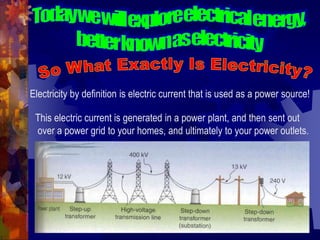
Electricity by definition is electric current that is used as a power source!
This electric current is generated in a power plant, and then sent out
over a power grid to your homes, and ultimately to your power outlets.
The movement of charges such
as electrons is called current, and
this electrical current is what
powers household appliances.
Electric Current =
Charge Passing
Through A Given Area
-------------------------------
Time
An easier way to think of electric current is to picture cars going
through a Turnpike or Parkway Toll.
The cars could represent
electrons or charge, and the
toll booth could represent the
cross sectional area of the
wire at a certain point.
If you counted the number of cars or electrons, that passed through
the toll booth or a certain cross sectional area of the wire, and divided
that number by the time it took for those cars or charges to pass,
you would get the current!
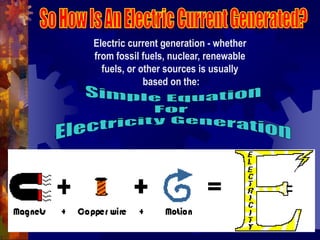
Electric current generation - whether
from fossil fuels, nuclear, renewable
fuels, or other sources is usually
based on the:
In September of 1831, Michael Faraday
made the discovery of Electromagnetic Induction.
Faraday attached two wires to a disc and
rotated the disc between the opposing
poles of a horseshoe magnet creating
an electric current.
An electric current is not generated unless the magnetic field is moving
relative to the copper wire, or the copper wire is moving relative to the
magnetic field.
If you place a magnet and a conductor (copper wire), in a room together
there will be no electric current generated.
This is because motion, from our equation for electricity, is missing!
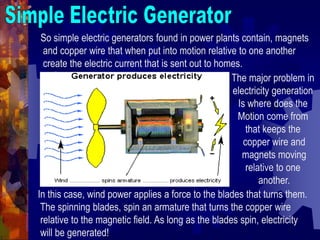
So simple electric generators found in power plants contain, magnets
and copper wire that when put into motion relative to one another
create the electric current that is sent out to homes.
The major problem in
electricity generation
Is where does the
Motion come from
that keeps the
copper wire and
magnets moving
relative to one
another.
In this case, wind power applies a force to the blades that turns them.
The spinning blades, spin an armature that turns the copper wire
relative to the magnetic field. As long as the blades spin, electricity
will be generated!
- AC of 60 Hz produced by generator
- Resistance losses are smallest at high voltages and low currents
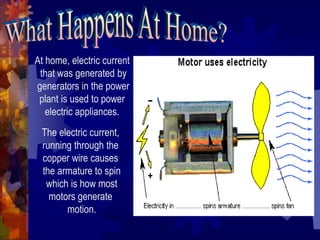
At home, electric current
that was generated by
generators in the power
plant is used to power
electric appliances.
The electric current,
running through the
copper wire causes
the armature to spin
which is how most
motors generate
motion.
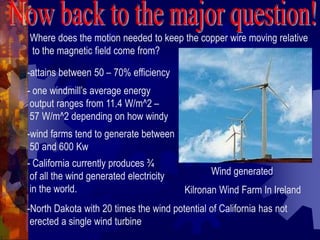
Where does the motion needed to keep the copper wire moving relative
to the magnetic field come from?
Wind generated
Kilronan Wind Farm In Ireland
-attains between 50 – 70% efficiency
- one windmill’s average energy
output ranges from 11.4 W/m^2 –
57 W/m^2 depending on how windy
-wind farms tend to generate between
50 and 600 Kw
- California currently produces ž
of all the wind generated electricity
in the world.
-North Dakota with 20 times the wind potential of California has not
erected a single wind turbine
Wind power classes 3 (300-400 W/m2) to 7 (800-2000 W/m2) are suitable
for wind power development
-Wind variability must be overcome by system design
- Basic energy Storage
- Differences in pressure gradients around wind turbines affect birds
-Noise from the turbines affects people and animals
-Eyesore, the appearance of mile after mile of wind machines with
transmission lines is of concern to the public
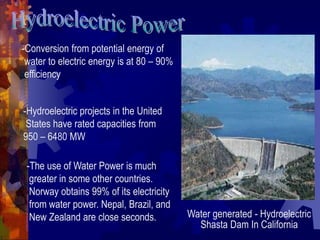
Water generated - Hydroelectric
Shasta Dam In California
-Conversion from potential energy of
water to electric energy is at 80 – 90%
efficiency
-Hydroelectric projects in the United
States have rated capacities from
950 – 6480 MW
-The use of Water Power is much
greater in some other countries.
Norway obtains 99% of its electricity
from water power. Nepal, Brazil, and
New Zealand are close seconds.
- Hydroelectricity has dropped from producing 30 % to 10% of US electricity
- Large fluctuations in output are mainly due to variable rainfall totals
-About 50% of the United States potential for hydroelectric energy has been
tapped. However, further advances are unlikely.
-The Wild and Scenic River Act and the Endangered Species Act have
inhibited development of some sites
-Silt collection in hydroelectric Dam storage volumes over time causes
maintenance issues, as well as environmental concerns
-The loss of free flowing streams and land due to flooding behind the dam
disturbs the life of species: eg – Salmon
- Possibility of dam failure
Fossil Fuels – Oil Refinery
Pasadena - Texas
Standard Large Power Plants Provide 1 Giga-watt of electric power
and releases 2 Giga-watts of thermal power as waste heat. An
efficiency averaging around 30%.
-9000 tons of coal a day
-40,000 barrels a day or one tanker a week of oil
-generates about 5.3 x 10^9 kwh/year
-powers a city of a million people
Oil Drilling Platform
Cook Inlet, Alaska
-total world production in 1996 of
petroleum is 62,239e3 barrels / day
-an average well in the US produces
only 11 barrels / day
-In Saudi Arabia an average well
produces 9600 barrels /day
Nuclear Power
Diablo Canyon - California
-Plant electrical output 1220 MW
-Plant efficiency 34%
-There are 109 power reactors in the United States
-Produce 22% of nation’s electricity
- In France 79% of electricity comes from nuclear reactors
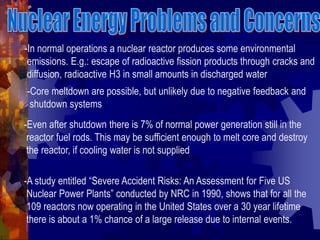
-In normal operations a nuclear reactor produces some environmental
emissions. E.g.: escape of radioactive fission products through cracks and
diffusion, radioactive H3 in small amounts in discharged water
-Core meltdown are possible, but unlikely due to negative feedback and
shutdown systems
-Even after shutdown there is 7% of normal power generation still in the
reactor fuel rods. This may be sufficient enough to melt core and destroy
the reactor, if cooling water is not supplied
-A study entitled “Severe Accident Risks: An Assessment for Five US
Nuclear Power Plants” conducted by NRC in 1990, shows that for all the
109 reactors now operating in the United States over a 30 year lifetime
there is about a 1% chance of a large release due to internal events.
-Solar Power – uses the sun energy to either boil water or directly converts
solar energy to electrical energy
-Ocean Thermal Energy Conversion – uses temperature differences
between different depths of ocean water to drive a heat engine. Working
fluid is ammonia which is gas at room temperature.
-Biomass Energy: Municipal Solid Waste – burning wastes to drive heat
engines
-Geothermal Energy – based on naturally occurring heat in the Earth in the
Earth due to radioactive decay
-Tidal Energy – uses the gravitational pull of the moon on our oceans to
drive turbines
Proportion of World’s energy
consumption - 1997
Proportion of the world’s
Electricity generation - 1997
Energy Generation.ppt

Energy Generation.ppt

  • 2.
    Electricity by definitionis electric current that is used as a power source! This electric current is generated in a power plant, and then sent out over a power grid to your homes, and ultimately to your power outlets.
  • 3.
    The movement ofcharges such as electrons is called current, and this electrical current is what powers household appliances. Electric Current = Charge Passing Through A Given Area ------------------------------- Time
  • 4.
    An easier wayto think of electric current is to picture cars going through a Turnpike or Parkway Toll. The cars could represent electrons or charge, and the toll booth could represent the cross sectional area of the wire at a certain point. If you counted the number of cars or electrons, that passed through the toll booth or a certain cross sectional area of the wire, and divided that number by the time it took for those cars or charges to pass, you would get the current!
  • 5.
    Electric current generation- whether from fossil fuels, nuclear, renewable fuels, or other sources is usually based on the:
  • 6.
    In September of1831, Michael Faraday made the discovery of Electromagnetic Induction. Faraday attached two wires to a disc and rotated the disc between the opposing poles of a horseshoe magnet creating an electric current.
  • 7.
    An electric currentis not generated unless the magnetic field is moving relative to the copper wire, or the copper wire is moving relative to the magnetic field. If you place a magnet and a conductor (copper wire), in a room together there will be no electric current generated. This is because motion, from our equation for electricity, is missing!
  • 8.
    So simple electricgenerators found in power plants contain, magnets and copper wire that when put into motion relative to one another create the electric current that is sent out to homes. The major problem in electricity generation Is where does the Motion come from that keeps the copper wire and magnets moving relative to one another. In this case, wind power applies a force to the blades that turns them. The spinning blades, spin an armature that turns the copper wire relative to the magnetic field. As long as the blades spin, electricity will be generated!
  • 9.
    - AC of60 Hz produced by generator - Resistance losses are smallest at high voltages and low currents
  • 10.
    At home, electriccurrent that was generated by generators in the power plant is used to power electric appliances. The electric current, running through the copper wire causes the armature to spin which is how most motors generate motion.
  • 11.
    Where does themotion needed to keep the copper wire moving relative to the magnetic field come from? Wind generated Kilronan Wind Farm In Ireland -attains between 50 – 70% efficiency - one windmill’s average energy output ranges from 11.4 W/m^2 – 57 W/m^2 depending on how windy -wind farms tend to generate between 50 and 600 Kw - California currently produces ¾ of all the wind generated electricity in the world. -North Dakota with 20 times the wind potential of California has not erected a single wind turbine
  • 12.
    Wind power classes3 (300-400 W/m2) to 7 (800-2000 W/m2) are suitable for wind power development
  • 13.
    -Wind variability mustbe overcome by system design - Basic energy Storage - Differences in pressure gradients around wind turbines affect birds -Noise from the turbines affects people and animals -Eyesore, the appearance of mile after mile of wind machines with transmission lines is of concern to the public
  • 14.
    Water generated -Hydroelectric Shasta Dam In California -Conversion from potential energy of water to electric energy is at 80 – 90% efficiency -Hydroelectric projects in the United States have rated capacities from 950 – 6480 MW -The use of Water Power is much greater in some other countries. Norway obtains 99% of its electricity from water power. Nepal, Brazil, and New Zealand are close seconds.
  • 16.
    - Hydroelectricity hasdropped from producing 30 % to 10% of US electricity - Large fluctuations in output are mainly due to variable rainfall totals
  • 17.
    -About 50% ofthe United States potential for hydroelectric energy has been tapped. However, further advances are unlikely. -The Wild and Scenic River Act and the Endangered Species Act have inhibited development of some sites -Silt collection in hydroelectric Dam storage volumes over time causes maintenance issues, as well as environmental concerns -The loss of free flowing streams and land due to flooding behind the dam disturbs the life of species: eg – Salmon - Possibility of dam failure
  • 18.
    Fossil Fuels –Oil Refinery Pasadena - Texas Standard Large Power Plants Provide 1 Giga-watt of electric power and releases 2 Giga-watts of thermal power as waste heat. An efficiency averaging around 30%. -9000 tons of coal a day -40,000 barrels a day or one tanker a week of oil -generates about 5.3 x 10^9 kwh/year -powers a city of a million people
  • 20.
    Oil Drilling Platform CookInlet, Alaska -total world production in 1996 of petroleum is 62,239e3 barrels / day -an average well in the US produces only 11 barrels / day -In Saudi Arabia an average well produces 9600 barrels /day
  • 23.
    Nuclear Power Diablo Canyon- California -Plant electrical output 1220 MW -Plant efficiency 34% -There are 109 power reactors in the United States -Produce 22% of nation’s electricity - In France 79% of electricity comes from nuclear reactors
  • 25.
    -In normal operationsa nuclear reactor produces some environmental emissions. E.g.: escape of radioactive fission products through cracks and diffusion, radioactive H3 in small amounts in discharged water -Core meltdown are possible, but unlikely due to negative feedback and shutdown systems -Even after shutdown there is 7% of normal power generation still in the reactor fuel rods. This may be sufficient enough to melt core and destroy the reactor, if cooling water is not supplied -A study entitled “Severe Accident Risks: An Assessment for Five US Nuclear Power Plants” conducted by NRC in 1990, shows that for all the 109 reactors now operating in the United States over a 30 year lifetime there is about a 1% chance of a large release due to internal events.
  • 26.
    -Solar Power –uses the sun energy to either boil water or directly converts solar energy to electrical energy -Ocean Thermal Energy Conversion – uses temperature differences between different depths of ocean water to drive a heat engine. Working fluid is ammonia which is gas at room temperature. -Biomass Energy: Municipal Solid Waste – burning wastes to drive heat engines -Geothermal Energy – based on naturally occurring heat in the Earth in the Earth due to radioactive decay -Tidal Energy – uses the gravitational pull of the moon on our oceans to drive turbines
  • 27.
    Proportion of World’senergy consumption - 1997 Proportion of the world’s Electricity generation - 1997