MOTOR CONTROL
Dr. Shweta Kotwani; Pediatric Physical Therapist
BPTh (MUHS); MPT (Neuro,MUHS); LASHS-U.K. Fellowship Dip.(Peds.Rehab.; Clinical
Neuro.Sc.)
OBJECTIVES
• What is motor control?
• Understanding the nature of the movement
• Factors within the individual that will constrain the movement
• Task constraints on movement
• Environmental constraints on movement
What is Motor Control?
•Motor Control is defined as the ability to regulate or
direct the mechanisms essential to movement.
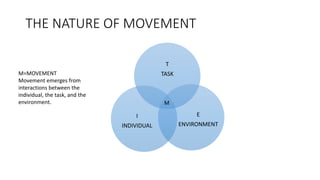
THE NATURE OF MOVEMENT
T
TASK
E
ENVIRONMENT
I
INDIVIDUAL
M
M=MOVEMENT
Movement emerges from
interactions between the
individual, the task, and the
environment.
THE NATURE OF MOVEMENT
• Movement is organized around both task and environmental
demands.
• The individual generates movement to meet the demands of the task
being performed within a specific environment.
• The individual’s capacity to meet interacting task and environmental
demands determines that person’s functional capability.
Factors within the individual that constrain
movement
• PERCEPTION
• ACTION
• COGNITION
T
EIC
Cognition
A
Action
P
Perception
Mobility
ManipulationStability
Regulatory
Non-
regulatory
M
• Factors within the individual, the
task and the environment affect
the organization of movement.
• Factors within the individual
include the interaction of
perception, cognition, and action
(motor) systems.
• Environmental constraints on
movement are divided into
regulatory and non-regulatory
factors.
• Finally, attributes of the task
contribute to the organization of
functional movement.
Movement and Action
• Movement is often described within the context of accomplishing a particular
action.
• Motor control is usually studied in relation to specific actions or activities. Eg.
Walking
• Understanding the control of action implies understanding the motor output
from the nervous system to the body’s effector systems, or muscles.
• The body is characterized by a high number of muscles and joints, all of which
must be controlled during the execution of co-ordinated, functional movement.
Movement and Perception
• Perception is essential to Action, just as Action is essential to Perception.
• It is the integration of sensory impressions into psychologically meaningful information.
• Perception includes-
a) Peripheral sensory mechanisms
b) Higher-level processing; that adds interpretation and meaning to incoming afferent
information
• Sensory/Perceptual systems provide information about the state of the body (Eg. Position of
different body parts in space) and features within the environment critical to the regulation of
movement.
Movement and Cognition
• Movement is not usually performed in the absence of intent, cognitive
processes are essential to motor control.
• Cognitive processes broadly to include attention, planning, problem
solving, motivation, and emotional aspects of motor control that underlie
the establishment of intent or goals.
• Motor control includes perception and action systems that are organized to
achieve specific goals or intents.
TASK CONSTRAINTS ON MOVEMENT
• The nature of the task being performed determines the type of movement
needed.
• Grouping tasks- bed mobility tasks, transfer tasks, ADL’s
• Discrete movement tasks vs Continuous movements
• Stability vs Mobility tasks
• Manipulation component
• Open movement tasks vs Close movement tasks
ENVIRONMENTAL CONSTRAINTS ON
MOVEMENT
• Tasks are performed in a wide range of environments.
• Regulatory and Non-regulatory features
• Features of the environment can in some instances enable or support
performance, or alternatively, may disable or hinder performance.
SUMMARY
• Nature of movement is determined by interaction of three factors, the individual,
the task and the environment.
• The movement one will observe in patients is shaped not just by the factors
within the individual, such as sensory(perception), motor(action), and cognitive
impairments, but also by the attributes of the task being performed and the
environment in which the individual is moving.
REFERENCES
• MOTOR CONTROL, Translating Research into Clinical Practice; Fourth
Edition, Anne Shumway Cook and Marjorie H. Woollacott.
THANK YOU

Motor Control

  • 1.
    MOTOR CONTROL Dr. ShwetaKotwani; Pediatric Physical Therapist BPTh (MUHS); MPT (Neuro,MUHS); LASHS-U.K. Fellowship Dip.(Peds.Rehab.; Clinical Neuro.Sc.)
  • 2.
    OBJECTIVES • What ismotor control? • Understanding the nature of the movement • Factors within the individual that will constrain the movement • Task constraints on movement • Environmental constraints on movement
  • 3.
    What is MotorControl? •Motor Control is defined as the ability to regulate or direct the mechanisms essential to movement.
  • 4.
    THE NATURE OFMOVEMENT T TASK E ENVIRONMENT I INDIVIDUAL M M=MOVEMENT Movement emerges from interactions between the individual, the task, and the environment.
  • 5.
    THE NATURE OFMOVEMENT • Movement is organized around both task and environmental demands. • The individual generates movement to meet the demands of the task being performed within a specific environment. • The individual’s capacity to meet interacting task and environmental demands determines that person’s functional capability.
  • 6.
    Factors within theindividual that constrain movement • PERCEPTION • ACTION • COGNITION
  • 7.
    T EIC Cognition A Action P Perception Mobility ManipulationStability Regulatory Non- regulatory M • Factors withinthe individual, the task and the environment affect the organization of movement. • Factors within the individual include the interaction of perception, cognition, and action (motor) systems. • Environmental constraints on movement are divided into regulatory and non-regulatory factors. • Finally, attributes of the task contribute to the organization of functional movement.
  • 8.
    Movement and Action •Movement is often described within the context of accomplishing a particular action. • Motor control is usually studied in relation to specific actions or activities. Eg. Walking • Understanding the control of action implies understanding the motor output from the nervous system to the body’s effector systems, or muscles. • The body is characterized by a high number of muscles and joints, all of which must be controlled during the execution of co-ordinated, functional movement.
  • 9.
    Movement and Perception •Perception is essential to Action, just as Action is essential to Perception. • It is the integration of sensory impressions into psychologically meaningful information. • Perception includes- a) Peripheral sensory mechanisms b) Higher-level processing; that adds interpretation and meaning to incoming afferent information • Sensory/Perceptual systems provide information about the state of the body (Eg. Position of different body parts in space) and features within the environment critical to the regulation of movement.
  • 10.
    Movement and Cognition •Movement is not usually performed in the absence of intent, cognitive processes are essential to motor control. • Cognitive processes broadly to include attention, planning, problem solving, motivation, and emotional aspects of motor control that underlie the establishment of intent or goals. • Motor control includes perception and action systems that are organized to achieve specific goals or intents.
  • 11.
    TASK CONSTRAINTS ONMOVEMENT • The nature of the task being performed determines the type of movement needed. • Grouping tasks- bed mobility tasks, transfer tasks, ADL’s • Discrete movement tasks vs Continuous movements • Stability vs Mobility tasks • Manipulation component • Open movement tasks vs Close movement tasks
  • 12.
    ENVIRONMENTAL CONSTRAINTS ON MOVEMENT •Tasks are performed in a wide range of environments. • Regulatory and Non-regulatory features • Features of the environment can in some instances enable or support performance, or alternatively, may disable or hinder performance.
  • 13.
    SUMMARY • Nature ofmovement is determined by interaction of three factors, the individual, the task and the environment. • The movement one will observe in patients is shaped not just by the factors within the individual, such as sensory(perception), motor(action), and cognitive impairments, but also by the attributes of the task being performed and the environment in which the individual is moving.
  • 14.
    REFERENCES • MOTOR CONTROL,Translating Research into Clinical Practice; Fourth Edition, Anne Shumway Cook and Marjorie H. Woollacott.
  • 15.