Motor Control
Activity:
Bring Me!
Introduction
– According to Roller et al (2012) the production and control of
human movement is a process that varies from a simple reflex
loop to a complex network of neural patterns that communicate
throughout the Central Nervous System (CNS) and Peripheral
Nervous System (PNS).
– New motor patterns are learned through movement, interactions
with rich sensory environments, and challenging experiences that
challenge a person to solve problems they encounter. The
knowledge about motor control and motor learning shape our
understanding of how individuals progress from novice to skilled
motor performance throughout the lifespan. This page provides
an overview about Motor Control and Motor Learning
Motor Control
defined as the process of
initiating, directing, and
grading purposeful
voluntary movement.
the ability to regulate
mechanisms essential to
movement
How does motor
control works?
The task that needs to be completed is
identified→ body gathers sensory
information from the environment→
perceives the information→ chooses a
movement plan appropriate plan to meet
the goal of the task
1
2
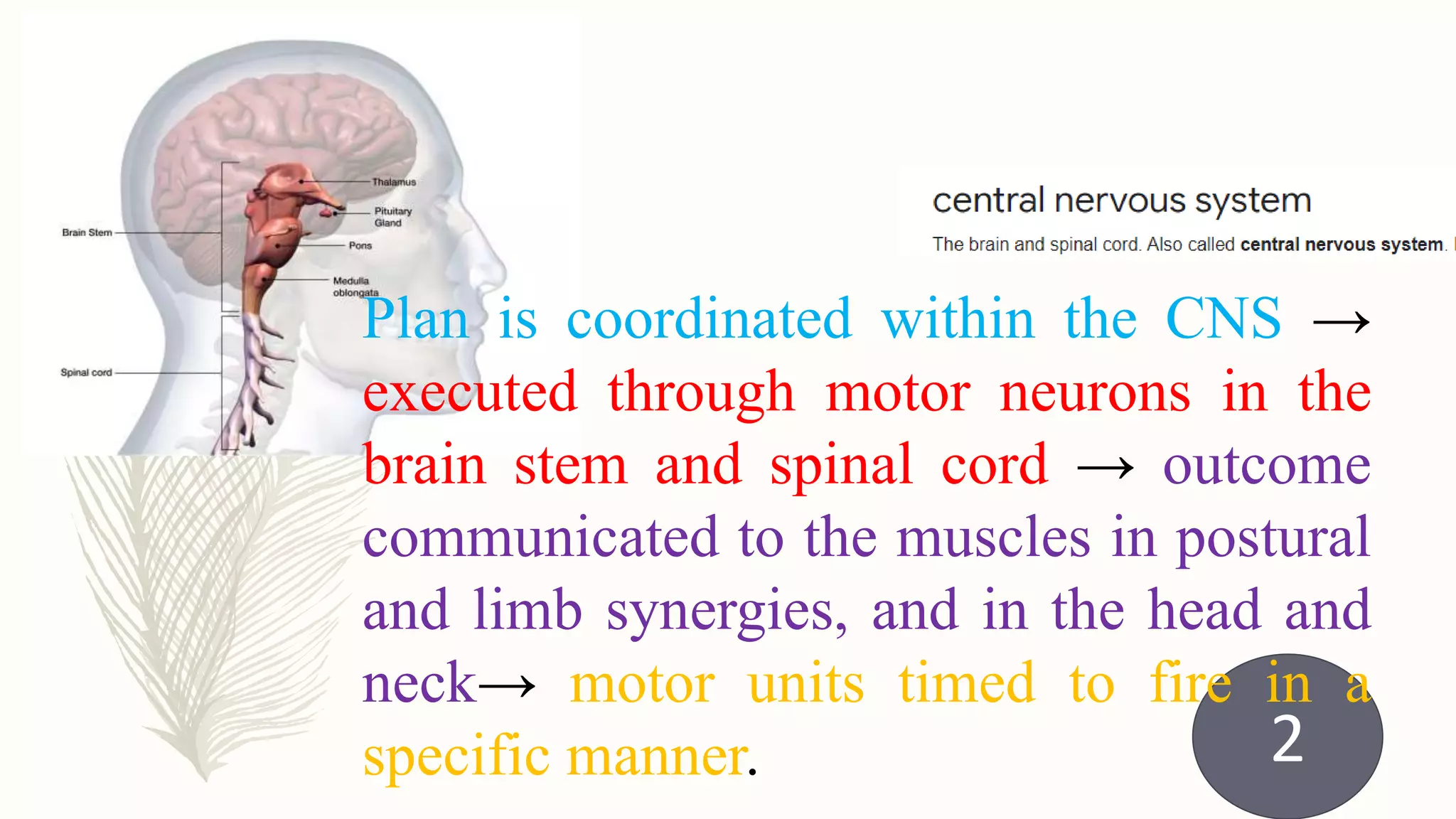
Plan is coordinated within the CNS →
executed through motor neurons in the
brain stem and spinal cord → outcome
communicated to the muscles in postural
and limb synergies, and in the head and
neck→ motor units timed to fire in a
specific manner.
3
Sensory feedback supplied to the CNS by
the movement → decision taken to (1)
modify the plan during execution, (2)
acknowledge the goal of the task to be
achieved, and (3) store the information for
future performance of the same task-goal
combination
Theories of Motor Control
Motor Control Theories include the production of reflexive,
automatic, adaptive, and voluntary movements and the
performance of efficient, coordinated, goal-directed movement
patterns which involve multiple body systems (input, output,
and central processing) and multiple levels within the nervous
system.
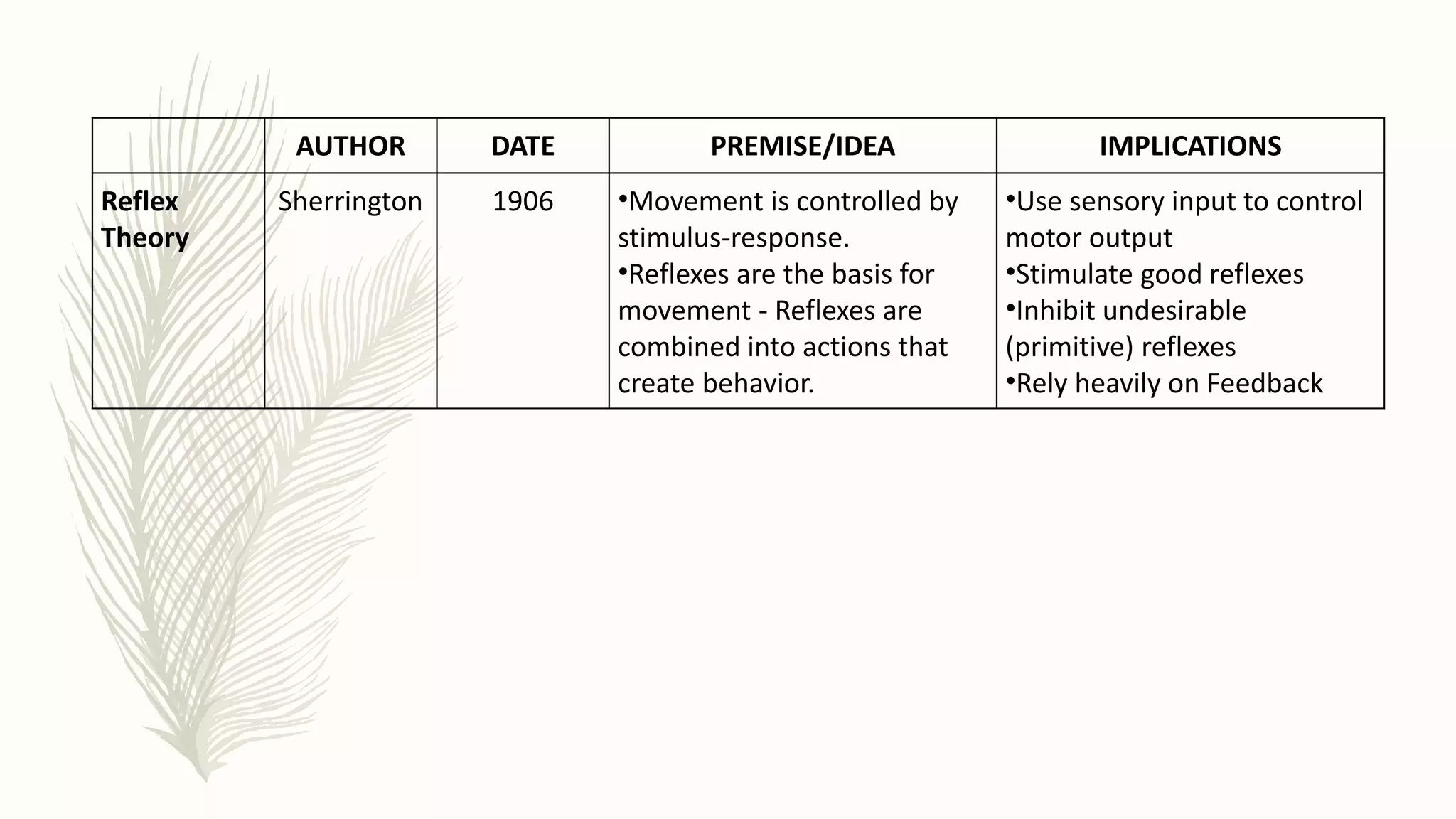
AUTHOR DATE PREMISE/IDEA IMPLICATIONS
Reflex
Theory
Sherrington 1906 •Movement is controlled by
stimulus-response.
•Reflexes are the basis for
movement - Reflexes are
combined into actions that
create behavior.
•Use sensory input to control
motor output
•Stimulate good reflexes
•Inhibit undesirable
(primitive) reflexes
•Rely heavily on Feedback
Dynamical
Systems Theory
Bernstein
Turvey
Kelso & Tuller
Thelen
1967
1977
1984
1987
•Movement emerges to control
degrees of freedom.
•Patterns of movements self-organize
within the characteristics of
environmental conditions and the
existing body systems of the
individual.
•Functional synergies are developed
naturally through practice and
experience and help solve the
problem of coordinating multiple
muscles and joint movements at
once.
•De-emphasize commands from CNS
in controlling movement and
emphasize physical explanations for
movement.
•Movement is an emergent property
from the interaction of multiple
elements.
•Understand the physical & dynamic
properties of the body - i.e., Velocity-
important for dynamics of movement.
May be good to encourage faster
movement in patients to produce
momentum and therefore help weak
patients move with greater ease.
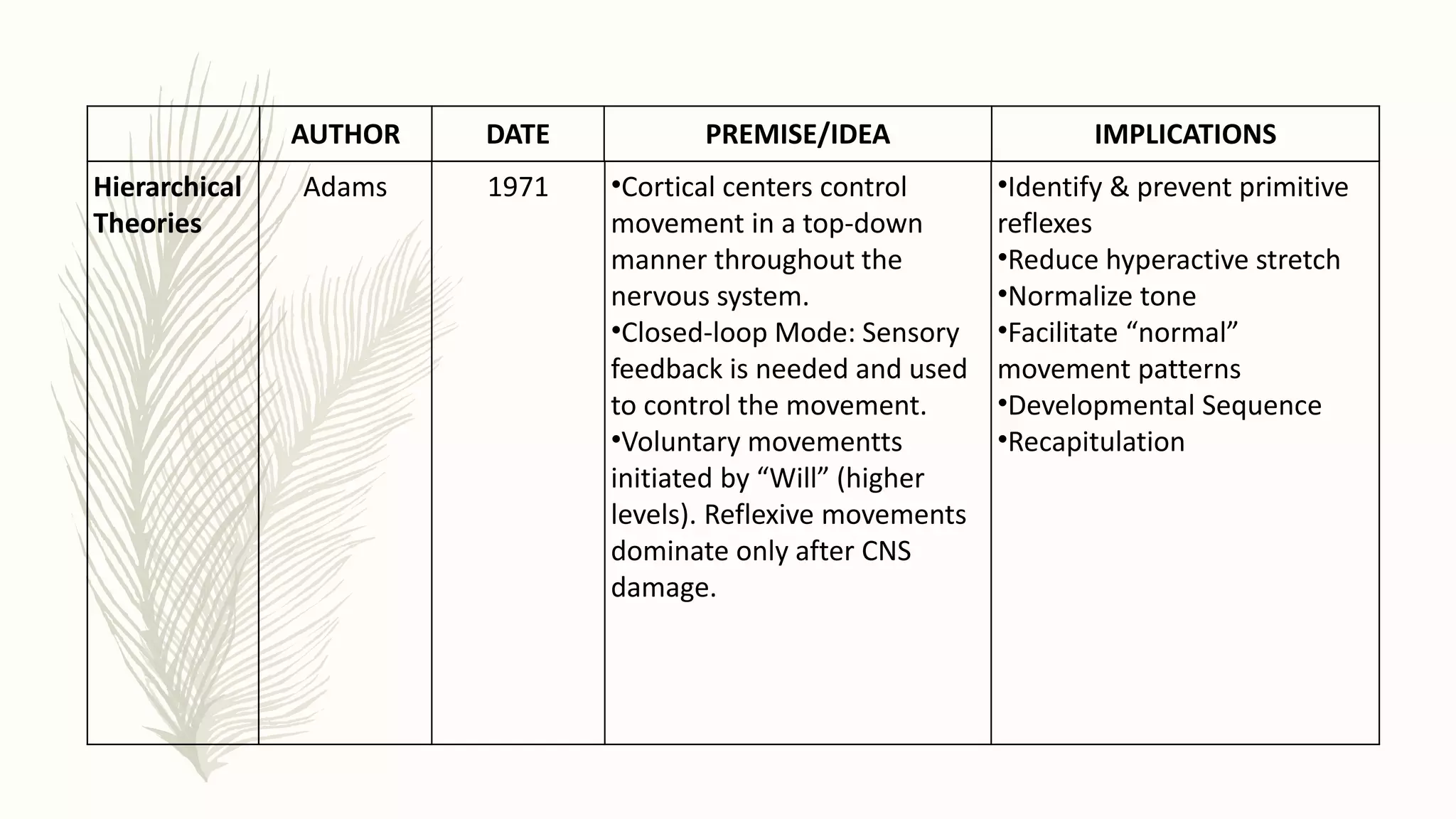
AUTHOR DATE PREMISE/IDEA IMPLICATIONS
Hierarchical
Theories
Adams 1971 •Cortical centers control
movement in a top-down
manner throughout the
nervous system.
•Closed-loop Mode: Sensory
feedback is needed and used
to control the movement.
•Voluntary movementts
initiated by “Will” (higher
levels). Reflexive movements
dominate only after CNS
damage.
•Identify & prevent primitive
reflexes
•Reduce hyperactive stretch
•Normalize tone
•Facilitate “normal”
movement patterns
•Developmental Sequence
•Recapitulation
AUTHOR DATE PREMISE/IDEA IMPLICATIONS
Motor
Program
Theory
Schmidt 1976 •Adaptive, exile motor
programs (MPs) and
generalized motor programs
(GMPs) exist to control
actions that have common
characteristics.
•Higher-level Motor Programs
- Store rules for generating
movements.
•Abnormal Movement - Not
just reflexive, also including
abnormalities in central
pattern generators or higher-
level motor programs.
•Help patients relearn the
correct rules for action
•Retrain movements
important to functional task
•Do not just reeducate
muscles in isolation
Ecological
Theories
Gibson &
Pick
2000 •The person, the task, and the
environment interact to
influence motor behavior and
learning. The interaction of
the person with any given
environment provides
perceptual information used
to control movement.
•The motivation to solve
problems to accomplish a
desired movement task goal
facilitates learning.
•Help patient explore multiple
ways in achieving functional
task → Discovering best
solution for patient, given the
set of limitations
AUTHOR DATE PREMISE/IDEA IMPLICATIONS
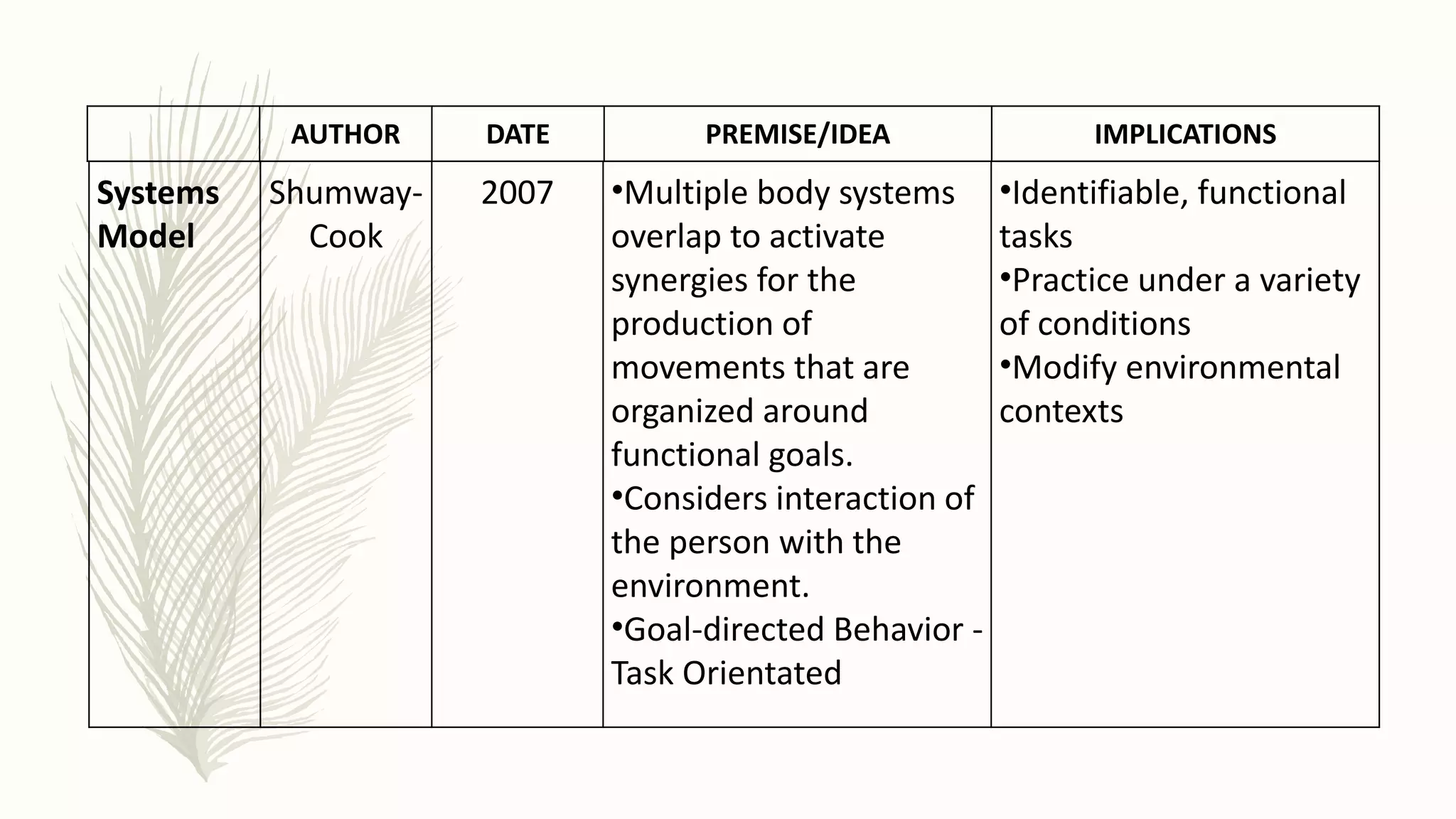
Systems
Model
Shumway-
Cook
2007 •Multiple body systems
overlap to activate
synergies for the
production of
movements that are
organized around
functional goals.
•Considers interaction of
the person with the
environment.
•Goal-directed Behavior -
Task Orientated
•Identifiable, functional
tasks
•Practice under a variety
of conditions
•Modify environmental
contexts
AUTHOR DATE PREMISE/IDEA IMPLICATIONS
For asynchronous class (Wednesday)
1. Choose one in the
following household
chores:
– Washing the dishes
– Sweeping the floor
– Folding the clothes
– Cleaning the house
– Wiping the walls
2. Record a one minute video of
you doing your chosen chore.
3. Make a narrative written
report describing how your body
works in doing the household
chore. Include one or more
motor control theory that you
can relate on it.
Motor Control and Learning - Physiopedia (physio-pedia.com)
Reference:

Motor Control.pptx

  • 1.
  • 2.
  • 3.
    Introduction – According toRoller et al (2012) the production and control of human movement is a process that varies from a simple reflex loop to a complex network of neural patterns that communicate throughout the Central Nervous System (CNS) and Peripheral Nervous System (PNS). – New motor patterns are learned through movement, interactions with rich sensory environments, and challenging experiences that challenge a person to solve problems they encounter. The knowledge about motor control and motor learning shape our understanding of how individuals progress from novice to skilled motor performance throughout the lifespan. This page provides an overview about Motor Control and Motor Learning
  • 4.
    Motor Control defined asthe process of initiating, directing, and grading purposeful voluntary movement. the ability to regulate mechanisms essential to movement
  • 5.
  • 6.
    The task thatneeds to be completed is identified→ body gathers sensory information from the environment→ perceives the information→ chooses a movement plan appropriate plan to meet the goal of the task 1
  • 7.
    2 Plan is coordinatedwithin the CNS → executed through motor neurons in the brain stem and spinal cord → outcome communicated to the muscles in postural and limb synergies, and in the head and neck→ motor units timed to fire in a specific manner.
  • 9.
    3 Sensory feedback suppliedto the CNS by the movement → decision taken to (1) modify the plan during execution, (2) acknowledge the goal of the task to be achieved, and (3) store the information for future performance of the same task-goal combination
  • 10.
    Theories of MotorControl Motor Control Theories include the production of reflexive, automatic, adaptive, and voluntary movements and the performance of efficient, coordinated, goal-directed movement patterns which involve multiple body systems (input, output, and central processing) and multiple levels within the nervous system.
  • 11.
    AUTHOR DATE PREMISE/IDEAIMPLICATIONS Reflex Theory Sherrington 1906 •Movement is controlled by stimulus-response. •Reflexes are the basis for movement - Reflexes are combined into actions that create behavior. •Use sensory input to control motor output •Stimulate good reflexes •Inhibit undesirable (primitive) reflexes •Rely heavily on Feedback
  • 12.
    Dynamical Systems Theory Bernstein Turvey Kelso &Tuller Thelen 1967 1977 1984 1987 •Movement emerges to control degrees of freedom. •Patterns of movements self-organize within the characteristics of environmental conditions and the existing body systems of the individual. •Functional synergies are developed naturally through practice and experience and help solve the problem of coordinating multiple muscles and joint movements at once. •De-emphasize commands from CNS in controlling movement and emphasize physical explanations for movement. •Movement is an emergent property from the interaction of multiple elements. •Understand the physical & dynamic properties of the body - i.e., Velocity- important for dynamics of movement. May be good to encourage faster movement in patients to produce momentum and therefore help weak patients move with greater ease. AUTHOR DATE PREMISE/IDEA IMPLICATIONS
  • 13.
    Hierarchical Theories Adams 1971 •Corticalcenters control movement in a top-down manner throughout the nervous system. •Closed-loop Mode: Sensory feedback is needed and used to control the movement. •Voluntary movementts initiated by “Will” (higher levels). Reflexive movements dominate only after CNS damage. •Identify & prevent primitive reflexes •Reduce hyperactive stretch •Normalize tone •Facilitate “normal” movement patterns •Developmental Sequence •Recapitulation AUTHOR DATE PREMISE/IDEA IMPLICATIONS
  • 14.
    AUTHOR DATE PREMISE/IDEAIMPLICATIONS Motor Program Theory Schmidt 1976 •Adaptive, exile motor programs (MPs) and generalized motor programs (GMPs) exist to control actions that have common characteristics. •Higher-level Motor Programs - Store rules for generating movements. •Abnormal Movement - Not just reflexive, also including abnormalities in central pattern generators or higher- level motor programs. •Help patients relearn the correct rules for action •Retrain movements important to functional task •Do not just reeducate muscles in isolation
  • 15.
    Ecological Theories Gibson & Pick 2000 •Theperson, the task, and the environment interact to influence motor behavior and learning. The interaction of the person with any given environment provides perceptual information used to control movement. •The motivation to solve problems to accomplish a desired movement task goal facilitates learning. •Help patient explore multiple ways in achieving functional task → Discovering best solution for patient, given the set of limitations AUTHOR DATE PREMISE/IDEA IMPLICATIONS
  • 16.
    Systems Model Shumway- Cook 2007 •Multiple bodysystems overlap to activate synergies for the production of movements that are organized around functional goals. •Considers interaction of the person with the environment. •Goal-directed Behavior - Task Orientated •Identifiable, functional tasks •Practice under a variety of conditions •Modify environmental contexts AUTHOR DATE PREMISE/IDEA IMPLICATIONS
  • 17.
    For asynchronous class(Wednesday) 1. Choose one in the following household chores: – Washing the dishes – Sweeping the floor – Folding the clothes – Cleaning the house – Wiping the walls 2. Record a one minute video of you doing your chosen chore. 3. Make a narrative written report describing how your body works in doing the household chore. Include one or more motor control theory that you can relate on it.
  • 18.
    Motor Control andLearning - Physiopedia (physio-pedia.com) Reference: