














The reason people do what they do. It is an
internal drive that encourages us to achieve
a particular goal.
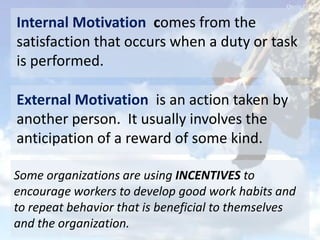
External Motivation is an action taken by
another person. It usually involves the
anticipation of a reward of some kind.
Internal Motivation comes from the
satisfaction that occurs when a duty or task
is performed.
Some organizations are using INCENTIVES to
encourage workers to develop good work habits and
to repeat behavior that is beneficial to themselves
and the organization.
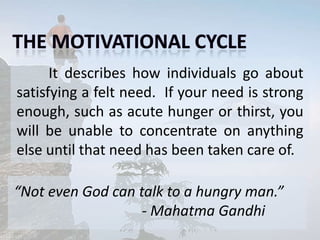
It describes how individuals go about
satisfying a felt need. If your need is strong
enough, such as acute hunger or thirst, you
will be unable to concentrate on anything
else until that need has been taken care of.
“Not even God can talk to a hungry man.”
- Mahatma Gandhi
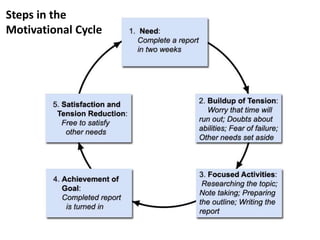
Steps in the
Motivational Cycle
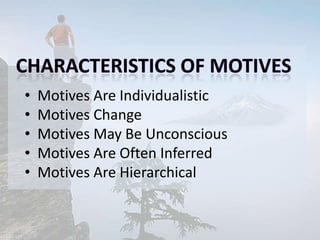
• Motives Are Individualistic
• Motives Change
• Motives May Be Unconscious
• Motives Are Often Inferred
• Motives Are Hierarchical
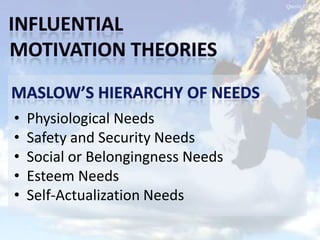
• Physiological Needs
• Safety and Security Needs
• Social or Belongingness Needs
• Esteem Needs
• Self-Actualization Needs
Maintenance Factors represent the basic
things people consider essential to any job,
such as salaries, fringe benefits, working
conditions, social relationships, supervision,
and organizational policies and
administration.
Motivational Factors are benefits above
and beyond the basic elements of job.
These benefits tend to increase employee
satisfaction – employees like to feel they are
getting something beyond a paycheck for
their time and effort at work.
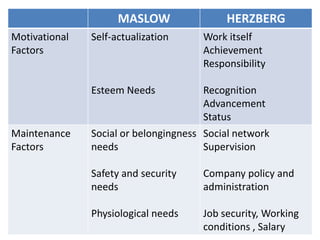
MASLOW HERZBERG
Motivational
Factors
Self-actualization
Esteem Needs
Work itself
Achievement
Responsibility
Recognition
Advancement
Status
Maintenance
Factors
Social or belongingness
needs
Safety and security
needs
Physiological needs
Social network
Supervision
Company policy and
administration
Job security, Working
conditions , Salary
Theory X: A Pessimistic View. According to
this theory, people do not really want to
work – they have to be pushed, closely
supervised, and prodded into doing things,
either with incentives such as pay or with
punishments for not working.
Theory Y: An Optimistic View. According to
this theory, work is natural to people as play
or rest. People are capable of self-direction
and can learn to both accept and seek
responsibility if they are committed to the
objectives of the organization.
Self-Fulfilling Prophecy – power of
expectations; reflects a connection between
your expectations for yourself and your
resulting behavior.
“Our lives are shaped not as much by our
experience, as by our expectations.”
- George Bernard Shaw
• Job Rotation
• Job Enlargement
• Job Enrichment
• Training and Education
Empowerment – means those efforts
made to move authority and
responsibility to the lowest ranks of the
organization.
• Take control of your expectations
• Fight the urge to underachieve
• Learn to love the job you hate
• Build immunity to cynicism
• Strive for balance
Motivating yourself and others

Motivating yourself and others

  • 5.
    The reason peopledo what they do. It is an internal drive that encourages us to achieve a particular goal.
  • 6.
    External Motivation isan action taken by another person. It usually involves the anticipation of a reward of some kind. Internal Motivation comes from the satisfaction that occurs when a duty or task is performed. Some organizations are using INCENTIVES to encourage workers to develop good work habits and to repeat behavior that is beneficial to themselves and the organization.
  • 7.
    It describes howindividuals go about satisfying a felt need. If your need is strong enough, such as acute hunger or thirst, you will be unable to concentrate on anything else until that need has been taken care of. “Not even God can talk to a hungry man.” - Mahatma Gandhi
  • 8.
  • 9.
    • Motives AreIndividualistic • Motives Change • Motives May Be Unconscious • Motives Are Often Inferred • Motives Are Hierarchical
  • 10.
    • Physiological Needs •Safety and Security Needs • Social or Belongingness Needs • Esteem Needs • Self-Actualization Needs
  • 12.
    Maintenance Factors representthe basic things people consider essential to any job, such as salaries, fringe benefits, working conditions, social relationships, supervision, and organizational policies and administration.
  • 13.
    Motivational Factors arebenefits above and beyond the basic elements of job. These benefits tend to increase employee satisfaction – employees like to feel they are getting something beyond a paycheck for their time and effort at work.
  • 14.
    MASLOW HERZBERG Motivational Factors Self-actualization Esteem Needs Workitself Achievement Responsibility Recognition Advancement Status Maintenance Factors Social or belongingness needs Safety and security needs Physiological needs Social network Supervision Company policy and administration Job security, Working conditions , Salary
  • 16.
    Theory X: APessimistic View. According to this theory, people do not really want to work – they have to be pushed, closely supervised, and prodded into doing things, either with incentives such as pay or with punishments for not working.
  • 17.
    Theory Y: AnOptimistic View. According to this theory, work is natural to people as play or rest. People are capable of self-direction and can learn to both accept and seek responsibility if they are committed to the objectives of the organization.
  • 19.
    Self-Fulfilling Prophecy –power of expectations; reflects a connection between your expectations for yourself and your resulting behavior. “Our lives are shaped not as much by our experience, as by our expectations.” - George Bernard Shaw
  • 20.
    • Job Rotation •Job Enlargement • Job Enrichment
  • 21.
    • Training andEducation Empowerment – means those efforts made to move authority and responsibility to the lowest ranks of the organization.
  • 22.
    • Take controlof your expectations • Fight the urge to underachieve • Learn to love the job you hate • Build immunity to cynicism • Strive for balance